783 résultats
1 Vol. In-8 gr pag. 262 12 ill. f.t (Disponiamo anche di edizione 1930) PROG 10519 CATT_ATT 48
Mm 160x250 B.E.F.A:R. 309. Volume cartonato di pp. 557 con 13 cartine nel testo e LVI tavole fuori testo. Opera in stato di nuovo. SPEDIZIONE IN 24 ORE DALLA CONFERMA DELL'ORDINE. WORLDWIDE DELIVERY.
159047728Venetia Venice apresso gli heredi di S. Gagliani 1590. Colophon: In Vintia appresso Giorgio Angelieri a instantia de gli heredi di Simon Gagliani de Karera 1590. Small folio. 18th century ab. 1780-90 half vellum with gilt leather title label to spine. Corners a bit bumped and title label a bit worn otherwise nice and tight. A very nice copy on thick crisp paper. A few quires browned and brownspotted and some occasional lighter browning. Four leaves with a marginal worm-tract far from affecting text. Beautiful engraved title-page consisting of a wide architectural border illustrated with large figures putti globes and various symbols. Beautiful large woodcut initials and head- and tail-pieces. 47 half-page engraved maps in the text by Porro of islands and continents excellent crisp impressions. Large woodcut device to colophon. 12 ff. 201 1 pp. <br/><br/><em>Third much enlarged edition with 47 maps as opposed to the mere 30 of the first edition of Porcacchi's great book of islands arguably the most famous of all "isolario"s with the 47 finely engraved maps by the famous map-maker Girolamo Porro which also include maps of non-insular places e.g North America and Mexico City the famous city plan of Venice and that of Constantinople. Porcachhi's great "isolario" represents the culmination of the "book of islands"-genre both in regards to artistic quality and the information provided. It furthermore constitutes a main work in the history of the published knowledge of farther parts of the world and an important link in the development from what we call the "book of islands" to the modern atlas. As such it is of great value in several respects both historically culturally and cartographically. "The "book of islands" or isolario a novel form of cartographic book combining maps and narrative-historical chorography was invented and initially developed in Italy during the fifteenth and sixteenth centuries. According to R.A. Skelton "like the portolano or pilot-book to which it was related it had its origins in the Mediterranean as an illustrated guide for travelers in the Aegean Archipelago and the Levant.". The first "book of islands" was authored by a Florentine ecclesiastic around 1420 named Cristoforo Buondelmonti .The "book of islands" was eventually superseded as a cartographic genre as was the "Geographia" of Ptolemy by the modern atlas; it persists even after Abraham Ortelius's 1570 "Theatrum orbis terrarium" but at the margins rather than at the center of the history of cartography. While the "isolario" Ptolemy's "Geographia" and the "modern" atlas coexist for some time the gradual eclipse of the "book of islands" at one level reflected a progressive decentering of the Mediterranean that occurred within the broader context of early modern history following the Atlantic discoveries. But well before that happened in conjunction with the culminating moment of the discoveries and exploration period and at the height of the high Renaissance the second printed "book of islands" appeared in 1528 in Venice published by Zoppino: the "Libro di Benedetto Bordone nel qual si ragiona de tutte l'isole del mondo" Book of Benedetto Bordone in which are discussed all the islands of the world. As the title suggests this "isolario" provided even broader coverage than the Martellus recensions of Buondelmonti and gave special prominence to the islands of the New World .Da li Sonetti's translation of Buondelmonti's "book of islands" into a cycle of sonnets in Venice represented in its way an expression of the same desire to reconcile contemporary geographical knowledge to Italian vernacular traditions of geographical poetry that Berlinghieri's poetic Ptolemy expressed. But while the tradition of Tuscan geographical poetry would not survive the Quattrocento the prose book of islands did thanks especially to the Venetian print culture that was responsible for da li Sonetti and that produced Bordone's High Renaissance print "isolario". As mentioned the print genre "book of islands" would endure in fact albeit at the margins of modern cartography and literature in multiple editions of Bordone which were followed by the no less successful Tommaso Porcacchi's "L'isole più famose del mondo" 1572; with copper-plate engravings a line that continued through the seventeenth century . But just as with other major literary fields of endeavor including the political Machiavelli the pastoral Sannazzaro the courtly-bureaucratic Castiglione and the epic-novellistic Ariosto the "isolario" produced its masterpieces in the discoveries and travel writing fieldalongside Columbus Vespucci and Verrazzano during the High Renaissance." Cachey "From the Mediterranean to the World: A Note on the Italian "Book of Islands" "isolario"" pp. 1-10. Shirley T.POR-1d; Phillips: 50. </em> hardcover
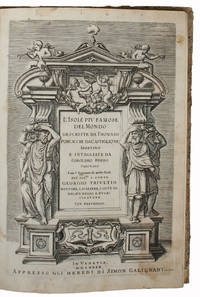
159047728Venetia [Venice], apresso gli heredi di S. Gagliani, 1590. [Colophon: In Vintia, appresso Giorgio Angelieri, a instantia de gli heredi di Simon Gagliani de Karera, 1590]. Small folio. 18th century (ab. 1780-90) half vellum with gilt leather title label to spine. Corners a bit bumped and title label a bit worn, otherwise nice and tight. A very nice copy, on thick, crisp paper. A few quires browned and brownspotted, and some occasional lighter browning. Four leaves with a marginal worm-tract, far from affecting text. Beautiful engraved title-page, consisting of a wide architectural border illustrated with large figures, putti, globes, and various symbols. Beautiful large woodcut initials and head- and tail-pieces. 47 half-page engraved maps in the text (by Porro, of islands and continents), excellent, crisp impressions. Large woodcut device to colophon. (12) ff., 201, (1) pp.
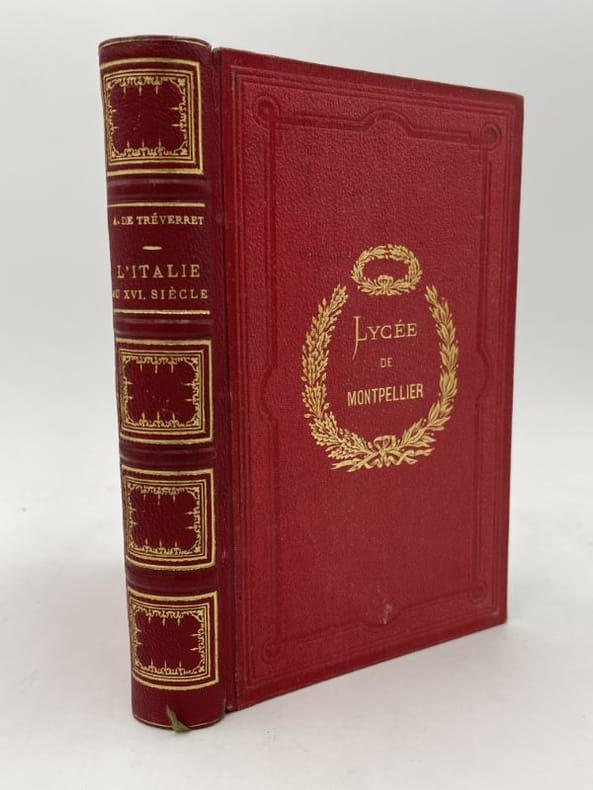
187799916139Hachette Paris Librairie Hachette 1877, In-8 demi chagrin rouge, dos à nerfs et caissons trés décorés, fer du lycée de Montpellier au 1° plat. 426 pages. Bien relié. Bel état.
Paris Librairie Hachette 1877, In-8 demi chagrin rouge, dos à nerfs et caissons trés décorés, fer du lycée de Montpellier au 1° plat. 426 pages. Bien relié. Bel état.
Arcidosso, Edizioni Effigi, 2006, in-8, br., pp. 174. Con ill. in b.n. e a col. e bibliografia. (Collana di storia e cultura locale "Genius Loci", 10). Stato di nuovo.
In 8, pp. XIX + 359 + (5). Br. ed. Atti del convegno sulla battaglia di Castiglione.
19644238Cercle du Bibliophile 1964 253 pages in8. 1964. Cartonnage editeur sous rhodoid. 253 pages. Biographie de la comtesse de Castiglione célèbre figure féminine de la cour de Napoléon III écrite par l'historien et académicien Alain Decaux. L'ouvrage retrace la vie de cette femme d'influence connue pour sa beauté et son rôle dans les milieux politiques du Second Empire
1973LFA-126716772Un ouvrage de 409 pages, format 135 x 210 mm, illustré, relié skivertex, publié en 1973, Librairie Académique Perrin, collection "Présence de l'Histoire", bon état
1981LFA-1267346162 volumes de 247 et 256 pages, format 120 x 180 mm, reliés skivertex, publiés en 1981, Editions Famot, bon état
1999LFA-126742541Un ouvrage de 409 pages, format 145 x 230 mm, illustré, broché couverture couleurs, publié en 1999, Librairie Académique Perrin, bon état
HIS513M1965 / 253 pages. Relié. Editions Club des femmes
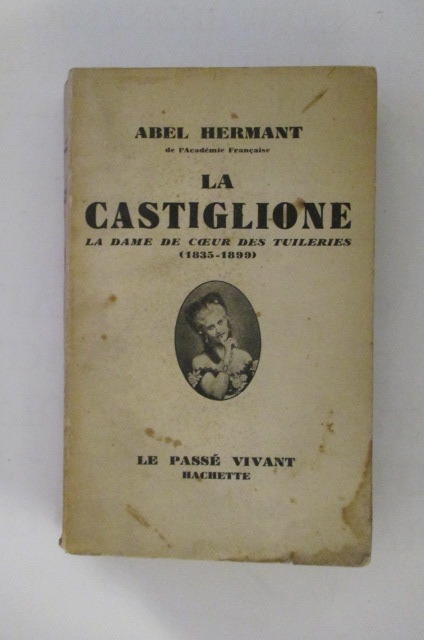
HIS488M1938 / 250 pages. Broché. Editions Hachette
in folio, pp. 45, bross. edit. Antip. con raff. della chiesa e alcune incis. n.t. Bello studio sulla chiesa di Castiglione Olona detta Collegiata, in provincia di Varese. Bell'esempl. [100]
11058Paris, J. Caboche, Demerville et Cie, Editeurs, 1848 (deuxième Edition, mise en un meilleur ordre). 4 volumes in-folio, (30 pp.), reliure moderne plein cuir, enrichi de planches dessinées en noir et blanc, rousseurs habituelles sinon très bon état.
11290Paris, J. Caboche, Demerville et Cie, Editeurs, 1848 (deuxième Edition, mise en un meilleur ordre). 2 volumes in-folio, (30 pp.), reliure ancienne demi-maroquin, dos ornés de fleurons, enrichi de 181 planches dessinées et coloriées, rousseurs habituelles sinon très bon état.
1291657614.Ghardcover. Good. Access codes and supplements are not guaranteed with used items. May be an ex-library book. hardcover
1552170691552 Broché - 15,5 x 24 - 230 pp - année 2002 - Editions Pygmalion Gerard Watelet -
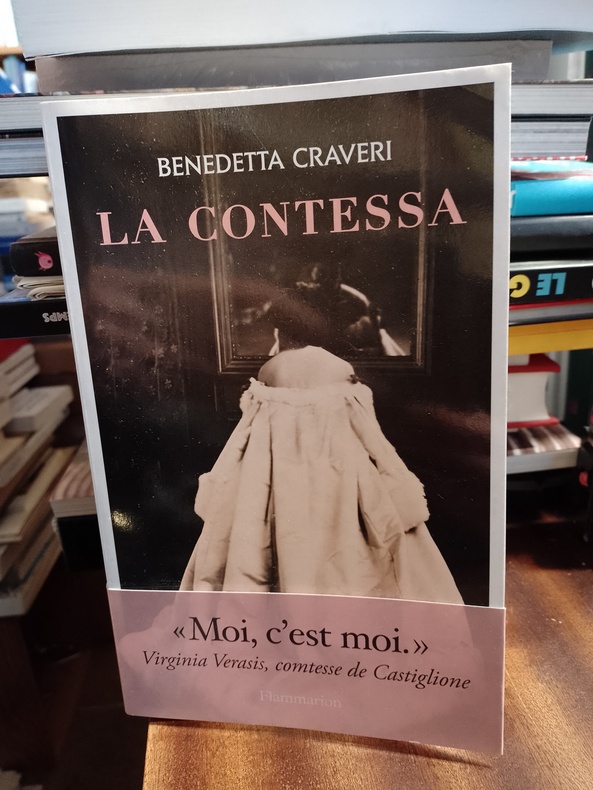
2021ITALHISTO464501223Paris, Flammarion, 2021, 15 x 24, 540-XVI pages sous couverture souple illustrée. Traduit de l'italien par Dominique Vittoz. Ouvrage enrichi d'un cahier de XVI pages d'illustrations noir & blanc et couleurs. "On croyait tout savoir de Virginia Verasis, comtesse de Castiglione, qui - à dix-huit ans à peine - s'était vu confier par le gouvernement piémontais la mission de "coqueter et séduire" Napoléon III. Tous les moyens étaient bons pour faire avancer la cause de l'unification italienne et obtenir le soutien de la France dans le conflit opposant le Piémont à l'Autriche. Les choses n'ont guère traîné : la belle Italienne, devenue sans perdre de temps la maîtresse de l'empereur et la coqueluche du Tout-Paris, a ensuite traversé les années du Second Empire et de la IIIe République comme une diva en tournée, poursuivie par des nuées d'amants à ses ordres, tout en veillant à immortaliser son incomparable beauté par des centaines de photos destinées à marquer son époque. Puis, l'âge venant, elle a affronté le déclin avec la dignité d'une héroïne tragique. Ce livre raconte aussi une autre histoire. En se fondant sur de très nombreux documents inédits, il dessine le portrait d'une femme assoiffée de liberté, refusant toute emprise masculine : "Comme la justice est faite par les hommes, c'est l'injustice pour la femme". Bafouant les règles du siècle bourgeois, la Contessa ne renonça jamais à son indépendance, fidèle uniquement à ses changeantes passions. En reconstruisant ce destin, grâce à ses propres témoignages et à ceux de ses proches, Benedetta Craveri nous convainc que la devise de la Castiglione, "Moi, c'est moi", n'est pas tant une revendication préféministe que le cri d'une personnalité insaisissable et farouche. Une éternelle fugitive qui se dérobe à toute explication convenue."
Legatura editoriale in cartoncino rigido ruvido, dalla copertina illustrata, con caratteri in oro e con titolo in oro al dorso, in tassello verde, protetto da sovraccoperta in plastica trasparente, con bandelle. Buonissimo lo stato di conservazione, pagine perfettamente tenute, ossidate da tonalità seppia, come i tagli, con XIV ( 14 ) illustrazioni in bianco e nero. Numero pagine 314. USATO
Biografia della Contessa con illustrazioni. Brossura
Legatura editoriale in cartoncino rigido, dalla copertina illustrata, leggermente annerita, con caratteri dorati e con titolo in oro al dorso, in tassello blu. Buonissimo lo stato conservativo, pagine perfettamente tenute, ossidate da tonalità seppia, bruniti i tagli, con XIV ( 14 ) tavole illustrate fuori testo. Numero pagine 314. USATO
In-8 (cm. 20.60), brossura illustrata, pp. 194, (4). Prima edizione riveduta “Il Saggiatore”. In ottimo stato (nice copy).