783 résultats
11290Paris, J. Caboche, Demerville et Cie, Editeurs, 1848 (deuxième Edition, mise en un meilleur ordre). 2 volumes in-folio, (30 pp.), reliure ancienne demi-maroquin, dos ornés de fleurons, enrichi de 181 planches dessinées et coloriées, rousseurs habituelles sinon très bon état.
154525180Vinegia: Figlioli di Aldo Aldus 1545. A very early and rare printing of Castiglione by Aldus in the original folio format mirroring the 1528 printing. Elaborate Aldine device impressed on the title and at the end on the verso of the colophon leaf. Dedication to Michel de Selva vescovo di Viseo. Folio handsomely bound in fine Italian vellum. 122 ff. pp. A beautifully preserved copy handsome and clean. RARE ALDINE EDITION OF THE CLASSIC LANDMARK IL CORTEGIANO. Castiglione’s great work is one of the most famous books of the Italian Renaissance and represents the highest level of committment to the prince and the new political and social order. The Courtier is the prototype of the courtesy book written as conversation between members of the court. At the time of its composition Castiglione was at the court of Guidobaldo de Montefeltre and Elizabetta Gonzaga at Urbino together with Bembo Giuliano de' Medici Federico Fregoso and other Renaissance luminaries; members of that court feature as speakers in the conversation. <br> Castiglione after serving the Sforzas at Milan and the Gonzagas at Mantua came to the Court of Urbino in 1504 where de Montefeltre and his consort Elizabetta Gonzaga were the center of the most brilliant court in Italy which counted among its members Bembo Bibbiena G. de’Medici and many other eminent men. This brilliant book is based on Castiglione’s experience of life among these dazzling figures.<br> ‘The Courtier’ depicts the ideal aristocrat and it has remained the perfect definition of a gentleman ever since. It is an epitome of the highest moral and social ideas of the Italian Renaissance and is written in the form of a discussion between members of the court. The fundamental idea that a man should perfect himself by developing all his faculties goes back to Aristotle’s ETHICS and many of the Aristotelian virtues reappear---honesty magnanimity and good manners. The ideal man should also be proficient in arms and games be a scholar and connoisseur of art; he should develop graceful speech and cherish a sense of honour. Relations between the prince and the courtier forms of government and rules for the conduct of a lady are also discussed and the book ends with the celebrated pronouncement on platonic love by Bembo.<br> This Renaissance ideal of the free development of individual faculties and its rules of civilized behaviour formed a new conception of personal rights and obligations in Europe. The book was translated into most European languages and between 1528 and 1616 no less than one hundred and eight editions were published. It had great influence in Spain where traces of it can be found in DON QUIXOTE and in France in Corneille’s writings. But its most potent influence was probably in England. Its influence can be seen in Shakepeare Spenser Ben Jonson Sir Philip Sidney Robert Burton and Shelley. It had a great impact on the development of English drama and comedy.<br> The beautiful and highly important printings of the house of Aldus are exceptional and revered in their own right. This one of the most exceptional of Italian Renaissance works published by the great Renaissance printer of Italy. Figlioli di Aldo (Aldus) hardcover
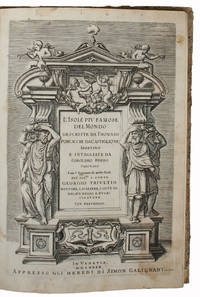
159047728Venetia [Venice], apresso gli heredi di S. Gagliani, 1590. [Colophon: In Vintia, appresso Giorgio Angelieri, a instantia de gli heredi di Simon Gagliani de Karera, 1590]. Small folio. 18th century (ab. 1780-90) half vellum with gilt leather title label to spine. Corners a bit bumped and title label a bit worn, otherwise nice and tight. A very nice copy, on thick, crisp paper. A few quires browned and brownspotted, and some occasional lighter browning. Four leaves with a marginal worm-tract, far from affecting text. Beautiful engraved title-page, consisting of a wide architectural border illustrated with large figures, putti, globes, and various symbols. Beautiful large woodcut initials and head- and tail-pieces. 47 half-page engraved maps in the text (by Porro, of islands and continents), excellent, crisp impressions. Large woodcut device to colophon. (12) ff., 201, (1) pp.
159047728Venetia Venice apresso gli heredi di S. Gagliani 1590. Colophon: In Vintia appresso Giorgio Angelieri a instantia de gli heredi di Simon Gagliani de Karera 1590. Small folio. 18th century ab. 1780-90 half vellum with gilt leather title label to spine. Corners a bit bumped and title label a bit worn otherwise nice and tight. A very nice copy on thick crisp paper. A few quires browned and brownspotted and some occasional lighter browning. Four leaves with a marginal worm-tract far from affecting text. Beautiful engraved title-page consisting of a wide architectural border illustrated with large figures putti globes and various symbols. Beautiful large woodcut initials and head- and tail-pieces. 47 half-page engraved maps in the text by Porro of islands and continents excellent crisp impressions. Large woodcut device to colophon. 12 ff. 201 1 pp. <br/><br/><em>Third much enlarged edition with 47 maps as opposed to the mere 30 of the first edition of Porcacchi's great book of islands arguably the most famous of all "isolario"s with the 47 finely engraved maps by the famous map-maker Girolamo Porro which also include maps of non-insular places e.g North America and Mexico City the famous city plan of Venice and that of Constantinople. Porcachhi's great "isolario" represents the culmination of the "book of islands"-genre both in regards to artistic quality and the information provided. It furthermore constitutes a main work in the history of the published knowledge of farther parts of the world and an important link in the development from what we call the "book of islands" to the modern atlas. As such it is of great value in several respects both historically culturally and cartographically. "The "book of islands" or isolario a novel form of cartographic book combining maps and narrative-historical chorography was invented and initially developed in Italy during the fifteenth and sixteenth centuries. According to R.A. Skelton "like the portolano or pilot-book to which it was related it had its origins in the Mediterranean as an illustrated guide for travelers in the Aegean Archipelago and the Levant.". The first "book of islands" was authored by a Florentine ecclesiastic around 1420 named Cristoforo Buondelmonti .The "book of islands" was eventually superseded as a cartographic genre as was the "Geographia" of Ptolemy by the modern atlas; it persists even after Abraham Ortelius's 1570 "Theatrum orbis terrarium" but at the margins rather than at the center of the history of cartography. While the "isolario" Ptolemy's "Geographia" and the "modern" atlas coexist for some time the gradual eclipse of the "book of islands" at one level reflected a progressive decentering of the Mediterranean that occurred within the broader context of early modern history following the Atlantic discoveries. But well before that happened in conjunction with the culminating moment of the discoveries and exploration period and at the height of the high Renaissance the second printed "book of islands" appeared in 1528 in Venice published by Zoppino: the "Libro di Benedetto Bordone nel qual si ragiona de tutte l'isole del mondo" Book of Benedetto Bordone in which are discussed all the islands of the world. As the title suggests this "isolario" provided even broader coverage than the Martellus recensions of Buondelmonti and gave special prominence to the islands of the New World .Da li Sonetti's translation of Buondelmonti's "book of islands" into a cycle of sonnets in Venice represented in its way an expression of the same desire to reconcile contemporary geographical knowledge to Italian vernacular traditions of geographical poetry that Berlinghieri's poetic Ptolemy expressed. But while the tradition of Tuscan geographical poetry would not survive the Quattrocento the prose book of islands did thanks especially to the Venetian print culture that was responsible for da li Sonetti and that produced Bordone's High Renaissance print "isolario". As mentioned the print genre "book of islands" would endure in fact albeit at the margins of modern cartography and literature in multiple editions of Bordone which were followed by the no less successful Tommaso Porcacchi's "L'isole più famose del mondo" 1572; with copper-plate engravings a line that continued through the seventeenth century . But just as with other major literary fields of endeavor including the political Machiavelli the pastoral Sannazzaro the courtly-bureaucratic Castiglione and the epic-novellistic Ariosto the "isolario" produced its masterpieces in the discoveries and travel writing fieldalongside Columbus Vespucci and Verrazzano during the High Renaissance." Cachey "From the Mediterranean to the World: A Note on the Italian "Book of Islands" "isolario"" pp. 1-10. Shirley T.POR-1d; Phillips: 50. </em> hardcover
154719132Vinegia: Figlioli di Aldo Aldus 1547. Early Printing by Aldus. Elaborate Aldine device Impressed on the titlepage and at the end on the verso of the colophon leaf. Dedication to Michel de Selva vescovo di Viseo. 8vo bound in 17th century stiff vellum red morocco lettering label gilt. ff. 5 195 8. A fine example with the title label with a bit of chipping and with some light loss. RARE ALDINE EDITION OF THE CLASSIC LANDMARK IL CORTEGIANO. Castiglione’s great work is one of the most famous books of the Italian Renaissance and represents the highest level of commitment to the prince and the new political and social order. The Courtier is the prototype of the courtesy book written as conversation between members of the court. At the time of its composition Castiglione was at the court of Guidobaldo de Montefeltre and Elizabetta Gonzaga at Urbino together with Bembo Giuliano de' Medici Federico Fregoso and other Renaissance luminaries; members of that court feature as speakers in the conversation. <br> Castiglione after serving the Sforzas at Milan and the Gonzagas at Mantua came to the Court of Urbino in 1504 where de Montefeltre and his consort Elizabetta Gonzaga were the center of the most brilliant court in Italy which counted among its members Bembo Bibbiena G. de’Medici and many other eminent men. This brilliant book is based on Castiglione’s experience of life among these dazzling figures.<br> ‘The Courtier’ depicts the ideal aristocrat and it has remained the perfect definition of a gentleman ever since. It is an epitome of the highest moral and social ideas of the Italian Renaissance and is written in the form of a discussion between members of the court. The fundamental idea that a man should perfect himself by developing all his faculties goes back to Aristotle’s ETHICS and many of the Aristotelian virtues reappear---honesty magnanimity and good manners. The ideal man should also be proficient in arms and games be a scholar and connoisseur of art; he should develop graceful speech and cherish a sense of honour. Relations between the prince and the courtier forms of government and rules for the conduct of a lady are also discussed and the book ends with the celebrated pronouncement on platonic love by Bembo.<br> This Renaissance ideal of the free development of individual faculties and its rules of civilized behaviour formed a new conception of personal rights and obligations in Europe. The book was translated into most European languages and between 1528 and 1616 no less than one hundred and eight editions were published. It had great influence in Spain where traces of it can be found in DON QUIXOTE and in France in Corneille’s writings. But its most potent influence was probably in England. Its influence can be seen in Shakespeare Spenser Ben Jonson Sir Philip Sidney Robert Burton and Shelley. It had a great impact on the development of English drama and comedy.<br> The beautiful and highly important printings of the house of Aldus are exceptional and revered in their own right. This one of the most exceptional of Italian Renaissance works published by the great Renaissance printer of Italy. Figlioli di Aldo (Aldus) hardcover
11058Paris, J. Caboche, Demerville et Cie, Editeurs, 1848 (deuxième Edition, mise en un meilleur ordre). 4 volumes in-folio, (30 pp.), reliure moderne plein cuir, enrichi de planches dessinées en noir et blanc, rousseurs habituelles sinon très bon état.
154532371Venetia Venice: nelle case de figlioli di Aldo I Manuzio 1545. Fourth Aldine printing. Small folio. 122 ff. Eighteenth century full pigskin gilt lettering to the spine all edges green a single leaf in book three lacking but the text supplied in consummate manuscript predating or contemporary with the binding. Faint dampstain cutting across the upper corner of the last 16 leaves at the gutter also evident on both pastedowns a few marks to the boards an attractive copy. Baldessare Castiglione 1478-1529 was very much a man of his day educated in a Humanist school in Milan in the 1490s where he also served at the court of Duke Ludovico Sforza. He returned to his native Mantua on the death of his father at the age of 21 whereupon he entered the service of the local marquis Francesco Gonzaga for the next five years. During this time he became acquainted with Guidobaldo da Montefeltro Duke of Urbino whose court he entered in 1504. Castiglione acted in various capacities for Guidobaldo and his successor principally diplomatic though he also played an active role in the flourishing cultural life of the court. His talents took him to Rome in ambassadorial roles for Urbino and subsequently Mantua leading to his involvement with the Vatican and his later ecclesiastical career towards the end of his life he was made Bishop of Avila. He is now best remembered for this work first published in 1528 by the Aldine Press. Written in the form of a dialogue between several protagonists Castiglione sought to define the courtly ideal. Going beyond a mere book of etiquette he described the essential characteristics and traits that a courtier should exhibit. These include refinement in the arts athletic prowess most obviously in bearing arms great oratory skills very much in the Ciceronian tradition and something which Castiglione termed "sprezzatura". Translated and defined by the Oxford English Dictionary as "studied carelessness" Castiglione suggested that a man about court should eschew flamboyance and grandiosity in favour of a genteel modest and nonchalant manner and temperament - essentially that all his efforts and undertakings should be worn lightly and completed with as little perceptible exertion as possible. Its contemporary importance is demonstrated by the fact that the Aldine Press had printed it another four times by 1547 the first four editions in folio as here the final as an 8vo. By 1616 over 100 further editions in Italian and in translation had been published. Unsurprisingly its cultural influence in the succeeding centuries became manifest across Europe with traces of the work found in the writings of Cervantes Corneille and amongst others in the English language Shakespeare Spenser and Shelley. Printing and the Mind of Man 59. "It is an epitome of the highest moral and social ideas of the Italian Renaissance. Venetia [Venice]: nelle case de figlioli di Aldo [I Manuzio] unknown
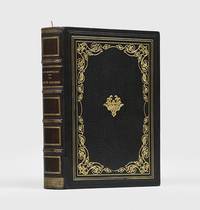
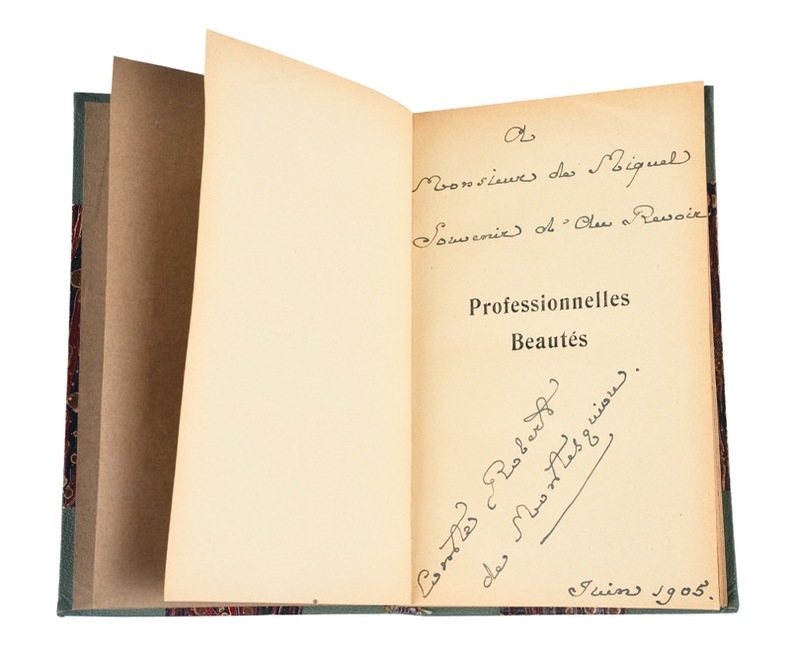
1913172668Paris: Goupil & Cie 1913. The most famous woman in Paris First edition of the Parisian aesthete's sumptuously illustrated biography. Castiglione 1837-1899 was a self-fashioned icon of high society whose extensive portfolio as a photographic model made her a major figure in the medium's early history. "La Castiglione was one of the first celebrated women to realize the iconic potential of the camera in this first period of photography. She was aware of the necessity for control a concern to use the camera rather than let the camera use her. Her chosen studio Mayer and Pierson made over seven hundred images of her an enterprise that in photography's earliest years represented a considerable investment in time and effort" Badger p. 51. She performed a wide variety of identities in her highly staged portraits including mythical historical seductive and grotesque. The fame resulting from her enigmatic images earned her significant political influence: her affair with Napoleon III likely contributed to Italian unification and Otto von Bismarck met with her to discuss the strategic importance of Paris following the Franco-Prussian war. Although he never met Castiglione Montesquiou 1855-1921 was enraptured by her reputation and collected hundreds of her photographs the majority of which are now held at the Metropolitan Museum of Art. A fellow photography enthusiast - he aspired to be the most photographed person in the world - he was also a Symbolist poet painter and dandy. Quarto 273 x 195 mm. Colour photogravure frontispiece 25 plates 5 colour captioned tissue guards floriated initials borders and head- and tailpieces by Louis Popineau chapter titles printed in red. Bound with original wrappers. Contemporary dark green morocco by Durvand of Paris spine lettered and ruled in gilt 4 raised bands covers framed in blind and gilt gilt crown centrepiece surrounded by scrollwork border gilt fillets on board edges and turn-ins purple moiré endpapers top edge gilt the rest uncut orange red and green silk bookmarker loosely inserted. Spine gently toned ends a little rubbed plates bright and clean: a fine copy. Gerry Badger The Pleasures of Good Photographs: Essays 2010. hardcover
02332New York: Charles Scribner's Sons 1901. The Classic Courtesy Book<br/>Newly Translated<br/>Bound By Gruel<br/><br/>GRUEL Léon binder. CASTIGLIONE Count Baldesar. The Book of the Courtier 1528. Translated From the Italian and Annotated by Leonard Eckstein Opdycke. With Seventy-One Portraits and Fifteen Autographs Reproduced by Edward Bierstadt. New York: Charles Scribner's Sons 1901. <br/><br/>First edition of the new English translation limited to 500 copies this being copy no. 199. Quarto 10 9/16 x 7 7/8 in; 274 x 200 mm. xii 2 439 1 pp. Seventy-one portraits and fifteen autograph reproductions with captioned tissue guards. <br/><br/>Bound by Léon Gruel stamp-signed in full contemporary crushed antelope brown morocco with decoratively gilt borders and a central panel enclosed by an elaborately blindstamped frame. Black crushed morocco doublures with wide dentelles and gilt cornerpieces. Navy blue ribbed linen endleaves. All edges gilt. Some very light rubbing to upper joint but still a superlative copy.<br/><br/>Baldassare Castiglione 1478 - 1529 count of Casatico was an Italian courtier diplomat and soldier. Originally published by the Aldine Press of Venice in 1528 his The Book of the Courtier remains the definitive account of Renaissance court life and is considered to be one of the most important books to emerge from that period. Amongst the most widely distributed books of the 16th century with editions printed in six languages and in twenty European centers the 1561 English translation by Thomas Hoby had a great influence on the English upper class's conception of a proper English gentleman. The total number of editions to date now exceeds 140.<br/><br/>Binder and gilder Léon Gruel 1841 - 1923 began working in the family bindery established in 1825 after his father assumed control of the Desforges binding workshop in Paris. In 1891 he became sole owner employing a large number of artisans. In 1887 Gruel published Manuel historique et bibliographique de l'amateur de reliures in which he argued for a synthesis of styles promoting the acceptance of non-traditional decoration for modern bindings. In practice he matched this belief with a diverse range of emblematic and pictorial covers. The binding under notice eschews the pictorial for a more traditional approach heightened by his use of elaborate and progressive blindstamping influenced by the Arts & Crafts movement. New York: Charles Scribner's Sons, 1901 unknown books
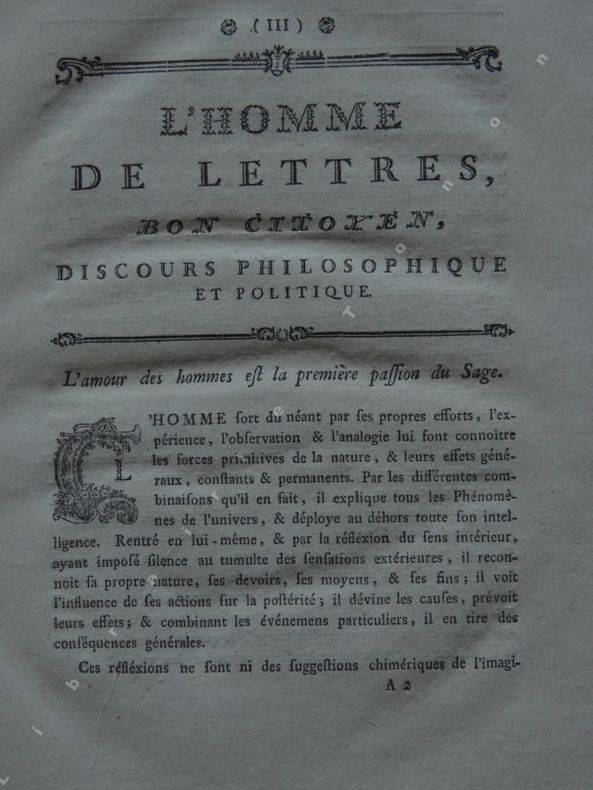
17771309Geneve 1777. Quarto. 7 3/4†x 9 1/2â€. Contemporary red morocco ruled with gilt floral sprays and pointelles at corners. Covers show a few small gouges spine rubbed and worn label frayed. Marbled endpapers bookplate of Edmond Couleru. Notes in pen and pencil on title. Stain on front blank otherwise very bright and clean. Four changes to the text in contemporary hand on pXXX. A stamp “Sold by H.M. Stationery Office†on p.XXXI indicates that the text was sold in England.<br/><br/> Pagination: One leaf verso with frontis portrait of Gonzaga after Corvi engraved by Giovanni Volpatto Designer and engraver. B. Bassono 1733 D. Rome 1803. Leaf of title verso blank text pages 1-124 in Roman numerals: Collation 1l A-P4 Q2. Contents: p III: Homme de Lettres Bon Citoyen; p. XXI: Reflexions sur la Poesis p. XXVII Essay Analytique sur les Decouvertes Capitales de L’Esprit Humain. The work ranges over modern philosophers including the English empiricists. It also discusses the American revolution. The last essay was given at the Royal Society in London 1777. <br/><br/> Luigi Gonzaga prince of Castiglione 1745-1819 was a scholar and a native of Vienna. His lineage was from the ancient house of Gonzaga a noble family that ruled Mantua in Northern Italy from 1328 to 1708; they also ruled Monferrato in Piedmont and Nevers in France. His family was a subbranch of the Gonzaga and Solferino family. His parents were Ferdinand III of Castiglione and Elena Medin. Childless he was the last in the line of this branch of the Gonzaga family. Luigi Gonzaga became a scholar traveler and activist and who read and followed the philosophers of the enlightenment and understood the need for progressive measures to support civil rights freedom and democracy.<br/><br/> Expelled from Venice for his progressive ideas Luigi Gonzaga became first a refugee then an exile then a tolerated member of a learned and ancient family. During his stay in Rome he became a friend of the poet Maria Maddalena Morelli. He was elected to membership in the patrician Pontificia Accademia degli Arcadi. Founded Rome 1690 The “Accademia degli Arcadi†was an important if archly conservative force in classical literature and culture until the 20th century.<br/><br/> First published Roma : B. Francesi 1776 as Il Letterato buon cittadino discorso filosofico e politico di. Don Luigi Gonzaga di Castiglione with extensive running commentary by Luigi Godard. A second edition in French in 12mo was published in Paris : Barrois l'aîné 1785.<br/><br/> Ref: Portalupi Napoleone. Sulla legittimitÅ• dei principi Gonzaga della linea di Vescovato per . Milano 1871.<br/><br/> Provenence : Edmund Coleru author of .Au pays de l'absinthe. MontbeÄ›liard Impr. MontbeÄ›liardaise 1908 unknown books
158557784Paris: Par Nicolas Bonfons 1585. 8vo pp. xxx 678 xxx. Title vingette bound in contemporary full vellum spine title in ink cover bit wrinkled lacks the front blank expert repair to the blank portion of the title page not affecting any letter press a very good copy. STC French p. 94;. An edition of the best C16th French translation of Castiglione's Cortigione by Gabriel Chapuis published simultaneously in Lyon Rouen and Paris a near exact reprint of the first of 1580 of tremendous influence in France. This translation was also published in Britain in 1588 in Wolfe's trilingual edition along with the equally influential English translation by Thomas Hoby. Chapuis states that his reason for attempting a new translation is in the same way that the Perfect Courtier described in the book cannot actually exist neither can the perfect translation and he felt that previous attempts had fallen short of the high standards demanded by Castiglione's masterpiece. Wikipedia: "Baldassare Castiglione December 6 1478 - February 2 1529 count of Casatico was an Italian courtier diplomat soldier and a prominent Renaissance author who is probably most famous for his authorship of The Book of the Courtier. The work was an example of a courtesy book dealing with questions of the etiquette and morality of the courtier and was very influential in 16th century European court circles. Castiglione was born into an illustrious family at Casatico near Mantua. In 1528 the year before his death the book for which Castiglione is most famous The Book of the Courtier Il Libro del Cortegiano was published in Venice by the Aldine Press run by the heirs of Aldus Manutius. The book in dialog form is an elegiac portrait of the exemplary court of Guidobaldo da Montefeltro of Urbino during Castiglione's youthful stay there at the beginning of the sixteenth century. It depicts an elegant philosophical conversation presided over by Elisabetta Gonzaga whose husband Guidobaldo an invalid was confined to bed and her sister-in-law Emilia Pia. Castiglione himself does not contribute to the discussion which is imagined as having occurred while he was away. The book is Castiglione's memorial tribute to life at Urbino and to his friendships with the other members of the court all of whom went on to have important positions and many of whom had died by the time the book was published giving poignancy to their portrayals of the Ducal Palace at Urbino setting of the Book of the Courtier. The conversation takes place over a span of four days in the year 1507. It addresses the topic proposed by Federigo Fregoso of what constitutes an ideal Renaissance gentleman. In the Middle Ages the perfect gentleman had been a chivalrous knight who distinguished himself by his prowess on the battlefield. Castiglione's book changed that. Now the perfect gentleman had to have a classical education in Greek and Latin letters as well. The Ciceronian humanist model of the ideal orator whom Cicero called "the honest man" on which The Courtier is based prescribes for the orator an active political life of service to country whether in war or peace. Scholars agree that Castiglione drew heavily from Cicero's celebrated treatise De Officiis "The Duties of a Gentleman" well known throughout the Middle Ages and even more so from his De Oratore which had been re-discovered in 1421 and which discusses the formation of an ideal orator-citizen. Par Nicolas Bonfons unknown books
1990102595Sagep Editrice S. P. A. New. 1990. Hardcover. FREE UPGRADE to Courier/Priority Shipping Upon Request - IN STOCK AND IMMEDIATELY AVAILABLE FOR SHIPMENT - Flawless copy brand new pristine never opened -- Text in Italian. 270 pp. With 235 ills. 64 col. . 28 x 21 cm. -- with a bonus offer-- . Sagep Editrice S. P. A. hardcover
1983102620Yale Univ Pr. New. 1983. Hardcover. 0300026498 . FREE UPGRADE to Courier/Priority Shipping Upon Request - IN STOCK AND IMMEDIATELY AVAILABLE FOR SHIPMENT - Flawless copy brand new pristine never opened -- 215 pages; illustrated in black and white. -- with a bonus offer-- . Yale Univ Pr hardcover
155475<p>4to 214x152 mm. 8 135 1 leaves. Collation: 4 †4 a-z4 A-L4. With the large woodcut portrait of the author on the title page and the printer's device on last leaf verso. Contemporary limp vellum inked title on the spine and lower edge remnants of ties new endpapers small stains. On title page manuscript ownership's inscription Ballybay Library. Inner margin of the title page reinforced small holes to the gutter of the first two leaves with no loss of text small ink stain on the upper blank margin at the end of the volume otherwise a very good genuine copy.</p><p>FIRST COMPLETE EDITION. First published in Bologna in 1546 containing only seventy-two chapters the <i>Ricordi</i> appeared in an enlarged edition in 1549 124 chapters also in Bologna. The present definitive edition containing 133 'ricordi' was edited by Zaccaria Bellenghi Fra Sabba's chaplain in Faenza shortly after the latter's death. The work became very popular and between 1546 and 1613 twenty-five editions were published.</p><p>In the present edition is also found for the first time the title woodcut showing Fra Sabba in his study. Ugo Rozzo <i>Lo studiolo nella silografia italiana 1479-1558</i> Udine 1998 pp. 90 114 deems this frontispiece to be remarkable for the mid-sixteenth century both for its Hospitaller imagery and its display of books within the study. The woodcut is emblematic of Sabba's monastic life conducted within the Order's parameters of social utility. He presents an iconographic image of the devout humanist knight who prefers the tranquility of his Commenda to the bustle of the city see also D. Thornton <i>The Scholar in his Study: Ownership and Experience in Renaissance Italy</i> New Haven CT 1997 pp. 106-114.</p><p>The work consists of two series of "avvertimenti" advices each closely related to Castiglione's initial idea of providing to his grandnephew Bartolomeo Righi useful hints on how to become a perfect knight Hospitaller but its numerous printings in the sixteenth century and its breadth of scope suggest a wider target audience. The other 'ricordi' were developed into true small treatises or essays that Castiglione expanded and augmented in every new edition. Despite not having a wide-ranging extent nevertheless they present a considerable interest especially when compared to the works of contemporaries on the same topics i.e. the life of a courtier the government of a city the prince and the tyrant men of arms and religion marriage how to decorate a house clothes food and drink physical exercise travel etc. But included were also his life in Faenza his political aspirations linguistic experiments ideas on religious reform. Geopolitical issues of the day are vigorously engaged and farcical passages replete with colloquial phrasing appear alongside passionate theological discourse expressing a strident anti-Lutheran viewpoint cf. C. Scarpati <i>Per il testo dei 'Ricordi'</i> in: "Studi sul Cinquecento italiano" Milano 1982 pp. 68-82; see also D.F. Allen <i>The Hospitaller Castiglione's Catholic Synthesis of Warfare Learning and Lay Piety on the Eve of the Council of Trent</i> in: "The Hospitallers the Mediterranean and Europe: Festschrift for Anthony Luttrell" K. Borchardt & al. eds. London 2016 pp. 286-298.</p><p>The <i>Ricordi</i> is also very interesting from the point of view of art history and criticism showing Fra Sabba's antiquarian efforts for Isabella d'Este his admiration for Dürer's prints and the artists he had known at Rome e.g. Gian Cristoforo Romano Bramante Raphael Cristoforo Foppa 'Il Caradosso' the San Gallo family just to mention a few cf. M. Collareta <i>Il mondi dell'arte dei 'Ricordi' di Fra Sabba</i> in: "Sabba da Castiglione 1480-1554. Dalle corti rinascimentali alls Commenda di Faenza. Atti del Covegno Faenza 19-20 maggio 2000" A.R. Gentilini ed. Florence 2004 pp. 297-312.</p><p>At the end of the volume is reprinted another work by Fra Sabba the <i>Consolatoria</i> written during his stay at Rhodes November 25 1517. This consolatory epistle addressed to the Milanese poet Camilla Scarampi for the death of her husband Ambrogio Guidoboni. This letter was published at Bologna in 1529. From the dedication dated March 15 1527 to Giacomo Guicciardini vice-president of Romagna we learn that Fra Sabba had submitted the work in the last ten years to Niccolò Machiavelli and Panfilo Sassi asking them if they considered it worthy of being published M.C. Tarsi <i>Una poetessa nella Milano di primo Cinquecento Samilla Scarampi</i> in: "Giornale storico della letteratura italiana" 192/639 2015 pp. 414-451.</p><p>Sabba da Castiglione was an instance of the self-fashioned courtier-knight of the later Renaissance who combines an unusual set of roles: Hospitaller commander canon regular art collector courtier poet and preceptor of knightly rules. He was born in Milan around 1480 where he also became his first. education. He pursued post-secondary studies at the University of Padua studying jurisprudence from about 1500 to late spring 1505 but did not finish his legal education. After a brief stay in Mantua in 1505 at the age of 25 he decided to join the Order of the Knights of Jerusalem later called Knights of Malta of which he soon became Deputy Attorney General. He lived in Rhodes until 1508 then moved to Rome where he sojourned seven years as legal aide-de-camp to the admiral of the Order of the Knights Hospitaller and later Grand Master Fabrizio del Carretto cultivating his interest in the arts and literature. In Rome he also met his cousin Baldassare Castiglione author of Il <i>Cortegiano</i>. Fra Sabba was a passionate forerunner of archaeology and during his stay on the Aegean Sea he was able to procure several ancient marble pieces to Isabella d'Este in Mantua. In 1515 at the age of thirty-five Fra Sabba became a Hospitaller commander accepting a post previously held by his friend Giulio de' Medici the future Pope Clement VII. He took up residence at the Order's Commenda or commandery a district headquarters similar to a feudal estate in Faenza Romagna part of the Papal States. He accepted this post to better dedicate himself to the studies he loved so much away from mundane affairs the intrigues of courts and military life. His residence in Faenza was the Church of Commenda Saint Mary Magdalene also called 'Magione' dating back to the XII century. It was not in good conditions when Fra Sabba came. This was due to the fact that previous commanders had not chosen the complex of the Commenda as their own living place employing their revenues for other purposes. In 1533 Fra Sabba entrusted Girolamo da Treviso with the task to embellish the church with a fresco portraying the 'Enthroned Madonna between Saint Mary Magdalene and Saint Catherine of Alexandria'. Another work of art of great importance accomplished in the year of his death is the one painted by Francesco Menzocchi from Forlì: a monochrome fresco depicting him as an old man presented by Saint Joseph to the Virgin. Underneath this image lies Fra Sabba's sepulchre with a Latin epigraph composed by himself. His interests as a man of study and collector gave birth to a library unfortunately lost and to a collection of pieces of art whose surviving items are to be seen in the Pinacoteca Comunale of Faenza F. Petrucci <i>Sabba da Castiglione</i> in: "Dizionario biografico degli italiani" 22 1978 pp. 100-106.</p>Edit 16 CNCE 10159; Universal STC 819593; Index Aureliensis 133.665; R.M. Bell <i>How To Do It. Guides to Good Living for Renaissance Italians</i> Chicago IL 1999 p. 337; C. Scarpati <i>op. cit.</i> p. 89. Paolo Gherardo books
155475<p>4to 214x152 mm. 8 135 1 leaves. Collation: 4 †4 a-z4 A-L4. With the large woodcut portrait of the author on the title page and the printer's device on last leaf verso. Contemporary limp vellum inked title on the spine and lower edge remnants of ties new endpapers small stains. On title page manuscript ownership's inscription Ballybay Library. Inner margin of the title page reinforced small holes to the gutter of the first two leaves with no loss of text small ink stain on the upper blank margin at the end of the volume otherwise a very good genuine copy.</p><p>FIRST COMPLETE EDITION. First published in Bologna in 1546 containing only seventy-two chapters the <em>Ricordi</em> appeared in an enlarged edition in 1549 124 chapters also in Bologna. The present definitive edition containing 133 'ricordi' was edited by Zaccaria Bellenghi Fra Sabba's chaplain in Faenza shortly after the latter's death. The work became very popular and between 1546 and 1613 twenty-five editions were published.</p><p>In the present edition is also found for the first time the title woodcut showing Fra Sabba in his study. Ugo Rozzo <em>Lo studiolo nella silografia italiana 1479-1558</em> Udine 1998 pp. 90 114 deems this frontispiece to be remarkable for the mid-sixteenth century both for its Hospitaller imagery and its display of books within the study. The woodcut is emblematic of Sabba's monastic life conducted within the Order's parameters of social utility. He presents an iconographic image of the devout humanist knight who prefers the tranquility of his Commenda to the bustle of the city see also D. Thornton <em>The Scholar in his Study: Ownership and Experience in Renaissance Italy</em> New Haven CT 1997 pp. 106-114.</p><p>The work consists of two series of "avvertimenti" advices each closely related to Castiglione's initial idea of providing to his grandnephew Bartolomeo Righi useful hints on how to become a perfect knight Hospitaller but its numerous printings in the sixteenth century and its breadth of scope suggest a wider target audience. The other 'ricordi' were developed into true small treatises or essays that Castiglione expanded and augmented in every new edition. Despite not having a wide-ranging extent nevertheless they present a considerable interest especially when compared to the works of contemporaries on the same topics i.e. the life of a courtier the government of a city the prince and the tyrant men of arms and religion marriage how to decorate a house clothes food and drink physical exercise travel etc. But included were also his life in Faenza his political aspirations linguistic experiments ideas on religious reform. Geopolitical issues of the day are vigorously engaged and farcical passages replete with colloquial phrasing appear alongside passionate theological discourse expressing a strident anti-Lutheran viewpoint cf. C. Scarpati <em>Per il testo dei 'Ricordi'</em> in: "Studi sul Cinquecento italiano" Milano 1982 pp. 68-82; see also D.F. Allen <em>The Hospitaller Castiglione's Catholic Synthesis of Warfare Learning and Lay Piety on the Eve of the Council of Trent</em> in: "The Hospitallers the Mediterranean and Europe: Festschrift for Anthony Luttrell" K. Borchardt & al. eds. London 2016 pp. 286-298.</p><p>The <em>Ricordi</em> is also very interesting from the point of view of art history and criticism showing Fra Sabba's antiquarian efforts for Isabella d'Este his admiration for Dürer's prints and the artists he had known at Rome e.g. Gian Cristoforo Romano Bramante Raphael Cristoforo Foppa 'Il Caradosso' the San Gallo family just to mention a few cf. M. Collareta <em>Il mondi dell'arte dei 'Ricordi' di Fra Sabba</em> in: "Sabba da Castiglione 1480-1554. Dalle corti rinascimentali alls Commenda di Faenza. Atti del Covegno Faenza 19-20 maggio 2000" A.R. Gentilini ed. Florence 2004 pp. 297-312.</p><p>At the end of the volume is reprinted another work by Fra Sabba the <em>Consolatoria</em> written during his stay at Rhodes November 25 1517. This consolatory epistle addressed to the Milanese poet Camilla Scarampi for the death of her husband Ambrogio Guidoboni. This letter was published at Bologna in 1529. From the dedication dated March 15 1527 to Giacomo Guicciardini vice-president of Romagna we learn that Fra Sabba had submitted the work in the last ten years to Niccolò Machiavelli and Panfilo Sassi asking them if they considered it worthy of being published M.C. Tarsi <em>Una poetessa nella Milano di primo Cinquecento Samilla Scarampi</em> in: "Giornale storico della letteratura italiana" 192/639 2015 pp. 414-451.</p><p>Sabba da Castiglione was an instance of the self-fashioned courtier-knight of the later Renaissance who combines an unusual set of roles: Hospitaller commander canon regular art collector courtier poet and preceptor of knightly rules. He was born in Milan around 1480 where he also became his first. education. He pursued post-secondary studies at the University of Padua studying jurisprudence from about 1500 to late spring 1505 but did not finish his legal education. After a brief stay in Mantua in 1505 at the age of 25 he decided to join the Order of the Knights of Jerusalem later called Knights of Malta of which he soon became Deputy Attorney General. He lived in Rhodes until 1508 then moved to Rome where he sojourned seven years as legal aide-de-camp to the admiral of the Order of the Knights Hospitaller and later Grand Master Fabrizio del Carretto cultivating his interest in the arts and literature. In Rome he also met his cousin Baldassare Castiglione author of Il <em>Cortegiano</em>. Fra Sabba was a passionate forerunner of archaeology and during his stay on the Aegean Sea he was able to procure several ancient marble pieces to Isabella d'Este in Mantua. In 1515 at the age of thirty-five Fra Sabba became a Hospitaller commander accepting a post previously held by his friend Giulio de' Medici the future Pope Clement VII. He took up residence at the Order's Commenda or commandery a district headquarters similar to a feudal estate in Faenza Romagna part of the Papal States. He accepted this post to better dedicate himself to the studies he loved so much away from mundane affairs the intrigues of courts and military life. His residence in Faenza was the Church of Commenda Saint Mary Magdalene also called 'Magione' dating back to the XII century. It was not in good conditions when Fra Sabba came. This was due to the fact that previous commanders had not chosen the complex of the Commenda as their own living place employing their revenues for other purposes. In 1533 Fra Sabba entrusted Girolamo da Treviso with the task to embellish the church with a fresco portraying the 'Enthroned Madonna between Saint Mary Magdalene and Saint Catherine of Alexandria'. Another work of art of great importance accomplished in the year of his death is the one painted by Francesco Menzocchi from Forlì: a monochrome fresco depicting him as an old man presented by Saint Joseph to the Virgin. Underneath this image lies Fra Sabba's sepulchre with a Latin epigraph composed by himself. His interests as a man of study and collector gave birth to a library unfortunately lost and to a collection of pieces of art whose surviving items are to be seen in the Pinacoteca Comunale of Faenza F. Petrucci <em>Sabba da Castiglione</em> in: "Dizionario biografico degli italiani" 22 1978 pp. 100-106.</p><p>Edit 16 CNCE 10159; Universal STC 819593; Index Aureliensis 133.665; R.M. Bell <em>How To Do It. Guides to Good Living for Renaissance Italians</em> Chicago IL 1999 p. 337; C. Scarpati <em>op. cit.</em> p. 89.</p> Paolo Gherardo
1913AMA-147Paris, Goupil, 1913. in 8°, plein maroquin aubergine, dos à nerfs orné de caissons dorés, décor doré sur les plats, tête dorée, roulette intérieure dorée et gardes de soie verte, couverture conservée, menus défauts à la reliure restaurée (Reliure de Durvand). (3)ff.-VII-247 pp.-(1)f.,
190521639Paris, Félix Juven (Imprimerie Paul Dupont), (1905) ; petit in-8, bradel de percaline à coins vert lentilles d’eau, pièce de titre chair (reliure de l’époque) ; XXXIV, 313 pp., [1] f. de table.
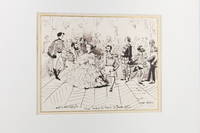
185677880Paris 1856. Fine. Paris 1856 30 x 24 cm une feuille sous marie-louise Original ink drawing signed and dated by Charles Robert titled ""Madame la Comtesse de Castiglione et Napoléon III ou Le bal aux Tuileries le mardi 29 janvier 1856"". This drawing immortalizes the historic meeting of the 19-year-old Countess de Castiglione with Emperor Napoleon III at a ball given by his cousin Princess Mathilde. Invested by Cavour with a delicate diplomatic mission the Countess came to Paris with the aim of seducing the Emperor and making him sympathetic to the Piedmontese cause and thus convert him to the idea of a unified Italy. She had a famed affair with the Emperor which strengthened ties between France and Italy before coming to an end as Italian carbonari made an attempt on the Emperor's life the following year. Aesthetic representation of the early days of this Italian Mata Hari as ambassador and spy to the French imperial court. unknown
185677880Paris 1856 | 30 x 24 cm | une feuille sous marie-louise
1761168701761 Amsterdam, Marc Michel Rey, 1761, 3 parties en 2 tomes rel. en 1 vol. in 4 de (6)-XVIII-310-(2) pp. ; (4)-288 pp. ; (2)-134-(2) pp., pages de titres imprimées en rouge et noir, 37 planches dépliantes gravées, rel. début XIXe de plein veau brun raciné, dos richement orné de fers dorés, pièce de titre de maroquin rouges, tranches jaspées de couleurs, bel ex.
1766BB1797Padova Padua: Appresso Giusseppe Comino 1766. Early Reprint. Full Calf. Fine. An important reprint of Aldine's first edition of 1528 discarding the extensive alterations to the text that corrupted editions of this classic treatise on etiquette for more than a century. 4to 23 x 16 cm xxiv 352pp with portrait frontispiece of Castiglione after Raphael illuminated initials and head and tail pieces throughput. Modern vellum and marbled boards spine titled in gilt. Included is the "best and fullest biography of Castiglione which was written by Abate Pietro Serassi who had access to the family papers brought to Rome by Cardinal Valenti Gonzaga secretary to Pope Benedict XIV." Cartwright A very scarce wide-margined survival tightly bound contents clean with only light occasional foxing. PMM 59. Razzollini p. 99. Gamba 296 for Comino's complete edition of Castiglione's works from 1733 upon which this edition is based. Cartwright v. 2 pp. 445-447. First printed in Venice by Aldine Press in 1528 then reprinted innumerable times since in every major European language. The Courtier is the most celebrated instruction manual on the courtly manners of the Italian High Renaissance "a veritable compendium of Renaissance culture." Literary Encyclopedia In 1590 Pope Sixtus V placed it on the Church's List of Prohibited Books but exempted the expurgated edition prepared by Antonio Ciccarelli which was the only edition that remained in circulation for more than 100 years. Finally in 1733 Volpi issued an edition of Castiglione's collected works that disregarded Ciccarelli's corruptions and reverted to the original Aldine edition. Our edition is a reprint here of Volpi's text of The Courtier and it exists in two states unmutilated and mutilated. According to Razzollini more than a thousand copies originally were printed but only one hundred were issued and only after the text primarily Book IV was extensively revised to incorporate Ciccarelli's changes and elisions reducing the original text to 303 pages vs. 352 pages in unmutilated copies. Our is one of the rare unmutilated copies beautifully preserved. N. B. With few exceptions always identified we only stock books in exceptional condition. All orders are packaged with care and posted promptly. Satisfaction guaranteed. Fine Editions Ltd is a member of the Independent Online Booksellers Association and we subscribe to its codes of ethics. Appresso Giusseppe Comino unknown
49Genève s. n. 1777 1è éd. française . 1 vol. in-4 ( 24,5 x 20 cm)CXXIV ppEn frontisp. remarquable portrait du prince de Castiglione d'après Domenico Corvi gravé par Giovanni Volpatto.En fin de la première partie, figure un Sonnet de Corilla au prince philosophe (en italien).Pleine basane mouchetée. Dos lisse orné de fleurons dorés; p. de titre maroquin havane. Roulettes dorées encadrant les plats. Toutes tranches dorées. Gardes marbrées.Qqs épidermures er rayures sur les plats. Mors inférieur fendu sur 1 cm en tête. Petite tâche marginale p. CV.
Carta murale particolareggiata del territorio dei dintorni di Lonato, Castiglione, Montichiari e Castenedolo. La carta, contenuta in astuccio coevo con segni di usura, è divisa in quattro fogli telati e piegati editorialmente, solamente i due fogli di dx. sono colorati
15385257Venice: Vettor de Rabani Vittore Ravani e compagni 1538. Acceptable/Early edition of the Book of the Courtier one decade after the first edition printed by Vittore Ravani who worked his late father Pietro's print shop with his mother Luchina during the 1530s. They had help from Melchiore Sessa. Most of their output centered on reprinting humanist bestsellers such as the present title Ariosto's Satires Benivieni's Ars Moriendi Erasmus's Adages and so on. . Octavo 16cm; 5 193 leaves lacks final two leaves blank but for printer's device on recto of BB7. Initial spaces with guide letters; printer's device two-tailed siren on title page. Italic type throughout. Bound in nineteenth-century green cloth with polished calf backstrip titled in gilt on spine. Lower margin of title page excised early on and repaired with place and year of publication inscribed in ink. Generally clean and fresh copy with occasional discoloration in first and last leaves and along edges. Not in Adams. Vettor de Rabani [Vittore Ravani] e compagni hardcover books