Mitchell, MargaretBiblio.com
26 193 résultats
19362502005MacMillan 1936. first. hardcover. near fine/very good. First UK edition. May 1936 on copyright page. near fine former owner's name and date to front free end paper slight discoloration to paste-downs and end papers small bookstore sticker to bottom of rear paste-down very minor wear to edges. Dust jacket very good price-clipped some wear to edges some small pieces missing along spine ends and hinges to flaps some rubbing and minor foxing. Comes in supplied wooden box. MacMillan unknown
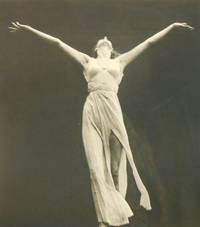
CNWT01Berkeley: Elysian Editions Wesley B. Tanner 1985. First and Limited Edition. Folio in a case. Fine. Mitchell Margaretta K. The printer's proof from an edition of fifty copies seven text pages and twelve photogravures all housed in a clamshell case. This an homage to Angela Isadora Duncan 1877-1927 and the incredible effect she had on modern dance which she initiated at the turn of the last century. <br /> <br /> She "emphasized the dynamics and rhythm of movement invoked the Greeks and refused to perform anywhere but in the sanctified halls of the opera house and concert stage. Duncan avoided all links with dance as it had been known in the nineteenth century - a 'leg business' that was titillating and low class. She remains a key figure in the history of American modern dance primarily because she established dance as a legitimate artistic practice" n.b. info and quote from the online Dictionary of American Biograpy. <br /> <br /> A native of San Francisco she spent much of her adult life in Europe and Russia. However her influence was deeply felt in the San Francisco Bay Area; an admirer and childhood friend of hers Florence Treadwell Boynton and her husband built a home in Berkeley designed by Bernard Maybeck which was named the "Temple of Wings". It was there that Florence created a dance school that adhered to her own beliefs regarding raising children with these beliefs integrated with the dance style of Duncan. Annual summer dance events were held at the Temple of Wings from 1914 through 1985 and it is this style of dance which is celebrated in this photographic portfolio. <br /> <br /> With photographs by Margaretta K. Mitchell b. 1935 whose "photographs belong to the Pictorialist tradition addressing formal concerns of line and shadow primarily in black and white" n.b. from Wiki. Her style shows in the twelve gravure plates in this work which bring to life the interpretation by Duncan and Boynton of the ancient Greek-style of dance. <br /> <br /> Issued in an edition of fifty copies plus nine copies reserved for the participants in the project this the printer's proof copy which we acquired directly from him. Somewhat uncommon in the marketplace as of this writing we see only a single other offering online; our search of OCLC locates four institutional holdings. <br /> <br /> ___DESCRIPTION: The work consists of nineteen sheets in a portfolio box the title page in blue and black four pages of Introduction this followed by the poem "The Dancer" this by the twelve photgravures with the colophon at the end the first page of the Introduction has a small photoengraved illustration printed in black there are nine continous-tone offset illustrations printed in black throughout the Introduction the twelve photogravures are all titled numbered this copy noted as "Printer's Proof" and dated by Margarette Mitchell each photogravure interleaved with archival paper for protection; types Castellar Van Dijck and Garamond on Arches paper the pages measure 19" by 15"; the box is covered in blue cloth with a white paper label mounted onto the front with blue lettering and measures 20 3/4" by 16 1/8". <br /> <br /> ___CONDITION: The text pages and photogravues all fine clean and without wear; the box near fine strong and sturdy but with a few spots of soil and a few areas of light wear including a small tear to the cloth at the bottom of the front of the box. <br /> <br /> ___CITATION: The Book Club of California Quarterly Newsletter Vol. LV Number 4 Autumn 1990 "A Bibliographical Checklist of Wesley B. Tanner Printer" Part II p. 98. <br /> <br /> ___POSTAGE: Please note that this is an extremely large and heavy item and additional postage may apply please inquire for details. International customers also please note that any taxes duty or tariffs charged by your country will of necessity be your responsibility. <br /> <br /> ___Swan's Fine Books is pleased to be a member of the ABAA ILAB and IOBA and we stand behind every book we sell. Please contact us with any questions you may have we are here to help. Elysian Editions [Wesley B. Tanner] unknown
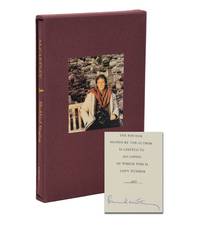
140946132New York & London: W.W. Norton & Company Inc 2001. Signed Limited Edition. Fine/Near Fine. First edition first printing limited issue. Number 129 of a limited 250 copies signed by Paul McCartney on the limitation page. Bound in publisher's original maroon cloth lettered in gilt with a matching cloth slipcase with photographic onlay. Fine in a Near Fine slipcase with light wear. Scarce limited edition collection of Sir Paul's lyrical poems. W.W. Norton & Company, Inc unknown
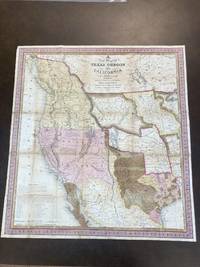
184687887Philadelphia PA: S. Augustus Mitchell 1846. Map. Good Plus. Folding lithographic map 22.75 in. x 21 in. with original color. Map is laid flat in archival plastic and will be securely protected and shipped in a mailing tube. Tanning to seams. Tape repairs and reinforcement on verso to all seams. Tiny losses of paper at six seam junctions. Storm 2841. Wagner-Camp 122b. <br /> <br /> This is Mitchell's third map of Oregon the first being "Oregon and California" published in Mitchell's ;School and Family Geography; and the second being "Mexico and Guatemala" which includes Upper or New California New Mexico and Texas." Wheat Mapping The Transmississippi West 520. Carl Wheat described it as: ".a work of real importance highly popular and.on it the influence of the War wioth Mexico is strikingly revealed.It was among the first by a commercial cartographer to utilize the recent explorations that had bounded and determined the nature of the Great Basin. The Texas claim to a western boundary up the Rio Grande is here shown with the northern panhandle extending all the way to the 42nd parallel.Because of its popularity this map of the West exerted great influence not only on the public but on other commercial cartographers." "The region covered by the map was of particular interest in 1846 because of two recent and related events. In 1845 Texas was admitted into the Union which prompted Mexico to invade Texas in 1846 thus precipitating the U.S.-Mexican war. General curiosity about the new State of Texas and interest in the war with Mexico led to Mitchell's timely map becoming quite popular. Mitchell used the latest and best sources for the map including Arrowsmith's 1841 map of Texas Fremont's and Emory's maps of their explorations in the region data from the Lewis & Clark expedition Nicollet's map of the region between the Mississippi River and the Missouri River Wilkes map of Oregon. <br /> <br /> Among other significant uses of the map Brigham Young ordered 6 copies of the map and an example in the BYU collection includes an annotation placing the Mormons in Utah pre-dating Fremont's map of 1848 which is the first printed map noting the presence of the Mormons in the Great Basin. <br /> <br /> The map shows Texas's claims to the Upper Rio Grande in present-day New Mexico -- eventually given up as part of the Great Compromise of 1850 in exchange for the U.S. Federal Government's assumption of Texas's public debt. One of the most influential maps in Western American History." from Stanford University Library. S. Augustus Mitchell unknown
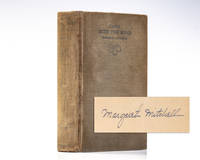
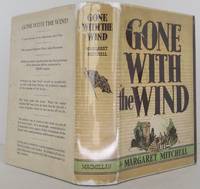
1936149717New York: The Macmillan Company 1936. First edition of Margaret Mitchell's masterpiece which remains one of the fastest selling novels in the history of American publishing with 50000 copies sold in a single day. Octavo original cloth. First printing with “Published May 1936†on the copyright page and no mention of other printings. Boldly signed by Margaret Mitchell on the front free endpaper. In very good condition. Housed in a custom half morocco slipcase. “Mitchell’s sweeping rendition of a South torn apart by civil war… has become national mythology†New York Public Library’s Books of the Century 111. “This is beyond doubt one of the most remarkable first novels produced by an American writer. It is also one of the best… It has been a long while since the American public has been offered such a bounteous feast of excellent story-telling†New York Times Book Review 1936. Said to be the fastest selling novel in the history of American publishing 50000 copies in a single day Gone with the Wind won Mitchell the Pulitzer Prize. The Macmillan Company hardcover
185949436Philadelphia: S. Augustus Mitchell 1859. Large hand-colored wall map on rods approx. 64" square with 4 engraved vignettes 3 inset maps 2 of the world and 1 of the Sandwich Islands all within an elaborate floral border; some infill along the margins slight loss in the population tables at the bottom and several cracks in the paper the whole neatly and professionally backed with linen; overall appearance is certainly very good or better with the usual small defects. America as it was on the eve of the Civil War. Unusual features of this map include the Shoshone Territory what is now mostly Idaho Colona now part of Colorado the unusually large Nebraska the horizontal Utah and New Mexico and the unusually small Dakotas. Phillips Maps of America lists only the 1856 edition. OCLC records examples from 1856 1857 both on conjoined sheets 1858 1860 and 1861 but not this. S. Augustus Mitchell unknown
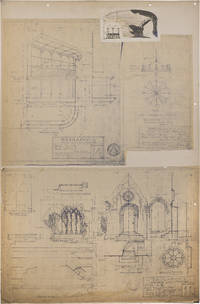
160189N.p.: N.p. 1978. Archive of approximately 200 original blueprints of set plans schematics and designs as well as photographs drawings notations and newspaper and magazine clippings for various Broadway and off-Broadway productions Metropolitan Opera productions film and television productions as well as various ballet companies including the National Ballet Company mounted on 62 oversize art boards 1943-1978. <br /> <br /> Detailed inventory and all images available upon request. Serious purchase inquiries only please.<br /> <br /> An expansive archive of sets and schematics blueprints for over 30 various productions from 1943 to 1978 all mounted on the rectos and versos of 62 oversize artboards the majority of which contain 1-6 blueprints per panel side. Included in the archive are 59 panels of blueprints for 16 Broadway and off-Broadway productions 1943-1978 36 panels for four Metropolitan Opera productions 1963-1967 as well as layout plans for the MET at Lincoln Center from 1965 the year before it premiered twelve panels for three film productions 1960-1971 three panels for two television productions 1959 and 1961 as well as panels of blueprints for the National Ballet circa 1962 the Pennsylvania Ballet circa 1963 the Columbia Theatre Association Ballet 1953 and various other film and theatre productions.<br /> <br /> From the estate of Boston sculptor Robert Berks who in his early years painted movie and theater backdrops as well as blueprint work for industrial design. <br /> <br /> All material Very Good to Very Good plus mounted to rectos and versos of boards as originally maintained.<br /> <br /> Shipping billed at cost. N.p. unknown
181969865Atlanta Georgia August 18 1936. attractively matted and framed with the envelope to an overall size of about 20 x 16 inches. . Light horizontal creases where folded to fit the envelope; otherwise very fine. 10-1/2 x 7 inches. Mitchell thanks her correspondent for her kind remarks about "Gone With the Wind" and the verisimilitude of her characters: "I know no higher compliment that can be paid to an author." Her second paragraph discusses the novel's ending and the future of Scarlett and Rhett and concludes "I do hate to write. Just now I feel that I will never write anything again." unknown
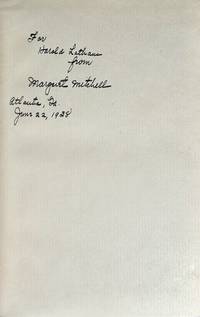
19389586<p>Inscribed <em>For Harold Latham from Margaret Mitchell- Atlanta Ga June 22 1938 </em>to the front endpaper. Harold Latham is best known for discovering Mitchell on a 1935 trip to Atlanta for Macmillan Inc. and later helping to edit <em>Gone with the Wind. </em>Twelfth impression of the English edition. Turquoise cloth with an unclipped dustjacket. Tape repairs to jacket as well as a loss to head see image. Wrapped in protective mylar. A nice clean copy with no previous owners' names or other defacements.</p><p>6.25 x 9 in</p> Macmillan and Co. hardcover
193616972JNew York: Macmillan 1936. First Edition First State May 1936. A little light wear a very good copy in original gray cloth with blue stamping in a very good first issue dust jacket which has had some mends by an expert paper conservationist. Winner of the Pulitzer Prize and the basis of the classic 1939 motion picture starring Vivien Leigh and Clark Gable. Macmillan hardcover
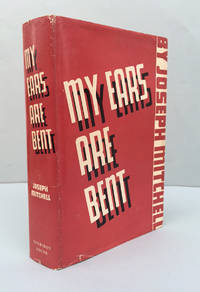
193823845New York: Sheridan House 1938. First edition of the author's first book. Hardcover. A resplendent copy in a bright dust jacket of a poorly made book. 8vo. With a droll frontispiece photograph of Mitchell who is sitting in a chair with newspapers strewn around his bare feet one of which completely obscures his face. Mitchell along with A.J. Liebling and St. Clair McKelway would become a New Yorker star of the first rank during the magazine's heyday. His carefully limned portraits of New York low-life institutions McSorley's Tavern and individuals Joe Gould and his putative oral history of the world earned him critical praise as well as imitators. <br /><br /> Sheridan House hardcover
1939600114<p>"Margaret" in black fountain pen ink on personal letterhead Atlanta May 3 1939. 4to 3 separate pages. To Mable and Edwin Granberry: " We have been in one of our hurricanes. It all started when Selznick at last announced Miss Vivien Leigh and things are just now quieting down." She then goes on to ponder an invitation to Long Beach New York. On page two she comments on that year's Pulitzer Prize-winner: "Of course you know about Marjorie Rawlings getting the Pulitzer award. There never was much doubt that she would get it if there was any justice anywhere.I do not know whether the award will keep her too busy to make this trip. The members of the Atlanta Women's Press Club have asked me to give a party for her should she come as they are all anxious to meet her." Mitchell closes with mention of the book which made her famous: "I was interested in your remarks about finding a GWTW mention in an article written by a Chinese. I did not see the article and if you have to or know who wrote it I'd be interested. As far as I know the book has not been done into Chinese.I am just learning now that it was published in Japan a year and half ago and that it has sold 150000 copies there. I will not get a cent from this because Japan has a treaty with the United States which gives them the right to translate and publish American books without paying royalties to the authors." Mitchell met Edwin Granberry when he wrote an early laudatory review of GWTW; he later interviewed her for his March 13 1937 article "The Private Life Of Margaret Mitchell." They became friends and frequent correspondents see Darden Pyron's "Southern Daughter" for numerous comments. Not in "GWTW Letters." Mitchell 1900-49 American writer; author of the 1936 Pulitzer Prize winning "Gone With the Wind" filmed by MGM in 1939 under directors George Cukor and Victor Fleming starring Clark Gable and Vivien Leigh.</p>
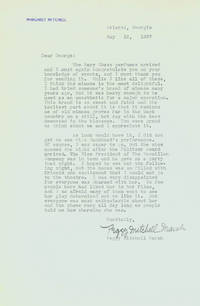
1937252027Atlanta Georgia 1937. One page on personal letterhead. 4to. light creasing and toning esle fine. One page on personal letterhead. 4to. Mitchell thanks Cukor for the gift of Mary Chess perfumes and especially the "mimosa":<br /> <br /> "I had tried someone's brand of mimosa many years ago but it was heavy enough to be used as an anesthetic for a major operation. This brand is so sweet and faint and the lovliest part about it is that it reminds me of old mimosa groves far in the back country on a still hot day with the bees demented in the blossoms."<br /> <br /> She then goes on to discuss Tallulah Bankhead's recent performance in Atlanta which she unfortunately missed:<br /> <br /> 'Of course I was eager to go but the show opened the night after the Pulitzer Award arrived. The Vice President of The Macmillan Company was in town and he gave me a party that night. I hoped to see her the following night but the house was so filled with friends and excitement that I could not go to the theatre. I was very disappointed for everyone was charmed with her. So few people here had liked her in her films and I am afraid many of them went to see her play determined not to like it. But everyone was most enthusiastic about her and the phone rang all day long as people told me how charming she was. "<br /> <br /> Mitchell won the Pulitzer Prize in 1937 for her novel GONE WITH THE WIND; and George Cukor was David Selznick's first choice as director of the film. unknown
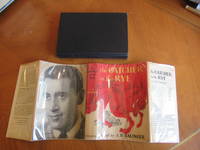
1951023353Boston: Little Brown & Co. 1951. First Edition stated 1st Printing. Black Cloth. Near Fine/Fine Dustjacket. 8 1/8" Tall. Stated First Edition 8 1/8" Tall Taller Than Some Other Copies Stating "First Edition" 1 5/16" Thick Thicker Than Some Other Copies Stating "First Edition". The Book Is Tight And Clean No Marks Without Marks Or Damage Just A Tiny Point Of Fraying Of Cloth At Each Of The Two Lower Tips A Little Wear/Dulling To The Spine Gilt And A Little Rubbing/Bumping To The Ends Of The Spine. Dust Jacket With The Portrait Of Salinger On The Rear Panel And With The $3.00 Price On The Front Flap Second State With Slight Space Between Top Of Head And Top Of Dust Jacket Apparently The First Issues Of The "First Edition" Were Slightly Shorter And With Cropping Of Salinger's Head In The Photograph On The Dj. The Dust Jacket Is Spectacular No Chipping Or Tears Without Restoration Or Cleaning Of Any Kind: No Fading To Orange-Red Or Yellow Colors On Spine And Front Panel The Red On Both Spine And Front Panel Being An Even Bright Red And The Author's Name On Spine Being The Same Bright Yellow As The Title On The Front Panel. There Is Not Any Sign Of Wear At The Top Of The Spine Panel And It Is Still Crisp. The Jacket Has 1/8" Light Age Toning To The White Color Along The The Lower Edge Of Front Panel To Top And Lower Edges Of White Flaps And Within A Somewhat Larger Area Around All Edges Of The Photograph. There Is A 1/8" Rub At The Upper Right Tip Of The Front Panel But No Other Rubs To The Color. There Is Almost Imperceptible 1/8" Bumping To Lower Edge Of Spine And Slight Waviness Along The Very Bottom Edge Of The Front Panel Without Damage To The Paper In The Area With Age-Toning Possibly Due To Storage In An Older Dust Jacket Protector. Scarce In This Un-Restored Un-Torn And Un-Chipped Jacket. <br/> <br/> Little, Brown & Co. hardcover
2001021472W W Norton & Co Inc 2001. Book. Fine. Hardcover. Signed by Authors. 1st Edition. #42 of only 250 copies of the signed limited edition. Bound in maroon cloth with marbled end papers and housed in a matching cloth slipcase with a photo of Paul McCartney on the front . W W Norton & Co Inc Hardcover
1936103Very Good in a Very Good dust jacket. No edge wear with one very small tear at the top of dust jacket's right corner. SEE PICTURES- I have uploaded 8 pictures fro you to view ; 8vo 8" - 9" tall<i><b><br /><br />From Wiki:<br />Gone with the Wind</b></i> is a 1939 American epic historical romance film adapted from Margaret Mitchell's 1936 novel<i>Gone with the Wind</i>. It was produced by David O. Selznick of Selznick International Pictures and directed by Victor Fleming. Set in the American South against the backdrop of the American Civil War and Reconstruction era the film tells the story of Scarlett O'Hara the strong-willed daughter of a Georgia plantation owner from her romantic pursuit ofAshley Wilkes who is married to his cousin Melanie Hamilton to her marriage to Rhett Butler. The leading roles are portrayed by Vivien Leigh Scarlett Clark Gable Rhett Leslie Howard Ashley and Olivia de Havilland Melanie. Macmillan hardcover
141846N.p.: N.p. 1970. Archive of 16 photographs seven double weight and ten single weight of rock performers circa the late 1960s and early 1970s. Struck by photographer Jim Marshall circa 1990s most with his stamp and manuscript identification number on the verso. <br /> <br /> Artists represented include Bob Dylan The Rolling Stones The Who Bob Dylan Joni Mitchell Sly and the Family Stone Santana Jim Morrison Tina Turner The Allman Brothers Band including standalone shots of Duane Allman and others. The Santana photos are especially notable as the band already a live sensation is performing at Woodstock just ahead of the release their first album. <br /> <br /> As a photographer for both record labels and magazines such as "Rolling Stone" Jim Marshall was one of the most prolific and influential chronicles of rock music during the 1960s and 1970s. Among his most iconic photographs are images of Jimi Hendrix setting his guitar on fire at Monterey Pop Johnny Cash performing at San Quentin and The Beatles backstage at their final live concert at Candlestick Park. In 2014 he was posthumously awarded a Lifetime Achievement Grammy the only photographer to be so honored. <br /> <br /> Photographs variously 5 x 7 inches and 8 x 10 inches. Fine overall. <br /> <br /> For details please inquire. N.p. unknown
1888106806Philadelphia: J.B. Lippincott Company 1888. Rare first edition presentation copy of the father of American neurology's most popular work. Octavo original cloth with gilt titles to the spine and front panel. Presentation copy inscribed by the author on the front free endpaper "Mrs. Johnson with the author's regards." Weir has also noted "25 copies large paper No. 19." In near fine condition. One of Mitchell's most popular works Doctor an Patient provides a prime example of the eminent physician's direct appeal to the common sense and intelligence of the layman at large. Addressed chiefly to women the essays include: The Physician Convalescence Pain and Consequences The Moral Management of Sick or Invalid Children Nervousness and it Influence on Character and Out-Door Camp-Life for Women. The work quickly gained popularity upon publication and went through four revisions. Mitchell's more prominent patients included Charlotte Perkins Gilman and Virginia Woolf who wrote a savage satire of his treatments in her 1925 novel Mrs. Dalloway. J.B. Lippincott Company hardcover
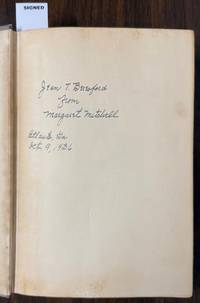
1936327851New York: Macmillan 1936. Reprint. hardcover. very good/very good-. 6 1037 pages. Thick 8vo original gray cloth very lightly worn at extremes and spine just a touch sunned iconic d.w. un-clipped and largely intact but well-rubbed and with chipping at ends and folds. New York: Macmillan 1936. Later printing 16th dated Sept. 1936.<br/> <br/> A very good copy in a very good- dust wrapper -- Inscribed and dated by Mitchell on the front free endpaper: "Jean T. Beresford from Margaret Mitchell Atlanta Ga Oct. 9 1936"<br/> <br/> Macmillan unknown
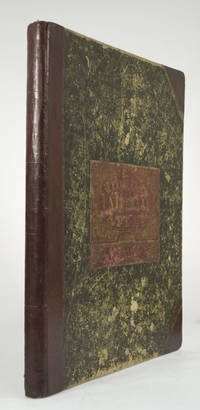
185265704Philadelphia: Cowperthwait & Co 1852. Complete with seventy-three full colored maps one of which is double-paged color frontispiece vignette title-page and table of contents heightened in gilt. Folio 17 x 14 inches; 430 x 355 mm.<br> <br> Half red morocco over marbled boards. Front board with red morocco label lettered in gilt. Binding scuffed and bumped. Hinges professionally repaired. Some toning throughout mainly to blank versos of maps and margin edges only occasionally affecting the maps. Closed tear to front free endpaper. A few instances of foxing on maps mainly to map 51 "Holland and Belgium." A small dark spot in Buenos Ayres on map 44. A small piece scraped off of map 73 "Oceana" but not making a hole all the way through. Also a marginal closed tear to this map professionally repaired. Overall a very good copy.<br> <br> This atlas was first published in 1846 by Mitchell & Sons after acquiring the rights to Tanner's New Universal Atlas in 1845. Mitchell & Sons reprinted it several times until 1850 when they sold the rights to Cowperthwait & Co. of Philadelphia who published it until 1856. During this time the atlas was further expanded and edited. Over half of this atlas deals with the Americas and features the double-page "A New Map of the United States of America." Within this map of the USA is a detailed inset of "The Gold Regions of California." The present edition is the first to show counties in California and New Mexico.<br> <br> Howes. Streeter.<br> <br> HBS 65704.<br> <br> $6500. Cowperthwait & Co unknown
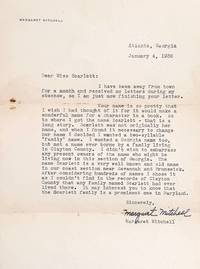
19362961Atlanta: NP 1936. Letter. Very Good. LETTER WRITTEN AND SIGNED BY MARGARET MITCHELL DETAILING NAMING OF CLASSIC CHARACTER SCARLETT O’HARA. Margaret Mitchell’s Gone With the Wind was published in the summer of 1936 to almost instantaneous success—reaching one million in sales by December at the unheard-of price of three dollars a monumental fee in an America still recovering from the Great Depression. Immediately the book polarized public debate. On one side were the critics: so-called ‘serious’ writers and high-brow detractors bemoaning as Nathaniel Hawthorne once put it “a damned mob of scribbling women†feeding “trash†to the public imagination. On the other side was a public deeply engaged with Mitchell’s powerful storytelling. As even Mitchell’s harshest critics admitted even if Gone With the Wind was not a great novel it did undoubtedly make the reader “weep at a deathbed†and “exult at a sudden rescue.†In an America still reeling from the Great Depression this escape was a much-needed one.<br /> <br /> Straight away Gone With the Wind’s protagonist Scarlett O’Hara confounded the public. Psychoanalytic journals and public psychiatrists concluded that “America’s new princess was a ‘partial psychopath’ and a person of ‘inward hollowness.’†Mitchell was amused and excited by the public’s response although at times frustrated by the press’s questions. When asked by a Vogue reporter to analyze Scarlett O’Hara in terms of her ‘modernity’ Mitchell responded by asking the reporter if they thought “hard-headed women only came to life in the 1930s Why don’t they read the Old Testamentâ€<br /> <br /> Some argued that Scarlett O’Hara served as a symbol of new and changing gender roles. A 1939 Reader’s Digest poll found that O’Hara’s primary appeal lay in her position as “the master of her world rather than its victim.†A 1957 survey of high school girls found that three-quarters of respondents identified themselves as Scarlett over any other character in the book. In this way many young women in the mid-20th century saw Scarlett O’Hara as a symbol of the bold women they might want to be—a character defined by as the novel’s dust jacket put it her identity as “a loyal friend and true gentlewoman.â€<br /> <br /> This is a letter postmarked January 5th 1937 only seven months after the original publication of Gone With the Wind during the crucial period in which the public discussed analyzed and fought over who Scarlett O’Hara was—and what she might represent. In this letter Mitchell responds to a fan named Miss Gay Scarlett asking about the origin of the name Scarlett O’Hara.<br /> <br /> In response to this question Mitchell expresses concern regarding the naming of her character—claiming she “didn’t wish to embarrass any present owners of the name†although she wished to convey to Miss Gay Scarlett that her full “name is so pretty that I wish I had thought of it for it would make a wonderful name for a character in a book.†It is quite unique that Mitchell expresses fear of embarrassing someone with the last name Scarlett rather than O’Hara demonstrating the intense care Mitchell put into her writing researching individuals with the first and last name Scarlett before naming her characters. Mitchell also shows her sensitivity towards the concerns of her reader responding to their questions with kindness and interest.<br /> <br /> As part of an America searching for themselves in Scarlett O’Hara the letter writer Miss Scarlett looked for a deeper understanding of her own name by prodding Margaret Mitchell on her character’s identity. Even as Gone With the Wind’s critics derided the book as empty Miss Scarlett’s letter shows the intense meaning imbued in every aspect of the book by a deeply interested American public.<br /> <br /> The text reads in full:<br /> <br /> “Atlanta Georgia<br /> January 4 1936 but actually 1937<br /> <br /> Dear Miss Scarlett:<br /> <br /> I have been away from town for a month and received no letters during my absence so I am just now finishing your letter.<br /> <br /> Your name is so pretty that I wish I had thought of it for it would make a wonderful name for a character in a book. As to where I got the name Scarlett — that is a long story. Scarlett was not originally her name and when I found it necessary to change her name I decided I wanted a two-syllable “family†name. I wanted a Georgia name too but not a name ever borne by a family living in Clayton County. I didn’t wish to embarrass any present owners of the name who might be living now in this section of Georgia. The name Scarlett is a very well known and old name in our coast section near Savannah and Brunswick. After considering hundreds of names I chose it as I couldn’t find in the records of Clayton County that any family named Scarlett had ever lived there. It may interest you to know that the Scarlett family is a prominent one in Maryland.<br /> <br /> Sincerely<br /> <br /> signed Margaret Mitchell<br /> <br /> printed Margaret Mitchell†<br /> <br /> Atlanta: np 1936. One page on one sheet 7.25 x 11 in of Mitchell's letterhead with her name printed in blue at top left. With original envelope postmarked Jan 5 1937 from Atlanta and with Mitchell's address on back. Letter with usual folds a few spots around folds but generally very good with signature particularly dark. Envelope with significant toning. Housed is custom presentation folder. <br /> <br /> References<br /> -Pierpont Claudia Roth. “A Critic at Large: A Study in Scarlett.†The New Yorker August 31 <br /> 1992 p. 87. NP unknown
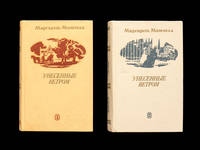
26<p><strong>This is a very rare first hardcover edition of Margaret Mitchell's Gone with the Wind Russian: УнеÑённые ветром published in 1982 by the Khudozhestvennaya Literatura Russian: ХудожеÑÑ‚Ð²ÐµÐ½Ð½Ð°Ñ Ð›Ð¸Ñ‚ÐµÑ€Ð°Ñ‚ÑƒÑ€Ð° publishing house in two volumes: the first volume was translated by Tatyana Ozerskaya Russian: ТатьÑна ОзерÑÐºÐ°Ñ the second by Tatyana Kudryavtseva Russian: ТатьÑна КудрÑвцева. A total of 10000 copies were printed which is a very small circulation for the USSR with its multi-million copies.</strong></p> Khudozhestvennaya Literatura hardcover
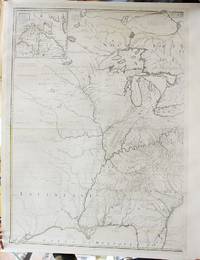
1770M10905Paris c.1770. Very Good backed on linen for long term preservation. Notes: French edition of Mitchell's map of the Central and Southern part of North America. It lacks the Eastern part.<br>The map was used for every treaty and boundary dispute from the French & Indian War until the end of the 19th Century. This example was published by the French cartographer Georges Le Rouge. Size : 1300x950 mm 51.18x37.40 Inches Coloring: Original Outline Coloring Category: Maps United States; unknown
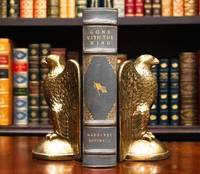
1936890New York: The Macmillan Company 1936. First Edition First Issue. Fine Leather Binding. Near Fine. A near fine example beautifully bound in 3/4 leather. Faint amount of rubbing to extremities. Binding and hinges are excellent pages are remarkably bright and clean no marks or writing no foxing. Book measures 8.75"x6". First Edition First Issue published May 1936. A stunning example scarce in leather. The Macmillan Company unknown
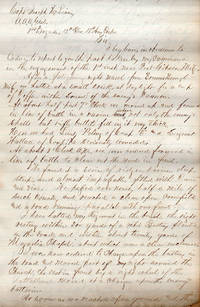
5491In the field Port Gibson Mississippi May 1863. 4to 8" x 12" lightly lined sheets fastened together at top. 33 pp. of manuscript. <p>A compelling brigade battlefield report composed in the immediate wake of the Battle of Port Gibson Mississippi 1 May '63 an assault that set the stage for Grant's pivotal siege of Vicksburg; the eight reports of Army of the Tennessee regiments and batteries chronicle extensive combat; the capture of Confederate colors; the taking of hundreds of rebel prisoners and guns; casualties and more.</p> <br /> <br /> <p>Likely transcribed by a regimental brigade clerk this fascinating document comprises highly detailed reports submitted by regimental and battery commanders with a prefatory brigade report by Brig. Gen. George F. McGinnis 1826-1910 Commander of the 1st Brig. 12th Div. 13th Army Corps of the Army of the Tennessee. Included here are the official reports for each of the following regimental battery commands: the 11th 24th 34th and 46th Indiana; the 2nd and 16th Ohio; and the 29th Wisconsin. All reports record combat and provide accounts of the participation of these regiments and batteries in the Battle of Port Gibson. Commanders whose companies endured serious casualties append lists of the killed and wounded and often record the specific nature of injuries.</p> <br /> <br /> <p>The seven regimental reports were written by the following commanders: Col. Dan Macauley 11th Indiana Inf.; Col. Wm. J. Splicely 24th Ind. Inf. Vols.; Col. R. H. Cameron 34th Ind. Inf. AKA "Morton Rifles"; Col. Chas. R. Gill 29th Regiment Wis. Inf.; Capt. James A. Mitchell 16th Ohio Inf.; Col. Thos. H. Bringhims 46th Ind. Inf.; Lieut. Aug. Beach 2nd Ohio Bat.</p> <br /> <br /> <p>The Battle of Port Gibson-in which the Union prevailed-was fought near Port Gibson Mississippi during Grant's Vicksburg Campaign. On 30 April '63 the Army of the Tennessee-composed of the 13th and 17th Corps-crossed the Mississippi River at Bruinsbur some thirty miles south of Vicksburg. Grant sought to move east toward the capital at Jackson Mississippi to prevent the Rebel Army commanded by Gen. Joseph E. Johnston from reinforcing Vicksburg. Port Gibson-ten miles east of Bruinsburg on the Bayou Pierre River-was the best route of approach and thus became the Union's primary target.</p> <br /> <br /> <p>Intense fighting broke out around midnight on 1 May when Union forces came upon Rebel Maj. Gen. John Bowen's men in the brush around Port Gibson. After a brief cessation the battle continued again at dawn. The fighting continued for the majority of the day as multiple Confederate lines suffered under the weight of the Union assault. After a rebel counterattack was thwarted in the late afternoon the Confederate forces retreated for good. 131 of Grant's men were killed and 719 were wounded of the 23000 engaged; 60 Confederate men-including Gen. Edward Tracy-were killed and 340 were wounded of some 8000 engaged. While Grant lost more men his victory enabled his army to secure a foothold on Mississippi soil.</p> <br /> <br /> <p>In turn Grant launched his campaign deeper into the interior of the state and started moving his army inland and eastward towards Jackson without resistance. Revealing the Confederate's inability to defend the line of the Mississippi River the Union victory forced the Confederate evacuation of Grand Gulf precipitating the fall of Vicksburg. "Local lore has it that Union forces marching through Mississippi spared the town of Port Gibson from the torch because it was too beautiful to burn" American Battlefield Trust.</p> <br /> <br /> <br /> <p>SOME REPRESENTATIVE PASSAGES:</p> <br /> <br /> <p>May 6 1863; Brig. Gen. George F. McGinnis "The balance of my brigade moved rapidly to the front and were soon within range of a rebel battery supported by a brigade of Infantry.a fearfully destructive fire was poured upon them that Col. Cameron very properly and with much coolness and judgment halted his command and protected them from the enemy's fire behind the brow of the hill.the 11th Ind. which had been in reserve moved to the front in double quick.the gunners and horses were shot down and the brigade in support turned their backs upon us and fled in confusion from the field. The result of this gallant dart.was the capture of the two twelve pounder Howitzers three Caissons three wagons loaded with ammunition three stand of colors several horses and over two hundred prisoners."</p> <br /> <br /> <p>Col. Dan Macauley 11th Ind. Inf. "My command was immediately ordered forward to support the 2nd .took up a position in the ravine and on the brow of the hill and opened fire upon the enemy. At this point the conflict was terrific and was kept up without any intermission whatever for an hour and thirty-seven minutes when the enemy finding that they could not drive us from our position retreated in dismay and made no further resistance on that part of the field. During this last engagement I received information that the rebels."</p> <br /> <br /> <p>"The 24th Ind. and 29th Wisconsin stood the brunt of this engagement occupying the front and most dangerous position. It was here that their heaviest loss occurred owing to the nature of the ground on which they moved.The expressions of admiration in which the two batteries were handled the precision and rapidity with which they were fired were frequent and well deserved. Officers and men are entitled to much praise."</p> <br /> <br /> <p>"I cannot refrain however from special mention of the 29th Wisconsin not that they fought longer or more gallantly than others; not that are more brave or better disciplined but that it is a new Regiment and this was the first time that they had been engaged with an enemy or that any of their men had even been under fire. They fought like veterans and suffered severely as their report of casual this will show."</p> <br /> <br /> <p>"A deep ravine choked by an almost impassable canebrake and undergrowth was before no through which with great exertion we succeeded in forcing our way. there was stationed a rebel battery supported by a heavy force of infantry."</p> <br /> <br /> <p>Col. Wm. J. Splicely 24th Ind. Inf. Vols. "At about daylight on the morning of May 1st 1863. Here we formed in line stacked arms and commenced breakfast. At about 7 O'clock A.M. while eating our whole line was assailed by a terrific shower of shot & shell from the enemy's batteries. Our line was soon formed.we moved rapidly over the hills and ravines and dense thickets of cane vines and underbrush."</p> <br /> <br /> <p>"We moved forward at double quick time formed in line in a deep gulch or ravine & were soon engaged with the enemy.The battle at this point raged fiercely for one hour & a half; my men standing up like veterans under this terrific fire the whole of that time. Here it was that I lost most of the killed & wounded of my command. About 3 o'clock PM the enemy gave way and left us in possession of the field."</p> <br /> <br /> <p>Col. R. H. Cameron 34th Ind. Inf. "After a fatiguing night march from Brewers Borough Mississippi. we halted at a small creek at daylight for a cup of coffee within sound of the enemy's cannon.we moved up and formed in line of battle in a ravine where not only the enemy's shells but rifle bullets fell in it very thick. Here we had Lieut. Poling of Comp. "E" and Sergeant Hallace of Comp. "H" seriously wounded."</p> <br /> <br /> <p>"After a hot fire for fifteen minutes the 11th Ind. came to our relief and both Regiments advanced with a shout upon the rebel guns.At this point it was impossible to distinguish the 11th Ind. from my own regiment except by their uniform as they were indiscriminately mixed with each other and the enemy."</p> <br /> <br /> <p>Col. Chas. R. Gill 29th Reg. Wis. Inf. "The well directed fire from my Reg. prevented the advance of this part of his line one foot. I produced fearful slaughter in the enemies ranks.I take great pleasure and pride in informing you that although he position of the regiment was a trying one being unexpectedly attached & so situated that it could not change position to advantage no man flinched-all faced the enemy bravely while their comrades fell dead & wounded at their sides.The night before the battle the Reg. had marched all night with knapsacks four days rations in harisacks & one hundred rounds of ammunition to each man."</p> <br /> <br /> <p>Capt. James A. Mitchell 16th Ohio Inf. "In front of the Battery the enemy appeared in large numbers in the bushy field beyond the ravine.-Formed Battery & commenced firing immediately with what effect could not be seen as the enemy were concealed in the grass & bushes. From this point about a mile to the east on a high hill commanding a full view of the field was what appeared to be the enemy's post of observation or Head Quarters."</p> <br /> <br /> <p>"During the action up to about 4 P.M. when the enemy disappeared from the Battery's front the men were exposed to a brisk fire from the enemy's sharpshooters said to be posted in the trees-although the gun carriages were struck several times by rifle balls yet strange enough none of the men or horses were injured."</p> <br /> <br /> <p>A rich compilation of reports composed in the immediate aftermath of the Battle of Port Gibson.</p> <br /> <br /> <p>REFERENCES: American Battlefield Trust. May 1 1863 The Battle of Port Gibson and Port Gibson at battlefields.org</p> <br /> <br /> <p>CONDITION: Short tears some staining and soiling mainly on the first and final few pp.; last leaf frayed along bottom edge; contents generally quite clean formerly rolled up a few missing letters to a few pp.</p> In the field, Port Gibson, Mississippi, May 1863 unknown