17 088 résultats
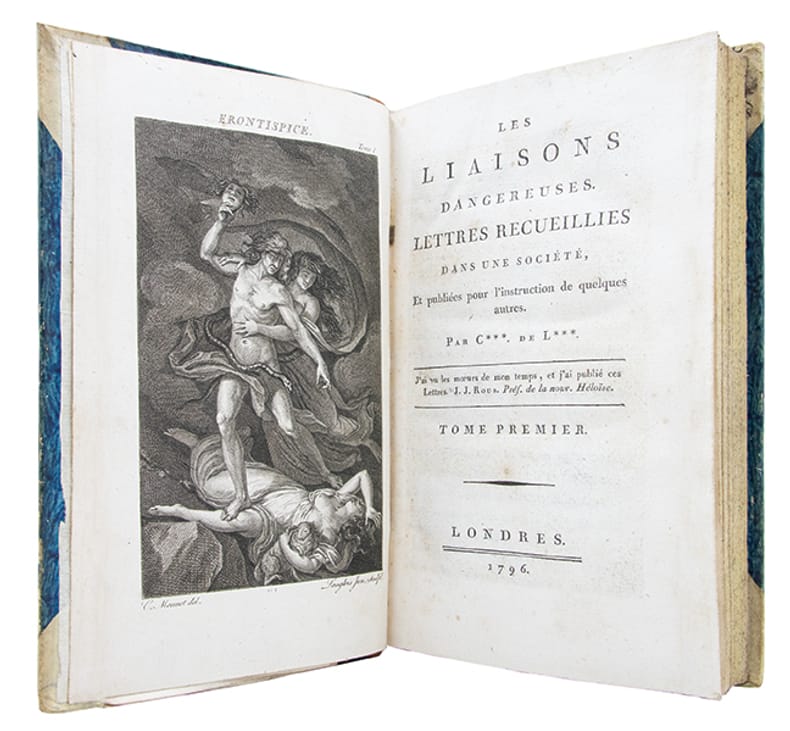
2 volumes in-8 (199 x 120 mm), plein veau blond raciné de l'époque, dos lisses ornés de compartiments alternativement garnis d'une résille dorée, fleurons, filets ondulés et palettes dorés, plats encadrés d'un jeu de filets perlés et roulettes dorés, roulette sur les coupes et les chasses, pièces de titre et de tomaison de veau rouge, tranches dorées, planche frontispice gravée, 415 p., 7 planches gravées (tome I) et frontispice, 398 p., 6 planches (tome II). Un des livres illustrés les plus célèbres du XVIIIe siècle, exemplaire de premier tirage sur papier vélin, orné de deux frontispices et de 13 figures de Charles Monnet, Marguerite Gérard et Alexandre Fragonard gravées par Baquoy, Duplessi-Bertaux, Dupréel, Godefroy, Langlois, Lemire, Lingée, Masquelier, Patas, Pauquet, Simonet et Trière. Cette suite iconographique est considérée comme la plus aboutie du XVIIIe siècle. "These striking plates form the outstanding contemporary interpretation of the 'Liaisons dangereuses'. They are not likely to be superseded, however, often this celebrated novel is illustrated" (G.N. Ray, 'The Art of the French Illustrated Book, Pierpont Morgan Library', 1982, n° 82). (Cohen, 235-237. Sander, 356). Petit accroc à une coiffe, piqûres au premier cahier du t. 1. Des bibliothèques Richard d'Aubigny, Mme Belin (catalogue, 1936, n°364) et Gérard de Berny (catalogue, III, 1959, n° 15). Bel exemplaire, grand de marges, imprimé sur papier vélin, bien relié à l'époque.
pp. 64 n.n. in quartini sciolti con 15 belle e grandi incisioni numer. e firmate da A. Sassu , stampate da Enrico maioli. Allegato un fasc. di 20 pag. con la traduz. in italiano delle poesie a cura di Francesca Valente. Ediz. di 127 es. : 70 num. arabi , 50 num. romani (da I a L), 7 con lettere (da A a G). Nostro n. 62/70. Raro livre d'artiste eseguito per il mercato americano in perfetto stato di conservaz. Testo composto a mano in carattere Caslon e stampato da Luigi Maestri. Importante volume impreziosito da alcuni dei più bei lavori incisori dell'artista italiano , abbinati a una raccolta di poesie di Irving Layton, pseudonimo di Irving Lazarovitch ( 1912- 2006 ), poeta canadese, nato in Romania, i cui genitori di origine ebrea emigrarono a Montréal quando Layton aveva un anno. Cfr. Opera citata con fotogr. sullo Jentsch, I libri d'artista italiani del Novecento, p. 307; P. Bellini, Aligi Sassu, Catalogo dell'opera incisa e litografica, 497-511; Bolaffi, Catalogo della grafica italiana, 1978, ad vocem, 119243-119256; Luigi Maestri, Mezzo secolo di arte tipografica, Milano Biblioteca Trivulziana, 1992, p. 48.
19102532ADeutschland oder Österreich, um 1910. Jeweils ca. 50 x 40 cm. Unter Passepartouts im Format 80 x 60 cm oder etw. kleiner.
19091787BWien, Privatdruck der Gesellschaft Österreichischer Bibliophilen, Stück XVII, 1909. 4°. 7 S. (Titel u. Einleitung) und 12 Tafeln mit Illustrationen unter betitelten Seidenhemdchen. HLeinen d. Zt. mit goldgepr. RTitel. Die Orig.-Broschur mit Fronttitel mit eingebunden.
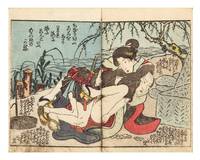
7716Seven double-page one of which has flaps & folds out into a four-panel scene and two single-page woodcuts all finely color-printed and nine double-page black & white woodcuts. One color-printed title-page pasted down on inner upper wrapper 24 folding leaves. Small 8vo orig. color-printed upper wrapper with embossing decorated lower wrapper new stitching. Edo: Preface dated 1864.<br/> <br/> First edition and very rare; we find no copy in WorldCat. The Preface was written by Tanekiyo Ryusuitei 1823-1907 using his pen name “Insuitei.†<br/> <br/> Following one of the frequent fires in the famous pleasure quarters of Yoshiwara often started by the prostitutes in an effort to free themselves many brothels temporarily re-established themselves in other locations throughout Edo. This book was issued as sort of a guide to the newly relocated brothels and very much reflects the changes that shunga books were going through during the end of the Edo period.<br/> <br/> The first double-page woodcut depicts the exterior of a thriving brothel in Edo with many prostitutes within looking out to the numerous passing men and women on the bustling street. This opens up into a four-panel image of the interior of the brothel showing men being entertained and engaging in several sexual activities. The following six double-page woodcuts depict the “star†prostitutes all engaged in sex with the names of the brothels where they worked. All the rooms shown are very luxuriously furnished with silk screens ornate fabrics and beautiful furniture. These woodcuts are all printed in richly saturated colors including silver and gold pigments and with complex embossing.<br/> <br/> The cult of sex organs where phalluses are objects of veneration and worship is also exhibited here in a most uncommon image. The final color-printed woodcut — single-page — depicts an altar inside the brothel where a phallus is the center of worship. Envelopes containing cash left by clients are piled in front. See Suzuki Kenko’s most fascinating “Popular Cults of Sex Organs in Japan: Guardian Deities Auspicious Objects and Votive Paintings†in Timothy Clark et al. eds. Shunga. Sex and Pleasure in Japanese Art British Museum: 2013 pp. 364-67.<br/> <br/> The text section contains nine very interesting double-page black-and-white woodcuts showing elaborate scenes of entertainment men and women having “intimate moments†the aftermath of sex with copious dribbling secretions used napkin wipes on the floor etc. These scenes can be described as “action-packed.â€<br/> <br/> Fine and fresh copy. One black-and-white woodcut has two small holes. unknown
191217372ABParis, Piazza, 1912. 30 : 24 cm. 122 páginas, 2 hojas, 20 láminas en color de Umberto Brunelleschi. Marroqui rojo, tapas y lomo abundantemente decorado en oro, contracantos en oro, firmado Durvand.
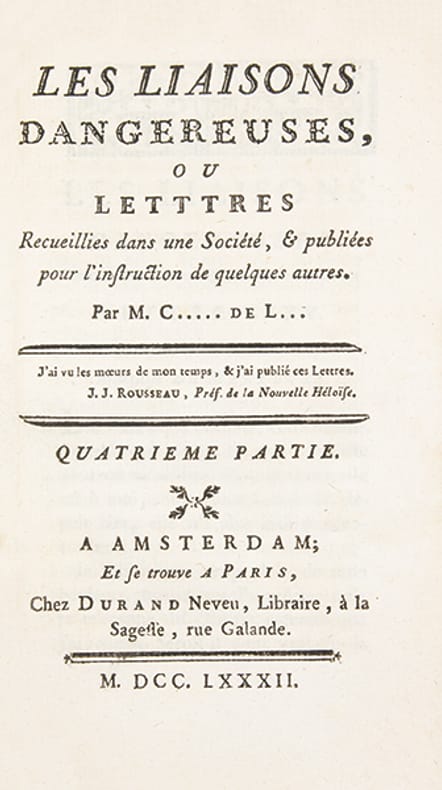
1792389781792 4 parties reliées en 2 volumes in-12 (165 x 96 mm), plein veau marbré de l'époque, dos lisses ornés de caissons fleuronnés et cloisonnés, pièces de titre et de tomaison de maroquin havane, tranches marbrées, 248 p.; 242 p.; 231 p. et 257 p. (chaque partie est précédée d'un titre et faux-titre inclus dans la pagination). Amsterdam, et se trouve à Paris, chez Durand neveu, libraire à la sagesse, rue Galande, 1782.
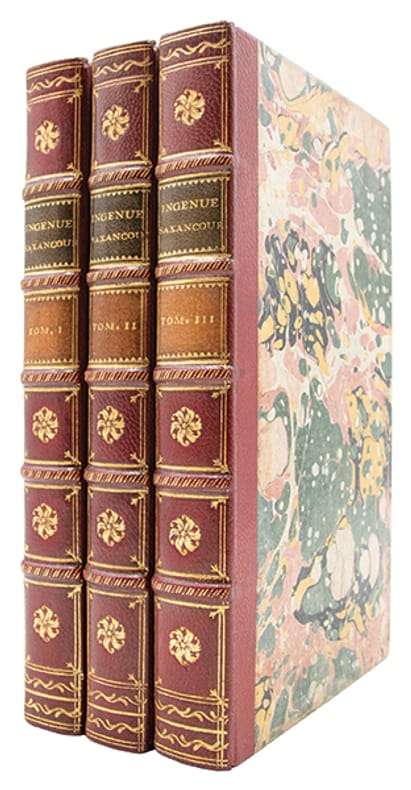
4 parties reliées en 2 volumes in-12 (161 x 96 mm), plein veau marbré de l'époque, dos lisses ornés de caissons fleuronnés et cloisonnés, pièces de titre et de tomaison de maroquin bordeaux, filet à froid en encadrement des plats, coupes filetées, tranches rouges, 248 p.; 242 p.; 231 p. et 257 p. (chaque partie est précédée d'un titre et faux-titre inclus dans la pagination). "Véritable seconde édition", donnée comme "très rare" par Max Brun ('Biblio. des éditions des Liaisons dangereuses', "B", p. 10), parue immédiatement à la suite du tirage "A". Elle est une impression nouvelle, entièrement recomposée, la seule corrigée par l'auteur. Elle contient le même nombre de cahiers et de pages que la première et est imprimée sur le même papier, avec les mêmes caractères. Cette édition a été identifiée par Gérard Willemetz conservateur à la Bibliothèque Nationale, sur l’unique exemplaire alors connu, acheté à Camille Bloch en 1928 (cf. ‘La véritable deuxième édition originale des 'Liaisons dangereuses'’, Bulletin du bibliophile, 1957, n°2, p. 45-52 et Max Brun, ‘Etudes des éditions...’, id., 1958, p. 125-134). "Le 19 juillet 1802, répondant à une question de son fils Etienne sur les exemplaires des ‘Liaisons dangereuses’, Laclos nous apprend qu'il n'a participé qu'à deux éditions de son roman, celles pour lesquelles il a passé contrat avec le libraire Durand: l'édition originale prévue par l'acte du 16 mars 1782 et [cette] deuxième édition, en application de l'avenant du 21 avril 1782, comportant les mêmes nombres de pages, parue en mai. Celle-ci constitue une révision de l'originale, en ce sens que les fautes ont été corrigées. C'est cette seconde édition, plus correcte que la première, que nous reproduisons (…). Aucune des éditions ultérieures n'a d'autorité" (cf. René Pomeau, préface à sa réédition des ‘Liaisons dangereuses’, GF, 2006). Ainsi, cette édition est la seule que Laclos ait personnellement revue et celle qui a servi aux rééditions modernes de son chef-d'oeuvre. Quelques rousseurs et brunissures éparses. Quelques petits défauts de papier marginaux sans perte de texte. Mors légèrement frottés. Bon exemplaire, bien relié à l'époque.
1796394561796 2 volumes in-8 (192 x 122 mm), demi-basane marbrée havane à petits coins de vélin, dos lisses, pièces de titre et de tomaison de veau rouge (reliure de lépoque), frontispice, 415 pages, (1) f. blanc et 7 planches hors texte ; (2) f., 398 pages, (1) f. blanc, frontispice et 6 planches hors texte. Londres [i.e. Paris], 1796.
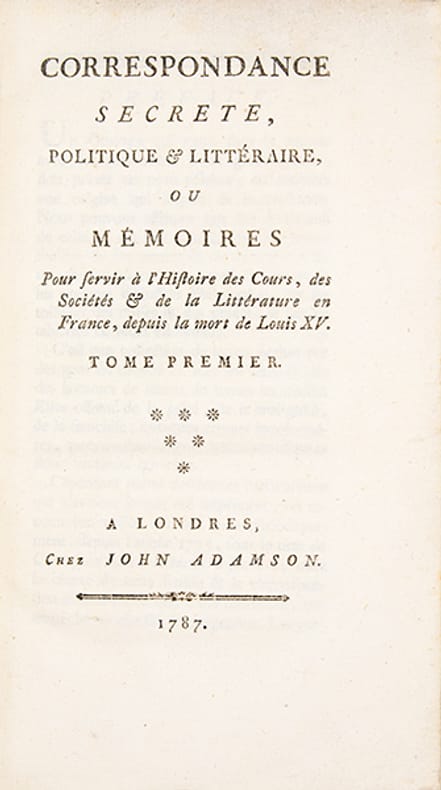
3898818 volumes in-12 (182 x 110 mm), demi-veau havane marbré, dos à 5 nerfs ornés de compartiments fleuronnés et cloisonnés, pièces de titre et de tomaison de veau fauve, tranches supérieures rouges (rel. du XIXe s. dans le goût de l'époque signée L. Pouillet). Londres, John Adamson, 1787-1790.
4 volumi in 8, pp. (2) + 312 + (2) di errata + (2 bianche) con 1 ritratto fuori testo inciso all'antiporta; (2) + 312 + (1) di errata + (1 bianca); (2) + 312; (2) + 312. I 4 frontespizi sono incisi all'acquaforte. Piena pelle con filetti a secco ai piatti e fregi oro ai dorsi della prima meta' del XIX secolo con qualche segno d'uso e pochi restauri ai dorsi e agli angoli. Edizione originale di questa notissima raccolta pubblicata postuma a cura di Lord Pembroke. Definita da Brunet: "Poesies obscenes en patois venitienne, elles ont, - dit - on ete imp. aux frais du Comte De Pembroke". I sonetti di questo nobile veneziano, casto nella vita ma estremamente licenzioso nei suoi scritti, fin tanto che l'autore fu in vita, circolarono sempre manoscritti. Alla sua morte comparve una prima raccolta, piuttosto incompleta, nel 1771. Questa, considerata come la raccolta piu' attendibile e completa, vide la luce a Venezia nel 1789 con falso luogo di stampa. Il giudizio dato di lui da Gamba, in "Serie degli scritti impressi in dialetto veneziano", e' quello che ebbe maggior diffusione per la costruzione dell'immagine di questo poeta, tra i piu' vivaci del suo tempo: "...Non v'ha scritto di Giorgio Baffo che non sia licenzioso, e l'autore valse a dare il suo nome ad ogni altra composizione che trovi ravvolta nel fango delle turpitudini. Vuolsi che questo gentiluomo veneziano fosse decentissimo nella sua vita civile, e tanto circospetto nei suoi famigliari discorsi... valga la sentenza del Ginguene' ch'egli parlasse come una pudica donzella ma scrivesse poi come un satiro". Piu' recentemente, di questo misconosciuto autore si occupo' anche Piero Chiara che defini' come punto di forza dei sonetti del Baffo, oltre alla schiettezza del dialetto veneziano, il gusto del "parlar aperto, del chiamar le cose con il loro nome" mentre Pier Paolo Pasolini, in una recensione su "Il Tempo", nel 1974, scrisse: "L'ossessione erotica rende Baffo leggibile nella pagina e, al contempo, illeggibile nell'opera. In senso morale, ossia intendo con leggibilita' la possibilita' psicologica di leggere...".
392033 volumes in-12 (158 x 92 mm), demi-basane marbré à coins de lépoque, dos lisses ornés de compartiments garnis de double filet en place des nerfs et d'un fleuron à la grenade répété au centre, pièces de titre et de tomaison de maroquin citron et olive, tranches rouges, 248 pages; (4), 240 pages et (4), 260, (6) pages. Liège et Paris, Maradan, 1789.
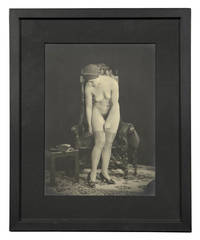
83369Paris c.1930s. . Six gelatin silver prints 22 x 16 cm. Very good condition and with very good tone. Framed. <br /> A series of six nude studies showing the same model posing in the photographer's studio. The style of the photographs which artistically combines high and low art allows to attribute the authorship to the Grundworth studio which is known to have been producing erotic postcards in Paris from the 1890s to the 1930s. <br /><br />Like most of the studios engaged in production of erotic photographs and postcards of the time little is known about it as despite the widespread circulation of these cards their production and distribution was illegal in France hence anonymity was essential. Given the time span and a number of different styles the name is unlikely to represent an individual photographer but more likely a group of photographers who were perhaps better known but wanted to hide their real identities.<br /> [Paris, c.1930s]. unknown
1923106903BBBerlin, Malik-Verlag, 1923. Folio (35,5 x 25,5 cm.). [2] Bl., 84 ganzs. Illustrationen nach Lithographien u. 16 Farbtafeln nach Aquarellen. Illustr. OKart. [11 Warenabbildungen]
1923105528BBBerlin, Malik-Verlag, 1923. Folio (35,5 x 25,5 cm.). [2] Bl., 84 ganzs. Illustrationen nach Lithographien u. 16 Farbtafeln nach Aquarellen. Illustr. OKart. [9 Warenabbildungen]
9827Three frontis. & 21 double-page color-printed woodblock illus. 16; 12.5; 13.5 folding leaves. 12mo 113 x 80 mm. orig. decorated semi-stiff wrappers with images of rabbits snowflakes & flowers labels on upper covers with motif of flowers old stitching. Japan: late Edo or early Meiji.<br /> <br> <br> <br /> <br /> A very rare small-format erotic work written by IkkadÅ Injin é€¸æ¡‚å ‚æ·«äºº and illustrated by KaikÅtei Shujin 開好äºä¸»äºº both clearly pen names. These volumes are very finely illustrated with the theme of “snow moon and flower.â€<br /> <br> <br> The artist was very accomplished and the images are highly complex and skilled. The volumes use almost all of the techniques that make Japanese illustrated books so remarkable. This late shunga is richly colored and employs bokashi the delicate variation of shading of pigment within the image; blind-embossing; and the very ample use of gold silver and copper pigments. The depicted garments are a mixture of extremely complex textures colors and patterns all accentuated by blind-embossing and multiple woodblock impressions. There are two kinds of black flat black and shiny black rendering a most unusual appearance.<br /> <br> <br> A very fine example. The title-page in Vol. I is a little cracked due to the use of metallic pigment. unknown
1464Paris G. & R. de Briffaut, Editeurs 1922 in 4 (27,5x22) 1 volume reliure demi maroquin vert lierre à coins de l'époque, dos lisse orné de filets et fleurons dorés, et d'un décor mosaïqué central, tête dorée, couverture conservée, 201 pages [1], étui bordé. Reliure signée de Flammarion-Vaillant. Ouvrage illustré de un titre, de 4 frontispices et de 18 compositions originales en couleurs hors texte gravées à l'eau-forte par André Lambert (4 frontispices and 18 etchings in color), et de lettrines et de bandeaux gravés sur bois par André Lambert. Texte latin et traduction nouvelle de Pierre Lièvre. Tirage limité à 500 exemplaires, celui-ci un des 400 exemplaires numérotés sur vélin d'arches au filigrane de la collection contenant l'état définitif en couleurs de toutes les planches. Collection ''Le Livre du Bibliophile''. Très bel exemplaire ( Photographies sur demande / We can send pictures of this book on simple request )
392043 volumes in-12 (176 x 103 mm), demi-maroquin rouge cerise, dos à 5 nerfs plats guillochés or, garnis d'un fer spécial répété entre-nerf, de filets et guirlandes, pièces de titre et de tomaison de maroquin olive et citron (rel. moderne dans le goût de l'époque), 248 pages; (4), 240 pages et (4), 260 pages, (6) pages, non rogné. Liège et Paris, Maradan, 1789.
19324286BBudapest [Paris, Paul Haasen], 1932. 4° (31,1 x 23,2 cm - Grösse der Tafeln). 4 S. (Titel, Introduction mit Impressum und Nummer) und 15 Tafeln mit Kaltnadelradierungen unter Masken. Orig. HLeinen-Mappe mit illustriertem Titelschild am VDeckel. Die Tafeln im kart. Orig.-Umschlag. [9 Warenabbildungen]
105Louis Michaud Éditeur, Paris, 1910, grand In-quarto (34,4 x 25,3 cm), 124 pages, couverture rempliée. Texte de Camille Mauclair. 41 eaux-fortes originales dont la couverture par le Peintre-Graveur Alméry Lobel-Riche. 1/73 exemplaires numérotés sur papier Japon, avec deux états des eaux-fortes, soit une suite additionnelle des 41 eaux-fortes avec remarques toutes signées par l'artiste au crayon et tirées sur vieux Japon, celle-ci dans une chemise à part, soit un total de 82 eaux-fortes. L'exemplaire est enrichi d'un dessin original de Lobel-Riche à la sanguine, signé, réalisé sur papier calque. Fort volume complet en excellent état. Une des meilleures productions de l'artiste, remarquable réalisation bibliophilique superbement imprimée, ici tel que paru en tirage de tête sur un très beau papier Japon, Japon à la forme pour la suite, un must. On peut noter de très rares rousseurs en marge de certaines eaux-fortes de la suite signée, et des rousseurs aux serpentes de protection s'agissant de la même suite.
19203799BOhne Ort, Privatdruck [ca. 1920]. Folio (43,5 x 34 cm). 2 Bll. (Titel, Inhalt, Colophon] und 10 erotische Original-Radierungen auf Velin lose unter Passepartout gelegt. Original-Halbpergamentmappe mit Buntpapierbezügen.
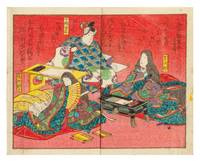
771516 double-page & four single-page color-printed woodcuts. 13; 11; 9 folding leaves. Three vols. Small 8vo orig. speckled semi-stiff boards boards rubbed orig. block-printed title labels on upper covers new stitching. Japan probably Edo: manuscript inscription dated “1832†at end of each volume.<br/> <br/> First edition and very rare; we do not find this book listed in WorldCat or in the Union Catalogue of Japanese Books. The Preface is signed by Akikei or Akikage Higashikuni.<br/> <br/> This work is an erotic version of Shiki no en an 18th-century group of songs on the four seasons of love from the Yamada ryu school of the Japanese harp koto. The poems of Haku Rakuten or Bai Letian 772-846 the Chinese poet of the mid-Tang dynasty are sources for the songs along with Japanese waka poems. Haku Rakuten “became the favorite poet of Heian times…He was the Chinese poet to whom allusions and from whom recollections were most frequent in Heian Japan. His verses were often used for kudai waka and he epitomized Chinese poetry.â€â€“Earl Miner et al. The Princeton Companion to Classical Japanese Literature p. 160.<br/> <br/> The first color-printed woodcut depicts a woman preparing to play the koto. There follows a series of erotic double-page woodcuts: kabuki actors young samurai Chinese characters and women of various social classes are shown engaged in sex through the changing seasons. It is fascinating to see the various rooms and their furnishings the participants’ costumes and the landscapes in the background.<br/> <br/> The fine woodcuts were clearly created by a member of the Utagawa school however we are unable to establish their artistic authorship.<br/> <br/> Very good set but with some thumbing. The second and third volumes have some worming touching several of the woodcuts. unknown
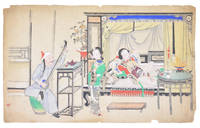
98168201China c.1820. Wood covers accordion folded album 15 fine color painted leaves each on silk pastels colors executed with a most steady & fine line minor soil covers slightly checked silk border mounted album size is 7.5 x 26 cm.RARE A LOVELY SUITE OF 15 FINE COLOR QING DYNASTY EROTIC CHINESE PAINTINGS. Painting size is ca.11 x 20 cm. Each painting shows a couple engaged in or preparing to enjoy sexual pleasure some with genitals exposed each painted with the most delicate and beautiful colors as their faces display a pink flush with excitement. The girls all have "Golden Lotus" feet or bound feet with tiny shoes tied on they are all dressed in lovely flowing gown with natural garden setting in the background with colorful flowers & trees. 1. The first scene shows a very young couple preparing to make love. 2. The next is of a young girl using a dildo while a male lover looks on with erect penis. 3. The third shows a girl sitting on her lover's knee as he fondles her vulva. 4. Next shows a couple engaging in love-making in the garden as the girl sits facing her lover. The genitals are shown where engaged. 5. Two girls prepare to engage in love-making. They are both on a sofa one reclines holds a bronze mirror while the other girl holds her lover's right leg up. Both share looking into the mirror to see the erotic scene some mild discoloration on her hip & face. 6. Shows a couple in the garden while the girl rests her face on her arm on a rock bending over exposing her posterior while her lover enters from the rear and holds her fast. 7. A couple are seated the man first then the woman sits upon his lap as she holds up one knee for deep penetration. 8. While the mistress sleeps on her bed in the background the master unsatisfied pulls the servant girl to his exposed penis. She resists. 9. A lovely garden scene shows the couple with the man holding the girl by the shoulder as they hug each other. 10. In the garden girl holds a fan while she awaits her lover who sends away a young girl so they may begin their love-making. 11. While standing in a shallow stream the master exposes his erect penis while the girl pulls him toward her showing him her exposed vulva as they both hold up their gowns giving view to their genitals. 12. A couple on a blanket with the man in the superior position as he mounts her while she entwines her legs around him holding him fast. 13. A garden scene shows a man on a wall as he "dallies" with a young maid-girl who reaches up to touch his hands likely to help him down. Probably a secret meeting with his young lover. 14. Shows a beautiful woman at an open gate while her lover passes by she flashes an enticing look his way. He turns his head towards her he is accompanied by a young servant- girl who carries his lute as he passes with his fan and gives her a good look. 15. The last is a view of the male-scholar as he sits at his desk and books while looking out a large round window at the girl. She is wearing a lovely saffron robe likely exposing her posterior to him in an inviting sexy stance. All of these lovely paintings show the most pleasant and joyful expressions on the face and especially in the eyes and lips. Books of this subject style are vintage are scarce. The Chinese had a very naturalistic view and open attitude toward sex during this period. Love-making and erotic scenes of this subject were drawn in the most natural ways. People are shown with very pleasant "Yin & Yang" looks between men and women and the act of "Clouds & Rain" love-making are done with pleasant and enjoyable expressions BINDING: The work is period bound and mounted with silk each painting is on silk. The accordion folded book is bound in hard-wood covers. Nicely executed mounted & bound in the traditional Chinese style. On the opposite pages to the paintings is a lovely hand-made gold-flecked Chinese papery. A wonderful example of the best of Chinese painting and bookbinding art form. . unknown
95123early 20th century. . Two loose folded watercolours on paper 56 x 34 cm. Some spotting and foxing some repaired tears.<br /> Erotic art - in letters and pictures - is an eminent part of the cultural heritage of ancient China where lovemaking was considered as a natural practice a sacred duty for both men and women. <br /><br />Albums with explicit drawings were often made for newly married couples as an instruction handbook. Here however the two scenes are rather unconventional illustrating polygamy practices that dominated aristocratic circles in the ancient Chinese society. The first watercolour shows not without a hint of humour two women engaged in a lovemaking game with a man. The second watercolour suggests the importance of self-pleasure for lonely females forced to live in a harem setting.<br /><br />Pieces like these provide a better understanding of Chinese culture that was largely suppressed in the wake of the Cultural Revolution in the mid-XX century. <br /><br /> [early 20th century]. unknown
Very Good Turkish, Ottoman (1500-1928) Contemporary quarter leather binding with gilt decorations without title lettering. Demy 8vo. (22 x 14 cm). In Ottoman script (Old Turkish with Arabic letters). Seven different books and tractates (nine works) in one volume: (235, [1] p., 24 p., 143 p., 80 p., [6], 71 p., 84 p., 22 p.). Two leaves are torn from the hinge in the first book but not missing, one tractate is trimmed by margins, the board's extremities are worn, overall a good volume including multiple books. First editions (except for one) of these exceedingly rare poetic tractates collected together contemporarily in one handsome volume, reflecting early Ottoman poetic pleasure, including thematic mystic and erotic poetry mostly printed in the early 19th century. This volume includes the multiple works of Enderunlu Fazil and Sünbülzâde Vehbi, which are the earliest erotic and homosexual poems that seem to have been concealed by adding Keçecizâde's works to the beginning and the end of the volume. "Defter-i ask" [i.e. The book of love] by Fazil, in which he tells about his own romances, is a masnavi of 438 couplets. It begins with a description of divine love and tells the story of the poet's romances, which he fell into only to regret and repent afterward. "Hubannâme" [i.e. The book of beautiful young men] consists of 796 couplets with various titles and it has a mystical analysis of beauty in the first chapter. After an introduction that gives geographical information that may be considered novel for its period, it describes the beauties of male bodies of many countries from India to America. This style is unique and the first in Turkish / Ottoman literature. In the work titled "Zenannâme" [i.e. The book of women], which is a masnavi of 1101 couplets, women of various nations are described. The poet indicated in the introduction of his work that he does not want to talk about women, and that he has no orientation towards women. Enderunlu Fazil was an Ottoman poet who depicted the beauty of men from various lands of the Ottoman Empire. He achieved fame through his erotic works, which were published posthumously. Among his most famous works is The Book of Women, which was banned in the Ottoman Empire. The book describes the advantages and disadvantages of women from different nations. Fazil was born in Acre into an Arab family originally of Medina. He spent his early years in Safed in Ottoman Palestine. His grandfather Zahir al-Umar and father Ali Tâhir were both executed (in 1775 and 1776, respectively ) for participating in a rebellion. After his father's death, Fazil moved to Istanbul. There, he was admitted to the Enderun palace school (thus taking on the name Enderuni or Enderûnlu), but was expelled in 1783 as a result of his love affairs with other men there. In 1799, he was exiled to Rhodes because of his satirical writings and was only allowed to return to Istanbul after becoming blind. He spent the rest of his life there, ill and bedridden. Other books in the volume: Manzumetü'l-müsemma be-mihnet-kesan, Ceride-i Havadis Matbaasi, Ist., AH 1269 = AD 1853. 235 p., 1 portrait of Keçecizâde. Lithography. Özege 13354.; Two copies are located in OCLC 57242940 - 51281526. This work is a social satire type masnavi in which Izzet Molla was exiled to Kesan, telling of the troubles he suffered there, and his pardon and returns to Istanbul. Destar-i hayâl., Osman Nevres Efendi (1820-1876), Matbaa-i Âmire, Ist., AH 1289 = AD 1872. 24 p., Özege 3899. First and Only Edition. This rare work is a masnavi consisting of six stories. Defter-i ask, Hubannâme, Zenânnâme and Sevkengîz., Enderuni Fazil (1757-1810) and Sümbülzâde [or Sünbülzâde] Vehbi, (1718-1809)., Darü't-Tibaatü'l-Âmire, Ist., AH 1253 = AD 1837., 143 p. (pp. 1-20 Defter-i ask; pp. 22-55 Hubânnâme; pp. 56-111 Zenânnâme; pp. 112-143 Sevkengîz.). Özege 18902. First Edition. Tuhfe-i Dilkes Nâli, Yusuf Nabi [sic] [Nâlî, Muhammed b. Osman el-Konevî, (For more info please visit our website)