17 088 résultats
191920944Berlin, Gurlitt-Presse, 1919 - 1920. 4°. 8 Orig.-Halbpergamentbände, 1 Orig.-Pappband (Band VII) und 1 Orig.-Kartonage (Prospektbuch). Insgesamt 10 Bände.
19234265BO.O., [Berlin], 1923. 4° (24,5 x 17 cm). 10 eindeutig erotische Kupferstiche auf leicht strukturiertem Velin unter Passepartout (Größe der Kupferstiche: 9 x 6 cm / Blattgröße Velin: 13 x 10 cm / Passepartout: 24 x 16 cm). Halbpergament-Mappe mit Flügeln. [7 Warenabbildungen]
27048301Japan n.d. ca.1830-1880'S. Green brocade silk covers all edges gilt accordion foldedvery clean & bright copy small nick to bottom edge else excellent contents bright 24 color woodblock prints 12.5 x 9.3 cm.in cloth Chitsu case. . . . A MOST SUPERB EROTIC EXAMPLE . . . COLOR WOODBLOCK PRINTED ALBUM . . CONTENTS The album contains two miniature polychrome woodcut print series. Each print is well executed with excellent registry and color care was taken to print them with the utmost quality and attention. This is not one of those quickly produced items lacking quality or refinement. Each print and series is a miniature work of erotic Ukiyo-e art. . The first series of prints are located on the verso or front pages of the album and consist of twelve prints. They show people from Edo period 1604-1868 and clearly from about 1840'S or so. Their hair style and Kimono fashion are of those times. The are done in the colors from that period and appear to have oxidation commensurate with about 140 years or so ago that would put their printing date at around 1868. in the Meiji era. There is very little background text at all but there are cartouches in several. Each print is clean and in excellent condition flawless. . The second series found on the recto or back side of the album and consists of twelve prints in all. The first three have a most unique and stunning silver background six with beige and 3 with indigo or "Aizuri" backgrounds. Each print is uniform within a circular cartouche for the most part and each print is exceptionally clean without flaw. . The work reflects people of the late Edo or early Meiji 1868-1912 period printed about 1869-1870's. . Number 2 shows a man with a huge phallus his hand caressing her vagina. . Number 3 shows the couple fully engaged in love making she is on top. . Number 4 shows the man on top while she locks her arms aroun him in an erotic embrace. . Number 5 is fascinating and RARE ! It shows a silken cord tied around his penis and she holds the cord so she can control its action. This sort of sexual "toy" is rarely shown in Japanese "Shunga" erotic prints. . Number 6 shows a male Buddhist priest or monk. He is fully engaged in licking his lover's vulva as she sucks his erect penis. . COMMENTARIES: The work begins with a couple about to make love he licks two fingers in readiness to insert his huge penis into her vulva she says "Its embarrassing to become like this." . He answers: "Why I am entering." She covers her mouth with here Kimono sleeve in shyness. She says: "Ready to put it in her mouth glug glug." He says "Its coming out to no end of joy." . Numbers 7-12 show couples engaged in love-making all with fascinating and very legible comments."Hayaku soko.iku ."Hurry right there I'm coming" and the like. . There is lots of "Chirishi" hand-made Washi toilet paper strewn around indicating lots of love-making and love juices freely flowing. This is a common erotic symbol and theme often found in Shunga. . RARITY: The work is RARE ! During our tenure of over fifty years we have seldom found Shunpon erotic woodcut books in such excellent and complete condition. . There are a number of very unique and unusual images found in this remarkable erotic album. . The work was clearly kept in the best of condition by some meticulous Japanese collector. Because the album consists of two distinct groups of similar period prints we can only assume it to be the property of a discreet collector from the period. The album's old silk covers and paper matches the print period. . THE GENRE OF JAPANESE EROTICA: This kind of book was banned from being published by the Tokugawa Shogunate. Also banned by the Meiji and Taisho governments. . Erotic woodblock prints "Shunga" & Shumpon erotic woodcut books were secretly drawn carved printed and published "underground." . It was an offence punishment was imprisonment and severe. All publishers had to submit their proposed publications to the government for the "Kiwame" or "Censor's seal" of approval. That "Kiwame" seal was carved into the block as visual proof of sanction. . The fact that all Japanese erotic works completely lacked official approval caused these kinds of books to be sold via a "black market." It is not surprising artists never signed their real name but commonly either did not sign or signed some laughable or ironic false name. . Regardless of any lack of meaningful signature many art historians and students of Japanese woodblock art can identify with an 'educated guess' the school style or the artist by stylistic analysis. Usually this was a giveaway ! . Many famous Ukiyo-e artists disliked being controlled by the government they continued to produce erotic prints and books for 'underground' publication regardless of the law as a means to supplement their meager income. . CONDITION & BINDING: The album is contained in an indigo-blue cloth Chitsu folding case ivory clasps and blank cover title slip. There is some of the old and usual minor fading to the Chitsu cloth. The overall size is 18 x 23.5 cm. . THE SILK COVERS: The green brocade-silk covered album is stunningly clean and bright. There is a small minor nick to the lower edge this does not encroach into the pages. . The album paper is very heavy bright clean and white with no foxing whatsoever. The 24 miniature woodcut prints are held in place by black paper mounting corners they can be removed at will and are not laid down. . Each color miniature woodblock print is exceptionally clean and bright with excellent color and registry. A couple have been restored mending a few old tiny worm holes. These are of minimal impact and are barely noticeable. The work is quite firm and solid. Our habit is to be a bit over critical about condition by and large this is an excellent item in aspects. Please view color digital images posted to our website. . . unknown
190015638BB(Tokyo, Nachdruck auf Chinesisch, um 1900). Als Blockbücher gebunden, in Seidenmappe. 4 Bände.
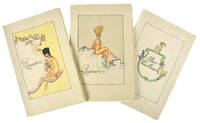
88027Paris Vialetay c. 1945. . Three volumes 8vo 26 x 17 cm. 31 hand-coloured pochoir plates monogrammed G.M. each with descriptive letterpress loose as issued in original wrappers.<br /> Witty erotic illustrations depicting 18th century French aristocracy each accompanied by proverbs and verses. Volumes numbered 273 127 and 170 are all from the edition of 300 published clandestinely by Jacques Vialetay rare when complete. <br /> Paris, Vialetay, [c. 1945]. unknown
19352541AAux dépens des Amis de Cupidon, o.J. [Paris, ca. 1935]. 4°. 2 Bll., 1 kolorierte Orig.-Radierung und 46 S. mit Orig.-Radierungen, 2 Bll. Lose Lagen in der Orig.-Broschur mit Fronttitel und kolorierter erot. Orig.-Radierung.
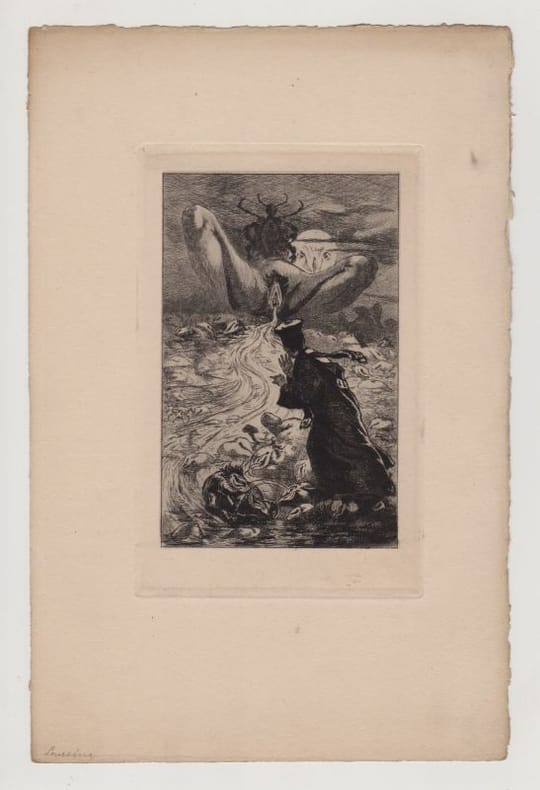
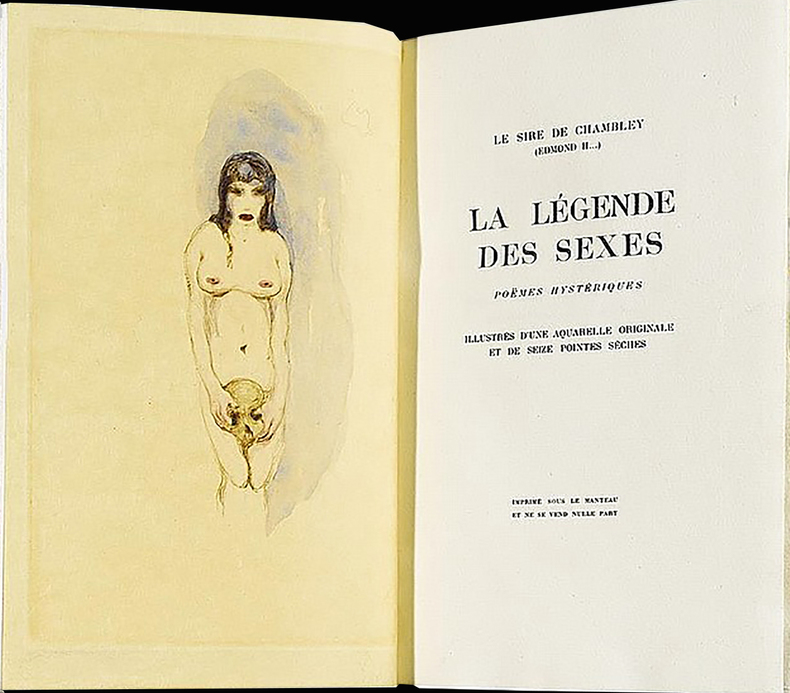
107Martin van Maële. Suite d'eaux-fortes originales pour illustrer La Légende des sexes d'Edmond Haraucourt. 12 eaux-fortes par Martin Van Maële inspirées de la Légende des Sexes d'Edmond Haraucourt, fantastique suite érotico-macabre tirée sur vergé à la forme. Chaque planche gravée, de dimension 16,5 x 25,5 cm, est légendée au cayon : "Chanson du moine", "La Parisienne", "Obsession", "Reine du monde", "Europe", "Coït des atomes", "Danaé", "Eden", "Lourcine", "Le crâne", "La flûte" et "Mélancolie". Est indiqué à la main sur le premier plat de la chemise défraîchie que les eaux-fortes sont bien du premier tirage sur vergé d'Arches, datant très certainement du début XXème. On rencontre le plus souvent la même suite tirée sur un papier d'Arches beaucoup plus blanc, et surtout aux noirs beaucoup moins marqués, conservée sous chemise éditeur, avec le titre imprimé sur une étiquette collée sur le premier plat, ce qui laisse supposer un tirage postérieur. Il existe également un tirage sur papier vergé beaucoup plus fin.. Rare suite en premier tirage, en très bon état.
19264306BParis, 1926. 4° (32,5 x 24,9 Blattgröße). 15 Tafeln mit aquarellierten und signierten Original-Federzeichnungen und ein Doppelblatt mit handschriftl. Titelgestaltung und handschriftl. Titelverzeichnis zu den Tafeln. Leinen-Flügelmappe d. Zeit. [9 Warenabbildungen]
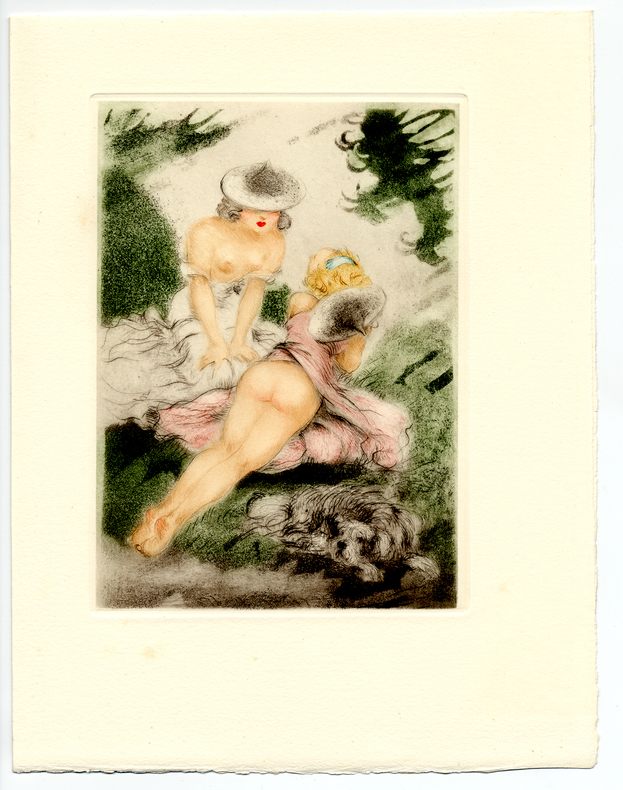
19491524Éditions de la Cité, Paris 1949. 1 fort volume in-4 (33 x 25 cm), en feuilles, couv. rempliée,chemise et étui recouvert de papier végétal rose de l’éditeur. 22 GRAVURES ORIGINALES EN COULEURS PAR LOUIS ICART EN HORS-TEXTE, 2 gravures en couleurs dans le texte. Celui-ci l' 1 des 30 numérotés sur vélin d'Arches avec LA SUITE COMPLÈTE DES GRAVURES EN DEUXIÈME ÉTAT TIRÉES EN SÉPIA sur papier de Rives. Détail du tirage : 165 exemplaires (20 Arches avec 2 suites + 30 Arches avec 1 suite + 100 Rives + 15 Lana h.c.).
192712281Paris, Le Livre de Palntin, 1927. 4°. Original Umschlag [4 Warenabbildungen]
1948AMO-1912LA DUCHESSE OU LA FEMME SYLPHIDE par Restif de la Bretonne, illustré d'eaux-fortes en couleurs. Aux dépens de quelques bibliophiles, s.d. (1948) 1 volume in-4 (28 x 23 cm), 125-(2) pages, 19 eaux-fortes en couleurs hors-texte et 1 eau-forte à mi-page dans le texte. Fleuron priapique en couleurs sur la page de titre imprimée en 3 couleurs. Complet, parfait état intérieur. Papier de qualité, très épais. Superbe tirage des eaux-fortes en couleurs. Reliure de l'époque plein maroquin caramel beurre salé, dos à nerfs, auteur et titre dorés, filet à froid sur les plats, doublure et garde de papier marbré fait main, tête dorée, non rogné, relié sur brochure, couverture conservée. Excellent état. Léger frottement sur un nerf. TIRAGE A 240 EXEMPLAIRES SEULEMENT. CELUI-CI, UN DES 190 EXEMPLAIRES SUR PAPIER LANA CHIFFON AVEC L’ÉTAT DÉFINITIF DES 20 EAUX-FORTES EN COULEURS. Références : Dutel, Bibliographie des ouvrages érotiques publiés clandestinement en français entre 1920 et 1970, n°1441 ; inconnu de Pia ; aucun exemplaire au CCfr (Bibliothèque nationale de France et autres bibliothèques de France) ; absent de l'Enfer donc ... "Une femme doit avoir l'air sylphide : un soulier plat lui donne l'air matériel ; au lieu qu'un talon haut l'empêche de toucher la terre en quelque sorte et en fait une créature céleste [...] Parmi nous, les Duchesses s'en tiennent presque toutes à ce dernier privilège : elles font les Sylphides chez elles, vont quelquefois se montrer à la Cour, s'enorgueillissent d'un sourire, d'un regard de la souveraine, et reviennent dans leur palais faire le même rôle qu'elles ont vu faire à leur égard. [...]" (Rétif de la Bretonne) La Femme-Sylphide ou Femme-Sylfide est une nouvelle tirée des Contemporaines de Rétif de la Bretonne parues pour la première fois en 1783. La première édition séparée de ce texte date de 1946 seulement (Paris, Librairie Lefrançois, 1946). Cette première édition séparée, de petit format, est ornée d'un frontispice et d'une planche hors-texte de Marcel Jean. L'édition de 1948 (date fournie par Dutel) que nous proposons ici est peu connue et Dutel ne donne aucun nom d'illustrateur pour cette superbe suite de 20 eaux-fortes en couleurs. Personne ne semble d'ailleurs s'être risqué à en donner un. Il s'agit pourtant d'un grand artiste au trait sûr et délicat. BEL EXEMPLAIRE DE CE SUPERBE ET RARE LIVRE ÉROTIQUE CLANDESTIN ILLUSTRÉ. TRÈS RARE EN PLEINE RELIURE.
19093264BLeipzig, Privatdruck, 1909. Folio: 39 x 29 cm. 105 Seiten mit 15 erotischen Illustrationen und illustriertem Titelblatt von Julius Klinger (geb. 1876). Original altrosa Moiréseideneinband mit goldgepr. Deckeltitel und Goldfileten im schwarzen Orig.-Pappschuber. Kopfgoldschnitt.
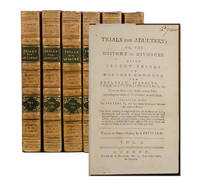
17803796London: Printed for S. Bladon 1780. First edition. Contemporary full calf covers decoratively bordered in blind spines with four wide raised bands decoratively tooled in gilt and blind in compartments two green morocco labels lettered in gilt blind-stamped board edges and turn-ins all edges gilt. Some minor wear to a few corners otherwise a near fine set. Volumes 1-6 only of 7. Six octavo volumes 7 3/4 x 4 7/8 inches; 197 x 124 mm. Collating 392; 392; 404 384; 426 of 428; 406. Twenty-one of twenty-four fine engraved plates. Volume I lacking two of the engraved plates Daly facing page 39 and Draper facing page 20 and clean inner marginal tear on Q4 pages 5/6; Volume II with light marginal stain on 3A4 pages 59/50; Volume IV Z3 pages 87/88 trimmed at fore-margin; Volume V Z3 pages 55/56 trimmed at fore-margin and lacking last leaf 3H4 pages. 305/306 Address to the Public verso blank; Volume VI lacking one engraved plate Grosvenor facing pages 114. Armorial bookplate on front paste-down of each volume and early ink signature of Thos. Grant at top of title-pages.<br /> <br /> Trials for Adultery was published over a period of two years and was completed in seven volumes with thirty engraved plates. Because of their 'pornographic' nature some or all of the plates are often not found. In our set three of the plates have been excised by a previous owner. "The genre of pornographic trial reports was fully developed in the late 1770s a fact which is borne out by the publication in seven volumes of a special collection of interesting cases Trials for Adultery: or the History of Divorces. The editor remarks to the reader that 'conjugal infidelity is become so general that it is hardly considered as criminal; especially in the fashionable world'. In view of the many erotic and obscene prints contained in the seven volumes the moral justifications offered in defence of the publication of the trial reports appear quite ridiculous if not hypocritical. Mostly erotic but occasionally also obscene such pictorial material now became a standard feature of trial reports for the rest of the century" Boucé. Printed for S. Bladon unknown
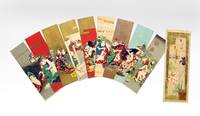
7720Ten cards 181 x 50 mm. all preserved in the orig. folded color-printed wrapper entitled on upper panel Furyu e tanzaku Elegantly Illustrated Tanzaku Cards. Japan: Meiji Era.<br/> <br/> Ten erotic cards issued together each in the tanzaku ban format and accompanied by their original color-printed wrapper. Tanzaku cards were popular in the Meiji era 1868-1912; see Rosina Buckland’s “Erotic Art of the Meiji Era 1868-1912†in Timothy Clark et al. eds. Shunga. Sex and Pleasure in Japanese Art British Museum: 2013 pp. 454-55.<br/> <br/> The upper panel of each is very finely color-printed with saturated inks embossing and rich use of metallic pigments revealing the Japanese printer’s art at its best. They all depict men and women engaged in a series of sexual acts. The woodblock-printed lower panels feature the conversations of the couples while engaged in their sexual acts and kyoka poems which are rich in sexual innuendos and racy double-meanings.<br/> <br/> The original wrapper that contains the ten cards has also been very finely color-printed again with saturated colors and embossing.<br/> <br/> In fine condition. unknown
1787046740Neufchâtel et Paris: Guillot 1787. First Edition. Hardcover Full Leather. Very Good Condition. Binet. 4 volumes in contemporary sponged calf spines darkened and a bit dry light wear at edges scattered light foxing including to plate margins. 300pp; 388pp; 392pp; 380pp with 20 plates and the often missing final two leaves in volume four with a list of further titles available. <br/><br/>Restif de la Bretonne takes on the subject of women here looking at 40 women in 8 categories - he believed this to be one of his finest works as did Palmézaux. Bibliographie et iconographie de tous les ouvrages de Restif de la Bretonne 247-250. Size: Octavo 8vo. 4-volume set complete. Previous owner's book-plate on endpaper. Illustrator: Binet. Quantity Available: 1. Shipped Weight: Under 1 kilo. Category: Literature & Literary; Erotica. Inventory No: 046740. Guillot hardcover
1787046740Neufchâtel et Paris: Guillot 1787. First Edition. Hardcover Full Leather. Very Good Condition. Binet. 4 volumes in contemporary sponged calf spines darkened and a bit dry light wear at edges scattered light foxing including to plate margins. 300pp; 388pp; 392pp; 380pp with 20 plates and the often missing final two leaves in volume four with a list of further titles available. <br/><br/>Restif de la Bretonne takes on the subject of women here looking at 40 women in 8 categories - he believed this to be one of his finest works as did Palmézaux. Bibliographie et iconographie de tous les ouvrages de Restif de la Bretonne 247-250. Size: Octavo 8vo. 4-volume set complete. Previous owner's book-plate on endpaper. Illustrator: Binet. Quantity Available: 1. Shipped Weight: Under 1 kilo. Category: Literature & Literary; Erotica. Inventory No: 046740. Guillot hardcover books
192122513BBWien, Verlag Ed. Strache, (1921). 34x45,5 cm. 12 n.n. S. Text und 49 (von 50) Lichtdrucken auf Karton montiert mit Seidenpapier. Originalhalbleinwandmappe mit kleinem goldgeprägtem Deckelmedaillon.
192122513BBWien, Verlag Ed. Strache (1921). 34x45,5 cm. 12 n.n. S. Text und 49 (von 50) Lichtdrucken auf Karton montiert mit Seidenpapier. Originalhalbleinwandmappe mit kleinem goldgeprägtem Deckelmedaillon.
14995ABo.J. Housed in original cloth box.
In-8°, 2 parti: 541(3);-54 (2). Legatura in pelle contemporanea con cornice in oro ai piatti, nervature, tasselli e titolo in oro al dorso, tagli in oro, buona copia, ex libris alla sguardia inziale di contropiatto. Prima edizione, che si distingue dalla seconda stampata nello stesso anno per la differenza dei fregi e dei capolettera e soprattutto per la differente consistenza della seconda parte, qui in 54 pp, nella seconda edizione in 38pp. Willems, Les Elzevier, 858 Contemporary calf binding with gold frame on the plates, bands, labels and gilt title on the spine, gold edges, good copy, ex libris at the endpaper of the front cover. First edition, which differs from the second printed in the same year for the difference of the friezes and the initials and above all for the different consistency of the second part, here in 54 pp, in the second edition in 38pp. Willems, Les Elzevier, 858 Capolavoro della letteratura erotica sono i Ragionamenti di Pietro Aretino, cioè i dialoghi tra prostitute, diviso in due parti, in cui si raccontano storie salaci e si propongono riflessioni. La Puttana Errante è licenziosa quanto la prima parte: si conclude con un'enumerazione esplicita delle posizioni sessuali (ed è spesso associata a una serie di tavole che le illustrano ciascuna). Alcuni hanno affermato che non è, infatti, di Aretino ma di Niccolò Franco o dell'assistente di Aretino, Lorenzo Venier. Masterpiece of erotic literature are Pietro Aretino's Ragionamenti, that is the dialogues between prostitutes, divided into two parts, in which spicy stories are told and reflections are proposed. La Puttana errante is as licentious as the first part: it ends with an explicit enumeration of sexual positions (and is often associated with a series of plates illustrating each). Some have stated that it is not, in fact, from Aretino but from Niccolò Franco or from Aretino's assistant, Lorenzo Venier.
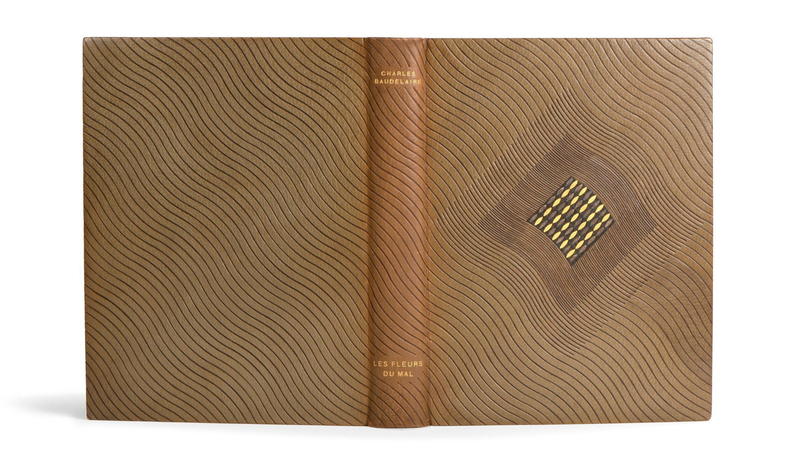
19283859Paris, G. Govone éditeur, 1928. Un volume in-4 (339 x 250 mm) 337 pp., reliure en plein maroquin gris, plats et dos ornés en continue de filets ondulés noirs parallèles, encadrant au centre du premier plat un losange de maroquin noir orné de bandes de motifs ovales mosaïqués bronze et dorés, dos lisse titré or, doublures avec un large encadrement de maroquin gris, orné de filets ondulés parallèles à froid et gardes de soie moirée bronze, doubles gardes, tête dorée, non rogné, couverture et dos conservés, étui bordé (Lefranc). Édition limitée à 353 exemplaires, ornée de la reproduction d’un autoportrait de Baudelaire et d’une page autographe de l’auteur en fac-similé, contrecollées à pleine page. 10 EAUX-FORTES ORIGINALES DE MARIETTE LYDIS TOUTES EN HORS-TEXTE. L'exemplaire est l'un des 290 exemplaires numérotés sur Hollande Pannekoek (n° 92). Il est exceptionnellement enrichi de LA SUITE COMPLÈTE DES DIX EAUX-FORTES TIRÉES EN COULEURS ET SIGNÉES AU CRAYON PAR MARIETTE LYDIS. Il s’agit ici de l’une des 75 en couleurs sur vélin de Hollande Pannekoek. Cette suite, considérée comme l’une des meilleures productions de l’artiste, a été publiée séparément par l’éditeur à 125 exemplaires seulement. À noter qu’en 1937, l’éditeur publiera une autre suite très différente de 33 compositions lithographiées en couleurs de Mariette Lydis pour illustrer ce même texte.
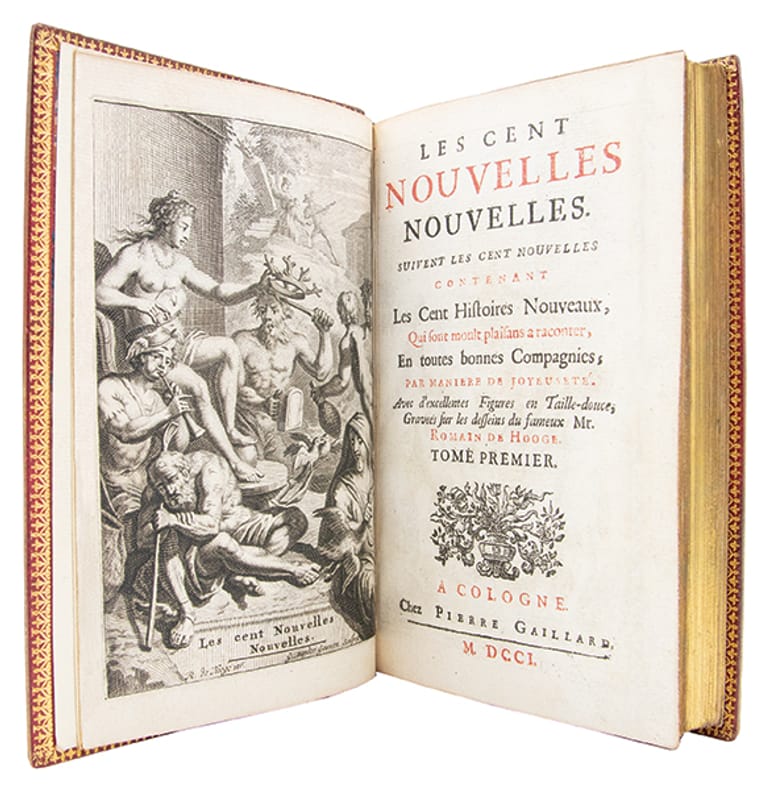
392512 volumes petit in-8 (152 x 94 mm), maroquin rouge, dos à cinq nerfs guillochés or, ornés de compartiments fleuronnés et cloisonnés, roulettes en tête et pied, triple filets d'encadrements sur les plats et les coupes, dentelle intérieure, tranches dorées sur marbrures (reliure XIXe), (30), 397, (1) pages, planche frontispice et (24), 389, (1) pages bl, (3) feuillets blancs. Cologne [i.e. Amsterdam], Pierre Gaillard, 1701
1932003181Paris, à l'enseigne de l'auteur qui ne veut pas dire son nom
19301550Imprimé sous le manteau et ne se vend nulle part, [vers 1930]. Grand in-8, [2] f., 118 p., [2] f., broché, couverture de papier vert imprimée rempliée, étui de l’éditeur (l'artiste) recouvert de papier argenté. Édition clandestine publiée par le graveur Frans de Geetere qui en a réalisé l’illustration. Tirage à 200 exemplaires. Celui-ci UN DES 30 EXEMPLAIRES SUR VERGÉ DE HOLLANDE (3e papier après 2 ex. sur japon et 23 Chine), comprenant 26 GRAVURES en noir : LE FRONTISPICE AQUARELLÉ PAR L'ARTISTE, 16 EAUX-FORTES EN HORS-TEXTE et 10 EAUX-FORTES REFUSÉES, UN DESSIN ORIGINAL AU CRAYON NOIR. Cet exemplaire est enrichi d'une gravure supplémentaire, sur japon nacré, aquarellée par l'artiste. Le volume est donc identique dans sa composition aux exemplaires sur Japon et Chine. Rare exemplaire de luxe à toutes marges, serpentes conservées. Collationné complet des 26 gravures et des originaux. (Pia 1998, col. 768-769). L'ensemble est en parfait état de conservation, non coupé.
Edtions d'art de l'intermédiaire du bibliophile, 1929. In-Folio en feuillets sous couverture illustrée rempliée de 62 pages. Illustré d'eaux-fortes originales en couleurs et de pointes-sèches gravées par Léon Courbouleix. Tous les cuivres ont été barrés par l'Editeur après le tirage. Tirage limité à 101 exemplaires. 1/85 exemplaires (16 à 100) sur papier d'estampes teinté de Rives à la cuve, ainsi que l'état avec remarques du bandeau et du cul-de-lampe. Exemplaire n°19. Exemplaire conservé dans une chemise nouée par lacets. Quelques rares rousseurs sur le papier intérieur de la couverture et quelques petites taches en son bord. Celle-ci étant dans son papier cristal de l'époque et l'ayant bien protégé néanmoins. Bon exemplaire. Rare