THUCYDIDE (THUCYDIDES).Biblio.com
11 résultats
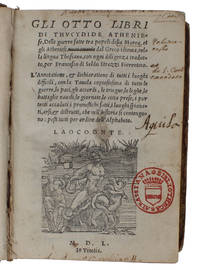
155060219Venice Laocoonte 1550. 8vo. In later full calf with five raised bands and gilt lettering to spine. Binding with considerable wear. Hinges weak and missing parts of leather. Stamp to title-page. All edges red. Printer's woodcut device to title-page and last page. Occassional underlignings in text and in margin throughout otherwise internally fine. 12 440 1 ff. <br/><br/><em>A fine Venetian edition of Thucydides’ famous history of the wars between Athens and the Peloponesians. </em> hardcover
155060219Venice, (Laocoonte), 1550. 8vo. In later full calf with five raised bands and gilt lettering to spine. Binding with considerable wear. Hinges weak and missing parts of leather. Stamp to title-page. All edges red. Printer's woodcut device to title-page and last page. Occassional underlignings in text and in margin throughout, otherwise internally fine. (12), 440, (1) ff.
1550322912Venice 1550. hardcover. very good. Very thick short 8vo. one gathering loose. Full vellum with title in gold all edges rubricated. Printer's woodcut device to title-page and last page. 12 440 1. Venice 1550. Very good.<br/> <br/> A fine Venetian edition of Thucydides' famous history of the wars between Athens and the Peloponesians.<br/> <br/> unknown
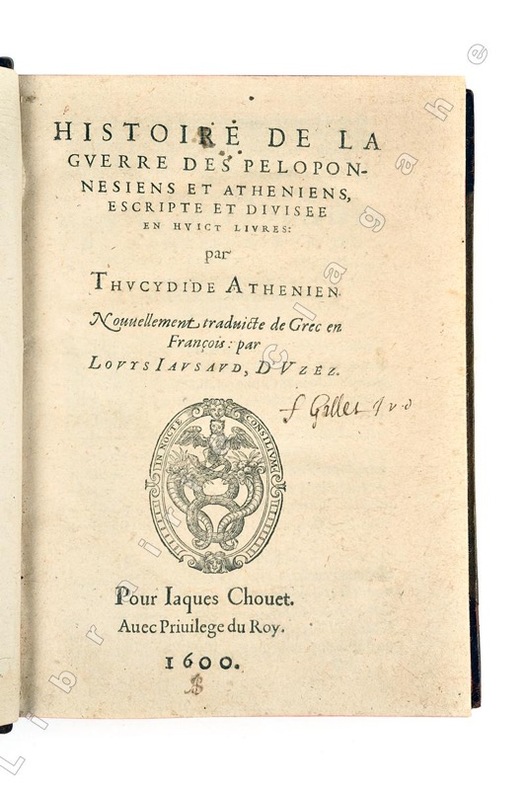
160020037[Genève], Iaques Chouet, 1600; marque de l’imprimeur au titre avec la devise “In nocte consilium” ; in-4, demi veau fauve à coins, dos lisse, pièce de titre grenat décoré, tranches rouges (reliure ancienne) ; [12], XIV, [1] f. blanc, 551, [1] bl., [23-1 bl.] ff. ; Col. 4, 2, -, A-Z, AA_ZZ, AAA-ZZZ, a-c4.
154500009254Venetia = Venice: Vincenzo Vaugris = Vincenzo Valgrisi 1545. First Italian edition. Hardcover. Near Fine. Small 8vo. 24 440 1 pp. Every other text page paginated. Recent early 20th century tan paper-covered boards. Title page with publisher's device woodcut initials final page of text with publisher's device on the reverse. Translated from the Italian on the title page: "With annotations and explanations of the historical places and most detailed alphabetized tables of all the wars the peace agreements the alliances formed the naval battles the daily events the cities taken the portents predicted and the leveled burned destroyed places that are recorded in history." Translated from the Greek into the Tuscan language by Francesco di Soldo Strozzi Fiorentino. A Manual of Classical Bibliography Joseph Moss 700. The Oxford Classical Dictionary 1134; 1516-1521. The first edition in Italian. Moss records this imprint as the first edition in Italian and writes that it has been reprinted several times both with and without dates. Adams records an undated Venetian imprint from Baldassar de Constantini Adams T-684 but not the Venetian Valgrisi imprint the Constantini imprint recorded by Adams shares the same collation as the Valgrisi imprint. Thucydides' Peloponnesian War is one of the first written histories dependent on eyewitness accounts and primary sources to be produced in the Western world. The work is divided into several parts: an introductory book a section on The Ten Years War focused on the conflict between Athens and Corinth the peace that followed this war The Peace of Nicias the Sicilian War the Plague that struck Athens with the last book Book 8 a portion of Thucydides history on the Decelean War. Thucydides intended his histories to describe the events that directly follow the ones recorded by Herodotus. He began writing the books soon after the Peloponnesian War started and recorded several of the events soon after they happened. From his 20s to his 50s Thucydides worked on his histories and the work reflects his changing perspective over time. His scientific exacting approach to describing the causes of the war and the fall of Athens along with his brief and concise prose all help his work to stand apart from the other historical writings of Classical Antiquity. Binding is Near Fine with two tiny splits to the paper over the joints leaves rarely show foxing with one or two corners missing not affecting the text marginal annotations or the catch words. Overall a nice clean copy. Vincenzo Vaugris [= Vincenzo Valgrisi] hardcover
15631310180028Appresso G. Giolito de' Ferrari 1563-01-01. Hardcover. Good. Bound in contemporary vellum with gilt flourish. Some soiling to cover. Good binding. 463 p. ; 20 cm. Clean unmarked pages. History of the Peloponnesian War. Printer's devices engravings. Appresso G. Giolito de' Ferrari hardcover
156428293(Genova), Excudebat Henricus Stephanus, illustris viri Huldrichi Fuggeri typographus, 1564. Folio. Later red full calf, rebacked, soft boards. Inner hinges reinforced. T-p. w. repaired loss to lower right corner, not affecting text. Upper part of first about 100 leaves w. decreasing waterstaining w. very minor affect to text. Cont. owner's name to t-p. (""Ex libris Rabillone""). T-p. in red and black, woodcut printer's device to t-p., woodcut initials and vignettes, first part w. beautiful Greek script. Overall good condition. (16), 297, (2), 216, (8) pp.
156428293Genova Excudebat Henricus Stephanus illustris viri Huldrichi Fuggeri typographus 1564. Folio. Later red full calf rebacked soft boards. Inner hinges reinforced. T-p. w. repaired loss to lower right corner not affecting text. Upper part of first about 100 leaves w. decreasing waterstaining w. very minor affect to text. Cont. owner's name to t-p. "Ex libris Rabillone". T-p. in red and black woodcut printer's device to t-p. woodcut initials and vignettes first part w. beautiful Greek script. Overall good condition. 16 297 2 216 8 pp. <br/><br/><em>First edition thus. First part in Greek second part in Latin. "The Latin version is Valla's which Stephan published separately in 1564 but which usually accompanies the Greek text." Dibdin II:506. "The text was first printed by Aldus in 1502. The edition of Henri Estienne a member of the famous French family of printers who corresponded with scholars as an equal first came out in 1564. The edition cited the second edition 1588 was improved by the addition of a translation into Latin by Lorenzo Valla." PMM 102. This edition also contains Valla's excellent and famous translation being the second part of the work separately paginated pp. 1 - 216; in the second edition the translation is not printed separately but in parallel columns on the same pages as the Greek text. "Édition plus belle" Brunet V:844. Stephanus Estienne worked in Paris and Dibdin mentions the work as being printed in Paris whereas PMM states that it is printed in Genova. Brunet V:844 PMM 201 Dibdin II:506. Greasse 7:149. </em> hardcover
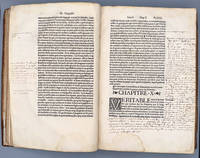
1527winter5<p> <strong>IMPORTANT THUCYDIDES ANNOTATED IN THE 1620s BY A REPRESENTATIVE OF THE "REPUBLIC OF LETTERS" CONTEMPORARY OF GABRIEL NAUDÉ & THE DUPUY BROTHERS CAPABLE OF INVOKING MACHIAVELLI AS WELL AS MAGELLAN</strong> </p><p>THUCYDIDES<br /><em>L'Histoire de la guerre qui fut entre les Peloponnesiens</em> Paris Josse Bade 1527.</p><p>Folio 15 ff. CCLXXXI ff. 17th-century sheep with corners and spine raised bands renewed caramel title-label. Title-leaf lacking small cut at foot of final leaf dampstain in the lower margin throughout more pronounced in the last quarter of the volume.<br />Dimensions: 32.7 × 22.3 cm.</p><p>References: Moreau-Renouard III 1343. USTC no. 22806.<br />Languages of annotation: French; quotations in Latin and Italian; a few words in Greek.</p><p>Bibliography<br />C. Grell "Thucydide en France de la Renaissance à la Révolution" in <em>Ombres de Thucydide. La réception de l'historien depuis l'Antiquité jusqu'au début du XXe siècle</em> Ausonius 2010 pp. 587–600.</p><p>An edition published at the instigation of François I</p><p>First edition of the translation by Claude de Seyssel based on Lorenzo Valla's Latin translation published at the instigation of François I by Jacques Colin his almoner and ordinary reader. The printing was made thanks to the manuscript kept in the king's library and the colophon explains the meaning of this gesture: "… et finablement a esté publié et mis en lumière par le commandement du tres chrestien Roy Françoys premier de ce nom au prouffit et edification de la noblesse et subjectz de son Royaulme."</p><p>Born in Savoy around 1450 Claude de Seyssel pursued a diplomatic career before becoming an influential prelate he died archbishop of Turin in 1520. He translated several historical works including Diodorus of Sicily offering his presentation manuscripts to Louis XII. The contract linking Josse Bade and François I is still preserved.</p><p>Important copy annotated by a reader belonging to the "Republic of Letters"</p><p>Our volume was very extensively annotated with great regularity by a humanist scholar from the late 1620s to the early 1630s. Indeed at f. CLXXVIIv an event of the year 1629 is mentioned designated as "this year": "de nostre temps ès villes huguenottes qu'on desmolit cest an 1629." The year 1632 also appears in a reference to Nicolas Faret's <em>Honneste-Homme</em> preface f. a 7v.</p><p>Our reader — who wrote about 1000 notes often substantial throughout the work — proves emblematic of the Republic of Letters: he makes the Ancients Thucydides Aristotle and the Moderns Machiavelli Bodin Giovio converse in the margins. He summons geography Ortelius as well as technical treatises; and relies on examples from navigators such as Magellan.</p><p>His humanistic cursive handwriting accompanies a precise method: to state maxims support them with examples then give precise references. The echoes to recent publications or to the current affairs of the reign of Louis XIII finally reveal an attentive eye on contemporary events faithful to the critical ideal of European men of letters. A profile emerges that places our annotator in the lineage or the milieu of Naudé the Dupuy brothers or Peiresc.</p><p>Numerous philosophical historical references & resonances with the history of his time</p><p>Our annotator makes numerous references to ancient Greek and Latin historical works Appian of Alexandria at f. XLVIII v° Aristotle's <em>Politics</em> at f. LVII v° Livy at f. XLIX v° Tacitus and Zonaras at f. XXV r° but it is above all the political and philosophical works of the Renaissance that he more readily invokes particularly Machiavelli <em>Florentine Histories</em> and the <em>Discourses</em> the history of Paolo Giovio and Jean Bodin.</p><p>His method often consists in formulating in the margin a general maxim which he illustrates with solid historical references confirming the usefulness — stressed by Seyssel — of the numerous speeches "contions" included in Thucydides' work. He possesses enough Italian to quote Machiavelli in the text on several occasions.</p><p>At f. XXIIIr concerning the Spartans who hear the complaints of the Athenians and send them out so they may deliberate among themselves he notes that "les intéressés doivent sortir des assemblées ou leurs affaires se deliberent Tite Live dec. 3 L. 6 fol. 140 fol. 141. dec 4. L. 5 fol. 135."</p><p>Likewise at f. CXXVI v° where he draws on Paolo Giovio's <em>History of His Time</em> which contains long developments on the Sack of Rome in 1527: "quiconque n'obtient à ce qu'il desire se persuade qu'on luy fat rot vide Jovio l. 31 fol. 231 du pape Clem 7 piqué contre l'empereur Charles 5."</p><p>Or again at the beginning of chapter 7 of book III where he cites Jean Bodin in support: "Toute ceste harangue tend à persuader qu'il faut pardonner. Bod. li. 4 <em>De la rép</em> ch. 6 p. 91" f. XCI r°.</p><p>From time to time our reader makes fascinating parallels with his own era: this is the case at f. CLXXVIIv where he connects a passage of book V chap. 10 of Thucydides on the effectiveness of the mobilisation of the entire Athenian people to strengthen the walls with the contemporary effort to destroy Huguenot strongholds in the France of Louis XIII: "de nostre temps ès villes huguenottes qu'on desmolit cest an 1629."</p><p>A reader fond of geography & seafaring who mentions Magellan & relies on the maps of Ortelius</p><p>Our annotator also pays attention to geographic and historical accuracy and makes use of comparative cartography of his time to picture the situation of a battle: from Athens to Mytilene he compares the map of Hondius who counts 240 miles while Ortelius counts only 200 f. XCIIIv°.</p><p>He often relies on the testimony of sailors mathematicians or geographers for greater accuracy: for example concerning the size of the kingdom of the Odrysians he refers to the <em>Dialogue de la longitude est-ouest</em> by Toussaint de Bessard Norman mathematician and hydrographer published in 1574. One sees how attached he is to the testimonial history of Thucydides as opposed to the more anthropological and sometimes unreliable history of Herodotus.</p><p>At f. 80 verso appears a reference to Magellan: after stating that "un capitaine de marine doit sur toutes choses prudence garder à soy" our annotator then mentions "Almeida près du cap de bonne espérance l'an 1510" & "Magellan à Zébu Cebu l'an 1521" references he finds "chez Osorius en l'Histoire de Portugal livre 6 no 16."</p><p>A few textual remarks and corrections are also to be noted: in chapter 4 of book II he notes that there is an improbability in the length of the wall and does not know to whom he should attribute the error: "ce passage estoit corrompu en l'original latin que Seyssel a traduit ou il a mal conceu l'intention de Thucicide …" f. XLVIII v°.</p><p><strong>Precious volume annotated by a humanist scholar of the 1620s manifestly close to the networks of the Republic of Letters</strong></p> Josse Bade
15408317Basileae Basel ex Officina Hervagiana 1557-1540. 2 works bound in one volume folio. pp. xx 310 ii blank; xxiv 178 iv blank with woodcut printer's device to verso of both final leaves. Greek text numerous early marginal notes and alternative readings in the first work occasional annotations in an early hand in the second. Near contemporary quarter pigskin over pasteboard rubbed. Johannes Herwagen was a protestant printer from Strasbourg. He became a citizen of Basel in 1528 and married Johann Froben's widow. Froben had made Basel a centre for the priting of Greek and Latin texts modelling his business on the example of scholar-printer Aldus Mantutius. Herwagen continued the tradition collaborating at first with his stepson Hieronymus Froben and his brother Nicholas Episcopius and printing under his own name from 1531. He was fined and expelled from the city in 1542 after having an affair with his stepson's wife but Landgrave Philip of Hesse Duke Christoph von Württemberg and the University of Basel campaigned for him so that he was pardoned in 1545 and a period of house arrest and a tavern ban were both lifted in 1547 by the City Council. He published the first edition in Greek of Euclid's Elements 1533 and other works such as Heliodorus' Aithiopika 1534. These are the third printings of the 'father of history' and of Thucydides in the original Greek. Book unknown
1550111546London: William Tylle 1550. First edition of one one of the greatest of classic historical works. Folio bound in 19th century full vellum morocco spine label marbled endpapers title-page with elaboarate historiated woodcut border. In very good condition with light toning to the text. Rare and desirable in this condition. “The standards and methods of Thucydides as a contemporary historian have never been bettered. He began work at the very start of the events he records and the penetration and concentration which he devoted to his account of the ‘Peloponnesian War’ the war between Athens and Sparta from 431 to 404 B.C. were based on the conviction that it would prove the most important event in Greek history… He saw his history as a source of profit to ‘those who desire an exact knowledge of the past as a key to the future which in all probability will resemble the past.’ It was in this sense… that he called it… ‘a possession forever.’ This is exactly what it has become†PMM 102. William Tylle hardcover