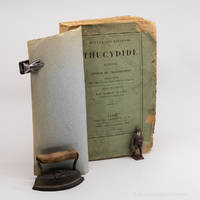
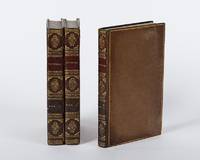
1 215 résultats
42997Leipzig, B.G. Teubner, 1894.
156258N.pl., The Universtity of Michigan Press, 1963.
94128Cambridge Mass., Harvard University Press, 1942.
156266Darmstadt, Wissenschaftliche Buchgesellschaft, 1968.
159982Roma, Edizioni di Storia e Letteratura, 2015.
109390Darmstadt, WB, 1968.
113905Zürich, N.Y., Olms., 1991.
130343Amsterdam (Te Amsteldam), Bij Pieter den Hengst, 1786.
34995Paris, 1964 Gallimard 512 p., broché 10,9 x 16,5
197397828452179681973, Les Belles Lettres, collections des universités de France, in-8 broché de 106 pages + 2 pages de cartes en fin d'ouvrage, couverture orange, Thucydide - Livre II, établi et traduit par J. de Romilly, texte en grec et traduction, troisième tirage | Etat : Très bon état général (Ref.: Ref91249)
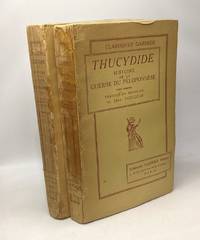
1937100099979Garnier Frères 1937 in12. 1937. Cartonné. 2 volume(s). livres I à VIII
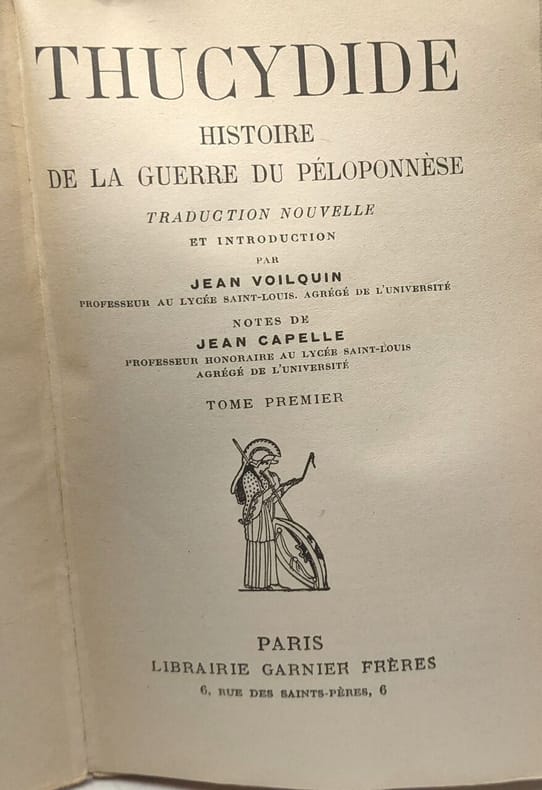
204054Les Belles Lettres Paris 1962 In-8 ( 205 X 130 mm ) de XLIII-106 broché sous couverture imprimée. EDITION ORIGINALE. Planches hors-texte dépliantes en fin d'ouvrage. Bel exemplaire.
15631310180028Appresso G. Giolito de' Ferrari 1563-01-01. Hardcover. Good. Bound in contemporary vellum with gilt flourish. Some soiling to cover. Good binding. 463 p. ; 20 cm. Clean unmarked pages. History of the Peloponnesian War. Printer's devices engravings. Appresso G. Giolito de' Ferrari hardcover
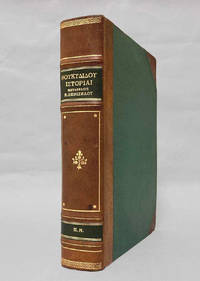
19606517Ekdotikos Oichos Patris E.P.E. Athens 1960; 8vo 7" x 9 3/4" 520 pages; illustrated. Landmark translation of Thucydides’ fifth century B.C. History from the original Classic Greek into Modern Greek by eminent Greek scholar and statesman Eleutherios Venizelos seven times Prime Minister of Greece who was instrumental in the formation of the modern Greek State. Painstakingly written over a period of seven years Venizelos’ translation is noted among other aspects for his use of katharevousa a modern Greek style closer to classic Greek than the demotic vernacular in order to correct later accretions and bring the language closer to that of Thucydides’ original. Copious commentary and analysis by Venizelos plus substantive prefaces by Stefanos I. Stephanou Dimitrios Kaklamanos Andreas Mikalopotaos and Konstantin D. Stergiopoulos. Illustrated with frontispiece Venizelos portrait plate five color fold-out maps six full-page b&w photo plates of various associated Greek antiquities and a facsimile of Venizelos’s four-page handwritten personal observations on Thucydides. Complete index at the back. Fine in custom binding of half calf textured green cloth raised bands gilt morocco spine labels and gilt spine decorations. A handsome volume of a monumental work of considerable value to Greek studies. Ekdotikos Oichos Patris E.P.E. hardcover
2026100099979Garnier Frères 2026. dos recollés couvertures défraîchies ternies frottées tranches un peu fanées intérieurs propres. in12. 2026. Cartonné. 2 volumes. livres I à VIII Garnier Frères unknown
2013619685.Gpaperback. Good. Access codes and supplements are not guaranteed with used items. May be an ex-library book. paperback
0267870310.Ghardcover. Good. Access codes and supplements are not guaranteed with used items. May be an ex-library book. hardcover
0259268011.Gpaperback. Good. Access codes and supplements are not guaranteed with used items. May be an ex-library book. paperback
18861246Paris: Librairie Hachette 1886. First Edition. Paperback. Good only. Textblock remains sound. Large 8vo. 467 pp. Blue hand-labelled wrappers over original greenish blue typographic wrappers. Greek text with critical and explanatory notes in French. Books 1 and 2. From the library of Univ. of Dallas Classics Professor Karl Maurer; unmarked. Librairie Hachette paperback
Cellotape has been applied to spine and rear wrap. Minor shelfwear and scuffing. Browning to spine. Light creasing to wraps. ; Parallel text in French and Greek. Xxxvi, 175 pp ; Collection Des Universités De France. Association Guillaume Budé; Vol. 4; 175 pages
Pencil notes and underlining to a few pages. Light water-staining to spine. Light creasing to wraps. Small chips to base of spine. ; Parallel text in French and Greek. Xxxvi, 175 pp ; Collection Des Universités De France. Association Guillaume Budé; Vol. 4; 175 pages
181132394AB1811. Bilingual Edition Greek-Latin. Three Volumes complete set. Oxford J.Parker 1811. Octavo. Pagination: Volume I:XXIV 440 pages / Volume II: 418 pages / Volume III: 266 pages plus 60 unnumbered pages of Index Rerum and Index Verborum. Hardcover / Original full leather with gilt lettering and ornament on spine and boards. Occasional annotations and textmarkings. Bindings rubbed and a little dusty but very firm and overall in very good condition with only minor signs of wear.Hinges all attached with only the front boards of Volume I and II slightly starting. Besides a few dogears a nd minor signs of only occasional foxing in very good condition. From the library of Daniel Conner Connerville / Manch House with his Exlibris / Bookplate to pastedown. This is a rare version of this text ! Thucydides c. 460 c. 400 BC was an Athenian historian and general. His History of the Peloponnesian War recounts the fifth-century BC war between Sparta and Athens until the year 411 BC. Thucydides has been dubbed the father of "scientific history" by those who accept his claims to have applied strict standards of impartiality and evidence-gathering and analysis of cause and effect without reference to intervention by the gods as outlined in his introduction to his work. Thucydides has been called the father of the school of political realism which views the political behaviour of individuals and the subsequent outcomes of relations between states as ultimately mediated by and constructed upon fear and self-interest. His text is still studied at universities and military colleges worldwide. The Melian dialogue is regarded as a seminal text of international relations theory while his version of Pericles's Funeral Oration is widely studied by political theorists historians and students of the classics. More generally Thucydides developed an understanding of human nature to explain behaviour in such crises as plagues massacres and wars. Thucydides believed that the Peloponnesian War represented an event of unmatched importance. As such he began to write the History at the onset of the war in 431 BC. He declared his intention was to write an account which would serve as "a possession for all time". The History breaks off near the end of the twenty-first year of the war 411 BC in the wake of the Athenian defeat at Syracuse and so does not elaborate on the final seven years of the conflict. The History of the Peloponnesian War continued to be modified well beyond the end of the war in 404 BC as exemplified by a reference at Book I.1.13 to the conclusion of the war. After his death Thucydides's History was subdivided into eight books: its modern title is the History of the Peloponnesian War. This subdivision was most likely made by librarians and archivists themselves being historians and scholars most likely working in the Library of Alexandria. Thucydides is generally regarded as one of the first true historians. Like his predecessor Herodotus known as "the father of history" Thucydides places a high value on eyewitness testimony and writes about events in which he probably took part. He also assiduously consulted written documents and interviewed participants about the events that he recorded. Unlike Herodotus whose stories often teach that a hubris invites the wrath of the deities Thucydides does not acknowledge divine intervention in human affairs. Thucydides exerted wide historiographical influence on subsequent Hellenistic and Roman historians although the exact description of his style in relation to many successive historians remains unclear. Readers in antiquity often placed the continuation of the stylistic legacy of the History in the writings of Thucydides's putative intellectual successor Xenophon. Such readings often described Xenophon's treatises as attempts to "finish" Thucydides's History. Many of these interpretations however have garnered significant scepticism among modern scholars such as Dillery who spurn the view of interpreting Xenophon qua Thucydides arguing that the latter's "modern" history defined as constructed based on literary and historical themes is antithetical to the former's account in the Hellenica which diverges from the Hellenic historiographical tradition in its absence of a preface or introduction to the text and the associated lack of an "overarching concept" unifying the history. A noteworthy difference between Thucydides's method of writing history and that of modern historians is Thucydides's inclusion of lengthy formal speeches that as he states were literary reconstructions rather than quotations of what was saidor perhaps what he believed ought to have been said. Arguably had he not done this the gist of what was said would not otherwise be known at allwhereas today there is a plethora of documentationwritten records archives and recording technology for historians to consult. Therefore Thucydides's method served to rescue his mostly oral sources from oblivion. We do not know how these historical figures spoke. Thucydides's recreation uses a heroic stylistic register. A celebrated example is Pericles' funeral oration which heaps honour on the dead and includes a defence of democracy: " The whole earth is the sepulchre of famous men; they are honoured not only by columns and inscriptions in their own land but in foreign nations on memorials graven not on stone but in the hearts and minds of men." Stylistically the placement of this passage also serves to heighten the contrast with the description of the plague in Athens immediately following it which graphically emphasises the horror of human mortality thereby conveying a powerful sense of verisimilitude: "Though many lay unburied birds and beasts would not touch them or died after tasting them . The bodies of dying men lay one upon another and half-dead creatures reeled about the streets and gathered round all the fountains in their longing for water. The sacred places also in which they had quartered themselves were full of corpses of persons who had died there just as they were; for as the disaster passed all bounds men not knowing what was to become of them became equally contemptuous of the property of and the dues to the deities. All the burial rites before in use were entirely upset and they buried the bodies as best they could. Many from want of the proper appliances through so many of their friends having died already had recourse to the most shameless sepultures: sometimes getting the start of those who had raised a pile they threw their own dead body upon the stranger's pyre and ignited it; sometimes they tossed the corpse which they were carrying on the top of another that was burning and so went off." Thucydides omits discussion of the arts literature or the social milieu in which the events in his book take place and in which he grew up. He saw himself as recording an event not a period and went to considerable lengths to exclude what he deemed frivolous or extraneous. Wikipedia hardcover
193048579Chelsea.: The Ashendene Press. 1930. Original publisher's full white pigskin by W. H. Smith & Son Ltd. with their signature gilt to rear turn-in banded spine with gilt title in six compartments. Folio. 408 x 282 mm. Printed title and 'Book I' to 'Book X' of Thucydides' text in English in red and black in Ptolemy type chapter summaries in Blado marginal chapter summaries and opening lines by Graily Hewitt in red the red initials from the alphabet designed by Eric Gill for the Ashendene Utopia final leaf with colophon and woodcut Ashendene device verso. The Ashendene Thucydides the final folio from the press.From the edition limited to 280 copies with this one of 260 on Batchelor 'knight in armour' Ashendene paper; 20 copies on vellum were also issued.The Greek text was translated by Benjamin Jowett Regius Professor of Greek at Oxford. The book is printed in Ptolemy with Blado marginal chapter summaries - the first time St John Hornby had used a different type for side-notes.This copy includes the original purchaser's invoice a single leaf 216 x 150 mm headed 'THE ASHENDENE PRESS / SHELLEY HOUSE CHELSEA' and made out to Mr. Jacques Steinitz / Warren Ohio'. Signed by St. John Hornby with two pence stamp and dated May 27th 1931 the cost is detailed as 15 Guineas.Ashendene XXXVII. The Ashendene Press. unknown
Z1-C-077-00137Heinemann. Used - Very Good. Ships from UK in 48 hours or less usually same day. Your purchase helps support Sri Lankan Children's Charity 'The Rainbow Centre'. Book has been well cared for. 100% money back guarantee. We are a world class secondhand bookstore based in Hertfordshire United Kingdom and specialize in high quality textbooks across an enormous variety of subjects. We aim to provide a vast range of textbooks rare and collectible books at a great price. Our donations to The Rainbow Centre have helped provide an education and a safe haven to hundreds of children who live in appalling conditions. We provide a 100% money back guarantee and are dedicated to providing our customers with the highest standards of service in the bookselling industry. Heinemann unknown