STEINBECK, JohnBiblio.com
2 587 résultats
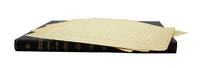
195369082n.p. 1953. n.p.: 1953.<br> <br> Full Description:<br> <br> STEINBECK John. Manuscript draft for essay entitled "My Short Novels". n.p.n.d ca: 1953.<br> <br> Manuscript draft in Steinbeck's hand for the essay entitled "My Short Novels which served as a preface to the Literary Guild's 1953 edition of "The Short Novels of John Steinbeck." A near word for word representation of the essay which was originally published by The Literary Guild Review and found in their magazine "Wings" in October 1953 Pages 4-8. This manuscript is exciting because it is an close representation but still a draft of what was finally printed. In comparing the two documents you can see that the published piece was trimmed down a bit from what Steinbeck wrote in this manuscript draft. Many of the edits are eliminations of a few words here and there but there are a few places where whole sentences and ideas have been cut. Most of these are some what self-deprecating which is interesting to watch him ultimately play down. Apart from punctuation changes the parts of this manuscript that are not found in the final publication have been indicated by us below by being housed within brackets.<br> <br> Four foolscap legal-sized pages 12 1/2 x 8 inches; 318 x 202 mm. Written in pencil on recto only of each page. With a few notes and corrections. Each page is approximately 28 lines long. Lacking a final leaf which would go on to discuss the final two stories. Some minor toning and a small bump to bottom left corner of all leaves. Still a near fine example of a wonderful Steinbeck manuscript. Housed in a blue quarter morocco clamshell. Another manuscript draft version of this essay was sold at auction in 2023 for 32500 Euros and was also incomplete.<br> <br> Together with A copy of the The Literary Guild Review Magazine "Wings" which includes the entire essay.<br> <br> In the four present pages he discusses the origins of the stories The Red Pony Tortilla Flat Of Mice and Men and The Moon is Down. The final page which is lacking goes on to discuss Cannery Row and The Pearl.<br> <br> The Manuscript reads:<br> <br> "I have never written a preface nor a comment to one of my books before believing that the work should stand on its own feet even if it's legs ankles were slightly wobbly. When I was asked to comment on the five short novels of this volume my first impulse was to refuse. And then thinking over the things that have happened to these stories since they were written I was taken with the idea that the things that happen to a book are very like those that happen to a man. These stories cover a long period of my life. As each one was finished that part of my life it represented was finished. It is true that while he is doing it the writer and his book are one. When the book is finished it is a kind of death a matter of pain and sorrow to the writer. And then he starts a new book and a new life and if he is growing and changing a new life starts. And the writer like a fickle lover forgets his old love. It is no longer his own- the intimacy and the surprise are gone. So much I knew but I had not thought of the poor little stories thrust out into an unfriendly world to make their way. They have experiences too they grow and change or wane and die just as everyone does. They make friends or enemies and sometimes they waste away from neglect. Remembering the careers of these short novels has been interesting to me. All of the have been experiments. That is why no two of them are remotely alike. And experiments are rarely accepted all at once.<br> <br> My stories have been slow starters almost like shy young men who do not make friends quickly. Indeed most of my books have succeeded without trying in making quick and fierce enemies at first. It is pleasing to me that they do in time make lasting and loyal friends.<br> <br> The Red Pony was written a long time ago when there was desolation in my family. The first death had occurred- and the family which every child believes immortal was shattered. Perhaps this is the first adulthood of any man or woman- the first tortured question why and then acceptance and your child was a man. The Red Pony then was an attempt an experiment if you must to set down loss and acceptance death a the transfiguration the adult mind must create for itself.<br> <br> At that time I had had three books published and all of them had failed to come any where near selling their first editions. The Red Pony could not find a publisher. It came back over and over again until at last a foolishly brave editor bought it for The North American Review and paid 90 dollars for it. This was more money than I thought the world contained. What a great party we had in celebration. The Magazine went broke almost immediately and my story disappeared for a good number of years. That it ever came back is the remarkable thing. But it not only did but it seems to gather friends as it goes.<br> <br> It takes only the tiniest pinch of encouragement to keep a writer going and if he gets none he sometimes learns to feed even on the acid of failure.<br> <br> Tortilla Flat grew out of a reading of the sources of The Arthurian cycle- from Mabinogion Through Geoffrey and through the to Tennyson. I wanted to take the stories of my town of Monterey and cast them into a kind of folklore. The result was Tortilla Flat. It followed the pattern. Publisher after publisher rejected it until Pascal Covici finally published it. But it did have one distinction the others had not. It was not ignored. Indeed the Chamber of Commerce of Monterey fearing for its tourist business issued a statement that the book was a lie and that certainly no such disreputable people lived in that neighborhood. But perhaps the chamber did me a good service for this book sold two editions I think and this was almost more encouragement than I could stand. I was afraid I might get used to such profligacy on the part of the public and I knew it couldn't last. A moving picture company bought it and paid 4000 dollars for it- 3600 came to me. It was a fortune. When a few years later the company fired its editor one of the reasons was that he had bought Tortilla Flat. He bought it for the from the company for the original 4000 and several years later sold it to MGM for 90000 dollars a triumph for me albeit shallow a kind of justification for me and a fortune for the editor.<br> <br> Of Mice and Men was another experiment- an attempt to write a novel in three acts to be played from the lines. I had nearly finished it when my setter pup ate it one night- literally made confetti of it. I had to start fresh. I don't know how close the first and second versions would prove to be.<br> <br> This book had some success but as usual it found its enemies. It was called brutal its characters sub humans its story sadistic and one group found homosexuality in it which puzzled me quite a bit. With rewriting however it did become a play and had some success.<br> <br> There were long books written between these little novel. I think the little ones were exercises for the longer ones. The war came on and I wrote The Moon is Down as a kind of celebration of the durability of democracy. I couldn't have conceived that it would be denounced as almost treason. I had written of Germans as men not super men and this was considered a very weak attitude to take. I couldn't make much sense out of this and it seems."<br> <br> HBS 69082.<br> <br> $10000. n.p. unknown
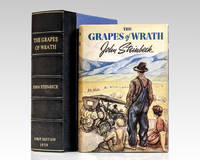
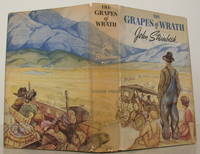
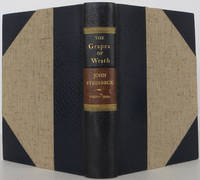
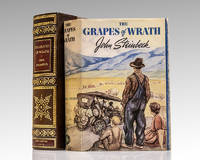
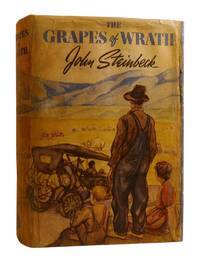
1939151252New York: The Viking Press 1939. First edition of this pivotal Pulitzer prize-winning novel with "First Published in April 1939" on the copyright page and first edition notice on the front flap of the dust jacket. Octavo original pictorial beige cloth pictorial endpapers. Near fine in a near fine dust jacket. Jacket design by Elmer Hader. Housed in a custom half morocco clamshell box. An exceptional example. 'The Grapes of Wrath' is the kind of art that is poured out of a crucible where pity and indignation merge. Its power and importance do not lie in its political insight but in its intense humanity. "It is the American novel of the season probably the year possibly the decade" Clifton Fadiman. The basis for the 1940 John Ford directed film bearing the same name starring Henry Fonda 'The Grapes of Wrath' is widely considered as one of the greatest American films of all time. In 1989 this film was one of the first 25 films to be selected for preservation in the United States National Film Registry by the Library of Congress as being 'culturally historically or aesthetically significant;' Listed by Modern Library as one of the 100 best novels of the twentieth century. The Viking Press hardcover
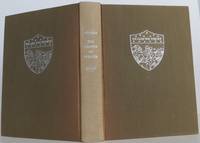
19401607218Heritage Press 1940. Illustrated Edition. Hardcover. Fine. Inscribed illustrated edition. Inscribed by John Steinbeck on the title page to Mr. and Mrs. O'Quinn. Thomas Hart Benton illustrator. 559 pgs 7 7/8" wide x 10 1/4" tall. Illustrated endpapers. Dark tan cloth with silver lettering . All external page edges have been tinted a light yellow by the publisher. The book spine is slightly sunned. Comes in publisher's slipcase edges worn and top edge on one side split. The book itself is internally unmarked clean tightly bound and in fine condition. All housed in a custom-made slipcase. The story of The O'Quinns: In 1955 John Steinbeck came to Austin Texas to visit his nephew Jon Atkinson. Jon was highschool friends with Kerry O'Quinn. During Steinbeck's visit Kerry went to Jon's house and took his parent's Heritage Club copy of The Grapes of Wrath which Steinbeck signed with the wonderful inscription: "For Mr. & Mrs. Quinn from John Steinbeck who isn't angry at anybody". FYI: When Jon and Kerry graduated highschool in 1956 their parents gave them a two week trip to New York City. John and Elaine Steinbeck were away at Sag Harbor for the summer but offered them the use of his 5-story townhouse on East 72nd Street complete with housekeeper and cook. Elaine helped them to get orchestra seats for all the big Broadway musicals including My Fair Lady which was sold out. Heritage Press hardcover
1939108158Viking Press 1939. 2nd Edition. Hardcover. Near Fine/Near Fine. Inscribed by John Steinbeck on the title page. A second printing before publication. Very good in a very good dust jacket. Book has slightly tanned spine and a small less than an inch tear in the spine cloth near the front panel. Jacket has reviews on the front flap and is from a later printing. Bottom corner of the front flap is clipped where it would have said what printing it is. We will provide a certificate of authenticity. Housed in a custom-made collector's slipcase. Viking Press hardcover
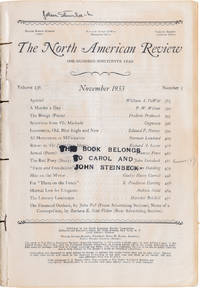
19341015New York: The North American Review Corporation 1934. First Edition. 3 volumes individual issues November 1933 December 1933 and April 1934 of the magazine each containing the first appearance of Steinbeck stories. Original printed wrappers bound in plain brown paper covered boards the front cover of the November '33 issue and the rear cover of the April '34 issue are used as a paste downs. Signed 'J.E. Steinbeck' in pencil on the top of the front cover of each issue the impression can be read on the back of the November cover that has been pasted down signed 'John Steinbeck' in pen on the title page of the November '33 issue along with a stamp reading "This book belongs to Carol and John Steinbeck" on the same title page. Front board has a watercolor of a woman reading likely by Carol Steinbeck. Rubbing chips to the spine soiling hinges split but holding else internally very good. Ex- Steinbeck nephew in-law David Heyler. A trio of stories that exhibit Steinbeck's ability to explore complex human experience at different stages in life. "The Red Pony" is a nuanced exploration about the delicate emotional journey of childhood. "The Murder" uses violence as a transformative act to initiate a shift in a stagnant marriage. "The Great Mountains" considers the themes of aging the allure of adventure and the mysterious nature of life and death. <br /> <br /> Steinbeck's early career during which these stories were published represents a crucial developmental period in his literary evolution. Writing during the depths of the Great Depression Steinbeck was beginning to forge connections between individual experiences and broader socioeconomic structures. In these three stories we can identify his emerging materialist analysis that would later flourish in works like "The Grapes of Wrath." Although not yet explicitly political these narratives contain the seeds of his later class consciousness. The intergenerational tensions in "The Great Mountains" the complex power dynamics of "The Murder" and the disillusionment narrative in "The Red Pony" all reveal Steinbeck's early interest in how social and economic forces shape human relationships and personal development. His writing methodology during this period involved immersive research into the lives of California's working people creating an authenticity that distinguishes his work from contemporaries who approached similar themes from more privileged perspectives. The North American Review Corporation unknown
1962207376New York: Viking 1962. First Edition; First Printing. Hardcover. Very Good in a Very Good dust jacket.; Personalized by author on title page. Viking hardcover
19392101037Viking Press 1939. fifth. hardcover. near fine. Fifth edition published one month after the first edition as stated on copyright page May 1939. One of ten leatherbound presentation copies signed by Steinbeck on a laid-in slip inscribed to Elyse. Book near fine. Housed in a custom-made fold-out case. Viking Press unknown books
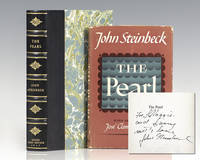
1947103774New York: The Viking Press 1947. First edition of this classic story of simplicity based on a Mexican folk tale. Octavo original cloth. Presentation copy inscribed by the author on the half-title page "For Maggie and Larry with love John Steinbeck." Near fine in a near fine first-issue dust jacket with Steinbeck looking to the left on the rear panel. Drawings by Jose Clemente Orozco. Housed in a custom half morocco clamshell box. A story of classic simplicity based on a Mexican folk tale The Pearl explores the secrets of man's nature the darkest depths of evil and the luminous possibilities of love. Steinbeck began writing the story as a movie script in 1944 and first published it as a short story called "The Pearl of the World" in Woman's Home Companion in December 1945. He expanded it to novella length and published it under the name The Pearl by Viking Press in 1947. As he was writing the novella version he was frequently travelling to Mexico where the film version co-written with Jack Wagner was being filmed. The film was also released by RKO in 1947 as a co-promotion with the book. The Viking Press hardcover books
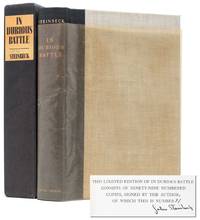
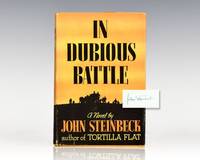
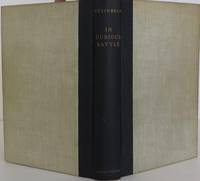
19366736New York: Covici Friedi 1936. First edition. Fine/Near Fine. Number 31 of 99 copies of the signed limited edition. This copy Fine and unread in the original glassine jacket and publisher's slipcase. Glassine also Nearly Fine condition with a small tear at the lower rear corner publisher's slipcase Near Fine with a small nick to the lower corner and slight rubbing. <br /> <br /> Historically overshadowed by Steinbeck's towering works East of Eden and The Grapes of Wrath his later novel In Dubious Battle has seen a resurgence of scholarly interest for its depictions of race and class. In developing the novel's central structure "Steinbeck utilized episodes from the Tagus Ranch peach strike of 1933 and a cotton strike throughout the San Joaquin Valley that October"; while he "deviated from the particulars of these labor disputes to clarify the central themes of the novel.In Dubious Battle indicates that the primary responsibility for human suffering rests on the growers since they preside over an economic framework that limits the opportunities available to the working class" predominantly composed of people of color Dawson. Steinbeck's emphasis on laborers unionizing to fight back against their abusers - predominantly powerful white men - are concerns that still resonate today. In Dubious Battle made its appearance on the big screen in 2017 as a film directed by James Franco.<br /> <br /> Goldstone & Payne A5a. Fine in Near Fine dust jacket. Covici Friedi unknown
1937000054New York: Covici Friede. First Printing. Clipped DJ in archival cover edge wear soiling damp stain. . Very Good. Hardcover. 1st Edition. 1st Printing. 1937. Covici Friede hardcover
19392306081New York: Viking 1939. First. hardcover. Fine/Fine. A fine first edition in a near ine first issue dust jacket tiny wear on top corners of spine of dj First Edition stated on front flap. Housed in a custom-made slipcase. Viking unknown
1939151791New York: The Viking Press 1939. First edition of this pivotal Pulitzer prize-winning novel with "First Published in April 1939" on the copyright page and first edition notice on the front flap of the dust jacket. Octavo original pictorial beige cloth pictorial endpapers. Fine in a near fine dust jacket. Jacket design by Elmer Hader. Housed in a custom half morocco slipcase. An exceptional example. 'The Grapes of Wrath' is the kind of art that is poured out of a crucible where pity and indignation merge. Its power and importance do not lie in its political insight but in its intense humanity. "It is the American novel of the season probably the year possibly the decade" Clifton Fadiman. The basis for the 1940 John Ford directed film bearing the same name starring Henry Fonda 'The Grapes of Wrath' is widely considered as one of the greatest American films of all time. In 1989 this film was one of the first 25 films to be selected for preservation in the United States National Film Registry by the Library of Congress as being 'culturally historically or aesthetically significant;' Listed by Modern Library as one of the 100 best novels of the twentieth century. The Viking Press hardcover
19392101037Viking Press 1939. fifth. hardcover. near fine. Fifth edition published one month after the first edition as stated on copyright page May 1939. One of ten leatherbound presentation copies signed by Steinbeck on a laid-in slip inscribed to Elyse. Book near fine. Housed in a custom-made fold-out case. Viking Press unknown
1947103774New York: The Viking Press 1947. First edition of this classic story of simplicity based on a Mexican folk tale. Octavo original cloth. Presentation copy inscribed by the author on the half-title page "For Maggie and Larry with love John Steinbeck." Near fine in a near fine first-issue dust jacket with Steinbeck looking to the left on the rear panel. Drawings by Jose Clemente Orozco. Housed in a custom half morocco clamshell box. A story of classic simplicity based on a Mexican folk tale The Pearl explores the secrets of man's nature the darkest depths of evil and the luminous possibilities of love. Steinbeck began writing the story as a movie script in 1944 and first published it as a short story called "The Pearl of the World" in Woman's Home Companion in December 1945. He expanded it to novella length and published it under the name The Pearl by Viking Press in 1947. As he was writing the novella version he was frequently travelling to Mexico where the film version co-written with Jack Wagner was being filmed. The film was also released by RKO in 1947 as a co-promotion with the book. The Viking Press hardcover
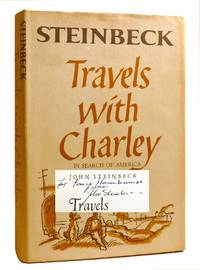
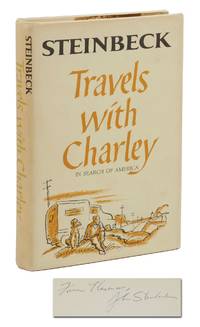
1962140941921New York: The Viking Press 1962. First Edition. Very Good/Near Fine. First edition. Signed by John Steinbeck on the half title inscribed to former owner "For Thomas." viii 246 pp. Original white cloth stamping in crimson and black. Very Good with very slight lean hinge starting at front ink underline and marginal note to p. 241 faint marginal bracket to another page. In a Near Fine dust jacket with sunning to spine light shelf wear unclipped. A rare signed copy of Steinbeck's bestselling American travelogue with his dog. The Viking Press unknown
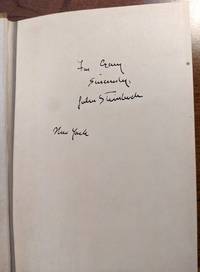
1954021229New York: The Viking Press 1954. First Edition. Hardcover. Slight bump to bottom front corner. About Fine in a Fine dustwrapper. In the first issue dustwrapper. This copy INSCRIBED and SIGNED by Steinbeck on the front endpaper: "For Craig/Sincerely/John Steinbeck/New York." A scarce book to find authentically signed <br/><br/> The Viking Press hardcover
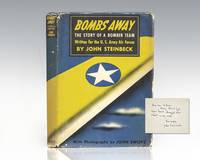
1942109635New York: The Viking Press 1942. First edition of Steinbeck's riveting account of his experiences with several bomber crews of the U.S. Army Air Forces during WWII. Octavo original cloth illustrated with 60 photographs by John Swope. Association copy inscribed by the author on the front free endpaper "Dear Mr. Wilson Many thanks for your lucid thoughts and interest in my work John Steinbeck." The recipient Edmund Wilson was an American literary critic and progenitor of the Library of America publication series. His critical works helped foster public appreciation for many of the foremost American writers of the 20th century including F. Scott Fitzgerald Ernest Hemingway John Dos Passos and William Faulkner. Steinbeck's inscription refers in jest to Wilson's harsh critique of his work in his 1941 publication The Boys in the Back Room: Notes on California Novelists. Near fine in the rare original dust jacket which is in very good condition. An exceptional association linking these two great American men of letters. Steinbeck was commissioned to write the present volume by the United States Army Forces as part of an effort to increase Air Force recruitment and morale. In order to write the book Steinbeck traveled more than 20000 miles in 30 days visiting dozens of training corps and flying fields with John Swopes himself a flier who took the 60 photographs that illustrate the book documenting the various jobs needed to form a bombing team. All royalties of the author and photographer as well as publishing profits were endowed to the perpetual Air Forces Aid Society Trust Fund to provide emergency aid for the families of fliers lost in the line of duty. The Viking Press hardcover books
1933153069New York: Robert O. Ballou 1933. One of 598 first issue copies First edition first printing. A near-fine copy in the first issue green cloth binding. Although 1498 copies were printed only 598 were bound. Sales were slow but after the success of Tortilla Flat in 1935 remaining sheets were bound and issued with a cancel title by different publishers. Octavo. Original green cloth lettering to spine in gilt pictorial endpapers top edge black. With dust jacket. Housed in a custom green morocco-backed folding box. Lower edge slightly sunned consistent browning; else an attractive and near-fine copy. Light browning to dust jacket with extremities slightly worn some small closed tears bookseller's label to rear flap; else a near-fine example of the jacket. Goldstone and Payne A3a hardcover
1935162745New York: Covici Friede Inc 1935. First Edition; First Printing. Hardcover. Very Good in Very Good dust jacket. Front hinge starting. Light foxing on side/bottom text block edges. Illustrations by Ruth Gannett. First Edition First Printing with NO indication of later printings printed on the copyright page. Supplied Dust jacket from a second printing with the John Steinbeck bibliography information on the back flap was later changed to blurbs. Covici Friede Inc hardcover
1941207419New York: Book League of America 1941. First Edition; Second Printing. Hardcover. Very Good in a Very Good price clipped dust jacket. All 4 flap corners clipped. Rubbing along panel edges. Light chipping along spine crown.; Personalized by author on half title page.; Signed by Author. Book League of America hardcover
1939183206New York: Viking 1939. First Edition; First Printing. Hardcover. Very Good in a Very Good price clipped dust jacket. All 4 flap corners clipped. Faint foxing on side/top text block edge. Viking hardcover
193660027New York: Covici-Friede Publishers 1936. First edition of this "dramatically intense beautifully written novel" The New Republic; the first book in Steinbeck's Dustbowl trilogy which was followed by Of Mice and Men and The Grapes of Wrath. Octavo original cloth. Signed by John Steinbeck on the front free endpaper in a contemporary hand. Near fine in a near fine dust jacket with light rubbing and a few short tears. Trade editions are rare signed. On publication New York Times reviewer Fred T. March compared it to the "genial gusto" of the "picaresque" Tortilla Flat. He commented that "You would never know that In Dubious Battle was by the same John Steinbeck if the publishers did not tell you so." He called it "courageous and desperately honest" "the best labor and strike novel to come out of our contemporary economic and social unrest" and "such a novel as Sinclair Lewis at his best might have done had he gone on with his projected labor novel." In 1943 with Steinbeck now famous Carlos Baker "revalued" the novel. He opened by saying "Among Steinbeck's best novels the least known is probably In Dubious Battle." Steinbeck he said "is supremely interested in what happens to men's minds and hearts when they function not as responsible self-governing individuals but as members of a group. Biologists have a word for this very important problem; they call it bionomics or ecology." He said that "Steinbeck's bionomic interest is visible in all that he has done from Tortilla Flat in the middle Thirties through his semi-biological Sea of Cortez to his latest communiques as a war correspondent in England." He characterized In Dubious Battle as "an attempt to study a typical mid-depression strike in bionomic terms." In 1958 critic Alfred Kazin referred to In Dubious Battle and The Grapes of Wrath as "his most powerful books" contrasting them with Cannery Row and The Wayward Bus. President Barack Obama told the New York Times that it was his favorite book by Steinbeck. It is the basis for the 2016 film directed by and produced by James Franco with a screenplay by Matt Rager. The film features an ensemble cast consisting of Franco Nat Wolff Josh Hutcherson Selena Gomez Vincent D'Onofrio Analeigh Tipton Zach Braff Bryan Cranston Ed Harris and Robert Duvall. Covici-Friede Publishers hardcover books
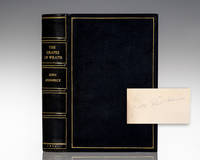
1939149708New York: The Viking Press 1939. First edition with "First Published in April 1939" on copyright page and first edition notice on the front flap of the dust jacket. Octavo bound in full morocco by the Harcourt Bindery with gilt titles and tooling to the spine in six compartments within raised gilt bands gilt ruling to the front and rear panel gilt inner dentelles stamp-signed by the Harcourt Bindery marbled endpapers all edges gilt. Boldly signed by John Steinbeck on a page bound-in. In fine condition. An exceptional presentation. "The Grapes of Wrath is the kind of art thats poured out of a crucible in which are mingled pity and indignation. Its power and importance do not lie in its political insight but in its intense humanity. It is the American novel of the season probably the year possibly the decade" Clifton Fadiman. It is the basis for the 1940 John Ford directed film bearing the same name starring Henry Fonda. It is widely considered as one of the greatest American films of all time. In 1989 this film was one of the first 25 films to be selected for preservation in the United States National Film Registry by the Library of Congress as being "culturally historically or aesthetically significant." Listed by Modern Library as one of the 100 best novels of the twentieth century. The Viking Press unknown
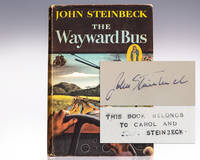
1947150377New York: The Viking Press 1947. First edition of this work by the Nobel Prize-winning writer. Octavo original cloth. Boldly signed by John Steinbeck on the front free endpaper. From the library of John and Carol Steinbeck with their stamp to the front pastedown. Carol Henning Steinbeck John Steinbeck’s first wife was instrumental in his early literary development sustaining the couple financially and offering editorial input during the years when Steinbeck struggled to establish himself as a writer. Their marriage which lasted from 1930 to 1943 coincided with the creation of some of his most important early works including Tortilla Flat 1935 and The Grapes of Wrath 1939 yet ultimately dissolved under the pressures of fame and Steinbeck’s personal restlessness. Near fine in a near fine dust jacket. Jacket design by Robert Hallock. An exceptional example most rare and desirable signed and from the writer's library. In his first novel to follow the publication of his enormous success The Grapes of Wrath Steinbeck’s vision comes wonderfully to life in this imaginative and unsentimental chronicle of a bus traveling California’s back roads transporting the lost and the lonely the good and the greedy the stupid and the scheming the beautiful and the vicious away from their shattered dreams and possibly toward the promise of the future. It was the basis for the 1957 film starring Jayne Mansfield Joan Collins Dan Dailey and Rick Jason. The Viking Press hardcover
19361804084Covici Friede 1936. 1st Edition Limited Edition. Hardcover. Near Fine/No Jacket. Near fine signed first limited edition as stated on colophon. Signed by John Steinbeck on colophon. Number 53 of 99 signed copies. Very light shelf wear. Light tanning between boards and endpapers. Slightly spine-cocked. Housed in slipcase. Covici Friede hardcover books