ABOUT EdmondLivre Rare Book
5 464 résultats
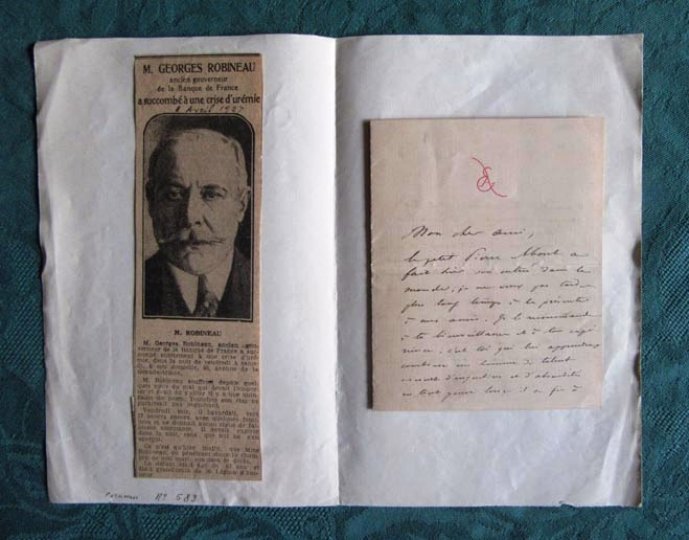
186716895Lettre Autographe Signée d'Edmond About, non datée (juillet 1867), sur papier à lettre à son chiffre. Il annonce la naissance de son fils Pierre à un ami peintre, et lui annonce qu'il le conduira à l'Exposition dans deux mois "s'il tette raisonnablement" pour lui montrer ses tableaux !2 pages format in-16° (15x9) sous chemise biographique. Très bon état.- De l'ancienne collection A. Baron, assureur, puis syndic-liquidateur à Bourges.Edmond François Valentin About, né le 14 février 1828 à Dieuze (Meurthe) et mort le 16 janvier 1885 à Paris, est un écrivain, journaliste et critique d'art français, membre de l'Académie française. Son fils Pierre dont il est question est né le 14 juillet 1867. Favorable au Second Empire, et violemment anticlérical, il se fait connaître comme polémiste. En 1871, il rallie la Troisième République et soutient la politique de Thiers. La Grèce contemporaine (1854) remporte un grand succès tout en insistant sur l'écart entre le mythe grec fondé sur l'Antiquité et la réalité contemporaine. Le Roi des montagnes ridiculise le mythe romantique du pallikare, guerrier-bandit héros de la guerre d'indépendance grecque.
Wolden-Raethinge, AnneNot in perfect condition. unknown
10152Undated but on paper watermarked 1841 and docketed 'Written for Dublin about 1843'. Folio 11 pp. On the rectos of eleven leaves of Britannia paper watermarked 'W H FELLOWS 1841'. Held together with string. Text clear and complete. In ink with deletions and emendations in pencil. Good on aged paper. Docketed on reverse of last leaf. The subject of the poem is the execution of Conradine in the market square in Naples 29 October 1268. The first section 3 pp begins 'Italia fair Italia unto thee Was beauty given twice with misery At once the loveliest and the loveliest clime Thou wert the seat of Empire and of crime; .'. An alternative to the last line has been written in and deleted: 'Thy charms were only equalled by thy crime'. The second section 4 pp originally titled 'The Morning immediately before the Execution' begins At that sweet hour when twilight into day Dips her dark wing and mistlike fades away .'. It contains another poem deleted by the author entitled 'Good Bye & Farewell' beginning 'The thrilling whisper of "Good Bye" Thou not unmix'd with pain Seems to anticipate the joy Of meeting once again.' The third section 4 pp begins 'Close to the castle walls and just beneath A solemn scaffold rear'd its form of death While close around a dense and bristling mass Of soldiers occupied the meanest place; .'. The author is not named. It may be a coincidence but a review of M. E. Jeffreys 'Hoel the Hostage and other Poems' in the Metropolitan Magazine for June 1842 mentions that the volume contains a poem by this title one of a number of historical narratives 'replete with animation and descriptive spirit'. Undated, but on paper watermarked 1841, and docketed 'Written for Dublin about 1843'. unknown
Ingrid Lydersen LystadNot in perfect condition. unknown
19981197139Berlin, Dt. Bibliotheksinstitut, 1993 - 1998. OBroschur.
19391204499Berlin, Preuß. Staatsbibliothek, (ab 1927:) de Gruyter, 1922 - 1939. Gr.-8vo. Zus. über 1450 S. Lwdbde d. Zeit m. geprägten Rückentiteln.
17131308911Frankfurt/M. u. Leipzig, Rengerische Buchhandlung, 1712 - 1713. 738 (recte: 722) S., 6 Bl., 8 gestochene Porträt-Tafeln. Ppbd d. Zeit (etwas bestoßen, St. 21 - 26 nur gering gebräunt, St. 27 u. 28 stärker gebräunt u. etwas feuchtspurig).
188758551887 Paris, A. Lahure, 1887 In-4° broché sous chemise et emboîtage en cartonnage brun avec motifs imprimés en noir. Exemplaire n° 78 (sur un tirage total de 115 exemplaires) imprimé sur Chine, avec suite des gravures sous serpentes. Couvertures conservées. Faux-titre, frontispice, titre en rouge et noir avec vignette, 365 pp., (3) pp. Frontispice, vignette de titre et vignettes in-texte gravés sur bois par Huyot d'après les dessins de Piguet.
Small folio in original brown slipcase and brown printed paper wraps, with original glassine jacket; 91 p., 15 leaves of plates (1 fold.) : ill. ; 33 cm. Bibliography: p. 89-[90]. In . In Italian. Printed by Luigi Maestri. One of two thousand un-numbered copies. Documenti sulle arti del libro, 4. || Paper industry -- History. Papier -- Industrie -- Histoire. Filigranes (Papeterie) Papier -- Histoire -- Europe. Papier -- Histoire -- Orient. Papier -- Histoire -- Chine. Karte
19071305390Uppsala, Almqvist & Wiksell u. Leipzig, R. Haupt, (1907). Gr.-8vo. 38 S., 1 Bl., 507, (1) S. (Kataloge der Inkunabeln der schwedischen Öffentlichen Bibliotheken 2). Hlwdbd m. goldgeprägtem Rückentitel (Rücken verblichen, innen gering gebräunt u. minimal fingerfleckig) .
18551216500Leipzig, T. O. Weigel, 1855. 4to. 8 S., 1 Bl., 114 S., 1 Bl., 218 Sp. bei zweispaltigem Druck, 12 Bildtaf. aus einem Heidelberger Codex. Neuer Hlwdbd m. eingebund. OVorderumschl. (Titel entfernt, oben teils m. schmalem Nässerand, gelegentl. leicht braunfleckig, letzte Taf. m. kl. Eckabriß u. laienhaft ausgebesserten Einrissen).
First etymological dictionary of Ukrainian, here vol. 1 (of 2 published) in the original part-issues with publisher's wrappers. – Contents: The »Etymological Dictionary of the Ukrainian Language« was a lifelong effort by prominent Ukrainian linguist and slavic scholar Jaroslav Rudnyckyj (1910-95) and is nowadays considered an indispensable resource for Ukrainian studies and Slavic studies in general. It was also the first Slavic etymological dictionary yet to appear in English language. The dictionary was published over a timespan of 20 years and consists of 2 volumes with 11 fascicles each, a total of 22 part issues. Present vol. 1 appeared between 1962 and 1972 in 10 part issues covering the first 5 letters of the Ukrainian alphabet, A to ?, as well as 1 introductory fascicle (numbered 0). Vol. 2 followed between 1973 and 1982 and comprised another 11 fascicles for the letters starting fromto ?. – Condition: Wrappers of introductory part and part 1 with little wear, otherwise mint, mainly uncut set. – Rarity: Scare in trade even in single part issues. – Reference: Senkus, R. (1993) Rudnyckyj, Jaroslav. In: Kubijowytsch, W: Encyclopedia of Ukraine, vol. 4: Ph-Sr.
19121320746Washington, Government Printing Office, 1912. 4to. Porträt-Tafel, farbig illustr. Titel, 10, 567, (1) S. OLwd (angestaubt, Vorderdeckel etwas fleckig, farb. Titel gebräunt u. gering braunfleckig).
Features include: The Donkey - A humble donkey co-operates to bring about the discomfiture of sundry Arab thieves; It Pays to Advertise - The Amazing result of the nefarious activities of a rascally 'wild-cat' company promoter and an unscrupulous newspaper reporter in Canada; Mr. Zaru - story from a ship; Into the Unknown - exploratino work in Tanganyika; Farm Life in South Africa - intended for aspiring British immigrants to South Africa; Through the Iron Curtain - an ambitious motor-cycle voyage through Yugoslavia, Bulgaria, and Turkey; Beyond the Barrier - Extraordinary incidents related by a famous stage magician, Jasper Maskelyne; A Matter of Boundaries - an amusing tale of a tribal land-dispute in Nigeria; The Little Gold Disc - A veteran seafarer's account of a remarkable experience on the China Coast; The Tiger That Thought; The Red Lacquer Pagoda; The Ship That Became a House; Guarding New Zealand's Forests - Illustrated in black and white. Chips from and tears to base of spine else average wear. Two inch opening at top of back cover. Magazine
395 pages including notes, references and index. Indicates the motivation and significance of the changes in physical geometry brought about by Einstein in both the first and second phases of Relativity. Also offers a historical and critical exposition of hte elements of the Special and General Theory of Relativity, with emphasis throughout on geometrical ideas and concepts. "A remarkable combination of first-rate historical scholarship and advanced mathematical acumen... an essential addition to my personal library." - Roger B. Angel, Concordia University. Clean, bright and unmarked with very light wear. Excellent copy. Book
Albertsson, Ingemar and PIn Pristine Condition. unknown
33776Turnhout, Brepols, 2005 Hardback, VI+346 p., 210 b/w ill. + 45 colour ill., 190 x 250 mm. ISBN 9782503521947.
Hardback, VI+346 p., 210 b/w ill. + 45 colour ill., 190 x 250 mm. ISBN 9782503521947. Der Pariser Buchmaler Jean Pichore ist zwischen 1502 und 1520 in mehreren Quellen bezeugt, die ihn mit Bilderhandschriften und mit dem Pariser Buchdruck verbinden. Obwohl diese Dokumente schon im 19. Jahrhundert publiziert waren, erkennt die Forschung erst seit zehn Jahren die zentrale Rolle des Pariser Kunstlers fur einen langst bekannten Stil franzosischer Buchmalerei an der Schwelle zur Renaissance, der zuvor aufgrund grosser Auftrage fur den Rouenaiser Erzbischof Kardinal Georges d'Amboise als 'Schule von Rouen' galt. Zwar ist Pichores Bedeutung inzwischen unbezweifelt, doch wird die Bestimmung seines Oeuvres weiterhin kontrovers diskutiert, da an der Ausstattung der Handschriften seines Stils offenbar mehrere Maler beteiligt waren, unter denen zwei Stilvarianten charakteristisch hervortreten. Da der der eine Stil die bedeutendsten Auftrage und die meisten Frontispizien bestimmt, wahrend der andere den grossten Teil der Werkstattproduktion ausmacht, stehen die Identitat des Meisters und die Struktur seiner Werkstatt in Frage. In einer Umbruchzeit des Buchgewerbes tritt Pichore als zukunftsorientierter Unternehmer auf, dessen Werkstatt nicht nur Buchmalerei, sondern auch Metallschnittserien fur den Stundenbuchdruck produzierte. Im Jahr 1504 verantwortete er sogar - zusammen mit einem sonst nicht beurkundeten Remy de Laistre - zwei gedruckte Stundenbucher als Verleger. Ausgehend von Pichores bislang unterschatzter Rolle im Pariser Fruhdruck erfahren seine Werkstatt, die Frage nach der Abgrenzung einzelner Kunstler und die Herkunft der Vorlagen aus der Touroner Buchmalerei und deutscher Graphik neue Betrachtung. Languages: English.
33778Turnhout, Brepols, 2009 Hardback, VIII+472 p., 141 b/w ill. + 40 colour ill. + + ills., 190 x 250 mm. ISBN 9782503515106.
Hardback, VIII+472 p., 141 b/w ill. + 40 colour ill. + + ills., 190 x 250 mm. ISBN 9782503515106. This study deals with the work of the most prolific Dutch book illuminators, the so-called Masters of the Dark Eyes, named after the most conspicuous aspect of their style: the dark, heavily accentuated shadows round the eyes of the figures. With their elaborately illuminated manuscripts, these masters completely dominated book production in the County of Holland during the late fifteenth and early sixteenth centuries. Their work is characterized by an overwhelming wealth of decorative and pictorial richness, which is especially evident in the unusually ornate programmes of the Books of Hours, and a new type of border decoration derived from the Ghent-Bruges School. This style of painting was practised by many artists of differing talents, as demonstrated by the large number of surviving manuscripts. Not all of the illuminators worked in Holland. Some of them settled in the Southern Netherlands, others emigrated to England, where they illuminated manuscripts for members of the English court. This monograph seeks to order, analyze and evaluate the work of the Masters of the Dark Eyes, and to position their achievements within the context of book illumination in the Northern Netherlands during the 'Waning of the Middle Ages'. It explores a virtually uncharted territory of Dutch manuscript painting. The accompanying descriptive catalogue provides complementary information on more than 70 manuscripts, many of which have never been published at length before. The work is illustrated with a wide selection of colour and black-and-white reproductions. Languages: English.
Hardcover with dusjacket 280 p., 138 b/w ill. + 29 colour ill., 210 x 297 mm, 2016 Languages: German. ISBN 9782503546124. Die vorliegende Studie ist die erste ausfuhrliche Untersuchung der Handschrift Ms. 68 in der Sammlung des J. Paul Getty Museums. Der Kodex enthalt zwei Texte des bedeutenden Humanisten und Diplomaten Enea Silvio Piccolomini, des spateren Papstes Pius II., De Curialium miseriis und Historia de duobus amantibus, die er 1444 noch vor Beginn seiner klerikalen Karriere verfasste. Die herausragende Bedeutung der Handschrift resultiert einerseits aus der buchmalerischen Ausstattung, die von besonderer Qualitat ist und von einem bis vor kurzem vollig unbekannten Buchmaler ausgefuhrt wurde, andererseits aus ihrer kulturhistorischen Stellung im Kontext des franzosischen Fruhhumanismus. Dem Piccolomini-Meister und seiner Werkstatt konnen auch eine Abschrift der Epistre Othea von Christine de Pizan in Den Haag sowie drei Miniaturen in einem Stundenbuch im Kunsthandel zugeordnet werden. Die Getty-Handschrift entstand wohl um 1465 in Bourges, auch weil der Auftraggeber mit Charles de France (1446?1472), dem jungeren Bruder des franzosischen Konigs Louis XI, identifiziert werden konnte. Die in dieser Studie erstmals versuchte Rekonstruktion von Charles Bibliothek weist sein ausgepragtes Interesse an antiken Schriften nach. Demnach beschaftigte er sich vor allem mit griechischen und romischen Philosophen, Dichtern und Geschichtsschreibern. Unter Zuhilfenahme literaturhistorischer Uberlegungen zu Eneas Texten sowie Uberlegungen zur Textinterpretation wird schliesslich Charles spezifisches Interesse an Eneas Texten rekonstruiert. Eine systematische Untersuchung der erhaltenen, in Frankreich entstandenen Handschriften mit Eneas Texten vermittelt zudem den weiteren Rezeptionskontext beider Texte in Frankreich im 15. Jahrhundert.
2021__3030809315Springer Nature 2021. Hardcover. New. 235 pages. 9.25x6.10x0.59 inches. Springer Nature hardcover
Wenche FindalNot in perfect condition. unknown
50802, Brepols Miller, 2017 Hardcover with dusjacket, 480 pages., 196 b/w ill. + 39 colour ill., 216 x 280 mm, Languages: French. ISBN 9782503574684.
Hardcover with dusjacket, 480 pages., 196 b/w ill. + 39 colour ill., 216 x 280 mm, Languages: French. ISBN 9782503574684. Orne de 85 enluminures encore en place, l?ouvrage est un temoignage exceptionnel, bien documente, qui permet de comprendre les modalites de la commande des manuscrits liturgiques enlumines au XIVe siecle, et qu?il est possible de replacer dans un contexte politique, religieux et artistique bien determine. En 1350, Pierre de la Jugie, neveu du pape Clement VI, est depuis trois ans sur le siege de Narbonne, a la tete d?un des archeveches les plus riches du royaume de France, lorsqu?il decide de faire realiser un pontifical a la hauteur de ses ambitions. Orne de 85 enluminures encore en place, l?ouvrage est un temoignage exceptionnel, bien documente, qui permet de comprendre les modalites de la commande des manuscrits liturgiques enlumines au XIVe siecle, et qu?il est possible de replacer dans un contexte politique, religieux et artistique bien determine. Le livre n?est qu?en partie fidele au modele de pontifical etabli par Guillaume Durand. Outre un calendrier et des feuillets de comput, il contient aussi plusieurs textes additionnels, expressement ajoutes par Pierre de la Jugie, et accompagne d?une iconographie qui leur est propre. L?etude des textes, du calendrier au pontifical, et de l?iconographie choisie pour les illustrer, permet de mettre en valeur la forte implication du commanditaire dans la mise en place de ce livre. Les peintures qui ornent ces pages sont l??uvre de quatre artistes qui, en depit de leurs formations differentes (Catalogne, Sud de la France, Italie) ont collabore et se sont mutuellement influences. Le recensement des productions de chacun des enlumineurs permet de mettre en valeur l?existence de reseaux d?echanges entre les artistes et les commanditaires ecclesiastiques appartenant a un meme clan de prelats limousins.


