BALZAC (Honoré de).Livre Rare Book
1 526 résultats
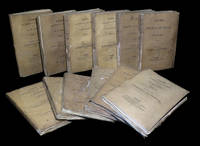
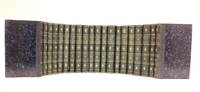
183424943Paris, Madame Charles Béchet [puis] Werdet, 1834 à 1837. 12 vol. au format in-8 (218 x 151 mm) de 2 ff. n.fol., 401 pp. et 1 f. ; 361 pp. et 3 ff. n.fol. ; 2 ff. n.fol., 386 pp. et 1 f. n.fol. ; 398 pp. et 1 f. n.fol. ; 384 pp., 1 f. n.fol. et 1 f. bl. ; 2 ff. n.fol., 387 pp., 1 f. n.fol. et 1 f. bl. ; 2 ff. n.fol. et 359 pp. ; 2 ff. n.fol., 357 pp., 1 f. n.fol. et 4 ff. de catalogue éditeur in fine ; 339 pp. ; 2 ff. n.fol., 366 pp. et 1 f. n.fol. ; 349 pp. et 1 f; n.fol. ; 390 pp. et 1 f. n.fol., brochés.
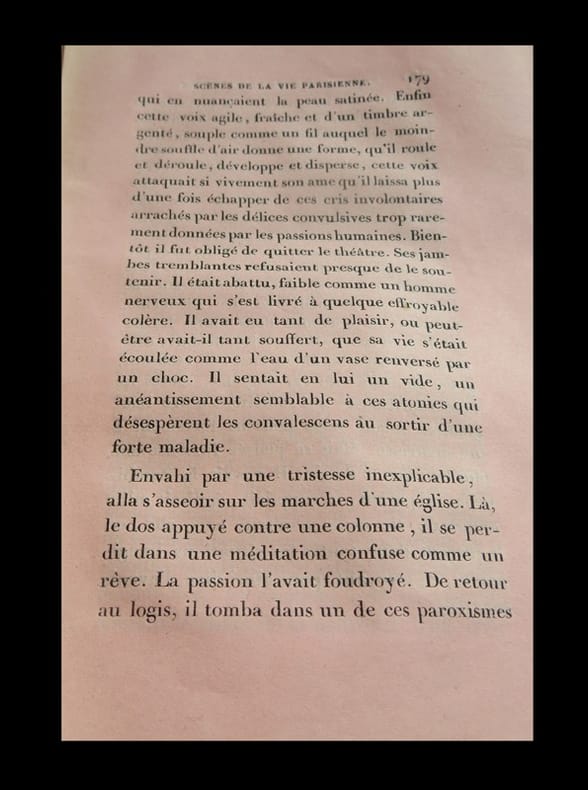
1834249431834. Paris Madame Charles BÂŽchet puis Werdet 1834 ˆ 1837. 12 vol. au format in-8 218 x 151 mm de 2 ff. n.fol. 401 pp. et 1 f. ; 361 pp. et 3 ff. n.fol. ; 2 ff. n.fol. 386 pp. et 1 f. n.fol. ; 398 pp. et 1 f. n.fol. ; 384 pp. 1 f. n.fol. et 1 f. bl. ; 2 ff. n.fol. 387 pp. 1 f. n.fol. et 1 f. bl. ; 2 ff. n.fol. et 359 pp. ; 2 ff. n.fol. 357 pp. 1 f. n.fol. et 4 ff. de catalogue ÂŽditeur in fine ; 339 pp. ; 2 ff. n.fol. 366 pp. et 1 f. n.fol. ; 349 pp. et 1 f; n.fol. ; 390 pp. et 1 f. n.fol. brochÂŽs. Edition originale ; complÂte des 12 volumes la constituant. Ensemble - ˆ grandes marges - comportant l'insigne particularitÂŽ que chacun des exemplaires le composant a ici ÂŽtÂŽ imprimÂŽ sur papier de couleur rose. Les exemplaires sur papier de couleur se rencontrent presque toujours sÂŽparÂŽment. Il est donc extrÂmement rare de trouver pareil ensemble complet de ses douze volumes ; tous imprimÂŽs sur papier rose. ''Collection rare et de plus en plus recherchÂŽe'' signalait dÂŽjˆ Clouzot. Clouzot encore : ÔÕDÕune partie de ces douze volumes ont ÂŽtÂŽ tirÂŽs quelques exemplaires sur papier rose ou jonquille que lÕon rencontre sÂŽparÂŽment et qui sont fort recherchÂŽsÕÕ. ''Cette sÂŽrie de 12 volumes des Etudes de moeurs est fort rare aujourd'hui ; elle se rencontre parfois ˆ l'ÂŽtat brochÂŽ elle est rarissime en belle reliure du temps. C'est l'ÂŽdition originale d'EugÂŽnie Grandet qui en fait la valeur. Quelques exemplaire ont ÂŽtÂŽ imprimÂŽs sur papier jonquille ; ils sont d'une grande raretÂŽ''. in Carteret. ''Cette ÂŽdition considÂŽrÂŽe comme le premier essai de La ComÂŽdie humaine est fort rare aujourd'hui surtout en reliure d'ÂŽpoque''. in Escoffier. Premier essai de ce qui deviendra plus tard La ComÂŽdie Humaine ; ici composÂŽ de 3 sÂŽries de 4 volumes ScÂnes de la vie privÂŽe ScÂnes de la vie de province et ScÂnes de la vie parisienne. L'ensemble recÂle plusieurs romans en ÂŽdition originale : EugÂŽnie Grandet premier grand succÂs public de l'auteur La Fleur des Pois qui deviendra Le Contrat de mariage La Recherche de l'absolu les deux derniers chapitres de La Femme de trente ans La Femme abandonnÂŽe La GrenadiÂre L'Illustre Gaudissart La Grande BretÂche ou les Trois Vengeances La Vieille fille la premiÂre partie des Illusions perdues l'Histoire des Treize I. Ferragus chef des DÂŽvorants et II. Ne touchez pas la hache qui deviendra La Duchesse de Langeais La Fille aux Yeux d'Or La Comtesse ˆ deux maris qui deviendra Le Colonel Chabert aprÂs sa parution en feuilleton dans la revue l'Artiste en 1832. Clouzot Le Guide du bibliophile pp. 11 et 12 - Vicaire I Manuel de l'amateur de livres du XIXÂme 196 ˆ 199 - Carteret I Le TrÂŽsor du bibliophile romantique et moderne pp. 68 et suivantes ne mentionnant pas l'existence d'exemplaires imprimÂŽs sur papier rose - Rahir La BibliothÂque de l'amateur p. 306 ne faisant pas cas d'exemplaires imprimÂŽs sur papier de couleur - Escoffier Le Mouvement romantique 1231. Plats prÂŽsentant un ÂŽclat lÂŽgÂrement altÂŽrÂŽ ainsi que parfois quelques t‰ches. Manques aux dos ; entra”nant de fait une faiblesse du brochage. TrÂs rares et discrÂtes rousseurs dans le texte. Cerne claire affectant les fonds de cahiers des derniers feuillets dÕun des volumes. Nonobstant ensemble en belle condition. b42961 unknown
184259614Paris: Charpentier 1842. Fine. Charpentier Paris 1842 12 x 19 cm relié First definitive editions partly original.Bound in red half-shagreen with corners spine with four raised bands decorated with blind-stamped panels and fillets the entwined monogram of Jules Hetzel at the foot uncut copy contemporary binding.A few occasional spots of foxing.Inscribed by the author to Jules Hetzel as a token of the authors friendship. In the 1840s Balzac contributed to a collective volume illustrated with Grandvilles vignettes Scènes de la vie privée et publique des animaux issued in parts by a new publisher Pierre-Jules Hetzel 18141886 who was to become a friend and play a crucial role in the consortium of publishers of La Comédie humaine. Balzac also assisted Hetzel in drafting texts signed P.-J. Stahl the publishers pseudonym. Roger Pierrot Honoré de Balzac Paris Fayard 1994 An outstanding copy inscribed by Balzac in a charming contemporary binding. Charpentier hardcover
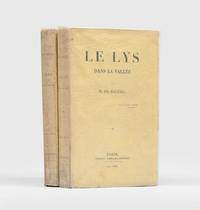
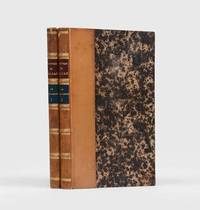
1836179013Paris: Werdet 1836. Uncommon in the original wrappers First edition. This story of unrequited love partly mirroring Balzac's own relationship with Laure de Berny became the object of a highly publicized literary-legal controversy which boosted its commercial success. Balzac wrote the novel over the course of several years inspired by Sainte-Beuve's earlier romance Volupté. The first part was published in the Revue de Paris on 22 November 1835. The journal's editor François Buloz owned the rights to Balzac's novels which were to be published in that journal only. In December Balzac found out that his uncorrected proofs had been sold by Buloz to the owners of the Revue étrangère of St Petersburg without his consent and that the Russian journal had published them in October. Balzac sued Buloz and refused to send him the second part of the novel. "Given whom and what was involved the legal controversy found its way into the press. Buloz used his power influence and publications to attack Balzac viciously. Alexandre Dumas and other writers - fearful of the publisher's power - lined up with Buloz; Victor Hugo and George Sand with Balzac. In the end the court ruled for Balzac" Kornstein p. 91. The complete novel was published in these two volumes by Werdet on 1 June 1836. An account of the trial by Balzac features as a second introduction in the first volume and was not reprinted in the following editions. Le Lys dans la vallée is the last of four romances in Balzac's Scènes de la vie de campagne the sixth narrative cycle in La Comédie humaine. It "appears as the point of convergence of confluence of the previous works. Several themes outlined or already developed in the future Comédie humaine and the Contes are taken up illustrated highlighted" trans. from Donnard p. 897. 2 vols octavo. Original yellow wrappers printed in black edges untrimmed. In later glassine wrappers and housed in custom marbled paper slipcases and chemises with red morocco-grain roan backstrips. With the gilt leather bookplate of French collector and bibliophile Pierre Duché whose renowned library was sold in 1972. Spines with splits and wear at ends small repairs to vol. I spine front joints partially split but holding wrappers slightly toned and marked a few small chips and nicks contents foxed. A very good copy of this fragile publication. Vicaire I 202-3. Daniel Kornstein Unlikely Muse: Legal Thinking and Artistic Imagination 2010. Jean-Hervé Donnard ed. La Comédie humaine vol. IX 1978. hardcover
184259614Charpentier | Paris 1842 | 12 x 19 cm | relié
183327381Un des 12 imprimé sur papier de couleur, dont quatre seulement sont connus.Précieux exemplaire offert par Balzac à George Sand. Paris, Charles Gosselin, 1833. 1 vol. (161 x 111 mm) de 264 p. dont le faux-titre et le titre ; cartonnage de papier rouge à la Bradel, dos lisse, titre doré (Wagner & Spachmann), chemise en demi-maroquin saumon avec étui assorti (G. Mercier, 1931). Première édition séparée, en grande partie originale. Un des 12 rarissimes exemplaires imprimés sur papier fort de couleur saumon. Précieux exemplaire offert à George Sand ; il porte sur le titre, sous le nom de l'auteur, de la main de la romancière : « Ex. donné par lui-même à G. Sand ».
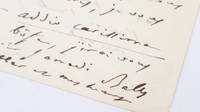
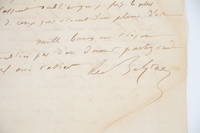
184286807Paris 1842. Fine. Balzac's Soon to be Lost Illusion Paris 12 mars 1842 13.50 x 26 cm 4 pages sur un feuillet Autograph letter signed by Honoré de Balzac to Sophie Koslowska. 4 pages in black ink on a bifolium. Usual folds. Very small lacks of paper along the horizontal fold of the first leaf. Published in his Correspondance 1819-1850 II. Paris Calmann-Lévy 1875 pp. 31-33. A long feverish letter by Balzac a few days before the premiere of Les Ressources de Quinola at the Odéon theater. The writer writes to his close friend Sophie Kozlowska daughter of Prince Kozlowski about the chaotic final preparations and urges her to fill the theater with all of Paris's Russian high society. Balzac wrote this important letter just as he was about to take one of the biggest gambles of his career. The writer wanted to convene a real audience for the premiere of Les Ressources de Quinola and have the play performed in front of a full house of paying spectators instead of using the famous claqueurs clappers traditionally seated in the parterre to encourage audience reactions which is described at length in Lost Illusions. His failed attempt was so publicized by all the newspapers that this performance proved the very necessity of claqueurs: The author preferred peril. Such is the reason for this first performance in which so many people were displeased to have been elevated to the dignity of independent judges Editor's notes in Balzac's OEuvres complètes A. Houssiaux 1855. La Mina wrote me that you were ill and it struck me as a blow as if someone had told Napoleon that his aide-de-camp had died: disregarding Kozlowska's fragile health Balzac set about filling the twelve hundred seats of the Théâtre-Français with all the high-ranking and wealthy spectators Paris had to offer. He relied on the relations of his carissima Sofia to pay for the priciest seats an inclination that earned him accusations of speculation. He indeed takes particular care going over prices in the letter: We'll play next Wednesday barring any misfortune. The first seatings with four places are one hundred francs a box and everyone wants to be there. But the fashionable place where the Aguados the Rothschilds the Doudeauvilles the Castries etc. are is the loge des premières fermées because one feels at home. . Lamartine has asked me for a box: I'll put him between the Russians. Princess Troubetskoï is not the same one whose husband I know. See to it that you write to the prince And don't forget your Makanof . So: balconies twenty-five francs; stalls twenty francs; premières découvertes twenty-five francs a seat; secondes découvertes twenty francs; secondes fermées twenty-five francs; baignoires twenty francs a seat. . Ah! if you only knew what wealth of beautiful women! There will be no clappers in the parterre which is priced at five francs . Write a note to Princess Constantine Razumovska. I don't dare do it myself. For you and for your mother you will go to the premières découvertes; I will place you well. These hurried lines reveal Balzac's great expectations. He deeply believed in the merits of his comedy play about a man of industrial genius in 16th century Spain although the play's reception certainly suffered from Balzac's poor choices during its premiere. The writer expected to solve his financial difficulties and travel with his beloved Madame Hanska following the play's success. Having finished writing the final acts in a hurry he describes the terrible days leading up to the premiere: I'm overwhelmed on edge! I have the actors rehearse in the morning the entire cast during the day and the actresses in the evening. There are twenty thousand francs worth of costumes in the play. The sets are brand new. I'm told that the work is a masterpiece and that makes me shudder! It will always be frighteningly solemn. Some lines even border on the paranoid abundantly underlined with unknown
184286807[Paris] 12 mars 1842 | 13.50 x 26 cm | 4 pages sur un feuillet
182963413Paris: Urbain Canel 1829. Fine. Urbain Canel Paris 1829 10 x 17.50 cm 4 volumes reliés Very rare and highly sought-after first edition of Balzac's first novel signed by his name. Published a small number of copies this first novel whose original title is inspired by the last of the Mohicans James Cooper reappeared reworked in 1834 under a new title: The Chouans . This first important work of Balzac also marks the beginning of the comedy Humaine which she constitura since 1845 a scene of the military life . Bindings in half red Russian leather smooth backs adorned with gilt and black threads gold friezes in heads and tails marbled paper plates Contemporary binding. A restored bit and a flap sheet of the first volume changed some small foxing. Exceptional exemplary set in a charming Contemporary binding. Urbain Canel hardcover
182963413Urbain Canel | Paris 1829 | 10 x 17.50 cm | 4 volumes reliés
1831124901Paris Charles Gosselin 1831 3 vol. relié 3 vol. in-8, demi-chagrin aubergine, dos à nerfs ornés d'encadrements à froid, têtes rouges, 400, 418 et 396 pp. Première édition collective, illustrée de trois frontispices de Tony Johannot sur chine, renfermant la Peau de chagrin, Sarrasine, la Comédie du diable, El Verdugo, l'Enfant maudit, l'Elixir de longue vie, les Proscrits, le Chef-d'oeuvre inconnu, le Réquisitionnaire, Etude de femme, les Deux rêves, Jésus-Christ en Flandre et l'Eglise. La Peau de Chagrin avait déjà paru la même année en deux volumes, ce qui explique la mention de seconde édition en page de titre, tous les autres textes étant publiés ici en originale. Précieux exemplaire enrichi d'un envoi autographe signé de Balzac au journaliste Charles Lautour-Mézeray (1801-1861). Ce dernier, fils d'un notaire d'Argentan, élevé avec Émile de Girardin au collège de cette ville, représentait le modèle de l'arriviste à cette époque. André Maurois lui consacre un beau portrait dans sa biographie de Balzac, précisant que ce dandy lança la mode du camélia blanc à la boutonnière. Dès 1831, Balzac était en admiration devant lui et il se ruinait pour imiter son élégance. Il tentait aussi de faire bonne figure à l'Opéra où la loge de Lautour, une baignoire de l'avant-scène, était surnommée la loge infernale. Balzac y avait sa place, puis il cessa de payer son billet devenu trop cher pour lui. Ajoutons encore que Latour-Mézeray est cité comme le modèle possible du journaliste Émile Blondet qui apparaît dans la Peau de chagrin puis dans de nombreux romans de La Comédie humaine comme archétype du journaliste ambitieux, désinvolte et insouciant. Reliure légèrement postérieure, quelques rousseurs et mouillures, mais bel exemplaire de remarquable provenance.
1831124901Paris Charles Gosselin 1831 3 vol. relié 3 vol. in-8, demi-chagrin aubergine, dos à nerfs ornés d'encadrements à froid, têtes rouges, 400, 418 et 396 pp. Première édition collective, illustrée de trois frontispices de Tony Johannot sur chine, renfermant la Peau de chagrin, Sarrasine, la Comédie du diable, El Verdugo, l'Enfant maudit, l'Elixir de longue vie, les Proscrits, le Chef-d'oeuvre inconnu, le Réquisitionnaire, Etude de femme, les Deux rêves, Jésus-Christ en Flandre et l'Eglise. La Peau de Chagrin avait déjà paru la même année en deux volumes, ce qui explique la mention de seconde édition en page de titre, tous les autres textes étant publiés ici en originale. Précieux exemplaire enrichi d'un envoi autographe signé de Balzac au journaliste Charles Lautour-Mézeray (1801-1861). Ce dernier, fils d'un notaire d'Argentan, élevé avec Émile de Girardin au collège de cette ville, représentait le modèle de l'arriviste à cette époque. André Maurois lui consacre un beau portrait dans sa biographie de Balzac, précisant que ce dandy lança la mode du camélia blanc à la boutonnière. Dès 1831, Balzac était en admiration devant lui et il se ruinait pour imiter son élégance. Il tentait aussi de faire bonne figure à l'Opéra où la loge de Lautour, une baignoire de l'avant-scène, était surnommée la loge infernale. Balzac y avait sa place, puis il cessa de payer son billet devenu trop cher pour lui. Ajoutons encore que Latour-Mézeray est cité comme le modèle possible du journaliste Émile Blondet qui apparaît dans la Peau de chagrin puis dans de nombreux romans de La Comédie humaine comme archétype du journaliste ambitieux, désinvolte et insouciant. Reliure légèrement postérieure, quelques rousseurs et mouillures, mais bel exemplaire de remarquable provenance.
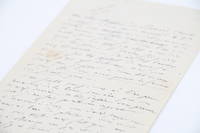
183077791Tours 1830. Fine. Tours 23 juin 1830 13.20 x 19.90 cm une feuille Unpublished autograph letter: As soon as I had arrived in Tours I was thrown on the coasts of Brittany by the best conditioned desire that had ever seized a man to shut off the atmosphere of Paris and its ideas by going to run on the beautiful rocks that border the sea in Brittany Tours 23 June 1830 13.2 x 19.9cm one leaf Unpublished handwritten letter signed by Honoré de Balzac one and a half pages written in black ink on a leaf of white paper. Transversal folds and ink a little faded at the bottom of the first page without making it difficult to read. The man from Tours poetically recounts his wanderings on the Breton coast during a trip he took in the company of Madame de Berny. Together they sailed up the Loire in a boat all the way to Le Croisic: As soon as I had arrived in Tours I was thrown on the coasts of Brittany by the best conditioned desire that had ever seized a man to shut off the atmosphere of Paris and its ideas by going to run on the beautiful rocks that border the sea in Brittany and there once arrived I stayed a fortnight the most delicious in the world running on the bays on the kelp collecting the pucelages that are in large numbers on the sea sand in reverse of the rue Vivienne. The pucelages here are shellfish so named because of their vulvoid shape allowing Balzac an allusion to the prostitution very popular at the time that occupied the Galerie Vivienne. This amusing letter is addressed to one of the editors of La Silhouette magazine as evidenced in particular by the sign off at the end of the letter mentioning the founder of the periodical: A thousand good friendships do not forget to give a large part to our friend Victor Ratier. Balzac also mentions several articles: I am writing to give you a sign of life proof of interest and of friendship but I write to you briefly because I have twenty letters to answer and I promise you a letter for.1st July which will contain the end of the charlatan issue 2 la bella dona and finally the articles that will have passed through my head and with which you will be furnished so as to not ask anything of me for a month or two and so that around August you will be my publisher. We have not found any trace of said letter in the writer's correspondence no more besides than the continuation of the Charlatan the first part of which was published in the second issue of La Silhouette. No article under the title of Bella Dona appears in the following issues either although Balzac emphasizes in his letter the desire to provide other texts given that the charms of the Loire must not make him forget that he is the poorest of those who live on a quill pen. A beautiful and spicy unpublished letter. unknown
183386496s. l. Neuchâtel 1833. Fine. Eve's first kiss: 'The gods grant no favours untainted.' s. l. Neuchâtel 29 septembre 1833 13.40 x 21.10 cm une page sur un double feuillet Autograph letter signed by Honoré de Balzac addressed to his friend the writer Charles de Bernard. One page written in black ink on a bifolium. On the verso of the second leaf appears the address of the recipient Charles de Bernard du Grail written in Balzacs hand along with postal stamps and the seal bearing the arms of the Balzac dEntraigues family which the author had appropriated. A few minor holes not affecting the text; fold marks as usual from mailing. Published in his correspondence Paris Calmann Lévy 1876 CXIV pp. 252253. Balzac wrote this letter four days after his very first meeting and first kiss with Madame Hanska in Neuchâtel following many months of epistolary correspondence. « Jai été très heureux ici. Je suis très content de ce que jai vu le pays est délicieux ; mais vous savez que Jupiter a deux tonneaux et que les dieux nont point de faveurs qui soient pures. » ""I have been very happy here. I am most pleased with what I have seen; the country is delightful. But you know that Jupiter has two jars and the gods grant no favours that are untainted."" Two years after receiving the first letter from the Stranger Éveline Rzewuska a lovestruck Balzac left Paris to join her in Switzerland. His brief stop in Besançon ostensibly a convenient detour served as a polite pretext for his departure from the capitalwhere he took the opportunity to visit his correspondent Charles de Bernard. « Il me semble que je vous ai bien peu remercié de la bonne journée que vous mavez donnée ; mais jespère vous prouver que je ne suis point un ingrat. À mercredi donc ; vous devez penser que jaurai bien du plaisir à vous revoir vous qui avez fait que mon voyage à Besançon na pas été inutile et que jy ai trouvé du plaisir ». I fear I thanked you all too little for the delightful day you gave me; but I hope to prove that I am not ungrateful. Until Wednesday then you must know how much I look forward to seeing you again you who ensured that my journey to Besançon was not in vain and even brought me joy. After a day in Besançon and a chaotic journey by mail coach Balzac finally met his beloved though regrettably in the company of her husband Count Hanski. Seizing upon the Counts absence the writer stole a long-awaited kiss with Madame Hanska on an ancient stone bench upon the hill of Crêt. In the rapture of their first encounter he could not help but invoke La Fontaines ominous fable in his letter: « mais vous savez que Jupiter a deux tonneaux et que les dieux nont point de faveurs qui soient pures ». but you know that Jupiter has two jars and the gods offer no favours untainted. His love affair with Madame Hanska would prove far from serene as Gonzague Saint Bris aptly summed it up: eighteen years of love sixteen of waiting two of happiness and six months of marriage. Neuchâtel would remain a powerful emblem of their union recurring in some sixty of their letters. Neuchâtel is like the white lily he wrote to her pure with a penetrating fragrance youth freshness brilliance hope happiness glimpsed. De Bernard who had previously arranged his journey to Switzerland was once again tasked with organising Balzacs return: « Jaurai le plaisir de vous revoir mercredi 2 octobre. Voulez-vous avoir lobligeance de me retenir une place à la malle pour Paris ». I shall have the pleasure of seeing you again on Wednesday 2 October. Would you be so kind as to reserve me a place in the mail coach to Paris The journey separating him once again from his beloved proved wretched: The mail coach was fully booked for six days so my friend from Besançon Charles de Bernard was unable to secure me a place. I was thus obliged to travel on the roof of a diligence in the company of five Swiss from the canton of Vaud unknown
184273008Paris: FurneDubochetHetzel & Paulinpuis Alexandre Houssiaux 1842. Fine. Furne Dubochet Hetzel & Paulin puis Alexandre Houssiaux Paris 1842-1855 14.50 x 22 cm 20 volumes reliés Honoré de BALZAC & Honoré DAUMIER & Charles Constant Albert Nicolas d'Arnoux de Limoges Saint-Saëns dit BERTALL & Paul GAVARNI & Tony JOHANNOT & Célestin NANTEUIL uvres complètes de H. de Balzac Complete Works Furne Dubochet Hetzel Paulin puis Alexandre Houssiaux Paris 1842-1855 14.5 x 22 cm 20 volumes in contemporary half shagreen First collective edition sold as the Works comprising as well as numerous texts published for the first time a new version of the Human Comedy reviewed and revised by Balzac. This is also the first illustrated edition. Contemporary half blue shagreen over marbled paper boards spines slightly sunned in five compartments with thin raised bands decorated with gilt dots and compartments with triple blind-ruled frames gilt fleurons to centre marbled endpapers and pastedowns. A little foxing in some volumes a very small stain to page 119 of volume 4 another to page 321 of volume 8 a tear to half-title of volume 9 a small damp stain to corner of pages 449 and following of volume 10 stain to pp. 173-74 of volume 14 stains to pages 303 to 307 of vol. 16. The full set of 152 hors-texte plates by the best artists of the age including Bertall Daumier Gavarni Johannot Nanteuil as well as illustrations to text. Four rejected plates have been added bringing the number of plates in this copy to 156. There are so many reasons for emphasising the interest of this edition one of the most important in French literature. Having had a turbulent existence and confused and having been several times republished in a great number of copies it is very rare in its first form and in this first version even rarer in a contemporary uniform binding than with a modern binding and the wrappers preserved cf Clouzot. A very good and rare copy in a contemporary uniform binding ca 1855 with all the plates called for by Clouzot and four additional ones. FurneDubochetHetzel & Paulinpuis Alexandre Houssiaux hardcover
183077791Tours 23 juin [1830] | 13.20 x 19.90 cm | une feuille
183386496s. l. [Neuchâtel] [29 septembre 1833] | 13.40 x 21.10 cm | une page sur un double feuillet
184273008Furne Dubochet Hetzel & Paulin puis Alexandre Houssiaux | Paris 1842-1855 | 14.50 x 22 cm | 20 volumes reliés
184183639s. l. Passy Paris 1841. Fine. s. l. Passy Paris « mardi matin » 28 décembre 1841 13.50 x 21.60 cm une page sur un double feuillet enveloppe jointe Autograph letter signed by Honoré de Balzac to Jean-Baptiste Violet d'Epagny director of the Odéon theater. One page in black ink on a double sheet. Enclosed and pasted on the second page is the envelope of this letter written in Balzac's hand.""My dear director under the terms of our agreements I am ready to read I have chosen tomorrow Wednesday and I have told your stage manager the names of the actors to whom I entrust our play. I've done a bit of your job I've conquered Madame Dorval who will make you rich I'll bring her myself. Find here my dear d'Épagny a thousand regards I have given you proof of our old acquaintance by choosing you for Les Ressources de Quinola I shall expect a return in our relations and I am entitled to a great deal of zeal."" Les Ressources de Quinola is both in the spirit Les Fourberies de Scapin and Les Noces de Figaro. From the 1840s until his death Balzac's ambition was to achieve a reputation comparable to his illustrious predecessors Molière and Beaumarchais. Although this proved to be a hope as vain as it was determined Balzac never doubted failure after failure that his success was imminent. On July 15 1841 d'Épagny was appointed director of the Odéon . as any theater director would have done in his place he spent summer vacations organizing his winter programme. He asked Balzac for a play and Balzac complied choosing Les Ressources de Quinola. . We all know what a fuss was made about Balzac's play and how childishly naive the author was in filling the room with the highest Parisian society and foreign elite in order to make snobs want to join such a brilliant assembly. . Madame Dorval more astute than the author refused the role intended for her as soon as Balzac read . She did well for one never saw a more complete failure"" L'Amateur d'autographes mai 1911 Interesting letter revealing the beginnings of the creation of Les Ressources de Quinola and the author's habit of reading his play for the actors who then voted to accept or reject it. Provenance: Arthur Meyer collection then ""AGR"" stamp on letter and envelope. unknown
183659886Paris: Werdet 1836. Fine. Werdet Paris 1836 12 x 19.50 cm 2 volumes reliés Rare and highly sought-after first edition . of which only a portion of the copies contains a preface cf. Clouzot. The important account of the lawsuit concerning The Lily of the Valley that precedes the novel was not retained in subsequent editions and is often lacking in a number of the copies published by Werdet. Copy complete with both the preface and the account of the lawsuit that opposed Balzac to the publisher François Buloz. Contemporary half green sheepskin bindings smooth spines decorated with gilt romantic typographical motifs gilt fillets at heads and tails marbled paper boards paste paper endpapers and pastedowns marbled edges contemporary romantic bindings. Some minor foxing bookseller's descriptive label pasted at head of front pastedown of the first volume. Exceptional copy in an elegant contemporary binding. Werdet hardcover
1835177783Paris: Librairie de Werdet 1835. A vast monument of Western prose fiction" Kanes First edition in book form first issue without the subsequently added preface this copy with the scarce original yellow wrappers bound in. Balzac's masterpiece and keystone of the Comedie Humaine not only provided his first systematic use of recurring characters but also a model which "determined the form and content of the European novel for the next century" Kanes p. 10. Le Père Goriot was published in four instalments in the Revue de Paris between 14 December 1834 and 11 February 1835. A sophisticated and pessimistic study of bourgeois society after the French revolution it was an immediate success and caused an upheaval in the press. It was reviewed by all major Parisian magazines both positively and negatively: the Journal de Femmes praised Balzac's analysis of female psychology while others questioned the morality of the story and accused him of plagiarising the theme of King Lear. Balzac responded to some of these comments in a preface which was separately printed and inserted in the second issue published on 8 March. A second edition appeared in May. Balzac proudly stated: "Le Père Goriot is a raging success; my fiercest enemies have had to bend the knee. I have triumphed over everything over friends as well as the envious" quoted in Kanes p. 12. The story was quickly adapted for stage appearing at the Théâtre des Variétés and Théâtre du Vaudeville in April 1835. As a testament to the novel's influence Zola remarked 35 years later that "how not to be Balzac" was one of his major problems. The well-known line that Varturin tells Eugene "In that case I will make you an offer that no one would decline" was famously reworked by Puzo in The Godfather. 2 vols octavo 210 x 128 mm. Bound with half-titles and table of contents at end as issued. Late 19th-century quarter calf red and blue spine labels compartments ruled in gilt marbled sides and endpapers top edges gilt fore and bottom edges untrimmed green silk bookmarkers original yellow front wrappers and vol. I rear wrapper bound in and with paper restoration at edges. Spines lightly toned mild rubbing sporadic foxing. A good set. Vicaire I 199-200. Martin Kanes Père Goriot: Anatomy of a Troubled World 1993. unknown
184183639s. l. [Passy] « mardi matin » [28 décembre 1841] | 13.50 x 21.60 cm | une page sur un double feuillet, enveloppe jointe
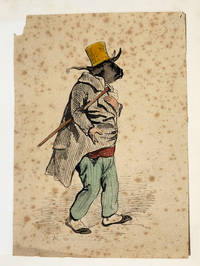
18421697391842. GRANDVILLE J.J. Scènes de la vie privée et publique des animaux. Two volumes. 8 386 6; 4 390 6 pp. with 201 engraved plates and 120 vignettes illustrating the text. Large 8vo 261 x 180 mm. uniformly bound in contemporary black half morocco. Paris: Hetzel et Paulin: 1842-1844. A splendid copy of a Grandville masterpiece accompanied by two original watercolours by Grandville and a long autograph letter from the publisher Hetzel. A fantastic example of anthropomorphic illustration and an important precursor of surrealism. These illustrations represent some of Grandville's most memorable creations. Many of the plates are of single figures but there are also satirical scenes of everyday life monsters animals looking at politicians caged at the zoo etc. The texts contained herein were written by such notable authors as Balzac Charles Nodier George Sand Louis Viardot and even J. Hetzel the publisher under the pseudonym of P.J. Stahl. Hetzel was the motivating force behind this work which he undertook in order to "give words to Grandville's marvellous animals and to join our pen with his pencil thereby coming to his assistance in criticizing the aberrations of our epoch and by preference among these aberrations those which are of every period and every country." Gordon N. Ray writes: "Through Grandville's animals Hetzel and his colleagues offered a witty and telling commentary on contemporary politics and personalities." Some slight edge wear one of the drawings with spotting else fine. PROVENANCE: Jacques Crepineau with his bookplate. Ray 194. Carteret III 552-59. Rebeyrat Catalogue bibliographique et bibliophilique in: J.J. Grandville 1985 pp. 289-90. unknown
183659886Werdet | Paris 1836 | 12 x 19.50 cm | 2 volumes reliés
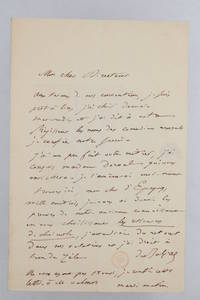
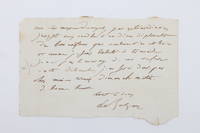
1839803451839. Fine. s. d. ca 1839 13 x 8 cm une feuille Signed handwritten letter to Louis Desnoyers ca 1839 13 x 8 cm one leaf Handwritten letter signed by Honoré de Balzac addressed to Louis Desnoyers written on a white piece of paper in black ink. My dear Mr Desnoyers extraordinarily today I attend a diplomatic dinner of good-natured folk who want to laugh and drink and as I am in a stupor at work I have not had the courage to refuse this debauchery; I will therefore not be at home. Come early Sunday morning. / Yours / de Balzac. Louis Desnoyers plays an important role in the foundation of the Société des gens de lettres which aims to protect literary and artistic property and to create a solidarity fund. Balzac supported the creation of this Society of which Desnoyers was vice-president. Amusing letter testimony of Balzac's love of good food. unknown