15 181 résultats
1819388201819 1 vol in-8 broché - tome VIII - octobre-décembre 1961
1941Paris, editions Garnier Frères, 1971 in 8 broché de 368 pages
2200Paris, Boivin et Cie, editions Contemporaines, 1950, revue de Littérature Comparée, avril-juin 1950, 24 ème année, n°84 in 8 broché de 224 pages
2207Paris, Les Editeurs Français Réunis, revue Europe , 28 ème année, n°55/56 Juillet-août 1950 in 8 broché
192894023-C2749Broché, Plon, M.CM.XXVIII. La prodigieuse vie d'Honoré de Balzac par René Benjamin avec 28 bois gravés de L. Schulz et 24 héliogravures hors texte. Format 28x23cm. Bon état, intérieur frais.
10824Taillandier In-4°, reliure cartonnée sous jaquette, 94 pages, bel ensemble, richement illustré de vignettes composées et de photographies en couleurs.
182846401304Paris, Brissot-Thivars, , 1828 ; 2 vol. in-16, demi-chevrette violette, dos orné de filets et de fleurons dorés, non rogné (Rel. de l’époque). - 2 ff. n.ch., XLVIII pp. (par Viollet Le Duc), 402 pp., 1 f. table. [Imprimerie de H. Balzac rue des Marais S.G., n° 17]. En réalité il s’agit de l’édition Desœr 1822 (même composition, même papier) qui fut cédée à Brissot-Thivars. Ce dernier s’est contenté de faire refaire les 2 ff. de faux-titre et titre par Balzac. Bel exemplaire avec, sur la garde, un ENVOI AUTOGRAPHE de Viollet-Le Duc « à Monsieur De la Tour, de la part de l’éditeur reconnaissant des soins donnés à son fils 1er janv. 1831 » Ex-libris. L’exemplaire a appartenu à H. Hanoteaux (ex-libris). Note manuscrite de ce dernier sur 4 ff. in 16, au sujet de ce tirage. On joint: REGNIER (Mathurin). Œuvres, avec commentaires, revues, corrigés et augmentés. Précédées de l’Histoire de la Satire en France pour servir de discours préliminaire. Par M. Viollet Le Duc. Edition elzévirienne. Paris, Desœr, 1822 ; in-16, demi-chevrette violette, dos orné de filets et de fleurons dorés, non rogné (Rel. pastiche). Cette édition, identique à celle de 1828, prouve que cette impression balzacienne est hautement contestable. Cet exemplaire porte également l’ex-libris de G. Hanoteaux. Hanoteaux et Vicaire, 141."
180926081Imprimerie Impériale | Paris 1809-1829 | 53.50 x 71 cm | une feuille
180932842Imprimerie Impériale | Paris 1809-1829 | 53.50 x 71 cm | une feuille
180932842Paris: Imprimerie Impériale 1809. Fine. Imprimerie Impériale Paris 1809-1829 53.50 x 71 cm une feuille Original unshaved full-page etching from the Imperial edition of the Description de l'Égypte or Recueil des observations et recherches faites en Égypte pendant l'expédition française publié par les ordres de Sa Majesté l'Empereur Napoléon le Grand A Collection of the observations and research carried out in Egypt during the French expedition published on the orders of his Majesty the Emperor Napoleon the Great'.Produced between February 1802 and 1830 on the orders of Naopleon Bonaparte and published between 1809 and 1828 1000 copies were printed and distributed to institutions on vergé paper with an 'Égypte ancienne et moderne' watermark visible when held up to the light. Light marginal spotting not touching image otherwise in very fresh fine condition. An engraving from the Description de l'Egypte one of the masterpieces of French printing and the birth of a new field: Egyptology. A gigantic survey of Egypt at the time of Bonaparte's conquests in 1798 and 1799 the work is divided into 13 volumes of engravings making up 892 plates of which 72 colored as well as presenting the splendors of the Egypt of the Pharaohs in 9 volumes. The other volumes discuss natural history and present a fascinating portrait of Coptic and Islamic Egypt as it was seen by Bonaparte's Eastern Armies. The Egyptian campaign' militarily a disaster demonstrates through the engravings of the Description d'Egypte the scientific success it nonetheless became thanks to the 167 expert members of the Commission of the Sciences and Arts of the Institut d'Egypte Egyptian Institute who followed Napoleon's army. The Institut gathered together in Egypt the mathematician Monge the chemist Berthollet the naturalist Geoffroy Saint-Hilaire as well as numerous artists engineers architects and doctors. They were tasked with re-discovering modern and ancient Egypt and displaying its natural treasures as well as the know-how of its inhabitants.This edition the so-called Imperial edition of the plates for the Description de l'Egypte was printed in four large formats two of which were specially created for it and christened Moyen-Egypte and Grand-Egypte. A special press was built to print it the process extending over 20 years from 1809 to 1829. The Imperial edition proved so popular that a second edition this time in black and white and without the Egypte ancienne et moderne watermark known as the Royal Edition was published during the Restoration by the printing house of C.-L.-F. Panckoucke Paris.The engravings of the Description d'Egypte owe a great deal to Baron Dominique-Vivant Denon illustrator diplomat collector and later Director of the Musée Napoléon the Louvre. His exploration of the South of Egypt gave Bonaparte the idea of sending the experts of the Institut there thus creating a faithful and complete portrait of the area. This was the research gathered together from 1802 in the mammoth Description de L'Egypte.Denon embarked on this story of archeological exploration at the age of 51 reaching first Alexandria and then Cairo before exploring Upper Egypt. Along with the members of the Institut d'Egypte the Natural History Museum's painter H.J. Redouté brother of Pierre-Joseph Redouté author of Roses the mineralogist Dolomiue and the draughtsman Joly Denon then explored the Nile Delta and Lower Egypt. When however he joined the 21st Light Infantry Regiment as it marched across Upper Egypt in pursuit of the retreating Mameluks in November 1798 he found himself the only civilian. In the very midst of the battle itself he reeled off sketches of the works of art that peppered his path right up to the threshold of the Sudan. He said that he had crossed a country that is apart from its name entirely unknown to Europeans and therefore everything was worth describing Voyages dans la Basse et la Haute Egypte pendant les campagnes Imprimerie Impériale unknown
180926081Paris: Imprimerie Impériale 1809. Fine. Imprimerie Impériale Paris 1809-1829 53.50 x 71 cm une feuille Original unshaved full-page etching from the Imperial edition of the Description de l'Égypte or Recueil des observations et recherches faites en Égypte pendant l'expédition française publié par les ordres de Sa Majesté l'Empereur Napoléon le Grand A Collection of the observations and research carried out in Egypt during the French expedition published on the orders of his Majesty the Emperor Napoleon the Great'.Produced between February 1802 and 1830 on the orders of Naopleon Bonaparte and published between 1809 and 1828 1000 copies were printed and distributed to institutions on vergé paper with an 'Égypte ancienne et moderne' watermark visible when held up to the light. Light marginal spotting not touching image otherwise in very fresh fine condition. An engraving from the Description de l'Egypte one of the masterpieces of French printing and the birth of a new field: Egyptology. A gigantic survey of Egypt at the time of Bonaparte's conquests in 1798 and 1799 the work is divided into 13 volumes of engravings making up 892 plates of which 72 colored as well as presenting the splendors of the Egypt of the Pharaohs in 9 volumes. The other volumes discuss natural history and present a fascinating portrait of Coptic and Islamic Egypt as it was seen by Bonaparte's Eastern Armies. The Egyptian campaign' militarily a disaster demonstrates through the engravings of the Description d'Egypte the scientific success it nonetheless became thanks to the 167 expert members of the Commission of the Sciences and Arts of the Institut d'Egypte Egyptian Institute who followed Napoleon's army. The Institut gathered together in Egypt the mathematician Monge the chemist Berthollet the naturalist Geoffroy Saint-Hilaire as well as numerous artists engineers architects and doctors. They were tasked with re-discovering modern and ancient Egypt and displaying its natural treasures as well as the know-how of its inhabitants.This edition the so-called Imperial edition of the plates for the Description de l'Egypte was printed in four large formats two of which were specially created for it and christened Moyen-Egypte and Grand-Egypte. A special press was built to print it the process extending over 20 years from 1809 to 1829. The Imperial edition proved so popular that a second edition this time in black and white and without the Egypte ancienne et moderne watermark known as the Royal Edition was published during the Restoration by the printing house of C.-L.-F. Panckoucke Paris.The engravings of the Description d'Egypte owe a great deal to Baron Dominique-Vivant Denon illustrator diplomat collector and later Director of the Musée Napoléon the Louvre. His exploration of the South of Egypt gave Bonaparte the idea of sending the experts of the Institut there thus creating a faithful and complete portrait of the area. This was the research gathered together from 1802 in the mammoth Description de L'Egypte.Denon embarked on this story of archeological exploration at the age of 51 reaching first Alexandria and then Cairo before exploring Upper Egypt. Along with the members of the Institut d'Egypte the Natural History Museum's painter H.J. Redouté brother of Pierre-Joseph Redouté author of Roses the mineralogist Dolomiue and the draughtsman Joly Denon then explored the Nile Delta and Lower Egypt. When however he joined the 21st Light Infantry Regiment as it marched across Upper Egypt in pursuit of the retreating Mameluks in November 1798 he found himself the only civilian. In the very midst of the battle itself he reeled off sketches of the works of art that peppered his path right up to the threshold of the Sudan. He said that he had crossed a country that is apart from its name entirely unknown to Europeans and therefore everything was worth describing Voyages dans la Basse et la Haute Egypte pendant les campagnes Imprimerie Impériale unknown
Mm 100x115 Brossura editoriale di pp. 216, in ottimo stato. SPEDIZIONE IN 24 ORE DALLA CONFERMA DELL'ORDINE.
14paris nizet 1966 in 12 broché 281 pages
1567Masson & Cie, éditeurs. Tiré à part des "Annales médico-psychologiques", n° 4, novembre 1954. Plaquette in-8° agrafée. 24 pages. E.O.
24 X 17,5 CM., 227 -(5) PP., BROSS. EDIT. ILL. IN NERO, NUOVO (M).<BR>(SAGGI E MATERIALI UNIVERSITARI 5. SERIE DI STORIA DEL TEATRO A CURA DI UMBERTO ARTIOLI E FERNANDO TREBBI)<BR>ISBN 8886413513 FL 348
BIO821M1980 chez Grasset. In-8, broché, 288p. Texte seulement. Exemplaire en assez bon état, le livre est jaunis et présente des marques d’usage. Les pages restes cependant parfaitement lisible.
201231430Joué-les-Tours La Simarre 2012 GRAND In-8 Envoi de l'auteu signé - Désicace de l'auteur à sa grand-mère, à ses grands-parents et à ses parents - Préface de Pierre Leveel - Avec la collaboration de Charlotte Dorotte (titulaire de la médaille de bronze de la Jeunesse et des Sports), Claude Villari et Philippe Leclerc-Ramette (pour les plans du château de Cangé) - 427 pp - Reproductions photographiques et plans compris dans la pagination
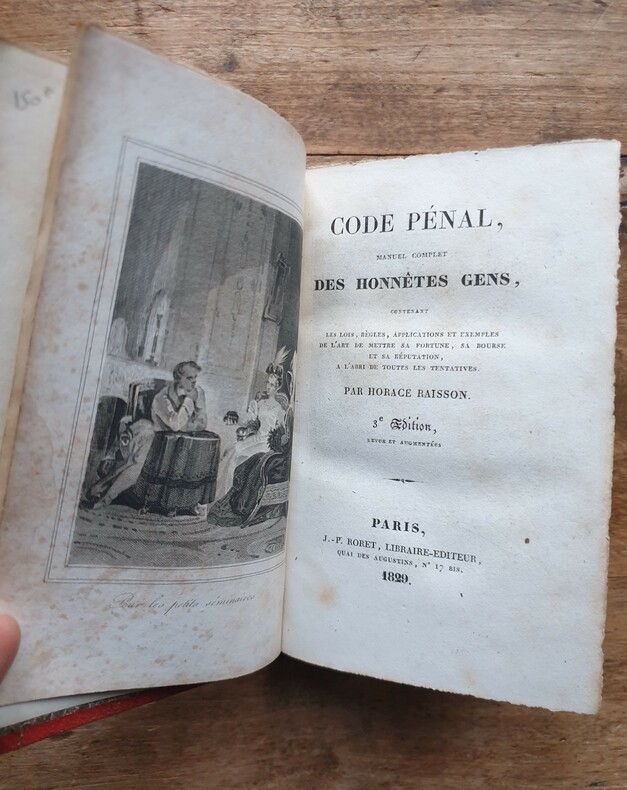
12101Paris, J.-P. Roret, Libraire-Editeur, 1829 "petit in 12 reliure demi chagrin rouge à coins, quatre nerfs, titrée ""H. de Balzac / Code pénal, de 373 pages incluant dans la pagination une publicité pour le Code Conjugal ""pour paraître le 1er février"""
237232Paris, J.-P. Roret, Levavasseur, 1829 in-16, ix pp., pp. 11316, 8 pp. de prospectus des autres codes, avec un frontispice sous serpente, gravé par Tony Johannot, demi-basane fauve modeste, dos lisse orné de filets et guirlandes dorés, ainsi que de fleurons à froid, tranches mouchetées de bleu (reliure de l'époque). Rousseurs.
237231Paris, J.-P. Roret [Imprimerie de Trouvé], 1829 in-16, [2] ff. n. ch., 373 pp., avec un frontispice sous serpente, demi-basane fauve marbrée, dos lisse orné de filets, guirlandes et fleurons dorés, pièce de titre bouteille, tranches marbrées (reliure de l'époque). Rousseurs.
196136475Histoire tirée des manuscrits de Dom Rago, ex-prieur de Bénédictin, mise au jour par ses deux neveux M. A. de Viellerglé, 2 vol. in-12 reliure demi-basane rouge, tête dorée, Chez Hubert, Paris, 1822, [ réédition pour la collection Le Cabinet Romantique, Imprimerie Genèse, Paris, 1961 ] 187-215 ; 194-218 pp