2 783 résultats
190079305Paris Nilsson 1900 1 vol. relié in-12, bradel toile éditeur marron, pièce de titre de basane acajou, 262 pp., portrait-frontispice. Edition originale de cet hommage d'un jeune nancéien, fondateur de la "Revue lorraine". Papier d'époque jauni mais exemplaire bien conservé par sa reliure toile.
22618ELBEUF, Paul Duval, Lib.-Ed. - sans date - Première édition - Petit in-folio - Cartonnage éditeur. Ouvrage abondamment illustré, nombreuses photos, dessins, gravures hors-texte en couleurs, contrecollées sur carton teinté - 320 pages - Très frais intérieurement
1918R320125458Editions de la renaissance contemporaine. 1918. In-8. Broché. Etat d'usage, Couv. légèrement passée, Agraffes rouillées, Intérieur acceptable. 16 pages agrafées - quelques illustrations en noir et blanc dans et hors texte - mouillures sur la page 16 sans conséquence sur la lecture.. . . . Classification Dewey : 908.44383-Régionalisme : Alsace
61832Impr. de Perriquet et Bouille - Auxerre 1857 In-8 24 cm 20pp. quelques marques d'usage sur la couverture hommage autographe de l'auteur Nb-0367 unknown
47917Paris, Editions des Horizons de France 1929, 170x110mm, 60pages, broché. Couverture rempliée. Papier cristal d’origine conservé. Exemplaire numéroté sur papier vélin teinté de Rives 590/900. Très bel exemplaire.
192963698Horizons de France, "Les roses latines" 4 1929 1 vol. broché in-12, broché, couv. rempliée, 60 pp. Un des 900 vélin teinté de Rives. Très bon état.
1929870621929 Paris, Horizons de France (Collection "Roses Latines"), 1929, petit in 12 broché, IV-63 pages ; couverture rempliée.
5179Paris, éd. des Horizons de France, 1929. In-12 broché, IV-61 p. Coll. "Les Roses Latines", n°4. Avant-propos de Gabriel Faure. Exemplaire n° 284 / 900 sur vélin teinté de Rives. Contient : Vacances au soleil (1890) ; L'Education par l'Italie (1892) ; Le bénéfice du voyage (1894) ; Souvenirs de Venise (1903) ; Une journée napolitaine (1908).
1929001844Paris 1929 EDITIONS Des Horizons De France Soft cover
1911269761911 P., Garnier, sans date (vers 1911), fort in 12, VIII-508 pages ;Illustré de très nombreuses reproductions photographiques in et hors texte de la plupart des cathédrales de France.-reliure amateur,dos muet,exemplaire de travail
177928787London: British Admiralty for 'The Atlantic Neptune' 1779. Etching with roulette work original outline color on laid paper watermarked "JBates" and countermarked "JB" This excellent example of Des Barres' craftsmanship details a portion of the strait between New Brunswick and what is now Prince Edward Island then St. John's Island. It includes on the New Brunswick side: Shediac Cocagne and Boutouche. The chart includes soundings throughout the Straits and Baie Verte. This is one of the many regions Des Barres himself surveyed during the 1760s. Des Barres of Swiss-Huguenot extraction studied under the great mathematician Daniel Bernoulli at the University of Basel before continuing on to the Royal Military College at Woolwich. Upon the outbreak of hostilities with France in 1756 he joined the British Royal American Regiment as a military engineer. He came to the attention of General James Wolfe who appointed him to join his personal detail. During this period he also worked with the future legendary explorer James Cook on a monumental chart of the St. Lawrence River. From 1762 Des Barres was enlisted to survey the coastlines of Nova Scotia Newfoundland and the Gulf of St. Lawrence while his colleague Samuel Holland charted the New England coast. He also managed to gain access to some surveys of the American South Cuba and Jamaica. In 1774 Des Barres returned to England where he began work on The Neptune. His dedication to the project was so strong that often at his own expense he continually updated and added new charts and views up until 1784. That year he returned to Canada where he remained for a further forty years becoming a senior political figure and a wealthy land owner and living to the advanced age of 103. The Atlantic Neptune the most celebrated sea atlas contained the first systematic survey of the east coast of North America. Des Barres's synergy of great empirical accuracy with the peerless artistic virtue of his aquatint views created a work that "has been described as the most splendid collection of charts plates and views ever published" National Maritime Museum Catalogue. Upon the conclusion of the Seven Years War Britain's empire in North America was greatly expanded and this required the creation of a master atlas featuring new and accurate sea charts for use by the Royal Navy. Des Barres was charged with this Herculean task publishing the first volume in London in 1775 which was soon followed by three further volumes. Des Barres's monumental endeavor eventually featured over two-hundred charts and views many being found in several states. Des Barres's charts were immensely detailed featuring both hydrographical and topographical information and in many cases remained the most authoritative maps of the regions covered for several decades.<br/> <br/>Streeter copy: Vol. II # 58; Stevens 68e. British Admiralty for 'The Atlantic Neptune'] unknown books
177928787London: British Admiralty for 'The Atlantic Neptune' 1779. Etching with roulette work original outline color on laid paper watermarked "JBates" and countermarked "JB" This excellent example of Des Barres' craftsmanship details a portion of the strait between New Brunswick and what is now Prince Edward Island then St. John's Island. It includes on the New Brunswick side: Shediac Cocagne and Boutouche. The chart includes soundings throughout the Straits and Baie Verte. This is one of the many regions Des Barres himself surveyed during the 1760s. Des Barres of Swiss-Huguenot extraction studied under the great mathematician Daniel Bernoulli at the University of Basel before continuing on to the Royal Military College at Woolwich. Upon the outbreak of hostilities with France in 1756 he joined the British Royal American Regiment as a military engineer. He came to the attention of General James Wolfe who appointed him to join his personal detail. During this period he also worked with the future legendary explorer James Cook on a monumental chart of the St. Lawrence River. From 1762 Des Barres was enlisted to survey the coastlines of Nova Scotia Newfoundland and the Gulf of St. Lawrence while his colleague Samuel Holland charted the New England coast. He also managed to gain access to some surveys of the American South Cuba and Jamaica. In 1774 Des Barres returned to England where he began work on The Neptune. His dedication to the project was so strong that often at his own expense he continually updated and added new charts and views up until 1784. That year he returned to Canada where he remained for a further forty years becoming a senior political figure and a wealthy land owner and living to the advanced age of 103. The Atlantic Neptune the most celebrated sea atlas contained the first systematic survey of the east coast of North America. Des Barres's synergy of great empirical accuracy with the peerless artistic virtue of his aquatint views created a work that "has been described as the most splendid collection of charts plates and views ever published" National Maritime Museum Catalogue. Upon the conclusion of the Seven Years War Britain's empire in North America was greatly expanded and this required the creation of a master atlas featuring new and accurate sea charts for use by the Royal Navy. Des Barres was charged with this Herculean task publishing the first volume in London in 1775 which was soon followed by three further volumes. Des Barres's monumental endeavor eventually featured over two-hundred charts and views many being found in several states. Des Barres's charts were immensely detailed featuring both hydrographical and topographical information and in many cases remained the most authoritative maps of the regions covered for several decades.<br/> <br/> Streeter copy: Vol. II # 58; Stevens 68e. British Admiralty for 'The Atlantic Neptune'] unknown
26305P., Plon, 1958, in 8° broché, 246pp. ; couverture légèrement fanée.
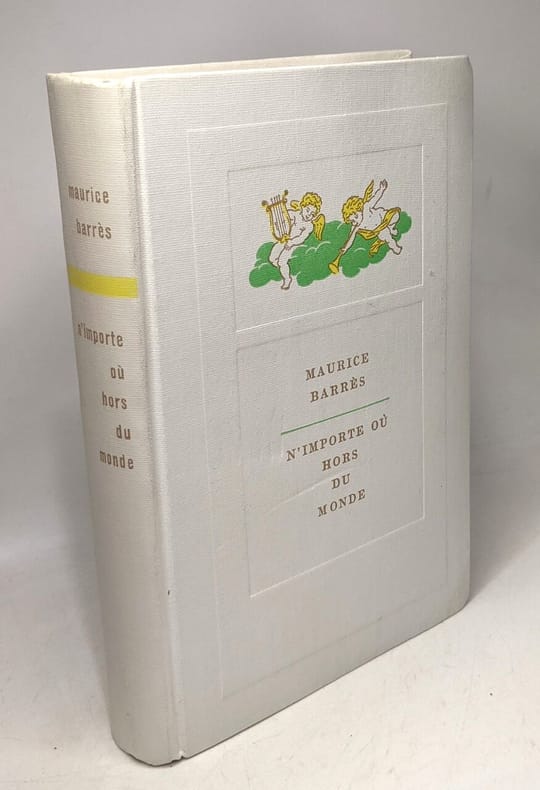
48765P., Club des Editeurs, 1958, petit in 8° reliure pleine toile décorée de l'éditeur, 16 pages non chiffrées (portrait) et 302 pages ; rousseurs sur les tranches.
1710Couverture légèrement déchirée en haut à gauche.
195813643Paris Club des éditeurs 1958 Un volume in-8 reliure de l'éditeur pleine toile blanche illustrée, 298 pages. Bon état.
19586356Préface de Philippe Barrès.Edition originale. Un des 300 exemplaires sur papier alfa (n° A.27).Paris, Plon 1958.Ouvrage broché. Non coupé. Très bon état. Format in-8° (20x14).
15903Paris Librairie Plon 1958 in 8 (20,5x14,5) 1 volume broché, 246 pages. Bon exemplaire
1958136799Plon 1958 300 pages in8. 1958. Cartonné. 300 pages. exemplaire (n°2486)
1958100104362Club des éditeurs 1958 in8. 1958. Cartonné.
195869512Plon | Paris 1958 | 15 x 21 cm | broché
195883979Plon | Paris 1958 | 15 x 20.50 cm | relié
1958R240134758CLUB DES EDITEURS / PLON. 1958. In-8. Relié. Bon état, Couv. convenable, Dos satisfaisant, Intérieur frais. 298 pages .. . . . Classification Dewey : 840.091-XX ème siècle
1958RO40251913Club des Editeurs. 1958. In-8. Relié. Bon état, Couv. convenable, Dos satisfaisant, Intérieur frais. 298 pages. Reliure d'éditeur beige illustrée sur le 1er plat.. . . . Classification Dewey : 94.41-Editions numérotées (gros tirage)