(British Military History) [Anon]Biblio.com
443 résultats
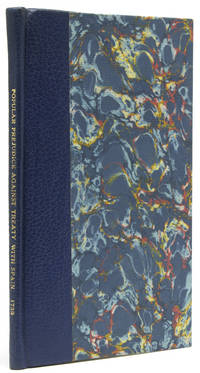
173912979London: Printed for T. Cooper 1739. 30 pp. 1 vols. 8vo. A very good copy with some minor browning to a few pages. Former owner's inscription in margin of title page. Modern half blue morocco gilt over marbled boards. 30 pp. 1 vols. 8vo. Printed for T. Cooper unknown
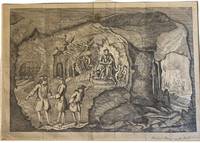
17545183Northern Netherlands: N/P 1754. First edition. A scarce engraving by an unknown engraver from 1754. It shows the arrival of Daniël Raap in Hell. A caricature on the death of the merchant and Orangist Daniël Raap on 15 January 1754 in Amsterdam. Raap with his ally Teepken in hell standing before the Devil on his throne. Details in the image numbered 1-5 but there is no legend. tipped onto a paper sheet and held under passe partout. We cannot find any other copies of this for sale and the only copy we can locate is in the Rijksmuseum RP-P-OB-84.474 also with no legend. engraved area is 21cm x 31cm. Sheet is 25cm x 34cm. Passe partout is 35cm x 50cm. The sheet is a little darkened and has a closed tear to one edge not affecting engraved area. The title is added in Dutch in manuscript to the bottom right and the number 114 to the bottom left. Small area of loss to the top edge of border hidden by passe partout. A scarce item. Daniel Raap 1703–1754 was a Dutch porcelain merchant from Amsterdam who played a significant role during the Orangist revolution in the Netherlands between 1747 and 1751. He was known for his agitation against the ruling Regent class advocating for greater public influence in government and supporting the restoration of the stadtholderate under William IV Prince of Orange. Raap along with other activists published pamphlets demanding democratic reforms and hereditary stadtholder rule. He organized petitions and called for the direct election of militia captains the restoration of guild privileges and auctioning of vacant public offices. His activities led to William IV intervening in Dutch politics but when the new city government remained dominated by the traditional regent families Raap found himself at odds with both more radical democrats and Orangists. By the time of his death Raap's former popularity had turned to hostility; riots occurred at his funeral and his coffin was even destroyed by a mob. Première édition. Rare gravure d'un graveur inconnu datant de 1754. Elle montre l'arrivée de Daniël Raap en enfer. Une caricature sur la mort du marchand et orangiste Daniël Raap le 15 janvier 1754 à Amsterdam. Raap et son allié Teepken en enfer devant le Diable sur son trône. Les détails de l'image sont numérotés de 1 à 5 mais il n'y a pas de légende. L'image a été collée sur une feuille de papier et conservée sous passe partout. Nous n'avons pas trouvé d'autres copies de ce tableau à vendre et la seule copie que nous avons pu localiser se trouve au Rijksmuseum RP-P-OB-84.474 également sans légende. La surface gravée est de 21cm x 31cm. La feuille mesure 25 cm x 34 cm. Passe partout mesure 35 cm x 50 cm. La feuille est un peu assombrie et présente une déchirure fermée sur un bord qui n'affecte pas la zone gravée. Le titre est ajouté en néerlandais dans le manuscrit en bas à droite et le numéro 114 en bas à gauche. Petite zone de perte au bord supérieur de la bordure cachée par un passe-partout. Une pièce rare. Daniel Raap 1703-1754 était un marchand de porcelaine néerlandais d'Amsterdam qui a joué un rôle important pendant la révolution orangiste aux Pays-Bas entre 1747 et 1751. Il était connu pour son agitation contre la classe régente au pouvoir prônant une plus grande influence du public dans le gouvernement et soutenant la restauration du stadtholderat sous Guillaume IV prince d'Orange. Avec d'autres activistes Raap a publié des pamphlets réclamant des réformes démocratiques et le règne héréditaire du stadtholder. Il organise des pétitions et demande l'élection directe des capitaines de milice le rétablissement des privilèges des guildes et la mise aux enchères des charges publiques vacantes. Ses activités ont incité Guillaume IV à intervenir dans la politique néerlandaise mais lorsque le nouveau gouvernement de la ville est resté dominé par les familles régentes traditionnelles Raap s'est retrouvé en désaccord avec les démocrates plus radicaux et les orangistes. Au moment de sa mort la popularité de Raap s'est transformée en hostilité ; des émeutes ont éclaté lors de ses funérailles et son cercueil a même été détruit par une foule. N/P unknown
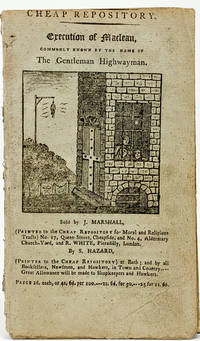
1795187London: J. Marshall & R. White; Bath: S. Hazard 1795. Very good self wrappers with the first leaf has a paper flaw resulting in skewed printing and a loss of a few words several pages shaved too closely and pages age-toned and smudged. A scarce Cheap Repository printing of the story of James Maclean who was executed at the infamous Tyburn tree on October 3 1750 following a short but successful stint as a highwayman who rid his victims of their possessions in the most courteous manner. With an ominous vignette on the title page of the gallows at Tyburn with crows circling a hanging body in the background while three Newgate inmates look on. <br /> <br /> 12mo. title 3-22pp. 2 advertisements. ESTC N490066 of the five editions noted this is the only edition featuring "Cheap Repository" printed at the head of the title; Not in Spinney but compare to Spinney 7 not indicating priority in different editions though this edition uses his #3 imprint; Blanch A Reassessment of the Authorship of the Cheap Repository Tracts 2009 Baylor U. Thesis at pg. 114. J. Marshall & R. White; Bath: S. Hazard unknown
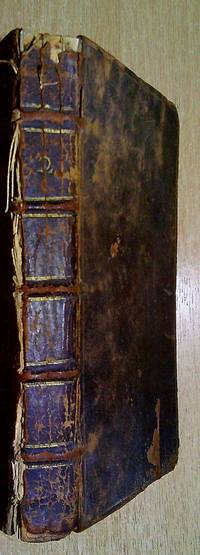
17804558Paris: Chez Onfroy 1780. Two volumes in one first edition. A rare guide to the state of Great Britain from a French perspective. Volume one was for 1780 volume two for 1781. It would seem that there were plans for this to be an annual review but if so this doesn't appear to have happened as Worldcat only records these two years. Full leather binding with gilt decoration to the spine. The label and one panel of the gilt to the spine has been pulled away leaving some leather but no surface see photos. The rest of the boards are in good slightly bumped condition. Inside there is an owner's signature to the end paper. The rest is clean and tidy. The half-title reads "Etat de l'Angleterre pour l'anneÌe 1780." viii 178 2 pages. The first volume conforms to OCLC: 40428559. This is followed by another half title for the year 1781 and a second volume of the book. viii 199 3. pages. This second volume conforms to OCLC: 630334412. Both volumes are full of the in depth information required by researchers. Including names addresses ranks etc. For example there is a list of the names and addresses of all the London bankers accounts of the King and court names of ships and vessels in the navy etc. etc. Text in French. 170 by 100mm 6¾ by 4 inches. No other copies available to purchase at the time of cataloguing. . Deux volumes en un première édition. Un guide de l'état de la Grande-Bretagne d'un point de vue français. Le premier volume porte sur l'année 1780 le second sur l'année 1781. Il semblerait qu'il était prévu que ce soit une revue annuelle mais si c'est le cas cela ne semble pas s'être produit car Worldcat n'enregistre que ces deux années. Reliure en plein cuir avec décoration dorée au dos. L'étiquette et un panneau de la dorure au dos ont été arrachés laissant un peu de cuir mais pas de surface voir les photos. Le reste des planches est en bon état légèrement bosselé. A l'intérieur la signature d'un propriétaire figure sur la page de garde. Le reste est propre et bien rangé. Le demi-titre indique "Etat de l'Angleterre pour l'année 1780". viii 178 2 pages. Le premier volume est conforme à OCLC : 40428559. Il est suivi d'un autre demi-titre pour l'année 1781 et d'un second volume du livre. viii 199 3 pages. Ce deuxième volume est conforme à OCLC : 630334412. Les deux volumes contiennent les informations détaillées dont les chercheurs ont besoin. Y compris les noms les adresses les grades etc. Par exemple il y a une liste des noms et adresses de tous les banquiers de Londres les comptes du roi et de la cour les noms des navires et des vaisseaux de la marine etc. etc. Texte en français. 170 x 100 mm. Aucun autre exemplaire disponible à l'achat au moment du catalogage. Chez Onfroy hardcover
17381106401738. Londres i.e. Amsterdam : Aux dépens de la Compagnie 1738. <br /> <br /> 12mo 4 179pp. Title- printed in red and black. Ink signature "Carteret Harvey" on A1. 19th-century blue cloth red label red edges very good.<br /> <br /> § OCLC: 12073708: "Miscellany comprising a grotesque fairy tale a philosophical epistle and a series of letters addressed from hell to the world above. The whole is redolent of political and philosophical overtones intended as a criticism of the Regency and the morality of the age. L'amour magot is a fable about the dangers of romantic love in an inexperienced young heroine. The 'lettres infernales' are written by inhabintants of hell. One letter is written from a bookseller addressed to his colleagues on earth in which he discusses hell's booktrade." OCLC locates in all about 18 copies but doubtless there are more. No one hazards a guess at the authorship. A pencil note in the book states: "Anon see Bulletin du bibliophile 16 série p. 372. Comte d'I.". unknown
18005415S.P.: S.P. C1800. First edition. 27 numbered sheets loose with marbled paper covers. Now held in a plastic folder. This is not a complete set. It is lacking the title page and contents page These are provided in photocopy and the final two plates 28 & 29 which were showing antique masks. The plates 1-27 are present and hold a total of 209 listed engravings. The sheets are a little darkened and have some edge wear. One plate has a closed tear to the bottom half not affecting image. Overall still an interesting set of these classical engravings in mainly bright condition. In the original printing the sheets were presented in two states - as found here and in reverse. We have only the 27 specified sold as collection of engravings not a complete publication. 30.5cm x 23cm. . Première édition. 27 feuilles numérotées détachées avec des couvertures en papier marbré. Actuellement conservées dans un dossier en plastique. Il ne s'agit pas d'un ensemble complet. Il manque la page de titre et la table des matières fournies sous forme de photocopie ainsi que les deux dernières planches 28 et 29 qui représentaient des masques antiques. Les planches 1 à 27 sont présentes et contiennent au total 209 gravures répertoriées. Les feuilles sont légèrement noircies et présentent quelques traces d'usure sur les bords. Une planche présente une déchirure fermée dans la moitié inférieure qui n'affecte pas l'image. Dans l'ensemble il s'agit tout de même d'un ensemble intéressant de gravures classiques dans un état globalement bon. Dans l'impression originale les feuilles étaient présentées sous deux formes : celle que l'on trouve ici et l'inverse. Nous ne disposons que des 27 gravures spécifiées vendues comme une collection de gravures et non comme une publication complète. 305 cm x 23 cm. S.P. unknown
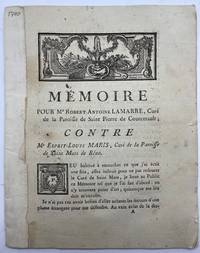
17803656Alençon: Malassis le jeune imprimeur du Roi de Monsieur Frere du Roi & du College 1780. Rare. Prémiere edition. Couverture souple. Etat : Très bon. Édition originale. 38 pages. 232 x 185 mm 9¼ x 7¼ inches. Malassis le jeune, imprimeur du Roi, de Monsieur, Frere du Roi, & du College unknown
17755002Japan: NP 1775. A lovely large water colour showing a woman in traditional geisha clothing holding a Shamisen. Painted onto thin mustard coloured paper this has been laid onto a cream backing sheet also thin paper which has in turn been laid onto a larger sheet of thin paper. The three sheets together giving much more strength than a single thin sheet. The painting itself has been expertly produced but is unsigned. We have priced this as an un-attributable artist. The painting has some small cracks with creasing and a tiny amount of paint loss to it but still a lovely authentic piece of Edo art very similar in style to the portraiture of Katsushika Hokusai even to the background colour of the sheet. It is of a very similar period between 1775 and 1800. The style of the painting including the detailed depiction of clothing patterns and the graceful posture of the figure is characteristic of bijin-ga paintings of beautiful women which were popular in Japanese art during this time. The use of vibrant colors such as deep blue and red and intricate patterns suggests that this piece may have been created by an artist influenced by ukiyo-e a genre of woodblock prints and paintings that flourished during the Edo period. Artists like Kitagawa Utamaro or Suzuki Harunobu were renowned for similar depictions of women in elegant attire.It was possibly intended as a scroll painting. The painted sheet measures 70cm x 24cm. The largest backing sheet and hence work overall measures 81.5cm x 39cm. The shamisen 三味線 also known as sangen 三絃 or samisen all meaning "three strings" is a three-stringed traditional Japanese musical instrument derived from the Chinese instrument sanxian. Geisha's were often skilled Shamisen players and used them to entertain their customers. . Une belle grande aquarelle représentant une femme en tenue traditionnelle de geisha tenant un shamisen Peinte sur un papier fin de couleur moutarde celui-ci a été posé sur une feuille de support crème également en papier fin elle-même posée sur une feuille plus grande de papier fin. Les trois feuilles réunies donnent beaucoup plus de solidité qu'une seule feuille mince. La peinture elle-même a été réalisée par des experts mais elle n'est pas signée. Nous avons fixé le prix comme étant celui d'un artiste non attribuable. La peinture présente quelques petites fissures des plis et une minuscule perte de peinture mais il s'agit toujours d'une belle et authentique œuvre d'art Edo dont le style est très similaire à celui des portraits de Katsushika Hokusai jusqu'à la couleur de fond de la feuille. Elle date d'une période très similaire entre 1775 et 1800. Le style de la peinture y compris la représentation détaillée des motifs des vêtements et la posture gracieuse du personnage est caractéristique des bijin-ga peintures de belles femmes qui étaient populaires dans l'art japonais à cette époque. L'utilisation de couleurs vives comme le bleu profond et le rouge et de motifs complexes suggère que cette pièce a pu être créée par un artiste influencé par l'ukiyo-e un genre d'estampes et de peintures sur bois qui a fleuri pendant la période Edo. Des artistes comme Kitagawa Utamaro ou Suzuki Harunobu étaient réputés pour leurs représentations similaires de femmes en tenue élégante. La feuille peinte mesure 70 cm x 24 cm. La plus grande feuille de support et donc l'ensemble de l'œuvre mesure 815 cm x 39 cm. Le shamisen 三味線 également connu sous le nom de sangen 三絃 ou samisen tous signifiant "trois cordes" est un instrument de musique traditionnel japonais à trois cordes dérivé de l'instrument chinois sanxian. Les geishas étaient souvent d'habiles joueuses de samisen qu'elles utilisaient pour divertir leurs clients. NP hardcover
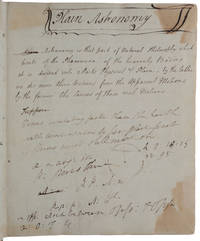
17805309N.p.: N.p. 1780. <p>A fascinating manual of astronomy particularly as it relates to the form of the motions of the heavens. The manuscript is in three parts: the first part covers the elementary parts of 'spherical astronomy' the second and third parts are more advanced covering sections of the Principia dealing with lunar theory and the inverse-square law of attraction. </p>. EIGHTEENTH-CENTURY MANUSCRIPT NOTEBOOK ON ASTRONOMY. <p>A fascinating manual of astronomy particularly as it relates to the form of the motions of the heavens dating from the period 1780-1825 probably from the beginning of that range. It is in a single hand with the exception of one page though with some variations indicating that different parts of the MS were written at different times. The MS could have been prepared for personal use or as part of public tuition probably the former. The writer summarizes the subject matter of the manual on the first leaf: 'Astronomy is that part of Natural Philosophy which treats of the Phenomena of the heavenly Bodies. It is divided into 2 Parts Physical and Plain: by the latter we discover their Motions from the Apparent Motions; by the former the Causes of these real Motions.' The MS is in three parts which are distinct in terms of subject matter. The first part covers the motion of the Earth around the Sun and its rotation about its axis with the consequences for the apparent motions of the Sun and the heavens; with the Moon and its phases and motion; and with lunar and solar eclipses. There are several references to John Keill's An Introduction to the True Astronomy London 1721 and subsequent editions. The second part principally consists of a discussion of section 11 of Newton's Principia 1713 or later editions in particular as it relates to the motion of the moon. This part ends with a short section on algebra particularly polynomials which seems to have been composed more haphazardly than the remainder of the text. The third part which runs backwards starting from the end of the notebook gives demonstrations of various results in Book I of Principia notably the theorem that the orbits of the bodies in the solar system do not precess if and only if the central attractive force operating on them is exactly inverse-square. This is an important result not only for Newton's system of universal gravitation but also for the observational astronomy of the solar system which is discussed in the opening section of the book. Between the end of the second part and that of the third there are a few blank leaves and others have been torn out but the text appears complete.</p> <br /> <p>The MS appears to be a working through of at least two different texts beginning with Keill's on astronomy. The first part of the MS refers particularly to the material in chapters 7-14 of Keill. It begins with the geometry of the sphere of the Earth and its orbit great circles and poles the plane of the ecliptic equinoctial points and the Tropics of Cancer and Capricorn. Then comes a section on the different systems of the world Ptolemaic Tychonic and Copernican illustrated by a diagram. The arguments supporting each system are given including the aberration of the fixed stars discovered by James Bradley in 1729 which supports Copernicus. It is noted that the Sun's apparent diameter varies according to the time of year which is explained by the fact that the Earth's distance from the Sun is not constant. Kepler's laws are stated with a long discussion of the area law and a statement that the Earth's orbit is an ellipse. The consequences of the fact that the plane of the Earth's orbit is inclined at an angle to the plane of the ecliptic are discussed the seasons. There is a section devoted to the precession of the equinoxes - the author notes that "Sir Isaac Newton has demonstrated that it arises from the broad spheroidal figure of the Earth." The author then turns to sunspots and the arguments for and against their being on the surface of the Sun. Then comes a long discussion of the planets: the planes and periods of their orbits phases conjunctions retrograde motions apparent brightness and their distances from the Sun. Special attention is given to the phases of Venus the varying appearances of Mars and Saturn's rings. This is followed by an extensive discussion of the Moon: its phases and motion and the fact that the same face is always turned to the Earth which implies that the Moon turns on its axis in the same time as it takes to orbit the Earth. This first part concludes with a fairly detailed account of lunar and solar eclipses.</p> <br /> <p>The second and third parts are notably more mathematical in nature than the first. The second works through Section 11 Prop. 66 of Principia and its corollaries which presents the perturbations of a remote body on a two-body system such as the Sun on the Earth-Moon system. This is one of the most difficult parts of Principia and one with which Newton was never completely happy and which is not entirely correct. The language used by the author of the notebook is reminiscent of the Principia but is primarily directed at following through Newton's working. There is a reference to a numbered figure '80' which does not appear to be numbered in any edition of the Principia. But it seems likely that the language and form of this discussion derives from familiarity with Robert Thorp's edition of Book 1 of the Principia 1777; cf. the notes published in Latin in 1765: pp. 266-90 in 1777 although Thorp is not referenced explicitly as Keill is. Thorp does have a figure 80 but it is not clear that he is the author being used at that particular point. There is then a discussion of algebra and the solution of equations which is fragmentary and incomplete followed by a number of blank and torn-out pages.</p> <br /> <p>The third part of the manuscript consists of a reading of various sections of Newton's Principia 1713 or later editions. Again it appears to take the form of working through and in some cases repeating the proofs of Newton's work rather than representing a translation or paraphrase. It is not based on Motte's translation nor does it correspond with the partial translation and edition of Thorp. It does not appear to be based on any other intermediary between Newton and the writer e.g. Pemberton but to rely on Newton's Latin original here rendered in places pretty exactly into English. It renders propositions 43 to 59 of section 9 of book 1 of the Principia which concern the motion of bodies in moveable orbits and the motion of the apsides. This is a topic which is still of some considerable interest to astronomers and historians of astronomy. Here Newton introduces what has come to be called Newton's 'rotating ellipse proposition' in which a rotating or precessing ellipse is described by a body for which the central force includes a term proportional to the cube of the distance from the focus; this rotating ellipse is compared with a similar stationary ellipse in which another similar body rotates about the same centre of force. Careful analysis leads to expressions for the extra inverse cube force depending on the number of upper and lower apses found in the moving ellipse. This part of the notebook includes the demonstration of the important proposition that the extra inverse cube force is absent i.e. the central force is exactly inverse-square if and only if the orbits of the bodies in the solar system do not precess.</p> <br /> <p>From the hand which seems constant throughout the book although with some considerable variation which might indicate a second writer or more likely the same writer at a different time or with a different pen and the paper we can with some confidence date the notebook to the period 1750-1825. If our supposition that it was Thorp's edition of Principia which was being used we might be able to narrow its date down to 1780-1825. The section of the planets in the first part does not mention Uranus Georgium sidus discovered by William Herschel in 1781 which appears to place this as an upper bound. This would therefore suggest a composition date in the late 1770s.</p> <br /> <p>We are indebted to Scott Mandelbrote for his assistance with the description of this notebook.</p> <br/> <br/> 4to 196 x 162 mm manuscript in ink on Dutch paper with Maid of Dort watermark without countermark. 101 and 26 leaves of text and diagrams 39 blank leaves in the middle last 26 leaves reversed illustrated with several astronomical and mathematical diagrams including one of a solar system. Late 18th century half calf marbled sides. N.p. unknown
176548742Glasgow: printed by Robert & Andrew Foulis 1765. First Foulis edition 8vo pp. 597 21 table; modern quarter polished tan calf over marbled boards spine in 6 compartments with gilt rules and elaborate decorations stamped in blind maroon morocco label; trimmed toned at edges occasional spots overall a very good attractive copy. Gaskell 440. printed by Robert & Andrew Foulis unknown
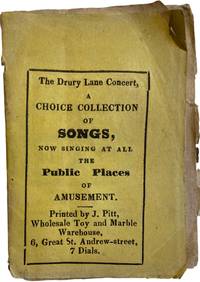
18005138London: J. Pitt C. 1800. C 1800. First edition. A small chapbook. Yellow paper covers containing 12 songs and three woodcuts. In good condition. It is a rough and ready disposable item. The yellow title has been printed off centre and the pages jut out a little. Slight edgewear to the pages but overall in good clean condition. Some pages uncut. 16 pages. This collection compiles popular songs performed at the Theatre Royal Drury Lane and other public venues during a period when music and song were integral to both theatrical and social life in London. Drury Lane under the management of figures like David Garrick 1747–1776 was a major centre for theatrical music including comic opera interludes and songs woven into plays and performances. J. Pitts John Pitts was a prominent London street ballad printer active from approximately 1765 to 1844. He operated in the Seven Dials district a well-known center for popular and cheap print production in the late 18th and early 19th centuries. Pitts specialized in printing broadsides—single sheets featuring ballads songs and topical verses—intended for mass public consumption. 10cm x 7cm. We cannot find a WorldCat / OCLC entry for this title. . C 1800. Première édition. Un petit livre de chapitres. Couvertures en papier jaune contenant 12 chansons et trois gravures sur bois. En bon état. Il s'agit d'un objet jetable brut et prêt à l'emploi. Le titre jaune a été imprimé de manière décentrée et les pages dépassent un peu. Légères traces d'usure sur les pages mais dans l'ensemble en bon état. Certaines pages ne sont pas coupées. 16 pages. Ce recueil compile des chansons populaires interprétées au Theatre Royal Drury Lane et dans d'autres lieux publics à une époque où la musique et la chanson faisaient partie intégrante de la vie théâtrale et sociale à Londres. Drury Lane sous la direction de personnalités comme David Garrick 1747-1776 était un centre majeur pour la musique théâtrale y compris l'opéra comique les interludes et les chansons intégrées dans les pièces et les représentations. J. Pitts John Pitts était un important imprimeur de ballades de rue londonien actif entre 1765 et 1844 environ. Il travaillait dans le quartier de Seven Dials un centre réputé pour sa production d'imprimés populaires et bon marché à la fin du XVIIIe siècle et au début du XIXe siècle. Pitts s'est spécialisé dans l'impression de broadsides - feuilles individuelles contenant des ballades des chansons et des vers d'actualité - destinés à la consommation publique de masse. 10 cm x 7 cm. Nous n'avons pas trouvé de notice WorldCat / OCLC pour ce titre. J. Pitt unknown
1787201London: Printed By Assignment from the Executors of E. Wicksteed for W. Bent Part 1 Printed for John Hinton Part 2 1787. Leather Bound. Near Fine. 4 x 6 1/2 inches. Part 1 consists of engraved frontispiece engraved title 1 leaf table of contents ix 156 numbered pages. Part 2 consists of engraved frontispiece engraved title 156 numbered pages. Bound at end is a 22 page publisher's catalogue of W. Lowndes. Bound in simple modern full black calf with red spine label and gilt title. Pages are bright and clean. An unrecorded variant of ESTCN56106 with 156 rather than 144 pages in Part 2. ESTC locates only 1 copy of the recorded version. An unusual copy of this popular Georgian devotional. Printed By Assignment from the Executors of E. Wicksteed for W. Bent (Part 1), Printed for John Hinton (Part 2) unknown
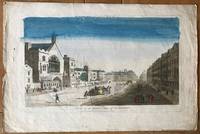
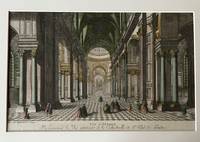
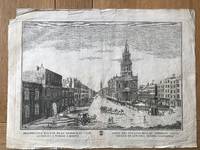
17662870Londres / Paris: Wichnyther / Basset 1766. Copper engraving beautifully hand coloured. Originally designed to be viewed through a zograscope. Title in both English and French. 23 x 41 cm image; Bottom left reads: Published according to Act of Parliament 1766. Sheet size: 340 x 515 mm 13½ x 20¼ inches. In very good condition with a very small loss to left edge and some minor soiling. Blank to verso. A zograscope is an optical device for magnifying flat images as the shape of the lens enhanced the sense of the depth shown in the picture. The precursor to 3D images! These were very fashionable in the late 18th century. Gravure sur cuivre magnifiquement colorée à la main. Conçu à l'origine pour être vu à travers un zograscope. Titre en anglais et en français. 23 x 41 cm image ; En bas à gauche se lit : publié conformément à la loi du Parlement 1766. Taille de la feuille : 340 x 515 mm 13½ x 20¼ pouces. En très bon état avec un très petit manque au bord gauche et quelques salissures mineures. Blanc au verso. Un zograscope est un appareil optique pour agrandir des images plates car la forme de l'objectif améliore le sens de la profondeur montrée dans l'image. Le précurseur des images 3D ! Celles-ci étaient très à la mode à la fin du XVIIIe siècle. Wichnyther / Basset unknown
17602871Paris: Maillet 1760. Scarce copper engraving finely hand coloured. Originally designed to be viewed through a zograscope. Title in French. Behind neat cream passe partout. 24 x 37 cm image; actual size: 335 x 475 mm 13¼ x 18¾ inches. In an excellent condition for such a scarce item. Blank to verso. A zograscope is an optical device for magnifying flat images as the shape of the lens enhanced the sense of the depth shown in the picture. The precursor to 3D images! These were very fashionable in the late 18th century. Rare gravure sur cuivre finement colorée à la main. Conçu à l'origine pour être vu à travers un zograscope. Titre en français. Derrière un passe partout crème soigné. 24 x 37 cm image ; taille réelle : 335 x 475 mm 13¼ x 18¾ pouces. En excellent état pour un objet si rare. Blanc au verso. Un zograscope est un appareil optique pour agrandir des images plates car la forme de l'objectif améliore le sens de la profondeur montrée dans l'image. Le précurseur des images 3D ! Celles-ci étaient très à la mode à la fin du XVIIIe siècle. Maillet unknown
17602936London 1760. Rare Latin / Spanish version of this copper engraving of Somerset House and St. Mary le Strand in London. Circa 1770. Originally designed to be viewed through a zograscope. Good condition. Slightly wrinkled / creased with some small closed tears to sheet edge not affecting the actual engraving. A few pale spots of foxing. Neat repair to verso. Light water stains only obvious from otherwise blank verso. 280 x 420 mm image; 306 x 490 mm sheet. A zograscope is an optical device for magnifying flat images as the shape of the lens enhanced the sense of the depth shown in the picture. The precursor to 3D images! These were very fashionable in the late 18th century. Rare version latine/espagnole de cette gravure sur cuivre de Somerset House et St Mary le Strand à Londres. Vers 1770. Conçu à l'origine pour être vu à travers un zograscope. Bonne condition. Légèrement froissé / froissé avec quelques petites déchirures fermées sur le bord de la feuille n'affectant pas la gravure proprement dite. Quelques taches pâles de rousseurs. Réparation soignée au verso. Légères taches d'eau évidentes uniquement à partir du verso autrement vierge.28 x 42 cm image; 36 x 49 cm feuille. Un zograscope est un appareil optique pour agrandir des images plates car la forme de la lentille améliore le sens de la profondeur montrée dans l'image. Le précurseur des images 3D ! Celles-ci étaient très à la mode à la fin du XVIIIe siècle. unknown
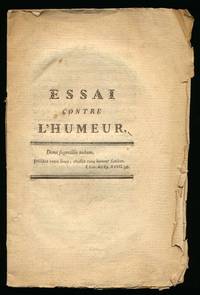
17753220255<p><em>8vo. pp. 19 1 blank; with engraved headpiece vignette and initial; stitched as issued uncut.</em></p><p>First edition of this rare moralistic essay on the subject of humour both good and bad.</p><p>The author states that he has no intention of being stuffy or professorial in his analysis of humour and its subspecies 'mauvaise humeur'. He notes that in the age of 'good company the need to be fashionable had almost entirely ruled out any place for humour and offers the reader a more optimistic view of existence more frivolous and worldly in which humour might have a role'.</p> [n.p., n.d., c.
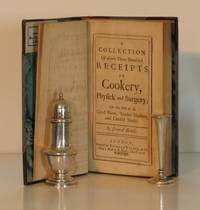
17147280London: For Richard Wilkin 1714. Octavo 19 x 12.5 cm. 16 218 13 pages. FIRST EDITION. “Mary Kettilby’s collection of cookery recipes and medicinal and home remedies from a tasty “green-pease soop without meat†to gooseberry wine. Households that could not afford French cooks or French cooking came to form a growing audience for books by women that contained unpretentious recipes cut to suit a less costly cloth for pickling and collaring rather than ragouts. Where Hannah Woolley had led plenty of female cooks with their eye on the profitable middle market followed with books like Mary Kettilby’s collection of recipes 1714 and Eliza Smith’s Compleat Housewife 1734†Colquhoun Taste: The Story of Britain through its Cookery 2015. Kettilby’s book purported to be a collective effort: the preface stating that ‘a Number of very Curious and Delicate House-wives Club’d to furnish out this Collection’. Maclean however pages 79-82 doubts this and notes that evidence from later editions indicate Kettilby to be the main author. Apart from the Preface there is no introduction of any sort: the recipes follow immediately after the chapter headings. The book is clearly divided into chapters of recipes for food and for remedies but within the chapters there is no definite structure. For example the first chapter begins with six recipes for soups followed by recipes for collared beef ‘French-Cutlets’ collared mutton stewed pigeons broiled pigeons dressed turbot and then patties ‘for a Dish of Fish’. The recipes are given either as goals as ‘To make Hogs-Puddings’ or as titles sometimes with descriptions as ‘A very good Tansy’. Quantities are given in whichever units are convenient as ‘a Gallon of grated Bread’ ‘three Pounds of Currants’ or ‘nine Eggs’. Often quantities rely on the cook’s judgment as ‘as much Sugar as will make it very sweet’. Temperatures and timings are given when necessary as ‘a cool Oven: Half an Hour bakes it’. Later binding in 19th century style. Half-calf gilt-decorated spine marbled endpapers. The front paste-down contains the bookplates of two significant culinary collections: Thomas Scruggs & Margaret Cook and Marian Hatch. The Hatch bookplate was designed and engraved by British engraver Alfred J. Downey. With the bookseller's ticket of Philip C. Duschnes to the rear pastedown. Ink ownership mark to half-title "1718 Eliseab; and inscription on final page of text "illeg. near New College Oxford". OCLC locates eighteen copies; Bitting page 258; Cagle 789; Maclean pages 79-82; Oxford page 54; Wellcome II page 389. For Richard Wilkin hardcover
172654527A Bettesworth Bettersworth 1726-01-01. Leather Bound. Very Good. Small tooled leather bound volume first edition 1726 issue printed for A. Bettesworth at the Red-Lyon. Ink to second free front endpaper and first free rear endpaper. Text unmarked. Tight binding. First edition with half-title. 12mo. xii 184 8 pp Please email for photos. A Bettesworth [Bettersworth] hardcover
17641079KB1764. 4 Teile in 1 Band. Carpentras D.-G. Quentin 1764. Kl.-8°. XXXVI VIII 256 S. - VIII 356 S. - 308 S. - 240 S. Lederband der Zeit mit reicher Rückenvergoldung berieben Rücken und Gelenke restauriert. Umlaufender Marmorschnitt. Abschnittsweise kleine Wurmgänge mit teilweisem Buchstabenverlust. Teil II S. 209/210 und Teil IV S. 167/168 geklebt. Sonst sehr schönes nahezu fleckenfreies Exemplar. Wellcome II 20; Blake 7 und 268; Hirsch/H. I 53. - Enthält: 1. Traité de l'origine des maladies et de l'usage de la poudre purgative. 1755. - 2. Medecine universelle prouvée par le raisonnement démontrée par l'expérience: ou précis du traité de J. Ailhaud par J.-G. Ailhaud son fils. 1762. - 3. Lettres de guérisons opérées par le reméde universel. 1763 - 4. Réponse de J.-G. Ailhaud a une lettre anonime contre la poudre d'Ailhaud et lettres de guérisons. 1764. 240 S. - Ailhaud 1674-1756 verdankt seinen Ruf der Verbreitung eines von ihm erfundenen Abführpulvers das nach seiner Behauptung ein Universalmittel gegen alle möglichen Krankheiten war. Seine Einnahmen aus dem Vertrieb des 'poudre purgative d'Ailhaud' waren sehr groß und erlaubten ihm einen aufwendigen Lebensstil. Sein Sohn Jean-Gaspard gest. 1800 führte die väterlichen Geschäfte fort. unknown
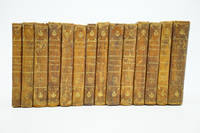
179910634London: Printed for C. Cooke c1799-1803. Hardcover. Fair/No DJ. DESCRIPTION: Thirteen quarter bound calf leather volumes with gilt titles to spine. Paper covered boards. Some volumes have the select British poets title page others do not. Plates to some volumes. Language: English. Book Condition: Fair: Wear to corners edges and spine ends. Heavy rubbed boards. Tightly bound with intact endpapers and firm hinges. One detached ffep. Light toning to some pages. Unmarked pages. DJ Condition: No DJ Pages Various. Size: 14cm by 9cm. POSTAGE: PLEASE NOTE - This is a heavy item and may require additional postage for overseas deliveries. We will contact you if additional charges are required. Please see our postage policy on our shop front for more information. BOOK RESUME: Volume 1: Poetical Works of Isaac Watts & Poetical Works of Isaac Watts Volume 2: Poetical Works of James Thomson Volume 3: Poetical Works of David Mallett & Poetical Works of Charles Rowe Volume 4: Poetical Works of Will Shenstone Volume 5: Poetical Works of Dr Tho. Parnell Volume 6: Poetical Works of Matthew Prior Vols I & II Volume 7: Poetical Works of Rev Dr E. Young Volume 8: Poetical Works of Joseph Addison & Poetical Works of Sir R. Blackmore Volume 9: Poetical Works of Cuthbert Shaw Volume 10: Poetical Works of John Dryden Vol II Volume 11: Poetical Works of John Dryden Vol III Volume 12: Poetical Works of William Somervile Volume 13: Poetical Works of Geo Granville & Poetical Works of William Broome Volume 14: Poetical Works of John Milton. Printed for C. Cooke hardcover
1745BTETM0001962Thomas Baskett 1745. 1st Edition. Unbound. Very Good/No Jacket. Octavo Standard 8vo 6 נ9 in 152 נ229 mm . Please email for Photographs or further information. Very Good - Unbound no covers. Pages clean some creases. Collation: pp. Please see Photos as part of condition report. 1745 1st Edition ACT RELATING TO SPIRITS SALT AND LOTTERIES By Anon Synopsis: 1745 ACT RELATING TO SPIRITS SALT AND LOTTERIES Unbound Folio Anno Regni georgii II. Regis Magnae Britanniae Franciae & Hiberniae decimo octavo. At the Parliament begun and holden at Westminster the First Day of December Anno Dom. 1741 in the fifteenth year of the reign of our sovereign Lord George the second by the Grace of God of Great Britain France and Ireland King Defender of the Faith.And thence continued be several Prorogations to the Seventeenth seventh Day of October 1744 being the Fifth Session of this present Parliament. Format: Unbound Octavo Standard 8vo 6 נ9 in 152 נ229 mm Note: Binding/size selection follows standard bibliographic conventions and is approximate; exact measurements may vary. Language: English Published By: Thomas Baskett Condition Report: Dust Jacket: No Jacket Dust Jacket Condition: No Jacket Very Good - Unbound no covers. Pages clean some creases. Collation: pp. Please see Photos as part of condition report. SKU: BTETM0001962 Shipping Info: Approximate Package Dimensions H: 12.5 L: 30 W: 25 Units: cm W: 2Kg Tracked Shipping Insurance Coverage as per Customer Request Thomas Baskett unknown
176011841760. Light browning but overall very good. 4" x 7"- 10.1 x 17.7 cm. . London: London Magazine A hand coloured copper engraved map. Jolly LOND-185 A good 18th century map showing the city of Stockholm and the numerous islands surrounding the capital. Military Map Stockholm Sweden Scandinavia Seven Years War London Magazine unknown
1718278159United Kingdom: printed for J Knapton 1718. Book. Good. hardback. hardback volume two of two. Octavo contemporary leather binding worn and scuffed with some edge loss. Lower hinge cracked but stitching holding the text unmarked but with browning to the paper. A collection of ten essays on the subject of Divinity Politics and Society. each separately paginated. printed for J Knapton Hardcover
1782013908London: Longmans 1782. Apparently 1st Ed. . Hardcover. Good-Very Good. Unlettered decorated boards with leather spine no obvious faults but clearly a later probably early 20th cent. rebind.t.p. 3 372 9 index; blue name stamp to fr. paste-down erasable penciled name fr. end-paper column of penciled numbers crossed through by end-gutter on paste-down apparently refering to entries top edge of text-block very dusty resisting removal. fr. end-gutter opening bt secure tanning patches intermittently throughout.No authors given for the entries. 11 cm x 18 cm <br/> <br/> Longmans hardcover