LAW, John; ANONBiblio.com

443 résultats
1720135019Leipzig: in der Missisippischen Staats-Druckerey 1720. John Law and the Mississippi Company Rare first edition of this anonymous account of the State of France under Louis XIV and under the Regent who "under the clever guidance of Mr. Law has to the amazement of all fortunately improved it" our translation. Dedicated to "Mons. Law" who "der Welt bey anderthalb Jahren so viel zu reden gemacht hat" the stubbornly anonymous author he signs himself so gives an account of the rise and decline of France under Louis XIV the state of France following his death its subsequent recovery under the Prince Regent and an account of Law's activities and Mississippi Company. Bound after this work is a copy of the life of Cardinal Giulio Alberoni prime minister of Anjou a German translation apparently from the Italian published in 1718. The work is attributed in WorldCat to Jean Rousset de Missy. Octavo 163 x 100 mm. With engraved portrait frontispiece of John Law. Bound with another work in contemporary speckled paste paper boards paper spine label lettered in manuscript. Housed in a dark brown flat-back cloth box by the Chelsea Bindery. Spine ends joints and corners rubbed with some flaking of sprinkled paper coverning paper stock lightly browned with occasional spotting; a very good copy. Alden 720/58; Goldsmiths' 5608; Kress 3185; Sabin 39308. hardcover
176876335Annual Register. 1768. Hardcover. Very Good. Volumes 11 - 107 1768 to 1865 An unbroken run including Index for 1758-1819 98 books 2 sm lib stamps to prelims bound in contemporary uniform calf binding except vol 14 gilt cover edges spines with raised bands gilt motifs leather spine labels. A few hinges sl tender otherwise a lovley run in nice bright condition. ; Octavo . Annual Register hardcover
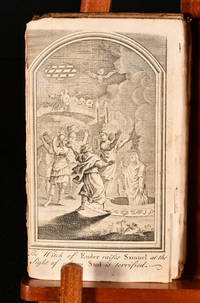
1772678L3Berwick: R Taylor c1772. First edition. Leather. Good Only. 7" by 4". Not Stated. A vanishingly scarce first edition of this occult work discussing first-hand accounts of witches ghosts and seers. Undated the ESTC reference T60882 speculates a publication date of 1775. However the front endpaper of this copy has a contemporary ownership inscription dated 1772. The prior owner's inscription is in neat copperplate and states a riddle that spells the name William. William Workman the prior owner has his stamp to the front endpaper and his monograph initials. 20th century inscription 'Geoffrey S Glover 1940' to the front free endpaper. With an engraved frontispiece. With the signatures: a6 A-L12 A very scarce work which is a collection of first-hand accounts of witches ghost encounters and tales of seers. These include an account of Rebecca Jones a witch an apparition to King James IV and his couriers the discovery of murder by an apparition and an account of a magician at Antwerp. There is also an eighteenth century account of the Pied Piper of Hamelin under the title of 'A marvellous prank played by the Devil at Hemelen a town in Germany'. In addition there is a short biography of John Faustus or Johann Faust the German magician and alchemist during the Renaissance. A fascinating collection of occult accounts. Published after the final execution for witchcraft in Britain and the implementation of the Witchcraft Act of 1735. Extremely scarce and in a bright condition. In a contemporary calf binding. Externally heavily rubbed to the spine and to the boards. Small loss to the head and tail of spine. Front board is detached but present. Rear hinge and joint are tender. Front endpapers and frontispiece are detached but present. Otherwise this work is generally firmly bound. Bottom outer corners of E2 and E3 have been removed by a prior owner only affecting the margin. Pages are generally bright. Occasional scattered spots to pages. Good Only R Taylor hardcover
1799641Venice: Appresso Giovanni di Antonio Zatta librajo all'insegna of Providence in Frezzaria 1799. Very Good. Bookplate of prior owner and also a signature of another owner on inside front cover. VERY GOOD condition wear to corners and edges some soiling. VERY RARE collection of political caricatures with French and Italian language. Appresso Giovanni di Antonio Zatta librajo all'insegna of Providence in Frezzaria unknown
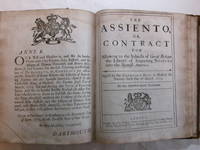
1713148771London : John Baskett 1713. 1st Edition . Hardcover. Good/No Jacket Issued. 4to - over 9¾ - 12" tall. FIVE WORKS IN ONE VOLUME original full leather hardcover with initials in gilt to front and rear cover Assiento double column Spanish and English privilege leaf 2 1-48pp some old staining to upper margins pages browned last page more so otherwise very good and complete. Treaty of Peace and Friendship84pp tear to margins of title page and first page without loss of text pages browned otherwise very good. Treaty of Navigation and Commerce 115pp pages browned otherwise very good.Treaty of Peace and Friendship Between The Most Serene and Most Potent Princess Anne and Most Potent Prince Philip the VTH.115 pppages browned otherwise very good. The Treatise of Peace and Commerce 40pp pages browned otherwise very good. Unusual illuminated inscription to flyleaf COVERS DETACHED In need of rebinding. WE CAN ONLY SHIP THIS ITEM WITHIN THE UNITED KINGDOM. We are a real bookshop with real books situated in and shipping from the United Kingdom. <br/> <br/> John Baskett hardcover
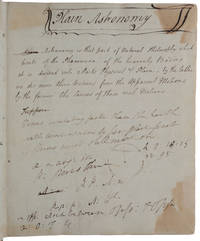
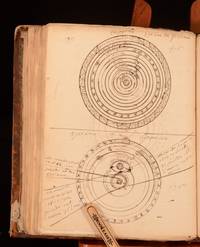
17805309N.p.: N.p. 1780. <p>A fascinating manual of astronomy particularly as it relates to the form of the motions of the heavens. The manuscript is in three parts: the first part covers the elementary parts of 'spherical astronomy' the second and third parts are more advanced covering sections of the Principia dealing with lunar theory and the inverse-square law of attraction. </p>. EIGHTEENTH-CENTURY MANUSCRIPT NOTEBOOK ON ASTRONOMY. <p>A fascinating manual of astronomy particularly as it relates to the form of the motions of the heavens dating from the period 1780-1825 probably from the beginning of that range. It is in a single hand with the exception of one page though with some variations indicating that different parts of the MS were written at different times. The MS could have been prepared for personal use or as part of public tuition probably the former. The writer summarizes the subject matter of the manual on the first leaf: 'Astronomy is that part of Natural Philosophy which treats of the Phenomena of the heavenly Bodies. It is divided into 2 Parts Physical and Plain: by the latter we discover their Motions from the Apparent Motions; by the former the Causes of these real Motions.' The MS is in three parts which are distinct in terms of subject matter. The first part covers the motion of the Earth around the Sun and its rotation about its axis with the consequences for the apparent motions of the Sun and the heavens; with the Moon and its phases and motion; and with lunar and solar eclipses. There are several references to John Keill's An Introduction to the True Astronomy London 1721 and subsequent editions. The second part principally consists of a discussion of section 11 of Newton's Principia 1713 or later editions in particular as it relates to the motion of the moon. This part ends with a short section on algebra particularly polynomials which seems to have been composed more haphazardly than the remainder of the text. The third part which runs backwards starting from the end of the notebook gives demonstrations of various results in Book I of Principia notably the theorem that the orbits of the bodies in the solar system do not precess if and only if the central attractive force operating on them is exactly inverse-square. This is an important result not only for Newton's system of universal gravitation but also for the observational astronomy of the solar system which is discussed in the opening section of the book. Between the end of the second part and that of the third there are a few blank leaves and others have been torn out but the text appears complete.</p> <br /> <p>The MS appears to be a working through of at least two different texts beginning with Keill's on astronomy. The first part of the MS refers particularly to the material in chapters 7-14 of Keill. It begins with the geometry of the sphere of the Earth and its orbit great circles and poles the plane of the ecliptic equinoctial points and the Tropics of Cancer and Capricorn. Then comes a section on the different systems of the world Ptolemaic Tychonic and Copernican illustrated by a diagram. The arguments supporting each system are given including the aberration of the fixed stars discovered by James Bradley in 1729 which supports Copernicus. It is noted that the Sun's apparent diameter varies according to the time of year which is explained by the fact that the Earth's distance from the Sun is not constant. Kepler's laws are stated with a long discussion of the area law and a statement that the Earth's orbit is an ellipse. The consequences of the fact that the plane of the Earth's orbit is inclined at an angle to the plane of the ecliptic are discussed the seasons. There is a section devoted to the precession of the equinoxes - the author notes that "Sir Isaac Newton has demonstrated that it arises from the broad spheroidal figure of the Earth." The author then turns to sunspots and the arguments for and against their being on the surface of the Sun. Then comes a long discussion of the planets: the planes and periods of their orbits phases conjunctions retrograde motions apparent brightness and their distances from the Sun. Special attention is given to the phases of Venus the varying appearances of Mars and Saturn's rings. This is followed by an extensive discussion of the Moon: its phases and motion and the fact that the same face is always turned to the Earth which implies that the Moon turns on its axis in the same time as it takes to orbit the Earth. This first part concludes with a fairly detailed account of lunar and solar eclipses.</p> <br /> <p>The second and third parts are notably more mathematical in nature than the first. The second works through Section 11 Prop. 66 of Principia and its corollaries which presents the perturbations of a remote body on a two-body system such as the Sun on the Earth-Moon system. This is one of the most difficult parts of Principia and one with which Newton was never completely happy and which is not entirely correct. The language used by the author of the notebook is reminiscent of the Principia but is primarily directed at following through Newton's working. There is a reference to a numbered figure '80' which does not appear to be numbered in any edition of the Principia. But it seems likely that the language and form of this discussion derives from familiarity with Robert Thorp's edition of Book 1 of the Principia 1777; cf. the notes published in Latin in 1765: pp. 266-90 in 1777 although Thorp is not referenced explicitly as Keill is. Thorp does have a figure 80 but it is not clear that he is the author being used at that particular point. There is then a discussion of algebra and the solution of equations which is fragmentary and incomplete followed by a number of blank and torn-out pages.</p> <br /> <p>The third part of the manuscript consists of a reading of various sections of Newton's Principia 1713 or later editions. Again it appears to take the form of working through and in some cases repeating the proofs of Newton's work rather than representing a translation or paraphrase. It is not based on Motte's translation nor does it correspond with the partial translation and edition of Thorp. It does not appear to be based on any other intermediary between Newton and the writer e.g. Pemberton but to rely on Newton's Latin original here rendered in places pretty exactly into English. It renders propositions 43 to 59 of section 9 of book 1 of the Principia which concern the motion of bodies in moveable orbits and the motion of the apsides. This is a topic which is still of some considerable interest to astronomers and historians of astronomy. Here Newton introduces what has come to be called Newton's 'rotating ellipse proposition' in which a rotating or precessing ellipse is described by a body for which the central force includes a term proportional to the cube of the distance from the focus; this rotating ellipse is compared with a similar stationary ellipse in which another similar body rotates about the same centre of force. Careful analysis leads to expressions for the extra inverse cube force depending on the number of upper and lower apses found in the moving ellipse. This part of the notebook includes the demonstration of the important proposition that the extra inverse cube force is absent i.e. the central force is exactly inverse-square if and only if the orbits of the bodies in the solar system do not precess.</p> <br /> <p>From the hand which seems constant throughout the book although with some considerable variation which might indicate a second writer or more likely the same writer at a different time or with a different pen and the paper we can with some confidence date the notebook to the period 1750-1825. If our supposition that it was Thorp's edition of Principia which was being used we might be able to narrow its date down to 1780-1825. The section of the planets in the first part does not mention Uranus Georgium sidus discovered by William Herschel in 1781 which appears to place this as an upper bound. This would therefore suggest a composition date in the late 1770s.</p> <br /> <p>We are indebted to Scott Mandelbrote for his assistance with the description of this notebook.</p> <br/> <br/> 4to 196 x 162 mm manuscript in ink on Dutch paper with Maid of Dort watermark without countermark. 101 and 26 leaves of text and diagrams 39 blank leaves in the middle last 26 leaves reversed illustrated with several astronomical and mathematical diagrams including one of a solar system. Late 18th century half calf marbled sides. N.p. unknown
1780EXP2-F-7Anon: Anon c1780. Leather. Good. 9" by 7". Anon. A unique handwritten volume covering predominantly Astronomy and the Use of Globes. Handwritten in a neat and legible hand across 400 pages numbered 1-90 and 1-300. Occasionally with blank page breaks but continuous numbering. An interesting specimen this volume contains exercises diagrams and notes on science geography and astronomy. Primarily focusing on the Use of Globes it contains four diagrams of celestial movements and pages of charts and lists relating to the planets and stars. Written in French with one passage in English describing the fixed stars of the Lion's Tale and Virgin's Spike. The first 90 pages are concerned with broader geography and written in a question and answer style. The second section contains explanations on the use of Globes both terrestrial and celestial and the information that can be gleaned from a practical application of this knowledge. Similar in style to 'Introduction to the Use of Globes' by W Field the text follows an instructive pattern whereby the information is transcribed and then applied to a series of problems. The author seems to have been working through Thomas Hood's 'The Use of both the Globes Celestial and Terrestrial' and making a practical collection of notes for personal or educational use. One section is titled 'Responses aux Questions de ''appendix qui est a la suite de l'introduction a l'usage des Globes par mr Molineux' that is 'responses to questions in the appendix to the introduction of the use of Globes by Molyneux'. Emery Molyneux was an English Elizabethan maker of Globes and his terrestrial and celestial globes were the first to be made in England. Though Molyneux published his own treatise on Globes entitled 'The Globes Celestial and Terrestrial Set Forth in Plano' it has now been lost. In the same year Thomas Hood published 'The Use of Both the Globes' which referenced Molyneux's works. Because of this we believe it is Hood's work to which the author of this manuscript is referring. The work has been dated based on the predictions of celestial movements made in the text up to the year 1800. In a full mottled calf binding wiith gilt detailing. Externally worn with loss to leather at extremities and spine. Worn spine label reading 'usage de globes'. Front pastedown with ridge as quirk of binding. Marbled endpapers and pastedowns. Personal label to front pastedown. Internally generally firmly bound. Approx 100 smaller pages bound in to front and 304 full sized pages follwoing 300 numbered. 2 pages loosening to rear block. Pages bright generally clean with marginal age toning and handling marks. Occasional scattered spots. Creasing to foredge. Good Anon hardcover
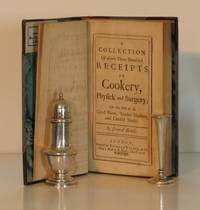
17147280London: For Richard Wilkin 1714. Octavo 19 x 12.5 cm. 16 218 13 pages. FIRST EDITION. “Mary Kettilby’s collection of cookery recipes and medicinal and home remedies from a tasty “green-pease soop without meat†to gooseberry wine. Households that could not afford French cooks or French cooking came to form a growing audience for books by women that contained unpretentious recipes cut to suit a less costly cloth for pickling and collaring rather than ragouts. Where Hannah Woolley had led plenty of female cooks with their eye on the profitable middle market followed with books like Mary Kettilby’s collection of recipes 1714 and Eliza Smith’s Compleat Housewife 1734†Colquhoun Taste: The Story of Britain through its Cookery 2015. Kettilby’s book purported to be a collective effort: the preface stating that ‘a Number of very Curious and Delicate House-wives Club’d to furnish out this Collection’. Maclean however pages 79-82 doubts this and notes that evidence from later editions indicate Kettilby to be the main author. Apart from the Preface there is no introduction of any sort: the recipes follow immediately after the chapter headings. The book is clearly divided into chapters of recipes for food and for remedies but within the chapters there is no definite structure. For example the first chapter begins with six recipes for soups followed by recipes for collared beef ‘French-Cutlets’ collared mutton stewed pigeons broiled pigeons dressed turbot and then patties ‘for a Dish of Fish’. The recipes are given either as goals as ‘To make Hogs-Puddings’ or as titles sometimes with descriptions as ‘A very good Tansy’. Quantities are given in whichever units are convenient as ‘a Gallon of grated Bread’ ‘three Pounds of Currants’ or ‘nine Eggs’. Often quantities rely on the cook’s judgment as ‘as much Sugar as will make it very sweet’. Temperatures and timings are given when necessary as ‘a cool Oven: Half an Hour bakes it’. Later binding in 19th century style. Half-calf gilt-decorated spine marbled endpapers. The front paste-down contains the bookplates of two significant culinary collections: Thomas Scruggs & Margaret Cook and Marian Hatch. The Hatch bookplate was designed and engraved by British engraver Alfred J. Downey. With the bookseller's ticket of Philip C. Duschnes to the rear pastedown. Ink ownership mark to half-title "1718 Eliseab; and inscription on final page of text "illeg. near New College Oxford". OCLC locates eighteen copies; Bitting page 258; Cagle 789; Maclean pages 79-82; Oxford page 54; Wellcome II page 389. For Richard Wilkin hardcover
17751758CAE-ANO-2-VGLondon: Vol 1-3: Henry Roberts & Vol 4: John Welcker 1775. Vols 1-4: 1st Editions. Very Good. <p>Rare and Important 18th century Song Books: Clio and Euterpe or British Harmony. Complete including the VERY RARE Vol IV.<br /> <br /> Vol 1: repaired with covers reattached spine laid down and new end papers.<br /> Vol 2: repaired with front covr reattached spine laid down and new end papers.<br /> Vol 3: repaired with spine laid down and new end papers.<br /> Vol 4: repaired with covers reattached spine laid down and new end papers.<br /> <br /> The first three volumes are complete with all 600 songs each page fully engraved and most with a quaint pictorial headpiece for each song. These were published by Roberts. The fourth volume its number written in ink on title page was published by Welcker who re-issued the trio and added this volume more diversified and with addition of violin. Most of its 112 pages are also illustrated. Also Vol IV retain the beautifully engraved trifold broadside "catalogue" for Welcker's music. Uniformally bound by Morrell London all edges gilt gold stamped turn ins. Spines repaired with original surviving leather and designs laid down. Most internal pages crisp and fine.<br /> <br /> </p> <br /> <p>Pages<br /> Vol 1: 218 <br /> Vol 2: 218 <br /> Vol 3: 218 <br /> Vol 4: 120 broadside</p> <br /> <p>Dimensions<br /> Vol 1: 9 x 5⅞ x 1<br /> Vol 2: 9 x 5⅞ x 1<br /> Vol 3: 9 x 5⅞ x 1<br /> Vol 4: 9 x 6 x ¾</p> . Vol 1-3: Henry Roberts & Vol 4: John Welcker unknown
1708000568Amsterdam: Pierre Mortier Librarie 1708. Hardcover. Very Good. 16mo 4 x 6.5 165 pages bound together with "Les Avantures d'Apollonius de Tyr" by Mons. Le Br. 130 pages. Tightly bound. Full Leather binding is intact but needs treatment appropriate oils/leather treatments mostly on the spine. Pages are foxed but supple remarkably well preserved for something that has existed for more than 300 years. Pierre Mortier, Librarie hardcover
1710000569Rotterdam: Jean Hofhout 1710. Hardcover. Very Good. 16mo 4 x 6.5 130 pages bound together with Journal Historique du Siege de la Ville et de la Citadelle de Turin l'Annee 1706 avec le Veritable Plan 165 pages. Interestingly there is a one page advertisement between the two: "Catalogue des livres nouvelles imprimees chez Pierre Mortier. Tightly bound. Full Leather binding is intact but needs treatment appropriate oils/leather treatments mostly on the spine. Pages are foxed but supple remarkably well preserved for something that has existed for more than 300 years. Jean Hofhout hardcover
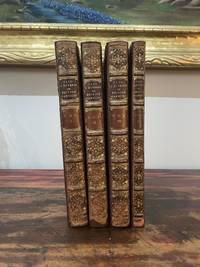
1788024356London: Printed for J. Walker 1788. Book. Very Good. Hardcover. First Edition. 12mo. A very good four volume set in contemporary full tree calf binding with double lettering pieces in red and green. Complete pp. iii-vii 1 222; 2 206; 2 238 & 2 198. No half-titles which may or may not be wanting but the pagination for the prelims to vol. I might suggest that one is required Very good bindings with a little rubbing a couple of volumes slightly chipped to the head/tail of the spines corners lightly bruised. Contents clean and tight manuscript Greek initials to title pages dated 1788 otherwise unmarked no foxing paper crisp. A very good set. A Rare Eighteenth Century Novel. We have managed to located just one other copy at auction in the last thirty years and that at Sotheby's sale of July 21 1993 where it made £1000 on the hammer though seemingly not such a nice copy. Referenced by: ESTC T068744. Printed for J. Walker Hardcover
1762778L27Cambridge: J Baskerville 1762. Leather. Very Good Indeed. 10" by 7". None. The scarce octavo Baskerville printing of this mid-eighteenth century 'Book of Common Prayer'. This book of Common Prayer was published the same year as a smaller format. This larger format is scarcer. Baskerville was an innovative type designer and printer. His typefaces were greatly admired by Benjamin Franklin. The Baskerville type is regarded as a transitional serif typeface intended as a refinement of the old-style typefaces of the period such as Calson. With 'Price Eight Shillings unbound' to the title page. ESTC reference no: T87227. Collated complete.A mid-eighteenth century edition of the common prayer and psalms published after a long period of taunt religious turmoil in England.'The Whole Book of Psalms' collected into English metre by Thomas Sternhold John Hopkins and others. Sternhold was an English courtier and was the principal author of this first English metrical rendition of the Psalms.With a table of a calendar containing table of lessons throughout the year guiding the reading on which prayers to read at morning and evening.Bookplate of R. H. S. Truell to the front pastedown. An important printing of the Book of Common prayer in a smart contemporary binding. In a full crushed morocco binding. Externally with light rubbing to the boards and to the raised bands. Fading to the gilt at the spine. Bookplate to the front pastedown R Mitford. Internally firmly bound. Pages are bright. Occasional light spots to pages. Very Good Indeed J Baskerville hardcover
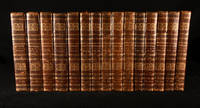
1798709L11London: G G and J Robinson J Johnson 1798. First edition. Leather. Very Good Indeed. 8.5" by5.5". None. A complete set of the biographical dictionary. A first edition thus published under the editorship and translator William Tooke. A New Edition of this dictionary but a first edition thus overall. The General Biographical Dictionary was first published in 1761 in eleven volumes with a supplement released in 1767. Tooke notes to the preface that 'though the work is apparently extended only by the addition of three volumes the actual augmentation is much greater'. Collated complete. A comprehensive study due to Tooke's capability to translate German French and Russian. Tooke was assisted in this work by William Beloe and Robert Nares. Tooke was a regular contributor to the Monthly Review and the Gentleman's Magazine. With entries on numerous important people including George Abbot Abraham Cowley William Cowper William Dampier Isaac Newton Nicholas Rowe Palladius Wiliam Shakespeare and Tobias Smollett. In a uniform half calf binding with paper covered boards. Externally generally smart. Some rubbing to the spines and boards. Small loss to the head and tail of spines. Internally firmly bound. Pages are bright with occasional scattered spots to pages. Very Good Indeed G G and J Robinson, J Johnson hardcover
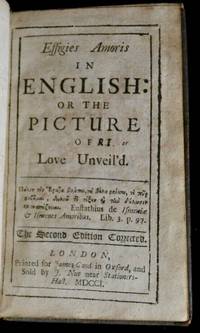
1701779Oxford: London : Printed for James Good in Oxford and sold by J. Nut i.e. Nutt London 1701. Second edition of the English translation by John Norton. ¶ Duodecimo; A-E12 F11 A1 half title present Bound in original full calf missing some leather from spine but cords are very strong. ESTC Citation No. N1243 415J. Some wonderful quotes for this book: <br /> <br /> The Answer of R. W. to his Friend importunately desiring to know what LOVE might be<br /> <br /> I Acknowledge the wanton Ty∣ranny of imperious Love that is always requiring the most diffi∣cult Trials of the Affections. Now though it be a kinde of an Hercu∣lean Labour it self to Love considering those severe duties those toyls and hazards appendant to it; as if Cruelty were its sole delight: Nevertheless we believe it reasonable what names so∣ever we have given to Love that he should exercise his Soveraignty which is certainly very great and puissant; and by the Severity of his Commands that he should augment the glory of his high Rule and our obedient Sub∣mission.<br /> <br /> "However this is the supreme Office of Reason to make a right choice of Disposition and Conditions; to choose a Companion with whom we are sure to live with more delight than with our selves; whose judgment we may be sure to follow as our own: or else to stay till we can finde a proper Ob∣ject of Love. Then also so to love like one who is guided by Judgment not carried away by Passion; like one so far from ceasing that he is always beginning to Love. This is to joyn Patience with Constancy. This is to receive the Idea more fairly imprinted in the Minde than in Wax and to preserve more stedfastly. 'Tis the Of∣fice of Vertue to determine upon one measure of wishing; to covet a dispo∣sition and inclination like his own through all the changes of Fortune; and so to make two of one that they may act the same person.". The "Amoris Effigies anon. London 1649 1664 1668 1671. In 1680 appeared a loose English translation by a Robert Nightingale which deviated in many points from the Latin original. John Norris under the pseudonym Phil-iconerus published a fresh translation London 1682; 2nd edit. 1701; In his introduction Norris wrote of Waring's "sweetness of fancy neatness of style and lusciousness of hidden sense".<br /> Waring also wrote Latin verses including in Jonsonus Virbius playwright Ben Jonson.1639 reprinted in the 1668 and subsequent editions of the Amoris Effigies under the title of Carmen Lapidorium." DNB. London : Printed for James Good in Oxford, and sold by J. Nut [i.e. Nutt, London] hardcover
1779mon0000064106T. Lowndes 1779. Hardcover. Very Good. in x in x in. T. Lowndes hardcover
1760720L5Cambridge: John Baskerville 1760. Leather. Very Good Indeed. 10" by 6.5". None. A finely bound early Baskerville edition of the Book of Common Prayer. This is the second Baskerville edition of this work. With seven shillings and six pence price at the foot of the title. The text is in double column within star and lozenge ornamental borders. ESTC reference no: T81393. With the signatures: a-b8 c4 B-P8 Q6 r-y4 z2 R-2C8 2D4 2E2 2F-2K4 2L2. Collated complete. Gift inscription to the verso of front endpaper addressed to Henry Pigeon of Clapham Common dated 1853. Possibly Henry Pigeon of the distilling family. Other owner inscriptions to this leaf Richard Carpenter Smith. A lovely edition of this important Anglican text. In a full straight grained morocco binding with gilt stamping to the spine and extremities. Externally very smart with light rubbing to the joints and extremities. Prior owners' inscriptions to the verso of front endpaper. Internally firmly bound. Pages are bright with occasional scattered spots to pages. Very Good Indeed John Baskerville hardcover
1794GT987London: William Lane at The Minerva Press Leadenhall -Street 1794. 1st Edition . Hardback. Vg. 12mo. 288pp last page incorrectly numbered 218. A very rare volume with only one printed copy traced but the title-page has no date but described as 1790 British Library. No copy appears in auction records. Hand-coloured by a child frontisplate and two full-page 'hand-coloured' 'cuts' as called for in the 'Directions for placing the cuts' page on the reverse of the title-page. Original tan full calf original binding with gilt rules to the spine. p70/71 leaf lower small corner lacking but not affecting the text. The covers are frayed and worn but intact.The spine label is worn away but the impress can be faintly observed. FULL TITLE . The pleasing companion; a collection of fairy tales calculated to improve the heart: the whole forming a system of moral precepts and examples for the conduct of youth through life: Containing Princess Hebe Graciosa and Percinet Story of Finetta Princess Carpilona The White Cat The Yellow Dwarf Pigeon and Dove Young and Handsome Ornamented with elegant cuts. <br/> <br/> William Lane at The Minerva Press, Leadenhall -Street hardcover
172654527A Bettesworth Bettersworth 1726-01-01. Leather Bound. Very Good. Small tooled leather bound volume first edition 1726 issue printed for A. Bettesworth at the Red-Lyon. Ink to second free front endpaper and first free rear endpaper. Text unmarked. Tight binding. First edition with half-title. 12mo. xii 184 8 pp Please email for photos. A Bettesworth [Bettersworth] hardcover
1788047296London: Printed for G. G. J. And J. Robinson Paternoster Row 1788. First Edition First Printing . Hardcover. Good. 8vo - over 7¾ - 9¾" tall. Octavo. 2 ii 4 xxviii 184 159 1 299 1 pages. Contains an early British printing of the United States Constitution Hardcover begins page 100 of the second section. Hardcover bound in original full leather with raised bands on the spine. Spine also has a burgundy lettering piece the date 1787 and rules in gilt. The binding is worn and rubbed. Front hinge is cracked and the rear hinge is starting. Removed bookplate from the front pastedown but an early simple paper bookplate bears the name "Robert Y. Hayne" and the title page has the signature of "Robt. Y. Hayne." The text of the book is toned and the text block is sound. Robert Young Hayne 1791-1839 was Governor of South Carolina 1832-1834 and was Mayor of Charleston 1836-1837. He was an ardent States Rights supporter. He died in Asheville North Carolina. This volume is notable for the inclusion of an early printing of the United States Constitution page 100 of the second section. This volume also includes George Washington's "Plan of a new Constitution of the United States of America agreed upon at a Convention held at New York." There is also "Dr. Ruston's Letter to Dr. Franklin on the Cure of Smoky Chimneys From Dr. Franklin's Philosophical and Miscellaneous Papers." Page 147 has the "History of Virginian Mountains. From Jefferson's Notes on the State of Virginia." <br/> <br/> Printed for G. G. J. And J. Robinson, Paternoster Row hardcover
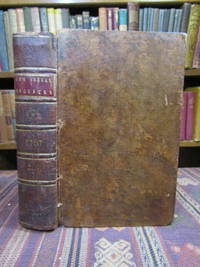
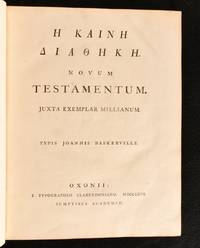
1763774L1Oxford; Oxonii: Clarendon Press; E Typographeo Clarendoniano 1763. First edition. Leather. Good Only. 11.5" by 9". None. The scarce first Baskerville edition of the New Testament. One of only 500 quarto editions produced by Baskerville. Printed in Greek and in Latin. The text of this New Testament mostly reproduces the text edited by John Mills which is one of the most famous eighteenth century Greek testaments. This Baskerville printing was issued in 4to and 8vo with 500 4to copies ordered and 2000 in 4vo. This is a bright wide-margined copy of this work. Bound with the half title. ESTC reference no: T94898. In need of a sympathetic rebind this copy remains extremely bright internally. In a contemporary full calf binding. The boards are detached but present. Loss to the head and tail of spine. Internally firmly bound. Pages are bright with just the odd spots. Good Only Clarendon Press; E Typographeo Clarendoniano hardcover
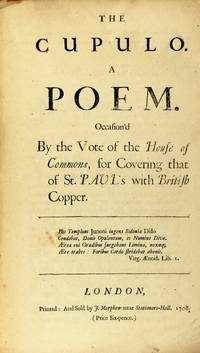
170851699London: printed and sold by J. Morphew 1708. Folio pp. 12; removed from binding; small withdrawn stamp at the base of A2 light soiling short tear at the top gutter; all else very good. Foxon C-541. Not found in CBEL or NCBEL. Apparently rare: ESTC locates only 3 copies: British Library Guildhall Library and the National Library of Scotland. OCLC adds Minnesota this copy and the only copy in America and the National Library of Sweden. COPAC finds three more: Manchester York and Leicester. printed and sold by J. Morphew unknown
1791278119United Kingdom: T Cadell 1791. Book. Good. hardback. hardback octavo bound in half calf and marbled paper covered boards and edges. Gilt title to spine. Lower hinge weak with board just attached.Tightly sewn with a text free of markings. The date at the foot of the final leaf has been excised. Foxing to the front endpapers and with one or two spots to the title page. The large folding map of North Africa by J Rennell has a short closed edge tear and is generally in very good order xvi 351pp. Scarce. . T Cadell Hardcover