830 résultats
CA09B-00189Progress. Collectible - Very Good. Moscow: "Progress" 1981. 2 Volume Set. 8vo hardcovers in slipcase. 238pp 226pp. Russian. Illustrations. Very Good set. Fair slipcase. French Artists Fauvism Books in Russian Inquire if you need further information. Progress hardcover
1997115551PRAMES S.A. 1997. Tapa dura. 2ª Mano. . Clasificación de los arboles 152 autóctonos y 38 introducidos sobre todo en jardineria corresponden esos 190 ejemplares a 67 especies de las cuales 40 son autóctonas. Cada arbol tiene su ficha y lugar donde se encuentra para su localización. Con mapa de carreteras desplegable de Aragon escala 1:300.000. Sobrecubierta con pequeña rotura reparada. . . . Tapa dura con sobrecubierta. 464 p.:il. col. ; 31x23 cm PRAMES, S.A. hardcover
DADAX026253780XMIT Press 2019-08-20. Illustrated. paperback. New. 6.00x0.42x9.00. Buy with confidence. Excellent Customer Service & Return policy. MIT Press paperback

2019x-026253780XMit Pr 2019. Paperback. New. 144 pages. 9.00x6.00x0.75 inches. Mit Pr paperback
ria9780262537803_inpPaperback. New. New Book; Fast Shipping from UK; Not signed; Not First Edition; N/A paperback
B9780262537803Paperback / softback. New. An in-depth examination of the novel ways young people support and learn from each other though participation in online fanfiction communities. paperback
A9780262537803Paperback / softback. New. An in-depth examination of the novel ways young people support and learn from each other though participation in online fanfiction communities. paperback
8Z-U3NB-2HRJPaperback. Very Good. FIRST EDITION Innsbruck: Tyrolia August 1946. Softcover in titled wraps. 160 pages plus b/w photo reproductions. The hard-to-find first issue of this interesting post-war German language arts and literature periodical. Minor soiling wear to covers toning to text else very good overall condition; no owner marking NOT EX-LIBRARY. p paperback
19752092902140305920Kodansha 1975. Soft Cover. Fine. Number of books: 1 Kodansha paperback
19512092902143900692Aoki-sha 1951. Soft Cover. Fine. Number of books: 3 Aoki-sha paperback
1988Q-0316049379Little Brown & Co 1988-06-01. Library Binding. New. In shrink wrap. Looks like an interesting title! Little Brown & Co unknown
19992111902153302531Kashiwashobo 1999. Soft Cover. Fine. Number of books: 1 Kashiwashobo paperback
19992090502124900596Kashiwashobo 1999. Soft Cover. Fine. The book is in fine condition. Kashiwashobo paperback
2083002115600848Kashiwashobo N.A. Soft Cover. Fine. Number of pages: 706p Size: 22cm Kashiwashobo paperback
BN83250Wege zu Giacometti <br/><br/> unknown
1972Q-2070361209Gallimard Education 1972-06-01. Pocket Book. New. New. In shrink wrap. Looks like an interesting title! Gallimard Education unknown
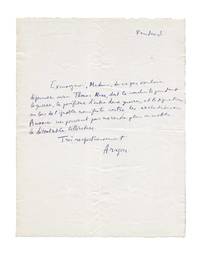
1950Aragon3<p><strong>ARAGON Louis 1897-1982</strong></p><p>Autograph letter signed "Aragon" to the "Red duchess" Elisabeth de Clermont-Tonnerre N.p.n.d 1950 1 p. in-4to</p><p><strong>Violent reproaches of Louis Aragon against Thomas Mann – The poet explains his hostility to the idea of meeting the German writer then on an official visit to Paris</strong></p><p><em>" <strong>Excusez-moi Madame de ne pas vouloir déjeuner avec Thomas Mann dont la conduite pendant la guerre le pacifisme d'entre deux guerres et la signature au bas de l'ignoble manifeste contre les exécutions en Russie ne peuvent pas me rendre plus aimable la détestable littérature. </strong></em> <em>Très respectueusement</em> <em>Aragon "</em></p><p><strong>Thomas Mann officially received in Paris in May 1950</strong></p><p>At the beginning of May 1950 Thomas Mann had begun a European lecture tour. On May 12 he arrived in Paris accompanied by his wife Katia. At the "Ritz" where his French publishing house has booked a suite they receive a very warm welcome. If during his stay in Paris which must have lasted a few days Thomas Mann could not see André Gide himself he spoke with Jean Schlumberger who had created with Gide La Nouvelle Revue Française. In the quick note he wrote for the bookseller Martin Flinker Mann mentions the "incredible beauty" of the capital of France and a French civilization at the "forefront of progress"… while confiding to his Journal his great fatigue and the aversion he felt for "the French linguistic sphere". He is indeed irritated by interviews that he considers malicious – such as that of Dominique Arban for Le Figaro who asks the author of Doctor Faustus if judging by his book it is possible to imagine a new Germany in which would have disappeared "the vertigo of obedience and blood". The interviewers' reminder of Paul Olberg's letter published in the Swiss newspaper Volksrecht also disturbs him to the highest degree. The Swedish journalist had indeed asked Thomas Mann how "he who had fought without concession Nazi Germany had been able to accept in 1949 the invitation of a regime that of the GDR which trampled underfoot with the same brutality freedom and humanity".</p><p><strong>Thomas Mann sensitive to communist propaganda</strong></p><p>At the end of the Second World War – after the election in 1945 of Harry Truman as President of the United States and until 1949 – Thomas Mann was sensitive like many intellectuals of the time to stalinist propaganda that presented the United States as an imperialist power ready to trigger a new conflict – and the USSR as concerned only with peace and the happiness of the peoples. Thus in March 1949 he supported the initiative of Harvard professor Harlow Shapley to convene in New York a world peace conference – directed against the Atlantic Pact finally signed on April 4 1949 – in which 24 delegates from communist countries participated in which Thomas Mann saw only "pure idealists". He telegraphed Dean Acheson the U.S. Secretary of State and father of the Marshall Plan to reconsider his ban on allowing other delegates from communist countries to enter American territory. Silent about the deportations and mass executions ordered by Stalin he does not miss an opportunity to protest against McCarthyism and "anti-communist hysteria" driven to this by his son Klaus and daughter Erika.</p><p>Thomas Mann still enthusiastically accepted the invitations – issued by the newly formed Federal Republic and the other part of Germany that would proclaim itself the "Democratic Republic" – to preside over the ceremonies given in July/August 1949 for the bicentenary of Goethe's birth first in Frankfurt West and Weimar East. Flattered by the honors that are rendered he wants to believe that it is only literature and does not want to see the instrumentalization to which he is the object of the communist leaders.</p><p><strong>Thomas Mann disappoints the Communists and abjures politics</strong></p><p>But soon after sensitive to criticism and becoming more far-sighted he refused to participate in the "World Congress of Supporters of Peace" which took place in Paris from 20 to 23 April 1949 under the patronage of Picasso with his famous "dove" and <strong>Aragon</strong>.</p><p><strong>Louis Aragon</strong>'s refusal to see Thomas Mann on the occasion of his official visit to Paris in May 1950 was thus explained by the hope aroused in the communist camp by some of his statements. The most prestigious German writer of the time an emeritus fighter of fascism since his American exile fundamentally hostile to the western part of Germany which he thought had not really got rid of Nazism represented a vector of propaganda of the highest order for the ideologues of communism. The spite felt by <strong>Louis Aragon</strong> and others following the defection of Thomas Mann is commensurate with their disappointment.</p><p>The many criticisms that Thomas Mann unleashed in the West helped to make him fully aware of the role that was intended to make him assume; this is how he declined the invitation to the 2nd Peace Congress organized in London from 13 to 19 November 1950. The English government banned Pierre Cot and Louis Aragon from entering British territory. The non-admitted delegates finally met in Warsaw. The organizers claim to have received a message of encouragement from Thomas Mann and even to have elected him to the office of the organization – which he firmly denies. In a scathing denial Thomas Mann says "he no longer wants to do anything with politics". All relations are permanently cut off.</p>
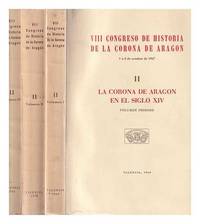
1969412913Valencia : Caja de Ahorros y Monte de Piedad de Valencia 1969. 1st edition. Softcover. Good copies in the original stiff-card wrappers; edges somewhat nicked slightly torn and dust-dulled as with age. Remains quite well-preserved overall. Physical Description; 3 volumes in 6. ; 24 cm. Contents; 1. Comisiones circulares discursos y crónica. 2. La Corona de Aragón en el siglo XIV 3 v. . 3. La Corona de Aragón en el siglo XVI 2 v. . Subjects; Aragon Espagne Histoire Congrès. Aragon Spain History Congresses. Conference papers and proceedings. History - Spain Aragon. Valencia : Caja de Ahorros y Monte de Piedad de Valencia paperback
8433927167.Gpaperback. Good. Access codes and supplements are not guaranteed with used items. May be an ex-library book. paperback
20023671817Madrid.: Mandala. 2002. Paperback. Good. 21 cm. 356 p. il. Encuadernación en tapa blanda de editorial ilustrada. Nuria Aragón Castro Sibila. Naturismo . ISBN: 8495052822 Higiene en general. Higiene y salud personal 613 Mandala. paperback
2006C93580Caja de Ahorros de La Inmaculada. As New. 2006. Hardcover. 8496007855 . FREE UPGRADE to Courier/Priority Shipping Upon Request - IN STOCK AND IMMEDIATELY AVAILABLE FOR SHIPMENT - FLAWLESS COPY BRAND NEW PRISTINE NEVER OPENED -- - Text in Spanish. 206 pages. Catalogue Raisonne Catalog Raisonné Complete Works Catalogo Razonado Obra Completa Raisonnee -- with a bonus offer-- - May be EITHER: out of print OOP and extremely rare in this pristine condition; signed by author or contributor; or a first or special edition; inquire for details . Caja de Ahorros de La Inmaculada hardcover
200693580Caja de Ahorros de La Inmaculada. New. 2006. Hardcover. 8496007855 . FREE UPGRADE to Courier/Priority Shipping Upon Request - IN STOCK AND IMMEDIATELY AVAILABLE FOR SHIPMENT - FLAWLESS COPY BRAND NEW PRISTINE NEVER OPENED -- - Text in Spanish. 206 pages. Catalogue Raisonne Catalog Raisonné Complete Works Catalogo Razonado Obra Completa Raisonnee Caja de Ahorros de La Inmaculada hardcover
196061678La Industria ValleCaucana 1960. Leather Bound. Used very good. IN SPANISH. Very Good Plus book in Good jacket. Very large hardcover bound in light blue leather gold lettering on front cover 1960 153pp; color and b&w photos of the region. Cover has no wear very lightly soiled by use covers bow out slightly; upper page edges somewhat soiled due to being dusty for a long time; sound binding; interior clean and unmarked. Jacket is rather thin paper moderate edgewear missing small chip at top of spine 1x2" chip at lower right corner of front panel; light rubbing 2x3" dampstain at top of spine. Overall very good condition. OVERSIZE. We provide professional service and individual attention to your order daily shipments and sturdy packaging. FREE TRACKING ON ALL SHIPMENTS WITHIN USA. La Industria ValleCaucana, hardcover
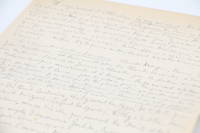
1948872391948. Fine. ""Nose in the air arms flying with nonchalance with joy as Willy Ronis says. black shoes a large hat a wasp waist skirt in the wind and not the slightest idea what all this could be for but all the sunshine of late April in the veil. and like Paris absurdly inimitable."" s. d. avril 1948 21 x 30 cm 4 pages sur 4 feuillets Exceptional complete autograph manuscript by Louis Aragon. 4 pages in pencil on 4 leaves numbered in his hand. Discrete trace of rust discharge on the first leaf and on the verso of the last. Horizontal fold across all leaves. The article would be published under the title ""L'Art de prendre une photo pour Les Lettres Françaises"" Regards May 14 1948. Aragon accompanies the great Willy Ronis during a photographic session for a fashion portrait for Les Lettres Françaises. Following in Ronis's footsteps as he directs his spinning model the writer takes us through four pages across an enchanting Paris where popular life and worldly elegance intermingle. ""The aim was to illustrate Le Nez au vent by Louis Chéronnet. The column's theme was: The Elegance of Paris is moving westward and more specifically focused on avenue Montaigne"" begins Aragon in his chronicle. For the duration of a day the writer documents with fascination the photographer's work in one of his favorite settings: the streets of Paris. Several tableaux unfold in succession in the Montorgueil quarter at the milliner's in Ronis's studio on avenue Montaigne at the Théâtre des Champs-Elysées. The key word for both Aragon and Ronis is movement. Photography is not static nor are Aragon's impressions. We jump like the model in the photographer's shots from one place to another. The portrait of the elegant woman expands under the writer's pen to her surroundings to the bubbling life of Paris that stops for an instant to contemplate the model's silhouette animated by the photographer's instructions. Sixty years later Ronis would remember that memorable day: ""Aragon had a very beautiful regard for photography. He knew what an image was. Elsa too. He had me work when he founded and directed Les Lettres françaises. I did several reports for him. The first small report was in 1947 or 48 a report on fashion on avenue Montaigne. Aragon came with me we had chosen a model. I was a bit intimidated by Aragon it was my first contact with him. I wanted to get the maximum from my model I was working very hard because I was nervous. Seeing me work amused him so much that he didn't write the report about the model but about me working. I had seen him quite many times afterward we used the familiar form with each other."" Willy Ronis interview in Libération September 14 2009 Their militant paths crossed on numerous occasions - Ronis contributed through his photographs to witness the social revolts that shook the 1930s while Aragon devoted many articles to them. In 1949 the photographer would follow the commemorative day of the Oradour-sur-Glane tragedy in which nearly 400 artists participated at Aragon's initiative. He would also be the author of beautiful portraits of the Aragon-Triolet couple. Excerpts from the manuscript: Willy Ronis had arranged to meet me at 10:30 at the corner of rue Tiquetonne and rue Montorgueil. Apparently he was photographing athletes there. Ah! it was that restaurant where in the past we used to go eat with Vaillant-Couturier and there were Action Française types who would shoot daggers at us with their eyes. Instead of athletes Willy was there in his velvet jacket with his spectacles taking shots left and right at the counter of a couple of lovers. Sweet the lovers. The little one especially. Perhaps it's a sport. . There is nothing more solemn than Caroline Reboux. It is the temple of hats. If he lived in our times this is where Aristotle would write. Caroline Reboux herself made the bonnets for Nana and Eugénie de Montijo; at her place Bel-Ami would twist h unknown
3388470413.Gpaperback. Good. Access codes and supplements are not guaranteed with used items. May be an ex-library book. paperback