[Broadside Ballad]Biblio.com
12 résultats
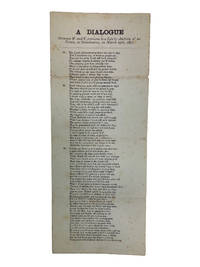
1877003678No Place: No Publisher 1877. Single sided printed ballad approximately 125mm x 315mm in size. Lightly foxed creased from old folds couple of minor nicks to edges at folds but fairly bright. A dialogue between W. and K. about a land sale where W. notes that K. has enough money to buy the land over the local lord. K. states that W. couldn't even afford the deposit and bemoans Radicals assailing his property rights. W. then advises K. that Death is at hand and he would do better to retire and marry a widow rather than a young maid as "It may be that the Lass for lucre's sake To the old Man may in appearance take But youth and beauty 'tis a shame to see Grafted upon an old and sapless tree". Swanbourne is in Buckinghamshire. Broadside Ballads Online: BOD628. First Edition. Unbound. Good. Folio. Broadside. No Publisher paperback
1894j2359aDurham: Thos Caldcleugh. G : in Good condition without dust jacket. Cover rubbed and soiled. 1894. First Edition. Brown hardback boards with blue cloth spine. 260mm x 200mm 10" x 8". 43pp. Line drawings by Rev. N Temple Hamlyn. A poem to celebrate the battle of Hedgely Moor in Northumberland in 1463. Dedicated to the Right Honourable Earl Percy - illustrations undertaken with his Lordship's permission. Illustrations include Alnwick Castle Chillingham wild cattle Eglingham and the armorial bearings of the Percys Nevilles and other noble families recounted in the ballad. . Thos Caldcleugh hardcover
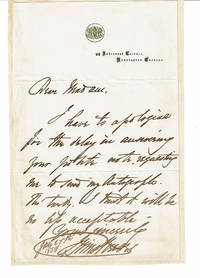
186896509Kensington Gardens January 27th 1868. 1868. Very good. - Approximately 32 words penned on his 7 inch high by 4-1/2 inch wide stationery embossed with his monogram and Kensington Gardens address. Replying to a request for his autograph Reeves writes "I have to apologize for the delay in answering your polite note requesting me to send my autograph." Signed "Sims Reeves" with the date penned within his signature's flourish. Once folded the letter is mounted with glue from the verso onto heavier stock clipped from an album. Very good. <p>Considered the foremost English operatic oratorio and ballad tenor vocalist of the mid Victorian era John Sims Reeves 1821-1900 received his early music education from his father who was a bass soloist in the Royal Artillery Band. He was appointed organist and choirmaster of North Gray church at the age of 14. He trained under Thomas Simpson Cooke first as a baritone and then a tenor while also learning to play several instruments. Kensington Gardens, January 27th, 1868. unknown
1826014495T. Davison, Whitefriars 1826. 1.Auflage Dieser Ausgabe Goldgeprägter Ganzlederband Gut, Schön, Solide
1860214168Glasgow: Printed for the Booksellers" 1860. No. 20 printed at foot of title. Title with woodcut vigentt of "Fair Rosanna". 8 pp. 1 vols. 12mo. Single sheet folded twice; unopened and unbound. A little dusty and wrinkled otherise very good. No. 20 printed at foot of title. Title with woodcut vigentt of "Fair Rosanna". 8 pp. 1 vols. 12mo. <br/><br/> Printed for the Booksellers" unknown
183029079London: H. Disley 1830. Good overall. That's Where You're Wrong' includes references to emigration to Canada a spirited revolutionary song: "Rise Britons rise and ring your voices thro' the land…"<br /> <br /> This is a broadside ballad were sold for half a penny or penny on the streets in London Manchester and other British cities during the 19th century. Once newspapers became more widespread and cheaper they largely displaced this type of street literature. Printed on cheap tissue paper they included religious warnings political arguments satire comedy bawdy tales crime news fantastic tales love and relationship advice and calls for social reform. In some cases the printer would suggest a familiar tune that would fit the lyrics provided. Most had a woodcut illustration although it may have been unrelated to the subject matter. Many broadside ballads in London were printed in the Seven Dials district. They were sold in large numbers on street corners in squares and at fairs by travelling ballad singers and also pinned on the walls of alehouses where they were sung and read. However because they were meant to be disposable presaging both the consumer culture and mass media relatively few have survived. 7 1/2 by 9 1/2 inches toned edges chipped fold line repaired. H. Disley unknown
1830TH262Nottingham: The Review-Office 1830. Original Ediiton . No Binding. Vg. Folio. Broadslip Ballad 32x13cms 12 3/4 x 5 inces. Attractive half page broadside with a fine and attractive printed border to the verses. Small woodcut to the head of the page depicting a printing press.NO COPY TRACED. Believed to be printed at Suttons Review Office in Nottingham and dated 1830. 8 four line verses extolling the press and reflecting on events of the year just gone.William IV had taken the throne and was welcomed as a Royal Navy sailor and a reformer. Charles and Richard Sutton printers and proprietors of the liberal Nottingham Review <br/> <br/> The Review-Office unknown
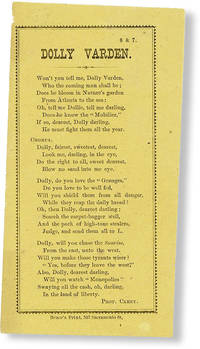
187048786San Francisco: Bruce's Print n.d. ca. 1870s. First Edition. Small broadside 16x8.5cm. printed within typographically decorative border on yellow stock. Miniscule loss at top left-hand margin else Near Fine. Printed at head of title "8 & 7."<br /> <br /> Reconstruction-era three verse ballad broadside addressed to Dolly Varden not /the/ Dolly Varden of Charles Dickens' novel "Barnaby Rudge" though the name was hugely popular as a result of the work and inspired a fashion craze and the name of a trout. The text makes mention of the 1872 Crédit Mobilier fraud; promotes the work of the Patrons of Husbandry "Dolly do you love the 'Granges' / Do you love to be well fed / Will you shield them from all danger / While they reap the daily bread"; and attacks the spread of carpet-bagging in the South "Search the carpet-bagger well / And the pack of high-tone stealers / Judge and send them all to L. Bruce's Print unknown
1827100140Paris, De l’Imprimerie de Crapelet, 1827. In-4, demi-veau vert à coins, dos à nerfs orné d’un décor doré. (quelques rares rousseurs éparses).
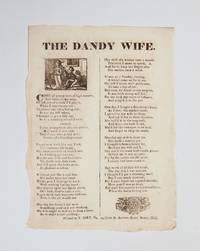
18285421London: T. Birt 1828. First edition. Single sheet measuring 250 x 185mm and printed in two columns to recto. Some edgewear to margins not affecting text; a bit of foxing and toning largely confined to margins. A scarce and delicate survivor OCLC documents only one example at the National Library of Scotland. The present is the only example on the market.<br /> <br /> The Dandy Wife is narrated by a man who aimed "to choose me out a loving wife" at the age of twenty-one but whose experience becomes a warning to "all young men of high renown": "If you want a tidy wife Beware of a boarding school." What unfolds is a satire of how the marriage economy is affected when women have access to knowledge -- intellectual and physical -- and how by meeting a man's superficial expectations a woman can fulfill her own more pressing needs.<br /> <br /> Thinking that a boarding school girl will have the innocence submissiveness and domestic skill he desires the narrator selects a wife from among their ranks. Thinking only of what he can obtain from such a bargain he is unprepared for what an educated woman brings into his house. The Dandy Wife he describes understands the commodity value of her own beauty and material adornment and that these are her key means for acquiring wealth of her own. "She takes one-half of what I earn In drinking gin and tea; Besides such frills and furbelows My Dandy Wife does wear.Her sleeves upon her dandy gown Oh! Lack they're such a size You'd think they were two balloons that in the air would rise." Aside from staying on par with fashion trends her clothing assists her in avoiding domestic tasks she abhors. She refuses to do laundry more than monthly and through ridiculous cooking failures she rapidly establishes that the kitchen is not a showcase for her skillset. Accustomed to a life of learning she is not trained to conduct domestic business. <br /> <br /> By the ballad's end it becomes clear that the Dandy Wife was savvier in managing a marriage than her husband was. For not only does her superior intellect help her carve out a more satisfying role but she also has physical knowledge that predates him: "The day that I was married I thought I'd got a charming maid But I was much deceived.For scarce five months we'd married been When she had a darling son. T. Birt unknown
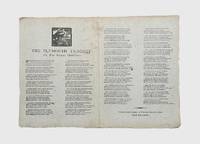
1809174972London: printed and sold by Jennings c.1809. A ballad telling a tragic tale of lovers tricked apart by "cruel" and "covetous" parents. Similar ballads often feature an unfaithful and avaricious antiheroine who suffers a cautionary downfall. Here however Susan is a "harmless maid" and it is families who are warned against prioritizing wealth over the happiness of the younger generation. The love triangle between a woman her husband and a sailor was a common trope in 17th- to 19th-century ballads but most had several key differences to this version. The woman was normally the one to prioritize financial gain unlike Susan who declares that "No wealth nor riches shall make me disloyal". The sailor was typically a demonic character sometimes the Devil in disguise whereas "sweet William" is an honest and faithful man. In most ballads only the woman dies while the sailor-demon escapes; both Susan and William perish here. Such entertaining ballads were an outlet for people "to voice tensions to work over the contradictions of human life" Gammon p. 237. The Plymouth Tragedy reflects an exasperation with the requirements on the young especially women to conform with their parents' desires at the expense of their own happiness. Single sheet 255 x 360 mm printed in columns. Woodcut vignette. A little nicked at edges old centre fold reinforced on verso with paper; overall a well-preserved copy of a fragile publication. Vic Gammon "Song Sex and Society in England 1600-1850" Folk Music Journal vol. 4 no. 3 1982. unknown
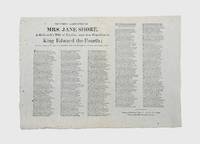
1810174973London: printed and sold by J. Pitts c.1810. An ephemeral broadside ballad detailing the story of Jane Shore a mistress of Edward IV and a popular cultural reference for many centuries. Shore's heavily fictionalized story featured many elements considered to have mass appeal in the era: a sexually voracious woman a relationship that transcended social hierarchies and an ending that punished transgressive behaviour. In Mrs. Jane Shore the eponymous character is described as a married woman who became King Edward's concubine and "lived in the court/With lords and ladies of great sort". Whilst she had influence over the King she ensured "to help the people that were poor" and "sav'd their lives condemned to die". Regardless her infidelity ultimately led to her social disgrace and she died in a ditch in East London. As detailed in the ballad urban mythology claimed that her unfortunate death gave the Shoreditch district its name. Ballads such as this were sung in a variety of communal spaces including pubs lodging houses and the streets and typically took criminal or socially deviant behaviour as their subject. In their own time broadside ballads were believed "to foster immorality and to glorify crime" O'Brien p. 16. More recent interpretations appreciate their literary and social value and consider that "their job was to voice tensions to work over the contradictions of human life" Gammon p. 237. Landscape single sheet 362 x 252 mm printed in columns. A little chipped at the edges but overall a well-preserved copy of a fragile publication. Vic Gammon "Song Sex and Society in England 1600-1850" Folk Music Journal vol. 4 no. 3 1982; Ellen L. O'Brien "'The Most Beautiful Murder': The Transgressive Aesthetics of Murder in Victorian Street Ballads" Victorian Literature and Culture vol. 28 no. 1 2000. unknown