57 résultats
2014108521Museum. New. 2014. Paperback. 0942949382 . FREE UPGRADE to Courier/Priority Shipping Upon Request - IN STOCK AND IMMEDIATELY AVAILABLE FOR SHIPMENT - Flawless copy brand new pristine never opened - -- with a bonus offer-- . Museum paperback
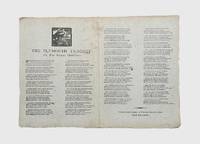
1809174972London: printed and sold by Jennings c.1809. A ballad telling a tragic tale of lovers tricked apart by "cruel" and "covetous" parents. Similar ballads often feature an unfaithful and avaricious antiheroine who suffers a cautionary downfall. Here however Susan is a "harmless maid" and it is families who are warned against prioritizing wealth over the happiness of the younger generation. The love triangle between a woman her husband and a sailor was a common trope in 17th- to 19th-century ballads but most had several key differences to this version. The woman was normally the one to prioritize financial gain unlike Susan who declares that "No wealth nor riches shall make me disloyal". The sailor was typically a demonic character sometimes the Devil in disguise whereas "sweet William" is an honest and faithful man. In most ballads only the woman dies while the sailor-demon escapes; both Susan and William perish here. Such entertaining ballads were an outlet for people "to voice tensions to work over the contradictions of human life" Gammon p. 237. The Plymouth Tragedy reflects an exasperation with the requirements on the young especially women to conform with their parents' desires at the expense of their own happiness. Single sheet 255 x 360 mm printed in columns. Woodcut vignette. A little nicked at edges old centre fold reinforced on verso with paper; overall a well-preserved copy of a fragile publication. Vic Gammon "Song Sex and Society in England 1600-1850" Folk Music Journal vol. 4 no. 3 1982. unknown
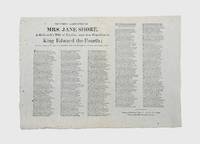
1810174973London: printed and sold by J. Pitts c.1810. An ephemeral broadside ballad detailing the story of Jane Shore a mistress of Edward IV and a popular cultural reference for many centuries. Shore's heavily fictionalized story featured many elements considered to have mass appeal in the era: a sexually voracious woman a relationship that transcended social hierarchies and an ending that punished transgressive behaviour. In Mrs. Jane Shore the eponymous character is described as a married woman who became King Edward's concubine and "lived in the court/With lords and ladies of great sort". Whilst she had influence over the King she ensured "to help the people that were poor" and "sav'd their lives condemned to die". Regardless her infidelity ultimately led to her social disgrace and she died in a ditch in East London. As detailed in the ballad urban mythology claimed that her unfortunate death gave the Shoreditch district its name. Ballads such as this were sung in a variety of communal spaces including pubs lodging houses and the streets and typically took criminal or socially deviant behaviour as their subject. In their own time broadside ballads were believed "to foster immorality and to glorify crime" O'Brien p. 16. More recent interpretations appreciate their literary and social value and consider that "their job was to voice tensions to work over the contradictions of human life" Gammon p. 237. Landscape single sheet 362 x 252 mm printed in columns. A little chipped at the edges but overall a well-preserved copy of a fragile publication. Vic Gammon "Song Sex and Society in England 1600-1850" Folk Music Journal vol. 4 no. 3 1982; Ellen L. O'Brien "'The Most Beautiful Murder': The Transgressive Aesthetics of Murder in Victorian Street Ballads" Victorian Literature and Culture vol. 28 no. 1 2000. unknown
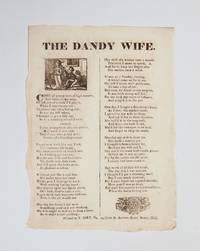
18285421London: T. Birt 1828. First edition. Single sheet measuring 250 x 185mm and printed in two columns to recto. Some edgewear to margins not affecting text; a bit of foxing and toning largely confined to margins. A scarce and delicate survivor OCLC documents only one example at the National Library of Scotland. The present is the only example on the market.<br /> <br /> The Dandy Wife is narrated by a man who aimed "to choose me out a loving wife" at the age of twenty-one but whose experience becomes a warning to "all young men of high renown": "If you want a tidy wife Beware of a boarding school." What unfolds is a satire of how the marriage economy is affected when women have access to knowledge -- intellectual and physical -- and how by meeting a man's superficial expectations a woman can fulfill her own more pressing needs.<br /> <br /> Thinking that a boarding school girl will have the innocence submissiveness and domestic skill he desires the narrator selects a wife from among their ranks. Thinking only of what he can obtain from such a bargain he is unprepared for what an educated woman brings into his house. The Dandy Wife he describes understands the commodity value of her own beauty and material adornment and that these are her key means for acquiring wealth of her own. "She takes one-half of what I earn In drinking gin and tea; Besides such frills and furbelows My Dandy Wife does wear.Her sleeves upon her dandy gown Oh! Lack they're such a size You'd think they were two balloons that in the air would rise." Aside from staying on par with fashion trends her clothing assists her in avoiding domestic tasks she abhors. She refuses to do laundry more than monthly and through ridiculous cooking failures she rapidly establishes that the kitchen is not a showcase for her skillset. Accustomed to a life of learning she is not trained to conduct domestic business. <br /> <br /> By the ballad's end it becomes clear that the Dandy Wife was savvier in managing a marriage than her husband was. For not only does her superior intellect help her carve out a more satisfying role but she also has physical knowledge that predates him: "The day that I was married I thought I'd got a charming maid But I was much deceived.For scarce five months we'd married been When she had a darling son. T. Birt unknown
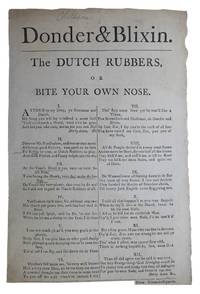
AQ25363London: Printed by W. & T. Bailey s.d. c.1785-1799 Single leaf broadside edges uncut. Shaving to foot with loss of imprint. A remarkably rare survival of 'three-half-pence' broadside verse satire in which a fight breaks out among a group of Dutchmen in a Chelsea tavern. The title of the bawdy ballad is a corruption of the Dutch expression 'donder en bliksem' meaning 'thunder and lightning'. ESTC records a single copy Oxford. ESTC N71592. Dimensions 200 x 290 mm. [Printed by W. & T. Bailey], [s.d., c.1785-1799] unknown
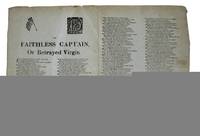
AQ31852London: J. Pitts s.d. c. 1820-44 Single leaf broadside edges uncut. Printed in four columns. With three woodcut vignettes. Old central vertical fold. A trifle creased and marked. A rare survival of a broadside ballad in which the captain of a ship bound for India discovers on board the young servant girl whom he had pledged to wed but then abandoned. He finds that she is carrying his child and though at first angered by her 'betrayal' agrees to marry. However 'fortune to them proves unkind' and a storm descends upon them sweeping the maiden into the sea. When the captain finds her body 'floating on the main' two days later he casts himself overboard to 'share the same fate'. The publishing house of John Pitts 1765-1844 was responsible for a prodigious output of cheap popular printing in the first half of the nineteenth-century. COPAC records copies at just two locations BL and Hull; OCLC adds two further Adelaide and Toronto. . Dimensions 360 x 250 mm. [J. Pitts], [s.d., c. 1820-44] unknown
Sven-Bertil JanssonNot in perfect condition. unknown
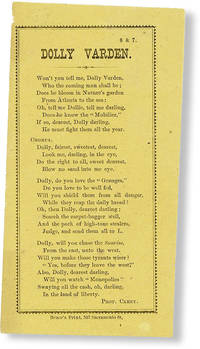
187048786San Francisco: Bruce's Print n.d. ca. 1870s. First Edition. Small broadside 16x8.5cm. printed within typographically decorative border on yellow stock. Miniscule loss at top left-hand margin else Near Fine. Printed at head of title "8 & 7."<br /> <br /> Reconstruction-era three verse ballad broadside addressed to Dolly Varden not /the/ Dolly Varden of Charles Dickens' novel "Barnaby Rudge" though the name was hugely popular as a result of the work and inspired a fashion craze and the name of a trout. The text makes mention of the 1872 Crédit Mobilier fraud; promotes the work of the Patrons of Husbandry "Dolly do you love the 'Granges' / Do you love to be well fed / Will you shield them from all danger / While they reap the daily bread"; and attacks the spread of carpet-bagging in the South "Search the carpet-bagger well / And the pack of high-tone stealers / Judge and send them all to L. Bruce's Print unknown
15906Early eighteenth century. Another later version published in the Gentleman's Magazine London May 1744. 2pp. on both sides of a strip of 35.5 x 11.5 cm laid paper with fleur-de-lys watermark. In a secretary hand employing the thorn and long s. In fair condition on aged and worn paper. An untitled forty-line poem divided into five numbered eight-line stanzas. The narrator is an older married woman advising a younger woman not to marry with observations on the frailties of the male sex. The first stanza reads: 'Ere ye. read ys. ye. may suppose. That some new listed Lover. By means of Poetry has chose. His Passion to discover. Know Faire one I am a Matron Grave Which Time & Care has wasted And would thy Youth from sorrow save Which I have in Wedlock tasted.' A variation of the poem was published in the Gentleman's Magazine May 1744 with the title 'The MATRON's Advice to a YOUNG LADY A new BALLAD. Tune Sally.' The grammar of the Gentleman's Magazine version is more modern in tone its first line reading: 'Ere you read this you may suppose' and the variations are most apparent in the third stanza including 'Beset thy dwelling' in the published version for 'Surround thy Threshold' in the manuscript; 'heedless' for 'regardless'; 'Pass all your minutes' for 'Thy Moments pass on'; 'While flames are offer'd at our shrine And Men like Idols sue us' for 'Darts flames & hoards adorn Our shrine And Awful Hymen woo us.' The writer has begun to write another poem on the reverse of the slip: 'Come lesten sic ye tories & jacobites now Your Plot <.> shew'. Not present in the English Broadside Ballad Archive. Early eighteenth century. [Another (later?) version published in the Gentleman's Magazine, London, May 1744.] unknown
20775Paperback. New. paperback
G1874312176I4N00Hisarlik Pr. Hardcover. Very Good. May have limited writing in cover pages. Pages are unmarked. ~ ThriftBooks: Read More Spend Less.Dust jacket quality is not guaranteed. Hisarlik Pr hardcover
40506New York: H. De Marsan n.y. Broadside. 6¼" X 10". Very good. Numerous edge chips along right side and bit on lower edge only slightly encroaching on decorative border. This crudely printed broadside ballad undated but circa 1861 includes a thick decorative patriotic border featuring red and blue stars and stripes olive-branch clutching American Eagle etc. with publisher's data "H. De Marsan Publisher / 54 Chatham St. / N.Y." at bottom center of border. Sung to the tune of "Marshal Ney" a popular tune celebrating the Napoleonic figure this Civil War tune celebrates the 69th New York Infantry Regiment the "Fighting Irish" or "Fighting Sixty-Ninth." Two stanzas and one chorus are featured the chorus reading: "Right and left -- left and right: / We fought the Rebels with all our might; / Brave CORCORAN did wounded fall / And HAGGERTY died by a Traitor's ball." Irish-born Michael Corcoran 1827-63 led the 69th at the First Battle of Bull Run in July 1861 in which he was taken prisoner and Irish-born Captain James Haggerty the first member of the 69th to die was reportedly killed by a Louisiana Zouave which also included many Irishmen. These "penny ballads" were all the rage during much of the 19th century and were invariably printed on thin delicate stock and sold by street vendors. A quite attractive example of this rare survivor. Inkstamped on verso is "Geo. F. Hambrecht" -- a well-known Civil War collector and noted Lincoln scholar 1871-1943 who founded the Lincoln Fellowship of Wisconsin and served as director of the Wisconsin State Board of Vocational Education. H. De Marsan unknown
1830TH262Nottingham: The Review-Office 1830. Original Ediiton . No Binding. Vg. Folio. Broadslip Ballad 32x13cms 12 3/4 x 5 inces. Attractive half page broadside with a fine and attractive printed border to the verses. Small woodcut to the head of the page depicting a printing press.NO COPY TRACED. Believed to be printed at Suttons Review Office in Nottingham and dated 1830. 8 four line verses extolling the press and reflecting on events of the year just gone.William IV had taken the throne and was welcomed as a Royal Navy sailor and a reformer. Charles and Richard Sutton printers and proprietors of the liberal Nottingham Review <br/> <br/> The Review-Office unknown
2013Jul18-2nd1284031594-8962Jones & Bartlett Learning 2013-07-23. Paperback. Good. US Edition Textbook May Have Highlights Notes and/or Underlining BOOK ONLY-NO ACCESS CODE NO CD Ships with Emailed Tracking from USA Jones & Bartlett Learning paperback
ria9781284031591_inpPaperback. New. New Book; Fast Shipping from UK; Not signed; Not First Edition; N/A paperback
183029079London: H. Disley 1830. Good overall. That's Where You're Wrong' includes references to emigration to Canada a spirited revolutionary song: "Rise Britons rise and ring your voices thro' the land…"<br /> <br /> This is a broadside ballad were sold for half a penny or penny on the streets in London Manchester and other British cities during the 19th century. Once newspapers became more widespread and cheaper they largely displaced this type of street literature. Printed on cheap tissue paper they included religious warnings political arguments satire comedy bawdy tales crime news fantastic tales love and relationship advice and calls for social reform. In some cases the printer would suggest a familiar tune that would fit the lyrics provided. Most had a woodcut illustration although it may have been unrelated to the subject matter. Many broadside ballads in London were printed in the Seven Dials district. They were sold in large numbers on street corners in squares and at fairs by travelling ballad singers and also pinned on the walls of alehouses where they were sung and read. However because they were meant to be disposable presaging both the consumer culture and mass media relatively few have survived. 7 1/2 by 9 1/2 inches toned edges chipped fold line repaired. H. Disley unknown
29078London. First line: "Have you heard of the rumpus there was I declare All the Popes in the world was in Belgrave Square…"<br /> With The Wonderful Crocodile. "Now list ye landmen all to me To tell you truth I'm bound What happen'd to me by going to sea…"<br /> <br /> According to Burl Ives this tune was based on an old Irish air. John and Alan Lomax collected it in Nova Scotia in 1921 from a man who said it was a song he'd known since he was a boy - "one of thoses that used to be roared out in the back rooms of taverns frequented by seamen forty or so years ago."<br /> <br /> This is a broadside ballad were sold for half a penny or penny on the streets in London Manchester and other British cities during the 19th century. Once newspapers became more widespread and cheaper they largely displaced this type of street literature. Printed on cheap tissue paper they included religious warnings political arguments satire comedy bawdy tales crime news fantastic tales love and relationship advice and calls for social reform. In some cases the printer would suggest a familiar tune that would fit the lyrics provided. Most had a woodcut illustration although it may have been unrelated to the subject matter. Many broadside ballads in London were printed in the Seven Dials district. They were sold in large numbers on street corners in squares and at fairs by travelling ballad singers and also pinned on the walls of alehouses where they were sung and read. However because they were meant to be disposable presaging both the consumer culture and mass media relatively few have survived. 7 1/2 by 10 inches. Edges slt ruffled o/w vgc. unknown
2010Viva-9780763791285JONES & BARTLETT LEARNING 2010. Paperback with Sewing. New. JONES & BARTLETT LEARNING paperback
6873'Printed and Sold by J. Pitts No. 14. Great Saint Andrew Street Seven Dials'. Printed on one side of a piece of rough laid paper approximately 24.5 x 8.5 cm. Crude circular woodcut of pedlar at head diameter 3.5 cm. Good on aged paper with a little creasing at head and foot. Consists of four four-line stanzas with refrain 'Doodle doodle doo.' First stanza heavy with double-entendre reads 'HEAV'N bless my dearest little dear The wind is not quite fair From Portland Road I write this here - Oh! bless your little hair. Doodle doodle doo.' Clearly refers to a high society Regency scandal possibly that concerning the Duke of York and Mary Anne Clarke. Not listed in Shepard's Short-List. Excessively scarce: no copy on COPAC. Image on application. 'Printed and Sold by J. Pitts, No. 14. Great Saint Andrew Street Seven Dials,' unknown
20397795-nnew. unknown
20397795like new. unknown
6139015286.Gpaperback. Good. Access codes and supplements are not guaranteed with used items. May be an ex-library book. paperback
6202156104.Gpaperback. Good. Access codes and supplements are not guaranteed with used items. May be an ex-library book. paperback
1860214168Glasgow: Printed for the Booksellers" 1860. No. 20 printed at foot of title. Title with woodcut vigentt of "Fair Rosanna". 8 pp. 1 vols. 12mo. Single sheet folded twice; unopened and unbound. A little dusty and wrinkled otherise very good. No. 20 printed at foot of title. Title with woodcut vigentt of "Fair Rosanna". 8 pp. 1 vols. 12mo. <br/><br/> Printed for the Booksellers" unknown