Woolf VirginiaABAA

533 résultats
19217367London: The Hogarth Press 1921. First Edition one of 1000 copies. 8vo; 91pp; one page of ads for other books by The Hogarth Press. Black and white illustration on front panel white panel on back brick-colored cloth spine. Some minor rubbing to black and white illustration on front panel endpapers browned some offsetting from woodcuts to text page opposite as usual and even so noted in Kunitz & Haycraft p. 1549 else fine housed in brick-colored cloth with brown morocco spine clamshell box. Illustrated with four original woodcuts by Vanessa Bell. Hand set and letterpress printed by McDermott at The Prompt Press Richmond. A lovely fresh copy.<br/>Virginia Woolf 1882-1941 English novelist essayist and critic married the political theorist Leonard Woolf in 1912 with whom she established the Hogarth Press. MONDAY OR TUESDAY was the first Hogarth Press title to be included in the Annals of English Literature 1475-1950. It was Woolf's "break out" book and it was noted that with this collection of short stories Mrs. Woolf "emerged definitely with the liveliest imagination and most delicate style of her time." Vanessa Bell 1879-1961 elder sister of Virginia Woolf was herself a talented artist. She designed a number of dust jackets for books published by her sister's press as well as illustrating the books. In her art she attempted to break the bonds of restrictive Victorian norms. She and the other members of the Bloomsbury group made significant efforts to introduce the French avant-garde to an English audience. Bell's art often decorative and especially in the period represented in this book owes much to Bonnard Vuillard and Matisse. The Hogarth Press unknown books
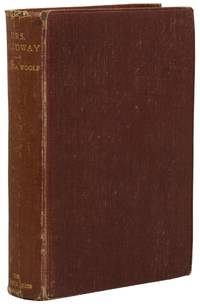
1925140941364London: The Hogarth Press 1925. First Edition. Good. First British edition first printing. Bound in publisher's brick-red cloth with covers ruled in blind and spine lettered in gilt; lacking the scarce dust jacket. Good with fading and rubbing to cloth with ear at spine ends. and corners. Former owner name and date to front free endpaper. Browning to endsheets. Lacking front free endpaper preliminary pages fragile at gutters hinge exposed at recto of rear free endhseet. Pages toned occasionally foxed with several short edge tears. The author's best-known work which follows a day in the life of Clarissa Dalloway as she prepares to host a party later that evening. The Hogarth Press unknown books
192630821London: Hogarth Press 1926. First edition. Small folio original vellum-backed boads with pink paper dust jacket printed on the spine only. Small chips from the jacket extremities not affecting the lettering a fine copy in near-fine jacket. An unnumbered copy from the British issue of 450. 710 copies were printed in all of which 260 were used for the Harcourt Brace edition. Kirkpatrick B5; Woolmer 86. <br/><br/> Hogarth Press hardcover books
19314119London: The Hogarth Press 1931. First edition. Fine/Near Fine. A Fine pristine book in Near Fine jacket on account of some toning to the spine trivial wear at the corner and some offsetting to the inner front flap. Internally fresh bright and clean. A pleasing copy in the iconic jacket designed by Vanessa Bell.<br/><br/>"'I am writing to a rhythm and not to a plot' Virginia Woolf stated of her eighth novel The Waves. Widely regarded as one of her greatest and most original works it conveys the rhythm of life in synchrony with the cycle of nature and the passage of time. Six children -- Bernard Susan Rhoda Neville Jinny and Louis -- meet in a garden close to the sea their voices sounding over the constant echo of the waves that role back and forth from the shore. The subsequent continuity of these six characters as they develop from childhood to maturity and follow different passions and ambitions is interspersed with the timeless and unifying chorus of nature.The Waves is Woolf's searching exploration of individual and collective identity" Parsons. A demanding and beautiful read The Waves was hailed as a masterpiece in its own time. "The book is as it were a piece of subtle penetrating magic. The substance of life as we are accustomed to seeing it in fiction is transposed and the form of the novel transmuted to match it.A glittering rain of impressions and reactions" Contemporary Times Literary Supplement. Fine in Near Fine dust jacket. The Hogarth Press unknown books
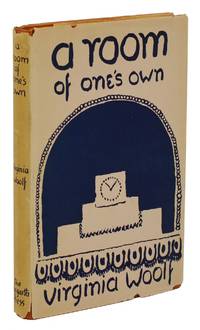
1929140938658London: The Hogarth Press 1929. First Edition. Near Fine/Near Fine. First edition first printing. Publisher's original cinnamon cloth covered boards with titles in gilt on spine. Near Fine with pages toned offsetting to endsheets and a small nick to the top edge of the front board. In a Near Fine dust jacket with toning to the spine light edge-chips and a 3-inch split started at the bottom of the front spine joint. A very lovely copy of Woolf's feminist essay which proclaims "a woman must have money and a room of her own if she is to write fiction. The Hogarth Press unknown books
1937VW117London: The Hogarth Press 1937 First edition first printing. Publisher's jade cloth lettered in gilt; in the original cream pictorial dust jacket designed by Vanessa Bell with an illustration of a rose surrounded by a repeating-circle design in black and brown. About fine with the spine ends lightly bumped else very tight and fresh; in a fine unclipped dust jacket with none of the usual toning. Overall an exceptionally bright copy free of any repairs or restoration. Housed in a custom folding case. Kirkpatrick A22a Woolmer 423. Simultaneously the last novel to be published and the most widely read during the author's lifetime The Years traces the history of the members of the Pargiter family from the 1880s to the 1930s. While the plot spans 50 years the text is more a collection of vignettes each of which represents a single moment of a given year. The Years began as a lecture Woolf gave in 1931 to the National Society for Women's Service. Building upon the issues generated in her previous novel A Room of One's Own 1929 she wanted to take a broader view of women's social and economic lives. The Years began as a series of essays with each followed by a novelistic passage; in the end only the novelistic passages were included and the essays were collected as Three Guineas 1938. First Edition. Hard Cover. Fine. Illus. by Bell Vanessa. London: The Hogarth Press hardcover books
192930439London: Hogarth Press 1929. First trade and first English edition. Cinnamon cloth a fine copy in a near-fine dust jacket with a little fading and spotting. Cloth case. Kirkpatrick A12b; Woolmer 215b. <br/><br/> Hogarth Press hardcover books
193030489London: Printed and Published by Leonard and Virginia at The Hogarth Press 1930. First edition. Copy 240 of 250 numbered and signed in purple ink by Virginia Woolf hand printed by the Woolfs from type set by Virginia. This is one of the preliminary state copies with the limitation notice corrected from 125 to 250 copies. Original vellum back green cloth sides marbled endpapers in fine condition. The dust jacket designed by Vanessa Bell shows mild wear and fading lacks small chips from the back panel and top of the spine. Neat ownership signature dated 1933. Kirkpatrick A14; Woolmer 245. <br/><br/> Printed and Published by Leonard and Virginia at The Hogarth Press hardcover books
19392425London: np 1939. First edition. Framed. Fine. THE MOST CELEBRATED PHOTOGRAPH FROM VIRGINIA WOOLF'S LAST SITTING WITH A PROFESSIONAL PHOTOGRAPHER; GISÈLE FREUND'S PHOTOGRAPHS FROM THIS SITTING ARE THE ONLY COLOR PHOTOGRAPHS EVER TAKEN OF WOOLF. "Woolf was acutely self-conscious and disliked sitting for pictures never mind 'seeing herself'. But a few rare portraits often by her family or friends capture her inner spirit. Freund's images taken just before the outbreak of war in 1939 are extremely valuable for not only are they unique in showing Woolf in her London home but they are in colour. Freund pioneered colour photography and made portraits of James Joyce Samuel Beckett Aldous Huxley and many other writers.<br /> <br /> "Freund was twice refused admission to Tavistock Square but eventually Woolf succumbed. She agreed to change her clothes to see which best suited the colour harmony. In some of the prints Woolf is pale and lined in others smiling a little and more youthful. The background of fabrics and mural panels by Bell and Grant adds to the value of the images; this was the inner sanctum of the queen of Bloomsbury where parties were given and friends came to tea. Just over a year later the house was destroyed in the blitz but for some time mural panels were left hanging on the wall open to the weather as recorded later by the Woolfs' friends Stephen Spender and William Plomer as the last vestiges of a disappearing world." Richard Shone "Portraits of Virginia Woolf: here the true face of the modern writer" The Guardian 20 June 2014.<br /> <br /> "Freund who was closely associated in Paris with Sylvia Beach her bookshop Shakespeare & Company and its visiting authors including James Joyce specialised in photographs of writers. Indeed it was Joyce who suggested that she should add to her collection by going to London. He assured her that if English writers knew she had photographed him and that he was pleased with the results they would readily agree to sit for her. This proved correct and she successfully photographed T.S. Eliot Elizabeth Bowen George Bernard Shaw Vita Sackville-West who also provided her with a letter of introduction Herbert Read and Peggy Guggenheim Victoria Ocampo and Hugh Walpole.<br /> <br /> "Virginia Woolf however initially turned her down. That is until Victoria Ocampo the wealthy Argentinian founder and publisher of the literary review Sur whom Woolf admired turned up at Tavistock Square with Freund in tow in order to show Woolf contact sheets of the literary men and women Freund had photographed.<br /> <br /> "Under pressure Woolf gave in and a sitting was arranged for later that same day. Woolf 's diary written before the afternoon session commenced reveals much irritation: 'No getting out of it with Okampo sic on the sofa & Freund there in the flesh. So my afternoon is gone in the way to me most detestable and upsetting of all.' Freund had recently begun working with colour film which had just come on to the market and Woolf dreaded becoming a 'life-sized life coloured animated photograph' yet it pleased her that at her request Leonard would also be photographed.<br /> <br /> "She left no account of this sitting but we can deduce from details supplied by Freund and from other clues that it was an unexpected success. Perhaps Woolf 's dread was removed by Joyce's message or Vita Sackville-West's introductory letter for the photographs show that she willingly collaborated: in fact she offered to show Freund her wardrobe so that she could help choose the most suitable clothes and three times changed her blouse and once the jacket she was wearing.<br /> <br /> "At one point she proudly informed Freund that there had been a celebrated photographer in her own family and she brought out a copy of the book that the Hogarth Press had published of Julia Margaret Cameron's photographs with essays by herself and Roger Fry and this she inscribed to Freund.<br /> <br /> "Out of this session came some of the most eloquent photo-portraits of Woolf ever produced. They vary in mood as outward composure gives way to melancholy introspection. They are also the only colour photographs of Woolf ever taken. For technical reasons it was not possible to publish them in colour at the time and for many years they were known only in black-and-white format.<br /> <br /> "After a bomb had sliced open the house in October 1940 and destroyed the better part of this room the decorations on the fireplace wall could be seen from the street below a fragile reminder of a different age a different way of life." Frances Spalding "The last photograph of Virginia Woolf" The Telegraph July 9 2014. <br /> <br /> Size: 8x12 in. 21x30 cm. Framed: 17x21 in. 43x53 cm.<br /> <br /> Chromogenic print. Taken June 1939; printed later likely c.1970s. Signed by Freund on back beneath Freund's stamped address and credit. Freund's blindstamp at bottom right of image. Elegantly framed with archival matting and UV-protecting museum glass. <br /> <br /> A stunning image in fine condition. np unknown books
1930109901Sm. San Francisco: The Westgate Press 1930. Sm. slim 8vo iv 34 pp. Original purple quarter morocco and boards backstrip lettered in gilt backstrip refurbished. Internally as new. § Limited edition signed in purple ink by Virginia Woolf on the colophon page. Presentation copy inscribed by David Magee in pencil “Copy X presentation copy†of 500 signed copies in all. Pencil note by Magee in the back also states that this is “one of a few copies bound in half purpleâ€. In Street Haunting Woolf intertwines the act of walking through a city with the movements of the imagination with echoes of Mrs Dalloway published two years earlier. In the essay "the narrator explores this imaginative act of dipping in and out of people’s minds as they move through the city’s wintry twilight streets. From prime ministers to the homeless the narrator examines the city’s inhabitants and the spaces they occupy. ‘What greater delight and wonder can there be than to leave the straight lines of personality’ the narrator asks to feel ‘that one is not tethered to a single mind but can put on briefly for a few minutes the bodies and minds of others’." The British Library.The essay was first published in the Yale Review October 1927. Kirkpatrick A13 states: "The essay was not published separately in the United Kingdom. It was reprinted in The Death of the Moth and Other Essays and in Collected Essays Vol. 4." The Westgate Press hardcover books
1931300451London The Hogarth Press 1931. 1931. First edition so stated. 8vo. Original purple cloth is vibrant and not faded. Dust jacket unclipped; four small chips. Very good-fine. No foxing. No signatures or bookplates. Connolly 100. Woolmer 279. 1st Edition. Hardcover. Very Good/Very Good. London, The Hogarth Press, 1931. hardcover books
1925140940735New York: Harcourt Brace and Company 1925. First American Edition. Very Good/Very Good. First American edition first printing. Bound in publisher's orange cloth with paper title label on spine printed in brown. Very Good with light fraying to cloth at crown light spotting to covers. Glue repairs to front and rear inner hinges previous owner names to front free endpaper. In a Very Good original dust jacket designed by Woolf's sister Vanessa Bell. The jacket was once pasted to the pastedowns leaving a glue mark to them and to the blindside of the flaps. Otherwise the jacket is rather presentable with light chipping and toning a small stain to the top edge of the rear panel and a chip to the top of the front panel which has been reattached with Japanese tissue from the blindside. The author's best-known work which follows a day in the life of Clarissa Dalloway as she prepares to host a party later that evening. Harcourt, Brace and Company unknown books
1932309445Athens 1932. 2 pp. recto and verso of single sheet of blue stationery. Oblong 8vo. Very pale spotting but fine. Matted and framed with photographic portrait. 2 pp. recto and verso of single sheet of blue stationery. Oblong 8vo. 'The proofs of my article have reached me here I am returning them corrected'. In part: "The proofs of my article have reached me here I am returning them corrected. I have checked the verse quotations from memory. I think that they are correct but I have not the books with me & as we shall not be back till May 17th or so I fear I cannot wait to compare them with the text. The names of the authors in order of quotation W.H. Auden/ numbers 123 & 4; John Lehmann 5; Day Lewis 6; W. Empson 7. I do not want the names to be quoted but I see you say that they are only for your own use."<br/>The article in question is "Letter to a Young Poet" addressed to John Lehmann which was originally published in the Yale Review for June 1932. It was brought out in a separate edition by the Hogarth Press later the same year. unknown books
1935309444np 1935. 2 pp. on single sheet of blue Tavistock Square stationery. 8vo. A small area of adhesion a file hole and a small chip at the bottom. Matted and framed. 2 pp. on single sheet of blue Tavistock Square stationery. 8vo. A tactful rejection letter from Woolf writing here in her role as publisher of the Hogarth Press to her literary acquaintance Logan Pearsall Smith 1865-1946. In part: <br/>"With reference to the essay charming as it is I am afraid that it would be of no use for us to attempt to publish it. The public appetite for separate essays seems to be exhausted so far as I am concerned so we have had to bring our essay series to an end. And even if we tried the experiment of beginning another series with your essay the fact that you are so soon going to include it in your book of essays would we fear be fatal drawback ."<br/>The Hogarth Press had published Smith's Stories from the Old Testament in 1920. unknown books
1915312644London: Duckworth & Co 1915. First edition. 458 pp. 6 16 ads pp. 8vo. Publisher's moss-green cloth boards spine lettered in gold upper cover ruled and lettered in black. Some wear cloth rubbed particularly at extremities with minimal loss. Housed in quarter black morocco-backed clamshell box. First edition. 458 pp. 6 16 ads pp. 8vo. KA COX'S COPY OF VIRGINIA WOOLF'S FIRST BOOK. Signed "Katharine Cox/ March 1915" on the front free endpaper. Ka Cox later Katharine Arnold-Forster and Virginia Woolf first met while spending a weekend in Oxford in 1911. The women were immediately drawn to each other and Cox became almost a member of the Bloomsbury household. Woolf appeared to have been particularly intrigued by Cox's love affair with Rupert Brooke at Newnham where she became a Neo-Pagan. After both their marriages Cox married labour politician Will Arnold-Forster the friendship seems to have cooled. Katharine however remained devoted to Virginia throughout her life. Kirkpatrick and Clarke A1a Duckworth & Co unknown books
191930438Richmond: Hogarth Press 1919. Second edition. One of 500 copies printed for the Hogarth Press by Richard Madley. Woodcuts by Vanessa Bell. Original hand painted wrappers; Leonard Woolf thought this paper was not from the Omega Workshops but copied by someone else from the papers used for the first edition. Light wear to the edges. Coth case. This was the first Hogarth Press publication to be printed by a commercial printer. Kirkpatrick A3b; Woolmer 7. <br/><br/> Hogarth Press unknown books
1925140941189London: The Hogarth Press 1925. First Edition. Near Fine. First edition first printing. Bound in publisher's brick red cloth; lacking the dust jacket. Near Fine with light wear at extremities slight fading to cloth at spine. Pages lightly toned. Front and rear free endsheets offset from binder's glue and light tape burns there as well. A lovely copy of one of Virginia Woolf's best-known works published by Virginia and Leonard at their Hogarth Press. The Hogarth Press unknown books
1914309447Richmond 1914. 1 p. pen and ink on single sheet of "17 The Green Richmond" stationery. 8vo. Fine. Matted and framed. 1 p. pen and ink on single sheet of "17 The Green Richmond" stationery. 8vo. A letter from Woolf to her brother-in-law and integral member of the Bloomsbury Group Clive Bell 1881-1964 dated only three months before the publication of Woolf's first book The Voyage Out 1915 and reading in part: <br/>"My dear Clive You will be bored by these perpetual demands - We rather think of spending a week at Marlborough at Christmas . I seem to remember that you once told me of some in the high street or other pleasant part. If you could put the name one a post card we shd. be grateful . It seemed divine country."<br/>Virginia and Leonard Woolf had just moved to Richmond in October. It was either just before or just after Christmas that they discovered Hogarth House which would become their home and the base of operations for the Hogarth Press for the decades to come. unknown books
1928140941165New York: Crosby Gaige 1928. Signed Limited First Edition. Near Fine. Limited first edition. Copy 114 of 861 copies signed by Virginia Woolf. Bound in publisher's original black cloth with spine decorated in gilt. Near Fine. Light fading to spine cloth and light edge wear. A lovely copy. Crosby Gaige unknown books
1915140940247London: Duckworth & Co 1915. First Edition. Trial Binding. Very Good. First edition first printing. iv 458 6 16 ads pp. The author's first book. Bound in what appears to be a publisher's trial binding: dark blue cloth triple ruled in blind on upper board with spine lettered in gilt and decorated with floral device in blind; lacking the dust jacket. J. Kirkpatrick notes a similar apparition appearing almost three-quarters of a century ago in A Bibliography of Virginia Woolf "a copy in red cloth lettered in gold on the spine and on the upper cover with the floral device and motto in blind on the lower cover was advertised in Raphael King Ltd's catalogue No. 52 1951 and is now in the Robert H. Taylor Collection Princeton University Library. It is probably a trial binding." In contrast the usual binding is green cloth with the spine lettered in gilt and paneled title block in black to upper board. Very Good. Lean to binding. Small faint stain to front cover. Spine lightly rubbed at ends slightly faded and gilt dulled. Top edge dust-soiled. Foxing to textblock edge preliminary terminal pages. Woolf began writing her first novel in 1910 and completed several drafts before its publication in 1915. It was a difficult five years for Woolf in which she suffered from bouts of depression and a suicide attempt but the final work contained seeds of what would later become her trademark: an innovative narrative style a focus on feminine consciousness sexuality and death. Duckworth & Co unknown books
1927304361927. Lady Sackville Vita Sackville-West's mother was then living at the Hotel Metrople in Brighton. Woolf writes "About Vitas new book-- I will certainly do my best to make her choose the title you want . but as far as I know she has not yet begun to write it . I shall remember your wishes and drop them tactfully into her ears". Woolf then suggests that Lady Sackville write her Memoirs for the Hogarth Press "Nothing could be more interesting. We would publish it with lots of pictures". The recipient has annotated the envelope "asking me to write my life and publish it through the Hogarth Press!!! I refused of course". With a 1982 letter from Nigel Nicolson Lady Sackville's grandson presenting the letter to a house-guest he remarks "If the illiterate crazy old lady which Lady S. had become in 1927 had accepted Virginia's offer what would the Press have done with the nonsense she produced" <br/><br/> unknown books
19291062408vo. New York/London: Fountain/Hogarth Press 1929. 8vo 159 pp. Original brick-red cloth with gilt titles. A near fine copy in a folding case. Bookplate of Stuart Schimmel on front paste down signature of Robert Hunter on front free end paper. § First edition large paper issue number 116 of 492 copies signed by Woolf in her customary purple ink on the half title. A classic of feminist literature in which Woolf considers the past and present barriers to women writers in a patriarchal culture and which originated as lectures given by Woolf at two women’s colleges in Cambridge. "A woman must have money and a room of her own if she is to write fiction." Fountain/Hogarth Press hardcover books
19301508125London: Hogarth Press 1930. Limited Edition. Hardcover. Near Fine/Very Good. Limited Edition. Octavo. 35 pages. Hand-set by the author. Hand-printed by the author and Leonard Woolf. Decoration by Vanessa Bell. Marbled endpapers. Partially uncut pages. Parchment-backed cloth. Number 80 of 250 copies signed by the author. Near fine in a very good dust jacket housed in a custom-made slipcase. London: Hogarth Press hardcover books
1930108111London: Hogarth Press 1930. Limited Edition. Hardcover. Fine/Fine. The Hogarth Press London. 1930. First edition. Octavo. 35 pages. Hand-set by the author. Hand-printed by the author and Leonard Woolf. Decoration by Vanessa Bell. Marbled endpapers. Parchment-backed cloth. Number 49 of 250 copies signed by the author. Fine in a fine dust jacket housed in a custom-made quarter-leather folding case. London: Hogarth Press hardcover books
192062New York: Doran 1920. First Edition. Hardcover. Near fine/very good. 1st American edition of her second book mining Shakespeare's As You Like It. Near fine edges slightly faded in a very good jacket faint shadow of a number on the spine edgetears and corner chips but no repair and for this jacket more pleasing than doing good in secret and being found out by accident. In answer to Albee's question I'm afraid of Virginia Woolf. There's not enough space here and I'm not smart enough nor enough of a researcher to tell you much about her you don't already know but I'll take my shot at stepping into the shoes of a great lady and externally considering her for a paragraph attentive to outside events that invaded her inner peace and twisted her life all because no one ever told her that detachment is the sure and only road to serenity She was entitled. Her mother was a Pre-Raphaelite model so she got her babeness by gene. Her father was a Sir of letters with a gigantic personal library and as a result her home-schooled education was an erudite exhibition of late Victorian society the way of the mouse symbolic of industry in quiet places. At 13 her mother died and she crumpled into a her first nervous breakdown. She was 18 when the 20th century arrived so she regrouped laced her shoes tight and like most of her generation met it teeming with hope. But in the background fate was already icing the stairs and during the 20th century's first decade the dull were full of themselves and the bright were full of doubt so the wealth of the empires amassed over 5 centuries was trashed in the woodchipper of W. W. I. Virginia reeled but she knew that a part of every process is only discipline so she buffed-up with the competence of stout feminist instincts and the resolve of The Little Engine That Could became an exalted author and publisher surrounded herself with a circle of brilliance and pursued ideas for their own sake. Then the depression flipped her out and W. W. II shook the ground beneath her feet and a German bomb flattened her house and the pressure inside her spirit began to build you can hide the fire but you can't hide the smoke and like the pressure in the atmosphere she didn't sense it but it was still there at 15 pounds per square inch and mistaking feeling for thinking the undiagnosed bipolar she guessed that 59 was old enough and that coping might be the mesh through which real life escapes so she spit the bit channeled her inner Billy Joe McAllister donned an overcoat filled the pockets with stones walked into the River Ouse and never came back. Doran hardcover books