Desnos, Louis CharlesBiblio.com

587 résultats
1766101196<p>Engraved map slight outline coloring decorative rococo boarder with landscape style cartouche 12" x 10.7". Decent margins but bottom margin a little narrow minor aging light pencil notation in right margin; overall in excellent condition with a very strong impression. While the interior of the map doesn't show a substantial amount of geographical detail this appears typical of the period. There are some large rivers and lakes that are identified. The Nile appears to rise from two small lakes in the Mts de la Lune above the Equator. In the south there aren't a lot of places named but there are still some tribal names present.</p>
176667669Paris: c.1766. A fine and handsome map of the British Isles with an inset of Orkneys and Shetland islands and a very ornate title cartouche. The map is flanked by informative text in French pertaining to the British Isles.The map is surrounded with a very pleasing "framed" effect border decoration. Published in the "Atlas Generale Civil et Ecclesiastique". Size: 390 x 575 mm. Copperplate engraving with later hand colour. Good condition. unknown
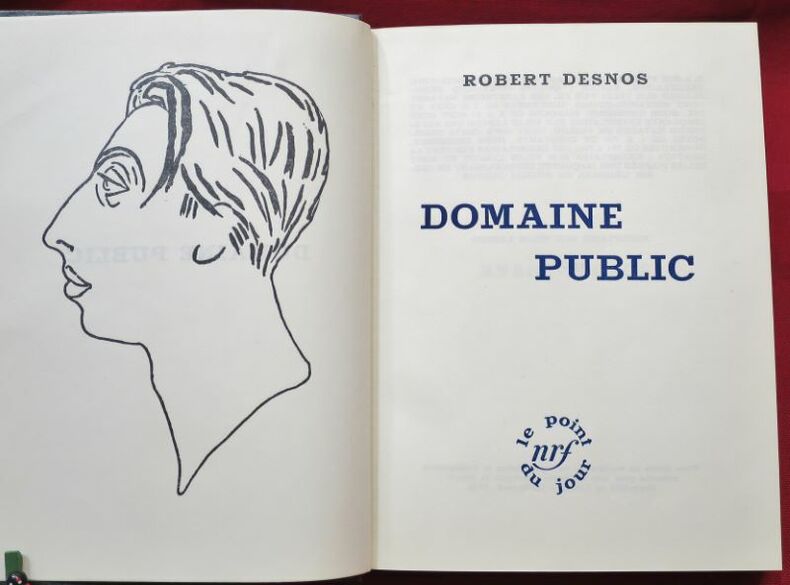
111006Le Point du Jour, 1953, 1 volume in-12 de 195x135 mm environ, 420 pages, reliure d'après une maquette reproduisant un dessin original de Robert Desnos sous rhodoïd et étui cartonné. Edition originale, Exemplaire N° 627, un des 700 exemplaire sur vélin Labeur. Etui insolé avec début de fente sur l'ouverture, sinon bon état.
10361 En feuillets, sous couverture imprimée rempliée d'édition, chemise et étui (traces d'usure sur ces derniers). Non coupé. 28,5 x 23 cm, [2]-88-[8] p. + hors-texte. Paris, Les Treize Epis, 1947.
10361 En feuillets, sous couverture imprimée rempliée d'édition, chemise et étui (traces d'usure sur ces derniers). Non coupé. 28,5 x 23 cm, [2]-88-[8] p. + hors-texte. Paris, Les Treize Epis, 1947.
ORD-11780Récits inédits. Eaux-fortes de Lucien Coutaud. Paris. Les 13 Épis. 1947. Edition originale. In-4 (228 x 284mm) en feuilles sous couverture à rabats imprimée en rouge et noir, chemise et étui carton lie de vin, 88, (2) pages, 4 eaux-fortes hors texte, léger report d'ombre sur les gardes, emboîtage un peu fatigué sinon très bel exemplaire exempt de rousseurs. Edition originale, tirée à 330 exemplaires, n°280/315 Lafuma.
193080872Calmann Lévy | Paris 1930 | 22 x 27.50 cm | broché
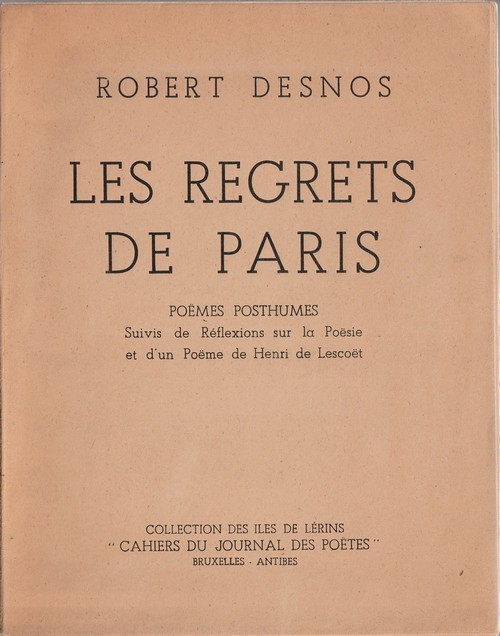
194721184Bruxelles / Antibes, Collection des Îles de Lérins / Cahiers du Journal des Poètes 1947. In-8 broché de 24 pages au format 16 x 20,5 cm. Couverture avec titre imprimé. Dos carré très légèrement, comme les bords et mors du 4ème plat. Intérieur frais. Exemplaire non coupé. Tirage unique, numéroté à la main, à 118 exemplaires sur papier Satiné des Îles ( n° 57 ), après 12 sur Bristol de Hombo. Superbe état général. Rarissime édition originale de ces poèmes Posthumes suivis de " Réflexions sur la Poésie " et d'un poème de Henri de Lescoët.
1761273345Paris: Louis Charles Desnos 1761. unbound. Copper plate engraving with original hand color. Image measure 14.25" x 20.75".<br/><br/> This lovely 1761 map by Claude Buy de Mornas depicts the Nile Delta in northern Egypt. The map presents the science arts and monuments of Egypt and as such does not identify cities towns or other locations. Includes illustrations of pyramids pharaohs and a labyrinth. The city of Memphis is labeled and mountains are rendered in profile. Along the left and right is French text and the whole is surrounded by a beautiful floral border.<br><br>The notable feature of this map is the mapping of the large Lake Moeris. Today a small lake named 'Birket Qarun' near modern day Hawara appears at the location of Lake Moeris. Nearby is the legendry 'Labyrinth'. The lost Labyrinth appears in many classical texts including those of Herodatus Strabo Diodorus and Pliny. Described to be megalithic complex designed by Imandes for the Pharaoh Amenemhet III the Labyrinth is believed to have contained thousands of rooms filled with hieroglyphs and ancient Egyptian sculptures. Herodotus wrote about it in the fifth century B.C.: <br><br>" Furthermore they resolved to leave a memorial of themselves in common and in pursuance of this resolve they made a labyrinth a little above Lake Moeris and situated near what is called the City of the Crocodiles. I saw it myself and it is indeed a wonder past words; for if one were to collect together all of the buildings of the Greeks and their most striking works of architecture they would all clearly be shown to have cost less labor and money than this labyrinth. Yet the temple at Ephesus and that in Samos are surely remarkable. The pyramids too were greater than words can tell and each of them is the equivalent of many of the great works of the Greeks; but the labyrinth surpasses the pyramids also. It has 12 roofed courts with doors facing one another 6 to the north and 6 to the south and in a continuous line. There are double sets of chambers in it some underground and some above and their number is 3000; there are 1500 of each. We ourselves saw the aboveground chambers for we went through them so we can talk of them but the underground chambers we can speak of only from hearsay. For the officials of the Egyptians entirely refused to show us these saying that there were in them the coffins of the kings who had built the labyrinth at the beginning and also those of the holy crocodiles. So we speak from hearsay of these underground places; but what we saw aboveground was certainly greater than all human works. The passages through the rooms and the winding goings-in and out through the courts in their extreme complication caused us countless marvelings as we went through from the court into the rooms and from the rooms into the pillared corridors and then from these corridors into other rooms again and from the rooms into other courts afterwards. The roof of the whole is stone as the walls are and the walls are full of engraved figures and each court is set round with pillars of white stone very exactly fitted. At the corner where the labyrinth ends there is nearby a pyramid 240 feet high and engraved with great animals. The road to this is made underground.<br><br> Such was the labyrinth; but an even greater marvel is what is called Lake Moeris beside which the labyrinth was built. The circuit of this lake is a distance of about 420 miles which is equal to the whole seaboard of Egypt. The length of the lake is north and south and its depth at the deepest is 50 fathoms 300 feet. That it is handmade and dug it itself is the best evidence. For in about the middle of the lake stand 2 pyramids that top the water each one by 50 fathoms 300 feet and each built as much again underwater; and on top of each there is a huge stone figure of a man sitting on a throne. So these pyramids are 100 fathoms 600 feet high and these 100 fathoms are the equivalent of a 600-foot furlong the fathom measuring 6 feet or four cubits the cubit being six spans. The water in the lake is not fed with natural springs for the country here is terribly waterless but it enters the lake from the Nile by a channel; and for 6 months it flows into the lake and then another 6 it flows again into the Nile. During the 6 months that it flows out it brings into the royal treasury each day a silver talent for the fish from it; and when the water flows in it brings 20 minas a day."<BR><BR>Despite many archelogical surveys being conducted at site no evidence of the Labyrinth has been confirmed till today. The French text along the sides also includes a brief description of the Labyrinth. <br><br>The map appears in the 1761 edition of "Atlas Methodique et Elementaire de Geographie et d'Histoire" published by Louis Charles Desnos. The map is in good condition with minor wear along the original centerfold and minor spotting. Some edge wear. Stain in lower margin not affecting printed image. Original plate mark is visible. <br><br>Louis Charles Desnos 1725 - 1805 was a cartographer and globe maker from Paris France. He was the Royal Globe Maker for the King of Denmark Christian VII and published a large number of maps during his time.<br/><br/> Louis Charles Desnos unknown books
1958008970Paris Aux dépens d'un Amateur pour M. Lhermine 1958 In-4 En feuilles
1947005900Paris Les 13 épis 1947 En feuilles, couv. rempliée
29664Paris, Édition Chronique du jour. Sommaire N° 2, 1er mai 1938, in-4, broché, 51-[1] pp. Deuxième numéro de cette célèbre revue illustrée d'une lithographie en couleurs d'imagerie cinghalaise. Paris, Edition Chronique du jour. Sommaire N° 2, 1er mai 1938. Un volume in-4, broché, 51-[1] pp. Deuxième numéro de cette célèbre revue illustrée d'une lithographie en couleurs d'imagerie cinghalaise.
22Les 13 Epis, éditeur. 1947. In-4° en feuilles sous étui-chemise et emboîtage. 60 pp. E.O. tirée à 325 exemplaires numérotés. 1/300 sur pur fil.
1929TransitionStories_EJ_1929<p>New York: Walter V. McKee 1929. First edition first printing. Octavo 19 x 13cm. xii 356pp. Bound in black cloth and decorative boards with a design by Albert Schiller spine stamped in red issued with a dust-jacket designed by Irving Politzer. A Near Fine copy in a Very Good unclipped dust-jacket. Light shelf-wear and soiling to extremities; shallow chipping to head and tail of wrapper.</p><p>This historically significant anthology gathers experimental works from the first thirteen issues of "transition" magazine one of the most influential little magazines of the 1920s. Founded by Eugene Jolas Maria Jolas and Elliott Paul "transition" advocated the "metamorphosis of reality" through artistic expression and provided a platform for a new internationalist modernism. Included here as "A Muster from 'Work in Progress'" are seven excerpts of drafts for James Joyce's yet unnamed "Finnegans Wake" textual excerpts which were revised for this printing and again for publication in 1939.</p> Walter V. McKee hardcover
101981Georges Bataille Paris, secrétaire général Georges Bataille, 271x216mm, (8),64p. numérotées de 185 à 248, broché sous couverture typographique
19481459Paris Maeght éditeur, 1948. In-folio (380 x 280 mm) en feuilles, 8 pages. 8 LITHOGRAPHIES ORIGINALES EN COULEURS PAR JOAN MIRO in-texte. Texte de Tristan Tzara "Joan Miro et l'interrogation naissante", Jean Cassou, Raymond Queneau, Paul Eluard, Ernest Hemingway, C. Zervos, G. Limbour, R. Desnos, P. Loeb, D.-H. Kahnweiler, etc. TIRAGE ORIGINAL RARISSIME. (Cramer 16)
101984Georges Bataille Paris, secrétaire général Georges Bataille, 270x217mm, (8),56p. numérotées de 233 à 278, broché sous couverture typographique.
2021x-3030565025Springer Nature 2021. Hardcover. New. 294 pages. 10.98x8.27x0.80 inches. Springer Nature hardcover
ORD-3101Paris. N.R.F. Le point du jour. 1953. In-8 (143 x 192mm) broché, sous jaquette imprimée, 420 pages. Edition en partie originale. 1 des 85 du tirage de tête sur vélin pur fil Lafuma. Bel exemplaire exempt de rousseurs.
1975A Paris, Chez Desnos Ingénieur-Géographe & Libraire de sa Majesté Danoise, 1771. In-12, broché.
9728Textes de René Daumal, Pierre Minet, Michel Leiris, Robert Desnos, Francis Picabia, Ramón Gómez de la Serna, Jean Giono, Giorgio de Chirico Photographies de Germaine Krull, Luis Buñuel, Man Ray. 1/200 de tête sur vélin pur chiffon. Rare sur ce papier. Bel exemplaire.
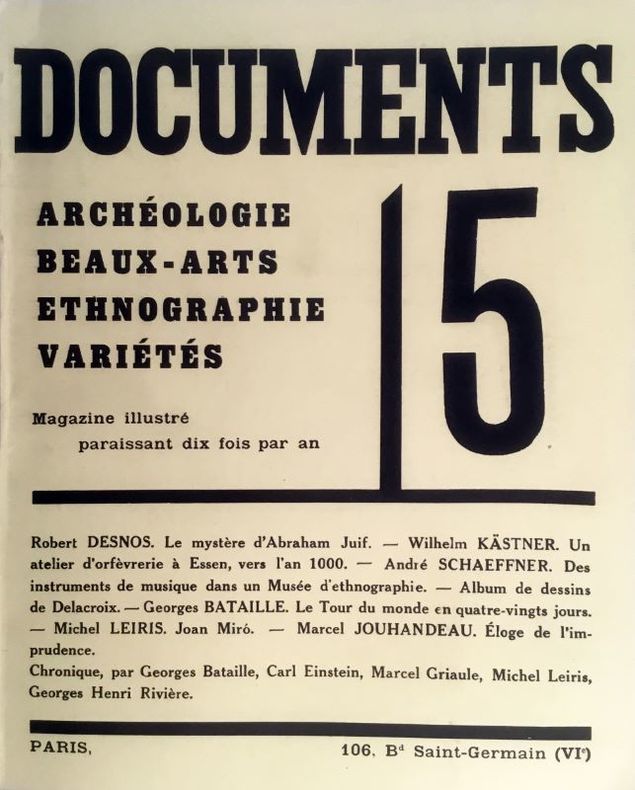
9885DOCUMENTS. " Doctrines - Archéologie - Beaux-Arts - Ethnographie " puis (à partir du n° 4 de 1929) " Archéologie - Beaux-Arts - Ethnographie - Variétés ". " Magazine illustré paraissant dix fois par an ". Paris (39, rue La Boétie, puis (à partir du n° 5 de 1929) 106, boulevard Saint-Germain). Secrétaire général : Georges Bataille. In-4° broché. Environ 70 pages par numéro (pagination continue d'un numéro au suivant). Impression sur papier couché. 15 numéros ont paru en 15 livraisons, d'avril 1929 à [automne] 1930. La première année (1929) compte 7 numéros ; la seconde année (1930) en compte 8. (Destribats, 292) /// Georges Bataille crée DOCUMENTS après sa rupture avec le mouvement surréaliste (et surtout avec André Breton de façon personnelle). C'est la première revue que Bataille - enclin aux communions et aux uvres collectives - dirige. DOCUMENTS s'oppose au surréalisme par son anti-idéalisme. Il instaure un nouveau rapport aux savoirs et aux images. Il propose une approche transversale des arts et des savoirs et réunit des disciplines habituellement étrangères les unes aux autres. Cela donne lieu à des rapprochements inattendus et lumineux. L'objectivité scientifique, suggérée par la neutralité du titre DOCUMENTS, a ses limites : la revue est pleine des thèmes obsessionnels qui fondent l'uvre de Bataille. Déjà point en certaines de ses pages ce qui deviendra, en 1937, le Collège de Sociologie. /// L'image occupe une place importante dans la revue DOCUMENTS. Reproductions d'uvres d'arts primitifs voisinant avec celles d'artistes d'avant-garde, documents ethnographiques, images en décalage ou en rapport critique avec le texte qu'elles illustrent, rapprochements inattendus d'images complémentaires, images curieuses ou délibérément choquantes. La photographie est mise en valeur : le papier couché de fort grammage favorise son impression ; la reproduction à pleine page est fréquente et lui donne une grande puissance. Jacques-André Boiffard est le photographe attitré de la revue. Ses photographies sont extraordinaires. Eli Lotar aussi collabore à DOCUMENTS. En novembre 1929, dans le n° 6, paraissent ses photographies devenues les plus célèbres - celles qu'il fit aux abattoirs de la Villette pour illustrer l'article " Abattoir " de Georges Bataille.
42746Nrf.4 Avril 1930.E.O.Ex.n°:608.Petit in-8 br.191 p. BE.Infimes piqùres.Rectangle découpé en haut,à droire du faux-titre.
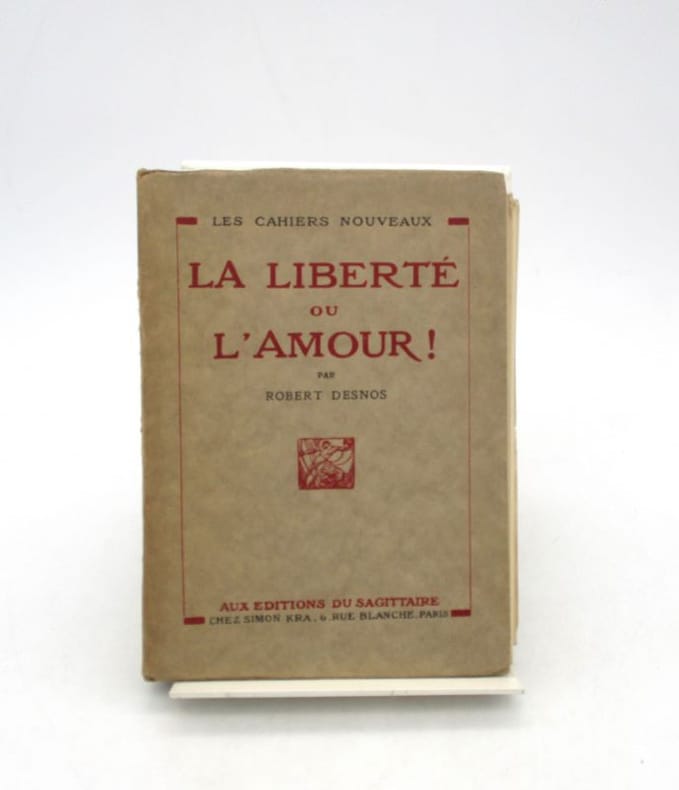
21235Paris, aux éditions du Sagittaire, 1927. In-12, 183 pp., broché, couverture originale imprimée (dos décollé).
29875Paris, Editions " Ars ", 1936. In-4, broché, couverture rempliée,10 pages de texte et XXXII planches hors texte de reproductions de tableaux en phototypies