668 résultats
18220007721Paris: Chez Bechet 1822. First French Language edition. Original Boards. Good. 8vo xiv 351; vi 359 pages untrimmed in contemporary boards. Very scarce. <br/><br/>Attracted by the ideals of the "Declaration of Independence" Fanny Wright traveled extensively through the U.S.A. tracking how those ideals were being realized. In France who became almost like a daughter to Gen. Lafayette. She and her sister returned to America and with Lafayette were guests of Jefferson at Monticello. Later as a U.S. citizen she founded the Nashoba commune in Tennessee in anticipation of emancipation. She visited New York and Philadelphia West Point Niagara Falls Lake Errie and on to Lower Canada Montreal Lake Champlain Burlington Vermont Washington D.C. to Virginia with many observations along the way. This edition has a dedication to Lafayette by the translator who also supplied a new translation. Vol. 1 ends with remarks upon Morris Birkbeck's letters about the Illinois country. All in all Fanny Wright became one of the most remarkable women of the first half of the 19th century: among other accomplishments being the first woman to write this work the first travelogue by a woman. Howes D74; Sabin 18642; Clark Old South 16; Buck 137. Chez Bechet hardcover
1874JC17692Northampton : Bridgman & Childs 1874. Paperback. Very Good. Stitched wraps. 31 pp. <br/><br/> Bridgman & Childs paperback
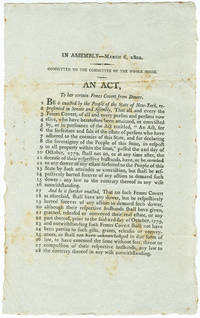
1802WRCAM55701Albany 1802. Letterpress broadside 13 1/2 x 8 1/4 inches. Docketed on verso. Old folds light foxing. Very good. Untrimmed. An unrecorded slip-bill printing of an act presented in the New York state legislature in 1802 to prevent widows of Loyalists from receiving dowers for confiscated property. It is evidence not only of continuing acrimony toward Loyalists and attempts to profit from their financial losses but also of continued legal efforts to keep women economically dependent in Federal-era America. This act was probably considered or presented in conjunction with an "Act to Facilitate the Discovery and Sale of the estates of Attainted Persons" that passed in the same session. That act allowed New Yorkers who discovered property owned by Loyalists and subject to forfeiture under its 1779 Forfeiture Act to receive a twenty- five percent share of the proceeds of the sale of this newly-discovered property. The present slip bill calls for preventing widows of deceased Loyalists from receiving any property deemed subject to confiscation. "Femes covert" is a legal term meaning simply "married woman." The final act as passed on March 31 1802 does not mention widows of deceased Loyalists but speaks simply of heirs to confiscated lands. <br> <br> "During the American Revolution many states passed laws allowing them to seize the property of known loyalists. So-called 'confiscation laws' effectively criminalized dissent against the American Revolution. The seizure and sale of loyalist property also raised revenue for the state by redistributing property from Loyalists to the rest of the community. Many new states established their legitimacy in the eyes of their constituents by depriving certain people of their right to property. New York built one of the most robust property confiscation regimes. In fact New Yorkers started seizing loyalist property even before the state ratified its Constitution. In March of 1777 the Provincial Convention - a provisional government - created in counties under Patriot control 'Committees of Sequestration' which seized property abandoned by Loyalists auctioned it off and sent those funds to the state treasurer.Alexander Hamilton made his legal career by representing former loyalists in lawsuits where they tried to reclaim seized property. Many of the loyalists Hamilton represented were quite wealthy and Hamilton believed these men and their capital would prove critical for building the United States. He wanted them to reintegrate into American society. Resolving disputes over property confiscation was a critical first step in accomplishing that goal and enabling the broader transition from violent revolution into routine civil government. Hamilton won in New York. Most other states also successfully reintegrated loyalists. The United States Constitution even includes a clause prohibiting bills of attainder the broad category of laws under which confiscation acts fell. It took away from democratic state legislature this coercive and punitive power to enforce political conformity" - Boonshoft. <br> <br> The legal discourse on attainder and the confiscation of Loyalists' property in the state of New York seems to be largely silent on the issue of widows' rights. The present broadside illuminates a dark corner of this rather difficult issue and helps bring to light yet another instance when the rights of women in early America were often null. <br> <br> Slip-bills' were printed in small numbers for the use of members of legislatures as a bill is being debated and considered. They are quite uncommon survivals and significant evidence of legislative intent and process. This slip-bill is unrecorded with no copies in auction records nor in OCLC. Mark Boonshoft "Dispossessing Loyalists and Redistributing Property in Revolutionary New York" posted on the New York Public Library Blog September 19 2016. unknown books
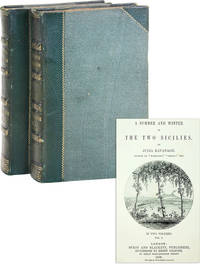
185850251London: Hurst and Blackett 1858. First Edition. Two volumes; small octavo 19cm; late 19th /early 20th-c. half-morocco over green cloth boards; marbled page edges; engraved frontispiece to each volume; vignette title pages; vii1-333 1-316pp. Small marginal perforation at gutter of v.1 leaf R1 pp.241-242; closed marginal tears to leaves N5-8 in v.2 pp 187-192 in both cases with no loss to text. Else a fresh Very Good or better set in an attractive period binding. Ex-libris "The Countess Dowager of Carnarvon" likely Elizabeth Catherine Howard 1857-1929 second wife of Henry Howard Molyneux Herbert 4th Earl of Carnarvon. The Earls of Carnarvon are the hereditary proprietors of Highclere Castle made famous as the locale for the popular television series "Downton Abbey." Popular account of Mediterranean travel by the prolific Irish novelist and essayist. Kavanagh 1824-1877 spent most of her adult life in France supporting herself and her mother on the proceeds from her writings which were numerous; in addition to several novels the best-known being Nathalie 1851 Kavanagh published volumes of critical essays devotional works books for children and many stories and short pieces for periodicals. Kavanagh's concern with gender and society inflected much of her published work and this is perhaps most true of her travel writing a genre which afforded her the opportunity to couch social critique in the form of casual observation. As one modern critic has noted ".as a hybrid genre travel writing.gave women such as Kavanagh the opportunity to write on historical and political themes and to compare the position of women in British society with that of women in other countries." see Anne O'Connor "Travel Literature and Traveling Irishness: an Italian Case Study" in Traveling Irishness in the Long Nineteenth Century Marguerite Corporaal and Christina Morin eds Lon: 2017. Hurst and Blackett unknown books
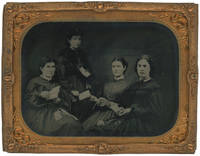
1860LIST0125American 1860. Tintype in case 3 ¼ x 4 ¼ inches. Fine. A quarter plate tintype of a women's sewing circle probably circa 1860s. Three women hold patterns while one sews. Ante-bellum sewing circles were often anti-slavery or missionary in nature though we can find no details here that offer clues as to the nature of this circle. A sharp image with good contrast fine condition. unknown books
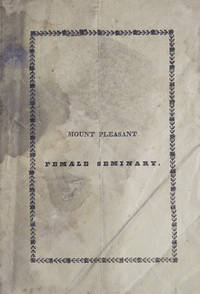
18313497Mount Pleasant: Roscoe Printer 1831. First edition. 8 pp. 1 vols. 8vo. Original printed yellow wrappers dampstained throughout. First edition. 8 pp. 1 vols. 8vo. NEITHER IN NUC NOR AMERICAN IMPRINTS. Prime of the well known family was made Principal of the Seminary in 1831 after the Ladies who conducted it were relieved of their duties. The curriculum included Latin Greek and French; Geology Mineralogy Botany and Zoology as well as Domestic Economy and Vocal Musick sic. Everything the well turned out young ladies of the seminary would need to know. Not in NUC. Not in American Imprints Roscoe, Printer unknown books
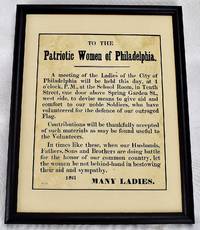
18611911280009Pennsylvania: King & Baird Printers 1861. First Edition. Framed Broadside. Very Good. Women during the Civil War Civil War Broadside from 1861 organizing Union women in Philadelphia. 30 x 23 cm. Held in modern frame. The Broadside reads: "A meeting of the Ladies of the City of Philadelphia will be held this day at 4 o'clock P.M. at the School Room in Tenth Street one door above Spring Garden St. to devise means to give aid and comfort to our noble Soldiers who have volunteered for the defense of our outraged Flag. Contributions will be thankfully accepted of such materials as may be found useful to the Volunteers. In times like these when our Husbands Fathers Sons and Brothers are doing battle for the honor of our common country let the women be not behind-hand in bestowing their aid and sympathy." Ref: LOC Printed Ephemera Collection; Portfolio 157 Folder 25. Pennsylvania: King & Baird Printers unknown
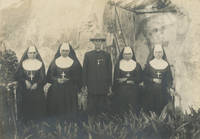
1900List518Most Cuba or Jacksonville 1900. Silver gelatin or albumen photographs various sizes ranging from 3 x 3 to 6 x 8 most captioned to verso. With handwritten manuscript four leaves discussing various diseases. The Spanish-American War was the first war in which nurses formed their own dedicated units as well as the first war in which they were accepted within military hospitals. While no nurses died in battle 153 died during the war from disease. Nurses were responsible for both treating soldiers as well as maintaining sanitary conditions within the camps. Conditions were often poor leading some to work until they were too sick to continue. <br /><br /> The current collection of photographs documents the experiences of a Mrs. Waters who was originally from Groton Massachusetts. The collection begins with a couple early photographs including a portrait as a young woman and a cyanotype of one of Waters' leprosy patients at Johns Hopkins Hospital in Baltimore. The next section shows Waters' training in Jacksonville Florida with either the Fourth or Seventh Army Corps at what was called Camp Cuba Libre both Corps trained there in 1898. The photographs of Jacksonville show life around the military camp and environs with some notable photographs of African-American inhabitants of the region. Three photographs quite notably show the Congregation of American Sisters a small group of American Indian nuns led by Reverend Francis Craft. The photographs taken in Cuba are notable for their portrayal of local life. Several photographs of military installations are taken around the "trocha" or line established by General Valeriana Weyler from Mariel to Majana. Another notable photograph is a cabinet card of a large group of nurses taken by the Havana photographer R. Testar. <br /><br /> The group overall shows very early photographic records of military nurses in training as well as a scarce photographic record from a woman in a combat situation. The photographs are generally well preserved in very good to excellent condition with some light fading. Accompanying the photographs is a four page manuscript essay presumably by Waters discussing leprosy as well as the booklet Spanish Phrase Book for American Soldiers and Sailors published by the National Relief Commission of Philadelphia. <br /><br /> Offered in partnership with Daniel / Oliver Gallery. books
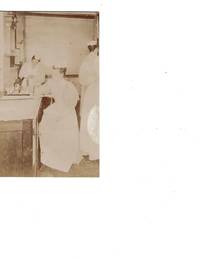
1900168731900. Women in Medicine Three Female Nurses at Work in the Hospital. c. 1900. Original silver gelatin print. 4 x 7 in. One nurse is filling a bottle with medicine while another is seated and logging a patient's progress or recording other information. The third nurse's back is turned to the camera which demonstrates the truly candid nature of this image. The nurses wear white caps and aprons over floor length striped dresses with leg-of-mutton sleeves. At the turn of the 20th century women faced harsh discrimination in applying to medical schools considered by many men to be unsuitable for women's "delicate" nature; thus women leveraged their perceived caregiver role to dominate the new field of nursing. These professionals had high levels training and their jobs required them to master a number of facts of patient care as shown in this photograph. Surface abrasion to lower left edge. Good condition. unknown
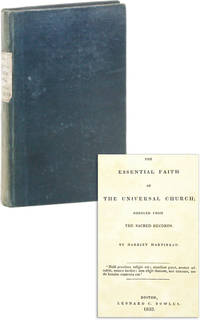
183346011Boston: Leonard C. Bowles 1833. First American Edition. 12mo 15cm.; publisher's blue cloth printed paper spine label; 170pp. Spine cloth a shade faded endpapers toned due to inferior stock light foxing throughout else a Very Good and fresh copy. One of three lengthy essays authored for the Committee of the British and Foreign Unitarian Association as an introduction and promotion of Christian Unitarianism this specifically addressed to members of the Catholic Church. Martineau raised in a Unitarian household began her career writing articles for the Unitarian journal "The Monthly Repository" though she later left the Church for more information see Ruth Watts "Harriet Martineau and the Unitarian Tradition of Education" in "Oxford Review of Education" Vol. 37 no. 5 October 2011 pp. 637-351. Leonard C. Bowles unknown books
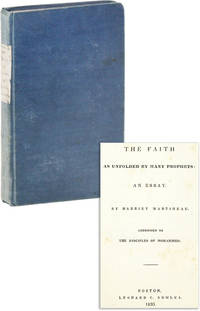
183346010Boston: Leonard C. Bowles 1833. First American Edition. 12mo 15.5cm.; publisher's blue cloth printed paper spine label; 2177pp. Light wear to extremities spine cloth a bit faded corners bumped light foxing throughout else a Very Good quite fresh copy. One of three lengthy essays authored for the Committee of the British and Foreign Unitarian Association as an introduction and promotion of Christian Unitarianism this specifically addressed to "Mohammedans" and written in the form of a dialogue between friends Havilah a Muslim and Eber a Christian. Martineau raised in a Unitarian household began her career writing articles for the Unitarian journal "The Monthly Repository" though she later left the Church for more information see Ruth Watts "Harriet Martineau and the Unitarian Tradition of Education" in "Oxford Review of Education" Vol. 37 no. 5 October 2011 pp. 637-351. Leonard C. Bowles unknown books
189847551Hartford: A.D. Worthington & Co. Publishers 1898. Early printing. Octavo 23cm; burgundy cloth with titling and decorations stamped in gilt and fleur-de-lis design and decorative border embossed to front cover; floral-patterned endpapers; xxxiv35-7304pp ads; with portrait frontispiece and 121 illustrations throughout the text. Spine gilt just starting to dull tiny bruise to rear cover with thin partial crack to gutter at copyright page and title page nearly separated; Very Good to Very Good. Handsome copy of the American journalist abolitionist and women's rights advocate's memoir including annecdotes regarding her experiences during the Civil War where she became involved with the United States Sanitary Commission. KRICHMAR 4843. A.D. Worthington & Co., Publishers unknown books
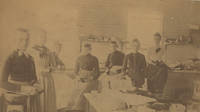
1880LIST124Lawrence 1880. Albumen photograph on card stock 7 ¾ x 4 ½ inches. Good. Working conditions were notoriously bad in Lawrence one of the industrial hubs of the textile industry in the late nineteenth century after the harnessing of the Merrimack River's water power in 1845. The city was a hub of immigration - mostly Irish - and many immigrants who were familiar with mill work flocked to the city in the 1850s. In 1860 an accident at the Pemberton Mill killed 145 workers. The Bread and Roses strike of 1912 also known as the Lawrence Textile Strike was the culmination of decades of poor working conditions. This uncommon occupational photograph of female mill workers gives scant clues as to the background of the workers or specifics of the factory. We find no record of the photographer a J.J. Greene based in Lawrence. The seven women pictured are mostly looking off-camera suggesting that the photographer had a companion. The date is unknown but the albumen cabinet card format and general feel suggest a date of 1880s-1890s. <br /> <br /> An uncommon occupational photograph of women in Lawrence's mills. Good condition overall fading to image and some light foxing verso with tears from tape removal. unknown books
18632488New York: Wm. C. Bryant & Co Printers 1863. First edition. Very Good . Original paper wraps. 23 pages. Number 10 in a series of 17 pamphlets addressing the causes and outcomes of the Civil War. One of two variant printings with no priority assigned this with page 23 beginning "attempt at corrupting." Some separation to the foot of spine with text block holding well. Soiling and edgewear to front wrap; rusted imprint of paperclip affecting top of pages 13-15. Small blot to text of page 13. Else a solid copy of this important work which suggests that all women who have survived the Civil War deserve credit for their strength and sacrifice. <br/><br/>While at its release A Few Words was anonymous an 1865 publication by the Loyal Publication Society attributes the work to Caroline Kirkland Mrs. C. M. Kirkland. Kirkland a writer educator and abolitionist brought a unique perspective to the debate on women's roles in the Civil War. A Northerner by birth she spend the years leading up to the war living with her husband on a homestead in Michigan. Her experience living in the North and West and traversing the South informs her response to the accusation being made by men on both sides: that the strength of Southern women and the apathy of Northern women had contributed to seccession and the duration of the conflict. According to Kirkland's argument women on both sides nursed sick soldiers rationed and experienced the losses of husbands brothers and fathers. Yet Kirkland argues that women of the South are implicated in the evils of slavery. "They having seen slavery felt it known its horrors suffered under its attendant evils and learned.its incompatibility with God's benign law of love have deliberately lent themselves.to the perpetuation of so awful an evil." As an abolitionist and a women's rights activist Kirkland highlights the cognitive dissonance involved in promoting the strength of women who refuse to recognize that their fight for equality is tied to that of all oppressed Americans. She concludes with hope from the West where she comments that strong-minded women have rejected courtships and shunned deserters who refuse to stand their ground. A rare and interesting work documenting a Union woman's perspective on American women's responsibilities in wartime.<br/><br/>History of American Women. Very Good . Wm. C. Bryant & Co Printers unknown books
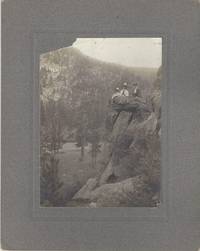
19001968Estes Park CO 1900. Large format gelatin silver photograph 17 cm x 12 cm on a plain gray mount 25 cm x 20 cm view chipped at upper left corner and coming up from mount on the left side. Image of two women and a boy in jaunty hats sitting atop of a rock ledge with a forested canyon beneath them.<br/><br/>Manuscript note on the reverse "Hat rock above McLeod cabin at Shenstone 19 Keith McLeod Bertha McLeod Aunt Florence Stewart. unknown books
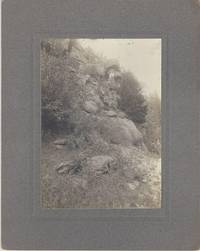
19001967Estes Park CO 1900. Large format gelatin silver photograph 17 cm x 12 cm on a plain gray mount 25 cm x 20 cm Very good. Image of two women and a boy standing among and atop of rocks in a canyon.<br/><br/>Manuscript note on the reverse "Rocks back of McLeod Cabin Shenstone - Big Thompson Canon - 'Perfect Tree' Aunt Florence Stewart Bertha McLeod Keith McLeod. unknown books
1900231291900. Women's History Women's labor photo archive documenting women at work across millinery laundry commercial kitchen precision bench and wartime relief settings preserving a concentrated visual record of how female labor was publicly pictured in the years immediately preceding and overlapping World War I. Several photographs bear Brown Bros. New York stamps placing part of the group within the sphere of press photography while the verso inscription "Russian Women Filling Bandages for the front" situates one image within the culture of wartime female service and aid production. The photographs show women's work as a visible and varied part of early twentieth-century public life where skill repetition discipline and service shaped how female labor was pictured.<br /> <br /> Photo archive of 8 photographs 7 silver gelatin and one mounted sepia photograph ranging from 6 x 4 to 9.5 x 7 inches including New York and other unidentified locations circa 1900-1915. One Brown Bros. photograph shows a seated woman trimming or assembling hats at a worktable crowded with millinery forms and materials framing decorative labor as skilled commercial production rather than private handiwork. Another image shows four women and one man gathered around tables stacked with folded cloth corresponding to the handwritten verso note "Russian Women Filling Bandages for the front." A larger photograph inscribed on the verso "women workers / compass making" shows a woman seated at a bench adjusting a circular instrument with tools and components arranged before her. Another workplace view pictures a woman handling a metal object beside machinery and a crate with partial printed text ending in ".products. Cleveland." The photograph inscribed "women in Laundry" shows several women bent over long tables in a bright workroom lined with tall windows while the mounted sepia image depicts six apron-clad women at long counters beneath a large hooded vent in a commercial kitchen. Across the group aprons work dresses caps tables tools and stacked materials recur giving the photographs a shared emphasis on feminine labor as organized visible and socially legible.<br /> <br /> The archive belongs to a period when women's wage labor was expanding in both scale and visibility and when photography increasingly circulated images of female work as part of modern urban and wartime culture. Its strength lies in the range of roles pictured: decorative trade work industrial handling laundry labor food preparation and aid work directed toward the front all of which show how women's labor was understood through service dexterity endurance and collective effort. The bandage-making image is especially important because it connects ordinary workplace culture to the wartime recasting of women's labor as patriotic and humanitarian duty. Light surface wear scattered creasing minor silvering and fading and general handling wear; mounted sepia photograph with heavier toning. Overall good condition. A compact and pointed visual record of the cultural meaning of women's work at the point where everyday labor and wartime service converged. unknown
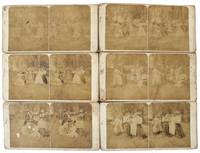
1900188011900. Women SPORTS Six action shots of a women's fencing dual in the early 1900s. 4" x 6" each. Stereoview on cardboard mount. N.p. Captioned "Le Duel" with each photograph numbered. Historically fencing has been primarily a men's sport and though women have been fencing for hundreds of years there was still heavy stigma against women taking up any sport. After WWI many French fencing schools opened up classes for women to grow their economy. This act opened up the doors for women to eventually be allowed to fence in the Olympics in 1924. This set of six stereoviews showcase two women fencers with a female referee and a group of female viewers. Each stereoview is numbered in the order of the duel; the first shows the two women facing each other with their swords down the second and third show the women mid duel and the last three show the victor heralding over the defeated opponent with two women side by side helping her recover. Minor wear to edges some sunning and wear to photos. Overall only good condition. unknown
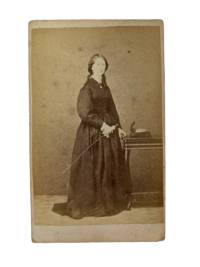
1850205961850. Albumen carte-de-visite depicting a woman dressed in a dark riding habit holding a slender riding crop in her right hand and resting her left on a desk. C.a. 1850s-70s. 2.5" x 4" on cardstock mount. There are no markings on the photograph indicating the woman's identity though her long-sleeved fitted bodice and full skirt are characteristic of American equestrian fashion in the mid-19th century. Riding habits of this period often adapted the tailored silhouette of men's coats paired with practical yet elegant skirts suitable for sidesaddle riding. The riding crop in her hand was both a functional tool for controlling a mount and a fashionable accessory in formal equestrian portraiture. Women's participation in equestrian activities in the 19th century was often associated with skill refinement and social standing with formal portraits like this serving as lasting representations of their horsemanship and style. Overall very good condition. A fine example of mid-19th century equestrian portrait photography. unknown
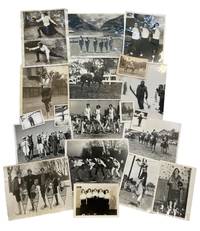
1900158521900. WOMEN IN SPORTS Photographic collection of 18 rare vintage photos celebrating girls and women in sports. Some are identified with names and locations. Locations include New Jersey Canada New York California Massachusetts. Dated approximately 1900-1940. Various sizes; mostly between 8.5" x 11" and 6.5x 8.5" with four smaller photos at 2.25" x 3.5". Black and white silver gelatin photographs. Many pieces show uniformed team photos and action shots documenting girls' increasingly rigorous participation in active sports in the first half of the 20th century. Sports include winter skiing ice skating fencing equestrian and polo bowling swimming track and field rugby. Many of the photos have extended captions on the verso. For example one photo features several Canadian swimmers in uniform in 1930 with the caption: "Swimming champions add to picturesque country at Lake Louise Canada. They are left to right: Agnes Geraghty Olympic swimmer; Catherine Ames Like Lindstrom Metropolitan Distance Champion; Constance Hanf Junior Metropolitan Champion; Eleanor Holm National Champion back stroke 100 and 200 yards; Georgia Colemen National Champion Diver. Miss Coleman is From Los Angeles while the other are members of the Women's Swimming Association New York. Another caption on a photo of several polo players states: "Southern California co-eds to form polo team sorority women at the University of Southern California are preparing to invade one of the few remaining sport sanctuaries of men- polo." Also included is a short of the American Women's Olympic Fencing Team which include: MMarion Lloyd Muriel Guggolz and Dorothy Locke. <br /> <br /> Curated photographic archive celebrating female athletes who overcame stereotypes of women as the "weaker" sex. Because early social constructs regulated physical activity for women few were able to rise up as professional sports competitors until the 20th century. This archive is a testament to these women's historic strides revealing their early physical training their membership in early sport clubs as well as their most daring record-breaking feats. The collection depicts women participating in during the early 20th century. unknown
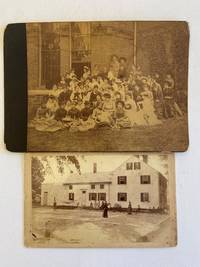
1880178721880. 2 Albumen photos of early recreational tennis game. Circa 1880's. Larger photo measures 6.75" x 8.5" inches on original photographer's board measuring 9.75" x 6.75". Smaller photo measures 7.25" x 4.5" inches on white photographer's board measuring 8" x 5" inches. Photo was taken by Marston photo studio of Bangor Maine. Larger photo shows a large group of young women posed in tiers on a lawn in front of a large brick building. The front row is spread across the grass with others in chairs behind them and the back row sitting on the open windowsill and ledge along the side of the building. The group is entirely female suggesting maybe an early women's college all of them dressed in high-collared dresses long skirts with bustles many in hats and some with parasols. In the front row four women hold tennis rackets as if posing before or after a game. This restless group of young women are pictured in the 1870s or 1880's. The other photo shows a tennis game at play with a man on one side of the net and two women on the other holding rackets on a tennis lawn. The court has been constructed on a lawn with painted boundaries and a net which was customary in 19th century. In the background is a large white wooden house. Lawn tennis came into fashion in the 1870's as an upper-class hobby marking leisure time for players and spectators. Some spotting and Light staining on photos does not effect clarity of images. Overall in very good condition. unknown
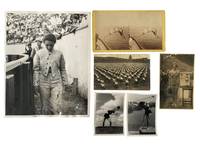
1900224351900. Sports and HobbiesWomen's History Archive of six original photographs depicting women in sports and physical culture ca. 1900s-1950s. A striking group of five silver gelatin photographs and one stereoview documenting early and mid-20th century women's athletics across a range of sports including bullfighting competitive swimming mass calisthenics and weight training. The archive is anchored by a powerful press photograph of Bertha Trujillo a Colombian woman bullfighter shown bloodstained and exhausted yet defiant after leaving the ring as documented by a Hamilton Wright press caption on verso dated May 7 1956. The image captures the rare spectacle of a woman operating within a hypermasculine and violently gendered tradition underlining her transgressive presence in the public arena of the corrida. Trujillo's visibility as a "girl bullfighter" not only subverts gendered codes of spectacle and aggression but also underscores the fraught place of women in national rituals of machismo.<br /> <br /> Also included is an early gelatin silver stereoview of a woman mid-dive from a boat into open water ca. 1900s her long dress captured in graceful suspension. A vintage sepia-toned postcard shows a massive synchronized physical training display by women in uniform skirts likely in a European stadium setting. A third photograph features a smiling young woman swimmer in a tight one-piece suit standing beside a trophy likely ca. 1920s-30s exuding post-competition confidence and the growing visibility of women in elite amateur sport. Two additional gelatin silver prints ca. 1930s-40s show women engaged in solitary strength and flexibility exercises: one throwing a medicine ball under clouded sky the other stretching a resistance band at the edge of a pond. Each of these images gestures toward evolving conceptions of female strength embodiment and public physicality across the 20th century. The photographs collectively trace a visual history of women's contested access to spaces of physical prowess and public acclaim. Minor edge wear and surface rubbing to a few prints. Overall very good condition. A varied archive showcasing women's athleticism in the early 20th century. unknown
1861174981861. Women's in Sciences Sepia photograph circa 1860-1880 identified in manuscript at the upper left "State Eclectic Medical Society at Worthington" depicting approximately twenty five women alongside male practitioners in Worthington Ohio an early center of Eclectic medical organization just north of Columbus Ohio. The image documents a rare mixed gender professional gathering at a moment when women's participation in formal medical education remained severely restricted under prevailing institutional norms. Within the dominant nineteenth century medical establishment women were largely excluded from training and professional societies; however the State Eclectic Medical Society of Ohio and the broader Eclectic movement created alternative pathways into medical study. These networks were closely tied to reformist traditions that challenged orthodox practice and opened limited but meaningful access to women prior to the broader professionalization of female physicians following mid century breakthroughs such as the graduation of Elizabeth Blackwell in 1849.<br /> <br /> Original Photograph. C. 1860-1880. Sepia. Approximately 6" x 9" Inches. Written in black ink in the upper left corner "State Eclectic Medical Society at Worthington". Photo shows about 25 women along with their male peers. The the first woman graduated medical school in the 1850s. The Eclectic Medical Society was notable for accepting female students before most women were allowed to study medicine.<br /> <br /> The photograph reflects the intellectual and institutional culture of Eclectic medicine a distinctly American medical movement that drew on botanical therapies Native American knowledge systems and the herbal tradition associated with Samuel Thomson. In contrast to orthodox allopathic medicine Eclectic practitioners emphasized plant based remedies and a more flexible therapeutic philosophy which correlated with a greater willingness to admit women into study and practice. The presence of a substantial number of women within this group suggests not only participation but active integration within the society's professional sphere offering visual evidence of gender inclusion within an otherwise exclusionary nineteenth century medical landscape. As a primary source the photograph provides direct documentation of women's early entry into organized medical communities in the United States capturing both the social composition and institutional networks that facilitated their participation. It is particularly valuable for research in women's medical history alternative medical movements and the development of professional education outside orthodox channels illustrating how reformist medical systems functioned as critical entry points for women prior to broader legal and institutional change. Some creasing present; otherwise in good condition overall. unknown
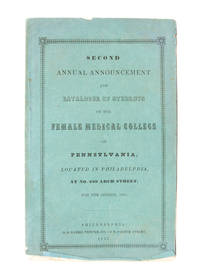
18512970Philadelphia: G.S. Harris 1851. First edition. Very Good . Original blue printed paper wraps printed to front. Some chipping and creasing to edges but overall intact and undamaged despite being quite delicate. Light scattered foxing throughout. Ownership signature of the college's original dean N.R. Mosely struck out at the top of the Faculty list on page 4; pencil ticks next to the names of several students listed in the catalogue on page 6. Exceptionally rare OCLC lists copies of this Announcement at only 2 institutions.<br/><br/>Only one year after Dr. Elizabeth Blackwell graduated valedictorian and became the first female M.D. in the U.S. the Female Medical College of Pennsylvania opened its doors. Located in Philadelphia it was the only the second school to open with the mission of training women in medicine -- having been preceded by the New England Female Medical College two years earlier in 1848. Founded by Quaker abolitionist and Underground Railroad activists who believed that women could make exceptional doctors "the college provided rare opportunities for women to teach perform research manage a medical school and with the eventual establishment of the Woman's Hospital in 1861 learn and practice in a hospital setting. It was the longest-lasting all-women medical school in the nation until it became coeducational in 1970" Mandell. The present Announcement predates these growths however showing the roots from which they emerged. One year running and the faculty remain largely male because there has yet to be an inaugural graduating class this would come in 1852; but already a female student Hannah E. Longshore is listed as a Demonstrator in Anatomy. Indeed Longshore and her sister Anna would both be part of the inaugural class of the college with the latter going on the author Discourses to Women in Medical Subjects 1897. Indeed the majority of women listed in this catalogue went on to become doctors even when it took time -- as it did for Hannah W. Ellis and Susanna H. Ellis both listed among the graduates of the 1865 class. 12 pages in all this scarce pamphlet contains Officers Corporators Faculty and Students of the school; an Announcement on the school's missions and accomplishments; information on Specialties available; Terms of enrollment; and a list of required Textbooks. It also conveys the excitement optimism and pride of those involved. "The Faculty of the Female Medical College of Pennsylvania are inspired by very different feelings from those that attended their efforts one year ago. Then they were about to enter into an untried path to engage in a great experiment.But that which was an experiment is an experiment no longer.give a woman knowledge commensurate with her natural qualifications enable her to go forth healing the sick and comforting the afflicted and she will bless the world." A rare survivor documenting that pivotal moment when women had been given the chance to prove their intellect rose to the challenge and made the future of the next female students more secure. Very Good . G.S. Harris unknown books
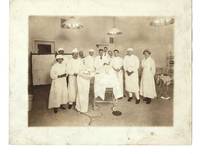
1900162081900. Women in Sciences. Original vintage photograph of operating room and surgery team. Photograph shows eleven figures dressed all in white standing around a patient in an early operating room. While most of the medical workers are men two women stand at the edges of the group and the woman standing on the left is shown wearing an operating apron and rubber gloves. 8 x 10 in. sepia photo. Photo is in good condition with light scuffing to photo surface two water marks in bottom left quadrant and some dirt and stains to the image border. Light crease in top left corner and small tear on lower right edge. Image remains crisp and clear. An important photograph that shows women's involvement in the medical field and the development of surgical technology throughout the 20th century. unknown