STENDHALLivre Rare Book
571 résultats
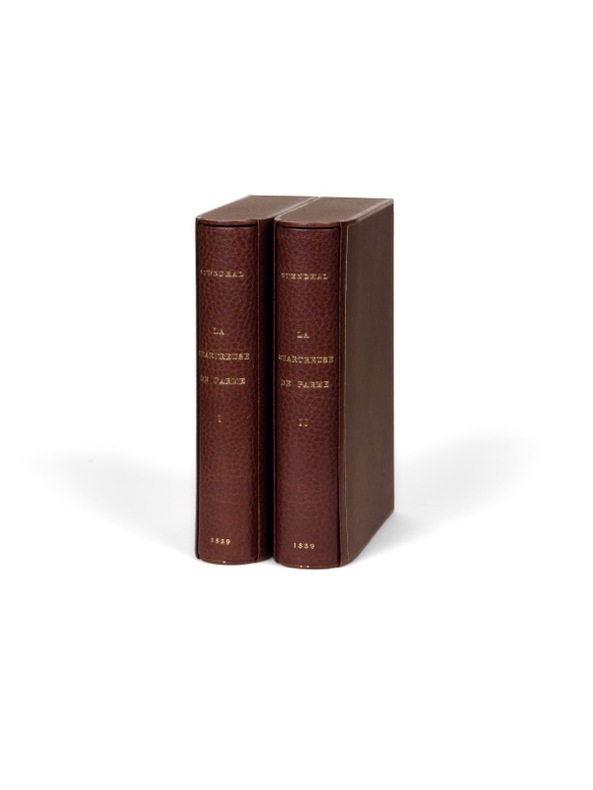
183927512Édition originale, premier tirage.L'un des huit exemplaires connus avec envoi autographe, le seul à une femme. Paris, Ambroise Dupont, 1839. 2 vol. (125 x 200 mm) de [2] f., 402 p. et 1 f. ; [2] f. et 445 p. Maroquin havane, contreplats et gardes de chèvre velours sable, titres dorés sur les pats, tranches dorées sur témoins, chemises avec titre et tomaison, étui bordé (reliure signée de Renaud Vernier - Claude Ribal, 2025). Édition originale. Exemplaire de première émission, sur papier vélin. Envoi autographe signé : « À Madame d'André, hommage respectueux de l'auteur ».
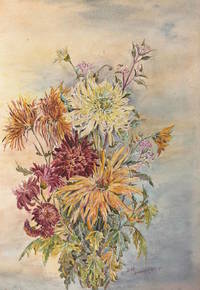
187932820588This magnificent imposing album was made by a prominent late-Victorian hostess patron of the arts and gifted artist.<br />Folio. Approx. 225 pages heavy card. Brown morocco gilt-stamped "H.R.H." metal lock and corner-pieces gilt edges rubbed at joints. Excellent condition.<br /><br />Helen Rose Huth was the wife of the banker Louis Huth. The Huths were major art collectors who displayed their art in the gallery built for the purpose at their home Possingworth. Helen sat for both George Frederic Watts and James Abbott McNeill Whistler who painted the celebrated Arrangement in Black No. 2: Portrait of Mrs Louis Huth. Whister required many sittings and when she complained that Watts never treated her that way Whistler replied "And still you know you come to me!" After Louis Huth's death in 1905 she married Archibald Howe.<br /><br />The album the product of vast labor contains 50 watercolors all but four by Mrs. Huth comprising studies of flowers landscapes and other scenes in Possingworth East Sussex and Scalpay and other Hebridean locations; 70 photographs of buildings landscapes people and paintings; and six pen-and-ink or pencil sketches. Many of the watercolors bear signatures dates and places. The album is filled with elegant calligraphic transcriptions of poems and prose pieces by Victorian writers the Brownings being particular favorites often with pen-and-ink floral borders. A number of the unsigned poems appear to be by Helen Rose Huth herself.<br /><br />The earliest watercolor in the album is dated 1879 and work continued until at least 1905. In that year Louis Huth died. A photograph of his tombstone is displayed opposite a portrait of the banker. A fine seated studio portrait of Helen Rose Huth dated 1895 appears early in the volume. The photographs are often connected to the subjects of the poems they accompany.<br /><br />Provenance: Helen Rose Huth 1837-1924. The Huths' fine country house Possingworth Park completed in 1866 "was a highly ornate neo-Gothic mansion … The house contained 42 bedrooms large oak panelled reception rooms and a conservatory named the Winter Garden. There was also a large picture gallery. Louis Huth was a passionate art collector and his house was designed to display artwork at its best. A large picture gallery on the ground floor was designed specifically to exhibit his most treasured artworks. … Possingworth was also the venue of a secret meeting between Major Generals Montgomery and Eisenhower in 1942. There they laid plans for the cross-channel invasion that was to take place two years later" Holy Cross Priory website. The house is now Holy Cross Priory. <br /> hardcover
186464004Detroit MI: Corydon C. Randall Photographer 220 Woodward Ave. c. 1864 1881-1882. One mounted albumen cabinet card photo sized 3.9 x 5.9 in. mounted on tan studio board sized 4.25 x 6.5 in. rounded corners printed caption below the image printed photographer’s imprint on verso minor age-toning minor spotting slight soiling to fore-edges old tiny pinhole evidenced at upper blank margin of mounted board not affecting the photograph very upper right w/ slight creasing & cracking of photo now neatly re-affixed still a VG exemplar of this very rare cabinet card image. A very scarce full-length albumen cabinet card portrait of Sojourner Truth 1797-1883 taken when she was 84-83 years old and used as a fund-raiser at her public events at the end of her life. This is one of Truth’s late portraits and she was quite unusual having acquired her copyright to her portrait during the Civil War giving her control over both the distribution of the CDV and Cabinet Card images and the revenues they generated. As one of the best-known African-American former slaves abolitionists and women’s rights advocates of the 19th-Century she traveled the country for decades giving lectures and attending conferences where she would sell her “Shadow†photographs as a primary means of support for her ongoing mission. According to extensive historical research by Darcy Grimaldo Grigsby Truth posed for Detroit photographer Corydon C. Randall’s camera on three occasions between June 1881 and April 1882. The finished albumen photos were prepared in both Carte de Visite 2.25 x 3.5 in. and Cabinet Card 4 x 6 in. formats and sold to Truth at .5¢ apiece. Randall’s studio records show purchases of 50 50 and 100 copies of each of the three separate poses which was “an astonishing order for a woman in her eighties†but considering they were some of the last photographs of Truth the editions size was quite small with the Cabinet cards scarcer than the CDV versions. Grigsby details this standing pose in her book: the photographs “stage her against a pedastal in front of painted seaside backdrop. The effect is unique among her portraits. She stands in what purports to be a natural scene her figure is smaller than the background suggesting a vastness of space we have not seen before. . . Even as we recognize its artiface we indulge in the illusion of space and air and natural light that it so economically suggests. . . In these late seaside portraits there is a soft winsome quality intensified when we realize that she is in her eighties and at the very end of a long arduous life of personal and political struggle.†Worldcat locates 1 copy of seated version CDV Boston Athenaeum; See: Grigsby Enduring Truths 2015 pp. 178-184. [Corydon C.] Randall, Photographer, 220 Woodward Ave., unknown
190029598Un des 20 premiers réimposés sur chine. Reliure signée de Marius Michel Paris, Fasquelle, 1900. 1 vol. (165 x 255 mm) de 1 f., [4] et 519 p. Maroquin brun, dos à nerfs orné de filets à froid, tranches dorées sur témoins, filets à froid sur les coupes, contreplat à encadrement orné d'un jeu de sept filets, couverture conservées (reliure signée de Marius Michel). Édition originale. Un des 20 premiers exemplaires réimposés sur chine (n° 18).
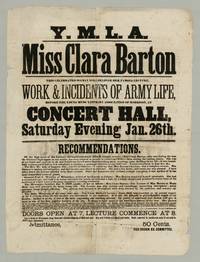
186713090Morrison WI 1867. Broadside 26.75 x 20.25 inches printed on thin paper. Old folds some creasing edges occasionally a bit frayed with a few small nicks or tears a couple of minor losses along folds. Overall very good condition. A striking and seemingly unique surviving broadside advertising a January 26 1867 lecture by Clara Barton entitled "War & Incidents of Army Life" part of a popular post-Civil War lecture series she delivered across the United States. Barton spent two years touring and recounting her battlefield experiences which helped popularize her and fund her subsequent efforts to locate missing soldiers. The present lecture was delivered to the Young Men's Literary Association of Morrison Wisconsin at the local Concert Hall. In addition to the bold title containing the relevant information on the lecture and the information on obtaining tickets at the bottom much of the lower portion of the broadside prints several laudatory "Recommendations" from various entities in Indiana and other locations in Wisconsin including a January 7 1867 review from The Milwaukee Sentinel. Noted temperance lecturer John B. Gough also praises Barton's lecture stating that "I never heard anything more touching more thrilling in my life."<br /> <br /> Typographically the broadside is interesting for employing several sizes of fonts likely wooden type especially near the bottom of the Recommendations section where the printers needed to reduce the size of the font to fit in the entirety of a quote from The Daily Wisconsin as well as a line in the smallest font from the Concert Hall promoter noting that the foregoing group of recommendations is "enough" and praising Barton for her "noble character which she has won by her efforts to ameliorate the sufferings of our sick and disabled soldiers."<br /> <br /> Clara Barton 1821-1912 was a noted educator and humanitarian who helped distribute needed supplies to the Union Army during the Civil War and later founded the American Red Cross. Barton garnered nationwide recognition for her efforts during the war and quickly became known as the "Angel of the Battlefield." After the war Barton's lecture tour brought her in contact with other notables of the day including Susan B. Anthony and Elizabeth Cady Stanton and also Frederick Douglass who involved her in the suffrage and civil rights movements respectively. In the Fall of 1866 Barton began to lecture on her Civil War experiences in lyceum halls churches town halls and schools. Though she never felt comfortable in front of an audience wherever she spoke Barton was well received. Her contemporary biographer Percy Epler wrote that "a tear-stained multitude thronged everywhere to hear her" as she had made it her mission to show not "the glories of conquering armies but the mischief and misery they strew in their tracks; and how while they march on.some one must follow closely in their steps crouching to the earth faces bathed in tears and hands in blood. This is the side which history never shows."<br /> <br /> From 1866 through 1868 Barton delivered over 200 lectures throughout the northeast and midwest regarding her Civil War experiences. She shared platforms with other prominent figures including the aforementioned Douglass as well as Ralph Waldo Emerson William Lloyd Garrison and Mark Twain. She often earned $75 to $100 per lecture. Original broadsides advertising her lectures especially of this size are exceedingly rare to say the least. We could locate just a single result in auction records of a much smaller example and OCLC reports just one institutional holding of any Barton lecture broadside again much smaller for an 1867 event in New Haven located at the Library of Congress. unknown
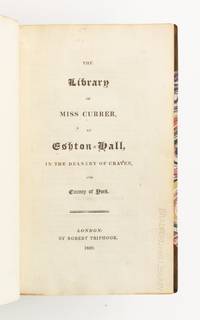
1820ST16983London: Robert Triphook 1820. ONE OF 40 COPIES PRINTED. 235 x 142 mm. 9 1/4 x 5 3/4". iii-xi 1 308 pp. lacking the first of the two title pages at front. <br/> In a very nice replica binding of honey-brown sheepskin over marbled boards raised bands ruled in gilt gilt titling. Front free endpaper INSCRIBED IN INK BY CURRER: With Miss Currer's Compliments"; small ownership perforation of the Bradford Free Library on title page and p. 99; two small ink stamps on p. 59 and 99. Front free endpaper with thinned area where indication of earlier ownership likely appeared. The boards just very lightly scuffed though probably to provide a feeling of authenticity otherwise only trivial imperfections. Apart from the signs of library ownership a very fine copy the text showing virtually no signs of use.<br/> <br/> This is a presentation copy of the first library catalogue of Frances Mary Richardson Currer an Englishwoman described by De Ricci as "England’s earliest female bibliophile" and hailed by Dibdin as "the head of all female collectors in Europe." An only child Currer 1785-1861 inherited considerable assets from both her father's and her mother's families: her relative Dorothy Richardson wrote in 1815 "She is in possession of both the Richardson and Currer estates and inherits all the taste of the former family having collected a very large and valuable library . . . in addition to what were collected by her great grandfather and great-uncle." Dibdin noted that her library at Eshton Hall in North Yorkshire was surpassed only by three collections those of Earl Spencer and the dukes of Devonshire and Buckingham. According to DNB "the library had substantial holdings in natural science topography antiquities and history together with a collection of the classics. There were rarities some early printed books a collection of Bibles and a fine gathering of illustrated books. . . . Dibdin first estimated the number of volumes at 15000 and later 18000. In 1852 Sir J. B. Burke put the number at 20000." With just 40 copies printed this first printing there was a 1933 second edition is very rarely seen on the market. Robert Triphook unknown
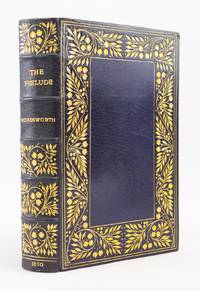
1850ST19683London: Edward Moxon 1850. FIRST EDITION. 222 x 140 mm. 8 3/4 x 5 1/2". x 374 pp. <br/> HANDSOME DARK BLUE MOROCCO GILT BY THE GUILD OF WOMEN BINDERS see below covers with frame of swirling flowering vines raised bands spine panels with similar floral decoration gilt lettering pastedowns framed by multiple gilt rules intersecting into squares at corners all edges gilt. Front pastedown with pencilled inscription attributing the binding to the Guild of Women Binders in the hand of former owner antiquarian bookseller John P. Love; front free endpaper with pencilled bibliographic information; handwritten card from Love's library catalogue laid in at front. Wise p. 35. Spine gently and evenly sunned one opening with two tiny brown marginal dots but A VERY FINE COPY with few signs of use inside or out.<br/> <br/> This is a lovely copy of one of the great autobiographies in verse offered here in a binding attributed to the Guild of Women Binders by a previous owner with extensive expertise in the field. According to DNB Wordsworth 1770-1850 began his "Prelude" in 1799 while travelling with his sister Dorothy and Samuel Coleridge in Germany using his sister's German exercise notebook to enter poetic accounts of his boyhood. These entries became the first version of his autobiographical testament a work that "is for many his most impressive poem." He completed it in 13 books in 1805 but continued to revise it throughout his lifetime adding a 14th book at the end. It was published poshumously and given its title by his wife. The Guild of Women Binders was established by bookseller Frank Karslake in 1898 to give an organizational identity to a group of women already at work binding books in various parts of Britain often in their own homes. As Tidcombe notes "because the women were generally unaware of the long history of traditional bookbinding design they produced designs that were freer and less stereotyped than those of men in the trade." Our binding is unsigned and is perhaps more conventional that other Guild works but there are elements that would lead an experienced connsoisseur like former owner John P. Love to make a confident attribution. One is the whimsical yet carefully executed spine decoration which carries over the curving floral vines from the covers. Another hint is the very slight variation in the parallel gilt rules indicating a less experienced hand. John Percival Love 1896-1974 joined the staff of the distinguished antiquarian bookseller Francis Edwards founded in 1855. Love served as Chairman of the firm from 1944 until his retirement in 1972. Like many antiquarian booksellers Love was also a collector. He built an impressive collection that was especially rich in incunabula and fine bindings. It is certainly possible that the present volume was once part of the Francis Edwards inventory and was definitively identified at that time as a Guild binding. Edward Moxon unknown
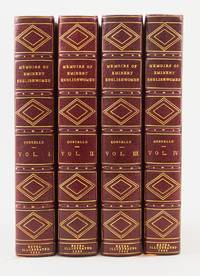
1844ST19249London: Richard Bentley 1844. FIRST EDITION. 220 x 138 mm. 8 3/4 x 5 1/2". Four volumes. <br/> HANDSOME BURGUNDY MOROCCO BY BAYNTUN stamp-signed in gilt on front turn-ins covers with triple gilt-ruled frame interlinking with a triple-gilt-ruled diamond raised bands with gilt dots gilt ruled compartments with gilt diamond shapes gilt lettering gilt-ruled turn-ins with a floral tool at each corner all edges gilt. With 18 portraits as called for four of these with hand coloring and EXTRA-ILLUSTRATED WITH AN ADDITIONAL 60 PLATES. Only the barest hint of wear to extremities spines just a shade darker than covers a handful of portraits a bit foxed but A FINE SET clean and fresh internally the bindings lustrous and the set obviously very little used.<br/> <br/> This is a very attractively bound set containing the biographies of 38 notable Englishwomen extra-illustrated with plates depicting some of the people and places integral to the subjects' lives. Covering the period from the reign of Queen Elizabeth I to the 18th century these four volumes include many women of noble birth and position such as Arabella Stuart Elizabeth Cromwell and Elizabeth Stuart Queen of Bohemia; poets and artists such as Susanna Centlivre Lady Mary Wortley Montagu and Mary Beale; and women famous for their fantastic deeds such as Jane Lane who assisted Charles II during his escape after the Battle of Worcester. Our author Louisa Stuart Costello 1799-1870 was a miniaturist poet and writer of biographies travel stories and fiction. According to DNB "her biographies of royal and noble women--which clearly traded on the popularity of similar works by Lucy Aikin the Strickland sisters and Mary Anne Everett Green--were creditable examples of this literary genre and generally involved some original research." For the present work Costello relied heavily on access to the library and papers of the duke of Devonshire whom she thanks in her introduction. In addition to 18 portraits called for in the contents several of which were drawn by Costello herself this set has been "grangerized" with 60 additional plates that further illustrate the life and times of these illustrious women. The lustrous bindings by an eminent British firm are an additional source of pleasure making a beautiful appearance on the shelf. Richard Bentley unknown
1894124133Oxford: printed for the Association by the Printers to the University 6 issues with the imprint of Horace Hart; the last 5 with that of Frederick Hall 1894-1919. The state of women's education in Oxford at the height of the suffragette agitation An important set of reports published by the pioneering Association for Promoting the Higher Education of Women AEW containing a mass of information relating to the state of women's education in Oxford at the height of the suffragette agitation. The earliest report dates from 1894-95 and the latest from 1918-19 each running from October of one year to the same month of the next. The sequence is incomplete with two issues missing 1900-01 and 1910-11. The reports are scarce in any sequence. WorldCat and Library Hub record runs at the London School of Economics and the British Library. The society's papers and publications are held in the Bodleian deposited there in 1975. The question of women's suffrage and its relevance within the structures of the University of Oxford had been a topic of frequent discussion prior to the formal debate on the subject at the Oxford Union on 19 February 1880. Societies like the Oxford Women's Liberal Association OWLA and the Women's Emancipation Union plus the activism of Florence Davenport Hill who had been a founder member of the Bristol Women's Suffrage society in 1868 and had since moved to Headington paved the way for groups like the AEW and later the Oxford Women's Suffrage Society. The organization's work led to the founding of four women's colleges: Lady Margaret Hall and Somerville opened in 1879 followed by St Hugh's in 1886 and St Hilda's in 1893. St Anne's also originated as part of the AEW catering for female students who lived with private families in Oxford while attending courses run by the society. The AEW counted the activist Eleanor Smith 1823-1896 among its founding members and Annie Rogers 1856-1937 Oxford's first woman don as a secretary. Perhaps the most significant sections in these reports are those titled "General Statistics" which provide accounts of lectures attended by students tutorial arrangements results of examinations donations and subscriptions. The report of 1917-18 also provides a commentary on the "extension of the University Parliamentary Franchise to women who being British subjects and not subject to any legal incapacity have attained the age of thirty and have been admitted to and passed the final examination and kept under the conditions required of women by the University the period of residence necessary for a man to obtain a degree at Oxford. They are registered on specially favourable terms as the Act admitting them is so drafted that the fee of £1 for registration cannot be required of persons who are not graduates. The Register contains at present the names of 409 women." The AEW continued its activities until November 1920 when it dissolved itself as the university by admitting women to membership had taken responsibility for them. 23 issues octavo; comprising a total of 616 pages the issues c.20-30 pp. in length. Original printed paper wrappers sewn and wire-stitched as issued. Housed in a former library's dark purple cloth flat-back box with metal latch closure paper label to spine reading "Australian Council for Educational Research". Each issue complete with stamps shelf marks and labels of the Education Department Library latterly the Board of Education Library. Overall a scarce survival in very good condition. Shelfwear and creasing to wrappers those for the earliest issue detached; rear wrapper for the 1909-10 issue torn but no loss. hardcover
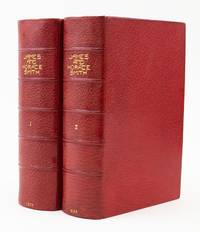
1899ST19035London: Hurst and Blackett Limited 1899. 190 x 125mm. 7 1/2 x 5". xii 128 pp.; 1 p.l. volume II title page handwritten in ink 129-312 pp. One volume expanded to two. <br/> Fine crimson crushed morocco by the Guild of Women Binders stamp-signed in gilt on front pastedown raised bands stylized gilt lettering on spines all edges gilt. With five portraits as called for and EXTRA-ILLUSTRATED WITH 264 PLATES 31 of these colored 12 folding about half of them scenes or views the rest portraits. Also containing the bookplate of David Garrick mounted on card at p. 10; an autograph letter signed from George Smart; an invoice or accounting signed by Eliza Matthews; and five other autographs mounted on heavy stock. Occasional trivial offsetting from inserted plates but A VERY FINE COPY clean and fresh internally in unworn bindings.<br/> <br/> Richly extra-illustrated with depictions of the people places and events discussed in the text this joint biography of brothers James and Horace Smith was simply and tastefully bound by members of the Guild of Women Binders. Although James 1775-1839 was a lawyer and Horace 1779-1849 a successful stockbroker both had literary aspirations and enjoyed being part of theatrical and artistic circles. Their dreams were realized when in 1812 the Drury Lane Theatre offered a £50 prize for an address to be recited on the theater's reopening following repair of fire damage. The Smiths hit on the idea of producing parodies of popular poets with James imitating Wordsworth Southey and Coleridge while Horace took on Byron Moore and Scott. Their humorous publication was an unexpected runaway hit going to seven editions in three months. According to Britannica "'Rejected Addresses' are the most widely popular parodies ever published in England and take classical rank in literature. . . . A striking feature is the absence of malice; none of the poets caricatured took offence while the imitation is so clever that both Byron and Scott are recorded to have said that they could hardly believe they had not written the addresses ascribed to them." In addition to being witty both men were kind and generous friends often helping impecunious artists. Percy Shelley and Horace became friends after competing in a sonnet-writing contest which Shelley won by producing "Ozymandias". Before leaving for Italy the poet entrusted his financial affairs to Horace of whom he said "Is it not odd that the only truly generous person I ever knew who had money enough to be generous with should be a stock-broker He writes poetry and pastoral dramas and yet knows how to make money and does make it and is still generous." The binding here was produced by the Guild of Women Binders established by bookseller Frank Karslake in 1898 to give an organizational identity to a group of women already at work binding books in various parts of Britain often in their own homes. Karslake first became interested in women binders when he visited the Victorian Era Exhibition at Earl's Court in 1897 held to celebrate the Queen's Diamond Jubilee. He was impressed with a number of bookbindings at the Jubilee exhibit prominent among them being those of Mrs. Annie MacDonald of Edinburgh and he invited the women to exhibit their work in his shop at 61 Charing Cross Road. The Guild was formed soon thereafter and operated until 1904. As Tidcombe notes "because the women were generally unaware of the long history of traditional bookbinding design they produced designs that were freer and less stereotyped than those of men in the trade." Our binding is more restrained that other Guild works but the spine lettering which juxtaposes curves and sharp angles stands out as a distinctive feature. Hurst and Blackett, Limited unknown
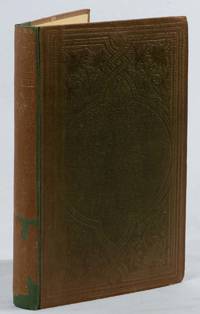
1839223681London.: Smith Elder and Co. Cornhill. 1839. Engraved handcoloured frontispiece opposite the additional engraved title page sketch map and 7 other full-page illustrations one folding and 5 hand-coloured text illustrations 2 half-title xvii including both the engraved and printed title pages 283pp; original blind-stamped pebbled green cloth boards 23 x 14.5 cms re-backed mounting the original gilt-lettered backstrip endpapers renewed scant spotting the boards faded and the backstrip chipped at the foot with the neat inked inscription of a previous owner but in very good condition. Scarce. Pioneering account beautifully illustrated after sketches by the author. Marianne Postans travelled to India in 1833 with her husband Thomas Postans a Captain in the 15th Regiment of the Bombay Native Infantry where he was posted to Cutch Kutch the northwestern region of modern-day Gujarat. They both shared a deep interest in the people and traditions of India. Marianne's account attempts to describe the culture of the region its bards and bardic literature including specific songs and stories of Kutchi bards arts and crafts and agriculture and trade. She also describes in detail rituals such as infanticide and the practise of sati. <br>The beauty of the Rann awed her: “The distant aspect of the Runn resembles that of the ocean at ebb tide; and as some water always remains on it the refraction of light produces the most beautiful and mysterious effects decorating it with all the enchantments of the most lovely specimens of mirage whose magic power exerting itself on the morning mists indues this desert tract with the most bewitching scenes…”. . Smith, Elder and Co. Cornhill. hardcover
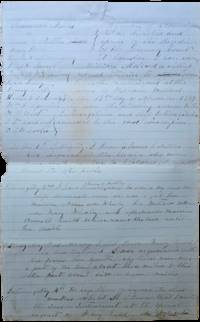
18905955Kutztown PA 1890. Quarter roan over marbled boards measuring 8 x 6.25 inches and comprised of 73 pages of manuscript text including a mixture of notes passed between friends on the verso of the final leaf and on the rear pastedown. Spine largely perished with boards and textblock held together by cords. Several leaves neatly excised towards rear. Containing notes from Fannie Hottenstein's courses in teacher training the present volumes offer researchers a range of study topics including the history of pedagogy and women's increasingly visible place in American education; the book also is a valuable resource for examining how educated young women were thinking through their own lives and roles -- as individuals and as a generation. <br /> <br /> Trained in one of the most educationally progressive states at the time Fannie Hottenstein was one of a generation of women who could more widely dream about and pursue more independent lives than their matriarchs. Historically Pennsylvania had been a vanguard for public and progressive education. "In his 1830 address to the state legislature Governor George Wold championed the cause of universal public education" as a scaffold for "the security and stability of the individual privileges we have inherited from our ancestors" Explore History. Before the decade was over "more than 1000 local school districts under a single statewide system of instruction" had been founded working to regularize "educational standards curriculum and instructional credentials" in tandem with the 1857 Normal School Act which founded "a network of ten state academies to prepare public school teachers" Explore History. Fannie attended one of these preparing for a career in education that would give her a new level of social and economic independence. <br /> <br /> Much of Fannie's notebook reflects the kind of rigorous work required to teach middle and high school students. Contents include for example three pages of facts on basic Botany; fifteen pages on the practice of Logic in writing and debate including an extensive section on presenting proper Opposition accompanied by text book page numbers; and five pages on pedagogical methods for helping students develop curiosity and drive it forward into productive study. There are additional fairly staid essay samples on topics such as Influence and Gentleness. Yet it is in the thirteen page essay We Girls that sparks of Fannie's individuality ambition and independence show. In it she reveals how much contact she has had with the period's literature on women's rights and suffrage; she shows her familiarity with anti-feminist arguments in opposition to women like her; and she powerfully expresses her hopes not only for her generation but the ones that follow.<br /> <br /> Fannie opens: "It is a recognized fact that the degree of civilization of every nation is marked by the social position of woman. Indeed one of the most prominent features of the progress of civilization is her gradual elevation in society and the clear perception and recognition of her rights. In the earlier ages of the world when the sphere of her influence was bounded by the narrow prejudices of the opposite sex her happiness as well as her mental improvement and social rank depended more on what was done for her at the hands of men than on what she could do for herself. All this is changed now." Fannie praises the hard-won changes women accomplished in accessing education and job training; and she touts how many opportunities are available for women to dream about and pursue. This does not mean she's unaware of the challenges that continue -- particularly from men. "We have to contend with the prejudice sometimes entertained against us that our highest destiny in life is to be a pretty piece of furniture in a handsome parlor. Men who entertain this notion we girls must always urge to get their furniture somewhere else." To those who accuse women of being too emotional and insufficiently intellectual she also has a response. "Our aim must be to develop and perfect our entire nature mental social and moral" she argues. Only by embracing both thinking and feeling as strengths can any individual -- man or women she contends -- succeed. Women are in a unique position to embrace both. <br /> <br /> A truly rich document which also includes brief notes among Fannie and her friends about their flirtations and recent purchases of accessories at the end gives insight into the development of a young woman who would go on to live what she preached. According to the US Census of 1900 Fannie remained single and lived in a boarding house working as an office stenographer. unknown
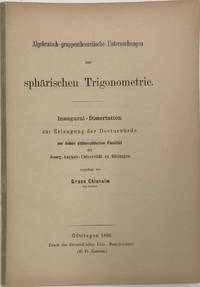
1895160351895. Chisholm Grace. Algebraic Group Theoretical Studies on Spherical Trigonometry. 1895. Scarce. Submitted in 1895 at the University of Göttingen this dissertation marks the first doctorate awarded to a woman in any discipline by a German university. At a time when Prussian institutions largely excluded women from formal academic candidacy Grace Chisholm crossed national boundaries from England to pursue advanced mathematical study under Felix Klein a leading architect of modern geometry. Her research applied group-theoretical methods then at the forefront of mathematical innovation to spherical trigonometry aligning with the Klein school's effort to unify algebra and geometry. The work stands at a pivotal moment in both the professionalization of mathematics and the gradual opening of European higher education to women.<br /> <br /> Chisholm Grace. Algebraic Group Theoretical Studies on Spherical Trigonometry. Göttingen: University of Göttingen 1895. Doctoral dissertation in German. Soft covers; 73 pages with mathematical figures and diagrams. Outer wrapper absent; green spine reinforcement visible. Minor edge wear and toning consistent with age. Chisholm later collaborated extensively with William Henry Young in analysis and measure theory while also publishing independent work such as On Infinite Derivatives 1915 which earned the Gamble Prize in Mathematics. Her career illustrates both intellectual accomplishment and structural barriers faced by women mathematicians at the turn of the twentieth century positioning this dissertation as a foundational document in the history of women in science. Overall very good condition. Scarce. Only two copies held in American institutions as per OCLC Worldcat. unknown
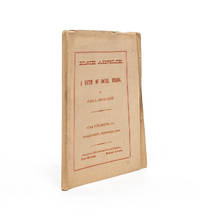
18853978Springfield Mass: Star Publishing Co 1885. First edition. Near Fine. Two variants of the first edition both in publisher's printed wraps lettered in red to front. Both exceptional survivors one in untrimmed wraps with some offsetting to the rear and fore-edges a bit chipped. Preliminary and terminal leaves uniformly toned else internally fresh. Collating 2 108 with adverts to interior of wraps. Second copy in trimmed wraps complete in 108 pages with dedication to verso of front wrap and adverts to recto of rear wrap issued without title page. Some toning to the first and final leaves else fresh. A scarce work considering the sexual dangers faced by women including women of color in a society that inadequately prepares them for male treachery. OCLC reports 8 first editions at libraries. The present pairing gives researchers a unique opportunity to study the print history of this rare work on gender and race. <br /> <br /> A contemporary publisher's advertisement for Sara Mecracken's tale of "social wrong" touts it as the story of "a beautiful pure young girl from New York" who is courted kidnapped and forced into marriage; and the publishers market her tragedy as "thrilling dramatic and touching.appropriate for the home of every mother who would prepare her daughters to meet the dangers of society." Such an overview focused on sensational thrills and conservative morality belie the sharp social critique that Mecracken delivers to white patriarchy. At its opening the book introduces us to an elderly Elsie. Watching her innocent grandson play she realizes that she has an opportunity to counteract a violent system in some small way by educating him to value the bodily rights and autonomy of women: "No he shall not be one to mar the life of the innocent nor wear the victor's crown of debauchery and wrong; my few remaining days shall be devoted to pluck one brand from the seething hell of social wrong. He shall be taught the true responsibilities which belong to his own soul." <br /> <br /> As the narrative unfolds the reader learns that in her youth Elsie a white woman trusted her suitor Albert Ainslie who would go on to sexually assault her abduct her and force her into marriage. Painfully aware now of her own vulnerability within the sexual economy she further learns that she is not the only woman Albert has victimized: he also assaulted Mira and Dora women of color "beautiful creole" girls who went on to be institutionalized and die by suicide. Women of any race are commodified and devalued by the system Albert operates within. Yet even they have stratified levels of empowerment. That the narrative comes from Elsie's perspective is notable. The suggestion persists throughout that Elsie' racial purity allowed for her survival her coerced marriage rather than abandonment and the chance to procreate and change the future through her offspring. Preserved by her whiteness she is freed from patriarchal oversight by the story's end in a way no other women are -- her father is fatally shot by Albert while attempting to free her and Albert subsequently flees to California and dies of alcoholism. No longer a victim but a survivor and a free woman under the legal system she can become a savior to future generations of women by preventing at least one boy from growing into violent manhood. In this sense Mecracken's story is progressive and conservative placing blame for systemic violence on the patriarchy while placing responsibility for its solution on individual women. Near Fine. Star Publishing Co unknown
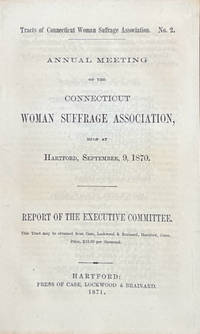
187160730Hartford CT: Printed by Case Lockwood & Brainard 1871. 8vo. 24 pp. Self-printed softcovers sewn at spine slight age toning very slight dustsoiling still NF copy. First edition of the second scarce Women’s Suffrage tract published by the pioneering Connecticut Woman Suffrage Association CWSA in 1871 subsequent to their second Annual Meeting held in 1870. This tract features the extended letter to Chicago IL suffragette and editor Myra Bradwell from Judge Howe of Wyoming detailing women serving as jurors on a murder trial jury after the passage of the Wyoming Territory’s 1869 Suffrage Act and that they discharged their duties with skill and also refutes the spurious claims that the men and women jurors had been improperly sequestered together for 4 days and nights. Following the publication of this tract Howe was replaced as a judge in the First District by Joseph Fisher a Union Army veteran who refused to recognize women being in the jury pool or allowed to set on juries even though they did have the right to vote. Isabella has also incorporated suffrage reports from the National Society for Woman Suffrage in England including specific mentions of petitions before Parliament in 1869 & 1870 on the admission of women to the suffrage by Lydia E. Becker along with excerpts of speeches by Mill delivered to the London Society of Woman Suffrage.Hooker closes with a report on a proposal by the Executive Committee to send women to meet with small local committees to “obtain signatures to the petitions for a 16th Amendment and to circulate tracts on the subject of Equal Suffrage.†See: Jessica Jenkins The Long Road to Women’s Suffrage in Connecticut Connecticut Explored Vol. 14 No. 2 Spring 2016; Kim Viner Women on the Jury: Wyoming Makes History Again Wyoming Historical Society Encyclopedia Jan. 23 2020. Printed by Case, Lockwood & Brainard, paperback
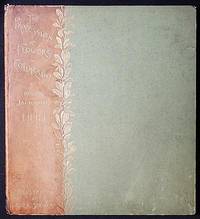
1886003136Boston: Roberts Brothers 1886. Hardcover. Very Good. 30 4 p.: hand-painted water color floral illustrations on 13 pages; 29 cm. Original wide cream calf spine with gilt-stamped cover title; light green paper over remainder of boards with gilt-stamped floral decoration running along leather-paper border. White moire endpapers. Lacking original slipcase. This is no. 47 of a limited edition of 100 copies each numbered and signed by the artist Alice Stewart. There are two or more binding variants. The illustrations vary in each of the 100 copies of this beautiful book. In Very Good Condition: edges are rubbed; binding lightly soiled; front free endpaper detached but present lacking lower gutter corner; first blank leaf following front endpapers also detached but present; a few small spots of light discoloration as is typical of this book; otherwise clean and bright. Roberts Brothers hardcover
183040052Sans lieu, , (c. 1830). 2 vol. in-8 manuscrits à pagination continue de (1)-922 pp. à 19 lignes par page, veau brun granité, dos lisse orné, filet et frise dorés d'encadrement sur les plats, tranches dorées (reliure de l'époque).
1900198801900 Aquarelle sur papier, signée en bas à droite, titrée au verso avec le cachet d'atelier, (1900), 104 x 104 cm.
1857List3026Wilcox County Alabama 1857. Two documents totaling five double-sided pages measuring 8 x 13 inches and six double-sided pages measuring 7 ½ x 12 inches. Folded with some stains and wear; Near Fine. Two legal documents from an Alabama chancery court suit brought against Susannah Nettles by her husband James C. Nettles concerning ownership of an enslaved woman named Chloe. The documents are a set of cross interrogatories and objections and their replies which were given by William Mellard the writer of the deed that originally gave Susannah ownership of Chloe. Mellard recalls that the deed written in 1829 provided the following:<br /> <br /> “Mary Rudd declared to him while directing him how to write the Instrument that as Susannah was her youngest child and a daughter that she wished while she yet lived to secure to her that much of her Estate to wit Chloe and her future increase; and she wished the Instrument so written that it would convey to Susannah the said girl Chloe in such a manner that she would not be subject to the control of her husband should she afterwards marry . and that the negro girl should not be subject to the debts of her husband should she marryâ€.<br /> <br /> Mellard claims that after Susannah’s marriage “James C. Nettles admitted the right of his wife to the Negroes and acquiesced in her title to them and did not claim any right to them.â€<br /> <br /> At the time the deed was drawn up the legal doctrine of coverture was in effect: a married woman did not have legal rights and obligations including a right to property ownership separate from her husband. Though Susannah was single at the time Chloe would have become James Nettles’ property on his marriage to Susannah were it not for the part of Mary Rudd’s deed which Mellard insists he is remembering correctly that set aside Chloe as only Susannah’s property. Though some states had passed Married Women’s Property Acts or similar Alabama would pass any such laws until 1867.1<br /> <br /> These documents are a striking example of the enforcement of a key aspect of women’s rights—the right to own one’s own property—in which it specifically hinges on the denial of rights to another group of women—those who are owned as property. Of interest to legal historians particularly of women’s rights and enslavement.<br /> <br /> 1 B. Zorina Khan The Democratization of Invention: Patents and Copyrights in American Economic Development 1790–1920 Cambridge University Press 2005 167. unknown
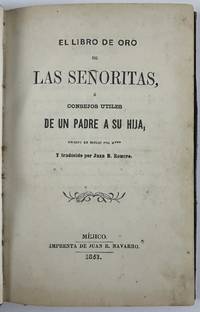
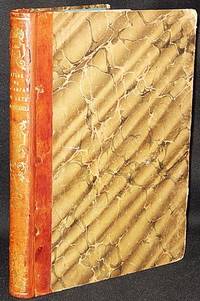
185113052Mexico City: Juan R. Navarro 1851. 208pp. Contemporary Mexican green morocco gilt borders to boards spine stamped in gilt. Minor edge wear some scuffing to boards light soiling. Uneven toning to text occasional minor staining. Overall very good. An apparently unrecorded book of manners supposedly translated from the English language by Juan B. Romero in Mexico in 1851. The title translates roughly to English as The Golden Book for Young Ladies or Useful Advice from a Father to His Daughter. We were unable to identify any English sources for this work thereby providing either an excellent research opportunity for a bibliographer to identify its source or as a new and interesting original work for scholars of Mexican literature in the 19th century. The half title indicates the work is part of the Biblioteca de la Semana de las Senoritas; OCLC reports just three other works under this series title all works of poetry. All of the works in the series were printed by Juan R. Navarro who also published a women's magazine under a similar title La semana de las senoritas mexicanas. Navarro's magazine was aimed at educating and informing women on cultural events history and science in response to the absence of formal schools. The present work presents an ideal of female behavior through advice from a helpful father figure. The chapters cover topics such as friendship education reading manners conversation entertainment interpersonal relationships marriage religious sentiments humility proper use of time and more. Somewhat morbidly the twentieth and final chapter advises young women on "prepararse para la muerte" "preparing for death". Juan R. Navarro unknown
1842003510Lisboa Lisbon: Imprensa Nacional 1842. Hardcover. Very Good. xx 154 vi p. 50 leaves of lithographed plates containing 196 illustrations; 26 cm. Rebacked retaining most of contemporary quarter calf with gilt-tooled spine title and decoration; marbled paper over boards. Blue endpapers. Includes list of subscribers. The extremely scarce Portugese edition of Atlas der Geburtshülflicher Abbildungen the important work of obstetrical plates by Dietrich Wilhelm Heinrich Busch first published the previous year. This was the first such obstetrical work published in Portuguese. In Very Good Condition: corners of boards are rubbed; reback as described; browning and foxing to both text and plates heavy at times; otherwise clean and tight. Imprensa Nacional hardcover
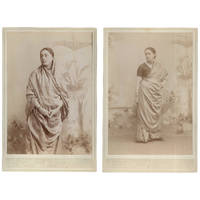
1892307182San Francisco: Abell & Priest 1892. Two fine images of pioneering physician Pauline Root dressed in a sari presumably one she wore in Madurai India while working as a doctor for the American Board of Commissioners for Foreign Missions ABCFM. <br /> <br /> Root 1859–1944 graduated from the Women's Medical College in Philadelphia and was the first female doctor to hold many posts throughout her working life. She spent seven or eight years in India establishing a Woman's Hospital in Madurai. She left India in 1891 and visited China and Japan before returning to the West Coast of the United States giving talks on her work to Christian groups along the way. She gave a lecture to the Occidental Board of Foreign Missions in San Francisco on February 3 1892 and these photographs are likely to have been taken at that time. <br /> <br /> After returning to the East Coast Root studied surgery at Cornell obtained licenses to practice in Massachusetts and New York and took a position as the resident physician at Smith College. In the 1920s she taught "social hygiene" sex-ed for the Bureau of Indian Affairs. <br /> <br /> Nineteenth century photographs of Dr. Root and other female physicians are uncommon. Drexel University has two poor condition cabinet cards of Root in Japan a few months before she arrived in San Francisco. Both images are fine with medium contrast sepia tones. The albumen silver prints measure 3-3/4 by 7-7/16 inches on 4-1/4 by 6-7/16 inch mounts. The photographer's imprint is "Abell & Priest Bancroft Building / 723 Market St. S.F. Cal." Both have blank backs with the notation "Dr. Pauline Root" and "India. Abell & Priest unknown
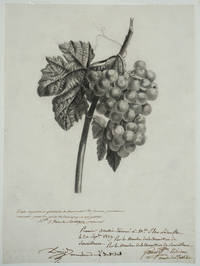
1829262371829. An intricate drawing of a bunch of grapes a survival from the Age of Enlightenment in France first prize in the annual competition given to a young woman by one of the women who ran the school. Free drawing schools were established in France from the 1740s onward with the aim of training and supporting poor children. The painter Ferrand de Monthelon was concerned about idleness of children after leaving school age 10 and before beginning apprenticeship age 15. The schools were supported by charitable donations and aimed to form the sound basis for further training in a dizzying list of trades. One of the most prominent free drawing schools was established in Paris by the painter Jean-Jacques Bachelier former artistic director of the royal porcelain manufacture at Sevres in 1766. Called "Ecole royale gratuite de dessin" it was initially only open to men. Bachelier was critical of the Guilds apprenticeship training as expensive and uninspiring. It continues today as "École nationale superieur des arts decoratifs".<br /> <br /> This drawing is a survival from another school that also trained women run by women. According to the "Almanach Royal et National pour l'An 1839" this school was directed by two sisters the Misses Frère de Montizon for young people destined to working in the arts and industrial professions. They were instructed in drawing & lithography. There was an annual prize awarded and honorable mentions instituted in 1828 the year before this drawing was done. The judges were the "Membres de la Commission de surveillance" and the artwork was publicly exhibited. The drawing is signed by Mlle Justine Frère de Montizon M. David and M. Garnier the judges & members of the "Commission". <br /> <br /> Inscribed "École royalle et gratuite de dessin pour les jeunes personnes / concours pour les prix de l'an 1829 ce 27 juillet. Mlle. T. Frère de Montizon professeur. Premier Acuellir déservé a Mlle. Flore Lécoufler le 30 Septre.1829. Par le Membres de la Commission de Surveillance. Par les Membres de la Commission de Surveillance / Garnier President Membres de l'Institute / David Membres de l'Institut".<br /> <br /> Exquisite pencil drawing approx. 6 x 9" on paper 9 1/4 x 12 3/4". Manuscript inscriptions beneath the drawing. Small pinholes in the lower left corner perhaps where the award was first pinned on exhibition. In remarkable condition.<br /> <br /> A rare survival and an accomplished drawing.<br /> <br /> De Munck Bert Steven L. Kaplan Hugo Soly edit. "Learning on the Shop Floor: Historical Perspectives on Apprenticeship" 2007. unknown
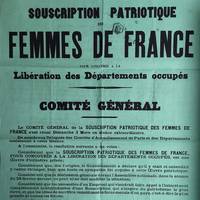
187219739<p><strong>Rare Parisian poster for the Souscription patriotique des femmes de France.</strong></p><p>It was part of the liberation of French territory following the Frankfurt Peace Treaty signed between the French Republic and the German Empire on May 10 1871. France was obliged to pay war indemnities of 5 billion francs.</p><p>Thiers' government launched an international loan and paid part of the sum so that by the end of 1871 German soldiers had evacuated the occupied territories remaining only in the city of Belfort and six departments of eastern France including the Ardennes.</p><p><strong>March 1872 the date of this poster marked the start of private initiatives to speed up repayment of the remaining war indemnity and liberate the last occupied territories as quickly as possible.</strong><br />The Souscription patriotique des femmes de France was part of this national and local movement. "<em>The Charleville municipal archives . contain documents relating to the local committee of this association. They show that after dividing the town into neighborhoods the women of this association knocked on the doors of every inhabitant to obtain cash donations or pledges." .</em> <em>"Despite this state support the subscription did not reach its target of 500 million francs and the subscribers were reimbursed. It did however bear witness to the shared determination of the population and the government to raise the funds needed to liberate the country as soon as possible."</em></p><p><strong>Fragile testimony to the central role played by women in this patriotic effort to liberate France.</strong></p><p>Information in this entry comes from the articleon the Ardennes departmental archives website.</p> Typography A. Pougin
1893248381893 Huile sur toile, signée et datée en bas à gauche, 1893, 46 x 61 cm., cadre doré.