8 019 résultats
1707619th c. Women's Education Autograph Letter Signed by a mother to a her daughter at Ipswich Female Seminary MA.1866: 4 pages folded from a single sheet. 8 x 5 in. Original mailing envelope with stamp and address. She writes on the girl's academic studies as well as the regulations with living in student life. ": "I am glad to hear from you so often & that you are getting along so well.I am satisfied that you try to have good lessons.I think it would be a good plan for you to go with a Latin class - if you will not have to work too hard." She also writes: "I do not expect you can always be perfect. I know that you will not break any of the rules of the school knowingly.I don't know as I understand what you wrote about Mrs Coats not allowing you to buy things to eat if it was that you should not go to the stores & buy treat I think she is perfectly right but I suppose she would have no objection to your having something from home." Ipswich Female Seminary was founded in Massachusetts in 1828 and the school's focus was on preparing girls for careers as teachers and missionaries. It offered a "rigorous curriculum" including study of English arithmetic geography chemistry human physiology history the natural sciences religion vocal music and calisthenics and placed an emphasis on "standards of personal conduct and discipline." As part of their preparation students practiced teaching with guidance from school instructors. Ink is slightly faded. A unique and personal piece of early Female Education history. unknown books
1707919th c. Women Education Two-Way Autograph Letter Signed on 2 pages between the head of Bethlehem Female Seminary and the guardian of one student. 10 x 7 ¾ in. Dated April 12 1813 and April 22 1813. The original letter is from the Guardian of Eliza Climer student at Bethlehem Female Seminary to Rev. Andrew Benade "Director of the Seminary at Bethlehem" to send Ms. Climer to Philadelphia "as soon as a convenient opportunity offers." He receives a response written on the same sheet below the initial letter on April 22 1813 from the new director Louis Hillner. Stating in part: "I have delivered your letter to Miss Eliza Climer directly to her; but instead of her being pleased with her soon leaving the Seminary she lamented and wept and insisted upon me to write a few lines to you and beg of you whether you would give her leave to stay in this seminary for some time longer. As she rose my whole compassion I could not do otherwise as to give her the promise to write to you. I am of the opinion dear Sir that it would indeed be for her best if she could stay here at least six months longer and I am convinced that if it is in your power dear Sir you will readily grant the petition in her behalf. You will be so kind as to let me know your intention on this head as soon as is convenient to you and I shall then act according as you think proper." The Bethlehem Female Seminary is the earliest established institution of female education in the United States tracing its roots to 1742 when it was first established in by Countess Benigna Zinzendorf. The Seminary began as an elementary educational institution for young girls starting at ages five or six years old. In 1785 due to increasing demand the Bethlehem Female Seminary reorganized as a secondary educational institution that became known as the Moravian Female Seminary. The newly reorganized female seminary also became open to all denominations. In 1913 the Seminary officially became a college and in 1954 merged with a male institution to become the coeducational Moravian College. Weakened along original fold lines. Repairs in 9 places with archival paper repair tape. Text remains clear and legible. Overall in good to very good condition. An incredible and early Female Education history. unknown books
1707719th c. Women Education Autograph Letter Signed from Student at Augusta Female Seminary in Staunton VA 1853. Letter from a female student to her father. 2 pages 8 x 6.5 in. Dated "Mar 2nd 1852". Comes with original mailing envelope. Envelope has blue seal from "Augusta Female Seminary" on rear flap. She writes on health updates and asks for her Mother to sew her some items. "Dr. Laud came up to see me yesterday and examined my foot. He said he would send me some bismuth and he wanted me to have my foot rubbed every night." The Augusta Female Seminary was founded in 1842; in 1923 it became Mary Baldwin College. The school maintained its original mission to serve women and in 2017 the institution welcomed its first residential men to campus joining day students and graduate students which had been co-educational since the mid-1970s. Today Mary Baldwin University is the oldest institution of higher education for women in the nation affiliated with the Presbyterian Church and it is home to the only all-female corps of cadets in the world. Writing on envelope and page 2 is very faded. In good condition. A unique and personal piece of early Female Education history. unknown books
1707319th c. Women's Education Autograph Letter Signed from female student dated May 25 1854. 4 pages folded from single sheet. 6.5 x 5.25 in. Written by student Eloise Hemstreet to her parents. She writes about her school which she feel is one of "the best of schools and one of the edens of the earth." She writes on her interest in astronomical observations and how she is looking forward to looking "at the eclipse through the telescope." She mentions "the college" and talks about the health and wellness of both male and female classmates at the Institution. Additionally she mentions that the College was getting a new roof. Research indicates Eloise was born in 1833 making her 21 at the time of this letter. She became a teacher thus was likely studying for the education profession as she wrote this letter. In the latter half of the 19th century women in America had growing access to higher education especially in the professional training to become teachers. For many women working as a teacher was the key to independence-both financial and socially. Hemstreet went on to teach in New York and Wisconsin where in 1861 she made $16 for teaching a summer session. Toning around bottom left edge and corner of page 1. Original fold lines with small 1/2 inch tear along outer edge of horizontal fold line on all pages. Very small tear 1/2 cm. along top edge of pages. Else in very good condition. A unique and personal piece of early Female Education history. unknown books
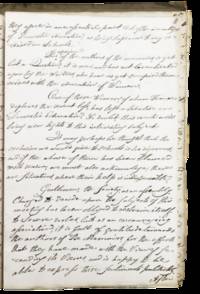
1827152741827. Philis Mr. Report of the Commission Charged to Examine Memoirs Relative to the Education of Women. Third Subject: Morality. 1827. This 1827 manuscript records one of the earliest sustained formal debates advocating systematic education for women across social classes. Structured as a commission evaluation of submitted memoirs the text advances the argument that education should be universally accessible to women "from the daughter of the Prince to that of the most humble of the subjects" asserting that the "elements of Language and Calculations" are "necessary and indispensable to women in all stations." At a time when formal education for girls was limited and higher education for women virtually nonexistent the manuscript situates female instruction not as ornamental refinement but as moral and civic necessity.<br /> <br /> Philis Mr. Report of the Commission Charged to Examine Memoirs Relative to the Education of Women. Third Subject: Morality. 1827. Folio manuscript in paper boards. 68 pages of handwritten script in black ink. The manuscript is organized around three submitted theses: "The Education Best Adapted to Form A Good Mother of A Family Is That Received at Home"; "It is Well Known That The Bad Education Of Women Does More Harm Than That of Men."; and "To Instruct the Children One Must Enlighten the Mothers." While the framing reflects prevailing assumptions that motherhood constituted women's primary social role the author strategically reverses that premise arguing that education is precisely what "nature formed women to be" capable of fulfilling their duties. Written one year after the opening of the first public high schools for girls in New York and Boston and more than a decade before women would begin earning college degrees the manuscript provides early evidence of reformist thought that linked women's education to broader civic improvement. Boards show wear with light soiling and scattered stains; manuscript evenly toned with occasional minor soiling; text clear and complete. Overall condition very good to good. unknown
1673119th cent Women Friendship album with poems and inscriptions written in many hands to a New England young lady. 1825-1830. Original paper boards. 7.5 x 6 in. 92 pages of handwritten inscriptions from numerous different individuals. Entries dated from 1825-1894. Friends included their location when they made the entry listing cities and towns from all over New England including Boston Amherst and Burlington VT. Mary Newton a young lady. Many of the entries are title "To a Friend" or "To Miss Newton." "Joy cannot claim a purer bliss Nor griefs den from stain more dear Than female friendship's meeting kiss Than female friendship's parting tear". Some such as "Song" are rhyming lines of poetry: "It is not for your eagle eye Though bright it glance may be It is not for your sunny smile That Mary I love thee-". The poems were usually not original but would have heavy themes of memory and sentimentality. "I looked and behold! A dark cloud met my sight But soon its thick mantle was blended with light For the sun's glorious ray had now shone from on high And light was the hue of the once clouded sky; So may all they hopes when with sorrow o'ercast Shine bright when the cloud of affliction has past Till thy spirit shall sick a pure mansion on high Where sorrow worn wanderer never heave a sigh."<br/><br/>One entry hints at the different jobs which may lead female friends to part ways. "Farewell my dear Mary the time is at hand That we must be parted from this social band Our several employments now call us away Our parting is needful and we must obey." She also writes on the ways in which women and men have equal rights and needs in a marriage. "I have always admired that receipt for making a good husband which enjoins that the wife should always greet him at this own door with smile. These smiles are cheap things; but when they spring from benign temper and an affectionate heart they penetrate all the hidden and primary sources of action-wives are also entitled to the greetings of their husbands. Women hold the keys of affection." Some of the poems had cheeky messages that could only be shared between close friends: "Says the rosebud to the bee 'Pray bee what does want of me" Blushing charmer 'May I help it' 'Do and welcome says the rose' And protest it as it flows' So the rose had bud and the bee Sealed a . of amity But a worm without a wing Enjoying then so sweet a thing Slyly unsuspecting stole And ate the rose bud to the soul." With a note below that "Bees are Husbands worms are Beaus." Light even toning heavier on first few pages. Some entries quite faded yet still legible. Original paper boards worn separated from sheets. Good condition. unknown books
184325566Philadelphia and New York: Various 1843. Three novels by these women writers individually published & separately paginated bound in one volume including: The Cadet De Colobrieres. A Tale of the Old Convents of Paris. Translated from the French of Madame Charles Reybaud. Complete in One Volume. Philadelphia: Carey and Hart 1847. 91 pages; with a one-page Preface by the un-named translator. Henriette Etiennette Fanny Arnaud Reybaud 1802-1871 French writer who wrote under the name of Madame Charles Reybaud and other noms-de-plume. Title page with the signature at top margin of V.E. Baudry May 1847. Cleveland: A Tale of the Catholic Church. New York: Burgess Stringer & Co. 1847. 105 pages printed double-column. Author is not noted on title page; by British writer Mary Anne Georgia Murray-Gartshore. d. 1851. Tipped on to the title page are two thin strips of paper with a clipped signature and date of V.E. Baudry Sept. 1847. Life in Sweden. The President's Daughters. Part II Nina. By Frederika Bremer translated by Mary Howitt. New York Published by Harper & Brothers 1843. 137 pages printed double column. Fredrika Bremer 1801-1865 Swedish writer feminist reformer; Mary Howitt Mary Howitt 1799-1888 prolific English author; nee Botham; published translations from Frederika Bremer and Hans Andersen and successful children's books. DNB. Previous owner small bookplate of S.M. DuPont on the front endpaper; binder's note in pencil on back free endpaper "Dupont ½ roan" Approx. 6" x 9 1/8" size; bound in blue & black striped & marbled paper covered boards black leather spine and corners gilt spine titles and simple rule-lines gilt. Much rubbing and wear to the boards & corners; some foxing and spotting to the contents; in good condition. . First Edition. Leather. Good. Various books
2023DADAX081319783XUniversity Press of Kentucky 2023-11-14. hardcover. New. 6.40x3.10x8.80. Buy with confidence. Excellent Customer Service & Return policy. University Press of Kentucky hardcover
20231-081319783XUniv Pr of Kentucky 2023. Hardcover. New. 1200 pages. 9.00x6.00x2.25 inches. Univ Pr of Kentucky hardcover
197456566Boston MA: 9 To 5 1974. Thirteen 8-1/2x11 inch sheets plus cover sheet stapled at left. Printed one side. VG. 9 To 5 unknown books
1863130211863 Paris, Morizot, 1863 fort volume grand in8, reliure de l'époque en demi chagrin , dos a nerfs, caissons ornés, titre doré, toutes tranches dorées, , garde moirée, 438 pp illustrées de 20 portraits lithographiés hors texte , bel exemplaire, bien relié a l'époque , intérieur de toute fraicheur, sans rousseurs, La duchesse de Bourgogne, Adrienne Lecouvreur, la duchesse de Berry, la marquise de Parabère, la duchesse d'Orléans, mademoiselle de Valois, l'abbesse de Chelles, la comédienne Emilie, Rosalba, madame de Tencin, mademoiselle Gaussin, la duchesse de Chateauroux, mademoiselle de Camargo, madame de Pompadour, madame du Chastelet, madame de la Popelinière, madame de Warens, mademoiselle de Marivaux, mademoiselle de Lespinasse, la reine Marie-Antoinette, mademoiselle Guimard, Sophie Arnould, mademoiselle Clairon, la blanchisseuse de Dufresny, la femme de Crébillon, la Manon de l'abbé Prévost, les filles de Grétry, la fille de Vanloo, madame Vigée-Lebrun, madame Récamier
34625Paris Calmann-Lévy, éditeur 1880 in 12 1 volume reliure demi maroquin saumon à coins de l'époque, dos à nerfs orné de caissons dorés avec fleurons dorés centraux mosaïqués, tête dorée, VII et 103 pages. Exemplaire imprimé sur papier vergé fort. Edition originale. Bel exemplaire, dans une fine et décorative reliure de l'époque ( Photographies sur demande / We can send pictures of this book on simple request )
19650London. Dated at head 'February 13th. A.D. 1890'. 3pp. 4to. Bifolium. Folded in customary fashion with 'Brief for the opinion of Mr Harington' on the outside of the packet beneath which in another hand: 'Feby 14th. 1890 Richard Harington Esq'. The author's hand is clearly disguised as is usual with valentines the writing being markedly ornate. There are various crude drawings in the margins ranging from images of a barrister and a woman faces of two women one smoking a pipe to small representations of cigar boxes briefs and books. The text of the poem which is unpublished reads: 'I sit me down and take my pen And write to you this line To greet you as in former years. Upon Saint Valentine Another year has rolled away Since February last And think of all those briefs & balls Now reckoned with the past. And may you of the latter have Enough to renovate you And joined with these this year I hope Ten thousand briefs await you. But I must further add – I trust That “Hawky†will have done And not keep you all sitting up Till some time after one! You say some day that ladies will Appear in wig and gown And armed with blue bags & with briefs Have “chambers†up in Town. Its rather sad to think of it What would you poor men do If your briefs went to Mrs. A Instead of going to you The Judge must be a lady too - I'd quite forgotten that But we've no ladies now-a-days To sit as Portia sat And then to think if all the girls Were so Su-per-i-or There'd be no dancing & no fun All would give way to law. No no I'm a conservative And you'll agree with me Let men remain the barristers And women what they be!' Last four lines and the word 'Su-per-i-or' in red ink the rest in black. From the Harington family papers. Sir Richard Harington of Ridlington 12th Baronet was educated at Eton and Christ College Cambridge. Called to the Bar in 1886 he practised as a barrister on the Oxford Circuit before taking up an appointment as a Puisne Judge in the High Court of Justice at Fort William in Bengal in 1899 serving in that capacity until returning home in 1913. In later years he acted as Justice of the Peace and Deputy Lieutenant for Herefordshire. [ London. ] Dated at head 'February 13th. A.D. 1890'. unknown
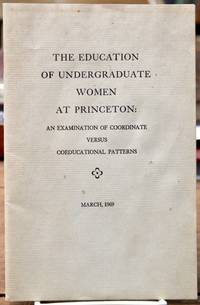
196916973<p>Princeton New Jersey: Princeton University March 1969 Pale bule printed paper wrappers. . Octavo. With a full-page table comparing educational models. Fading and light foxing to front cover. Very bright and clean throughout. A very good copy of an uncommon item reporting the results of a study on how Princeton University could implement their decision to admit women. A committee of Princeton students faculty and administrators considered five models for incorporating women into the college: 1 "Separate educational institutions joined by a 'treaty' which makes possible some sharing of facilities and faculty"; 2 "Two institutions with separate formal identities but with one faculty identified with the men's college"; 3 "A separate women's residential college or zone within the University"; 4 "A single institution with an established ratio of women to men students but with no separate residential college"; and 5 "A single institution with no established ratio of women to men students." The present item summarizes the characteristics advantages and disadvantages of the five models. Princeton began admitting undergraduate women in the fall of 1969 under the fourth proposed model. The model allowed women to choose between living on campus in designated spaces women-only dorms or women's sections in larger dorms or living off campus and between eating and socializing in communal spaces with men or in their own dorms and private residences. The text reads: "This model avoids any connotations of 'segregation' and thus is attractive on grounds of principle to those who believe it is important that men and women students learn how to know each other simply as 'people'" p. 9.</p> Princeton University,]
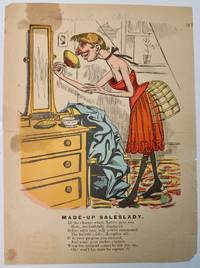
189516961n.p.: ca. 1895 Three leaves two sized 7" x 10" one sized 6 " x 11 ". . Printed in color with caricatures mocking the appearance and character of three working women. With captions in verse. Some creasing and a few small open tears to edges. Two sheets reinforced with document tape on versos. A few stains to "Made-Up Saleslady." Pencil signatures of Clementine Allen to rectos of "Gossiping Wash-Lady" and "Made-Up Saleslady" plus pencil inscription on verso of the former "To Clementine from Lloyd 1895" and date 1895 on verso of the latter. A very good set of these fragile "vinegar valentines." These insulting valentines commonly referred to as vinegar valentines or penny dreadfuls sharing the nickname with Victorian-era dime novels first appeared in the 1840s and maintained a prominent place in pop culture well into the twentieth century. They were produced from the cheapest paper and were designed to be sent anonymously; the inscriptions in the present set however beg the question of whether Clementine sent a vinegar valentine to Lloyd in return. Vinegar valentines were "designed to caricature the shortcomings of the recipient and encapsulate the spirit of the Victorian era…During the 1920s and 1930s they were very popular among schoolboys who were more than happy to give their cranky teacher their grouchy neighbor and bullish schoolgirls. Every trade or profession was represented in terms far from flattering including politicians…Vinegar valentines reflected the spirit of the times between the late 1800s to 1920s with rising taxes wartime and the women's suffrage movement."
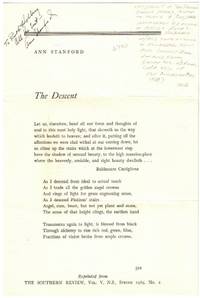
68799Ephemera. Very Good. This lot includes:<br /> <br /> 1 Offprint of "The Descent." folded to make 4 pages. Reprinted from The Southern Review Vol. V N.S. Spring 1969 No. 2. Inscribed by author to Ruth L. Holberg. Massachusetts author Ruth Langland Holberg 1889-1984 wrote a number of children's books two cookbooks and several poems.<br /> 2 ALS on a sheet of paper 7 1/4 x 10 3/8". Two horizontal fold lines. With envelope torn. The letter discusses the fact that Stanford received the Shelley Memorial Award. She also mentions that her new book of poetry "The Descent" will be coming out the following spring.<br /> 3 Poetry Society of America Bulletin May 1969 with very occasional minor pen marks. California poet and scholar Ann Stanford 1916-1987 studied at Stanford University and Radcliffe College and earned her PhD at UCLA. She published eight poetry collections during her lifetime. Her poetry is meditative and often weaves themes of ecology urbanity and solitude. Stanford is also known for her translation of the "Bhagavad Gita" 1970. Her legacy is honored by the University of Southern California with the Ann Stanford Poetry Prize. unknown
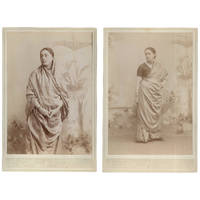
1892307182San Francisco: Abell & Priest 1892. Two fine images of pioneering physician Pauline Root dressed in a sari presumably one she wore in Madurai India while working as a doctor for the American Board of Commissioners for Foreign Missions ABCFM. <br /> <br /> Root 1859–1944 graduated from the Women's Medical College in Philadelphia and was the first female doctor to hold many posts throughout her working life. She spent seven or eight years in India establishing a Woman's Hospital in Madurai. She left India in 1891 and visited China and Japan before returning to the West Coast of the United States giving talks on her work to Christian groups along the way. She gave a lecture to the Occidental Board of Foreign Missions in San Francisco on February 3 1892 and these photographs are likely to have been taken at that time. <br /> <br /> After returning to the East Coast Root studied surgery at Cornell obtained licenses to practice in Massachusetts and New York and took a position as the resident physician at Smith College. In the 1920s she taught "social hygiene" sex-ed for the Bureau of Indian Affairs. <br /> <br /> Nineteenth century photographs of Dr. Root and other female physicians are uncommon. Drexel University has two poor condition cabinet cards of Root in Japan a few months before she arrived in San Francisco. Both images are fine with medium contrast sepia tones. The albumen silver prints measure 3-3/4 by 7-7/16 inches on 4-1/4 by 6-7/16 inch mounts. The photographer's imprint is "Abell & Priest Bancroft Building / 723 Market St. S.F. Cal." Both have blank backs with the notation "Dr. Pauline Root" and "India. Abell & Priest unknown
194758899Garden City NY: The Crime Club Doubleday & Co. Inc. 1947. 8vo. 217 1 pp. Brick red cloth white lettering front cover & spine light uniform interior toning w/ d.j. cover art of jeweled Preying Mantis minor chipping head & foot of spine couple minor tears dustsoiling still VG/G copy. First edition stated of this uncommon Crime Club mystery of suspense a blind con artist a jeweled brooch and the secret society of The Preying Mantis. Rutledge 1901-1976 wrote ten mysteries from 1944-1960 as Rutledge and also published with the pseudonym Leigh Bryson in 1947 with Preying Mantis as her 3rd. The Crime Club, Doubleday & Co., Inc., hardcover
16672Women in Science Medicine Original Gelatin silver print photograph of a Rustic pharmacological laboratory with female technician c. 1910. Three individuals pose amongst dozens of glass vials containing medical powders and remedies. 3.5 x 5 in. Original black and white photograph. Two figures wear white aprons or smocks indicating their important role in mixing and measuring different medicines. The first university Pharmacology department was established in 1847 and thus began the formalization of this field of scientific research as the 20th century witnessed a steady increase in the number of new drugs that would improve the human condition tremendously. Verso inscription in pencil and pen in European language. Very good condition. unknown
GF17656Vevey, Guignard - Paris, Packer, 1899 - Une plaquette (12 x18 cm) brochée de 48 pages -
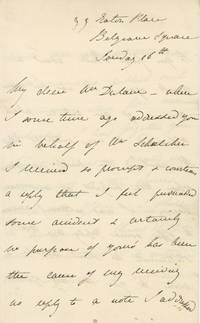
1800List2802London United Kingdom 1800. Single four page letter measuring 4 ½ x 7 inches. Near fine. Frances Anne “Fanny†Kemble 1809–1893 was a British actor writer and later abolitionist. After her initial retirement from acting she married Pierce Mease Butler maternal grandson of American Founding Father Pierce Butler. Butler and Kemble lived in Philadelphia but Butler had been deeded three large plantations—and the people enslaved on them—on Butler Island in Georgia. Kemble finally saw the plantations for herself several years into their marriage and during this time wrote Journal of a Residence on a Georgian Plantation in 1838–1839 which was critical of the conditions of the enslaved people. Butler forbade Kemble to publish the Journal; the two divorced but it was not published until 1863.<br /> <br /> Offered here is a letter from Fanny Kemble to a publisher or newspaper editor about printing her response to a statement in an article about American slavery likely written following her return to London in 1877. Kemble is frustrated about not having received a reply to her initial note to the publisher which was:<br /> <br /> “in consequence of an article which appeared to me extremely likely to the public judgement upon the subject of American slavery – I was extremely anxious to offer some reply to the statement in that article & wrote to you to beg you could tell me whether you would receive & publish such a communication from me . it contained some references to my own private circumstances which I intended for you & no one else.â€<br /> <br /> Of interest to scholars of the abolitionist movement especially women abolitionists. unknown
195062367London: Robert Hale Ltd. 1950. Tall 8vo. x 302 pp. Photo frontisp. numerous photo plates. Green publisher’s cloth gilt lettering on spine w/ d.j. cover art by CWB minor chipping head & foot of spine edgewear still VG/VG copy. First British edition of this adventure memoir recounting Ellen Waddil Gatti’s experiences on an expedition into the Belgian Congo in search of the rare Okapi with her husband Attilio Gatti detailing her efforts to build a jungle home grow a vegetable garden and experience with many of the Indigenous African peoples. Robert Hale, Ltd., hardcover
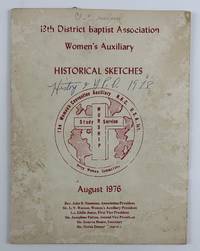
19764649Shreveport La 1976. Good. 34pp. Original pictorial cream wrappers stapled. Moderate staining and noticeable insect damage to wrappers some pen notations on covers. A few ink notations and underlinings in the text but mostly clean with center gathering detached. An unrecorded pamphlet containing numerous "historical sketches" of the various groups within the 13th District Baptist Association Women's Auxiliary in Shreveport Louisiana. The work contains a history of the Antioch Baptist Church Missionary Society which began in 1889 and sketches on the women of the Broadway Missionary Church Mission Band the Lakeside Baptist Church the Little Union Missionary Baptist Church Mission Society and Woman's Missionary Union and many many more groups from area churches. The text is illustrated throughout with dozens of photographs of notable officers members and other figures within the groups various churches and more. An excellent snapshot of Shreveport-area women's church groups with no copies in OCLC. unknown
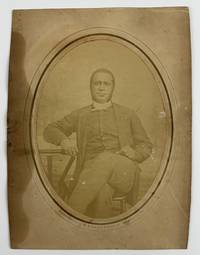
18804292Wilmington De: E. Webb 1880. Good. Oval albumen photograph 7.25 x 5.25 inches at nexus points on a printed studio mount measuring 10 x 7.5 inches. Long stain along left edge not touching the image some edge wear and spotting to mount minor soiling and surface wear to image. Verso tanned. A striking photographic portrait of a dignified African-American man in jacket and collar leaning against a table in a Delaware photographic studio in the latter part of the 19th century. The photographer was Emily Webb 1830-1914 an early Delaware photographer trained by her shutterfly father Benjamin Webb. The printed caption on the present studio mount reads "Photographed by E. Webb 302 Market St. Wilmington Del." Webb opened her Union Gallery studio on Market Street in 1864 and became a legendary local figure who at one time was referred to as "The Most Interesting Woman in Wilmington." She was a prolific photographer who took studio portraits of the local community especially the African-American community but also pets and other wildlife. She even helped found the Wilmington chapter of the SPCA in 1882. Webb's photographs are uncommon in the trade but her portraits of African-American figures even more so. E. Webb unknown
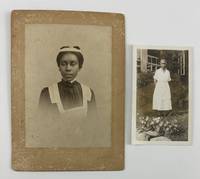
19025398Philadelphia: C.M. Gilbert 1902. Very good. Albumen photograph 5.5 x 4 inches on a cardboard studio mount. Minor surface rubbing dust-soiling and edge wear. A wonderful original photograph of Gertrude Easton dated in March 1902 and produced by the C.M. Gilbert Studio in Philadelphia. In the present photograph Gertrude Easton 1878-1950 is dressed in a domestic servant's uniform. A later vernacular photograph of Easton is also present here and sheds clear light on Easton's work via the manuscript notation on its verso: "Gertrude Easton originally from New Haven Conn went to work for Rebecca & Grellet Collins in Wynwood Pa. at 16 yrs old. Spent later life at Dott & Mort Gibbons Neff." The older photograph here has a small printed sticker on the back belonging to Grellet Newell Collins with his address in Philadelphia. Collins was half-owner of Dill & Collins Paper Company in Philadelphia. An interesting pair of photographs capturing a young African-American domestic worker in her young years and then her later life. C.M. Gilbert unknown