5 244 résultats
199556987San Francisco CA: Levi Strauss & Co. Publishing 1995. Folio. 313 5 pp. With 100s of illustrations colour plates colour photos large folding plates & pages illustrated endpapers. Quarter-black cloth over illustrated boards cover art of Levi’s brand jean label slight shelfwear rubbing w/ mylar dustjacket minor bumping to foot of spine edgewear still NF/VG- copy inscribed by Downey & McDonough in Sharpie marker on ffep. to Gina “Always sweet always the best-dressed!†First edition signed presentation copy of this lavish pop-culture artist’s book celebrating the advertising and Levi’s jeans worn by miners labor union members field workers protesters and many others for over 150 years. Even includes a photograph of the complete first womenswear outfit produced by Levi Strauss of hiking knickerbockers for that visit to Yosemite. Levi Strauss & Co., Publishing, hardcover
151960351Greenwich CT & New York: Conde Nast Publications Inc. Sept. 15 1932. Folio. 96 pp. With 100’s of text illustrations photo illustrations mostly in black & white some colour illustrations photos & plates. Colour-illustrated softcovers cover art by Benito 1891-1981 on metallic silver background Art Deco lettering design Camel cigarette ad on back cover chipping head & foot of spine minor creasing edgewear still VG copy. First edition thus of this installment in the noted fashion magazine’s results of the Paris Autumn fashion lines featuring designs by Schiaparelli Patou Lelong Forstmann’s Elga and others. Benito who was a native of Valladolid Spain later became one of the most iconic Art Deco artists of the Jazz Age creating covers for Vogue and Vanity Fair and heavily influenced by Picasso Modigliani and others. Conde Nast Publications, Inc., paperback
196758002Philadelphia: Budget Uniform Center 1613 Chestnut Street Winter 1967. 4to. 54 2 pp. With 100’s of photo illustrations many in colour. Colour-illustrated softcovers scuffing front & back cover minor shelfwear rubbing still VG copy from library of Phyllis M. Compton w/ mailing label on back cover. First edition of this 1960’s marketed to the “miss who likes to be ‘with it’ while maintaining a professional look.†Budget Uniform Center nursing and medical uniforms emphasized their drip-dry Dacron and Cotton Bengaline blends or the Drip-Dry Dacron and Nylon stretch jersey fabrics featuring “top designer’s†shift shape dresses swinging skirts demi-fit skimmer shapes and more all presented as the new sleek slim high-fashion uniforms. Candy Striper and other auxiliary uniforms and smocks were available while also offering for sale Kay’s No-Starch Caps shadowproof slips and graceful Naturalizer sole shoes. No copies in Worldcat. Budget Uniform Center, 1613 Chestnut Street, paperback

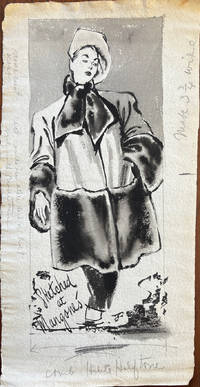
194261064Brooklyn NY: Barbara Duffy ca. 1942-1945. Seven pieces of original pen & ink art and gouache colouring and overpainting sized from 10 x 15 in. 3 up to 15 x 20 in. 3 on “Winsor & Newton’s Illustration Board 30 x 40†while the 7th piece is 9 x 17 in. executed on textured thick laid-paper pencil annotations in MS on fore-edges all pieces signed in thick black pen on versos some dustsoiling staining to fore-edges to a couple bumping to corners edgewear still a VG set of well-done exemplars. These original fashion design illustrations encompass women’s dresses hats fur coats evening wear and a post-War design by Mangone. The two dresses drawn by Duffy are reminiscent of the Claire McCardell easy to wear and comfortable dresses which emerged at the end of the War and featured a cinched-in waist floppy collars and padded shoulders retaining the influence of men’s tailoring on women’s fashions during the War. The “Toppers†are splendid examples of box or swagger coats often made in light wool cotton or rayon blends and in this case with fetching hats and cinched-in waists. The two smaller designs with mink or beaver coats include one with a matching purse and the other with a pillbox hat. The two “Paris†style Cloche hats are nicely drawn and one is fitted with a mesh veil. The exceptional Mangone design indicates it was “Sketched at Mangone’s†which was probably one of the frequent sessions the designer would put on fashion shows at the Fashion Institute or local boutiques in and around New York following World War II and features a coat trimmed in beaver fur with Cloche hat and according to Duffy was available in light and dark wool along with an ascot. Mangone 1884-1957 was not only a significant Italian-American designer who quickly adapted Paris fashion trends into his own American style and was very popular from before World War I until after World War II. Strikingly he also was a survivor of the Hindenburg disaster who managed to leap from the Zeppelin at Lakehurst NJ with his daughter and grand-daughter looking on suffering significant burns and after shock and hospitalization spent considerable time recovering. Duffy b. 1919 taught at the Jacob Gould Vocational School for girls in Prospect Park Brooklyn NY from the time she left college until after World War II after which she worked as designer in local department stores and then disappears from census and public records. Barbara Duffy, unknown
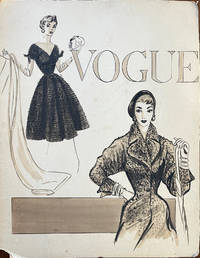
195561063Los Angeles CA: K. Jo ca. 1955. Folio. 14 x 18 in. Original pen & ink w/ gouache colouring on studio board initials of artist at lower right corner edgewear & chipping to corners fore-edges still a VG- exemplar. This delightful artwork mock-up for a Vogue fashion advertising counter display featuring a stylish black chenille silk yarn cocktail dress with the model sporting a short haircut hoop earrings and white evening gloves. The same model is shown wearing a beret and chenille wool/rayon fabric evening coat double-breasted pinch waist and gloves. K. Jo the unidentified artist has left the banner blank which would have included in the printed version the day & time of either the fashion display or of the possible patterns. This cataloguer could find no information on the original artist and two possible references to cover art designs for Vogue in 1951 and 1953. K. Jo, unknown
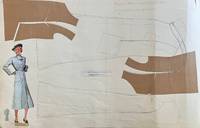
193059525Hannover: Schneidermister ca. 1930-1933. Oblong elephant folio. 23.5 x 14.5 in. 25 leaves unnumbered. Original women’s fashion patterns in pencil throughout many with tipped-in pattern cutouts mounted on the sheets as well as colour images of the finished design tipped-in and mounted manuscript pencil notes & directions in some colour pencil additions to a a few patterns. Stiff limp beige covers black cloth spine title mounted on front cover scutting edgewear repair to corners of front cover corner still a remarkable manuscript w/ tipped-in instructions for taking measurements and fashion by the Nazi Party on first leaf including one entitled “Ein Modewart macht Propaganda.†This German fashion pattern tailoring and pattern manuscript provides an exceptional original artifact of the period when the Nazi Party began to force educational and cultural changes upon German Society against the tailoring and fashion industry in Germany during the early 1930’s. By 1930 Berlin had emerged as an international fashion capital drawing Parisian fashion designers and most of the tailoring schools and fashion houses were operated by generations of Jewish family owners. Tailors and fashion designers were constantly reminded that they must create a wholly Aryan fashion and that they were to avoid French or other outside influences. Despite the pressure most women tailors and fashion designers in the tailoring or cutting schools continued to still draw their influences from Parisian and American couturiers by creating their own patterns and pattern books from which these internationally themed clothing designs could be made. This fashion pattern book by Bode focuses on women’s suits skirts capes coats and knickerbockers. However the Party never succeeded in creating a unique Fashion industry especially because of the drive to dress women in peasant costumes or uniforms even as the Nazi Party would confiscate the assets of over 2700 Jewish fashion houses retailers and manufacturers with 1000’s of tailors and seamstresses forced into labor and concentration camps to produce clothes for military and high society. See: Uwe Westphal Fashion Metropolis Berlin 1836-1939: The Story of the Rise and Destruction of the Jewish Fashion Industry 2019. Schneidermister, hardcover
191344810New York: Reliance Newspaper Syndicate 1913. 12mo. 101 1 pp. Photo frntsp. numerous photo plates. Orange cloth blk lettrng on frnt cvr & spine slght bmpng hd of spine mnr dustsoilng hd & ft of spine w/ d.j. mnr chppng & tear hd of spine affecting lettrng tear to lwr fore-edge of rear cover some dustsoilng still NF/G- copy. First edition of this fascinating and early work advising careers in the burgeoning silent movie industry. Agnew 1891-1967 starred in a number of early movies for the small studios but by her early 20s was becoming an agent industry critic and screenwriter on such movies as Are Parents People The Golden Princess; Soft Living; Love Hungry; and others. She includes sections describing the early history of the industry the differences of acting in movies as opposed to stage necessary qualifications training agencies salaries and producing. Of particular interest are her chapters on early stars with interviews including Miss Gwendoline Pates with Pathe Freres Carlyle Blackwell with Kalem Miss Miriam Nesbitt with Edison Miss Flora Finch with Vitagraph Miss Muriel Ostriche with Reliance John Bunny with Vitagraph and others. Very scarce in the original dustjacket. Reliance Newspaper Syndicate, hardcover
196059781Binghamton NY: John Kolcun Maureen O’Hara Fan Club Spring 1960. 4to. 43 leaves dittoed. With 5 tipped-in photographs. Illustrated dittoed softcovers cover art by Robert Shoemaker lozenge photo of O’Hara by Dorothy M. Fenger stapled as issued at gutter margin minor shelfwear rubbing still NF copy from library of Jim & Ruth Hanf w/ membership dues notice and membership fan club card laid-in. First edition of this exceedingly scarce fanzine issued by the consummate John Kolcun who was President of Maureen’s official fan club in the 1950’s and 1960’s with a roster of over 800 members. Each issue was filled with tan letters box office totals newspaper items reviews announcements of coming performances and theatrical appearances as well as personal information. O’Hara 1920-2015 was born Maureen FitzSimons and is perhaps best remembered for her iconic portrayals of hard-headed and athletic women. She typically performed her own stunts and played roles ranging from the cynical mother of Natalie Wood in Miracle on 34th Street 1947 to the Quiet Man Wings of Eagles McClintock! and Big Jake starring with John Wayne. No copies in Worldcat. John Kolcun, Maureen O’Hara Fan Club, paperback
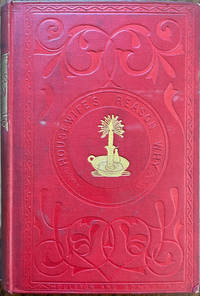
186963221London: Houlston & Sons Paternoster Square 1869. 12mo. xvi 368 pp. Embossed & decorated red publisher’s cloth gilt illust. front cover gilt lettering on spine advertising on endpapers minor dustsoiling darkening to spine slight shelfwear still a VG bright copy. Revised & expanded edition of this Victorian handbook which served as precursor to the modern-day search engine and offered concise quick researched facts about food cookery food science chemistry heating & ventilation cleanliness women’s medicine pediatrics and more. Philp 1819-1882 was an organizer and contributor to the Chartist Movement in the UK pushing for universal male suffrage secret ballots annual parliamentary elections and other reforms but is perhaps best remembered as the very successful publisher of his handbooks on practical everyday topics which originally launched in 1856 with “Enquire Within†and later in 1867 with the early version of this title. Houlston & Sons, Paternoster Square, hardcover
187058998London: T. Nelson and Sons Pternoster Row 1870. 12mo. viii 9-160 pp. Woodcut-engraved vignette on title woodcut engraved frontisp. woodcut engraved illustrations throughout some as borders plates text illustrations. Publisher’s decorated red cloth over beveled boards gilt & black ornamental borders & lettering blue-tinted plate mounted front cover brown clay-sized endpapers a.e.g. very minor edgewear to lower corners slight bumping to rear corner still VG bright copy w/ former ownership markings on 2nd flyleaf. First edition of this second title in the “Walter†series by the author of the “Walter at the Sea-side†a popular work on marine zoology for young people. This volume explores the arboreal residents of Southern England’s New Forest first proclaimed a Royal Forest in 1079 at the time 150 acres of protected hunting lands. Inter-weaved are poetry and anecdotes of oaks chestnuts elms birches conifers cypress â€Graveyard Trees†and even describes the California Sequoia and its attributes. Mary Greg 1809-1895 worked with her husband in establishing “The Mount†where she assisted her husband Samuel Greg II 1804-1876 British industrialist and Unitarian philanthropist and lecturer on scientfic subjects to the workers of Macclesfield. She was a close friend of the poet and author Elizabeth Gaskell who often stayed with the family and was a frequent correspondent while Mary Greg wrote on natural history and religious topics. See: Marie Moss Travelling the Literary Trail The Gaskell Society Newsletter Aug. 2000 pp. 8-10. T. Nelson and Sons, Pternoster Row, hardcover
179148375Paris: Au Bureau des Revolutions de Paris Rue des Marais 1791. 8vo. xvi 460 pp. Engraved frontisp. 4 engraved plates. Contemporary quarter-calf over green marbled boards rebacked occasional light foxing some toning still VG copy signed by the publisher on verso of half-title with details about the engravings. First edition signed of this sensationalistic and titillating commentary on the social and sexual habits of the Queens of France with special emphasis on Marie Antoinette. Louise de Keralio 1757-1821 denounced Queen Marie Antoinette with subtle reference to her sexual debauchery and art of seducing and betraying as well as much more awful crimes. The text was released under the publisher’s name instead of that of Keralio although as early as 1791 Keralio was attacked in Les crimes constitutionnels de France for writing the work. She also reviewed many of the other notorious French Queens noting their turpitudes and condemning their sexual dalliances and crimes. See: Weber Queen of fashion: what Marie Antoinette wore to the Revolution; Hunt Psychoanalysis Feminism and the French Revolution in Main Trends in Cultural History pp. 170-172; Au Bureau des Revolutions de Paris, Rue des Marais, hardcover
193960959San Francisco CA: San Francisco Bay Exposition 1939. 8vo. 116 pp. With oblong folio. 19.25 x 16 in. colour pictorial map frontisp. detailed sections of island and exhibits in blue on verso fold creases numerous photo illustrations text maps diagrams stepped thumb tabs at outer fore-edge. Blue-cloth backed softcovers featuring the striking Art Deco cover art by Simon “Si†Vanderlaan 1904-1986 famed pin-up artist and illustrator who worked for Walt Disney studios during World War II minor scuffing very minor age toning shelfwear still VG bright copy from the library of Prof. Marvin Nathan. Revised 1939 edition of this excellent guide to the first year in 1939 of the Golden Gate International Exposition including “Cartograph†revealing all of the Art Deco architectural wonders and surrounding areas of Treasure Island. The pictorial maps were issued separately as well as with the “Official Guide Books.†Ruth Taylor White’s 1902-1985 delightful pictographic maps or cartographs included depictions of the Territory of Hawaii in which she had driven or traveled to every corner of the Islands and the Grand Canyon for her for her brother’s book “Grand Canyon Country.†Later Little Brown requested an entire atlas which was published as the very scarce Our U.S.A. “A gay geography.†Her cartographs influenced the style of American cartographic illustration for decades afterwards. See: Griffin Mapping Wonderlands: Illustrated Cartography pp. 192-193; Field MapCarte 29/364: Our U.S.A. A Gay Geography 2014. San Francisco Bay Exposition, paperback
194060958San Francisco: Golden Gate International Exposition 1940. 4to. 4 pp upaginated. printed on gold-coloured paper in red & black. Self-printed softcovers GGIE logo on banner minor shelfwear slight creasing at corner still VG copy. First edition of this scarce daily program printed on Treasure Island announcing the days’ events which in this case was Women’s Day. Dedicated to the Women of Western America the special events included Flower Arrangements Quilt Exhibit Art in Action Home Economics Hour Wine demonstration by Marjorie Glass as well as honoring with Tea & Reception many of the Bay Area Women’s organizations. Worldcat locates only 2 runs Cal State Fresno & City College of San Francisco. Golden Gate International Exposition, paperback
194863234New York: A.S. Barnes & Co. 1948. 8vo. 125 1 pp. Photo frontisp. photo illustrations throughout. Light green publisher’s cloth green lettering front cover & spine slight shelfwear w/ d.j. cover art of Babe Didrikson golf swings minor chipping & small tear head of spine creasing & edgewear still VG/G- copy w/ former ownership markings of Pacific Northwest golfer Lena Hillsman on ffep. First edition of this compact and detailed work by the 1948 US Women’s Open champion in 1948 detailing the fundamentals of the game and her stroke-by-stroke techniques. Didrikson 1911-1956 was considered one of the best women athletes in the first half of the 20th-Century who excelled at a myriad of sports qualified for five Olympic events in Los Angeles even though women were allowed to compete in only three setting a world record and winning the first Olympic 80-meter hurdels broke the world record with Jean Smiley in the high jump and dominated Women’s golf during the 1940’s. A.S. Barnes & Co., hardcover
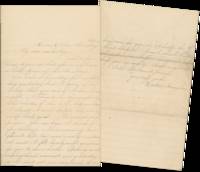
1909List3421Ohio Illinois Michigan and Ontario 1909. Seventy-four letters in thirty-seven envelopes mainly dating between 1885 and 1895. With two undated and one empty envelope. Conditions vary with a few letters having damage intersecting with significant amounts of text and others Near Fine. Overall excellent. A collection of letters mainly sent between Captain William Faragher 1842–1921 and his second wife Harriet Chamberlin 1853–1920 with several from Faragher’s children from his first marriage Burton 1872–1961 and Maude 1875–1952. Most letters are from Chamberlin to Faragher with fourteen from Faragher to Chamberlin.<br /> <br /> Faragher owned and captained several merchant ships in Lake Erie and Lake St. Clair—presumably sailboats as he frequently complains of having been stuck without wind. He also describes more severe weather out on the lake writing from St. Clair Michigan:<br /> <br /> “I am anxious to get down from here but as the day advanced the wind began to frisken and it began to snow hard and as it was freezing hard it had rained then snowed and then froze hard saturday night so the poor Venture was in a sad plight but she was in a worse one when we got to where we lay run as it breezed up fresh and the wind dead ahead the water was flying over her in all directions and froze wherever it fell and besides it had turned into a blinding snow storm but we had a certain point to make . she seemed as anxious to get to a place of safety as I did and as the boys say she got there and none too soon as it has been blowing a gale ever since and snowing and freezing but we are in the lee and at a good dock and are comfortable but oh the wind is whistling through the rigging .†November 20 1887<br /> <br /> In the 1880s steamships were increasing in popularity on the Great Lakes primarily because of sailboats’ susceptibility to both calm and weather; steamboats were bulky for their capacity and slow but more reliable whereas sailboats could carry overall more cargo.1 Generally steamers took packaged goods and passengers and sailboats mainly schooners took bulk cargo. The Great Lakes were the site of much shipping innovation; Faragher’s fleet was not yet behind the times but steam would overtake sail in the 1880s and 90s.<br /> <br /> Faragher’s cargo was mainly produce—apples and grapes—though he does mention picking up salt and other materials. His letters indicate that his business involved both shipping and mercantile aspects: he chose and bought the products shipped them to their destination and then also had to find and sell to customers. The grapes in particular seem to cause a lot of trouble:<br /> <br /> “We left Lorain Sunday morning early and had a nice trip to the Island got there at 4 PM bustled around monday morning and bought 400 baskets of grapes and had them all aboard by dark . it commenced to snow just as we got to Marine City bad bad omen for grapes but imagine my chagrin when I went up town and not a store or commission house wanted a grape folks were full of grapes and there was no sale for them and they said that I had got left and if the truth were known they were glad of it but its a cold day when I get left if trying will lit me out but one thing certain the weather and the lateness of the season were against me but you know I never cross a bridge before I get to it well we hauled up to our old Island Saturday morning and I sold out to my old friend . we had sold since 11 am 190 baskets of grapes . only half our cargo and at a good margin too. People would ask are you the man that was arrested here for selling grapes when told yes they seldom failed to buy but the strangest part was the number of ladies that came to buyâ€. October 28 1887<br /> <br /> Though he does not narrate the incident in which he was arrested for grape peddling—nor does it appear to have made the paper—he later mentions yet another grape-related debacle this time at Port Huron:<br /> <br /> “Sander and I went to town to sell the grapes today . when down came a city official and wanted to know if I had a license to sell . well I couldent sell another grape without paying 5.00 a day license that was a stormer you see the whole sale men were going to drive me out of the market . but they were not as sharp as they thought they were I went and gave a bill of sale of my whole cargo to a citizen here and he appointed one of his agents to sell the grapes†September 20 1888<br /> <br /> Faragher’s letters here do not discuss the financial state of his business but given Chamberlin’s statements it cannot have been all too positive. Chamberlin’s letters depict a woman struggling with her financial circumstances and with how the era’s expectations of her gender intersected with them. In one illustrative letter she writes:<br /> <br /> “A man drove by here Sat. asking for you. Ms. Lawler has given him her note to collect. He says the interest brings it to nearly fifty dollars. I told him I thought you could not meet it just at present but he said he must have the money and would give you just one week and if it was not paid then he would let the law settle it. Marvin and Laird are his lawyers. Mr. Laird is the one who helped get my money from father’s estate. I would not have them connected in this way about you for – O a great deal!! I have thought and planned till it seems as though my brain would burst. I have inquired about that law regarding taking any more married women as teachers. If Mr. Day would work for me it might perhaps be broken. There will be a vacancy in the Detroit building this fall. Will if I possibly can I want to commence teaching in Sept. The children would have to learn to do more about the house and with both of us earning it seems as though some of these harassing debts must be settled after a time. The frequent calls of men with bills against you have taken away all my pride and I believe I am humble enough to do most anything now.†July 11 1887<br /> <br /> In 1887 Ohio passed the Married Women’s Property Act which allowed married women to keep their own property separate from their husbands’—in fact Chamberlin occasionally mentions “her†money in her correspondence. At the same time the state’s Board of Education was debating passing an act that would not only ban school districts from hiring married women as teachers but also fire all the married women it then employed. Newspaper reporting at the time indicates that this measure was not particularly popular not the least because married women tended to be older and more experienced with the job.<br /> <br /> Chamberlin clearly perceives her role as a wife in a rather more progressive way at one point writing to Faragher that “a true wife†is “not a doll-baby to be kept in finery†N.d. after he had taken out a loan to send her money for a new hat. Throughout their correspondence Chamberlin is perhaps surprisingly open with Faragher about her opinions particularly on his work and their financial affairs; for instance:<br /> <br /> “I should like to examine your pocket-book after that $25 tax money left it. What are you going to live on up there while you are hunting for freight Sawdust won’t put any fat on your bones. Sailing up and down past Saginaw bay won’t prolong your life or lessen your grey hairs. What are you sailing for anyway For the sake of wearing yourself out and giving employment to two or three men and keeping the Root from rusting out I guess I am naughty!†May 25 1894<br /> <br /> She also frequently provides her opinion on whether and at what rate Faragher should sell his two other ships besides the Root the Venture and the Sassacus. She continues in the same letter:<br /> <br /> “I know I almost had a regular fight yesterday morning right there on the lounge. I wanted to do my housework and I couldn’t. I wanted to sew and I couldn’t sit up long for that. I wanted to help you and I couldn’t. I wanted to earn money and whereas I used to earn fifty-five cents for every hour I worked now I can not earn anything. Then if I could not do for self and family I wanted to make church and S.S. calls but I couldn’t walk for that.†<br /> <br /> Of course she was at that time prevented from these activities by her health not by gendered standards but she clearly had financial ambitions for herself. After her time as a regular school teacher Chamberlin taught at a Sunday school where she earned a few cents per student and in one letter reported having eighty-one students in a single session. <br /> <br /> Chamberlin also struggles with the expectations of her as step-mother to Faragher’s two children from his first marriage to Emma Humphrey 1848–1880. She writes:<br /> <br /> “I get so discouraged sometimes and it seems as though I am in the wrong place as mother. I think of Emma as my sister. I want to do as she would have me. I look upon my work as sacred. And yet sometimes I feel as though life was not worth living.†November 5 1886<br /> <br /> She frequently describes conflict with Burt who was then in his late teens to early twenties writing that she could not “have quite the very own mother-love for him†though she is “sure that Emma was not more conscientious in her desires to do right by him than I am†May 20 1891. As it still is today the role of step-mother was a difficult and frequently demonized one with the trauma of losing a mother and wife often in conflict with the feminine duty of maintaining perfect domestic harmony. In general Chamberlin seems to have been somewhat out of step with the feminine ideal of the time even telling Faragher in a letter describing the death of an acquaintance’s baby how glad she was to not have any children of her own.<br /> <br /> Overall a look at the private lives and difficulties of a middle-class Ohio household as despite the relative prestige of its head being a captain-owner it struggled with debt. Of interest to both historians of Great Lakes trade and those of women’s roles in the late nineteenth century.<br /> <br /> 1 Dina M. Bazzill “The Missing Link Between Sail and Steam: Steambarges and the Joys of Door County Wisconsin†East Carolina University Program in Maritime Studies Research Report no. 19 2007. unknown
193554569Garden City NY: Doubleday Doran & Co. 1935. Tall 8vo. 6 338 pp. Photo frontisp. numerous photo illust. Green cloth black lettering & cityscape illustration on spine illust. front cover minor soiling & sunning to spine as usual faint tidemark ring on lower front cover still VG- copy. Early printing of this amazing story of a woman who died leaving an estate of over $100000000. Doubleday, Doran & Co., hardcover
190659979London: Simpkin Marshall Hamilton Kent & Co. Ltd. 1906. 8vo. x 526 pp. plus 2 pp. publisher’s ads. Frontisp. plates numerous text illustrations diagrams. Maroon-coloured publisher’s cloth white lettering front cover & spine ruling on covers painted illust. front cover & spine slight edgewear very slight bumping to couple corners very light interior toning still a VG bright copy from the library of Edwin E. Farr w/ markings on ffep. First edition of this excellent work which details the evolution of the shotgun from flintlock to hammerless ejector as well as Express Rifles ball and shoguns sporting bullets shooting in Europe and Great Britain. Of particular interest are the chapters by Henry on the increase of women shooting and hunting with specifications for women’s shotguns shotgun loads and shape of grip. Mary Russell Duchess of Bedford 1865-1937 was a noted ornithologist hunter one of the first Western women to study jujitsu and later became noted aviator with record breaking flights to Karachi and Cape Town. Simpkin, Marshall, Hamilton, Kent & Co., Ltd., hardcover
192832754Honolulu: Honolulu Star-Bulletin 1928. Tall 8vo. xii 209 1 pp. Frntsp photo. Blue cloth gilt lettrng w/ G.P. Judd Centenary Luau Kualoa July 4 1928 place marker laid-in w/ frmr ownrshp signature dated July 19 1928. First edition thus of this fascinating memoir. Honolulu Star-Bulletin, hardcover
185464185New York NY: Harper & Brothers Publishers 329 & 331 Pearl Street 1854. 12mo. 369 13 pp. With numerous woodcut-engravings. Embossed plum-coloured publisher’s cloth gilt lettering on spine minor sunning to spine slight sunning to fore-edges minor bumping to corners occasional light foxing still VG- copy from the library of Eleanore Weinstock. Revised & expanded edition of this groundbreaking work by one of the most significant women reformers of the 19th-Century older sister to Harriet Beecher Stowe and Henry Ward Beecher. After the death of their mother Roxanna Foote Beecher left the 16-year-old Catharine as surrogate mother she spent her career promoting education for women and urging education reforms treating women as teaching professionals including founding of the short-lived Western Female Institute in 1837. Beecher advocated that not only should women receive rigorous instruction in child rearing home economics and domestic science but also taught history Latin rhetoric algebra logic physical education and science. Although she vigorously advocated for women’s education supported better health practices and increasing public roles she remained later in life resistant to women’s suffrage believing it would interfere with their roles in ensuring morality and security in the home. Harper & Brothers, Publishers, 329 & 331 Pearl Street, hardcover
189863249Boston MA: Home Science Publishing Go. 1898. 12mo. 5.25 x 6.75 in. 85 3 pp. w/ title printed on front cover numerous text illustrations diagrams. Publisher’s light-green textured softcovers minor chip to lower right corner some minor shelfwear scuffing still VG copy w/ former ownership marking at upper right corner front and manuscript medical notes at rear. Revised & expanded edition of this early Progressive Era work on family household sanitation and hygiene produced by the Sanitary Science Club an organization which spearheaded women’s policies and sociology at Wellesley College and other organizations in New England. Talbot 1858-1948 was the daughter of Israel Talbot a homeopathic doctor and mother Emily Talbot who was a fierce advocate of women’s rights in higher education. This edition focused primarily on the house and eliminated the sections on food and clothing from the 1887 version replacing them with sections on caring and hygienic methods for the country house. Home Science Publishing Go., paperback
185664187New York NY: Harper & Brothers Publishers 329 & 331 Pearl Street 1856. 12mo. vi 7-192 2 29 1 pp. With numerous woodcut-engravings throughout the text. Embossed blue-green-coloured publisher’s cloth gilt lettering on spine slight shelfwear rubbing offset toning on endpapers still a VG copy from the library of Eleanore Weinstock. Second printing of this informative work in applied health statistics by the noted 19th-Century woman’s reformer offering a valuable guide to contemporary ideas about women’s health and sexual exploitation of women and the seeming sexual precocity of the younger generation. Beecher declaims in her introduction that “the majority of parents in this nation are systematically educating the rising generation to be feeble deformed homely sickly and miserable; as much so as if it were their express aim. . . .†In preparing this work she had asked one woman in each of 200 different communities to report on the health of 10 married women among their friends and the replies showed that the great majority were “habitual invalids†“delicate†or “diseased†with only a small number well and strong due to lack of fresh air and exercise tight-waisted garments poor diet and ignorance of bodily functions including sexuality and sexual exploitation by male physicians. As the older sister to Harriet Beecher Stowe and Henry Ward Beecher Catharine spent her career promoting education for women and urging education reforms treating women as teaching professionals including founding of the short-lived Western Female Institute in 1837. Catharine Beecher also advocated that not only should women receive rigorous instruction in child rearing home economics and domestic science but also taught history Latin rhetoric algebra logic physical education and science. Although she vigorously advocated for women’s education supported better health practices and increasing public roles she remained later in life resistant to women’s suffrage believing it would interfere with their roles in ensuring morality and security in the home. Harper & Brothers, Publishers, 329 & 331 Pearl Street, hardcover
185564186New York NY: Harper & Brothers Publishers 329 & 331 Pearl Street 1855. 12mo. vi 7-192 2 29 1 pp. With numerous woodcut-engravings throughout the text. Embossed scarlet-coloured publisher’s cloth gilt lettering on spine minor chipping & rubbing to head of spine minor scuffing slight bumping to corners still a VG copy from the library of Miss Addie Hobbs Mayfield Michigan Aug. 31 1873 S.L. Macy and Eleanore Weinstock w/ ownership markings on endpapers. First edition first printing of this informative work in applied health statistics by the noted 19th-Century woman’s reformer offering a valuable guide to contemporary ideas about women’s health and sexual exploitation of women and the seeming sexual precocity of the younger generation. Beecher declaims in her introduction that “the majority of parents in this nation are systematically educating the rising generation to be feeble deformed homely sickly and miserable; as much so as if it were their express aim. . . .†In preparing this work she had asked one woman in each of 200 different communities to report on the health of 10 married women among their friends and the replies showed that the great majority were “habitual invalids†“delicate†or “diseased†with only a small number well and strong due to lack of fresh air and exercise tight-waisted garments poor diet and ignorance of bodily functions including sexuality and sexual exploitation by male physicians. As the older sister to Harriet Beecher Stowe and Henry Ward Beecher Catharine spent her career promoting education for women and urging education reforms treating women as teaching professionals including founding of the short-lived Western Female Institute in 1837. Catharine Beecher also advocated that not only should women receive rigorous instruction in child rearing home economics and domestic science but also taught history Latin rhetoric algebra logic physical education and science. Although she vigorously advocated for women’s education supported better health practices and increasing public roles she remained later in life resistant to women’s suffrage believing it would interfere with their roles in ensuring morality and security in the home. Harper & Brothers, Publishers, 329 & 331 Pearl Street, hardcover
186064188New York NY: Harper & Brothers Publishers Franklin Square 1860. Two works in one. 12mo. viii 9-193 1; 6 58 pp. With numerous woodcut-engravings throughout the text. Embossed dark brown publisher’s cloth gilt lettering on spine slight shelfwear rubbing spotting on upper fore-edge front cover still a VG copy from the libraries of Sophia Casey and Eleanore Weinstock. Early printing of these well-illustrated works on physiology health and gymnastics for fitness by the noted 19th-Century woman’s reformer offering a valuable guide to contemporary ideas about women’s health which grew out of the physical fitness and nutrition ideas popular in hydropathic quackery medicine in the U.S. prior to the Civil War. Catharine Beecher felt corsets not only made exercise impossible but actually deformed women’s bodies and these deformities could be passed on through heredity and degrade the human race so she vigorously campaigned for curriculum to include calisthenics and appropriate dress and exercises for young women. Harper & Brothers, Publishers, Franklin Square, hardcover
192352587San Diego: Arts & Crafts Press Printers and Binders 1923. 12mo. 122 pp. Photo frontisp. decorated title page numerous plates. Gray publisher’s cloth decorated and lettered in blue blue ruling slight bumping to lower corners still NF copy inscribed by Minna K. Powell to Marion Talley 1906-1983 noted American opera singer. First edition signed of this scarce title on exercise and diet for women ghostwritten for Blair b. 1863 by her sister Minna K. Powell music editor in Kansas City MO at the time. In 1918 Blair who had been a successful home economics teacher and instructor in sewing began suffering serious debilitating disease and decided to recuperate using diet and exercise. Eventually she began giving lectures and performing stunts demonstrating her good health such as when at age 70 she performed by walking on the ledge of the roof of the Waldorf Hotel in New York. Minna K. Powell who was her younger sister as well as music editor for the Kansas City Star was friend and one of the biggest proponents and boosters for Marion Talley’s opera career. Arts & Crafts Press, Printers and Binders, hardcover
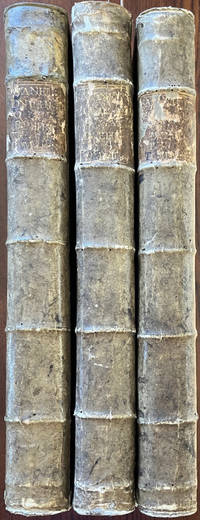
175861510Venice: Typis Antonii Zattae 1758-1762. Three vols. Folio. 11.5 x 15.5 in. xxxii 600; v 1 618; 8 579 1 xl pp. Title of vol. I in red & black woodcut-engraved vignettes historiated initials couple text copper plate engravings in vol. II splendid woodblock-engraved printer’s device tailpiece in Vol. III. Uniformly bound in contemporary vellum raised bands on spines brown morocco & gilt spine labels marbled fore-edges heads of a couple spines expertly repaired minor bumping to corners some soiling to back cover of final vol minor rippling to textblocks still VG set w/former armorial ownership stamps on titles old bookseller notes & pricing on endpapers typescript translation title on red ruled paper laid-in to vol. II. Second edition substantially revised and corrected of this sweeping history of the Hieronymites monastic orders of monks and nuns of the Poor Hermits of Saint Jerome Pisa first established near Pisa in 1377 and would eventually grow to fifty houses of which two still survive in Rome and Viterbo Italy. Sajanelli was a general director of the Hieronymite Poor Hermits of Blessed Saint Jerome Pisa and doctor of theology of Padua who has carefully assembled all of the related documents along with detailed indices and chronologies together with Papal Bulls and monastic orders chronicling the origins and ongoing mission of the this order. Convents with extensive documentation included by Sajanelli include those of the Convent of the Most Holy Trinity founded in 1380 near Montebellum the Convent of Saint Jerome outside of Ariminum and that of Saint Mary of the Annunciation in the town of Saint Anthimum founded originally in 1490. Originating in Spain the monastic order was recognized by Pope Gregory XI in his Papal Bull dated Oct. 18 1373 recognizing the religious order to operate under the Rule of St. Augustine and both monks and nuns adopted the religious order habits of white tunics with brown scapulars similar to the Carmelites. The first nunnery convent began in Toledo Spain led by Maria Garcia near Toledo and perhaps the most revered and well known was Sor Juana Ines de la Cruz of the convent of San Jeronimo y Stanta Paula in Mexico City considered the “Tenth Muse.†See: Perennes Dicionnaire de Bibliographie Catholique Vol. III 1839 p. 933-934; Besse Hieronymites Catholic Encyclopedia 1910. Typis Antonii Zattae, hardcover