STENDHALLivre Rare Book
7 984 résultats
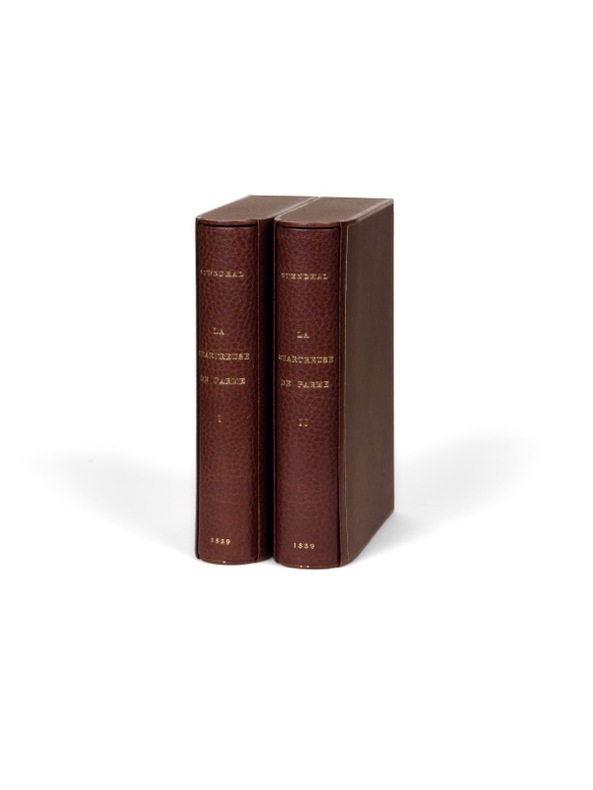
183927512Édition originale, premier tirage.L'un des huit exemplaires connus avec envoi autographe, le seul à une femme. Paris, Ambroise Dupont, 1839. 2 vol. (125 x 200 mm) de [2] f., 402 p. et 1 f. ; [2] f. et 445 p. Maroquin havane, contreplats et gardes de chèvre velours sable, titres dorés sur les pats, tranches dorées sur témoins, chemises avec titre et tomaison, étui bordé (reliure signée de Renaud Vernier - Claude Ribal, 2025). Édition originale. Exemplaire de première émission, sur papier vélin. Envoi autographe signé : « À Madame d'André, hommage respectueux de l'auteur ».
195829809Exemplaires sur Hollande, en reliures de Pierre-Lucien Martin Paris, Gallimard, (septembre) 1958, (octobre) 1960, (octobre) 1963 et (août) 1972. 1 vol. (135 x 205 mm) de 359 p. et [3] f. Veau brique à encadrement, plats en daim marine avec décor à la lettre repris sur le dos, tête dorée, doublure et garde de papier bleu, couverture et dos, chemise et étui (P.-L. Martin, 1961) ; 1 vol. (140 x 205 mm) de 622 p. et [1] f. Maroquin ébène à encadrement, plats de daim marron avec décor à la lettre réhaussé d'une pièce de papier granité, décor repris sur le dos, tête dorée, doublure de papier bordeaux et garde de papier bleu, couverture et dos, chemise et étui (P.-L. Martin, 1961) ; 1 vol. (155 x 210 mm) de 686 p. et [1] f. Maroquin bleu nuit à encadrement, plats en daim marine avec décor à la lettre réhaussé d'une pièce de box, titre et tête dorés, date en pied, doublures et gardes papier, couvertures et dos conservés, chemise et étui bordé (P.-L. Martin, 1964) ; 1 vol. (155 x 220 mm) de 512 p. et [2] f. Maroquin vert à encadrement, plats en daim vert avec décor à la lettre réhaussé d'une pièce de box, titre doré, date en pied, doublure et garde papier vert, tête dorée, couvertures et dos conservés, chemise et étui (P.-L. Martin, 1975). Édition originale pour tous les volumes. Un des 25 premiers exemplaires sur vélin de Hollande (n° 13). Un des 30 premiers exemplaires sur vélin de Hollande (n° 25). Un des 35 premiers exemplaires sur vélin de Hollande (n° 10). Un des 40 premiers exemplaires sur vergé blanc de Hollande (n° 21).
19838908LA 1983. Unique. Near Fine. Unique. "Violent Femmes" was the debut album by Violent Femmes and one of the defining albums of the era. Recorded in July 1982 the album was released by Slash Records on vinyl in April 1983. Gordon Gano wrote most of the songs for the album while still in high school in Milwaukee Wisconsin. It was the band's most successful album going platinum eight years after its release. The album achieved what is believed to be a unique fee buy going gold four years after release without having made an appearance on Billboard's top 200 album chart. Rolling Stone ranked the album Number 22 on its list of the 100 Greatest Albums of All Time. They were discovered by James Honeyman-Scott of The Pretenders on August 23 1981 when the band was busking on a street corner in front of the Oriental Theatre the Milwaukee venue that The Pretenders would be playing later that night. Chrissie Hynde invited them to play a brief acoustic set after the opening act. <br /> The letter and lyrics sheet dated 2/23/83 and all in Gano's hand addresses a handful of major issues to be resolved before the album release a couple months later. Notably it includes the densely written sheet of all the song lyrics that was printed on the LP sleeve included with the debut album. The letter goes into detail regard reproduction of the sheet and addresses several other issues e.g. the quoting of a Muddy Water's song in Gone Daddy Gone. This is the original mss which launched over a million copies and helped shape a genre. Minor toning else bright and clean. 8.5x11" notebook paper; mss in black ink. Signed by the author. unknown
15274Women's Early Education. Report of the Commission Charged to examine memoirs relative to the education of women. Third Subject. - Morality. By Mr. Philis - Reporter. 1827. Paper boards. Folio size 13 in x 8.5 in. 68 pages of handwritten script in black ink. In this manuscript one of the earliest formal debates on the value of education for women the author radically concludes that formal education for women should be universally accessible: "We think that in whatever condition heaven has placed a woman" the author argues "from the daughter of the Prince to that of the most humble of the subjects there should be a similarity of ideas. When they are wisely explained the elements of Language and Calculations are they not necessary and indispensable to women in all stations" The author then reverses the very argument used against women's education-- that it is unnatural since motherhood is the only suitable destiny for women-- by arguing that education is exactly suited to "what nature formed women to be". "She knows she was created to fulfill duties and penetrated with a sense of those she has to perform she makes all she possesses of enlightened ideas talents and fortune concur in accomplishing them. This is what nature formed women to be and such a well directed education would make her. This is what would make a good mother of a family who would well know how to form daughters worthy of imitating her." Education in fact is as naturally suited to women as motherhood and ought to be the province of adult women and girls alike regardless of age or opportunity-- an ideal still worth fighting for even nearly two centuries later. <br/><br/>It begins with a deceptively leading question: "What is the sort of education most suitable to Woman and the most proper to render them capable of fulfilling their destination as Mothers of families"Although the opening query is limited by modern standards formal education for many children-boys and girls alike-was not considered necessary in this period let alone for adult women with responsibilities in the home. The argument that education would serve women in their motherly duties was a crucial tool for advocates of womens' enfranchisement. The Commission judges three memoirs submitted on this topic and this forms the structure of the manuscript: "The Education Best Adapted to Form A Good Mother of A Family Is That Received at Home"; "It is Well Known That The Bad Education Of Women Does More Harm Than That of Men Because the Want of Good Conduct in Man Proceeds Frequently From The Education They Received From Their Mother ."; and "To Instruct the Children One Must Enlighten the Mothers". Thus the manuscript is valuable not only for its radical ideals but for its historical benefit as an overview of attitudes towards women's education at the turn of the 20th century. Just one year prior in 1826 the first public high schools were opened for girls in New York and Boston; it would be another 13 years until the first woman earned a college Bachelor's degree.  Cover boards worn with light soiling and scattered stains. Even toning and light soiling throughout. Very good to good condition. unknown books
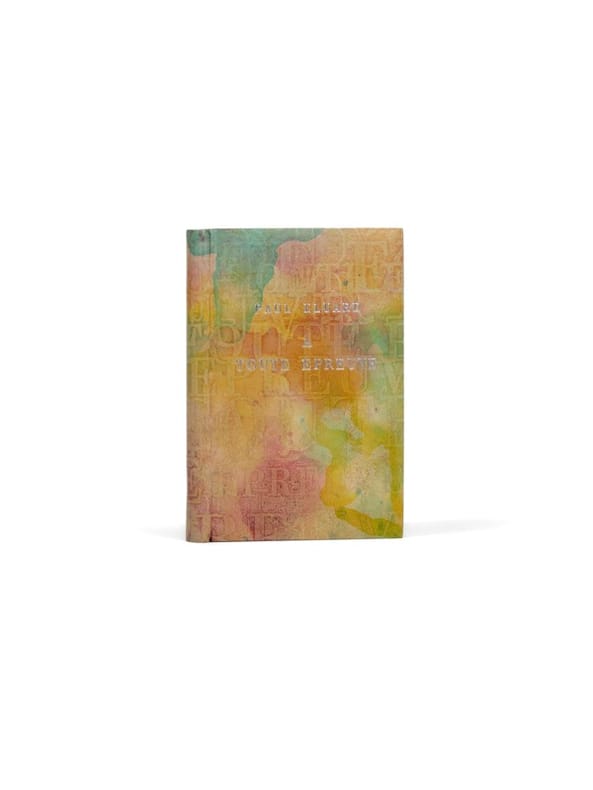
193020266Seul exemplaire sur Chine et papiers de couleurs connu : celui d'Yves Tanguy Paris, Éditions surréalistes, (15 octobre) 1930. 7 plaquettes de [16 p.] et 15 p. réunies en 1 vol. (65 x 105 mm). Veau naturel teinté et estampé d'une eau-forte originale dans les tons rose, jaune et bleu pastel inspirée des caractères typographiques de la page de titre, contreplats bord-à-bord du même décor, titre au palladium sur le premier plat, gardes de chèvre velours vert d'eau, tranches dorées à l'or blanc par Jean-Luc Bongrain, chemise et étui bordés (reliure signée de Louise Bescond - titr. Claude Ribal, 2025). Édition originale. Un des 30 exemplaires sur chine (n° 27). Envoi signé : « Exemplaire d'Yves Tanguy, son vieil ami fidèle, Paul Éluard ». À la suite, sont reliés un exemplaire sur papier d'édition et un jeu d'exemplaire sur papiers de couleurs (saumon, vert, jaune, rose), puis un exemplaire de la plaquette qui servit de modèle à Paul Éluard pour composer la maquette : Victor Hugo, Lettre à Lord Palmerston, publiée à Jersey en 1854]. Soit un ensemble de sept plaquettes.
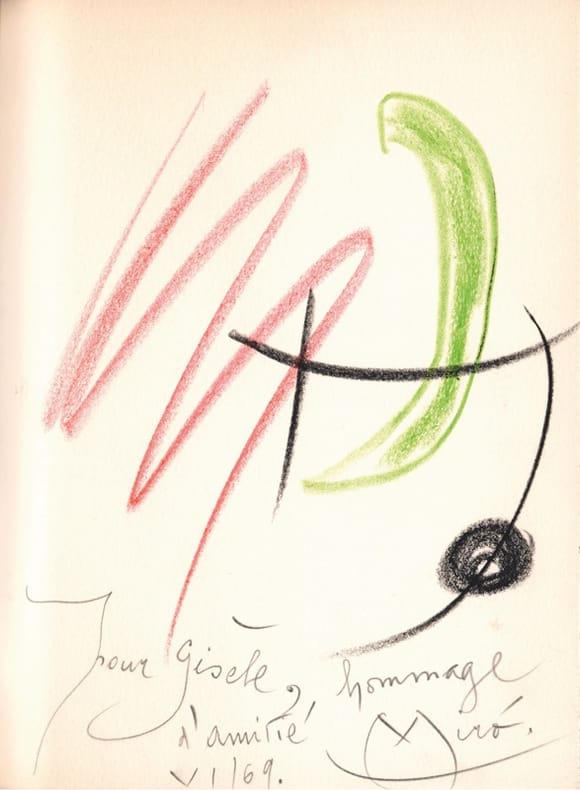
196926895Envoi signé et dessin de Miro. Reliure de Louise Bescond Paris, GLM, (janvier) 1969. 1 vol. (150 x 215 mm) de 25 p., [2] et 1 f. Plein veau naturel teinté gris anthracite, estampé d'une eau-forte originale inspirée d'une lithographie de Joan Miró, tire à la chinoise, contreplats bords à bords à et gardes de chèvre velours, tranches dorées sur témoins, couvertures et dos conservés, chemise et étui bordés (reliure signée de Louise Bescond, 2022 - titrage Claude Ribal). Édition originale. Un des 95 premiers exemplaires sur vélin d’Arches (n° 65) contenant la lithographie originale en couleurs de Joan Miro, signée. Envoi signé enrichi d'un dessin : « Pour Gisèle, hommage d’amitié, Miro, VI/69 ».
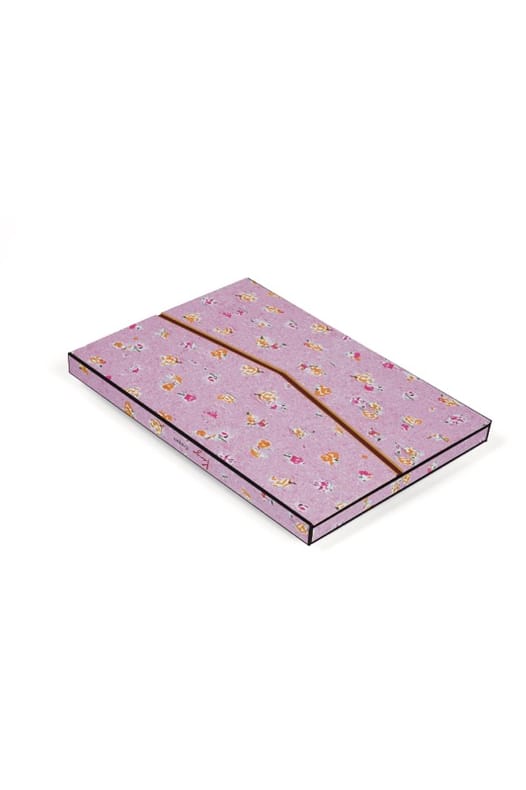
20032914060 croquis et dessins de mode à l'encre, feutre et aquarelle S.l.n.d. [1990-2000]. 60 croquis originaux (210 x 280 mm), à l'encre, feutre, mine de plomb ou aquarelle. En feuilles, sous emboîtage à rabat signé de Julie Nadot. Réunion de 60 croquis et dessins de mode pour les dernières collections, réalisés entre 1990 et 2000, date de son départ de la marque Kenzo.
13540Archive on women's crucial role in the creation and development of vaccines especially it's accessibility to children regardless of economic class and the global eradication of smallpox. Containing 3 early and rare pieces that show how women emerged as a driving force in developing and sharing immunization techniques that continue increasing child survival rates today. Includes 2 scarce first edition books by Lady Mary Wortley Montagu with writing about her experiences bringing inoculation to the Western world and her advocacy for mothers using inoculation to save their children's lives. Accompanied by a letter to Lady Mary by Lady Margaret Cavendish Bentinck the curator of an influential scientific collection and a proponent of women's scientific research. By 1796 Lady Mary's work was advanced by Edward Jenner who developed a safer method of immunization using a vaccine derived from cowpox. <br/> <br/>Having witnessed the lifesaving benefits of immunization while traveling in Turkey Lady Mary Wortley Montagu made medical history in 1721 when she had her own children inoculated and became the first person to bring inoculation to the West. As one of the first immunization activists in the West she used her power and influence as a literary pioneer to publish about it promoting the procedure to combat Britain's smallpox epidemic. This archive's two rare books by Lady Mary contain her writing on smallpox prevention: a 1747 first edition of "Six Town Eclogues" never before sold at auction which focuses on the hardships women and girls faced when unable to access inoculation; and an 1803 five volume first edition of "The Works of the Right Honorable Lady Mary Wortley Monagu" describing "the introduction of the art of inoculation into this Kingdom" and her time "dedicated to various consultations" about the procedure. Accompanied by a letter to Lady Mary Montagu written by Lady Margaret Cavendish Bentinck who curated an influential natural science collection and encouraged women's work in science. Lady Mary Wortley Montagu and the thousands of other women who supported Jenner's vaccine were responsible directly and indirectly for saving tens of thousands of lives. Over the following decades women were crucial in helping Jenner provide the vaccine to children around the world and by the 1850's records suggest that in England alone women were responsible for ensuring vaccination for over 30000 children and for soliciting funding to allow Jenner's clinics to rescue even more. 150 years later the World Health Organization finally declared smallpox eradicated in 1980. An important archive revealing women's crucial role in the past present and future of vaccination. unknown books
187932820588This magnificent imposing album was made by a prominent late-Victorian hostess patron of the arts and gifted artist.<br />Folio. Approx. 225 pages heavy card. Brown morocco gilt-stamped "H.R.H." metal lock and corner-pieces gilt edges rubbed at joints. Excellent condition.<br /><br />Helen Rose Huth was the wife of the banker Louis Huth. The Huths were major art collectors who displayed their art in the gallery built for the purpose at their home Possingworth. Helen sat for both George Frederic Watts and James Abbott McNeill Whistler who painted the celebrated Arrangement in Black No. 2: Portrait of Mrs Louis Huth. Whister required many sittings and when she complained that Watts never treated her that way Whistler replied "And still you know you come to me!" After Louis Huth's death in 1905 she married Archibald Howe.<br /><br />The album the product of vast labor contains 50 watercolors all but four by Mrs. Huth comprising studies of flowers landscapes and other scenes in Possingworth East Sussex and Scalpay and other Hebridean locations; 70 photographs of buildings landscapes people and paintings; and six pen-and-ink or pencil sketches. Many of the watercolors bear signatures dates and places. The album is filled with elegant calligraphic transcriptions of poems and prose pieces by Victorian writers the Brownings being particular favorites often with pen-and-ink floral borders. A number of the unsigned poems appear to be by Helen Rose Huth herself.<br /><br />The earliest watercolor in the album is dated 1879 and work continued until at least 1905. In that year Louis Huth died. A photograph of his tombstone is displayed opposite a portrait of the banker. A fine seated studio portrait of Helen Rose Huth dated 1895 appears early in the volume. The photographs are often connected to the subjects of the poems they accompany.<br /><br />Provenance: Helen Rose Huth 1837-1924. The Huths' fine country house Possingworth Park completed in 1866 "was a highly ornate neo-Gothic mansion … The house contained 42 bedrooms large oak panelled reception rooms and a conservatory named the Winter Garden. There was also a large picture gallery. Louis Huth was a passionate art collector and his house was designed to display artwork at its best. A large picture gallery on the ground floor was designed specifically to exhibit his most treasured artworks. … Possingworth was also the venue of a secret meeting between Major Generals Montgomery and Eisenhower in 1942. There they laid plans for the cross-channel invasion that was to take place two years later" Holy Cross Priory website. The house is now Holy Cross Priory. <br /> hardcover
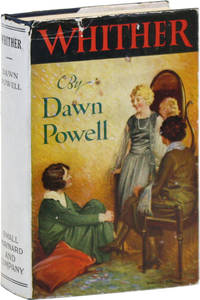
192546542Boston: Small Maynard & Company 1925. First Edition. Octavo 19.5cm; navy blue cloth with titles stamped in gilt on spine and front cover; dustjacket; iv23-3053pp. Spine ends very gently nudged hint of dustiness to upper edge of textblock else a fresh Fine copy. In the dustjacket designed by Harold James Cue priced $2.00 on front flap; light shelfwear touch of dust-soil to spine rear panel and flap edges with a few short tears and attendant creases upper edge of front panel and upper rear joint shallow loss to spine ends none affecting lettering and a dozen small soil spots to panels; still a bright substantially complete and Very Good example unrestored. Attractive copy of Powell's first novel an autobiographical work recounting the story of an idealistic Midwestern girl who moves to New York aspiring to be a playwright. She settles into a boarding house for women surrounded by a cast of characters who are perpetually out of money deeply concerned with their wardrobes and trying to find a man. She finds fulfilling work as a copy writer navigates her way throughout a string of suitors all the while soliciting advice from her housemates quits her job and briefly entertains the idea of taking up with a Greenwich Village bohemian and writing plays full-time; she abandons her dreams after accepting an eleventh hour proposal from a wealthy suitor embarks on a steamship to London with her man and sails off toward her new life with the words "Is the world really so gorgeous as this" <br/><br/>The earlier part of the novel at least somewhat mirrors Powell's own experiences. She led a somewhat unhappy childhood in Ohio where her stepmother took pleasure at burning her early attempts at poetry and fiction; after moving in with a supportive aunt and attending Lake Erie College she moved to Manhattan to pursue a career as a writer finding work as a publicist for several organizations before marrying her husband an advertising executive named Joseph Gousha and settling in Greenwich Village where she would live out the rest of her life. Her marriage allowed her to quit her job and focus on her writing full-time "using the Children's Reading Room of the New York Public Library on Fifth Avenue as the place to write. What became the classic elements of Dawn Powell's work were in evidence from the outset. Her first novel Whither.has the characteristic satiric tone mordant wit and unforgiving eye for the foibles of middle-class Americans whether they lived in the Middle West the setting for her early work or were newly arrived midwestern émigrés to the big city of New York desperately seeking sophistication" Carnes Mark C. "Dawn Powell." Invisible Giants: Fifty Americans Who Shaped the Nation but Missed the History Books p.232. Powell disavowed her literary debut leaving it out of lists of her publications throughout her lifetime and referring to She Walks In Beauty 1928 as her first novel. An uncommon debut published in small numbers and rare in dustjacket; we find no copies for sale in the auction record and OCLC notes a scant 11 holdings in U.S. institutions. SMITH P-576. Small, Maynard & Company unknown books
190601-G1906. Öl auf Leinwand, links unten signiert und datiert ?Eug. Bandell 1906?, verso auf dem Keilrahmen von der Künstlerin nochmals signiert und datiert sowie betitelt. 84,5:64 cm. Literatur: S. Sumera, Eugenie Bandell (1858-1918), Eine Frankfurter Malerin - das Spätwerk. Magisterarbeit, Univ. Frankfurt am Main, 1996, Nr. 99; Ausst. Katalog: Frankfurter Malerei seit der Jahrhundertwende. Galerie und Kunstantiquariat Joseph Fach, Frankfurt am Main, 1988, Nr. 6 mit Farbabb. auf dem Titel; Ausst. Katalog: Frauen an der Staffelei - Ein vernachlässigtes Kapitel der Frankfurter Kunstgeschichte. Frankfurter Sparkasse von 1822, Frankfurt am Main 1994.
186464004Detroit MI: Corydon C. Randall Photographer 220 Woodward Ave. c. 1864 1881-1882. One mounted albumen cabinet card photo sized 3.9 x 5.9 in. mounted on tan studio board sized 4.25 x 6.5 in. rounded corners printed caption below the image printed photographer’s imprint on verso minor age-toning minor spotting slight soiling to fore-edges old tiny pinhole evidenced at upper blank margin of mounted board not affecting the photograph very upper right w/ slight creasing & cracking of photo now neatly re-affixed still a VG exemplar of this very rare cabinet card image. A very scarce full-length albumen cabinet card portrait of Sojourner Truth 1797-1883 taken when she was 84-83 years old and used as a fund-raiser at her public events at the end of her life. This is one of Truth’s late portraits and she was quite unusual having acquired her copyright to her portrait during the Civil War giving her control over both the distribution of the CDV and Cabinet Card images and the revenues they generated. As one of the best-known African-American former slaves abolitionists and women’s rights advocates of the 19th-Century she traveled the country for decades giving lectures and attending conferences where she would sell her “Shadow†photographs as a primary means of support for her ongoing mission. According to extensive historical research by Darcy Grimaldo Grigsby Truth posed for Detroit photographer Corydon C. Randall’s camera on three occasions between June 1881 and April 1882. The finished albumen photos were prepared in both Carte de Visite 2.25 x 3.5 in. and Cabinet Card 4 x 6 in. formats and sold to Truth at .5¢ apiece. Randall’s studio records show purchases of 50 50 and 100 copies of each of the three separate poses which was “an astonishing order for a woman in her eighties†but considering they were some of the last photographs of Truth the editions size was quite small with the Cabinet cards scarcer than the CDV versions. Grigsby details this standing pose in her book: the photographs “stage her against a pedastal in front of painted seaside backdrop. The effect is unique among her portraits. She stands in what purports to be a natural scene her figure is smaller than the background suggesting a vastness of space we have not seen before. . . Even as we recognize its artiface we indulge in the illusion of space and air and natural light that it so economically suggests. . . In these late seaside portraits there is a soft winsome quality intensified when we realize that she is in her eighties and at the very end of a long arduous life of personal and political struggle.†Worldcat locates 1 copy of seated version CDV Boston Athenaeum; See: Grigsby Enduring Truths 2015 pp. 178-184. [Corydon C.] Randall, Photographer, 220 Woodward Ave., unknown
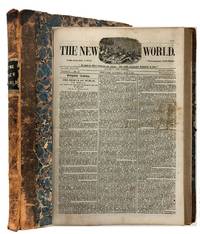
15960The Rights of Woman" Profound Influence on the Seneca Falls Declaration of Sentiments within The New World Vol. II No. 19 May 8 1841. Benjamin Park Editor. New York attorney and legal reformer E.P. Hurlbut's article "The Rights of Woman" appeared in the May 8 1841 issue of The New World newspaper begins p. 289. Hurlbut's article on the reform of marriage laws and married women's rights had a profound influence on women's right's pioneer Elizabeth Cady Stanton. Stanton was the principal author of the Declaration of Sentiments adopted at the 1848 Seneca Falls Convention seven years after Hurlbut's essay. His essay was first delivered as a speech in early 1841 at the Mechanics Institute of the City of New York the city's oldest technical school before being published in The New World newspaper. "The Rights of Woman" was later published in Hurlbut's work Essays on Human Rights and Their Political Guarantees 1845. Foxing to first and last pages and minor water damage to bottom corner of first pages. Very good.<br/><br/>Scholar Ann D. Gordon editor of The Selected Papers of Elizabeth Cady Stanton and Susan B. Anthony writes that Hurlbut's ".criticism included a scathing portrait of male domination that is echoed in the Declaration of Sentiments. . In his chapter on 'The Rights of Woman' he described woman's civil death. Her property is conferred on her husband because 'everybody knows that the dead cannot keep their property-and the wife is legally dead.' The authors of the Declaration followed Hurlbut in all their examples."¹<br/><br/>In ten full newspaper columns Hurlbut's essay develops his conception of the rights of women. His lawyerly arguments derive from the legal principles of Sir William Blackstone and the the common law and interestingly from the tenets of phrenology and physiology. He writes:<br/><br/>Those laws then which in the least detract from woman's intellectual freedom or moral responsibility or restrain the harmonious activity of her faculties after marriage outrage her rights. Her happiness still depends upon the free exercise of her natural powers. Her restraints must be those of her own enlightened nature. The woman and the wife must remain one and the same. She must be deemed capable of moral and legal consent; capable of judging and of acting; of willing and refusing. Her rights must be acknowledged in her wrongs redressed. column 7<br/>Later discussing pending legislation in the State of Missouri Jan. 1841 Hurlbut declares: "Let us carry the principle of equality into the married state and allow the wife to know and feel that she is truly the partner and equal of her husband." column 10.<br/><br/>Winchester's The New World was only published between 1839 to 1845.<br/><br/>Description: E.P. Hurlbut Elisha Powell Hurlbut 1807-; Park Benjamin Editor Park Benjamin Sr. 1809-1864. "The Rights of Woman" Profound Influence on the Seneca Falls Declaration of Sentiments within The New World Vol. II No. 19 May 8 1841. New York: J. Winchester Publisher Saturday May 8 1841. 16pp. Newspaper. 15¼ x 10½ inches. Removed. Illustrated masthead; printed in three columns. First and final leaves separated; otherwise very good. 3726549<br/>Note. 1. Gordon ed. The Selected Papers of Elizabeth Cady Stanton and Susan B. Anthony Volume I In the School of Anti-Slavery 1840 to 1866 Rutgers 1997 2001 p86. unknown books
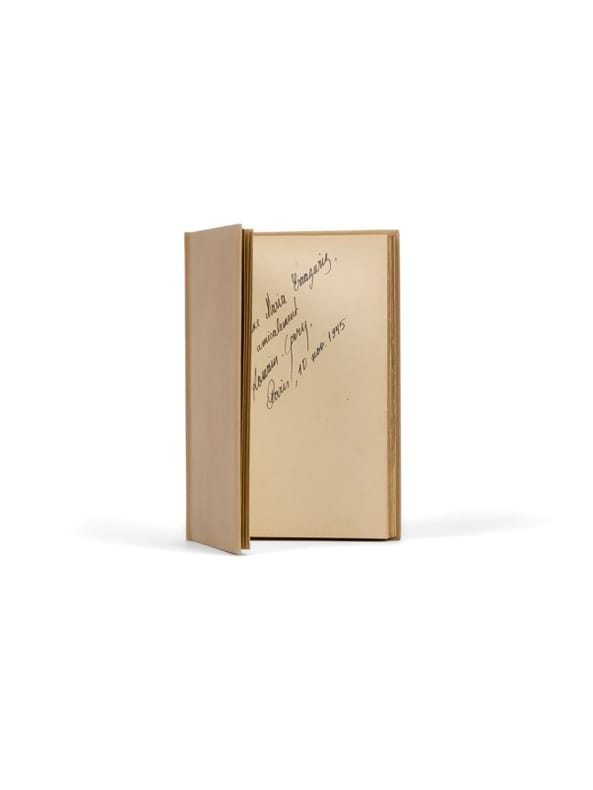
194531565Précieux exemplaire d'une « Juste parmi les nations» et figure majeure de la Résistance Paris, Calmann-Lévy, (juin) 1945. 1 vol. (120 x 185 mm) de 178 p., [1] et 1 f. Box beige, doublures et gardes de daim sable, titre doré, tranches dorées, couvertures et dos conservés, étui bordé (reliure signée de Goy & Vilaine). Édition originale. Un des 200 premiers exemplaires sur Outhenin-Chalandre (n° 6). Envoi signé : «À Madame Maria Errázuriz, très amicalement, Romain Gary. Paris, 10 nov. 1945».
1904240251904 1 Huile sur toile signée en bas à gauche, 1904, 72 x 90 cm., cadre noir renversé.
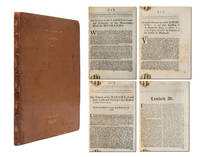
16934178London: Various 1693. First editions. Late 18th - early 19th century full polished calf with gilt to spine and front board. Marbled endpapers. A pleasing square copy with just a bit of rubbing to extremities. Gilt and embossed bookplate of bibliophile Edward Hailstone 1767-1851 to front pastedown. Containing four complete exceedingly scarce pamphlets from the 17th century querelle des femmes debates about women's humanity and place in society interleaved with blanks likely for manuscript glossing although all remain unmarked. Comprised of:<br/><br/>1. Petition of the Ladies of London and Westminster to the Honourable House for Husbands. London: Printed for Mary Want-man the fore-maid of the petitioners and sold by A. Roper in Fleetstreet 1693. First edition. Complete including all four pages called for by ESTC and listing its imprint in the colophon. ESTC records only 8 copies with only 3 listed in the modern auction record since 1940.<br/><br/>2. An Humble Remonstrance of the Batchelors in and about London.in Answer to the Late Paper Intituled A Petition of the Ladies for Husbands. London: Printed for and Sold by the Bookselling Batchelors in St. Paul's Churchyard 1693. First edition. Complete including all four pages called for by ESTC and listing its imprint in the colophon. In all a clean and neat copy of this scarce and important part of the debate on women. ESTC lists only 8 extant copies with only 2 listed in the modern auction record. ESTC R4393.<br/><br/>3. The Petition of the Widows in and about London and Westminster for a Redress of their Grievances. By the Same Solicitor that Drew up The Petition for Ladies. London: Printed for the Use of the Wide--ows 1693. First edition. Complete including all four pages called for by ESTC with the imprint appearing at the rear colphon. A scarce piece recorded at only 7 institutions by ESTC and recorded only twice at auction since 1927. ESTC R25582.<br/><br/>4. Lambeth Ale. London: Printed for Abel Roper 1693. First edition. Complete in four pages with the imprint recorded on the rear colophon. With no listing on ESTC and no appearances at auction a truly scarce piece.<br/><br/>A unique opportunity to trace a string of direct argument-and-response publications rapidly produced within one year of the 17th century querelle des femme pamphlet wars. Brought together in one binding by solicitor and bibliophile Edward Hailstone whose remarkable library at Walton Hall included rare books and antiquities. <br/><br/>The Querelle des Femmes the Woman Question was a debate on women's status that raged across Europe and England through the 16th to 18th century depicted at times in drama and literature but most often enacted through broadsides and pamphlets. While early iterations of the debate focused on whether women were humans or indeed possessed souls emphasis began shifting as an increasing number of women began printing responses of their own. In this collection's first pamphlet "Mary Want-man the fore-maid of the petitioners" the anonymous female author draws attention to the negative impacts that misogynist bolster lectures have had on the general state of matrimony. By labeling women as natural harlots predestined to cuckold their husbands the Petition alleges polemicists endangered women and men alike: the former would lack economic and legal security without a spouse and the former would turn to drink and debauchery. "Mary Want-man" in this sense turns the tables on the terms of the debate. Men are morally weak without a helpmeet and need wives -- and women are placed at social disadvantage by the rules that define them as men's companions. To this end the Petition sets out the demand that men be required to marry much as women have been and that they meet five terms: "First that all men of Quality and Degree soever shall be obliged to marry as soon as they are one and twenty and that those persons who decline so doing shall for their Liberty as they call it pay yearly to the State.Secondly that no Excuse shall be admitted but that of natural Frigidity or Impotence.Thirdly since it is found by experience that the generality of young men are such Idolators of the Bottle.that no person whatsoever shall be privileged to enter a Tavern who is not married.That every Poet or pretender to be a poet or anyone who is hired to write .to the derogation of the Matrimonial State shall be obliged to marry before Lady day ensuing.Lastly.every person of Quality pretending to keep a Miss.must dispose of her in Marriage to his Footman or Groom." Biting and witty this feminist satire suggests that men must be corralled and that marriage is the means by which to do it thus also ensuring stability for women. <br/><br/>Soon after the "Bookselling Batchelors" engaged "Mary" with their own publication -- and in attempting to break down the Petition's satirical arguments An Humble Remonstrance relies on many of the misogynistic commonplaces that the Ladies decried. And in its conclusion Remonstrance teases the possibility that women were right about men's current debauched tendencies shifting The Petition's desire for social instability to one of bawdy fulfillment for men's benefit. "The Ladies are weary of lying alone and so are we: They would fain be advantageously married and so would your humble Servants. The Quarrel on their side is therefore unjustly begun.but because Jacob could serve two Apprenticeships for his Rachel they imagine that we must do the same; not considering that the Race of Methuselahs and Patriarchs is quite extinct."<br/><br/>Unwilling to be outdone the women clap back; and a pamphleteer claiming to represent the interests of the region's Widows joins the printed fray. "Last week a petition subscribed by the unmarried Ladies came before you.Tis true we wondered to find an Army of Maids from whom the world usually expects modesty and silence.Widowes indeed who lye under no such restrictions are allowed to speak for themselves." Thus the Widows point out a crucial and problematic differentiation among women based on marital status: the division of the femme covert unmarried or married women with legal identities subsumed by fathers or husbands under coverture versus femme sole orphaned or widowed women with more independent legal and social status. To this end the widows recognize the need of the Maids to raise concerns about the issues most affecting them; while the more empowered widows can build on this foundation and push for a further expansion of rights.<br/><br/>While the final pamphlet of the group is not a direct engagement with the others it does suggest the collector's own interest in the role alcohol plays in much of the behavior decried by women in these works. <br/><br/>An opportunity unlikely to arise again for acquiring three incredibly scarce directly related arguments released only weeks apart. Various unknown books
195331599Reliure de Louise Bescond Paris, Gallimard, (mars) 1953. 1 vol. (125 x 190 mm) de 252 p., [1] et 1 f. Reliure souple en veau naturel teinté gris perle et estampé, tranches dorées sur témoins, couvertures et dos conservés (reliure signée de Louise Bescond, 2018). Édition originale. Un des 55 premiers exemplaires sur vélin pur fil (n° 6).
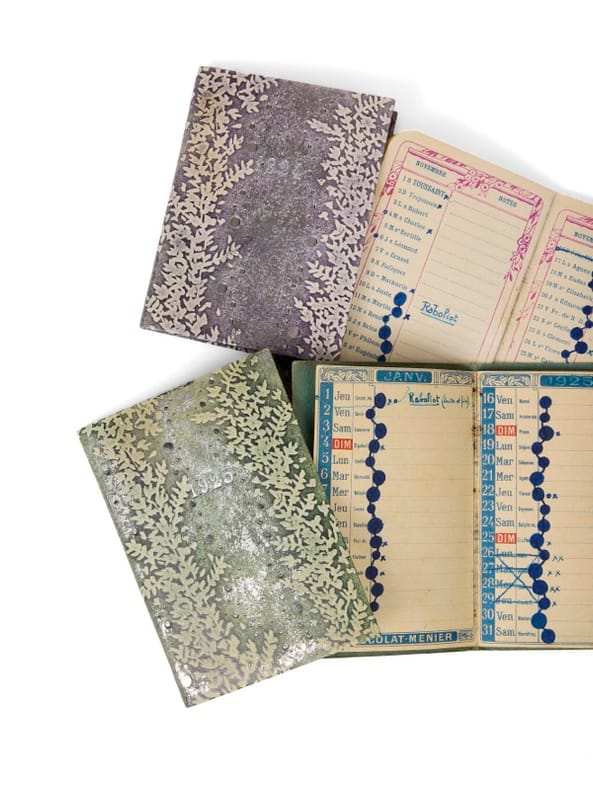
192431647Témoignage exceptionnel du processus créatif de Genevoix [1924 et 1925]. 2 vol. (55 x 80 mm et 60 x 80 mm). Brochés, sous chemises en veau naturel estampé d’une eau-forte originale au motif de feuillages, teintée mauve pour l’une et vert pour l’autre, semis de points au palladium, gardes de chèvre velours gris, chemise et étui bordés (signée de Louise Bescond, titres Claude Ribal, 2025). Témoignage exceptionnel du processus créatif de Genevoix : deux agendas manuscrits, qui documentent jour après jour l’avancement de trois œuvres majeures : Euthymos, Raboliot et La Boîte à pêche.
190029598Un des 20 premiers réimposés sur chine. Reliure signée de Marius Michel Paris, Fasquelle, 1900. 1 vol. (165 x 255 mm) de 1 f., [4] et 519 p. Maroquin brun, dos à nerfs orné de filets à froid, tranches dorées sur témoins, filets à froid sur les coupes, contreplat à encadrement orné d'un jeu de sept filets, couverture conservées (reliure signée de Marius Michel). Édition originale. Un des 20 premiers exemplaires réimposés sur chine (n° 18).
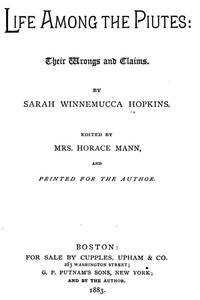
19963406V.p. 1996. A collection of 410 titles concerning Women in the West. Condition Statement: Overall most of the books in the collection are in "good" or "good" condition which typically describes a book that is sufficiently worn the binding soiled scuffed stained or spotted and may have loose joints hinges pages etc. To a lesser extent there are books in "fair" condition namely a well-worn book that has complete text pages including those with maps or plates but may lack endpapers half-title etc. The binding and/or jacket may also be worn. Women in the American West: Books and Ephemera from the Collection of Dorothy Sloan. SEE DETAILED FINDING AID on our website. <br/><br/>Dorothy Sloan b. 1943 is justly considered to be one of great scholar-booksellers of Western Americana Texana and Latin Americana. Dorothy Sloan Rare Books auction catalogues are recognized as models of their kind and feature an unusually broad array of printed books maps manuscripts and ephemera and are particularly strong in 19th-century materials. In many instances Sloan's bibliographic descriptions have become the description of record.<br/>She began her career at John Howell in San Francisco and thence to Jenkins Company in Austin. She issued her first rare book catalogue in 1984 and her first auction catalogue in 1994. Suffice it to say that as a woman she was literally a pioneer in such an endeavor. <br/><br/>Over the years she built a collection of Women in the West which is described in the 29-page Inventory below. Here is a collection of both women authors and women as the subject of historical and literary narrative. Most of the collection was kept in storage for the last twenty-eight years awaiting cataloguing and eventual sale. As we all know "Life" often interferes with our plans particularly as we grow older. <br/><br/>When Dorothy retired last year we acquired the collection of Women in the West. We are pleased to offer it en bloc for the price of $8200 which includes free shipping in the Continental United States. <br/><br/>Of the 410 titles in the collection nearly 25% are more than a century old. The earliest book in the collection is Sally Hastings' Poems on different subjects. To which is added a descriptive account of a family tour to the West. Lancaster 1808. The author describes her travels from Lancaster County to Washington PA. through the Alleghenies and gives an account of the Ohio River at Pittsburgh.<br/><br/>Only a handful of titles in the collection were published in the last 30 years the "newest" one dated 1996 namely: Anne Butler and Ona Siporin Uncommon common women. which contains culturally and ethnically diverse accounts of women who lived in the American West.<br/><br/>The physical size of the collection is considerable. Without any packing material it would encompass 15 large boxes. There are photographs gum cards engravings various inscribed books plays of the California Gold Rush memoirs and captivity narratives travelogues captivity narratives autobiographies Western novels pamphlets private press material a few 'zines journals catalogues and magazines. It is the culmination of decades of labor spanning all genres in the Western Americana tradition. The collection represents women's voices of a myriad of ethnicities including various Native American tribes African and African-American women Hispanic women prostitutes madams cowgirls ranchers pioneers and their struggles in the face of physical social and cultural adversity. <br/><br/>We are reluctant to mention "highlights" as it would suggest that "lowlights" do not merit attention from scholars and bibliophiles alike. We invite readers to peruse the Inventory of the collection capably prepared by Hunter Corb to allow readers to make that determination for themselves. <br/><br/>Included is the first edition of Miriam Colt's autobiography which describes her ill-fated expedition to Kansas Went to Kansas 1862 in which she traveled more than 1300 miles to establish a communal vegetarian colony. Colt provides vivid and frightening details of a family's ordeals on the frontier landscape including severe illness and encounters with lawless gangs. Defrauded of their investment in the Vegetarian Settlement Company the Colts left Kansas in the fall of 1856. Colt's husband and son died en route leaving only mother and daughter to return to New York. <br/><br/>Another work of interest is Sarah Hopkins's Life Among the Piutes an autobiography written at the encouragement of Ralph Waldo Emerson. This is considered to be the first book written and published in English by a Native American woman. It provides "extensive information about pre-White northern Paiute culture the types of foods marriage and other social practices as well as political leadership" Paher while simultaneously increasing awareness and sympathy for the plight of Native Americans. <br/><br/>Melinda Rankin's Twenty Years Among the Mexicans describes her missionary labor in south Texas and Mexico. Herein are depicted the experiences of the first Protestant woman missionary in Latin America. Although laws in Mexico at the time forbade the introduction of any form of Protestantism into the country Rankin traveled there in 1852 and established the first Protestant mission in Northern Mexico continuing her work there for a few decades before returning to the United States due to health problems. This narrative describes not just Rankin's missionary labors but also many dramatic events in Texas and Mexico including revolutionary turmoil the American Civil War and her capture by the notorious military leader rancher and outlaw Juan Cortina.<br/><br/>From early settlers of the West during and shortly after the American Revolution; to ranchers and pioneering women in the early days of the Republic of Texas and the fight for independence; to overland travels in covered wagons on the famed Oregon Trail at the outset of the American Civil War; to excursions into Mexico and Latin America at the end of the 19th and into the 20th centuries. Over two hundred years of women's experiences can be found within this collection and as such there is something for every student and subject matter.<br/><br/>SEE DETAILED FINDING AID ON OUR WEBSITE which enumerates each and every one of the 410 titles:<br/><br/>https://www.michaellaird.com/cat.phpid=307. unknown books
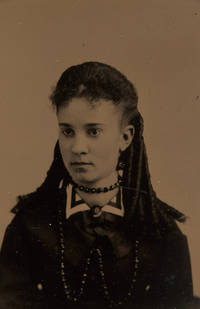
32820632<p>80 tintypes one fully painted a few others with painted highlights. 19th-century brown leather album with diecut sheets housing the photographs. Color lithograph title page stating "album." Very good condition overall. This fascinating album contains 80 tintype portraits of women and girls young and old. Some are dressed plainly while others are in fine dresses and at least one is in mourning attire. The photographs include head and shoulders seated and full-length standing portraits. The album opens with a fine half plate tintype of a woman seated with her presumed husband their two daughters standing behind them. The second photograph is an horizontal half plate tintype of two women seated in front of a large painted studio backdrop of a bridge or pier. Studio furniture props curtains and backdrops may facilitate identification of photographers. The collection comprises 80 portraits as follows: 3 whole plate tintypes one hand painted trimmed at left and right to fit the album 5 half plate tintypes 3 of them showing multiple sitters 72 six plate tintypes In addition the album contains two tintypes of men one a painted whole plate and the other a half plate. This extensive collection of portraits of women is a wonderful resource for the study of fashion hairstyles jewelry and the history of portrait photography.</p>
D20128Folio 20 x 12½ inches contemporary half calf worn with boards detached. The first 24 leaves of this truly remarkable and quite large object are used as a circa 1820s scrapbook. This is followed by approximately 100 complete issues of the Gazette of the United States plus some partial issues with moderate wear. Philadelphia and environs 1802-circa 1824. The compliler of this scrapbook was possibly a descendant of Lynford Lardner 1715-1774 a close associate of the Penn's who had an estate at Tacony near Philadelphia. Much of the original art is by women. As nearly as can be assumed the artists featured include his daughter Hannah Lardner 1756-1839 and granddaughter Elizabeth Lardner 1791-1877 whose mother was from the Saltar family. The original art includes: a watercolor of a rose by Elizabeth Saltar Lardner of Tacony; an ink and wash landscape by Miss Hannah Lardner of Tacony; two ink and wash views by Frances "Fanny" Saltar 1790-1880 titled "Cootstown from the East" of Kutztown PA and "A View Down the Lehigh River from Bethlehem Bridge". There are two watercolors of flowers by Frances Saltar of Tacony trimmed and laid in rather than mounted; an unsigned watercolor still life of shells; an unsigned pencil sketch of a ruined building; an unsigned pencil sketch of a residence; and a watercolor of flowers in an urn signed "S. Courlander." Also included are 20 silhouettes in a uniform format 5 x 4 inches all but three of them laid down on dark paper. Some bear faint embossed stamps reading "Museum" which helps identify them as products of Peale's Museum run by the noted artist Charles Willson Peale. A formerly enslaved man named Moses Williams who had been owned by the Peale family secured his freedom in 1802 and then produced thousands of silhouettes for Peale's Museum at 8 cents each. His remarkable story has only recently received attention. These works are not signed and Peale may have employed other silhouettists in addition to Williams but many or all of these portraits were likely by Williams. Three are captioned in manuscript: Mary F. Smith "Lardner" and "Country Cousin." Additional ephemera mounted in the scrapbook includes an 1824 engraved invitation to the Lafayette Ball; a set of French allegorical prints of the four seasons; 8 large hand-colored botanical engravings; and an engraved portrait of Lafayette by Longacre. Most of the volume was actually never used as a scrapbook. The Philadelphia newspaper Gazette of the United States 16 February to 30 June 1802 is bound as fairly close to a complete run of approximately 100 issues but 5 issues are missing and 7 are incomplete. The 8 March issue has two black-bordered pages to mourn the death of Federalism at the hands of Thomas Jefferson. More traditionally the black-bordered 26 May issue mourns the death of Martha Washington. <br /> <br/><br/> hardcover
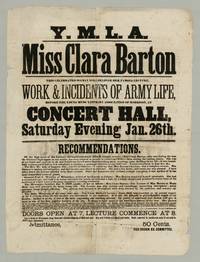
186713090Morrison WI 1867. Broadside 26.75 x 20.25 inches printed on thin paper. Old folds some creasing edges occasionally a bit frayed with a few small nicks or tears a couple of minor losses along folds. Overall very good condition. A striking and seemingly unique surviving broadside advertising a January 26 1867 lecture by Clara Barton entitled "War & Incidents of Army Life" part of a popular post-Civil War lecture series she delivered across the United States. Barton spent two years touring and recounting her battlefield experiences which helped popularize her and fund her subsequent efforts to locate missing soldiers. The present lecture was delivered to the Young Men's Literary Association of Morrison Wisconsin at the local Concert Hall. In addition to the bold title containing the relevant information on the lecture and the information on obtaining tickets at the bottom much of the lower portion of the broadside prints several laudatory "Recommendations" from various entities in Indiana and other locations in Wisconsin including a January 7 1867 review from The Milwaukee Sentinel. Noted temperance lecturer John B. Gough also praises Barton's lecture stating that "I never heard anything more touching more thrilling in my life."<br /> <br /> Typographically the broadside is interesting for employing several sizes of fonts likely wooden type especially near the bottom of the Recommendations section where the printers needed to reduce the size of the font to fit in the entirety of a quote from The Daily Wisconsin as well as a line in the smallest font from the Concert Hall promoter noting that the foregoing group of recommendations is "enough" and praising Barton for her "noble character which she has won by her efforts to ameliorate the sufferings of our sick and disabled soldiers."<br /> <br /> Clara Barton 1821-1912 was a noted educator and humanitarian who helped distribute needed supplies to the Union Army during the Civil War and later founded the American Red Cross. Barton garnered nationwide recognition for her efforts during the war and quickly became known as the "Angel of the Battlefield." After the war Barton's lecture tour brought her in contact with other notables of the day including Susan B. Anthony and Elizabeth Cady Stanton and also Frederick Douglass who involved her in the suffrage and civil rights movements respectively. In the Fall of 1866 Barton began to lecture on her Civil War experiences in lyceum halls churches town halls and schools. Though she never felt comfortable in front of an audience wherever she spoke Barton was well received. Her contemporary biographer Percy Epler wrote that "a tear-stained multitude thronged everywhere to hear her" as she had made it her mission to show not "the glories of conquering armies but the mischief and misery they strew in their tracks; and how while they march on.some one must follow closely in their steps crouching to the earth faces bathed in tears and hands in blood. This is the side which history never shows."<br /> <br /> From 1866 through 1868 Barton delivered over 200 lectures throughout the northeast and midwest regarding her Civil War experiences. She shared platforms with other prominent figures including the aforementioned Douglass as well as Ralph Waldo Emerson William Lloyd Garrison and Mark Twain. She often earned $75 to $100 per lecture. Original broadsides advertising her lectures especially of this size are exceedingly rare to say the least. We could locate just a single result in auction records of a much smaller example and OCLC reports just one institutional holding of any Barton lecture broadside again much smaller for an 1867 event in New Haven located at the Library of Congress. unknown
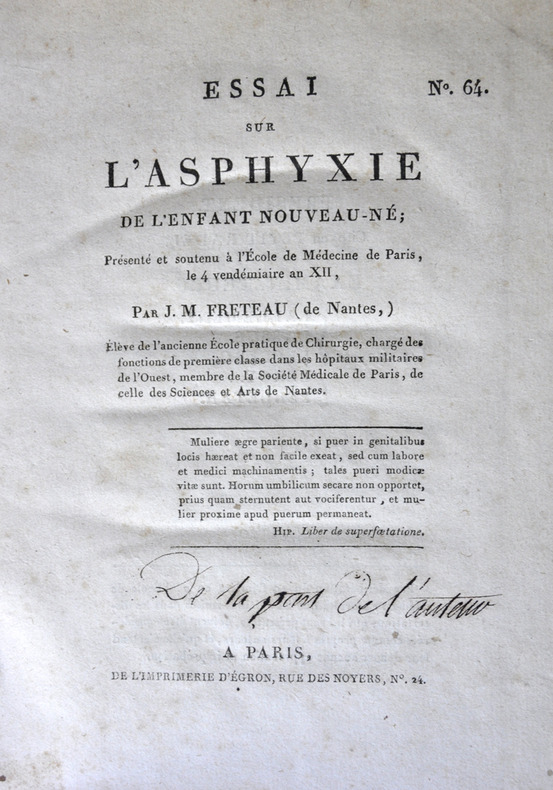
5432Deux importants volumes contenants 29 theses medicales datant du tout debut XIX em siecle, in 4 carré , reliés demi veau dos lisses, decorés pas de pages de titres ni de tables , les theses s'enchainenet les unes aux autres : pas de pagination continue. A Paris , imprimerie Didot Jeune , pour la majorité , photos sur demande
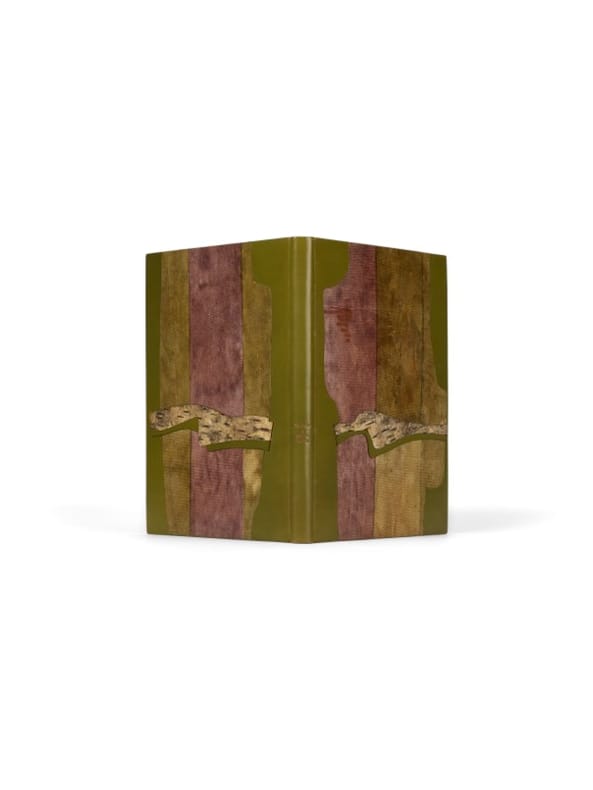
195432334Reliure de Monique Mathieu Paris, Grasset, (20 décembre) 1954. 1 vol. (175 x 225 mm) de 139 p., [2] et 1 f. Veau vert, plats ornés d'un décor mosaïqué en relief et en creux composé d'une pièce irrégulière de box et de papier posée sur un fond de papier vergé teinté et ciré, titre à l'œser prune au dos, tête cirée en vert, contreplats et gardes de papier bois, couvertures et dos conservés, chemsie et étui bordés (reliure signée de Monique Mathieu). Édition originale. Un des 18 exemplaires sur japon (n° XV).