[Mexico]. [Women]Biblio.com
5 244 résultats
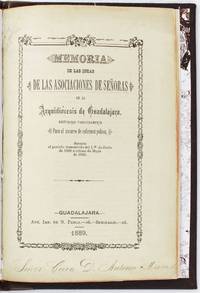
18895774Guadalajara 1889. Very good. 214pp. plus folding plate. Later quarter calf and cloth boards stmaped in blind gilt lettered. Minor wear to boards. Contemporary ownership inscription on title page. Even tanning. An apparently unrecorded account of this Mexican women's charitable association operating in Guadalajara at the end of the 1880s. The group was made up of more than 4000 women whose goal was to raise money for the poor and ill of the city. According to the documents here they helped more than 2500 sick people in the year prior to their general meeting which took place in July 1889. All the positions in this association are occupied by women except for the general director with the canon lector in that role. The report is fronted by an edict from the Archbishop of Guadalajara calling the ladies' group "Una de las mas importantes Asociaciones de Caridad que had nacido y se han desarrollada en la Santa Iglesia" and approves eighty days of indulgence for each work of charity completed. At the rear is a folding plate that prints the finances and funds raised by local groups across the state. Not in OCLC. unknown
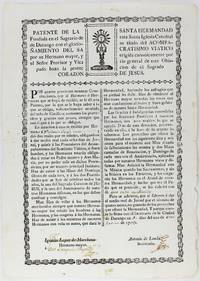
17933334Durango Mx: October 1793. Very good. Broadside 12 x 8.5 inches printed in two columns with a central woodcut headpiece all within a handsome ornamental border. Old folds minor foxing light edge wear eight pinpoint wormholes not affecting readability of text. Completed in ink with ink docketing on verso. Signed and rubricated. A seemingly unrecorded "patente" or indulgence issued by the Holy Cathedral Church of Durango conferring membership into a religious confraternity for a woman named Maria Josefa Cano whose name is entered in ink within the text of the broadside. This indulgence issued by the colonial "Santa Hermandad" defined Cano's duties which included attendance at mass on the last Sunday of each month as well as certain festivities assist sickly brothers and sisters and attend funerals of fellow members "with a candle in hand." It also provided Cano with membership indulgences provided for sixteen pesos for her burial and defined the masses to be performed upon her death. This example includes the name of the former "Hermano mayor" eldest brother crossed out and with the name of the current elder signed and rubricated just below; also includes rubrication below the secretary's name. A wonderful indulgence for a woman in Durango in the last decade of the 18th century. October unknown
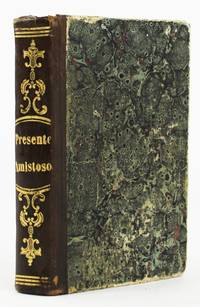
18505777Mexico: Luis G. Gonzalez 1850. About very good. 82541pp. plus four plates. 16mo. Contemporary quarter calf and marbled boards spine gilt. Light wear at edges and spine ends a bit heavier to corners. Light dampstaining at outer corners of plates otherwise light toning and an a occasion fox mark internally. Scarce 1850 issue of this Mexican gift book for women which in its introduction claims to "Ofrecer al bello sexo mexicano una coleccion de articulos que por su variedad puedan servir de agradable entretenimiento en los ratos de ocio." The contents are comprised principally of poetry religious stories and and moral tales four of which are illustrated with lithograph plates. Interestingly the other publications in the series which ran only from 1847 to 1852 were printed by Ignacio Cumplido whereas the present issue bears the imprint of Luis Gonzales. No individual copies catalogued of this 1850 issue in OCLC; nor could we locate any examples in the serial records. Luis G. Gonzalez unknown
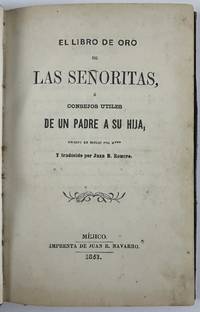
185113052Mexico City: Juan R. Navarro 1851. 208pp. Contemporary Mexican green morocco gilt borders to boards spine stamped in gilt. Minor edge wear some scuffing to boards light soiling. Uneven toning to text occasional minor staining. Overall very good. An apparently unrecorded book of manners supposedly translated from the English language by Juan B. Romero in Mexico in 1851. The title translates roughly to English as The Golden Book for Young Ladies or Useful Advice from a Father to His Daughter. We were unable to identify any English sources for this work thereby providing either an excellent research opportunity for a bibliographer to identify its source or as a new and interesting original work for scholars of Mexican literature in the 19th century. The half title indicates the work is part of the Biblioteca de la Semana de las Senoritas; OCLC reports just three other works under this series title all works of poetry. All of the works in the series were printed by Juan R. Navarro who also published a women's magazine under a similar title La semana de las senoritas mexicanas. Navarro's magazine was aimed at educating and informing women on cultural events history and science in response to the absence of formal schools. The present work presents an ideal of female behavior through advice from a helpful father figure. The chapters cover topics such as friendship education reading manners conversation entertainment interpersonal relationships marriage religious sentiments humility proper use of time and more. Somewhat morbidly the twentieth and final chapter advises young women on "prepararse para la muerte" "preparing for death". Juan R. Navarro unknown
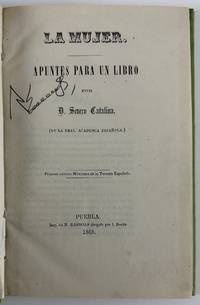
186813053Puebla: Imp. de N. Bassols dirigida por I. Boclar 1868. 3162pp. Contemporary light green cloth gilt spine titles. Minor edge wear light soiling to boards. Sam black ink signature to title page last page of text and Index leaf. Very good. The very rare first Mexican edition of a popular Spanish work authored by Don Severo Catalina del Amo 1832-1871 a Spanish professor of Hebrew studies who was admitted to the Royal Spanish Academy in 1861. In his "Notes for a Book" on "The Woman" Severo Catalina expounds on various aspects of the character of women in chapters on education modesty pride "virtue and mysticism" love marriage maternity widowhood "the religious profession" charity poverty social gatherings and more. The work opens with the 1858 prologue to the first Madrid edition written by Ramon de Campoamor which begins with a question that seems to go to the heart of the work: "Is this book an apology for women or a libel against the female sex" A decade passed before the work appeared in Mexico interesting for studying the transmission of popular Spanish works to Latin America in the latter half of the 19th century.<br /> <br /> Early Spanish editions of La Mujer are rare but this "Primera edicion Mexicana de la Tercera Espanola" is almost unheard of. OCLC reports just a single institutional copy at the Daniel Cosío Villegas Library of El Colegio de México. This Puebla imprint is a somewhat shaky production with numerous mistakes in the page numbers but nonetheless interesting bibliographically. Imp. de N. Bassols dirigida por I. Boclar unknown
197341364Detroit: Nancy Lee Coleman 1973. 4to. 38 leaves. Including 8 wood engraved plates on sumi-e paper. Black & green rice-paper portfolio leaves & plates loose as issued w/ open-backed cream-linen slipcase w/ decorative papers on cvrs signed & numbered by the artist. First edition No. 1 of 7 copies printed by the artist and presented to Katy Thomas. This private press book was printed by the author in summer 1973 the prints hand rubbed on sumi-e paper and mounted on dyed rice papers. The poems were printed in 18 point Spartan Book Type hand set by the artist and printed at Wayne State University on Tuscan cover gray. Nancy Lee Coleman, unknown
193955010New York: E.P. Dutton & Co. Inc. 1939. Small 4to. 86 pp. Illustrated title in pink & black numerous plates and text illustrations throughout many printed in combination of pink & black. Brown publisher’s cloth black lettering front cover & spine illustrated endpapers w/ d.j. cover art by Downer very light age toning and dustsoiling 1 closed tear at spine NF/VG copy. First edition stated of this beloved and charming book based on the childhood of Michigan pioneer Amelia Kaden. The nicely illustrated story relates the tale of the Kadens arriving in Petoskey MI and then developing and claiming their homestead near what today is Chandler near Boyne Falls. E.P. Dutton & Co., Inc., hardcover
192551837Chicago: Rand McNally & Co. 1925. Small 4to. 194 pp. Colour frontisp. 1 colour plates 125 text illustrations diagrams photo illustrations. Olive-coloured cloth Arts & Crafts cover art of young woman wearing a hat reflected in mirror w/ borders and lettering in blue & black slight shelfwear very slight rubbing NF copy. First edition of this well-illustrated and excellent work on hat making by the noted University of Washington Assistant Professor during the Flapper Era. Patty 1872-1972 offers extensive practical knowledge and instructions on making paper patterns the necessary equipment materials for construction including braids fabrics furs using molded frames wire frames covering the hats and more. Rand McNally & Co., hardcover
First edition, 8vo (170 x 105mm), [4], 285, [3, publishers ads]; [4], 291, [1, publishers ads]; [4], 336; [4], 336pp., with half-titles, ex-library copy, neat library label to front-paste down (Sheffield Public Library), library stamp to verso of title, neat blind stamp to first and last leaves, orig. green cloth, red leather spine label lettered in gilt, library number to base of spine, spines chipped and defective (see images supplied). A rare Minerva Press novel by a lady author, JISC locates just 3 copies (BL, Oxford and University of Manchester). Garside, Raven & Schw?erling, 1812: 37.
8vo (175 x 115 mm), woodcut vignette to title, light staining and age toning throughout, blank fore-edge margin of title page with small chip, disbound, uncut. Rare Cheap Repository tract by Hannah More, aimed through the use of a moral tale at helping less educated and poor women run efficient, economical kitchens which could still provide nutritious food to their families. One of several editions published between 1795 and 1810, all of which are scarce. Maclean, p. 78.
8vo, v, [2], 8-304pp., cont. sheep, rubbed, upper joint split, red morocco spine label. Provenance: Early ownership signature to front pastedown: John Widdowson.
194256718Eugene OR: Obsidian Club 1942-1945. Oblong 8vo. 9.5 x 6.25 in. 36 pp unpaginated. on thick black paper stock. With 44 photographs tipped-in 1 Kodacolor colour photo w/ all on hinges many w/ annotations in pencil manuscript on verso 1 newspaper clipping for the 1945 climb. Contemporary lim suede calf post-binder painted illust. of Native American Chief & headdress wigwams on front cover Vancouver Canada punch sewn at gutter margin w/ black silk braid minor shelfwear rubbing VG exemplar. This mountaineering album offers a detailed visual record of the Obsidian Club Camp Outings during World War II opening with their summer camp Aug. 2-16 1942 at Linnton Meadows at the base of Husband peak east of Husband Lake with splendid views of Middle Sister South Sister and the Husband. The many photos show the Husband hiking near the Lake followed by climbs of the North and South Sister peaks including several images of the climbing parties trekking across the glaciers and passes. This outing also included visits by Forrest Morgan Ray Engles and Supervisor Bruckart of the Willamette National Forest with Engles making his first major climb on the North Sister. The second part includes photos for the 1945 Outing held at Obsidian Camp and featured climbs of the North Sister Middle and South Sisters as well as the Husband and Little Borthers and several views of the Linnton Meadows Lake campsite. Also included is a the souvenir photo invitation from the Obsidians announcing the Summer Camp Reunion Sept. 22 1945 urging members to bring their photos and stories. Florence Sims became the Obsidian Club’s first woman president in the Fall of 1942. The Obsidian Club was originally founded after two students were lost in the Three Sisters in 1927 and it was determined their needed to be a local mountaineering and rescue group. See: The Obsidian Vol. V Nos. 2-3; Vol. VI No. 1; Vol. VII No. 9; History of Obsidians - Obsidians’ First Year The Obsidian Bulletin Vol. 77 No. 9 Oct. 2017. Obsidian Club, unknown
193156722Portland OR: Grace Lougheed & L.S. Lougheed 1931-1934. Three parts. 1st. -- Oblong 4to. 44 pp unpaginated. on thick black paper stock. With 126 silver gelatin photographs all mounted w/ black corners sized from 2.5 x 3.5 in. up to 5 x 7 in. and nearly all w/ manuscript annotations in white ink below in the margins. Contemporary faux alligator skin post-binder punch-sewn at gutter margin w/ black braid minor edgewear rubbing minor bumping to corners still NF album; 2nd -- 4 leaves unnumbered. pencil manuscript written in clear cursive using R.B. Pettijohn & Co. letterhead order sheets as scrap paper minor creasing a few corrections still VG; 3rd -- 8vo. 4; 4 pp. minor toning offsetting to front of first issue edgewear still VG copies. This remarkable photo album written and assembled by Grace Lougheed chronicling the multiple mountaineering expeditions to peaks in the Cascade Mountains for the Multnomah Amateur Athletic Club led by her husband L.S. Lougheed. “The first of our climbs for the summer of 1930†was Zigzag Mountain a 5007 foot peak considered a foothill of Mt. Hood and a popular hiking trail of about 8 miles with images of Loverne & Grace seated Loverne & Alden on one of the peaks and vistas of Mt. Hood in the distance. The couple followed this with trip and climb on Mt. St. Helens ascents of Mt. Hood from the South and North Sides with trails marked on the RPPC cards and noting that “Left Cloud Cap Inn at 2:40 AM reached top at noon. Very hard climb -- logs of rocks falling†with views glaciers on Mt. Hood and climbers in deep snow in August. In March 1931 they return to a climb on Mt. St. Helens with views across the crater from their cabin at the summit and crevasses they nearly fell into. In August 1931 they make ascent on Mt. Adams noting that they “left Cold Springs Camp at 2:40 AM arrived back at camp 5:20 PM went part of the way with a party of Crag Rats from Hood River†including photo of Grace seated with Joe & Loverne resting on the climb. August 31-Sept. 21 1931 illustrates climbs to Illumination Rock at the Summit rim on the Reid Glacier Ansel Rock Zigzag Glacier and finally Elliot Glacier at the last. In October they return for more climbs on Mt. Hood recording first new snow the summit cabin the Timberline Cabin in January 1931 with photo of the cabin interior. The first climb Jan. 11 1931 shows image of Ole Lien Al Builmore Don Hampton & Jim Harlan on the slopes above Government Camp. Their ascent of Mt. Rainier was undertaken from July 4-5 1931 with views near Anvil Rock and the summit at Camp Muir Gibraltar Rock and views of the Tatoosh Range. The final climb documented in the album was a climb to Eliot Glacier up the Sunshine Route which follows the lower aspects of the Cooper Spur Route and then climb toward Cathedral Ridge. The Climb up Mt. Jefferson is announced for MAAC members in The Winged “M†August 17 1934 with announcement that this would be the fourth climb of the year for the club whereas the pencil manuscript specifically notes that the Jefferson climb was the fifth in the series scheduled. Loverne writes that eleven people including the only woman Grace chose to go and that after leaving “Wapinitia Cut-Off eleven miles past Government Camp and turning down into the Oregon Skyline Trail we had a beautiful drive in the moonlight. The silvery light made the forest and meadows look like a fairyland with a lake now and then. . . at times we turned the car lights off and drove down the long forest road with just the bright moonlight shining through the trees.†The next day just as the sun was getting bright they were “ready for our trek of seven miles into Jefferson Park. Everyone was packed pretty heavily. . . and now and then we ran into bear tracks -- before we realized it we were came to the rim of Jefferson Park. Here the scene that is before one can hardly be put into words. . . the mountain with its pinnacles and great rought sic contours. The great bergschruds and crevasses shining in the sun made us all thrill to the sight.†They began the climb at midnight crossed ice fields hundreds of crevasses and reached the summit with Jay Oliver and Melwood Howlett. After their return climb down the mountain an hour before dark they packed out for the return of seven miles to the cars parked at Breitenbush Lake “a trip which was rather punishing after sixteen miles of steady climbing up the mountain & Back.†Grace Lougheed b. 1901 appears to have married Loverne Lougheed sometime in the late 1920s first appearing in Portland City directories in 1928 but we were unable to uncover her whereabouts after 1934. Loverne Lougheed 1902-1978 was a Canadian-American whose father Ormand Lougheed b. 1878 owned and operated a very successful sawmill and logging saw filing operation in Portland on Denver and later Union Ave. for decades. Loverne appears as Vice President of the O.J. Lougheed & Son until after World War II when his third wife Janet Lougheed is listed as a widow in 1948 but then he reappears returning from California and appearing in directory listings by the 1950s. Grace Lougheed & L.S. Lougheed, unknown
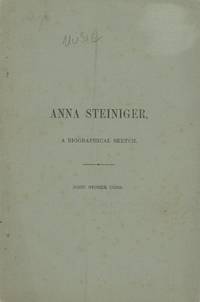
1886List3234Boston Massachusetts: G. Schirmer Jr. 1886. Forty page booklet measuring 4 ¼ x 6 ½ inches in paper wraps. A biography of German pianist Anna Clark-Steiniger by English writer and cremation proponent John Storer Cobb. The biography details Steiniger’s early years as a student of Theodor Kullak and Ludwig Deppe her rise to prominence and performances with friends including Etelka Gerster and her arrival in the United States with her American husband Frederick Clark. Though popular at the time Steiniger seems to be fairly unknown at present with Cobb’s book written shortly after her American debut the main source of biographical information. We find eight copies of the book in OCLC. G. Schirmer, Jr. unknown
194456445Garden City NY: Crime Club Doubleday Doran & Co. Inc. 1944. 8vo. 188 pp. Tan publisher’s cloth dark brown lettering very slight bumping foot of spine minor shelfwear w/ d.j. cover art of black lizard and straight razor minor chipping & creasing foot of spine edgewear still VG/VG- copy. First edition stated of this scarce Crime Club mystery set against the backdrop of amnesia mistaken identity barking lizards and murder on the Trans-Australian Express. Very rare in original dustjacket. The Australian born sisters wrote 21 mysteries and nearly all featured “Black†in the title. Crime Club, Doubleday, Doran & Co., Inc., hardcover
193746322New York: Macmillan Co. 1937. 8vo. 8 323 1 pp. Beige cloth black lettering blue ruling slight shelfwear w/ d.j. vivid cover art in black white & blue of man in fedora with leopard head superimposed on bars by Norman Guthrie Rudolph minor rubbing head & foot of spine minor shelfwear NF/VG copy. First edition of the author’s only suspense mystery set against the backdrop of the London Zoo. Ashton 1891-1958 was a World War I nurse and later house physician at Great Ormond Street Hospital in London. Macmillan Co., hardcover
193157645New York: A.L. Burt Co. 1931. 12mo. 313 1 pp. plus 4 pp. publisher’s ads. Blue publisher’s cloth Art Deco lettering front cover & spine minor rubbing shelfwear very slight bumping to couple corners w/ d.j. vivid Art Deco cover art of African native peering through bushes at the legs of a corpse and nearby pith helmet minor chipping head & foot of spine couple corners light sunning still VG/VG- copy. First Burt edition of one of the author’s scarce “Kenya novels†a romance mystery fiction developed and popularized together with fellow authors including Nora St. John Beale Nora Strange & Eslpeth Hxley published originally as Valley of Suspicion Bles 1930. This sub-genre surrounded the social milieu of British Empire proponents and upper class in the Kenya Colony between the War with decided tinges of anti-semitism and unapologetic racism. Riddell d. 1960 was a popular romance mystery and adventure novelist whose works included Dream Island Perilous Love Kismet in Kenya and others whose life experiences included working as a governess teacher matron of a board house manager of a boarding school and author. . Scarce in dustjacket. See: C.J.D. Duder Love and the Lions: The Image of White Settlement in Kenya in Popular Fiction 1919-1939 African Affairs Vol. 90 No. 360 July 1991 pp. 427-438. A.L. Burt Co., hardcover
194558891New York: Farrar & Rinehart Inc. 1945. 8vo. 8 280 pp. Yellow cloth black lettering w/ d.j. cover art by Lester Kohs minor chipping & tears head & foot of spine small tear lower fore-edge front cover corners worn VG/G-. First edition of this espionage mystery set against the backdrop of sabotage at an arms manufacturing plant in New Mexico during World War II. Wadsworth 1901-1959 graduated Ogden High School and after attending Utah State worked at the Ogden Carnegie Library and afterwards the Dept. of Agriculture Ogden High School Library and during the war at Clearfield Naval Supply Depot and librarian at the Univ. of Utah. She wrote many juvenile mystery titles including Mystery at the Black Cat Masquerade Mystery and others. Farrar & Rinehart, Inc., hardcover
194761074New York: Macmillan Co. 1947. 8vo. 8 183 1 pp. Navy-blue tweed boards red lettering minor shelfwear w/ d.j. vivid Art Deco inspired cover art of stoplight minor edgewear slight bumping to couple corners sunning to spine & fore-edges still VG/VG- copy. First edition stated of this first Miss Julia Tyler mystery in which the 68-year-old retired Latin teacher investigates the death of a Navy wife’s murder on the bus. This “locked room mystery†explores the Homefront conditions during World War II Annapolis MD and the psychology of the unassuming former burlesque dancer serial killer revealed at the end. Macmillan Co., hardcover
195159805Philadelphia PA: Indian Rights Association 1951. 8vo. iv 35 1 pp. Illustrated beige softcovers cover art photo of Choctaw Indian elder front cover map on rear cover of extent of Five Tribes lands dustsoiling creasing minor edgewear annotation at upper fore-edge still G copy. First edition of this surprisingly uncommon sequel to the author’s controversial “And Still the Waters Run.†She intended this report as a follow-up to her final question in the book on “could the last Fullbloods of the Five Tribes be saved†Her earlier “And Still the Waters Run†was so controversial the Univ. of Oklahoma Press refused to publish the work and she was denied a professorship but the book was later printed in 1941 by Princeton. She touches in this report on the Farm Loan Policy and Land Purchases for the Five Tribes which were developed as part of the Oklahoma Indian Welfare Act. She also examines the push to introduce creating textiles and textiles industry among the Five Tribes such as the Sequoyah School with night courses taught by Grace Myson. The Indian Rights Association which initially formed and adopted the paternalistic assimilationist views advocating tribal members be detribalized to increase economic and social status was still the first non-governmental organization to push for support of Native Americans and also exposed frequent abuses by federal government and local government employees. Indian Rights Association, paperback
193462402New York: Dodd Mead & Co. 1934. 8vo. vi 4 246 pp. Photo frontisp. numerous photo plates. Blue publisher’s cloth illust. of monkey in black on front cover black lettering w/ d.j. Art Deco cover art of montage of animals on front cover by B.K. Morris minor chipping to head of spine minor sunning dustsoiling price-clipped still NF/VG copy w/ former ownership bookplate on front pastedown. First edition of this engaging memoir by the author whose scientific career centered around the Smithsonian Institution and was an editor for the Bureau of Entomology and the National Zoological Park. She writes of her journeys to Africa Central America South America and Asia with her husband William Mann collecting animals for the zoo how she often cared for them herself or in her home including Susan the lion cub herded uncaged flamingos on a cargo ship and more. Mann 1897-1986 is also well remembered for her popular “Tropical Fish†for aquariums and aquarium enthusiasts which remained in print over 40 years. Scarce in original dustjacket. Dodd, Mead & Co., hardcover
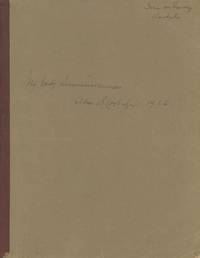
1926List3141Quincy Massachusetts: unpublished 1926. 201 pp cardstock wraps. Normal wear to wraps; overall Near Fine. Alice Brackett White Coolidge 1864–1927 was a Boston socialite of the prominent Richardson family; her grandfather was merchant and Massachusetts State Legislator Jeffrey Richardson. Coolidge was also the author of three children’s books: The Bunnies of Evergreen Village 1917 The Refugees in Evergreen Village 1918 and Evergreen Village to the Rescue 1922. Offered here is Coolidge’s unpublished memoir of her early life written in 1926 titled My Early Reminiscences.<br /> <br /> The memoir recalls Coolidge’s childhood and teen years spent mainly in Massachusetts New Hampshire and Maine. Her recollections typically involve extensive descriptions of the houses at which her family stayed the scenery around them and the various families they met and visited with. Given her position in society her acquaintances are sometimes quite influential people: Princeton president John Grier Hibben enjoys Coolidge’s fishcakes; Trinity Church rector Phillips Brooks gives her grandfather an “excellent pew†in the newly-finished church; pioneering doctor Alfred Worcester mistakes red pepper for mercury in a scientific demonstration at her school; and she recalls brief correspondences with John Greenleaf Whittier and William James.<br /> <br /> Coolidge also took dance lessons from Augustus Papanti whom she describes as “one of the thinnest men I ever saw†who was “very melancholy. I hardly remember his ever smilingâ€; and remembers Judge Charles Devens for “his great stature his charming face his courtliness of manner and his really boyish simplicity in entering into our evening games†including a game of “mind reading†which Devens played “with zest.â€<br /> <br /> One of her longtime friends was Rear Admiral John E. Pillsbury. She recalls:<br /> <br /> “Mr. Pillsbury as a young naval man a brother-in-law of my uncle Dr. Richardson used to take me out in the swan-boats on the Public Garden Pond. Later he went through all the ranks up to being retired as a Rear Admiral but time and circumstances never changed him. We always met at Thanksgiving and Christmas dinners and always talked at great length. . He was a wonderfully interesting lovable man and very modest and unassuming and shy. I always considered him one of my best friends though older by many years than I.â€<br /> <br /> Another interesting New England figure Coolidge encountered was Joseph Lee. She describes Lee’s hotel in Newton:<br /> <br /> “The house where we stayed was kept by a remarkable man named Joseph Lee. He was a mulatto much above many of his kind and his wife was a handsome woman partly Indian. They did the cooking and he waited on table with a colored maid to help him. In fact there were no white women in the house. The cooking was delicious.â€<br /> <br /> Lee was born enslaved in South Carolina freed in 1865 and went on to invent the automatic bread kneading and bread crumbing machines.<br /> <br /> Though nearly all of her childhood was spent in New England she also remembers being invited to visit Charles Joseph Bonaparte in Baltimore:<br /> <br /> “We had never been so far south except to Washington and I felt a curious feeling of being in a different atmosphere from any I had known. . We were met at the station by Mrs. Bonaparte in a large roomy covered vehicle with two horses. The coachman and footman were in the Bonaparte colors -- a deep wine color. The footman I well remember. He was a light-colored young negro very handsome and smiling and excited over having young ladies from the North. . All the servants were colored and lived in cabins near the house. . I never knew Mr. Bonaparte in public life so my memories of him are quite intimate and I fancy I saw much of his real self. . His mind was very active. He used to talk or listen as he walked and he moved his head in a curious way from one side to the other with a slightly rolling motion which was distinctly individual. . I never saw him irritated or excited and he was always very simple. In the group picture we had taken at the Maplewood he sat down cross-legged on the piazza floor like a boy. That was in about 1887. I suppose in public life or in law he was different but he was very equable and charming as we met him in his home and at the mountains. Most of all I admired his sweet tender ways with his flower-like wife.â€<br /> <br /> This was not too long after the end of Reconstruction and Coolidge remarks on the tense atmosphere:<br /> <br /> “Mrs. Bonaparte had warned me to be careful about questions regarding the North and South as the ‘feeling’ had not yet died away. I was so glad she had warned me. A gentleman slipped in and sat down beside me to watch a parade and whispered in my ear as the bands had been playing ‘Dixie’ how glad he was to meet a Northerner. I was glad to meet him too although I remember neither his name nor face but I felt I breathed freer in his sympathetic locality. . I had no idea that this feeling still remained as far North as Baltimore and of course I remembered how our Massachusetts troops had been fired upon in Baltimore at the outset of the war but I was admonished and very wise and only returned my unremembered neighbor’s greeting with a sympathetic word and look.â€<br /> <br /> Besides individuals Coolidge does cover a few historical events including the Great Boston Fire of 1872:<br /> <br /> “Oh! a horrible sight met our eyes. Back of the opposite houses in Park Square was a background of sheets of red flames and heavy black smoke rising high into the air. . On the Parade Ground all was in confusion and the sight was very sad and never-to-be-forgotten. It was literally covered with boxes and bales of furniture and sad forlorn desperate looking people crouching or sitting or standing amidst what they had saved from their homes . At night . the whole city was in darkness as there was no gas.â€<br /> <br /> The family also frequently stayed at hotels in the White Mountains of New Hampshire and Coolidge recalls the “overwhelmingly tragic†effects of the 1867 sale of this land to logging companies; she writes that looking out from the Flume House in Franconia “all about were brown scarred places marking the woodchoppers’ work which was cutting away our beautiful trees for lumberâ€.<br /> <br /> In this memoir Coolidge supplies detailed remembrances of the private personalities of influential figures of Gilded Age New England. We find two copies of My Early Reminiscences on OCLC. Of interest to historians of the era especially as told through the perspective of a young woman. unpublished unknown
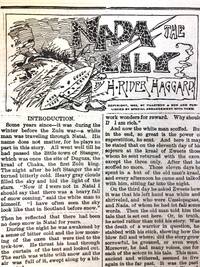
189241348New York: E.G. Howard & Co. 1892. First edition. Self wrappers. Very good minus unopened uncut copy with small holes in first pages leaves affecting a few letters of text. Unpaged 1 sheet folded twice 8 pp. Illus. with b/w in-text drawings. 22 x 17 3/4 inches. Last year of publication of this weekly newspaper from New York that includes local state and national news along with advertising. With an early publication of H. Rider Haggard's "Nada the Lily" up to Chapter 4; extensive coverage of the upcoming Masonic Convention; numerous items on women including topics such as Mary Lowe Dickinson Woman Lawyers Woman Artists of Brooklyn Woman designers etc plus a three column New York Masonic Directory; and early Sci-fi item: -'Off for Mars She wanted a passage reserved for her'- beginning: "The great interplanetary transportation company had opened its offices for business and the passengers had begun to arrive at the station."<br /> <br /> The paper under this name was published by 1888 until 1892. Issues are scarce and we could locate none from 1890 until 1892. The New-York Historical Society has issues from 1888-1889. E.G. Howard & Co. unknown
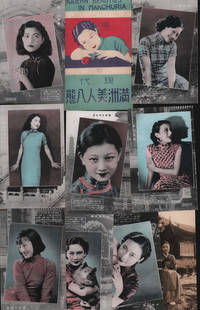
1933217569Japan. Circa Showa 8 1933 . Nine postcards eight in colour and one real photograph black and white postcard which is not part of the set 14 x 9cm envelope size 15.2 x 9.5cm Japanese captions. All cards in very good condition presented in a slightly worn and soiled pictorial colour envelope. This collection of post cards features eight young women in Manchuria and a separate real photograph postcard showing a beautiful Korean woman in traditional dress. Most of the Manchurian women wear qipao the accompanying captions introduce them as "attractive companions". Some of the women are portrayed as seductive while others look shy and innocent. . unknown
Original Wraps. 12mo. [2], 79, [1] pages. 20 cm. First edition. A letter, supposedly written by the spirit of Sarah Churchill (1660-1744) , Duchess of Marlborough, to William Pitt. Includes material on the colonies in America, Cape Breton, and political events on the continent. Subjects: Marlborough, Sarah Jennings Churchill, Duchess of, 1660-1744. Pitt, William, Earl of Chatham, 1708-1778. Great Britain - Politics and government - 1727-1760. OCLC lists 28 copies. Spine rebacked. Spine light soiling and minor tear to title page, otherwise clean and fresh. Good condition. (SPEC-40-44)