Women in SportsBiblio.com
7 962 résultats
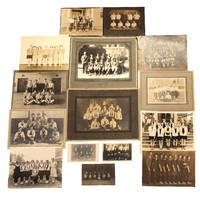
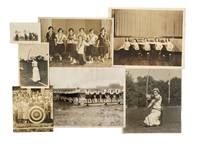
1910219051910. Archive of original photographs documenting women's participation in athletics and organized physical culture during the early twentieth century when women's sports and exercise programs increasingly became accepted within schools colleges camps and recreational organizations. The photographs show women engaged in archery synchronized gymnastics calisthenics and cheer leading during a period when female athletic participation expanded alongside broader debates concerning women's health education public visibility and social independence. The photographs provide visual evidence of the physical culture movement as it shaped women's recreational and educational environments in the United States and abroad preserving both formal athletic training and communal performance activities that contributed to changing expectations surrounding women's physical activity and public presence.<br /> Collection consists of seven original silver gelatin photographs dating approximately from the 1910s through the 1930s. The archive includes several photographs of women participating in organized physical education exercises and athletic activities while dressed in period sporting attire. One image dated July 5 1928 documents uniformed women performing synchronized gymnastic drills during a Sokol Festival dress rehearsal in Prague capturing rows of participants in coordinated motion during a major international physical culture gathering influenced by Central European nationalist and athletic traditions. Another photograph from the 1910s-1920s shows a group of young women posed with medicine balls Indian clubs and batons while wearing sailor-inspired gymnasium uniforms associated with school or collegiate athletic programs. A separate 1930s image depicts a cheerleading squad in matching lettered "S" sweaters posed in formation within a school auditorium. Archery appears prominently throughout the archive. One press photograph portrays Olympic diver and sportswoman Helen Meany Balfe standing with a bow on the grounds of White Sulphur Springs West Virginia as identified by a typed caption on the verso. Another image depicts Stella M. Ives identified in manuscript drawing a bow while dressed in full sporting attire. A vernacular photograph portrays four young women practicing archery in the hills above Troy New York including one identified as Louise Hatch of Troy with a handwritten verso inscription linking the group to Bridgewater Massachusetts. The final photograph shows a large assembly of young women gathered on outdoor steps beside a prominent archery target possibly at a camp or collegiate event emphasizing organized recreation and group participation.<br /> The archive documents the increasing visibility of women's athletic participation during the early twentieth century when organized exercise and sports became associated with women's education health reform and public modernity. Physical culture programs in schools colleges camps and civic organizations promoted athletics as both disciplined recreation and social training while sports such as archery and gymnastics offered women expanded opportunities for public competition and physical expression. Particularly notable is the range of activities represented from regimented calisthenic performance to recreational archery and cheerleading illustrating the broad spectrum of athletic environments available to women before the widespread professionalization of women's sports. Light wear and occasional handling marks consistent with age; photographs remain well-preserved overall in very good condition. A visually engaging archive documenting the growth of women's athletics and physical culture in the early twentieth century. unknown
1918185121918. Women's basketball photograph archive 1918-1929 documents the early institutionalization of women's competitive athletics in the United States recording team organization uniform development and player identification in the decades following the sport's introduction to women's education. Basketball adapted for women in the 1890s under the direction of physical educator Senda Berenson at Smith College expanded into intercollegiate and regional competition by the early twentieth century despite ongoing debate over women's participation in organized sport. These images provide direct visual evidence of that expansion with named players and structured teams indicating the normalization of women's basketball within school and community settings during the interwar period.<br /> <br /> Archive of 15 silver gelatin photographs ranging in size from approximately 3.5 x 5.5 inches to 11 x 13 inches dating between 1918 and 1929. All images are formal team portraits with groups of six to twelve players in some cases accompanied by coaches. Many photographs include handwritten identifications on versos naming players or teams. Several compositions feature a central player holding a basketball marked with team initials and year. The photographs document changes in athletic dress including high top sneakers short skirts sailor style tops and later variations incorporating shorts reflecting evolving standards of movement and athletic practicality. Produced during a period when women's athletics expanded within educational institutions while remaining subject to cultural scrutiny the archive provides material for the study of gender norms physical education and the development of organized sport prior to formal Olympic inclusion of women's basketball in 1976. The progression of uniforms and team structures across the decade offers evidence of shifting expectations regarding women's physical activity and public visibility in competitive environments. Light edge wear and minor foxing to some prints; images remain sharp and fully legible. Overall very good condition. unknown
1944235151944. Women's Royal Naval Service photograph album documenting life at HMS Royal Arthur the Royal Navy's training camp establishment at Skegness where a prewar holiday camp was transformed into a military training and accommodation center during the Second World War. Named individuals throughout with handwritten identifications the album follows Dorothy Gardner and other Wrens serving in the expanding wartime navy while also capturing the theatrical entertainment routines featuring cross dressed men and ceremonial duties that shaped daily life away from the front lines. Beyond its images of uniformed women the album records a military community of offices dining halls stages chalets and training facilities that supported Britain's wartime naval operations at a camp which was bombed by German aircraft on February 21st 1942.<br /> <br /> Photo album of approximately 73 silver gelatin photographs various sizes ranging from 1.5" x 1.5" to 8.5" x 6.5" chiefly HMS Royal Arthur Camp Skegness Lincoln and other British locations c. 1944. Large group portraits are captioned "H.M.S. Royal Arthur July 1944" showing rows of Wrens in naval caps and dark uniforms. Several photos show soldiers by artillery navy men on small military boats and canons. Multiple group photos show men and women in Navy uniform. The photographs place women within the essential but often overlooked machinery of wartime naval administration including supply clerical work communications camp management transport and food service. Captions identify Peggy Marjorie Dorothy Margaret Joan Harry Blake Farnsworth Bernard Cavanagh Dennis Leo Dugay May of Glasgow Geoffrey Roy Bluemel Mrs. Thomason of Leigh Pat Taylor Nancy and Cynthia of HMS Ariel. Additional off camp photographs show bicycle outings skating scenes shipboard snapshots barracks and chalet interiors social gatherings and a guard of honour at Lincoln near the cathedral. Particularly notable is the album's extensive documentation of entertainment and morale-building activities. Several photographs are captioned "Up Spirits" and "concerts at H.M.S. Royal Arthur" revealing an active performance culture within the camp. Sailors appear in theatrical productions alongside women in costume while musicians perform with accordions and pianos before assembled audiences. One series features actor Charles Redgrave "with the girls" and another photograph captures the wartime tradition of gender-crossing stage entertainment in which male servicemen performed in women's clothing for camp audiences. These scenes provide an unusually vivid record of military leisure performance and social life within a wartime naval community.<br /> <br /> HMS Royal Arthur was bombed by German aircraft on 21 February 1942 The album therefore records daily life at a site that was both a military workplace and a target of wartime attack. By 1944 the Women's Royal Naval Service had expanded dramatically from its earlier First World War role with women serving in hundreds of naval occupations while remaining largely excluded from combat at sea. The photographs capture that transformation through named individuals workplace groups ceremonial events friendships and recreational activities illustrating how women became integral to the operation of Britain's wartime navy. The album documents the social world created when thousands of servicewomen and servicemen lived and worked together inside one of Britain's largest naval shore establishments. Sailors Wrens airmen Canadians civilians performers and local acquaintances appear throughout its pages creating a rich portrait of wartime relationships and community formation. Album shows handling wear page wear and a few removed photographs; handwritten captions remain extensive and legible throughout. Overall in good condition. An unusually dense and highly personal record of women's naval service wartime labor military entertainment gender performance and everyday life at HMS Royal Arthur during the Second World War. unknown
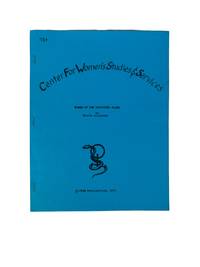
18163Scholarly article on the overlooked state of women in prison. "Women of the Convicted Class" by Rhetta Alexander. Center for Women's Studies and Services Publications 1971. Stapled with bright blue front and back soft covers front cover with illustration of black snake coiled around the female gender symbol. Measures 8.5 x 11 inches. 13 pages with article subdivided into parts I-VI. 75 cent mark on upper left hand of front cover. Paper details the institutional disinterest on the state of women's prisons and the broader systemic link between patriarchy and female incarceration. "The nature of the crimes committed by women and the conditions surrounding their imprisonment are rooted in the sexism of American society; a society in which sex-based inequlities are written into the law." A sweeping indictment of the carceral state and call to action for a population most often ignored. Slight crease to back cover. Very good condition. unknown
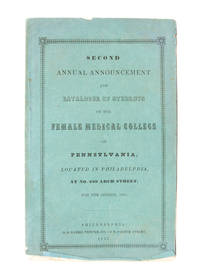
18512970Philadelphia: G.S. Harris 1851. First edition. Very Good . Original blue printed paper wraps printed to front. Some chipping and creasing to edges but overall intact and undamaged despite being quite delicate. Light scattered foxing throughout. Ownership signature of the college's original dean N.R. Mosely struck out at the top of the Faculty list on page 4; pencil ticks next to the names of several students listed in the catalogue on page 6. Exceptionally rare OCLC lists copies of this Announcement at only 2 institutions.<br/><br/>Only one year after Dr. Elizabeth Blackwell graduated valedictorian and became the first female M.D. in the U.S. the Female Medical College of Pennsylvania opened its doors. Located in Philadelphia it was the only the second school to open with the mission of training women in medicine -- having been preceded by the New England Female Medical College two years earlier in 1848. Founded by Quaker abolitionist and Underground Railroad activists who believed that women could make exceptional doctors "the college provided rare opportunities for women to teach perform research manage a medical school and with the eventual establishment of the Woman's Hospital in 1861 learn and practice in a hospital setting. It was the longest-lasting all-women medical school in the nation until it became coeducational in 1970" Mandell. The present Announcement predates these growths however showing the roots from which they emerged. One year running and the faculty remain largely male because there has yet to be an inaugural graduating class this would come in 1852; but already a female student Hannah E. Longshore is listed as a Demonstrator in Anatomy. Indeed Longshore and her sister Anna would both be part of the inaugural class of the college with the latter going on the author Discourses to Women in Medical Subjects 1897. Indeed the majority of women listed in this catalogue went on to become doctors even when it took time -- as it did for Hannah W. Ellis and Susanna H. Ellis both listed among the graduates of the 1865 class. 12 pages in all this scarce pamphlet contains Officers Corporators Faculty and Students of the school; an Announcement on the school's missions and accomplishments; information on Specialties available; Terms of enrollment; and a list of required Textbooks. It also conveys the excitement optimism and pride of those involved. "The Faculty of the Female Medical College of Pennsylvania are inspired by very different feelings from those that attended their efforts one year ago. Then they were about to enter into an untried path to engage in a great experiment.But that which was an experiment is an experiment no longer.give a woman knowledge commensurate with her natural qualifications enable her to go forth healing the sick and comforting the afflicted and she will bless the world." A rare survivor documenting that pivotal moment when women had been given the chance to prove their intellect rose to the challenge and made the future of the next female students more secure. Very Good . G.S. Harris unknown books
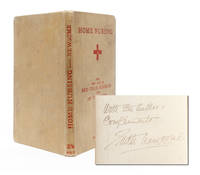
19163202London: The Scientific Press 1916. First edition. Very Good . Scarce first edition of a Red Cross manual designed both for emergency workers and women in the home. Original publisher's cloth binding titled in red on spine and front board. Boards a bit rubbed and soiled corners bumped. Faint offsetting to the endpapers. Inscribed by Edith Newsome on the front pastedown: "With the Author's Compliments Edith Newsome. 16.10.23." A scarce book institutionally and in trade OCLC reports only 11 copies in libraries this being the only one currently on the market. <br/><br/>Edith Newsome's first major work on nursing produced after she realized that her Red Cross lecture series could not provide complete enough information to train "those who have so nobly responded to the 'call of duty'; to do all that is in their power to tend and succour the brave men of our nation by proving themselves valuable and intelligent helpers." Indeed Newsome's work was released two years into World War I -- the first modern war which brought with it a horrifying number of previously unknown injuries and ailments. In addition to professional nurses women enrolled to assist as Volunteer Aid Detachments VADs because there simply were not enough women with medical educations to serve the nation's need. The present work is a stirring acknowledgement of this. Comprehensive in training VADs and new nurses in field operations it also contains information for women in the home who confronted infection illness or injury and served as domestic caretakers for men returning from the front. Very Good . The Scientific Press unknown books
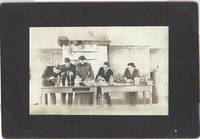
16189Original vintage photograph of a female teacher directing male medical students dissecting a cadaver c. 1890. Black and white 3"x5" with back matting. One woman surrounded by four men lean over a table with a skeleton. Behind them is a chalkboard with anatomical pull down charts. Although women had participated in the informal practice of medicine for hundreds of years the United States and most industrialized nations did not allow women into the formal practice of medicine until the latter half of the 19th century. This female doctor was part of the first generation formally accepted by medical institution. She wears a medal indicating her importance and perhaps former military involvement. Early photographs of women in medicine are very rare photograph of surgery or dissection much rarer. <br/><br/>Women practiced in the medical field for hundreds of years until new licenser rules established in the Victorian era provided a means for their exclusion. The story of how women reclaimed their role in medicine is one of resourcefulness and determination. In 1849 the first American woman graduated medical school. The path was difficult; few medical schools would accepted them and the reception was not always welcoming. Female doctors were called not only to prove their ability to practice medicine but to justify their unique necessity to the field. Of all the specialties the most embattled for women is surgery; early on they faced a challenge obtaining education training and facilities. A perennial argument was that cadaver dissection necessary to training was inappropriate for the delicate female disposition. However this Victorian-era photograph showing a woman capably participating in cadaver dissection proves that in the words of Dr. Mary Putnam Jacobi the best known female doctor in 1891 "It is perfectly evident.that the opposition to women physicians has rarely been based upon any sincere conviction that women could not be instructed in medicine but upon an intense dislike to the idea that they should be. unknown books
16210Two letters commending a female medical student Clara Cowles who is about to enter the field. The first is an autograph letter signed and dated 16 March 1893. 1 page handwritten on National Homeopathic Medical College of Chicago letterhead from the desk of W. M. W. Davison M. D. 9 x 5 ¾ in. Excellent condition with two horizontal fold lines. Davison writes in part: "Miss Cowles Kindly I wish to congratulate you for your most excellent paper." This letter also comes with a business card from W. M. W. Davison again dated March 16th 1893 which verifies that "Miss C S Cowles has passed the examination in Histology and Physiology and her standing is 90 in the former and 100 in the latter."<br/><br/>The second is a typed letter signed and dated January 24 1896. 1 page on The People's Health Journal letterhead from the desk of editors L. D. Rogers M.D. and Ida Wright Rogers M.D. two married doctors. 8.5 x 11 in. They write:<br/><br/>"Miss Clara CowlesEl Dorado Kas.<br/>Dear Miss Cowles:--<br/>Your favor of the 17th. together with your first examination papers came duly to hand. We have returned the papers. They were excellent. <br/>We thank you for the names of your two friends and will write to them. Let us hear from you often. <br/>Yours very sincerely Drs Rogers & Rogers"<br/><br/>Very good condition with two vertical fold creases and one horizontal one at center. Small tear at upper left crease. Comes with a joint business card for Drs. Rogers & Rogers and inscribed in pencil on verso is the address for Dr. E. S. Reed Dentist. Four more inscribed business cards from doctors are included. One of the cards is from Dr. E. S. Reed and has a neat inscription on verso in ink declaring that Miss C. S. Cowles "has a standing of 98 in Dental-Surgery for the session of 1892 & '93" signed by E.S. Reed Professor of Dental Surgery. Interesting 19th century correspondence related to a young woman's medical education and those who offered her professional support and encouragement. unknown books
16209Autograph letter signed from a male doctor E. C. Houston practicing out of Memphis TN to a woman doctor Lydia Bailey located in Philadelphia. 6 pages 7 ¾ x 5 in. Houston addresses the letter "Dear Doctor" and goes on to write about his interest in finding a wife who is "educated in the same profession" as himself. He writes that believes that he "could love her better" than one who didn't share his medical background. He goes on to list basic facts about himself and inquires about her background and physical qualities such as her "height weight and measurement around hips waist & chest". Very good condition with two worn horizontal fold lines in letter pages. Papers are separating at edges of fold lines sheets 2 and 3 have minor tape repairs. Light soiling from handling but overall clean and clear script. Includes original envelope Houston's calling card listing him as a medical doctor and a blank prescription sheet that lists his medical credentials. An interesting letter that demonstrates a unique social situation that educated professional women could face in the late 19th century. unknown books
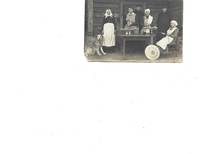
1922168751922. Vaccines Women in Medicine Original silver gelatin print photograph of a Vaccination clinic in rural European village. 1922. size is 3.5 x 5.5 in. Outdoor vaccination clinic administered by women who are cleaning and preparing the equipment. Six figures stand around a table filled with glass vials test tubes and a makeshift hand-powered centrifuge seated woman holds straps which rotate mechanism. Two clean-cut men in dark overcoats stand among the women; they could be medical specialists from a nearby city overseeing the clinic. While women faced discrimination in pursuing formal medical training to become doctors they took part in many informal yet critically important roles in which they could support public health initiatives. Small loss to bottom left corner not affecting any figures. Very good condition. Exceptional early photograph of a rustic vaccination clinic. unknown
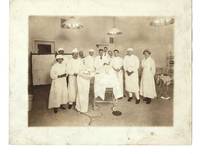
1900162081900. Women in Sciences. Original vintage photograph of operating room and surgery team. Photograph shows eleven figures dressed all in white standing around a patient in an early operating room. While most of the medical workers are men two women stand at the edges of the group and the woman standing on the left is shown wearing an operating apron and rubber gloves. 8 x 10 in. sepia photo. Photo is in good condition with light scuffing to photo surface two water marks in bottom left quadrant and some dirt and stains to the image border. Light crease in top left corner and small tear on lower right edge. Image remains crisp and clear. An important photograph that shows women's involvement in the medical field and the development of surgical technology throughout the 20th century. unknown
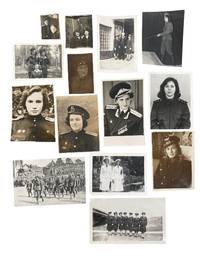
1941231851941. Women's HistoryMilitary Women's military service photo archive documenting the incorporation of women into military organizations in the United States Russia and Europe from the ear;y 40s through the end of World War II with especially strong evidence of uniformed training rank identity weapons instruction and military parades in the 1940s. The group shows women as enlisted or commissioned participants in military systems in portrait sittings unit groupings drill formal dress and liberation era parade culture. Several images center on Czechoslovak and Soviet aligned visual culture at the end of the war including a Prague parade photograph explicitly identifying women volunteers attached to the 1st Czechoslovak Army on 17 May 1945 placing female service on the public stage of postwar victory.<br /> Photo archive of 14 likely silver gelatin photographs ranging from 1.5 x 2 to 3 x 5.5 inches United States and Europe circa 1910s-1945. The archive includes formal studio portraits of individual women in military tunics with shoulder boards insignia peaked caps and medals; a close portrait of a decorated woman officer wearing a sash and multiple campaign medals; and a full length image of a young servicewoman holding a rifle on what appears to be a stage or drill platform. Group scenes include seven women in matching belted uniforms and caps posed outdoors near a long low building captioned 1944 three women in service dress photographed among trees and two women in white formal or naval style uniforms standing in a landscaped garden. A small early portrait shows a younger female figure in uniform beside an older woman extending the chronology back before the Second World War. The Prague parade image is the most textually grounded item: its printed Czech caption states that the military review of the 1st Czechoslovak Army was held in Old Town Square on 17 May 1945 in the presence of President Edvard Beneš and identifies the marching contingent as women volunteers assigned to that army. Recurring themes across the collection include rank display military insignia paired and group portraits emphasizing unit identity and the shift from informal military support to organized involvement and state recognition.<br /> Across the first half of the twentieth century women entered military institutions through auxiliary organizations medical and communications branches transport and administrative service anti aircraft and weapons training and in some national contexts direct incorporation into regular formations. This archive tracks that process through its own evidence: portraiture records accession into uniformed hierarchy group photographs show women organized in units the rifle image places female service within martial training rather than clerical abstraction and the Prague review demonstrates how women's wartime labor and service were folded into liberation politics and postwar state ceremony. The international span gives the group unusual strength for institutional collecting on women's military history because it places American and European service culture in one frame and shows the common mechanisms by which states made women visible disciplined and legible within military life between the two world wars and at the end of the second. Light to moderate wear scattered creasing edge wear handling marks and some fading or softness to several prints; overall good condition. This is a compact but pointed body of photographic evidence for how women were absorbed into military systems through uniform training ceremony and public recognition across the WWI-WWII era. unknown
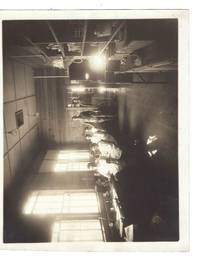
1910161911910. Women in Sciences. Photograph: Female Scientist At Work In Laboratory 1910. Large sepia gelatin photograph. Image measures 9" x 7" with a 10"x8" white boarder. Light toning of boarder. Near fine condition. One female scientist sits at a laboratory table amongst her four male colleges. Her expression unlike the others in sidelong and a little wry. Two men in military uniforms stand at attention in the doorway sunshine pours through the window on the left; on the right hand side are shelves stacked with bottles beakers and cotton swabs. Women were discouraged from pursuing a scientific education let alone a career and those who did found their contributions minimized. Despite the obstacles this original period photo is a testimony to the existence of women in the sciences in the first half of the 20th century. unknown
6356294488University of Nebraska Press pp. 250 . Hardback. Used. University of Nebraska Press hardcover
2003Q-0803298323University of Nebraska Press 2003-01-01. Paperback. New. New. In shrink wrap. Looks like an interesting title! University of Nebraska Press paperback
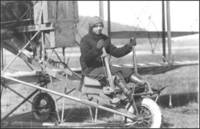
18789Women in Aviation. Silver gelatin print photo of female pilot sitting in early aircraft with her hands on the gears the body of the plane partially visible behind her. Circa 1920s. 4.75" x 6.5" inches. Legislative barriers as well as social and economic factors made it nearly impossible for women to participate in early aviation. Getting through flight school and gaining access to a plane to fly was a testament to the incredible tenacity and resources required for a woman to access both. Photo shows a woman sitting belted to pilot's seat one hand on each large gear shift feet prepped on the thin ledge above the plane's front tire. She wears a gingham hat cut close to her head a wool coat wool pants and knee-high leather boots with protective-wear covering the shins. The plane's front tire is muddy suggesting she's just landed in a field. A few ink spots do not obstruct the plane or female pilot. This original photo is evidence that women participated in early aviation. Overall good condition. unknown
ANAIS-0907179029Bookpeople. paperback. Good. 1.8x09x2.1. Buy with confidence. Excellent Customer Service & Return policy. Bookpeople paperback
SONG0907179029Brand: Bookpeople 0000-00-00. First Edition. paperback. Used: Good. 0.00x0.00x0.00. Buy with confidence. Excellent Customer Service & Return policy. Brand: Bookpeople paperback
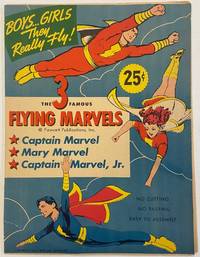
1945174471945. This 1945 booklet contains the cut out models for Captain Marvel Mary Marvel and Captain Marvel Jr. who could be assembled into 3D paper action figures. Reed and Associates 1945. 12" x 9" inches. Action figure height around 8.5" x 5" inches. Each of the three character models are intact and ready for assembly even after 75 years. Comes with assembly instructions. Mary Marvel was one of the first female characters in any comic book franchise. Today Captain Marvel is a woman and the subject of the 2019 film Captain Marvel as well as being included in several other installations in the Marvel Cinematic Universe. This booklet is in very good quality overall. unknown
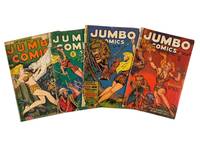
1943213981943. Fiction House. Jumbo Comics featuring Sheena Queen of the Jungle 1943 to 1952 documents the emergence of a female action protagonist in American comic publishing during the Golden Age and provides direct evidence of how gender roles were negotiated within mass market entertainment during World War II and the postwar period. Created by Will Eisner and Jerry Iger Sheena stands as one of the earliest female comic characters to headline her own title appearing as a physically capable and independent figure at a time when women were rarely depicted in positions of authority or combat within popular media. These issues support research into comics history women's representation and mid twentieth century visual culture particularly in relation to wartime narratives and evolving depictions of female agency.<br /> <br /> Four issues of Jumbo Comics issued between 1943 and 1952 by Fiction House each in original color illustrated wrappers. 1 Jumbo Comics No. 55. New York: Fiction House September 1943. Wartime issue featuring Sheena in action oriented narratives alongside backup stories such as The Phantom Falcon and Tiger Morgan's U.S. Rangers reflecting contemporary military themes. 2 Jumbo Comics No. 134. New York: Fiction House April 1950. Depicts Sheena intervening in conflict between rival groups emphasizing both combat and mediation roles while presenting indigenous characters through period stereotypes. 3 Jumbo Comics No. 141. New York: Fiction House November 1950. Includes "The Curse of Daanga" combining adventure and supernatural elements with Sheena's leadership within hostile environments. 4 Jumbo Comics No. 155. New York: Fiction House January 1952. Later issue showing continued emphasis on pulp adventure themes and Sheena's role confronting exploitation within jungle settings. Standard comic format 8vo with illustrated covers and interior black and white sequential art.<br /> <br /> Issued during a period of expanding comic readership and heightened wartime and postwar production these issues demonstrate how publishers incorporated female protagonists into adventure narratives while maintaining broader genre conventions rooted in colonial fantasy and exoticized settings. Sheena's characterization as self reliant and physically dominant complicates prevailing mid century gender expectations even as the surrounding narratives reflect contemporary racial and cultural stereotypes. The series' longevity into the early 1950s situates it within the transition from wartime storytelling to postwar entertainment markets offering a sustained record of how female heroism was visualized and consumed in American popular culture. Chipping and edge wear to covers some pencil marks two issues with textblocks separated from wrappers but covers present and general age toning; overall condition good. unknown
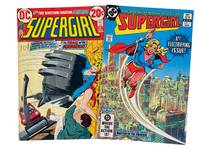
1972214621972. FeminismComics Two Supergirl first-issue comics published a decade apart in 1972 and 1982 capturing the shifting portrayal of the character across two distinct eras in superhero history. These issues serve as milestones in Supergirl's evolution from a supporting figure in Superman's world to an independent heroine headlining her own series. The 1970s and 1980s saw increased representation of female superheroes yet they remained relatively rare in lead roles. Supergirl's ability to sustain multiple solo titles reflects her cultural significance and DC Comics' foray into creating female protagonists in a traditionally male-dominated genre.<br /> <br /> 1 Woolfolk Dorothy. Supergirl #1. New York: National Periodical Publications DC Comics 1972. First issue. Illustrated by Carmine Infantino and inked by Vince Colletta. Color comic in staple-bound format. This issue marks Supergirl's first self-titled solo series after years of appearing in Action Comics and Adventure Comics. The cover featuring Supergirl dramatically saving civilians from a massive drilling machine highlights her strength and heroism in a narrative distinct from Superman's. Edited by Dorothy Woolfolk one of the few women working in the comic book industry at the time the series reflects a broader push toward female-led storytelling. Published during the height of the Women's Liberation Movement the series capitalized on shifting gender dynamics giving Supergirl more agency and independence. Some creasing and wear to cover light pencil markings pages yellowed due to age. Overall good condition.<br /> <br /> 2 Kupperberg Paul. The Daring New Adventures of Supergirl #1. New York: DC Comics 1982. First issue. Illustrated by Carmine Infantino. Color comic in staple-bound format. A relaunch of Supergirl's solo adventures this issue redefines the character by relocating her to Chicago emphasizing her efforts to forge an identity separate from Superman. The cover featuring Supergirl soaring above a realistic cityscape visually reinforces this theme of independence. The 1980s saw a renewed interest in strong female protagonists in comics yet Supergirl remained one of the few female superheroes with her own title. <br /> This archive offers a rare opportunity to examine the progression of Supergirl's portrayal in two pivotal decades. Both issues serve as key historical artifacts illustrating the challenges and successes of female-led superhero titles during a period when women in comics were still struggling for mainstream representation. unknown
1994214141994. ComicsFeminism Archive of 4 issues of Supergirl Vol. 4 Nos. 1234 1994. A complete four-issue run of Supergirl Vol. 4 published in 1994 by DC Comics written by Roger Stern with art by June Brigman and Jackson Guice. This limited series marked a redefinition of the Supergirl character during the early 1990s a period of shifting gender dynamics in comics. The series follows the adventures of Matrix a protoplasmic being with shape-shifting abilities introduced as a replacement for Kara Zor-El after Crisis on Infinite Earths 1985 erased Superman's cousin from continuity. The 1990s saw an increase in female-led superhero titles often reflecting the era's tensions between traditional portrayals of femininity and the demand for stronger more independent heroines. Supergirl was emblematic of this struggle presenting a character who was both powerful and emotionally complex navigating her identity in a world that often underestimated her.<br /> <br /> 1 Supergirl Vol. 4 No. 1 February 1994 - "Reign of Tomorrow!" The debut issue establishes Matrix-Supergirl's struggle with self-definition as she attempts to carve out her own place separate from Superman. Set against the backdrop of Metropolis the issue explores themes of legacy and autonomy. The cover featuring Supergirl flying triumphantly against a sunset skyline reflects her attempt to step out of Superman's shadow.<br /> <br /> 2 Supergirl Vol. 4 No. 2 March 1994 - "Supergirls" This issue delves deeper into Matrix's shifting identity featuring multiple versions of herself symbolizing internal conflict and self-discovery. The 1990s were an era of deconstructing superheroes often portraying them as psychologically conflicted a theme echoed in Matrix's struggle for stability. The striking cover filled with fragmented images of Supergirl visually reinforces the theme of identity crisis.<br /> <br /> 3 Supergirl Vol. 4 No. 3 April 1994 - "Inside Out!" Supergirl is pushed to her limits as she faces both external threats and internal turmoil. The storyline continues to explore themes of transformation empowerment and the blurred line between heroism and self-doubt. The cover art featuring Supergirl in an intense almost feral stance mirrors the narrative's psychological depth.<br /> <br /> 4 Supergirl Vol. 4 No. 4 May 1994 - "Supergirl Gets Even!" The concluding issue brings resolution to Matrix's journey reinforcing themes of perseverance and agency. The cover depicts Supergirl in combat asserting herself in the face of adversity an apt metaphor for the broader feminist discourse of the 1990s when women in comics were increasingly portrayed as dynamic multidimensional protagonists rather than mere sidekicks or love interests.<br /> <br /> The 1990s marked a pivotal time for female superheroes as publishers responded to a growing demand for stronger more independent women in comics. However this era also saw the hypersexualization of female characters a contradiction Supergirl attempted to navigate. Matrix-Supergirl with her shape-shifting abilities and fluctuating sense of self became an allegory for the broader struggle of women's representation in pop culture-capable powerful yet constantly redefined by external forces. All four issues are in well-preserved condition with minor wear to covers and light handling marks. Colors remain vibrant and interior pages are clean. A complete run documenting a significant moment in the evolution of Supergirl and female superheroes in mainstream comics. unknown
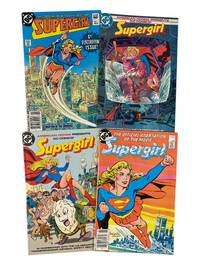
1982214611982. FeminismComics Archive of four Supergirl comic books published by DC Comics between 1982 and 1986 chronicling a pivotal period in the character's development. This archive documents Supergirl's evolving role as a solo heroine in the pre-Crisis on Infinite Earths era her transition into multimedia adaptations and her use in public safety campaigns. These comics exemplify the growing presence of female superheroes in mainstream comics during the 1980s a time when representation remained limited and women in leading roles were still an exception rather than the norm.<br /> <br /> 1 Kupperberg Paul. The Daring New Adventures of Supergirl #1. New York: DC Comics 1982. First issue. 32 pages. Illustrated by Carmine Infantino. Color comic in staple-bound format. 10.25 x 6.75 inches. This issue marks the launch of Supergirl's solo series distinguishing her narrative from Superman's and emphasizing her individual identity. The story follows Kara Zor-El as she relocates to Chicago to carve out a life on her own terms a significant shift from her prior depictions as a supporting character. <br /> 2 Cavalieri Joey. Supergirl: The Official Adaptation of the Movie. New York: DC Comics 1984. First edition. 64 pages. Illustrated by Gray Morrow. Color comic in staple-bound format. 10.25 x 6.75 inches. This adaptation of the Supergirl film starring Helen Slater was released in conjunction with the movie's theatrical debut and remains a notable piece of media tie-in history. The comic follows the plot of the film in which Kara Zor-El ventures to Earth in search of the Omegahedron an artifact crucial to Argo City's survival. <br /> <br /> 3 Orlando Joe. American Honda Presents Supergirl. New York: DC Comics 1984. Promotional issue. 32 pages. Color comic in staple-bound format. 10.25 x 6.75 inches. A unique corporate-sponsored issue produced in partnership with the U.S. Department of Transportation to promote traffic safety. The narrative follows Supergirl as she educates civilians on the importance of responsible driving positioning her as a public service figure. This era saw an increasing use of superheroes in educational campaigns and Supergirl's inclusion highlights her status as a role model for young audiences. <br /> 4 Orlando Joe. American Honda Presents Supergirl. New York: DC Comics 1986. Promotional issue. 32 pages. Color comic in staple-bound format. 10.25 x 6.75 inches. A follow-up to the 1984 promotional issue this installment once again partners Supergirl with the U.S. Department of Transportation. The narrative reinforces safety messaging with Supergirl instructing civilians alongside Vince and Larry the crash test dummies featured in national PSA campaigns. As one of the few female superheroes headlining public service comics Supergirl's role here is emblematic of her broader cultural relevance. <br /> This archive captures Supergirl's prominence during a transformative decade illustrating her transition from a supporting character to a central figure across multiple mediums. The comics showcase not only her narrative independence but also her function as a role model in both fictional and educational contexts reinforcing her lasting impact on the portrayal of female superheroes in American comics. Overall very good condition. unknown
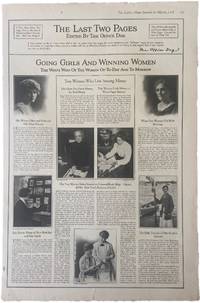
1918179141918. Ladies Home Journal 1918. Loose pages show female innovators in business section titled "Going Girls And Winning Women The Who's Who Of The Women Of To-Day and To-Morrow". Measures 16" x 10.25" inches. The page give profiles of various women in business including a filmmaker and producer two women who started their own bookshop selling only the titles they themselves deemed worth reading a teacher for children who live in lighthouses and more. The biographies include details of how much capital went into starting businesses and how much profit was made in their first year. The back of the page features a section called "The Office Dog" which includes excerpts of articles that editors passed on but were deemed interesting enough to print in part by the "office dog" editor. An inspiring capsule of individual women paving the way for women in business across a range of fields. Small tears less than an inch long at top bottom and along one side do not affect image or text. Paper clean. Overall very good condition. unknown
AD 9781803827346USA Edition . New. Brand New! Fast Delivery US Edition and ship within 24-48 hours. Deliver by FedEx and Dhl & Aramex UPS & USPS and we do accept APO and PO BOX Addresses. Order can be delivered worldwide within 7-12 days and we do have flat rate for up to 2LB. Extra shipping charges will be requested if the Book weight is more than 5 LB. This Item May be shipped from India United states & United Kingdom. Depending on your location and availability. unknown