POMPADOUR (Jeanne Antoinette Poisson, marquise de)Livre Rare Book
3 966 résultats
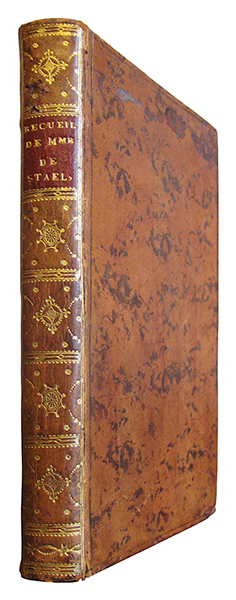
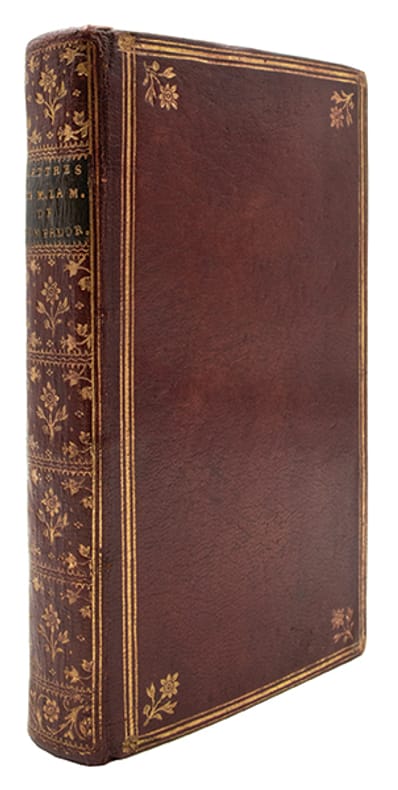
391513 tomes reliés en un volume in-12 (163 x 94 mm), maroquin rouge de lépoque, dos lisse richement orné de compartiments fleuronnés et cloisonnés, pièce de titre de maroquin bronze, triples filets dencadrement sur les plats avec fleurons dangle, roulette sur les coiffes et les coupes, dentelle intérieure, tranches dorées, gardes de papier dAugsbourg doré et étoilé, (4), 128 p. ; 100, (10) p., (1) f. blanc et (16), 236 p., bandeaux, culs-de-lampe et ornements typographiques gravés sur bois.
36583Ensemble relié en un volume in-8, veau marbré de lépoque, dos lisse orné de caissons fleuronnés et cloisonnés, pièce de titre de maroquin rouge, filet dencadrement à froid sur les plats, chasses et coupes filetées, tranches mouchetées de rouge.
Ensemble relié en un volume in-8, plein veau marbré de l'époque, dos lisse orné de caissons fleuronnés, pièce de titre de maroquin rouge, filet d'encadrement à froid sur les plats, chasses et coupes filetées, tranches mouchetées rouges. 1- Première édition collective de ce recueil d'oeuvres de jeunesse de Madame de Staël, jusqu'alors inédites: "Epître au malheur ou Adèle et Edouard" - "Essai sur les fictions" dans lequel l'auteure développe sa théorie du roman et de la fiction, que Goethe traduisit par pour la revue littéraire "Die Horen" ainsi que trois nouvelles : "Mirza ou lettre d'un voyageur", "Adélaïde et Théodore" et "Histoire de Pauline" où personnages et situations préfigurent ceux des romans de Mme de Staël à venir. (Schazmann, 21. Lonchamp, 27-1). 2- Edition originale posthume de cet ouvrage publié et préfacé par le mari de l'auteure, le ministre Necker, quelques mois après sa mort. Cultivée, belle et spirituelle, la mère de Mme de Staël parvint à grouper autour d'elle, dans son salon de la rue Michel Lecomte, l'élite de la société française de son temps. Elle ne put jamais se livrer à son goût pour l'écriture, son mari jugeant cette activité "peu convenable" pour les femmes, et ne laissa donc que peu d'écrits. (Gay, III, 987. Monglond, III, col. 111). Petit accroc au mors inf., qqs petites épidermures. Bon exemplaire, frais, bien relié à l'époque.
Fine Turkish Original bdg. HC. Large roy. 8vo. (25 x 17 cm). In Turkish. 8, 627, 7 p., b/w and color ills. 1. Türk dünyasi Kadinlar kurultayi konusmalar - bildiriler.
201109761Paris, J'ai Lu, 2008 ; grand in-12, 181 pp., broché, couverture illustr. Comme neuf.
197872847Couverture souple. Broché. 191 pages.
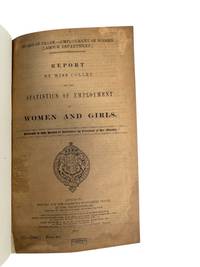
1894221311894. Women's EmploymentLaborFeminism Collet Clara Elizabeth. Report by Miss Collet on the Statistics of Employment of Women and Girls. London: Her Majesty's Stationery Office 1894. First edition. 153 pages. Rebound with blue cardstock wrappers with blue cloth spine. A foundational document in the history of women's labor rights in the United Kingdom this government-commissioned report by feminist economist and civil servant Clara Collet presents a rigorously detailed statistical study of female employment across various industries and regions in late 19th-century Britain. The report was produced under the auspices of the Board of Trade's Labour Department and presented to both Houses of Parliament by command of Queen Victoria. Collet's work documents an early official recognition of gender disparities in wages labor conditions and occupational distribution.<br /> <br /> Clara Collet was a pioneering advocate for working-class women. In this report she compiles extensive census and wage data comparing the years 1881 and 1891 with particular focus on textile and manufacturing sectors including cotton wool and worsted mills. The report also explores regional patterns in employment rates of marriage and widowhood and the social consequences of low female wages. Appendices provide granular data segmented by occupation and geography highlighting for instance employment patterns among married women and child laborers. Of note is Collet's contextual analysis of women's roles in both domestic and industrial economies and her subtle but pointed criticism of systemic inequalities in pay and opportunity. Her work prefigures later feminist labor studies by over half a century and has been cited by scholars as foundational to the evolution of state labor policy in Britain. Pages toned with scattered foxing binding stable and professionally renewed; textblock complete. Overall good to very good condition. A landmark primary source in the history of women's labor advocacy and feminist economics and a rare survival in its first edition. unknown
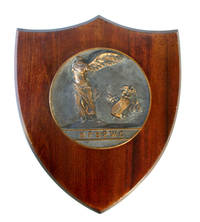
1919149951919. A large Wood Mounted 1919 NFBPWC Plaque The National Federation of Business and Professional Women's Clubs. Bronze embossed large seal. Dated one year Before National Suffrage. the National Federation of Business and Professional Women Clubs Inc. have been working to empower women through our mission which is to develop the business professional and leadership potential of all women through education advocacy mentoring networking skill building and economic empowerment programs and projects. unknown
200069049BBBerlin., Neue Gesellschaft für bildende Kunst., 2000. 27 x 21,5 cm. 157 S. OPappband., 69049B.jpg 1. Auflage. Einband leicht angestaubt und am Rücken etwas aufgehellt, sonst gutes Exemplar. Unterbrochene Karrieren.
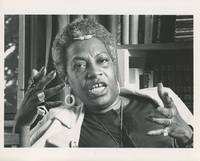
1973List3007United States 1973. Single photograph measuring 8 x 10 inches. Manuscript captions verso reading “Florence Kennedy / Fla / Womens Lib†and “FLORYNCE KENNEDY / WOMEN’S RIGHTS†with stamps “PHOTO BY AKIRA SUWA†and “MAR4-1973â€. Near Fine. Florynce Kennedy 1916–2000 was an African American activist lecturer and lawyer. She attended Columbia University as a pre-law student graduating in 1948; she was rejected from Columbia Law School but the decision was reversed when she threatened legal action for racial and gender discrimination. Kennedy went into private practice in 1954; she represented Billie Holliday’s and Charlie Parker’s estates and defended Black Panthers H. Rap Brown and Assata Shakur and radical feminist Valerie Solanas. She founded The Feminist Party which nominated Shirley Chisholm for president sued the Catholic Church lectured on issues of race and gender and organized and participated in numerous protests.<br /> <br /> Shortly after this photograph was taken in 1973 Kennedy organized the National Black Feminist Organization. The group first met in New York City and its first attendees included Faith Ringgold Ringgold’s daughter Michele Wallace Margaret Sloan-Hunter and other prominent African American feminist activists. In the photograph Kennedy wears a pin reading “DEFEAT THE FETUS FETISHISTSâ€. Abortion rights were an important cause for Kennedy; the pin is likely related to the October 1973 protests by the Women’s National Abortion Action Coalition against the New York City Archdiocesan “Respect Life Week†where the slogan appeared on many protestors’ signs.1<br /> <br /> 1 “Respect Life Week Stresses the Unborn†The New York Times October 3 1972 22. unknown
New English Paperback. Demy 8vo. (21 x 14 cm). In Turkish. 252, [3] p. 1980'lerden 2000'lere siyasal Kürt kadinin insasi. Building of politic Kurdish women from 1980s to 2000s. KURDS Woman Society Policy Ethnicity Turkish Republic Kurdish identity.
Lingua italiana, COMMISSIONE PER LA REALIZZAZIONE DELLA PARITA FRA UOMO E DONNA, Franco Angeli, Regione Lavoro, 1990, 494 pp., brossura editore, buono stato.
339412 pages petit in4 - trés bon état - Portraitiste et paysagiste post-impressionniste, Hermine David fut l'épouse du peintre Jules Pascin -
AMA-8093 pp in 8°.
AMA-9063 pp. et demie in 8°, 1 p. et demie in 12.
1899AMA-6353 pp. et demie in 8°, 1 p. et demie in 12.
71701aafParis, Ed. Payot, 1989, in-8vo, 521 p., brochure originale.
200625-004in-8° 188 pp., éditions des PUF, Paris 2006. Comme neuf.
Very Good Arabic Original pictorial wrappers. Cr. 8vo. (20 x 14 cm). In Arabic. 169, [1] p., many ills. First Beirut Edition and early edition in Arabic literature of this classic novel by Salih, who is one of Sudan's greatest authors of the twentieth century. The story is set in the fictional village of Wad Hamid, the same setting as Salih's famous Season of Migration to the North. It is a comic novella, centering on the unlikely nuptials of the town's eccentric Zein. Tall and odd-looking, with just two teeth in his mouth, Zein has made a reputation for himself as the man who falls in love over and over with girls who promptly marry other men, to the point where mothers seek him out in hopes that he will draw the eye of available suitors to their eligible daughters. "The Wedding of Zein" was made into a drama in Libya and won Kuwaiti filmmaker Khalid Siddiq an award at the Cannes Film Festival in the late 1970s. Some critics identify this novella may be considered part of the tradition of magical realism, although Salih considered it as a socialist realist one. Minor stains on cover and edges. Overall a good copy. Only two paper copies in OCLC in Library University of Amsterdam and Leiden University Library: 71470668. It's also the earliest edition in the OCLC.
Very Good Turkish, Ottoman (1500-1928) A large and fine collection and archive of Cahit Uçuk, (1909-2004) including various size clippings, a caricature, her biography, news, her serialized stories published in Turkish periodicals, and newspapers with several autograph corrections by Uçuk (Serialized novels include approx. 65 p., two are complete) as well as her original autograph - manuscript letter, manuscripts titled "Televizyon için notlar" [i.e. Notes for Television] (40 paged), a compilation of Turkish nursery rhymes (17 pp.), stories, fables, and fairy tales, and her population register document (it seems he was born in Diyarbakir city contrary to what is known as Istanbul, or Thessaloniki [Salonica] according to this document), manuscript report of her interview made by Hikmet Altinkaynak (1945-), and an essay titled "Yunanlilar'a Mektup" [i.e. A letter to Greeks]; and her plan for a journey to Italy. Cahit Uçuk was a Turkish female author and story writer. Ibrahim Vehbi Üçok, whose father was the Siverek Deputy and District Governor in the last Ottoman Parliament, and her mother was Hadiye Hanim, who was originally from Thessaloniki. Cahit's first tale was published in the magazine named "Yarim Ay" [i.e. Half Moon] published by Nâzim Hikmet in 1935. Mrs. Cahit, who also wrote poetry before, turned to story and novel writing. In her works, she mostly dealt with women's rights and the place of women in society, and occasionally worked on mystical themes. She's famous for her children's books. Many female writers have adopted male noms-de-plume, or otherwise gender-ambiguous pseudonyms, for a number of reasons: to publish without prejudice in male-dominated circles; to experiment with the freedom of anonymity or to encourage male readership. Cahit Uçuk, in his memoirs about the difficulties of being a woman writer in the world of men, could not keep a secret behind the name that everyone thought belonged to a man, and Bab-i Âlî [i.e. the street in Istanbul where publishers gathered in the Ottoman Empire] soon learned that she was a very beautiful woman.
Very Good Turkish, Ottoman (1500-1928) Contemporary burgundy cloth. Fading and foxing on boards, stains on pages. Overall a good copy. Cr. 8vo. (19 x 13 cm). In Ottoman script (Old Turkish with Arabic letters). 184 p. Extremely rare first edition of this last utopian work, printed before the proclamation of the Republic in 1923, by the Turkish / Ottoman Women Magazine publishing house, including an enthusiastic call for the political unity of the Turks outside Anatolia. Müfide Ferid Tek was one of the first female representatives of the Turkism and Turanism movement in the novel genre and she would later support the Turkish War of Independence (1919-1922) with her literary works. Özege 1343.; 10 copies worldwide located in OCLC: 314528178 (5 copies), 1030064092 (1 copy), 49367479 (4 copies). (Utopias from the Middle East 4).
Original Mail Envelope. 9.5 x 14 cm. Russian and English. Envelope (internal letter absent) addressed to Henrietta Szold of the Jewish Agency Aliyah Bureau, sent from Tashkent (Tachkent) , U. S. S. R. Registered in Jerusalem 15th July, 1944. Contains Russian and English registered mail stamps, as well as Russian censor pass (pasted over side of letter after opening and inspection) . Szold was the Head of the Youth Aliyah and founder of Hadassah. Subjects: Henrietta Szold Youth Aliyah Tashkent USSR Jewish Refugees World War II. Ephemera Henrietta Szold Jewish Agency, Aliyah Bureau. Enveloped soiled, torn at edge where opened, otherwise fresh. Good condition. (WOMEN-1-15)
Fine Turkish Original b/w photograph. 8,5x13,5 cm. Shows Yildiz Eruçman and twelve male parachutists and aviators, an aircraft wing with its shadow on the surface. Yildiz Kayalar Eruçman was the first Turkish female parachutist. She was born in Thessaloniki, Kingdom of Greece in 1919. Her family was of Turkish descent, and according to the Population exchange agreement between Turkey and Greece, her family moved to Turkey and settled in Izmir in 1924. In 1934, after the Surname Law, the family assumed the surname Kayalar. Eruçman is her surname by marriage. In 1935, after reading an article in a foreign periodical about female pilots, she applied to the training center of the Turkish Aeronautical Association in Ankara. Mustafa Kemal Atatürk's adopted daughter and aviator Sabiha Gökçen personally concerned herself with Eruçman's training. Together with three other women in the training center, namely Edibe Subasi, Nezihe Viranyali, and Sahavet Karapas, she received her aviation certificate. On 4 October 1935, she parachuted from a Soviet-made aircraft of type Polikarpov R-5. She was the first-ever female skydiver in Turkey. In later years, she continued in the same association as a trainer. However, her profession was not officially acknowledged. So, her title was "minaret worker", which was considered one of the most dangerous occupations of that time. A fine and extremely rare image.
Very Good Turkish, Ottoman (1500-1928) Paperback. 12mo. (16 x 11 cm). In Ottoman script. 64 p. Partly uncut. Chipped on cover. Otherwise a good copy. Ezop. Since the 5th-century BC, Aesop's Fables have been circulating the world as proverbial stories for various uses in different cultural contexts. Throughout the centuries, these fables were used in the schools of rhetoric to teach linguistic discipline, paraphrasing, expansion, compression, and argumentation (Blackham, 1985). The circulation of the fables was not limited to Western world: the fables that were mostly attributed to Aesop and his followers had a wide circulation in the Ottoman Empire. Second Edition of first Turkish collection of Aisopos' tales or fables printed in the Ottoman Empire. First Edition 1888. This is the second Aisopos collection was a Karamanlidika book (Turkish with Greek letters) in Turkish literature. TBTK 9392.; Özege 5350. Second Edition.
Very Good Turkish, Ottoman (1500-1928) Contemporary 1/3 leather bdg. made as original illustrated covers preserved inside. Foolscap 8vo. (18 x 12 cm). In Ottoman script (Old Turkish with Arabic letters). 221 p.; 291 p. Fourth Edition (both). Early editions of this bestseller novel(s) telling "the suffering of a woman who buried her forbidden love in her heart in a society where love is closed behind thick curtains, through the eyes of a woman", by Güzide Sabri (1886-1946). Güzide Sabri Aygün was a Turkish female writer known for her modern romances, which were published in multiple editions and several languages. She had two sisters, Fatma Aliye and Emine Semiye. She grew up in Çamlica neighborhood of Istanbul. In later years, she had to leave Istanbul and move to Anatolia with her family as her father was exiled, resulting from his opposition to the despotism of Ottoman Sultan Abdulhamid II (reigned 1876-1909). At a young age, she was married to Ahmet Sabri Aygün, the first notary of Beyoglu (Pera). She was educated at home by special tutors. She was interested in literature, inspired by her teacher Hodja Tahir Effendi, a dictionary writer. She started to write at a very young age. However, her teachers proposed she better deal with religious matters instead of poetry. Contrary to the pressures of her literature teacher, she wrote her first novel Münevver in her youth years in 1899. She wrote the novel in remembrance of her friend, who died from tuberculosis. It was serialized in the newspaper Hanimlara Mahsus ("For Ladies"), and won well recognition. In 1901, two years later, the novel was published as a book and was also translated into the Serbian language. Her husband felt discomfort by his wife's prominence. As her teachers' reaction was not enough, her husband also objected to her writing. However, her enthusiasm could not deter her from writing. It is understood that her husband tried to prevent her writing as he did not allow her to write already at the wedding. She was forced to continue writing at night or secretly. After a short time, her husband died. The unexpected death of her husband left deep traces in her. Güzide Sabri became a female writer, who remained lifelong unhappy having a sad life in literature history. During this time, the Servet-i Fünun ("Wealth of Knowledge") movement, formed by Recaizâde Mahmud Ekrem (1847-1914) and his students, left its mark on the literature. Güzide Sabri was one of the authors, who did not join the movement and remained on their own line. She is considered as one of the first female novelists among Turkish writers with widespread fame, even though she was not involved in the new literary movement. She published her works in the Servet-i Fünun and other journals of the "National Literature" without being a member of any literary community. Her novels, which were written in the early years of the Second Constitutional Era (1908-1918) and the Republican era (from 1922), and were subject of feeling, dream, blind love, and broken hearts, were very popular, and had multiple editions and were repeatedly filmed. Her second novel Ölmüs Bir Kadinin Evrak-i Metrûkesi ("Derelict Documents of a Dead For Woman") was a bestseller. It was first published in 1901, reprinted several times, and was filmed twice, in 1956 and then in 1969. The novel was translated into the Armenian language. She authored romance novels for simple readers. She is considered as the author writing the first examples of the so-called mass-market romance novels, and pioneer of the broken-hearts novels in her country. Her 1930-novel Hicran Gecesi ("Night of Sorrow") is about the forbidden love of a bad woman. This book takes the romance novel one step forward in a forbidden, impossible love story. Her novels, which take place in Istanbul, attracted the interest of readers outside of big cities like Istanbul and Izmir as well. First book: Özege 16077 (Özege has 4th edition, however page number: 221).; TBTK 5323.; Second one: Özege 15317.; TBTK 5