1 540 résultats
1664ABC_50496Amsterdam 1664. Oblong 8vo. Hieronymus Sweerts Contemporary vellum sewn on 2 supports laced through the joints. With an engraved frontispiece and 32 engraved plates 1 folding 31 full-page. 96 pp. Rare first edition of one the finest and most extensively illustrated early works on culinary carving describing and illustrating refined techniques the order of serving and the handling of various foods including poultry hare rabbit pork veal lamb mutton venison ham lobster fish artichokes and both sweet and savoury pastries. The plates illustrate a variety of carving methods and include a large folding plate depicting forks and carving knives. The work predates Joseph Moxons well-known deck of cards with illustrated carving instructions by thirteen years.The frontispiece depicts a gentleman at table attended by a servant carving a fowl in the Italian manner holding it aloft on a fork and carving it in mid-air for display. As noted by the anonymous author in the preface this method was not customary in the Netherlands. Accordingly the work addresses both this practice and the more conventional technique of carving on a platter. Hieronymous Sweerts 1629-1696 was a printer bookseller and poet from Amsterdam who was trained at the printing office of his uncle Paulus Aertsz. van Ravesteyn. He established his own press in 1664 and printed a wide variety of works including Bibles poetry fables and separate prints. The present work was published anonymously but one WorldCat description of the present edition says that Sweerts signed the preface "H. Sw." suggesting he might be the author of the work or at least the preface. However in all copies we have seen including the present the preface is unsigned.The vellum is soiled and somewhat stained with a small split at the spine and at the bottom of the front board. The leaves and plates are somewhat foxed and occasionally stained. Otherwise in good condition.l Bibliotheca Gastronomica 6508 4 copies; Bitting p. 530; Ferro 81a; Horn-Arndt 114; Landwehr Ned. Kookboek 17.2 this issue & 17 1664 issue; STCN 84289344X 4 copies; Van Tol et al. Kookboeken 1991 13 & ill. 10; USTC 1801667 4 copies; Vicaire col. 870; WorldCat 993593983 1170905165 902095689 504084118 8 copies; cf. for Sweerts: Van Eeghen IV pp. 138-140. hardcover
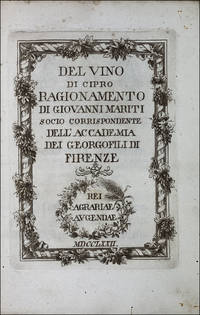
1772117<p>Extraordinary rare first edition of the famous treatise on Cyprus wine by Giovanni Mariti</p><p>A complete analysis on wines grapes vines and production technique</p><p>Mariti Giovanni. <em>Del vino di Cipro ragionamento di Giovanni Mariti socio corrispondente dell'Accademia dei georgofili di Firenze: Rei agrariae avgendae</em>. Firenze : G. Cambiagi MDCCLXXII 1772.</p><p>8vo 220 x 155 mm original printer cardboard pp. 2 XVI 127 1 illustrations along the text engraved title page before the dedicatory letter at leaf a1r a chalcographic vignette with coat of arms of the dedicatee Lord Nassau Clavering signature a⸠πa1 A-Hâ¸.</p><p>xylographic illustrations along the text one full page plate depicting tool for wine production</p><p>In his treatise <em>Del vino di Cipro</em> About the Cyprus Wine published in Florence in 1772 by Cambiagi Mariti dedicates an ample analysis to the wine of Cyprus discussing a lot about the types and varieties of the vines and wines produced in the different regions of the island and reporting its own "observations" made in the countryside around Larnaca where it draws indications and procedures to follow in Italy too to reach the maximus possible efficiency of the crops as Mariti himself well describe in the Preface to the volume:</p><p>"In questo mio Ragionamento ho avuto il riflesso di appagare non solo la curiosità di qualche dilettante de i grati e generosi Vini di Cipro e di dar la norma per qui allignarli ma ancora di poter giovare alla Coltivazione alla Manifattura e alla Conservazione de i nostri Vini Toscani e particolarmente per migliorare alcuna sorta di quegli che oggigiorno sogliono qui farli in scelta maniera il che mi lusingo possa ottenersi dal genio de i nostri Agricoltori Mariti 1772 p. 3. In this reasoning I had the will to satisfy not only the curiosity of some amateur of the grateful and generous Wines of Cyprus giving the rules to list them but also to be able to improve the Cultivation the Manufacture and the Conservation of our Tuscan Wines and particularly to improve the quality of the wines produced there using the support from the genius of our Farmers"</p><p>More in details he starts addressing the issue of the poor resistance of Tuscan wines to navigation deepening the observations already published in the first volume of his "Travels in Cyprus". Mariti studying grapes and winemaking processes in use in Cyprus gives an account of the island's wines distinguishing them by types based on the quality of the grapes the length of the aging process and their conservation and also giving data and figures relating to the sale of the product both in the East and in the West.</p><p>Mariti dedicated this essay on the wines of Cyprus to Lord Clavering whose arms are engraved at the top of the first leaf of the dedication. The preliminary leaves also include an account of the <em>Accademia dei Georgofili</em> devoted to the study of agriculture which was founded in Florence in 1753 and is still active today.</p><p>Giovanni Filippo Mariti 1736 –1806 he was an Italian antiquarian scientist and historian. Intellectual with multiple interests he became famous in Europe mainly for his travels in the East.</p><p>Mariti became interested since his youth in natural sciences cultivating botany and especially agronomy studies and in 1772 he became a corresponding member of the <em>Accademia dei Georgofili</em> founded in Florence on July 4 1753 by Ubaldo Montelatici under the impulse of that renewal of agriculture that the Habsburgs-Lorraine hoped for and promoted to remedy the problems that arose in their lands starting from the first decade of the second half of the century regarding crops and food supplies.</p><p>Mariti lived for seven years at Larnaca in Cyprus becoming honorary British vice-consul and became increasingly familiar with the wine-making process of the island. A shortened version of this treatise was included in the French translation of his "Travels in the Levant".</p><p>Beside <em>Del Vino di Cipro</em> he is remembered for the treatise titled <em>Della Robbia sua coltivazione suoi usi</em> Florence 1776 dedicated by Mariti to the Grand Duke of Tuscany Pietro Leopoldo concerning a plant the <em>Robbia</em> Madder cultivated in the East and used for the colouring of clothes which Mariti hoped to introduce in Europe and for <em>Odeporico o sia itinerario per le colline pisane</em> which was published in Florence in two volumes between 1797 and 1799.</p><p>The first volume of this work which remained partly unpublished deals with the agricultural history of the Tuscan hills the second is dedicated to the history of the water bath today Casciana Terme. The two volumes are divided into chapters that take the form of letters written to an imaginary friend.</p><p>George Clavering-Cowper 3rd Earl Cowper 1739 - 1789 was an English nobleman and politician. In 1780 he purchased Villa Palmieri in Fiesole with a splendid view of Florence. Skilled diplomat and politician he decided to obtain prestige by turning a blind eye on the relationship that his wife had established with the Grand Duke Pietro Leopoldo from which he managed to obtain the title of Prince of Nassau d'Auverquerque.</p><p>The art collection that Count Cowper built during his years in Florence was a great investment of time and money for him. Among the most important works that were part of his collection we mention two paintings by Raphael the first known with the name of <em>Piccola Madonna Cowper</em> and the other as <em>Madonna Niccolini-Cowper</em>.</p><p>Conditions: fine copy untrimmed in its original printer paper board small restoration at spine.</p><p>Provenance: I. Ownership signature dated 1868 at rear inside board. II. Handwritten title at front board and spine.</p><p>References: Lastri p.82; Sormanni p.79; <em>Bibl. </em><em>Vinaria</em> p. 139; Andre Simon Bibliotheca Gastronomica page 97 No 1002</p> G. Cambiagi hardcover
Second edition, small 4to (187 x 130 mm), [8], 232pp., title with woodcut ornamental border and illustration of record ear of barley on verso, woodcut illustrations, title with ink initials at head & small ink stain and browned at edges, one or two old manuscript notes, a few other small stains, mostly to last few leaves, new endpapers, modern calf, covers with double fillet border in blind, spine tooled in gilt and faded, red morocco label. Compendium of useful household information including instructions on storing fruit and flowers, "how to carry gold in a most secret manner", brewing, "how to speak by signs onely", stealing bees, preventing drunkeness, helping smoking chmineys, killing rats, keeping oysters good ten or twelve days, distilling, how to cheat at cards, etc. First published in 1594 this edition also includes a discourse on minerals by Arnold Boate. Wing, P2390.
In Firenze, presso Giuseppe Luchi in faccia al Fisco, 1797, volumi 2, in-8 piccolo, cartonatura rustica coeva, pp. 276, XI, [1] - 16, 272. Prima ed unica edizione, rarissima. Non presente in ICCU né nelle principali biblioteche europee (altre importanti opere del Leonardi - "L'Apicio moderno", "Gianina o sia la cuciniera della Alpi", "Il cuciniere perfetto italiano" - sono invece presenti in ICCU). La Libreria del Congresso ne possiede un solo volume. Westbury, p. 133, n. 3. Pennell 119 (un solo volume). Il termine "pasticciere" è qui da considerarsi nel senso più ampio della parola: notate tantissime ricette di pasticci salati: di carne rossa, di carne bianca, di cacciagione, di pesce, ecc. Francesco Leonardi, di nascita romano, lavorò al servizio del maresciallo di Richelieu e dei potenti di Polonia, Turchia, Germania e Inghilterra, fino ad arrivare, con il ruolo di cuoco e scalco, alla corte di Caterina II imperatrice di tutte le Russie. Ottimo esemplare con solo qualche brunitura sparsa.
158140653DBRom, in aedibus populi Romani, 1581 (im Druckevermerk 1582). Folio. 340 S., (12) Bl. (Index). Mit einer Holzschnitt-Druckermarke auf dem letzten Blatt. Etwas späterer Pergamentband mit goldgeprägtem Rückentitel. + Wichtig: Für unsere Kunden in der EU erfolgt der Versand alle 14 Tage verzollt ab Deutschland / Postbank-Konto in Deutschland vorhanden +, A|B [2 Warenabbildungen]
193654291Chicago: Walter Hill 1936. Each signed with initials of the Artist. Matted with the corresponding captioned illustrations. 1 vols. Various Sizes 13.5 x 11 inches to 3 x 7 inches matted on 14.5 x 22 inch boards . In worn and split cloth drop box morocco label. Each signed with initials of the Artist. Matted with the corresponding captioned illustrations. 1 vols. Various Sizes 13.5 x 11 inches to 3 x 7 inches matted on 14.5 x 22 inch boards . Bitting p. 13: "Fully annotated. The name was synonymous with gourmandise and among the ancients was given to choice dishes the name of the author was probably Coelius who gave the name Apicius to his book"; Vicaire p. 277 Walter Hill unknown
193654291Chicago: Walter Hill 1936. Each signed with initials of the Artist. Matted with the corresponding captioned illustrations. 1 vols. Various Sizes 13.5 x 11 inches to 3 x 7 inches matted on 14.5 x 22 inch boards . In worn and split cloth drop box morocco label. Each signed with initials of the Artist. Matted with the corresponding captioned illustrations. 1 vols. Various Sizes 13.5 x 11 inches to 3 x 7 inches matted on 14.5 x 22 inch boards . Bitting p. 13: "Fully annotated. The name was synonymous with gourmandise and among the ancients was given to choice dishes the name of the author was probably Coelius who gave the name Apicius to his book"; Vicaire p. 277 Walter Hill unknown books
Three volumes, complete. FIRST EDITION of this scholarly, encyclopedic, and highly entertaining history of French gastronomy. XIII, (3), 373, (1); (4), 383, (1); (4), 363, (1). Half-titles present (they are often missing). SIGNED (in pencil) ON THE HALF-TITLE OF VOLUME I BY JORDI, JOSEP, AND JOAN ROCA OF EL CELLER DE CAN ROCA IN GIRONA, SPAIN, CURRENTLY THE BEST RESTAURANT IN THE WORLD (according to the highly prestigious San Pellegrino survey). And SIGNED (in pencil) ON THE HALF-TITLE OF VOLUME II BY FERRAN ADRIA, OF EL BULLI, winner of the San Pellegrino survey a record five times. The author originally set out to write an extensive work covering all facets of private life in France, but only this first part--which covers everything related to cooking, wine, eating, and hunting--was published. Discusses the origins of cooking tools and techniques, the provenance of all kinds of foods (including, of course, foodstuffs that came from the New World), and much more, including an extensive section on hunting. A classic. PRINTED ON FINE LAID PAPER. 8vo. ELEGANTLY BOUND IN FULL CONTEMPORARY HALF RUSSIA AND MARBLED BOARDS, SPINE IN SIX COMPARTMENTS WITH RAISED BANDS. Minimal traces of wear to bindings, upper joint of volume I cracked but firm, else a fine and bright copy with very large margins and very white paper. Vicaire 510 ("Ouvrage tres interessant et tres utile...."); Bitting 280 ("This is one of the finest works upon the social life of the French people...."); Thiebaud 576. AN OUTSTANDING SET OF A RARE AND IMPORTANT WORK.
158140653DBRom, in aedibus populi Romani, 1581 (im Druckevermerk 1582). Folio. 340 S., (12) Bl. (Index). Mit einer Holzschnitt-Druckermarke auf dem letzten Blatt. Etwas späterer Pergamentband mit goldgeprägtem Rückentitel.
8vo., Third Impression, with title-vignette, title in green and black, and illustrations in the text, half-title mildly browned, edges mildly dust-soiled; handsomely bound in full dark green crushed morocco, sides with gilt frame border, back with raised bands, second and fourth compartments ruled and lettered in gilt, all other compartments ruled and tooled with a gilt marmite, gilt top, hand-made endpapers, Renny illustration from original front board mounted on new leaf at front, a most attractive copy ideal as a gift or for presentation. SIGNED BY THE AUTHOR ON TITLE in the usual blue ink with double line. Published a year after the first edition. SIGNED COPIES OF DAVID'S WORKS ARE VERY SCARCE.
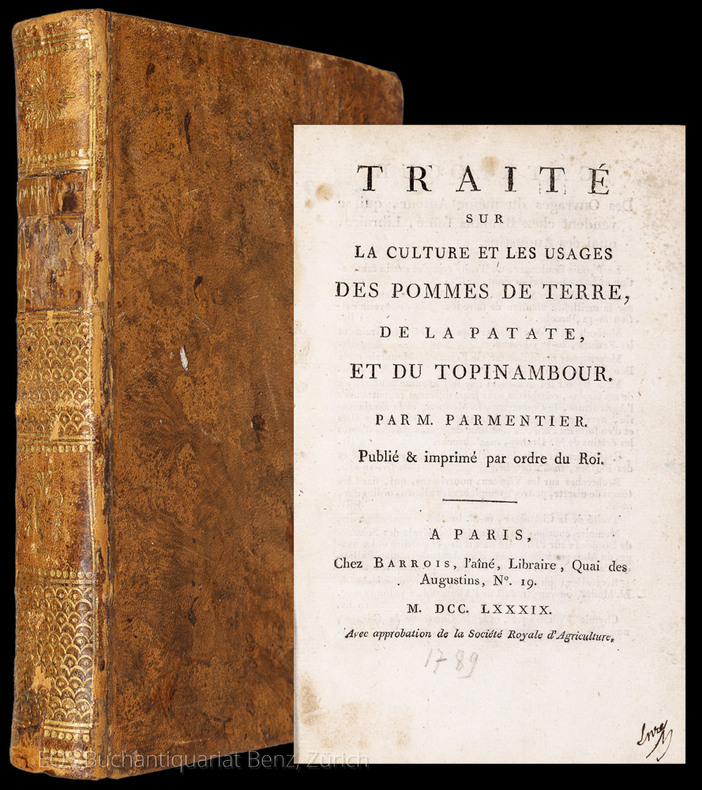
17897184CBParis, Chez Barrois, 1789. VIII, 389 (recte 392). Lederband der Zeit mit reicher Rückenvergoldung. + Wichtig: Für unsere Kunden in der EU erfolgt der Versand alle 14 Tage verzollt ab Deutschland / Postbank-Konto in Deutschland vorhanden +, A|B [2 Warenabbildungen]
4620No Binding. Very Good. Copper plate engraving 23 x 30 cm printed surface. n.d. but c. 1775. A few folds but generally excellent with a fine impression. Charming engraving of a genre scene depicting a man grating parmesan cheese by the Venetian engraver and Volpato pupil Francesco del Pedro 1749-1806 after a painting by the Venetian painter Francesco Maggioto 1750-1805. The printer has added a moralizing motto from Horace Odes III.16 on how to the fortunate man whatever material goods are at hand are enough. Benezit VIII.186 Pedro VII. 62 Maggioto. unknown
4620No Binding. Very Good. Copper plate engraving 23 x 30 cm printed surface. n.d. but c. 1775. A few folds but generally excellent with a fine impression. Charming engraving of a genre scene depicting a man grating parmesan cheese by the Venetian engraver and Volpato pupil Francesco del Pedro 1749-1806 after a painting by the Venetian painter Francesco Maggioto 1750-1805. The printer has added a moralizing motto from Horace Odes III.16 on how to the fortunate man whatever material goods are at hand are enough. Benezit VIII.186 Pedro VII. 62 Maggioto. unknown books
17897184CBParis, Chez Barrois, 1789. VIII, 389 (recte 392). Lederband der Zeit mit reicher Rückenvergoldung.
19616087Paris, Les Francs Bibliophiles, 1961 ; in-8 en feuilles ; couverture crème imprimée en bleu marine rempliée, étui de suédine noire (emboitage de l'éditeur) ; (3) ff. blancs, 108, (8) pp., (3) ff. blancs, 25 gravures dont 1 en frontispice, protégées par des serpentes de papier de soie.
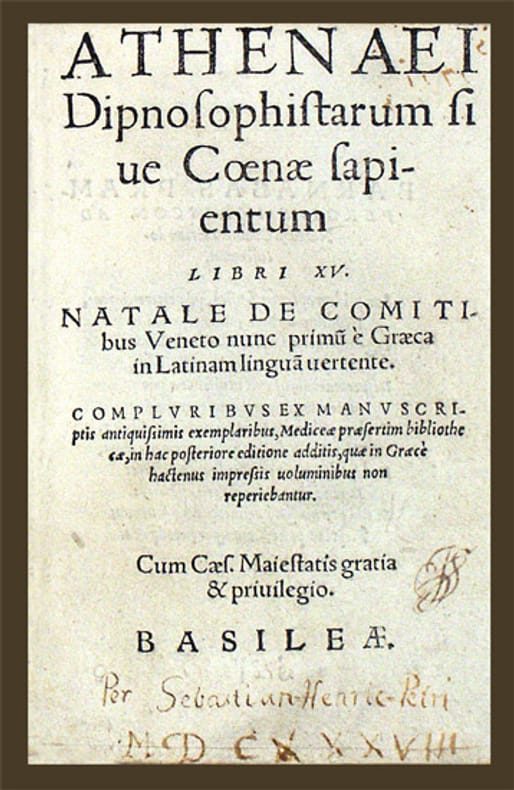
155640664DBBasel, (Henri Petri, August 1556). 8°. (26) Bl., 1122 S. Pappband um 1820 mit rotem goldgeprägtem Rückentitel. + Wichtig: Für unsere Kunden in der EU erfolgt der Versand alle 14 Tage verzollt ab Deutschland / Postbank-Konto in Deutschland vorhanden +, 40664D
155640664DBBasel, (Henri Petri, August 1556) 8°. (26) Bl., 1122 S. Pappband um 1820 mit rotem goldgeprägtem Rückentitel.
A HOLOGRAPH MANUSCRIPT COOKBOOK INITIALED TWICE BY FRANZ TOUSAINT (1879-1955), famed Orientalist author, poet, screenwriter, and translator. The title-page asserts that "Aucune de ces recettes ne se trouve dans un livre de cuisine". The preface (initialed by Toussaint) asserts that Toussaint's great-grandfather, the GÈnÈral Baron Toussaint (1772-1827) was friends with Grimod de la ReyniËre (they lived in the same building on the Champs-ElysÈes, a building that later became the American Embassy). Many of the recipes date to the 1820s and earlier. A later note in Toussaint¥s hand, after the preface: "Recettes relues en pleine famine, 1944." An inserted slip (dated 1949 and initialed by Toussaint) adds: "Ce carnet ne doit Ítre prÍtÈ ‡ personne, quelle que soit la personne et quel que soit le prÈtexte." 43 pages of French recipes follow, written in ink in Toussaint¥s minuscule but extremely clear and legible hand ("La seule vraie recette pour la bouillabaisse", "truffes ‡ la marÈchale", "poulet ‡ la mistral", "la bÈcasse Louis XV", and many, many others. Four blank leaves follow (obviously left blank so more French recipes could be included, if necessary. Then there are 3 pages of Turkish and Arab recipes, 2 blank leaves, and one page of rice dishes. Then a blank leaf and a tomato recipe. Then two blank leaves, then a bound-in ticket to the "Exposition coloniale internationale" held in Paris in 1931 (!), then seven more blank leaves. Then 7 pages of sauce recipes, then another blank leaf. Then 2 pages of recipes for stuffings and then 5 more blank leaves. Then a page with recipes for crËme anglaise and crËme au chocolat and then 4 more blank leaves. Then 3 pages of dessert recipes (including "PÍches en seins de VÈnus" and then another blank leaf. Then a page of recipes for "oranges confites" and "jus d'oranges [sic] confit", and then 5 more blank leaves. Then 4 pages of recipes for coctails, and then 7 more blank leaves. And finally a table of wines, followed by 2 final blank leaves. On fine Sorel-Moussel wove paper with a moleskine-type cover, with Toussaint's bookplate and inkstamp on preliminary blank. 12mo (17.5 x 11 cm). Tiny traces of wear to binding, else FINE AND BRIGHT. Unique, and worthy of publication.
8vo., Second Edition, on laid paper, with frontispiece, illustrated title, and numerous full-page and smaller illustrations in the text, some relevant annotations in pencil to several recipes; original olive cloth, backstrip blocked in red and lettered in gilt, a very good, firm copy in unclipped dustwrapper, the latter browned at fold-ins, rubbed at joints, and mildly browned at backstrip. SIGNED BY THE AUTHOR ON HALF-TITLE in the usual blue ink with double line. David's second book, fitst published in 1951 and to many the finest of the three classic titles that changed the nature of English cookery for ever. In common with her first work 'A Book of Mediterranean Food' this volume is greatly enhanced by the wonderful Minton illustrations, particularly the artwork for the wrap-around dustwrapper. In this second edition (from Macdonald rather than Lehmann) David adds a new Preface explaining the scope of the work, and excludes certain details relative to wartime rationing as no longer necessary. SIGNED COPIES OF DAVID'S WORKS ARE VERY SCARCE.
New edition, [2], ii, 3, [1], xxiii, [1], 271, [1], 46pp., 'On distilling in general' has separate pagination, handsomely bound in half calf by Trevor Lloyd of Ludlow, marbled boards, five raised bands to spine with red morocco title label and tooled in gilt, a very nice copy. It was not until the publication of this new edition that the "Ingenious Foreigner", responsible for the 1770 and 1771 editions, revealed himself as "Mr. Borella, now head confectioner to the Spanish Ambassador in England." All three edition are rare with ESTC recording 7 copies of the first 1770 edition, 1 of the second edition of 1771, and 8 copies of this new and last edition. Maclean, pp. 10-11; Oxford, p. 102; Bitting, p. 49-50; Simon, 227; Cagle, 572.
Original menu card for the celebration dinner at the Waldorf Astoria Hotel in New York, on the occasion of John Fritz’s 80th birthday and the 1st bestowal of the »John Fritz medal«, awarded annually since 1902 by the American Association of Engineering Societies for outstanding scientific or industrial achievements. The menu is personally signed by John Fritz, who also was the 1st recipient of the medal. - The menu card was designed by Thomas A. Sindelar (1867-1923), also bearing his signature on the cover (blind stamped monogram) and on one of the plates (printed full name). Sindelar, an illustrator and designer of Bohemian origin had studied in Paris, presumably with Alfons Mucha, before he settle in the U.S. He remains best known for his elaborate, allegorical and symbolic designs for menu cards, e.g. for the »Lotos Club«, a New York men’s group of distinguished professional, literary, and academic pursuits. - Cover worn, in parts rusty and with little folds, inside very well preserved indeed. - Miloslav Rechcigl: Encyclopedia of Bohemian and Czech-American Biography, vol. 2 (2016).
[Torun (Polonia), s.n., 1697-1698], manoscritto su carta, in-4, legatura settecentesca in mezza pelle con punte (spellature diffuse) cc. 221 totali, non numerate (specifica dei vari titoli: cc. [74] ultime 5 bianche - [34] - cc. [60], ultime 2 bianche - [8], ultime 2 bianche - [10] - [6], ultima bianca - [8] - [5] - [16]). Steso in chiara grafia, da una sola mano, in lingue latina (in gran parte) e polacca. Interno in condizioni più che buone. Dell'estensore del manoscritto, Giovanni Francesco Pagnini che studiava a Torun nel 1697, non sappiamo nulla, se non che apparteneva ad un ramo della famiglia Pagnini originaria di Prato, che ebbe ramificazioni a Volterra, Lucca e, appunto, in Polonia. Ben più ampie le notizie disponibili sul suo professore, Raczynski, nato a Podlasie nel 1664, e che negli anni 1697-1708 insegnò retorica a Torun, Lublino e Poznan. La sua opera maggiore è l'"Historia naturalis curiosa regni Poloniae, magni ducatus Lituaniae annexarunque provinciarum" edita nel 1721, che, nonostante sia, in buona parte, una raccolta di descrizioni da varie fonti, costituisce una delle maggiori opere di storia naturale polacche del XVIII secolo. Morì nel 1737 a Danzica. Nel volume da noi presentato segnaliamo il secondo titolo che affronta argomenti intorno alla convivialità e alla gastronomia.
Small to (184 x 128 mm), [8], 80, 79-174, 173-133 [i.e. 233], [1]pp., without final blank, fore-edge shaved effecting some margin notes, marbled endpapers, nineteenth-century full smooth calf, boards with floral gilt border, spine tooled in gilt, all edges gilt, a nice copy. An enlarged version of part 2 of his: Countrey contentments, in two bookes, 1615. Also issued as part 3 of his: A way to get wealth, 1623. Poynter, 34.1; STC 17343; Cagle, 847; Rothamsted, p.97.
8vo., Second Impression, with title-vignette and illustrations in the text; pale blue cloth, gilt back, boards mildly age-soiled else a very good, bright, clean copy in price-clipped dustwrapper, the latter lightly age-soiled and chipped (not affecting lettering) at head of backstrip. SIGNED BY THE AUTHOR ON TITLE in the usual blue ink with double line. David's fourth book, first published in 1955. This second impression is the last to contain her original text, for in 1965 she revised and enlarged it for its first issue in the well-known Penguin Handbooks series (which guaranteed its continuing success). SIGNED COPIES OF DAVID'S WORKS ARE VERY SCARCE.
In Firenze, per Domenico Manzani, 1605, in-8 piccolo, cartonatura marmorizzata del primo ottocento, pp. 45, [3]. Con marca xilografica sul front. (un gatto che aziona un buratto, riferimento all'Accademia della Crusca) diversa da quella segnalata in ICCU. Seconda edizione (la prima censita in ICCU è del 1583). Raro. Frontespizio con alcuni antichi restauri reintegrativi (ben fatti). B.IN.G. 448.