Merian, Maria SibyllaAntiquariat.de

6 514 résultats
17147500CBAmsterdam, Valk, 1714-1717. Kl.-4°. 1 Bl., (6) S. 8?30; (2) Bl., 30 S.; (4) S. 5?24. Mit Portrait, 3 Frontisp. (davon 2 kol.) und 150 kol. Kupferfafeln. Lederband der Zeit. + Wichtig: Für unsere Kunden in der EU erfolgt der Versand alle 14 Tage verzollt ab Deutschland / Postbank-Konto in Deutschland vorhanden +, 7500CB|7500CB_2|7500CB_3|7500CB_4 [4 Warenabbildungen]
1790ST19326Amsterdam: H. Keyzer H. Gartman en W. Vermandel 1790. 555 x 345 mm. 21 7/8 x 13 3/4". 2 p.l. 62 folding plates. <br/> Attractive late 19th or early 20th century retrospective polished brown calf by L. Guétant stamp-signed in gilt on tail of spine double gilt-ruled border floral cornerpieces raised bands spine panels with scrolling floral borders and central flower ornament gilt titling. With title vignette and 62 ENGRAVED FOLDING PLATES ALL WITH BEAUTIFUL HAND COLORING AND HIGHLIGHTED WITH GOLD depicting Bible scenes from the Old and New Testament 61 of which are by Jan Luyken. A Large Paper Copy. For earlier editions: Graesse IV p. 308; Brunet III 1245-46; Klaversma & Hannema 159-164. Light rubbing to joints and edges boards just a little marked trivial foxing and faint spots here and there but A REMARKABLY FINE COPY the binding lustrous and showing little wear the paper extremely bright and fresh the margins immense and the paint and gold unusually vibrant.<br/> <br/> The marvelous illustrations of Dutch engraver and poet Jan Luyken comprise this collection of "remarkable stories" from the Bible each depicted with panoramic grandeur and enhanced with a wide range of finely applied colors and gold. Luyken 1649-1712 had written and illustrated erotic poetry as a young man but later became a devout Pietist after reading the works of German mystic Jakob Böhme. He became a member of the Baptist Church in 1673 and thereafter devoted his talents to producing religious works. The vast scenes here are notable in their scale detail and animation. There are a number of battle scenes from the Old Testament as well as dramatic depictions of the plagues and a fascinating episode from the histories of Josephus depicting Herod's soldiers being lowered down the side of a cliff in large boxes suspended from chains in order to attack the thieves hiding in caverns on the cliffside. There is a majestic portrayal of the Queen of Sheba arriving at the court of Solomon a peaceful scene of Adam naming the beasts in the Garden of Eden and a festive celebration of the Feast of Tabernacles. New Testament scenes include a terrifying final judgment a blinding conversion of St. Paul and scenes from that Apostle's travels. The engravings have one common trait: they are heavily populated whether by men or beasts and one of Luyken's special gifts is to render every person in the crowd as an individual with his own concerns and reactions to the events at hand. The engravings while already greatly pleasing in black and white are even more stirring and memorable when seen in the full color and gold used here. Expansive tableaus are given greater definition and clarity and events such as Noah’s flood and the destruction of Sodom and Gomorrah are rendered even more successful in expressing the awesome powers of the Almighty. The illustrations are quite definitely Protestant in point of view: there are no depictions of the Virgin Mary not even a Nativity scene. Except for engravings of the Annunciation to the Shepherds and the Massacre of the Holy Innocents the illustrations focus on Jesus as an adult and on the work of his Apostles spreading the gospel. There were earlier editions containing Luyken's 62 large plates which originally appeared without text as here in 1708 and they appeared again with a text in Dutch in 1729 and in French in 1732. Copies of these editions appear with some regularity in the marketplace but are usually not colored and are often found incomplete or with other major condition issues. We can trace no record in RBH or OCLC of a copy of our 1790 edition and we can find nothing that compares with the quality of coloring and grand height attained by the monumental margins seen here. H. Keyzer, H. Gartman en W. Vermandel unknown
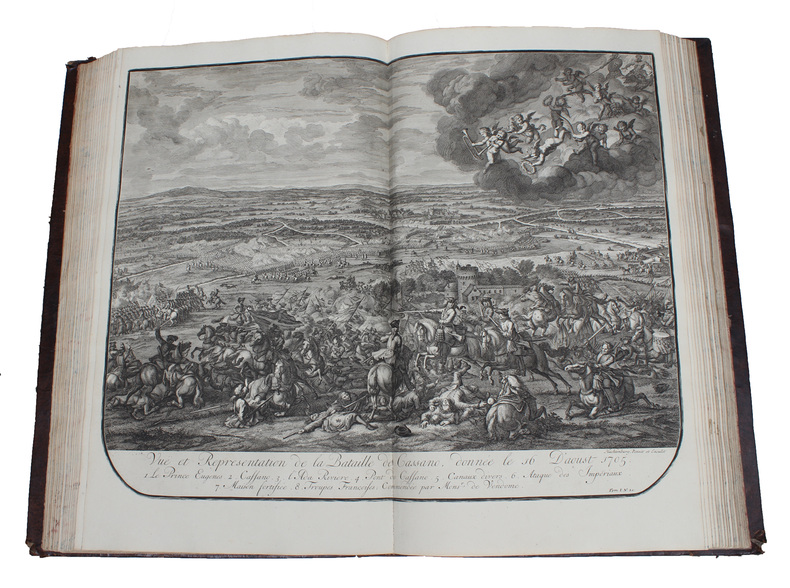
172955765A la Haye, chez Isaac van der Klott, 1729-47. Large folio. (54 x 35 cm.). 3 uniform contemporary full mottled calf. Spine with 9 compartments, divided by 8 raised bands. Compartments richly gilt. Titlelabels with gilt lettering. Light wear to top of spine on volume I. Small stamp on title-pages. LXI,132 II,336(6),357,(1) pp. 3 engraved titlevignettes, 10 half-page engraved headpieces and 101 fine engraved plates (10 maps, 12 battle-scenes 77 plans and views, 2 portrait-plates (one as frontispiece in Vol. III) mostly double-page (also triple-page or more). 6 tables, some folding. Internally fine and clean, printed on good paper. Wide-margined.
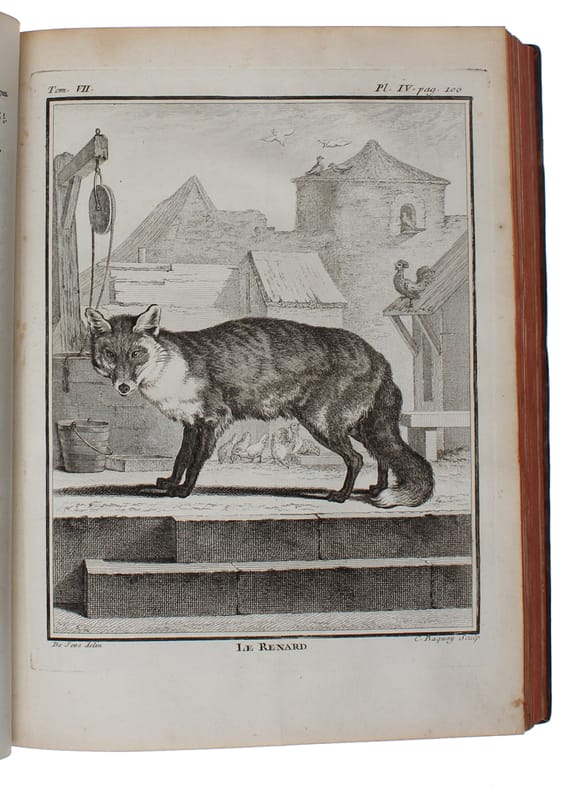
178960389Paris, l' Imprimerie Royale, Plassan, 1749 - 1789. 4to (262 x 205 mm). Uniformly bound in 32 contemporary full sprinkled calf bindings with five raised bands and richly gilt spines. Leather tome- and title-labels to all volumes. Edges of boards gilt. Light wear to extremities primarily affecting head and foot of spines, corners bumped. Internally with light occassional, marginal brownspotting, but generally fine. With ""J. Collin"" (Danish zoologist Jonas Collin) to top margin of most front free end-papers. An overall nice set comprising the following:Histoire Naturelle, Générale et Particulière (15 vols) - 578 plates and 2 maps.Supplément à l'Histoire naturelle (6 vols) - 141 plates and 2 maps.Histoire naturelle des Oiseaux (9 vols) - 257 plates.Quadrupedes Ovipares et des Serpens (2 vols) - 66 plates. A total of 1042 plates and 4 maps. Wanting the portrait. The complex collation of this work has not been accurately described by bibliographers. Nissen and Heilbrun differ in the listing of number of plates and misname the descriptions of the plates.
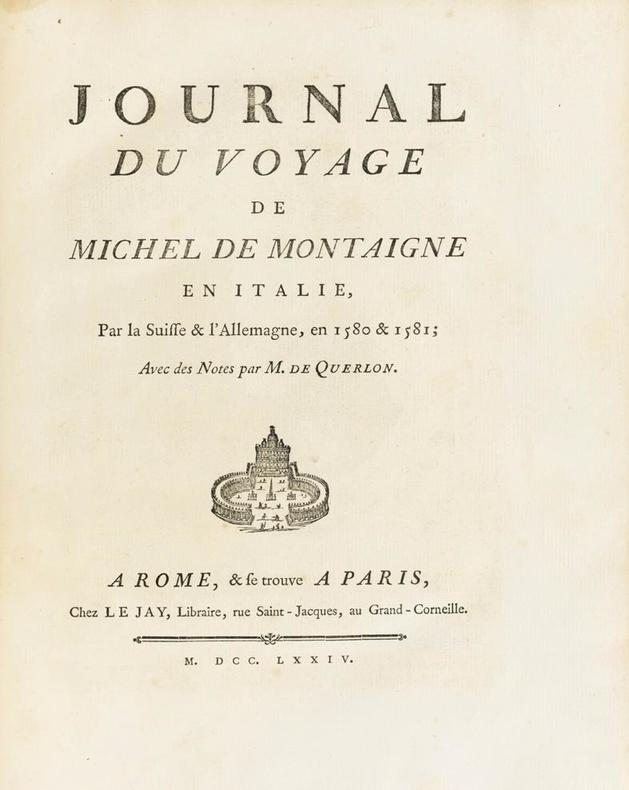
1774YTB-5Le Jay - J. Tonson & J. Watts (1774) 2 ouvrages en 4 volumes in-4 de : I/ (1) f. pour le portrait, (2) ff., XV pp., (4) ff., 363 pp., (6) ff., XVIII pp., (1) f. bl., (1) f., 95 pp. ; II/ 538 pp., (8) ff. de table.; III/ (1) f.,411 pp., (12) pp. de table ; IV/ (1) f. pour le portrait, (4) ff., LIV et 416 pp. Maroquin bleu nuit, triple filet or encadrant les plats, dos lisses richement ornés, pièces de titre et de tomaison en maroquin rouge, double filet or sur les coupes, roulette intérieure dorée, tranches dorées. Reliure de l’époque. 289 X 230 mm. EXCEPTIONNELLE REUNION, EN TRES BELLE RELIURE HOMOGENE EN MAROQUIN DU TEMPS, DE L’EDITION ORIGINALE IN-4 DU VOYAGE DE MONTAIGNE ET DE LA PREMIERE EDITION COMPLETE DES ESSAIS. LES EDITIONS ANCIENNES DES « Essais » DE MONTAIGNE EN MAROQUIN DE L’EPOQUE ONT DE TOUT TEMPS ETE RECHERCHEES. SUPERBE ET PRECIEUX EXEMPLAIRE, GRAND DE MARGES (hauteur : 289 mm), SUR GRAND PAPIER, CONSERVE DANS SON MAROQUIN BLEU NUIT DE L’EPOQUE. L’exemplaire répertorié par Philippe Desan mesurait 283 mm de haut et l’exemplaire répertorié par André Pottiée-Sperry : 285 mm. Tchemerzine ne cite que 3 exemplaires, tous reliés en veau ancien : « Bénard, 4000 frs ; Roussel, 1300 frs ; De Backer, 3650 fr. ». EXCEPTIONNELLE REUNION DES ESSAIS ET DU JOURNAL DE MONTAIGNE CONSERVES DANS LEUR RELIURE HOMOGENE EN SUPERBE MAROQUIN BLEU NUIT DU TEMPS.
1792494721792 Paris, chez Dufart, Favre, 1792 - Edition Originale - In-16 -Reliure 1/2 chagrin rouge postérieure- dos lisse - Gravure en frontispice - XXXVI-107 pages - Bon exemplaire - Réf. 49472
179641095, , 1796-1797. Ensemble 24 volumes.
1738ST16322London: Printed for the Society for the Encouragement of Learning by S. Richardson 1738. FIRST EDITION. 240 x 186 mm. 9 1/2 x 7 1/4". 4 p.l. 187 1 pp. <br/> Contemporary sprinkled calf raised bands red morocco label. With engraved device of the Society on title page and final page engraved tailpiece and TWO FOLDING MAPS. Church 930; Howes K-36; Sabin 37240; ESTC T115083. Front joint cracked but the cover still firmly attached thin half-inch chip to spine at tail of front joint other minor signs of wear to the leather but the original unsophisticated binding sound and pleasing. Light scattered foxing mostly confined to margins one leaf with a tiny hole affecting a couple of words other trivial imperfections but A FINE COPY INTERNALLY the paper fresh and clean the maps remarkably free from any tears.<br/> <br/> Tracing the history of Virginia from the earliest English settlements through the first quarter of the 18th century with valuable notes on the colony's economy and trade this is a scarce and valuable work by a former colonial official with direct knowledge of the region. The history draws on earlier accounts most notably the 1705 work of Jamestown-born historian Robert Beverley ca. 1667-1722 but the more contemporary observations including those related to agriculture and economy come from the firsthand experiences of author William Keith 1680-1749 who went to Virginia in 1714 upon his appointment as surveyor-general of customs for the southern colonies in North America. According to ANB he toured Virginia the Carolinas Pennsylvania and Jamaica over the next two years charming all he met. In 1717 he became governor of Pennsylvania and ANB notes "for five years from 1717 to 1722 Keith was the most popular governor since the founding of the colony." During his service in the American colonies Keith wrote reports to the British government that ANB says "helped shape royal policy well into the 1760s." Knowledge gleaned in producing these reports is shared in the present work which features two fine maps: "A New and Correct Map of America" measuring 560 x 475 mm. showing North and South America with California as an island with inset views of Port Royal Boston Georgia North Pole and a Newfoundland cod fishery as well as "A New Map of Virginia" measuring 340 x 235 mm. by Thomas Fairfax dated 1738 showing the Tidewater region of the Mid-Atlantic states centering on Virginia with Maryland and New Jersey to the north and North Carolina to the south. Thomas Jefferson was familiar with this work remarking in "Notes on Virginia" that it is "agreeable enough in style and passes over events of little importance." Keith intended this to be the first in a series on the British colonies in North America--thus the "End of Vol. I" notation on the final page--but the project was abandoned for lack of funds. This work is rare in the marketplace: just two copies complete with maps one of these in a modern binding have appeared at auction since 1991. [Printed for] the Society for the Encouragement of Learning by S. Richardson unknown
1735ST18632Amsterdam: Petrus Shenk 1735-38. First Edition in Dutch. 415 x 264 mm. 16 3/8 x 10 3/8". Entirely complete with continuous pagination but with a jump in page numbering from the end of book XIII to the beginning of XIV as usual. 15 parts in eight volumes. Translated by Florentius H. J. van Halen. <br/> HANDSOME CONTEMPORARY VELLUM covers with large gilt entrelac centerpiece framed with gilt floral rule with bouquet-like cornerpieces gilt floral border raised bands compartments richly gilt titles and volume numbers handwritten in ink on spines all edges gilt. With head- and tailpieces 15 engraved titles printed in red and black with engraved vignettes and complete with frontispiece two engraved portraits of the author and the engraver the latter with shorter margins probably tipped-in and 760 OFTEN STRIKING COPPER ENGRAVINGS on 758 plates one with partial hand coloring a few double-page. Front pastedown of first volume with handwritten note in French on lined paper; with additional black & white title to first work erroneously dated 1728. Nissen ZBI 3661; see also: Faber du Faur "German Baroque Literature" p. 472. Trivial soiling to the vellum the seventh volume with a faint marginal dampstain affecting a few quires but not touching engravings the odd negligible blemish but AN OUTSTANDING SET the very attractive original bindings showing only insignificant wear and THE CONTENTS ESPECIALLY FRESH AND CLEAN THROUGHOUT WITH VERY FINE IMPRESSIONS OF THE PLATES.<br/> <br/> This is the first Dutch translation of Scheuchzer's "Sacred Nature" one of the most splendid German illustrated books of the 18th century presenting what surely is the most impressive combination of biblical exegesis and scientific illustration to be found in any printed book. First published in 1731-35 as the "Physica Sacra" in Latin and as the "Kupfer-Bibel" in German so-named for the amazing array of copperplate engravings this work is arranged according to the progression of books in the Bible citing passages from those chapters where phenomena from the natural world are mentioned. The typical pattern here includes a textual citation followed by the author's often lengthy remarks on the passage and in many cases a dramatic engraving to illustrate what is said. The plates are identical to the earlier editions retaining the inscriptions in Latin and German and are the work of Johann-Melchior Fuseli of the well-known Zurich family of 18th and 19th century artists. The engraved scenes are always executed with great skill are generally very animated and are often fascinating. Of the 760 images meant to illustrate the text many are strictly or primarily depictions of biblical scenes; several are simply illustrations of specimens of nature; and a large number perhaps half offer a kind of combination. An example of this last type includes a wonderful scene showing the birth of Man as related in Genesis 1:26-27 depicting not only a startled Adam in his fecund paradise but also 10 images of fetuses placentas and the skeletons of children attached like mounted specimens to the architectural frame of the illustration. According to Faber du Faur it is in this work that "the Baroque attains philosophically as well as artistically its high point and its conclusion. It is the last of those elegant works which do not really contain illustrations to a text but which are in effect composed of splendid plates with a text to accompany them." Scheuchzer 1672-1733 was a prolific naturalist who promoted at every opportunity the most modern scientific ideas though without wanting to risk the accusation of being irreverent. He says that the present work represents an attempt at finding a harmony between reason and revelation though it can also be seen as an effort to promulgate progressive theories under the venerable cloak of biblical commentary. The bibliographies disagree about the number of plates that ought to be present in this work and in other editions but ours corresponds to copies previously sold at auction as complete. Copies of the "Physica Sacra" and its translations show up regularly for sale but almost never does one see the work both complete and as here with a clean and fresh text in remarkably well-preserved and attractive contemporary bindings. Petrus Shenk unknown
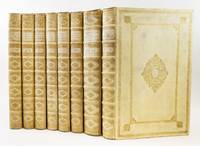
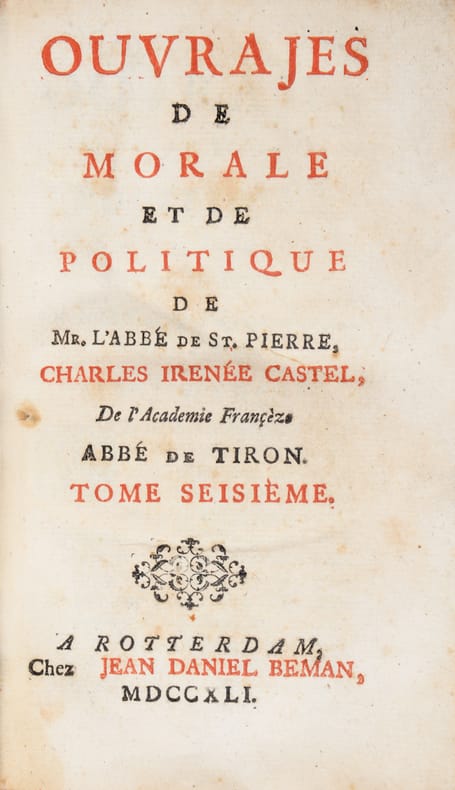
173311268A Rotterdam, chez Jean-Daniel Beman, 1733-1741. 16 vol. in-12, demi-basane brune à petits coins, dos lisse orné de roulettes dorées (reliure italienne de la fin du XVIIIe siècle).
172956915A la Haye, chez Isaac van der Klott, 1729-47. Large folio. (54 x 35 cm.). 3 uniform contemporary full mottled calf. Compartments richly gilt. Tome- and titlelabels with gilt lettering. Some wear to top of spine and some cracking to leather along joints on volume I-II. Corners a bit bumped. Small stamp on title-pages. LXI,132 II,336(6),357,(1) pp. 3 engraved titlevignettes, 10 half-page engraved headpieces and 95 fine engraved plates (7 maps, 13 battle-scenes 73 plans and views, 2 portrait-plates (one as frontispiece in Vol. III)) mostly double-page (also triple-page or more). 8 tables, some folding. Internally fine and clean, printed on good paper. Wide-margined.
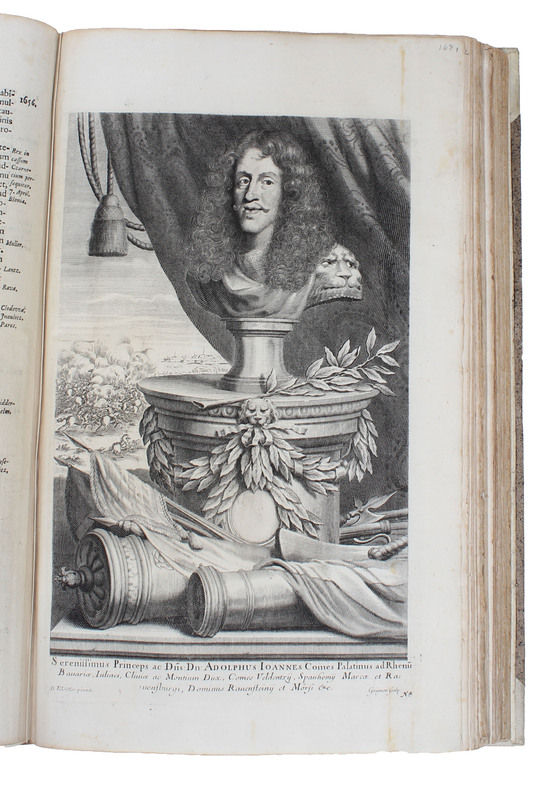
172954188Nürnberg, Christopher Riegel, 1729. Folio. (38x25 cm.). Bound in two unifrom later half vellum with handwritten titles and line bands on spine, all in black ink. Bound partly uncut. Half-title, (8), 362, (363-367), 368-626 pp. + Tractatus Praecipui 53 pp. + Index (9) pp. + Informatio pro Bibliopegis &c (2) pp. Engraved allegorical frontispiece (by Jean Boulanger after D.K. Ehrenstrahl). 12 engraved portraits and 115 fine engraved plates (numbered up to 112, some numbers omitted, some unnumbered, some double-numb - COMPLETE). Plates are double-page, but some of the plates folded three times and made from more than one copperplate" the plate with the view of Stockholm, showing the procession of the funeral of Carl X Gustav, is printed from 13 plates and is 450 cm. long. One plate (Expeditio Gloriosa... qua Mare Balticum) shaved in left and right margins, loosing part of the printed frame. Many engraved vignettes, coins and medals in the text. Although the binding is rather new, it is the copy's first binding, thus the first and last few leaves in both volumes have some brownspots and some soiling, otherwise rather clean with some scattered brownspots, mainly to margins. A few corners with minor repairs (no loss). 7 plates in part I having a wormtract in upper right corners, not affecting the engravings.
1779148241779-1781, imprimerie royale, in-4 plein cuir de XVI+707 et 844 pages, gardes marbrées, dos à 5 nerfs, titrages dorés, 13 planches dépliantes en fin de chaque ouvrage. | Etat : Bon état général, dos, champs et mors usés, rousseurs, manque de la 14ème planche du 2nd volume, complet de ses 2 volumes. (Ref.: MA87)
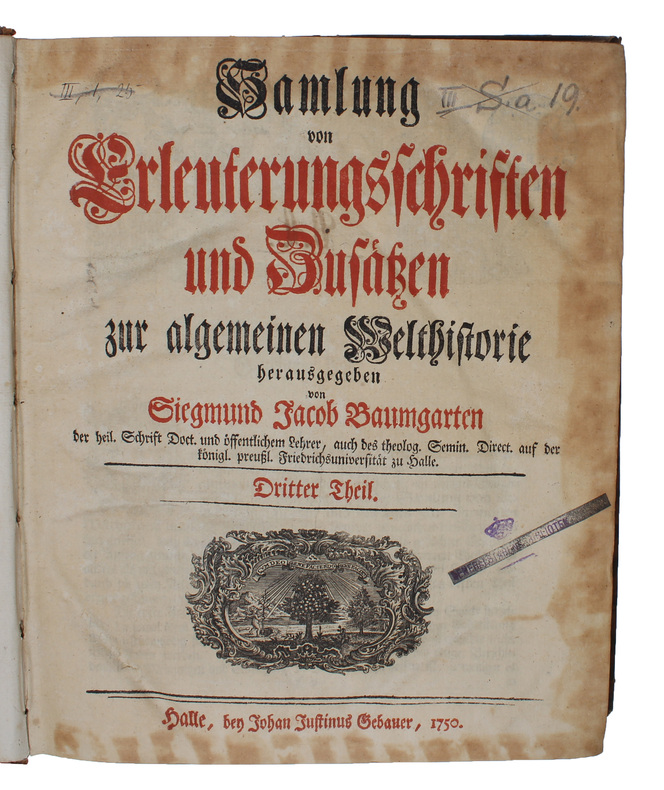
174456102Halle, Johann Justinus Gebauer. 1744-1793 4to. Bound in 65 (Theil 48 in 3 volumes) nice contemporary full calf with raised bands and richly gilt spines. A few volumes have some wear to upper spines. With 58 frontispices, 124 engraved plates, and 103 engraved folded maps. Internally nice and clean.
179288280Metz le 4 [janvier-février 1792] | 11.50 x 17.10 cm | une feuille
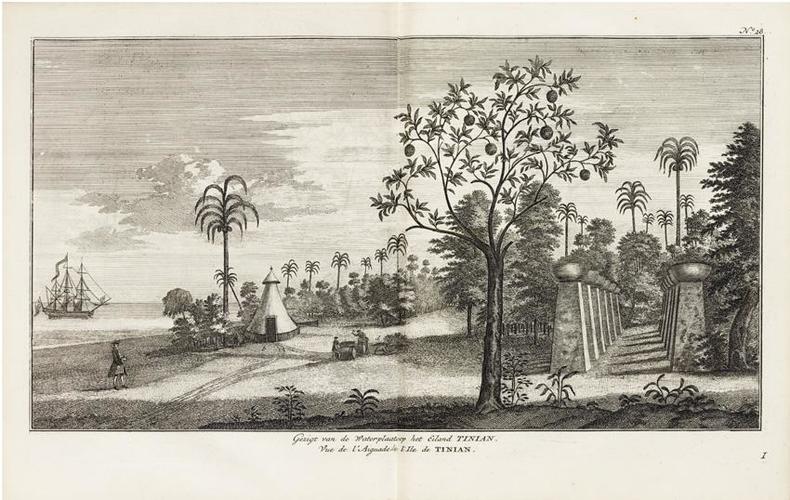
1749YTB-19Amsterdam, Arkstee et Merkus, 1749. Edition originale. Amsterdam, Arkstee et Merkus,1749. In-4 de (4) ff., XVI et 333 pp., (1) p. d’errata et 34 planches gravées. Maroquin rouge, triple filet doré encadrant les plats, dos à nerfs orné à la grotesque, double filet or sur les coupes, roulette intérieure dorée, tranches dorées. Reliure par Jacques Antoine Derome, avec étiquette. 255 X 210 mm. EDITION ORIGINALE FRANÇAISE DU CELEBRE VOYAGE AUTOUR DU MONDE D’ANSON. Elle est illustrée de 34 belles planches dépliantes représentant des navires, des cartes et des vues d’Argentine, du Brésil, du Pérou, du Mexique et de la Chine. Elle est demeurée inconnue de Chadenat. Sabin, 1637 ; Cordier Sinica, III, 2096 ; Allibone, III, 2563 ; Borba Moraes, I, 38-39 ; Palau, 12 865.
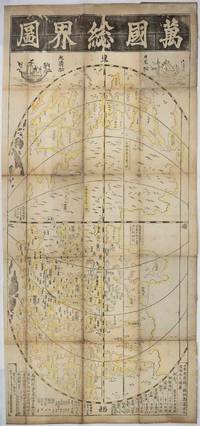
1708219243東京. Tokyo.: 須原屋茂兵衛. Suwaraya Mohei. Hoei 5 1708. Black and white woodblock map with yellow outlining in original hand colour 55.8 x 127cm map; 59.5 x 131cm sheet folding into the original Japanese wrappers chipped and rather worn 26.4 x 17.4cm the map with old repairs laid down on washi rather browned and wormed at the folds but with no serious loss the sheet age-toned and a little dusty but overall in remarkably good condition. Preserved in a modern blue linen Japanese case with toggle-closures. A famous woodblock-printed Japanese map of the world by renowned Edo Period map-maker Ishikawa Tomonobu who is also known as Ishikawa Ryūsen. This is a revised version of an earlier map produced by Ishikawa in 1688. <br> <br>The map appears to draw on Chinese and Portuguese geographical knowledge. The Chinese production of world maps had been transformed by the influence of the Italian Jesuit Matteo Ricci who collaborated with Chinese cartographers to produce a 1584 map of the world. In Japan the production of maps of "the myriad countries" or "the international countries" bankoku had been inspired by contact with Portuguese missionaries and with the Dutch in the 16th century. <br> <br>Ishikawa's map broadly resembles the Ricci map in being placed in an oval frame with the Pacific and thus also China and Japan at the centre. The content though is different. While Ricci's map is oriented to the north Ishikawa's is oriented to the east with America at the top of the page and the sketchy outlines of Europe including 'Ikiresu' England and a large and clearly marked Holland and Africa 'Kafuri' at the bottom. This orientation apparently influenced by the first world map in Japan "Bankoku Sōzu" 万国総図 which was published in 1645. Interestingly although Ishikawa had earlier produced a quite detailed and fairly accurate map of Japan the Japan shown on this world map is a rather loosely outlined collection of islands in which for example Ryūkyū the Ryukyu Kingdom now Okinawa and Hachijōjima appear much larger than they are in reality. Japan is also unusually oriented making it appear as though Ezo now Hokkaido is in the middle of the Pacific. It seems that the cartographer's interest here was less in outlining Japan in detail than in broadly setting out the country's place in relation to the land masses to the east and west. <br> <br>Like other Japanese world maps of the Edo period and like Ricci's map Ishikawa's image of the world includes imagined countries such as 'The Land of Giants". The continuing centrality of China in Japanese thought is indicated by the fact that Ishikawa's map contains a very clearly marked depiction of the Great Wall and that the map is decorated at the top with depictions of a Japanese and a Chinese sailing ship. The text at the bottom gives estimated distances between Hizen Province where the port of Nagasaki provided Japan's main official outlet to the world in this age of seclusion and various places in China and between Hizen and the Ryūkyū Kingdom. It also gives the estimated distance from Korea to Tsushima Island which served as Japan's gateway for diplomatic and trade relations with Korea. <br> <br>Engelbert Kaempfer a German physician and explorer brought back the 1688 edition of this map printing to Europe after his stay in Japan between 1690 and 1692. The map was introduced to European audiences in the 17th century and impacted on later European cartographic endeavours. <br> <br>Copies of this rare and historically significant map are held only in a handful of major collections: the British Library National Diet Library NDL of Japan the Staatsbibliothek of Berlin University of California Berkeley's Japanese Historic Maps Collection and the University of British Columbia. . 須原屋茂兵衛. [Suwaraya Mohei]. unknown
178025574Paris: D. Lothrop & Company. Very Good with No dust jacket as issued. 1780-1804. First Edition. Hardcover. Full leather is what appears to be contemporary bindings. The first 2 volumes have minor separations along the ends of the hinges. The Atlas volume is missing the title page and has numerous notations in the first maps in French. ; 8vo 8" - 9" tall . D. Lothrop & Company hardcover
1778AMO-4503A Paris, chez la veuve Duchesne, 1778 [de l'imprimerie de Claude Simon] [de l'imprimerie de Clousier]. 6 volumes in-8 (21,5 x 13,5 cm) de XVI-594, 600, 479, 462, 472 et 524-(3) pages. 1 portrait de l'auteur en frontispice et 2 figures d'après Marillier. Reliure de l'époque plein maroquin rouge à grain long, dos lisses richements ornés aux petits fers typiques de l'époque Directoire (1795-1799), pièces de titres (auteur et titre de chaque volume) en maroquin vert, roulette dorée en encadrement des plats et sur les coupes, doublures et gardes de papier marbré, encadrement intérieur de roulettes dorées, tranches dorées (reliure signée Bradel le Jeune, rue d'Ecosses, n°1, quartier Ste Geneviève, à Paris - avec son étiquette contrecollée au verso de la garde du premier volume). Impression sur papier fort à belles marges (grand papier). Excellent état de l'ensemble des volumes, reliures et intérieur. Très frais. Quelques infimes marques et ombres aux reliures qui sont néanmoins dans un splendide état de conservation.
1776601551 vol. in-12 reliure début XIXe demi-basane marbrée, Chez Demonville, Paris, 1776, 144-120pp. (avec deux pages de titres identiques pour les deux parties) avec une carte dépliante en couleurs (format 35 x 17 cm). Titre complet : Journal, dédié à Monsieur, Frère du Roi. Table Générale des Journaux anciens et modernes, Contenant les Jugements des Journalistes sur les principaux Ouvrages en tout genre ; Suivie d'Observations impartiales, & de Planches en taille-douce ou en couleurs. Septembre N° I : Tome Premier [ Avec : ] Septembre N° I : Tome Premier [ Edition originale ] [ With one of the earliest color printed maps of North America ]
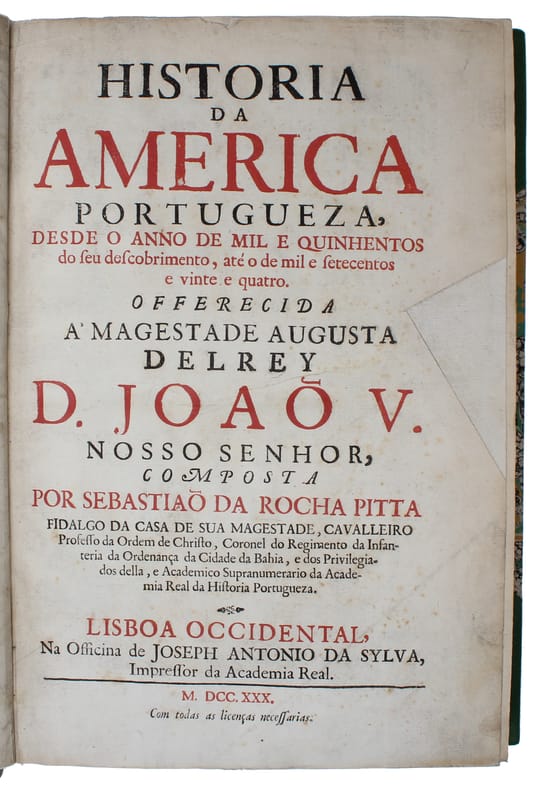
173060026Lisboa Occidental, na Officina de Joseph Antonio da Sylva, 1730. Folio (29 x 195 mm). In recent green half calf with five raised bands and gilt lettering and ornamentation to spine. Title-page mounted and with repair to outer margin, no loss of text. Last leaf with repair to lower outer corner, also with no loss of text. First and least few leaves with brownspotting. Very light browning in margins throughout. Title printed in red and black, woodcut initials and head-pieces. A fine and clean copy. (14), 716 pp. (Here with the often missing half title, but wanting the final blank).
173610314Paris, Imprimerie Royale, 1736-1770. 35 vol. in-4, veau blond, dos orné à nerfs, pièces de titre en maroquin rouge et de tomaison en maroquin olive, tranches rouges (reliure de l'époque).
179011124Paris, Desenne, 1790-1796. 10 tomes en 10 vol. in-8, demi-basane marbrée, dos lisse orné, pièce de titre en maroquin noir et de tomaison fauve, tranches rouges (reliure de l'époque).
175615777La Haye, Pierre de Hondt, 1756. In-4 de XVI-125-(3) pp., 1 frontispice et 39 planches numérotées en couleurs, veau porphyre, dos orné à nerfs, pièce de titre en maroquin brun, fleurons aux angles et triple filet doré d'encadrement sur les plats, gardes de papier dominoté doré, tranches dorées (reliure de l'époque).
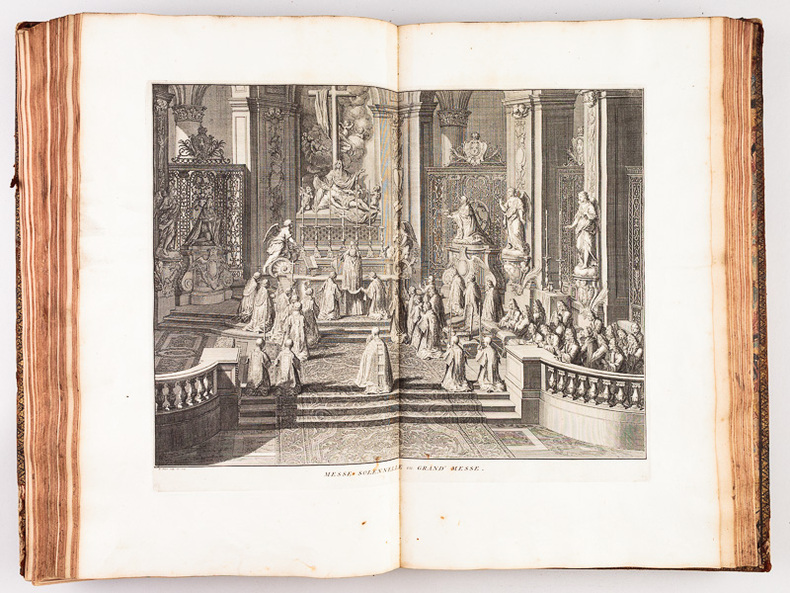
1723582957 vol. in-folio (45,4 x 28,5 cm en marges) reliure de l'époque plein veau marbré, dos à 6 nerfs ornés (différence entre les fers des 3 premiers volumes et des 4 derniers), A Amsterdam, 1723-1737, Tome I (Juifs et Chrétiens catholiques), 1723 : 1 f. blanc, 6 ff., XLVII pp., 4 ff., 66 pp., 1 f., 153-206 pp., 1 f. 1 f. blanc, avec 35 planches hors texte ; Tome II (Catholiques), 1723 : 2 ff., 197-104 pp. avec 27 planches hors texte ; Tome III (Cérémonies des peuples des Indes Occidentales), 1723 : 2 ff., 211-150 pp., 1 f., 1 f. blanc, avec 45 planches hors texte ; Tome IV (Des Peuples Idolâtres), 1728 : 2 ff., 386-38-84 pp. et 1 f. n. ch., avec 58 planches hors texte ; Tome V (Cérémonies des Grecs et des Protestants), 1733 : 396 pp. avec 15 planches hors texte ; Tome VI (Anglicans, Quakers, Anabaptistes), 1736 : 2 ff., 13-348 pp. et 1 f. n. ch. (carton en sus : pp. 187-188), avec 14 planches hors texte ; Tome VII (Mahométans) : 2 ff., 291-32-160 pp. avec 26 planches hors texte (dont la dernière rehaussée en couleurs)