Seton, Grace ThompsonBiblio.com

66 723 résultats
1925SB1943NY: Harper & Brothers Publishers 1925. Illustrated end pages. Textblock is clean and tight. Pink top edge. Moderately to heavily sunned edges and spine bumped corners overall light shelf wear. 370p. including appendix. Illustrated Gilt Cloth. Very Good. Illus. by Photographs. 8vo - over 7¾" - 9¾" tall. Hardcover. Harper & Brothers Publishers Hardcover
2008525542Hildesheim: GEBRUDER Gerstenberg 2008. Hardcover without dust jacket. Text in German. Minor wear and slight bumps to board corners and lower edges. A couple of small nicks to rear board. Ex-library with stamps/stickers to endpapers and to title page. Internally clean and bright binding sound and spine tight. AD. Hardcover. Good. Used. GEBRUDER Gerstenberg Hardcover
192153415Dublin: The Talbot Press. This is a Good Copy of this book in Publisher's blue cloth with black title lettering to spine.No dust-jacket.This copy has NO previous names or inscriptions present.The book has a firm binding with no hinge weakness and there is no leaning ro rolling to spine.There is some wear to cloth at base of spine and colour tone of the spine has now dulled down.This is a scarce title on Irish Nationalism and Sinn Fein and on the days of internment.Very Scarce title small 8vo 112pp First Edition . Good. Hardcover. First Edition. 1921. The Talbot Press hardcover
19985962945Oxford Clarendon Press 1998. This is an ex-library book and may have the usual library/used-book markings inside.This book has soft covers. Book contains pen markings. In poor condition suitable as a reading copy. Please note the Image in this listing is a stock photo and may not match the covers of the actual item600grams ISBN:9780198207375 Oxford Clarendon Press paperback
2013536098Leiden: Brill 2013. Hardcover without dust jacket in very good condition. Pencil marginalia from previous owner Prof Peter Edwards London Professor of British History evident throughout. The boards pages and text are otherwise clear and bright. Hardcover. Very Good/No Dust Jacket. Used. Brill Hardcover
20175561836Boydell Press 2017. This is an ex-library book and may have the usual library/used-book markings inside.This book has hardback covers. In good all round condition. Please note the Image in this listing is a stock photo and may not match the covers of the actual item650grams ISBN:9781783271801 Boydell Press hardcover
19839984763Humanities Press 1983. Volume 37. This is an ex-library book and may have the usual library/used-book markings inside.This book has hardback covers. In good all round condition. No dust jacket. Please note the Image in this listing is a stock photo and may not match the covers of the actual item600grams ISBN:0391029266 Humanities Press hardcover
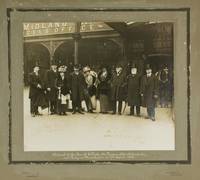
1913114191Manchester: Mack & Co. Photographers 1913. Very Good. Manchester Mack & Co. Photographers 1913. A gelatin silver photograph image size 240 × 283 mm on the original mount external dimensions 375 × 455 mm; the caption is in white ink in a calligraphic hand below the image; the details of the photographic studio are printed below an embossed printed border. The mount is a little rubbed and worn at the extremities with a small sealed crack to one margin; there is minor surface damage to the mount well clear of the image and caption where an old window mat has been removed; the photograph has a few tiny surface blemishes near the bottom edge but overall in excellent condition. At the time Archibald Henry Peake 1859-1920 was the Premier of South Australia a position he held on three occasions 1909-1910 1912-1915 and 1917-1920. He died in office on 6 April 1920. In 1912 'the Liberals won an eight-seat majority . Peake again became premier treasurer and minister of education. His government concentrated on constructing rural railway lines often against expert advice. Most proved uneconomic impoverishing the railways for years. In 1912 the government created the Industrial Arbitration Court; in return for the introduction by it of a minimum wage workers lost the right to strike or to engage in any activity which might prolong a strike. Six o'clock closing of hotels was carried at a plebiscite simultaneously with the 1915 election and remained for over fifty years. Peake's government liberalized the franchise for the Legislative Council. In London in 1913 Peake had an audience with King George V and recorded his experiences in "Notes from a Diary" 1914. The ministry's major achievement was its arrangement in 1914 with the Federal New South Wales and Victorian governments for the locking of the Murray River: the River Murray Commission carried out the co-ordinating agreement' 'Australian Dictionary of Biography'. The nature of this item and the fact that we purchased it with other photographs identified as such suggest strongly that it was originally in the possession of Peake himself. Mack & Co. [Photographers] unknown
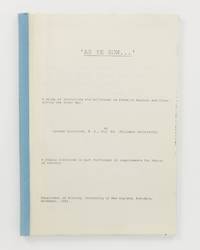
1995140223North Adelaide: The Author 1995. Very Good. North Adelaide The Author 1995. Foolscap folio v v 74 4 examiner's report pages of duplicated typescript with 18 xerographically reproduced illustrations. Quarter card and clear plastic covers; front cover and first leaf a little creased; an excellent copy. 'A thesis submitted in part fulfilment of requirements for Master of Letters. Department of History University of New England Armidale November 1993'. The Author unknown
106714The carte de visite an albumen paper photograph 55 x 91 mm was recently removed from an old album leaf and remounted on acid-free card; the title above was written in pencil on the verso of the image. The number '202' is pencilled on a fence-post in the foreground; in excellent condition. The photographer is unidentified; undated but possibly 1860s. unknown
20032509Routledge. 2003. Hardcover. Near Fine in Near Fine dust jacket. Minor bump to head of spine and along back edge else Fine. DJ has minor rubbing.; 0.65 x 9.76 x 6.28 Inches; 192 pages; Cities in the ancient world relied on private generosity to provide many basic amenities as well as expecting leading citizens to pay for 'bread and circuses' - free food and public entertainment. This collection of essays by leading scholars from the UK and USA explores the important phenomenon of benefaction and public patronage in Roman Italy. Ranging from the late republican period to the later Roman Empire the contributions cover a wide range of topics including the impact of benefactions and benefactors on the urban development of Roman Italy on cultural and economic activity and on the changing role of games and festivals in Roman society. They also explore the relationship between communities and their benefactors whether these were local notables senators or the emperor himself and examine how the nature of benefaction changed under the Empire. . 0415146895 . Routledge hardcover
20033484Routledge. 2003. Hardcover. Fine in Fine dust jacket. 0.65 x 9.76 x 6.28 Inches; 192 pages; Cities in the ancient world relied on private generosity to provide many basic amenities as well as expecting leading citizens to pay for 'bread and circuses' - free food and public entertainment. This collection of essays by leading scholars from the UK and USA explores the important phenomenon of benefaction and public patronage in Roman Italy. Ranging from the late republican period to the later Roman Empire the contributions cover a wide range of topics including the impact of benefactions and benefactors on the urban development of Roman Italy on cultural and economic activity and on the changing role of games and festivals in Roman society. They also explore the relationship between communities and their benefactors whether these were local notables senators or the emperor himself and examine how the nature of benefaction changed under the Empire. . 0415146895 . Routledge hardcover
102930Very Good. A vintage gelatin silver photograph matted glazed and framed visible image size 230 × 360 mm captioned and signed in pencil on the mat. The mat shows some acid discolouration and is a little foxed; the photograph and the original simple wooden frame are in excellent condition. Frederick Allen Joyner 1863-1945 was 'President of the South Australian Photographic Society at the height of its influence as a leading group in the fledgling nation and as an individual he had his own work shown and reproduced around the world. Later in the 1920s he was one of the first modern photographers to see and interpret the light and nuances of the Flinders Ranges' from the catalogue of the 1981 AGSA exhibition of F.A. Joyner's photographs. unknown
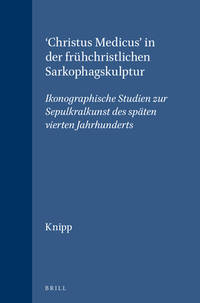
19982887Brill Academic Publishers. 1998. Hardcover. Fine in Fine dust jacket. Unwrapped in Plastic.; In German. This study deals with the representation of Christ's Healing Miracles in early Christian sepulchral art from Provence and Northern Italy. It sees the imagery through the contemporary exegetical writings and tries thus to uncover new strata of symbolic significance in early Christian art. The aim of the work is to reveal the complex theological concepts reflected in the relief decoration of a small number of late fourth-century sarcophagi and to cast thus light upon the spiritual climate of the sphere the persons who commissioned them were part of. It also links the narrative structure of representations of medical treatment and miracle scenes in ancient art with the Christian images and establishes new formal and iconographic connexions.; Vigiliae Christianae Supplements No 37; 0.86 x 9.64 x 6.52 Inches; 209 pages . 9004108629 . Brill Academic Publishers hardcover
19998694275Leicester University Press 1999. This is an ex-library book and may have the usual library/used-book markings inside.This book has hardback covers. In fair condition suitable as a study copy. No dust jacket. Please note the Image in this listing is a stock photo and may not match the covers of the actual item750grams ISBN:9780718500948 Leicester University Press hardcover
197619601AB1976. Kunsthalle Basel 1976 4° 42 S. mit s/w-Abbildungen und Illustrationen sowie sieben Seiten mit Werbeanzeigen Text zweisprachig: deutsch-englisch schliche graue original Kartonage Paperback mit schwarzer Deckelbeschriftung der Rücken und die Rückenkanten leicht aufgehellt sonst ein schönes sauberes Exemplar dieses frühen Katalogs. Abholung im Ladengeschäft in Frankfurt am Main Nordend ggü. Musterschule möglich. Das spart die Portokosten. Pickup at the store in Frankfurt am Main Nordend close to Musterschule is possible. It saves the shipping costs. paperback
20124323927Chinese University Press 2012. This is an ex-library book and may have the usual library/used-book markings inside.This book has hardback covers. In good all round condition. Dust jacket in fair condition. Please note the Image in this listing is a stock photo and may not match the covers of the actual item1100grams ISBN:9789629964450 Chinese University Press hardcover
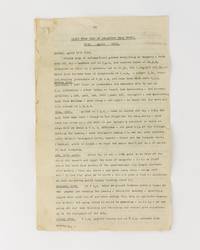
117286Foolscap folio 22 leaves rectos only with a few manuscript addenda and corrigenda; three horizontal creases where folded; small puncture from the original metal fastener to all top left-hand corners; last leaf heavily chipped around the edges with an old short tape repair; occasional chips to the edges of the other leaves; in very good condition and now housed in individual sheet protectors. Although this significant account is transcribed we can find no record that the original diary is held in any institutional collection or indeed that it survives. The Australian War Memorial has a small collection of material relating to the Boer War service of 'Captain Surgeon Frederick David Jermyn' including 'photocopied extracts from the hand written memoirs . describing his experiences as a medical officer . in the South African War' but merely notes that he 'served as a major in the Australian Army Medical Corp during the First World War. Suffering illness he was invalided to Australia in late 1916 read 1915 and his appointment terminated in early 1916'. Frederick David Jermyn 1866-1948 was a Mt Gambier general practitioner aged 49 when he embarked on HMAT A35 'Berrima' in December 1914. The transcript commences when they 'Struck Camp at Heliopolis' and marched to Cairo. The first five pages describe the not uneventful journey to Lemnos Island where in Mudros Bay they practised disembarking 'up and down rope pilot ladders in full landing kit. Great Coats - blankets 3 days iron rations - Haversack waterbottle - medical gear I tell you it is some job'. He notes that the 'attack on the Dardenelles sic is well planned and we have received our orders'. He discusses the plans and the orders at length: 'The 3 divisions of Stretcher Bearers & 9 Officers are to go ashore in the first flight absolutely . we'll go ashore and look after the wounded . There's no doubt it is going to be one of the solidest things in history'. Bad weather delays the landing but on the 24th he writes 'Tomorrow at Daybreak the British are to attack the point of the Peninsula around Cape Helles and we later in the day will land about 11 miles up or west of Gallipoli Peninsular sic - the British are to have the use of our pontoons for landing and we will be the only ship of the Australian and NZ Troops to see the Big Bombardment of the Main forts on the point'. Jermyn devotes two pages to his eye-witness account of the landing of the British 29th Division. The small advance party 'must have suffered fairly severely as testified by the heap of bodies which we saw lying on the Beach when the sun was up poor beggars and they lay there all day long - As the sun rose it was a beautiful sunrise a proper sunday morning - and then about 5.15 on this perfect morning all Hell broke loose - every battleship with guns trained on this point Cape Helles started fire'. It wasn't until 11.30 pm that his ship moved northwards. He was awakened a few hours later for his night shift as Orderly Officer: 'there was a fierce night attack by Turks on our men and rain was pelting down poor beggars the first night of their battle on the side of a cliff with rain and bullets pelting among them and been there ever since early morning but Hurrah for Australia's low boys I've studied them such in the last seven months they'll curse and booze and blaspheme to beat the Band they'll do any old thing but God they've got guts when the time arrives they stuck it and they fought back all through the night'. He landed later that evening the 27th but not before spending two hours in a lighter waiting for a naval pinnace a sitting duck for Turkish shrapnel shells. He then describes in horrific detail his work over the next few days in the Clearing Station on the beach. 'Friday 30th. Things just the same shell shrapnel and snipers summed up - it's "Hell" - every day there are casualties on the beach - men killed while working eating and sleeping - shells land right to the dugouts and men's heads are blown off - and abdomens disembowelled - Its awful and hideous life and if we didn't get enough work we'd go dippy I think. Saturday 1st May. Everything shot shell and Hell - I can't write about it its all beastly - I've had two friends brought down today who died at the Dressing Station - The Morphine Syringe is the most merciful thing here - and you bet the doses are large'. He writes a lot about sniping 'which is the bane of our existence . - the boys get an afternoon off and go off shooting snipers and by God when they get one he gets nothing. A party of 15 went out the other day after a sniper who had been doing us a lot of harm shooting from the back - they ran the swine down in a well made dugout - and he turned out to be one of our men who had enlisted in Australia - a foreigner of some kind - they shot him in the leg and then the whole bunch got in and cut him up with bayonets - I never saw a man in such a mess before'. The month of May contains more of the same broken by the Armistice on Monday 24th: 'We met the Turkish Doctors and Staff Officers and Medical fatigue parties. We made a line with flags midway between the trenches and they had to bury all on their side and we on ours . we were all quite friendly and swapped cigarettes etc some German Staff Officers were present they are the brutes I hate - the sights up there were appalling and revolting - I had never imagined anything like it' and he proceeds to give details. It 'was the most awful day I have ever put in - to search among a blackened decayed carcase sic for something to identify it by and then to find in some case it was a pal who had been full of life ten days or a fortnight before but it had to be done for the sake of those at home for to know a man is dead is far better for his relations than uncertainty'. The last entry is on Friday June 4th: 'They started off fresh today with shrapnel in the morning they made such a terrible welter on the beach that it reminded us of the first horrible week here. of course some of our birds had to be flash and go and have a wash during the slight lull in the shelling and in consequence three were wounded and one killed. That is the sort of thing that annoys me it really is so damn silly. Its not like a man being killed doing his job'. Jermyn survived the war; in fact shortly after he wrote this last entry he was admitted to hospital himself with glaucoma. He was invalided to Australia in September and his appointment terminated in early 1916. A small portrait photograph of Jermyn and two fellow-officers a modern reproduction is included. unknown
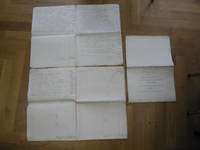
18019538AB1801. Unikate Frankfurt am Main Administration der Senckenbergische Stiftung 1801 1804 1804 Folio 12 4 12 nicht paginierte S. original handgeschriebene Bögen gute saubere Exemplare. Beiliegt die gedruckte 'Bilanz der Dr. Senckenbergischen Anatomie 1913/14' 1 Doppelblatt. Abholung im Ladengeschäft in Frankfurt am Main Nordend ggü. Musterschule möglich. Das spart die Portokosten. Pickup at the store in Frankfurt am Main Nordend close to Musterschule is possible. It saves the shipping costs. unknown
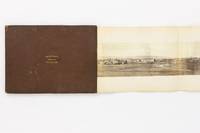
1866141595Adelaide: Townsend Duryea 1866. First Edition. Hardcover. Adelaide Townsend Duryea circa 1866. A photograph album 254 × 340 mm containing a magnificent panorama of Adelaide comprising five roughly uniform albumen paper photographs mounted as issued slightly overlapping to form a continuous image 124 × 880 mm on a linen-backed card mount 244 × 951 mm folded into three plus 12 albumen paper photographs nine of them around 130 × 200 mm or the reverse one 130 × 172 mm and the last two approximately 220 × 285 mm mounted on the rectos of stiff card leaves. Original russet pebble-grain cloth lettered in gilt on the front cover; cloth slightly flecked with minor wear to the extremities; endpapers foxed with slight loss to silverfish and the rear free endpaper is missing; leading edge ribbon ties appear never to have been inserted; mounts lightly cockled and occasionally lightly spotted and foxed; bottom margin of the final mount lightly stained with trifling loss to silverfish; minimal signs of age and use; overall a very pleasing copy with the photographs - and in particular the stunning panorama - in uniformly fine condition. The twelve individual photographs are captioned in pencil on the mounts: 'View in botanical gardens - showing Asylum' 'View in Botanical Gardens' 'View in Gardens' five captioned simply 'Botanical Gardens' 'Bridge between N & S Adelaide' 'near Willunga' and two captioned 'Willunga' both superb large-format prints. <p>New York-born Townsend Duryea 1823-1888 emigrated to Australia Melbourne in 1852 and commenced work as a photographer the following year. In 1855 he relocated his studio to Adelaide. By the early 1870s Duryea's panoramas royal portraits and prizes won in Society of Arts photographic competitions had made him famous 'Australian Dictionary of Biography'. Much more detail on Duryea may be had from the lengthy article in Joan Kerr's 'Dictionary of Australian Artists . to 1870'. However the panorama in this album is not the one described in Kerr 'a fold-out 360-degree panorama of Adelaide taken from the tower of Adelaide Town Hall in 1865 was the album's major feature' nor is it the larger panorama 'taken from the top of the GPO tower soon after it was completed in 1870'. The present panorama is taken from a local rise in North Adelaide and sweeps left to right from the hills towards the sea. All of these panoramas are very rare indeed not least because 'Duryea's studio and enormous collection of glass-plate negatives stated to number 50 000 were destroyed by fire in 1875'. This catastrophe effectively ended Duryea's career as a photographer. It must assuredly account for the genuine scarcity of material by Duryea on the open market other than bread-and-butter carte de visite portraits. <p>This album is very rare in our experience and if the available records are any guide for long before we came on the scene in the mid-1970s. Although this is the fourth example we have handled it is also only the fourth one we have seen on the open market in that time. We have inspected three other examples in institutions; all seven copies are bound similarly and contain the same panorama. However the balance of the contents varies in quantity and image selection in each instance. <p>Duryea began to advertise these albums in Adelaide newspapers in August 1866. One such from the 'South Australian Register' for 28 August 1866 reads: 'DURYEA'S VIEW ALBUMS. These Albums are neatly bound in cloth and form a beautiful acquisition either for the drawing-room table or transmission home. A PANORAMIC VIEW of the CITY of ADELAIDE and the SUBURBS three feet in length has been introduced as a Frontispiece; and as a further advantage purchasers have the privilege of choosing Photographs from a large Album containing 90 of the most interesting and picturesque Views of Adelaide and the Country. The above are open to the inspection of the public at Mr. Duryea's Studio 66 and 68 King William-street. Any of the Views mentioned above can be had separately. Photographs of Gentlemen's Country Seats Business Offices Shops &c. taken at the shortest notice by Ross's Improved Wide Angle Lens'. <p>Provenance: Edwin Ashby 1861-1941 South Australian property developer and naturalist; by descent. While Ashby was obviously not the first owner of this album its numerous images of the Botanical Gardens must have appealed to him. The fine gardens he established at his property 'Wittunga' at Blackwood in the Adelaide hills after the turn of the century were later donated to the State by his heirs and are now the Wittunga Botanic Garden. Townsend Duryea hardcover
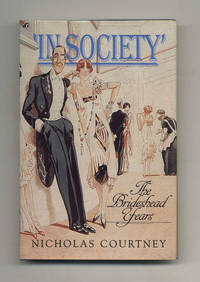
198650590London: Michael Joseph Limited. Very Good in Near Fine dust jacket. 1986. First Edition; First Printing. Hardcover. 0907516912 . An eye catching first edition/first printing in Very Good condition in Near Fine dust-jacket with light edgewear and sticker residue to rear; In Society the Brideshead Years Courtney tells the story of the social and romantic upheaval experienced by the Underwood family in the 1930s. The novel opens with the death of Lady Marchmain the matriarch of the Underwoods and her sons Hugh and Sebastian are thrust into a world of political intrigue and social change. As Hugh and Sebastian navigate their way through the challenges of their new lives they must deal with the consequences of their mother's death including the arrival of their new stepmother and the challenges of forming relationships with their new family and friends.; 8vo; 166 pages . Michael Joseph Limited hardcover
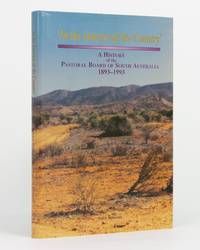
1995145280Adelaide: Pastoral Management Branch of the South Australian Department of Environment and Natural Resources 1995. First Edition. Hardcover. Fine/Fine. Adelaide Pastoral Management Branch of the South Australian Department of Environment and Natural Resources 1995. Octavo xii 236 pages with numerous illustrations. Papered boards; contemporary ownership details on the front free endpaper and title page; essentially a fine copy with the fine dustwrapper. Pastoral Management Branch of the South Australian Department of Environment and Natural Resources hardcover
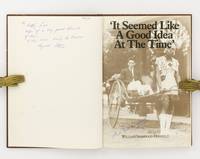
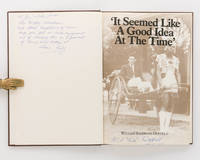
1988144166Mile End: The Author 1988. First Edition. Hardcover. Very Good. Mile End The Author 1988. Quarto ii 99 pages with numerous illustrations from photographs. Synthetic cloth a little flecked; an excellent copy. The title page is signed by the author; the verso of the front free endpaper is inscribed 'To Betty Lee Wife of a very good friend of mine A very nice lady to know Regards. Bill'. <p>The privately-published autobiography of a South Australian with a taste for adventure including travels in Africa and journeys by light aircraft in Australia. Bill Duffield died in 1989. The Author hardcover
1988117633Mile End: The Author 1988. First Edition. Hardcover. Fine. Mile End The Author 1988. Quarto ii 99 pages with numerous illustrations from photographs. Synthetic cloth; a fine copy. The privately-published autobiography of a South Australian with a taste for adventure including travels in Africa and journeys by light aircraft in Australia. The book is warmly inscribed in part 'Hope you get as much enjoyment out of reading this as I got out of living and writing it' and signed by the author who died in 1989; a small newspaper clipping of three short funeral notices is loosely inserted. The Author hardcover
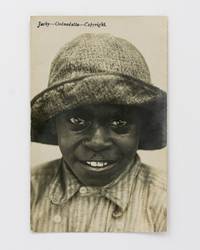
1900128025Unley: Chas P. Scott 1900. Very Good. Unley Chas P. Scott circa 1900s. A sepia-toned postcard-format gelatin silver photograph 138 × 87 mm blind-stamped with the photographer's details 'Chas P. Scott Unley S.A.'; the caption is inkstamped at the head of the recto and the verso is printed for use as a postcard. Tiny surface chip and crease to the top right-hand corner-tip; in excellent condition. Charles Scott 1878-1928 is 'Listed as photographer at 21A Waymouth Street Adelaide in directories from 1909 to 1915 his "private residence" being given as 10 Grace Street Goodwood Park' Photohistory SA website. The Art Gallery of SA gives the date '1903-04' for this image in its collection; this example with the address in Unley an Adelaide suburb near Goodwood Park would appear to have been produced prior to Scott's relocation to Waymouth Street. <p>The Adelaide 'Chronicle' for 8 September 1932 quotes a letter from F.W. Marsh formerly of Oodnadatta reminiscing about this portrait a copy of which hung 'in the strangers' room at Tattersalls Club. Well Jacky Rags when about three years old came with two other black boys early one morning to my place in Oodnadatta. When I asked what they wanted I was told that his father Charlie had killed his mother that night with a boomerang and that Jacky had come to me for protection. I kept him for a long time but when he was about 15 years old he was persuaded to ask me to allow him to go for a spell meaning he wanted to go to the camp in the bush. I let him go and later found that the older blacks had performed certain ceremonies on him from which he never recovered. He developed consumption and died a year or so later. I think living on the whites' food for so many years and then going to the bush where those to be initiated are starved until they are very weak so that the ceremony can be performed easily led to his early death. The name Jacky Rags was given him because whatever clothes he received in a day or two they would be in rags. He was a good lad'. Chas P. Scott unknown