The 71st RegimentBiblio.com
1 314 résultats
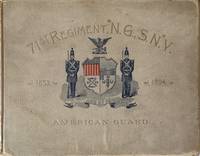
010294New York: The 71st Regiment 1894 First edition. Oblong 8vo; 108 pp.; illustrated from photographs. Owner's stamp to title page; wear to spine some staining and bubbling to rear board; else a good copy or better in original silver-stamped leatherette covers. A souvenir book commemorating the new armory at Fourth Ave. and 34th Street designed by John Thomas. With a history of the Regiment by the Rev. George R. van der Water a musical program advertisements etc. New York: The 71st Regiment, 1894 hardcover
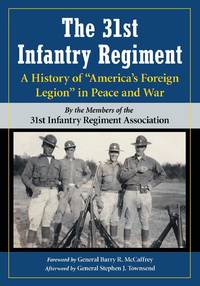
ria9781476669090_inpPaperback. New. New Book; Fast Shipping from UK; Not signed; Not First Edition; Formed in 1916 the U.S. Army 31st Infantry Regiment--known as the Polar Bears--has fought in virtually every war in modern American history. This richly illustrated chronicle of the regiment's century of combat service covers their ex paperback
194053679N. P.: Privately printed n. d. ca 1940. 1940. TEXAS WORLD WAR II. First edition. Stapled 6" x 9" brown printed wrappers with titles and unit insignia printed in black on the front and rear cover n. p. 39 pp. numerous illustrations from photographs. Camp Hulen was a military training camp near Palacios Texas operating from 1925 until 1946. At one time it supported the largest concentration of troops for field training in the U. S. military. In 1940 the War Department leased Camp Hulen from the Texas National Guard for antiaircraft training of National Guard units. At its peak the camp had facilities for 12000 military personnel. It continued as a training facility until 1944. The 197th Coast Artillery was one of these units. The oldest antiaircraft National Guard unit in the U.S. it was part of the New Hampshire National Guard. During World War II it was stationed in Australia as part of the defense against a feared Japanese invasion. This souvenir brochure shows group images of the various batteries making up the unit and its commanding officer. There are photographs of training exercises camp scenes recreation and social events including scenes from nearby Cuero and Palacious. Among the numerous images is a double page panoramic view of Camp Hulen in 1940. Also included is a history of the regiment and its unit. Very scarce with WorldCat locating only the copies at the United States War College and Yale. Faint evidence of a vertical crease to the front cover and minor wear to the top corner else a near fine copy of a scarce item. Privately printed, n. d. (ca 1940). unknown
2013066293Brockenhurst Hampshire: T.R. and L. Woods 2013. 1st Edition . Hardcover. New/New. Folio - over 12 - 15" tall. The second in the series concentrates on the insignia not previously covered in the Royal Hampshire Regiment and related military units in Hampshire and the Isle of Wight. Some 330 items of shoulder belt plates pouch plates waist belt clasps buttons and uniforms have been identified measured described and photographed for this book covering the period 1702-1995. <br/> <br/> T.R. and L. Woods hardcover
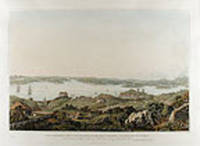
14758London: Alecto Editions and the State Library of New South Wales 1988. Originally engraved by Robert Havell and son printed by Edward Egerton-Williams in colours and finished by hand with printer's blindstamp. "By 1820 Sydney was a town of 12000 inhabitants about a third of whom were convicts. It had grown dramatically during the administration of Lachlan Macquarie who was appointed governor of New South Wales in 1810. Unlike previous governors Macquarie was not content merely to oversee a penal colony. His vigorous building programme changed forever the appearance of Sydney while his policy of accepting emancipated convicts as respected citizens demonstrated a social attitude strangely out of step with the times. Both these policies earned him criticism. In 1819 alarmed by Macquarie's extravagant public works the British Government commissioned a lawyer and civil servant J.T.Bigge to investigate. The attacks by his critics were met head on by Macquarrie's supporters in New South Wales. Books pamphlets and paintings luded the governor's undoubted achievements. Almost certainly Major Taylor's drawings were used in if not commissioned for this cause. The engraved view presents a flattering image of the Australian seat of government and by extension of Macquarie's term there.Taylor arranged the engraving and printing of the of the three sheet Panorama. upon his return to England in July 1822.Havell appears to have worked from Taylor's. large watercolours but amended them with additional details. and decorative elements.It is most fortuitous that the copper plates.have survived. There is no other example of such a case for 19th century Australian engravings. Alecto Editions and the State Library of New South Wales unknown
14891A fine pair of plates engraved by Robert Havell and son printed by Edward Egerton-Williams in colours and finished by hand each in very good condition "The Town of Sydney" with a slightly greyer paper tone. From an edition limited to 110 copies printed from the original printing plates in 1988 employing the same techniques as used in 1823. This fine edition was published as a collaborative effort between the State Library of New South Wales and the renowned fine art publishers Alecto Editions.<br/> <br/> "By 1820 Sydney was a town of 12000 inhabitants about a third of whom were convicts. It had grown dramatically during the administration of Lachlan Macquarie who was appointed governor of New South Wales in 1810. Unlike previous governors Macquarie was not content merely to oversee a penal colony. His vigorous building programme changed forever the appearance of Sydney while his policy of accepting emancipated convicts as respected citizens demonstrated a social attitude strangely out of step with the times. Both these policies earned him criticism. In 1819 alarmed by Macquarie's extravagant public works the British Government commissioned a lawyer and civil servant J.T.Bigge to investigate. The attacks by his critics were met head on by Macquarrie's supporters in New South Wales. Books pamphlets and paintings lauded the governor's undoubted achievements. Almost certainly Major Taylor's drawings were used in if not commissioned for this cause. The engraved views of the Panorama present a flattering image of the Australian seat of government and by extension of Macquarie's term there.Taylor arranged the engraving and printing of the of the three sheet Panorama. upon his return to England in July 1822.Havell appears to have worked from Taylor's. large watercolours but amended them with additional details. and decorative elements.It is most fortuitous that the copper plates.have survived. There is no other example of such a case for 19th century Australian engravings. unknown
14757Three plates engraved by Robert Havell and son printed by Edward Egerton-Williams in colours and finished by hand each with printer's blindstamp. From an edition limited to 110 copies printed from the original printing plates in 1988 employing the same techniques as used in 1823. This fine edition was published as a collaborative effort between the State Library of New South Wales and the renowned fine art publishers Alecto Editions.<br/> <br/> "By 1820 Sydney was a town of 12000 inhabitants about a third of whom were convicts. It had grown dramatically during the administration of Lachlan Macquarie who was appointed governor of New South Wales in 1810. Unlike previous governors Macquarie was not content merely to oversee a penal colony. His vigorous building programme changed forever the appearance of Sydney while his policy of accepting emancipated convicts as respected citizens demonstrated a social attitude strangely out of step with the times. Both these policies earned him criticism. In 1819 alarmed by Macquarie's extravagant public works the British Government commissioned a lawyer and civil servant J.T.Bigge to investigate. The attacks by his critics were met head on by Macquarrie's supporters in New South Wales. Books pamphlets and paintings luded the governor's undoubted achievements. Almost certainly Major Taylor's drawings were used in if not commissioned for this cause. The engraved views of the Panorama present a flattering image of the Australian seat of government and by extension of Macquarie's term there.Taylor arranged the engraving and printing of the of the three sheet Panorama. upon his return to England in July 1822.Havell appears to have worked from Taylor's. large watercolours but amended them with additional details. and decorative elements.It is most fortuitous that the copper plates.have survived. There is no other example of such a case for 19th century Australian engravings. unknown
198814758London: Alecto Editions and the State Library of New South Wales 1988. Originally engraved by Robert Havell and son printed by Edward Egerton-Williams in colours and finished by hand with printer's blindstamp. "By 1820 Sydney was a town of 12000 inhabitants about a third of whom were convicts. It had grown dramatically during the administration of Lachlan Macquarie who was appointed governor of New South Wales in 1810. Unlike previous governors Macquarie was not content merely to oversee a penal colony. His vigorous building programme changed forever the appearance of Sydney while his policy of accepting emancipated convicts as respected citizens demonstrated a social attitude strangely out of step with the times. Both these policies earned him criticism. In 1819 alarmed by Macquarie's extravagant public works the British Government commissioned a lawyer and civil servant J.T.Bigge to investigate. The attacks by his critics were met head on by Macquarrie's supporters in New South Wales. Books pamphlets and paintings luded the governor's undoubted achievements. Almost certainly Major Taylor's drawings were used in if not commissioned for this cause. The engraved view presents a flattering image of the Australian seat of government and by extension of Macquarie's term there.Taylor arranged the engraving and printing of the of the three sheet Panorama. upon his return to England in July 1822.Havell appears to have worked from Taylor's. large watercolours but amended them with additional details. and decorative elements.It is most fortuitous that the copper plates.have survived. There is no other example of such a case for 19th century Australian engravings. Alecto Editions and the State Library of New South Wales unknown books
14757Three plates engraved by Robert Havell and son printed by Edward Egerton-Williams in colours and finished by hand each with printer's blindstamp. From an edition limited to 110 copies printed from the original printing plates in 1988 employing the same techniques as used in 1823. This fine edition was published as a collaborative effort between the State Library of New South Wales and the renowned fine art publishers Alecto Editions.<br/> <br/>"By 1820 Sydney was a town of 12000 inhabitants about a third of whom were convicts. It had grown dramatically during the administration of Lachlan Macquarie who was appointed governor of New South Wales in 1810. Unlike previous governors Macquarie was not content merely to oversee a penal colony. His vigorous building programme changed forever the appearance of Sydney while his policy of accepting emancipated convicts as respected citizens demonstrated a social attitude strangely out of step with the times. Both these policies earned him criticism. In 1819 alarmed by Macquarie's extravagant public works the British Government commissioned a lawyer and civil servant J.T.Bigge to investigate. The attacks by his critics were met head on by Macquarrie's supporters in New South Wales. Books pamphlets and paintings luded the governor's undoubted achievements. Almost certainly Major Taylor's drawings were used in if not commissioned for this cause. The engraved views of the Panorama present a flattering image of the Australian seat of government and by extension of Macquarie's term there.Taylor arranged the engraving and printing of the of the three sheet Panorama. upon his return to England in July 1822.Havell appears to have worked from Taylor's. large watercolours but amended them with additional details. and decorative elements.It is most fortuitous that the copper plates.have survived. There is no other example of such a case for 19th century Australian engravings. unknown books
Edidions E.F.M. - 1989 - grand In-4 - Cartonnage éditeur sous jaquette (petit accroc) illustrée en couleurs - Illustrations NB ou couleurs, certaines PP - 190 pages - Bel exemplaire
22886Edidions E.F.M. - 1989 - grand In-4 - Cartonnage éditeur sous jaquette (petit accroc) illustrée en couleurs - Illustrations NB ou couleurs, certaines PP - 190 pages - Bel exemplaire
39913London W. Bulmer and Co. 1800 Hardcover book first edition 503 pages with engraving and maps- some folding as called for. Dedicated the the chairman of the east India Company. this lovely volume explores the history geography people and natural history of the country now referred to as Myanmar and formerly Burma. The author undertook a long and arduas journey throgh the country ending in 1795. a Very good copy bound in half-calf brown boards and marbled endpapers. all plates and maps are present as listed in the directions to the binder at the rear. Maps and plates have some light foxing. Fold-out map of the Irrawwady river has some perforations to the foldsalthough this is not serious. Other plates have light foxing and some margin stains but this does not affect the images. One page 288 has some margin notes and one page 157 has a short closed tear to edge. Previous owners contemporary signature to top of title page. Binding is lightly rubbed but firm and without splits. Pictures available. Please note this is a heavy volume and will require additional shipping charges. London, W. Bulmer and Co. 1800 hardcover
8vo., First Edition, with numerous plates; cloth, a near fine copy in unclipped dustwrapper. Contains many rare photographs drawn from the regimental museum.
8vo., First Edition, with coloured frontispiece, numerous plates in monochrome and endpaper maps; green cloth, upper board with regimental crest blocked in silver, gilt back, a near fine copy in price-clipped dustwrapper. A PRESENTATION COPY WITH SIGNED HOLOGRAPH INSCRIPTION BY THE CURATOR OF THE REGIMENTAL MUSEUM. Sutcliffe, p.212.
8vo., First Edition; original dark green cloth, upper board blocked with regimental crest in silver and red, boards lightly age-marked, backstrip faded and lightly pulled at head else a very good, bright, clean copy. Extremely scarce. Sutcliffe, p.464; White, p.205.
124 pages. Features: The All Canadian Route of '98; Regimental Depot; Regimental Band; First Battalion Report; Second Battalion Report; The Loyal Edmonton Regiment (3 PPCLI); 2551 PPCLI Cadet Corps; The Royal Green Jackets (The Rifle Brigade); CJATC Report; Mount Hamilton Gault; The Hamilton Gault Trophy; The End of an Era; Lt Col FD Farquar (In Memorium); and more. Gilt lettering and emblem upon forest green flexible cloth boards. Moderate wear. Unmarked. Book
139 pages. Features include: War in Italy, The Naviglio Canal; Regimental Depot; First Battalion; Second Battalion; The Loyal Edmonton Regiment (3 PPCLI); 2551 PPCLI Cadet Corps; The Royal Green Jackets (The Rifle Brigade); Canadian Forces Base Rivers; Brig WG Colquhoun (In Memorium); The US Army Command and General Staff College; The Queen's Commendation for Brave Conduct (Cpl Batiuk); PPCLI Association; and more. Unmarked. Moderate wear. Forest Green flexible green cloth boards decorated with gilt lettering and emblem. Nice copy. Book
192693241ABOldenburg, Stalling, 1926. Mit 1 Tafel, zahlr. Abb., 8 (tls. mehrf. gefalt.) Übersichtskarten u. 26 Kartenskizz. auf 26 Tafeln. 11, 304 S. OHPergament. - Erinnerungsblätter deutscher Regimenter, Bd. 190. - Gutes bis sehr gutes Ex.
2008007667US Army/Minneapolis Minnesota: 2nd Stryker Cavalry Regiment/Jostens Commercial Printing 2008. Hardcover. Fine/No Jacket. Folio - over 12" - 15" tall. 303pp.; HB blk.w/gilt-emboss cover; fine condition w/cleantight pgs. History & yearbook. color photos throughout. <br/> <br/> 2nd Stryker Cavalry Regiment/Jostens Commercial Printing hardcover
8vo., Second Impression, with plates and maps; black cloth, gilt back, a near fine copy in unclipped dustwrapper. Published in the same year as the first edition.
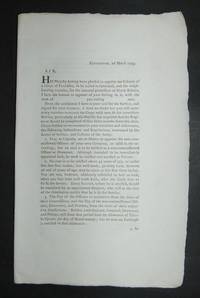
40454Edinburgh: n.p. 1793. Folio 340 x 215 mm 4pp. dated on p. 1: Edinburgh 2d March 1793 3 folded as issued uncut a fine copy. With reference to the "Grant Fencible Regiment" that is the Strathspey Regiment of Fencible Men instituted on 1 March 1793 and commanded by Sir James Grant The form of commission for a Captain in the Regiment with instructions on raising a Company which include "the Regiment should be completed within three months from this date. You as Captain are at liberty to appoint the non-commissioned Officers of your own Company. No man is to be inlisted above 45 years of age or under five feet four inches; but well made growing Lads between 16 and 18 years of age may be taken at five feet three inches. The Pay of the Officers to commence from the dates of their Commissions. each Serjeant Corporal Drummer and Private have an allowance of Three halfpence per day of Bread-money;. each Recruit must have the following articles viz Two Shirts; Two pair of Shoes Two pair fine Hose; A Bonnet and Feathers; A black Stock; A Haversack; all of which to be purchased out of his Bounty;. The Regiment is to serve in any part of Scotland but not to march out of it except in case of Invasion of the more Southern parts of the Kingdom." The British Library and National Library of Scotland copies only in the ESTC. [Edinburgh: n.p., 1793.] unknown
431 pages. Includes WWI and WWII Rolls of Honour, Honours & Awards, Index, fold-out maps, black and white photos. Gilt lettering and decoration upon publisher's handsome red cloth. "It was my great honour and privilege to have the Loyal Edmonton Regiment as one of the infantry battalions under my command in the Sicilian and Italian campaigns in World War II. The achievements of this great Canadian infantry regiment were built by the blood, sweat and tears of its officers and men in battle. Those who survived must ensure that these achievements endure, particularly for the people of the part of Canada to which the regiment belongs, and for succeeding generations of officers and men of the Regiment." - C. Vokes, Major-General. Small label removal blemish atop front free endpaper otherwise book clean, bright and unmarked with very light wear. Binding tight. Moderate wear to dust jacket now preserved in archival-grade Brodart. A high-quality copy of this proud record. DORNBUSCH 106A, COOKE [3E] p.210, STRATHERN 2757. Book
Roy. 4to., First Edition, with numerous photographs, maps and facsimiles in the text; original photographic wrappers, a near fine copy. Published in the 'Pals' series with statistics, rolls and other appendices. Sutcliffe, p. 349.
18778187Imprimeur C. Annoot-Braeckman 13,5 x 19,5 Gand 1877 Plaquette brochée, 87 pp. Planche dépliante in fine. Publication de la Revue Belge d'art et de sciences militaires. Couverture très piquée, mais bon intérieur, pages non coupées.(Home33)
18778187Imprimeur C. Annoot-Braeckman 13,5 x 19,5 Gand 1877 Plaquette brochée, 87 pp. Planche dépliante in fine. Publication de la Revue Belge d'art et de sciences militaires. Couverture très piquée, mais bon intérieur, pages non coupées.(Home33)