Shahar, GaliliAntiquariat.de

1 314 résultats
28599Göttingen : Wallstein Verlag [2016]. 254 Seiten : Illustrationen, Diagramme ; 22 cm Top Zustand, Broschur, Softcover/Paperback
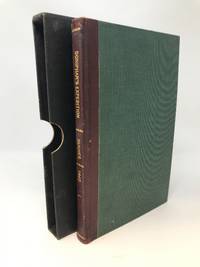
282 pages. Handsome bright gilt decoration upon front board. Gilt lettering upon backstrip clearly legible excepting a chip affecting three characters. Loss from top of backstrip. Prior owner's signature inside front board else unmarked. Narrow opening along back hinge. Average external wear. Additional photos available upon request. Book
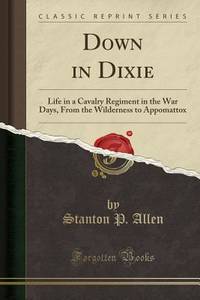
1241701873.Gpaperback. Good. Access codes and supplements are not guaranteed with used items. May be an ex-library book. paperback
193793219ABZeulenroda, Sporn, 1937. Mit Abb. auf 9 Tafeln, zahlr. Textill., 4 Karten u. 15 Skizzen auf 2 mehrf. gefalt. Tafeln. XII, 260 S. Blauer OLwd. m. goldgeprägt. Rt. u. Deckelillustr. - Aus Deutschlands großer Zeit, Bd. 96. - Gutes bis sehr gutes Ex.
193393226ABOldenburg, Stalling, 1933. Mit 80 Abb. a. Taf., zahlr. Textillustr. u. 45 Skizz. i. geklammerten Skizzenheft. 432 S. OLwd. m. goldgeprägt. Rt. u. Deckeltitel u. gr. gold-blau-schwarz geprägt. Deckelillustr. Erinnerungsblätter deutscher Regimenter : Truppenteile des ehemaligen preußischen Kontingents ; Bd. 355. - Ohne die Karte. - Gutes Ex.
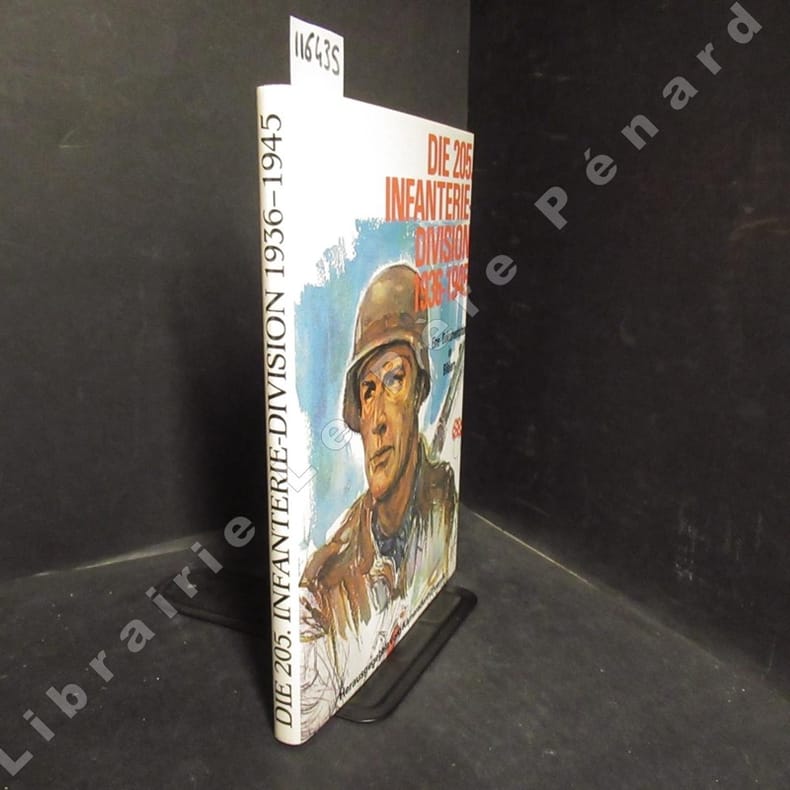
116435sd Editions Podzun Pallas - Sans date - Grand In-8, cartonnage toilé gris sous jaquette illustrée en couleurs de l'éditeur - 157 p. - Très riche iconographie hors texte en N&B - Ouvrage en allemand
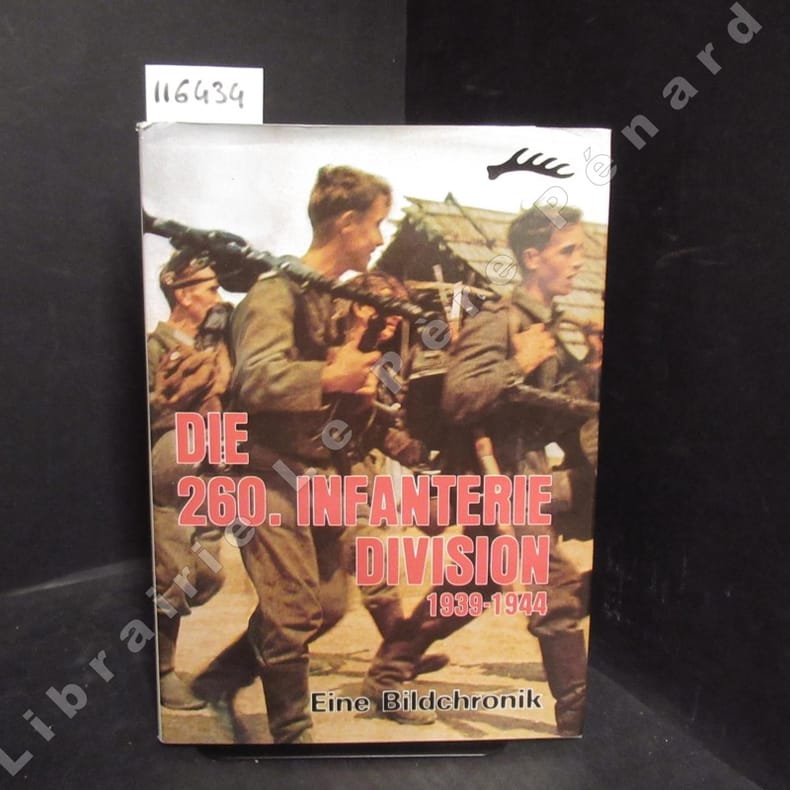
116434sd Editions Podzun Pallas - Sans date - Grand In-8, cartonnage toilé gris sous jaquette illustrée en couleurs de l'éditeur - 160 p. - Très riche iconographie hors texte en N&B - Ouvrage en allemand
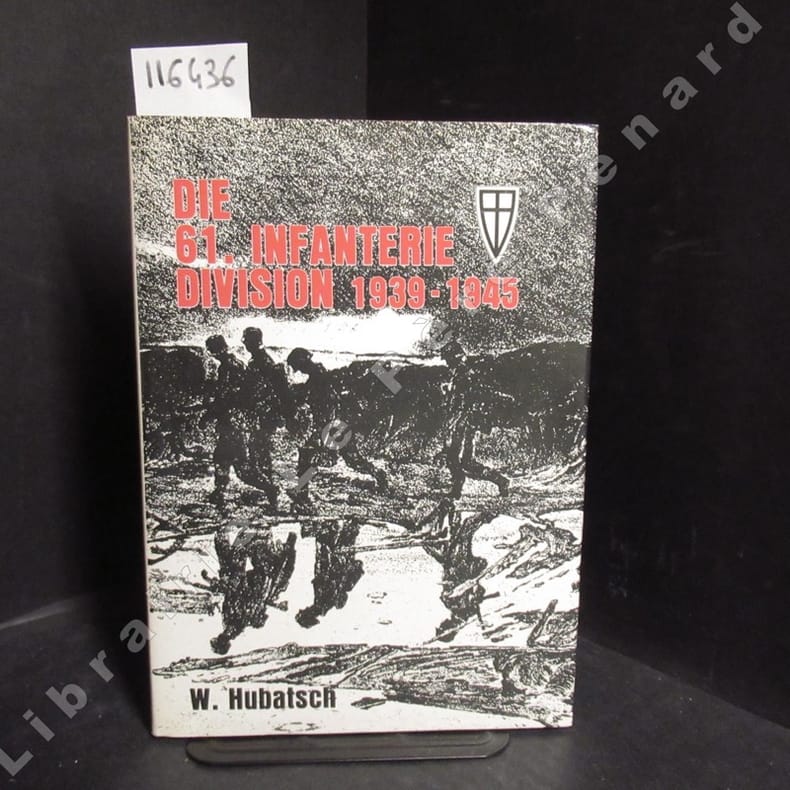
19831164361983 Editions Podzun Pallas - 1983 - Grand In-8, cartonnage toilé vert sous jaquette illustrée en N&B de l'éditeur - 160 p. - Très riche iconographie hors texte en N&B - Ouvrage en allemand
2g1833Mittler & Sohn Bln. 1903. VI/90 S. mit 6 altcolor. lithogr. Uniformtafeln 1 Karte 4 Skizzen u. 2 Marschkarten. original Halbleinen. Einband fleckig u. berieben/Widmung der Zeit auf Vorsatz. unknown
192431949ABBerlin, Morawe & Scheffelt, 1924. 8°, XXXII, 260 S. sowie einige Ausklapp-Tafeln mit Faksimiles auf dunklerem Papier, mit einem Seiden-Lesebändchen, original Halbpergamenteinband mit goldener Rückenbeschriftung und -verierung, 5. (und letzte) Auflage der Rücken unten mit dem Rest eines Signaturschildchens, innen auf der Rückseite der Titelseite ein schöner alter Rundstempel der Lehrerbibliothek eines alteingesessenen Frankfurter Gymnasiums, sonst ein altersgemäß schönes, sauberes Exemplar (L)
193493220ABZeulenroda, Sporn, 1934. Mit 142 Abb. auf Taf., 1 Federzeichnung u. 32 Skizzen in 1 Skizzenheft. 12, 288 S. Blauer OLwd. m. goldgeprägt. Rt. u. Deckelillustr. - Aus Deutschlands grosser Zeit, Heldentaten dt. Regimenter, Bd. 43. - StaV., S. X m. kl. hs. Notiz, gutes Ex.
200129805AUtting, Edition Dörfler im Nebel-Verlag (Archiv-Verlag), (2001). 4°. 160 Seiten. Mit 35 ganzseitigen farbigen Abbildungen von Kürassierern, Dragonern und Husaren. 1 Kartenskizze. Kunstlederband mit Kopfgoldschnitt. (Gutes Exemplar).
193857597BBStuttgart, Christain Belser Verlagsbuchhandlung, 1938. 4°. 31 cm. XVI, 839 Seiten. Grüner Original-Leinenband mit goldgeprägtem Rücken- und Deckeltitel und Original-Schutzumschlag.
23732sl,sd,sn,IN4 reliure pleine toile muette,imprimé à Paris septembre 1934 sur papier japon,signé (illisible),88 feuillet .+table+bibliographie,illustré de photographies originales,cartes et cartes postales ajoutées + le 1er regiment de Zouaves de 1830 à nos jours ,tapuscrit en bleu de 14 feuillets, chant illustré : au glorieux drapeau du 1er Zouaves Casablanca collé sur un feuillet,rare document historique
185479672Cincinnati: U.P. James 1854. Later printing. Hardcover. Good. Quarterbound buckram over leather spine with gilt lettering. Original Minor age-tanning and staining/tideline throughout and marginal spotting. viii 144 pages. With price of twenty-five cents printed at the top of front wrap. 13 illustrations. Text in double columns. Howes H-767. Graff: 2006. One of the later printings from earlier stereotype plates which had been retained Wagner Camp Becker 134 probably 1854 or after when the James brothers dissolved their business partnership. U.P. James hardcover
5107Verdun, Les Editions Lorraines Frémont, sans date, 3ème édition (1949 ?), broché, couverture illustrée, 13,5x21 cm, 159 pages. Une page d'avertissement de l'auteur (G.G. mars 1949) , note de l'auteur, 4 pages hors texte : Le Régiment d'Infanterie Coloniale du Maroc (Batailles, citations, décorations, Mémorial), préface du Lt-Colonel DOREY.
1333928041.Gpaperback. Good. Access codes and supplements are not guaranteed with used items. May be an ex-library book. paperback
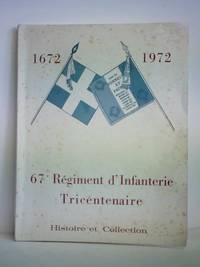
2i8099Eigenverlag ohne Ort 1972. 30 S. mit einigen eingeklebten Originalfotos kartoniert quart Einband fleckig/ganzseitige Widmung auf Vorsatz. - Typoskript / Texte et Collection de Monsieur Menuge-Crepeaux G. - Soissons / Text französisch - unknown
222 pages. Bibliography. Many black and white photographic plates. "The gripping story of how one man's half-century of service and devotion helped build and develop the Hastings & Prince Edward Regiment; and how that regiment played a vital role in Canada's efforts during the Second World War. Moderate wear. Clean and unmarked. A quality copy. Book
206471s.l.n.d. (1790) in-8, 8 pp., broché, sous couverture d'attente orange.
1723910819CGBerlin:, Königl. Preuiß. Hof-Buchdr. Gotthard Schlechtiger, 1723. 33 x 39 cm, gefaltet. [2 Warenabbildungen]
17022The account of 'Events in 1855 and 1856' dated by Wrench from Park Lodge Baslow Derbyshire 1902. The duplicated letter dated 12 December 1880. The printed advertisement for talk at the School Baslow and dated 14 January 1881. Wrench was the son of a clergyman and well connected being presented to the Prince of Wales and staying at Chatsworth in his old age. His obituary in the British Medical Journal 27 April 1812 describes how he went out to the Crimea in 1854. 'He had been gazetted Assistant Surgeon to the 34th Regiment in November and joined it on its arrival in the Crimea. He served during the terrible winter of that year and was present at the capture of the quarries the successful assault on the Redan of June 18th and the final capture of Sebastopol on September 8th 1855. He was mentioned in despatches and received the Crimean medal and clasp for Sebastopol and the Turkish medal.' Wrench's own account of his experiences in the Crimea Item One below – entirely unpublished – is a personal one vividly-written and full of detail. It does not appear to be present in the collection of his family papers at Nottingham University Library. ONE: Manuscript consisting of 'Events in 1855' 4pp and '1856 12pp making a total of 16pp. 8vo on twelve leaves attached with a stud. In good condition on aged and dogeared paper. The first page of the 1855 manuscript is headed '12 sic Pages in this Year' but comprises four numbered pages. The beginning of account sets the scene and gives an indication of the level of detail: 'The 1st Janry found me doing duty with the 28th Foot or Slashers in the 3rd. Divt of the army before Sebastopol having landed at Balaclava from the Ship "Queen of the South" on the 20th. Nov. 1854. On the 6th July I was ordered to do duty with the 50th. Foot but as I did not wish to move the weather being very bad and my tent being as comfortable or rather as little uncomfortable as it could be made except to join my own Regt. the 34th. to which I had been gazetted on the 1st. of December 1854. I applied to be sent to it and was ordered to join which I did on 9th of Janry.' The account is made up from diary entries and is none the less vivid and interesting for that: 'On the following morning a wounded Russian named Alexo was brought into our Hospital and we amputated his leg he did really well and was eventually exchanged at Odessa. Poor Jordan's death threw a great damp on the Regiment as he was the first Officer we had had killed. On the 9th. of April being Easter Monday the 2nd. Bombardment took place. It was a fearfully wet windy day so that no one was able to go out to see what damage was done. On the 10th. I was on trenches and the noise was terrific but nothing to what I have since heard. I had a very narrow escape from a round shot which hopped over the parapet close to where I was.' In June 'after 68 hours bombardment an assault was made on the Quarries by ourselves . I did not go down till about 8 with Robinson Scott & Peel and 100 men. We were marching about the Trenches half the night and were finally sent to the middle ravine just below Mamelon. The scene there was most horrible the ground being strewn with dead & wounded. English French & Russians. One poor Russian boy was dragged up by two Zouaves but fainted just opposite to where we were lying. I got a light and found he was shot through the belly and that nothing could be done for him. I gave him some water and he lie sic by me some time but died before morning. I got an amulet off his neck & his cap pouch which I sent home'. The 1856 account begins in dramatic style: 'The first entry in this Diary relates to the explosion which took place within the British Lines during the Siege of Sebastopol. Feb 3rd. I was not many hundred yards from this explosion when it took place & will here relate now Janry 1900 my recollection of it. It took place in Novr. or Decr. 1855. I had just come in from a ride & had given my horse to my Batman when I noticed a vast cloud of smoke shoot up from the Right Siege train an open air arsenal about 500 yds from my house - a tremendous noise of explosion followed & knowing that there would be a rain of missiles from above to fall immediately I jumped under my doorway - hoping the strong lintel would protect me . a shower of fragments fell around me rattling on my iron roof - and wounding many men in the Regiment - 70 men were killed by the explosion some over half a mile off. The artillery horses were passing in front of my door to water & stampeded hurting several men in their rush. Both my horse and my dog bolted. I got the horse back in a few hours - but my dog taken sic a few weeks before out of Sebastopol returned to her old home and was found there weeks afterwards I brought her to England My house that I had just finished building myself did not sustain much damage. .' The account continues packed with incident. At one point he writes: 'I had written the above in 1859 and continue it forty one years after November 4 1900. The events & fights of May 1856 being written so legibly in my brain that I can read much of what we did & said. Alas all the actors except myself are passed away. My notice has been called to the excursion by reading an Illustrated article in a magazine named "Travel" in which Dr. Hy. Lansell has been describing a tour taken last year over the same ground - so little altered from what I saw in 1856 that his description would do for mine'. The diary concludes in fine style. On 2 May 1856 he goes to Yalta where he finds 'the daughters of the English Clerk of the Works of Prince W's Palace were keeping the Hotel a very rough primitive structure low stone built rooms with a long rough wooden verandah overlooking the lovely Bay - We enjoyed an excellent dinner of Turbot & Oyster Sauce & a bottle of excellent local wine like Hock - as we returned we went over the Emperor's Villa Orianda . One day when I remember seeing for the first time a Persian horizontal Water Wheel in a very pretty village embosomed in Walnut Trees where also I bought an embroidered linen neck scarf which I still possess - On another occasion I accompanied Best & Chapman to the Alma & where I picked up the Russian Cannon Ball now on top of the Study Clock - I tried hard to get someone to accompany me to Bagshi Serai & Chuphut Kale but I had to go alone - I wonder now how I dare. For it was in the heart of the Enemies Country. I remember the Priest spit when I went near them in the Church in the Rock and I rode home at night through the Russian Camp on the river Balbec. I certainly felt no fear but that was the Ignorance of youth'. A final note more than half a page long records a meeting at Chatsworth in 1902 with Grand Duke Michael and his wife the Countess Torby. TWO: Duplicated letter by Wrench a hectograph in purple ink intended for circulation among his 'dear children'. 4pp. 12mo. Bifolium. In fair condition on aged and lightly-creased paper. Signed 'E. M. Wrench'. At the beginning is a half-page drawing by Wrench captioned 'Russian Soldier - In the Valley of the Shadow of Death. near Sebastopol - 1855 on Black Sea in the distance'. He describes a lecture he gave at Bakewell the previous Monday on the Siege of Sebastopol beginning 'I began by describing the terrible state of the hospital at Balaclava in November 1854. I had a ward full of wounded from Inkerman with bad cases of fever & cholera - All the windows had been blown out by the great storm of November the 14th. The sick had no beds and often nothing to eat until 3 or 4 oclock in the afternoon. The harbour of Balaclava was crowded with steamers while the coast near was strewn with the wrecks of the 21 ships that had gone down in the storm. .' The letter continues with much valuable detail and a drawing of a 'Section of "sunk" tent with fire place' on the third page. In the final paragraph he reports that 'Lord Edward Cavendish M.P. took the chair at my lecture. The room was quite full and some of the audience had come 8 or 10 miles to hear me.' THREE: Printed handbill advertisement with duplicated illustration another purple hectograph by Wrench on reverse joke featuring two soldiers and a horse and cart. 1p. 12mo. In good condition on lightly-aged paper. The printed advertisement is crisply printed and the date '14th' is added in red ink. It reads: 'A Lecture will be delivered in the School Baslow On Friday January 14th. 1881 At 7.30 p.m. By E. M. Wrench F.R.G.S. entitled Personal recollections of the Siege of Sebastopol. Illustrated by Drawings &c. Admission One Penny. No Change given at the Door.' The account of 'Events in 1855 [and 1856]' dated by Wrench from Park Lodge, Baslow [Derbyshire], 1902. The duplicated letter dat unknown
17021Two duplicate letters one dated from Park Lodge Baslow Derbyshire on 23 December 1907 and 'Christmas 1907'; and the other from the same place 'Aug 1909' and 13 September 1909. Third duplicate and typescript without place or date. Wrench was the son of a clergyman and well educated and well connected being presented to the Prince of Wales and staying at Chatsworth in his old age. His obituary in the British Medical Journal 27 April 1912 describes how after service in the Crimea 'he was transferred to the 4th Lancers went to Madras with that regiment in the following month and served with it during the whole of the Indian Mutiny. For his services in India he received the Indian medal and clasp for Central India. He returned to England in 1860 and married in 1861 his cousin the daughter of Mr. William Kirke of Markham Hall Nottinghamshire'. The four items in the present collection are all in good condition on lightly-aged paper. The three duplicates - all closely and neatly written in a vivid and informative style - are among ones produced by Wrench for circulation within his family there being copies in the collection of Wrench papers in Nottingham University Library. They comprise two letters and a narrative account. The typescript by an unnamed individual is not present at Nottingham. None of the four items is in the Imperial War Museum catalogue. ONE: Duplicate of Autograph Letter by Wrench 'Edwd M Wrench M.V.O - F.R.C.S. late asst Sugeon 12 R Lancers'. Dated at beginning 23 December 1907 and at end 'Christmas 1907 - Park Lodge Baslow Derbyshire'. The letter describes the 'Jubilee commemoration' at the Royal Albert Hall and is headed 'My last Parade'. It begins: 'It was indeed well done The dinner to the surviving Veterans who fought in the Indian Mutiny campaign in 1857 given by the proprietors of the London Daily Telegraph a procession of heart stirring episodes from the Inspection by F.M. Lord Roberts on the steps of the Albert Memorial where I found private Meredith of the 24th who was with me in the trenches at the assault on the Redan Sebastopol June 18 1855 to the surging chorus by the thousands in the Albert Hall of Auld Lang Syne near the end of what Lord Curzon in his thrilling speech said was a "ceremony" rather than a festival a speech that made the tears tremble on my eyelids. They overflowed at the solemn sounding of the "last post" recalling to my memory in the words of the poet O Hara a charge of the 12th Lancers I rode with at the battle of Banda .'. He names others present including 'Col Robertson . he was still the bravest of the brave for though 86 he was in velvet Levee dress silk stockings & pumps without a great coat. He told me he was a teetotaller his picturesque appearance attracted Lord Roberts eye and drew a heavy fire on us not of rifles but of snap shot cameras the result of which has been my portrait in such good company scattered by the hundreds of thousands in The Daily Mirror of Decr 24 . I have looked down the barrel of a loaded musket near enough to see a Sepoys yellow eyes taking aim at the butt end and ridden with cannon balls hopping over my head like balls in a cricket ground I cannot compare my perils during the Sepoy Mutiny to many others of the Kirke family'. 2pp. 8vo. TWO: Duplicate of Autograph Letter by Wrench 'Ed M Wrench'. Dated at beginning 'Park Lodge Baslow Aug 1909' and at end 13 September 1909. 3pp. 8vo. The letter begins: 'Having recently discovered that General W A Franks Major-General William Astell Franks 1838-1929 now living at Northland Road Southampton was present when Uncle Henry Kirke died when fleeing from the Mutineers of his Regt. 12 BNI in 1857 I took the liberty of writing to him he very kindly responded to my enquiries & I feel sure the information he has afforded will be interesting adding much to our scanty knowledge of that terrible time.' There follow extended transcriptions from Franks's letters: '. I saw him the day he died . he was on his horse but rolling about on it . he looked at me with a vacant stare & was deadly pale. I could see he was dying. Shortly after he fell off his horse he was the only one of our party that was buried all the rest being left where they fell .'. Of his own activities Wrench notes: 'I had gone to India almost direct from the Crimea in the year previous 1856. I was assistant Surgeon in the 12th Lancers so was never in the same danger as the Officers of the Native Regiments though I had my share of dangers . and had men blown to pieces by shell not a dozen yards from me . We went not as is said to revenge the Mutiny but to protect the loyal natives of which there were many & restore order yet in one battle we killed 500 rebels and looted two Palaces from one at Kabula we took 40 cart loads of gold & silver; my share of which was £750 . 0 . 0 so I have no personal grievance'. He continues with reference to the Battle of Banda and 'hunting rebels in the jungles'. THREE: Narrative account titled 'Cousin Henry Kirkes story of his escape from Mutineers June 1857'. The account begins: 'In 1857 Uncle Henry was commanding the Head Quarters of the 12th Bengal N.I. at Nowgong now spelt Naogaon Aunt Kirke Henry & St George were with him - He greatly distrusted the Sepoys and when he heard of the mutiny at Barrackpoor in April he immediately sent Aunt & St George off to the Hills just in time for they left Meerut only two days before the fatal 10 May'. A gripping account follows filled with incident: '. At the beginning of June Uncle heard that the left wing of his regiment stationed at Jhansi about sixty miles distant had killed the officers and all the Christian women and children there; Uncle forthwith ordered a parade and addressed the men. He told them of the mutiny of their comrades at Jhansi and added "Now I will let any man that wishes go and join the mutineers but let those who are true come and swear by the Colours". The whole 500 cheered and swore they would be true to him and the Colours. Two days afterwards they broke out into open mutiny shot the Regtl. Sergeant Major and made the officers fly for their lives. . The Europeans ten officers two ladies riding on Uncle's charger and a baby that Henry carried in front with a man riding behind him started for Banda. They asked a Brahmin the way he refused unless they gave him a rupee this Henry did when he ran off demanding another and swore by his gods that if given this he would be faithful but having got it he called to some villagers to come and kill the Faringhees for they had lots of money and so they would be rich for life. Some of the officers wished to shoot the man but Henry dissuaded them but presently the ruffian threw his lathi or club at the ladies horse which reared and they fell off. The man ran forward to kill them when Henry shot him through the back of the head he fell on his face. The villagers turned the dead man over and the two rupees fell out of his mouth when Henry heard them say "It is true they are rich for see they have loaded their guns with rupees". .'. 3pp. 8vo. FOUR: Mimeographed typescript titled '"Not to Revenge but to Protect."' 18pp. 8vo. Containing a transcriptions of Item One pp.16-18 and Item Three pp.4-9 and of passages from Item Two pp.13-15 with a commentary by a knowledgeable but unrelated party. Two duplicate letters, one dated from Park Lodge, Baslow, Derbyshire, on 23 December 1907 (and 'Christmas 1907'); and the other unknown
193636076Madrid 1936.- Una enorme hoja de papel couchet en Gran folio Imperial 62 x 104 cm. con el texto bilingüe español-francés profusamente ilustrada por ambas caras con fotografías en negro y que muestran los diversos daños causados a la población civil por los ataques de aviones enemigos sobre el barrio de Tetuán de las Victorias.- Buen estado en general algo debilitada por la parte de las dobleces. GUERRA CIVIL 1936-1939 Y EXILIO Libro en español Sin editorial paperback
193636075Madrid 1936.- 1 hoja en papel couché de Gran Folio Imperial apaisado 325 x 73 cm. con texto trilingüe español-francés-inglés profusamente ilustrada en sus dos caras con fotografías de Museo del Prado en las que se aprecia toda la destrucción que causaron los ataques llevados a cabo sobre Madrid el 16 de Noviembre entre 7 y 8 de la tarde.- Lleva noticia del entonces subdirector del Museo F. S. Sánchez Cantón y artículo del poeta Antonio Machado. Está en buenas condiciones aunque se han restaurado rajitas de las dobleces. GUERRA CIVIL 1936-1939 Y EXILIO Libro en español Sin editorial paperback