CIVIL WARABAA
1 575 résultats
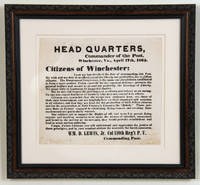
186222128<p>Broadside describing the first occupation of Winchester Virginia during the Civil War.</p> <b>CIVIL WAR.</b>Broadside signed in type by Colonel William D. Lewis Winchester Virginia April 17 1862 1 p. 12½ x 11 in.<p><b>Partial Transcript</b></p><p><i>"HEAD QUARTERS </i></p><p><i>Commander of the Post </i></p><p><i>Winchester Va. April 17 1862. </i></p><p><i>CITIZENS OF WINCHESTER: </i></p><p><i>Upon me has devolved the duty of commanding this Post. My wish and my duty is to afford you all the </i>liberty<i> and </i>protection<i> due to </i>fellow citizens<i>. The </i>Government<i> I represent is </i>the same our forefathers established <i>to form a more perfect </i>Union<i>. . . promote the </i>general welfare<i> and secure to </i>us and our posterity<i> the blessing of </i>Liberty<i>. We mean truly to represent its impartial </i>Justice.</p><p><i>But no one can expect the privileges of a </i>citizen<i> and behave as an </i>enemy<i>. No one can expect kindness . . . who does not extend it to others. </i></p><p><i>Citizens are reminded that the troops now stationed here are those of </i>their own Government<i> and are </i>lawfully<i> here on their </i>country's soil<i>. . . they are here for the </i>protection<i>of their fellow citizens and for the prosecution of their Country's Enemies the 'Rebels.' Those persons Male or Female engaged in circulating flying rumors and creating false excitements are particularly warned. </i></p><p><i>Our soldiers are to support the </i>Rights of all<i> and were I to permit flying reports and insulting remarks to be made the means of mischief annoyance and insult to the service or its servants they would provoke retaliations and lead to much useless suffering. </i></p><p><i>I trust Fellow Citizens you will understand and appreciate the justice of these principles and by your conduct obviate the necessity for harsh measures"</i></p><p><b>Historical Background</b></p><p>Colonel William D. Lewis issues a warning to the citizens of Winchester Virginia imploring them to submit to his occupation or face <i>"harsh measures."</i> This was the first official occupation of a town that would change hands nearly seventy times during the war. Union General Nathaniel Banks entered the Shenandoah Valley in March 1862 occupied Winchester on March 12 and defeated the Confederates at the battle of Kernstown on March 23. On May 25 Union forces were defeated by Stonewall Jackson at the first battle of Winchester and forced to withdraw from the town towards Harper's Ferry thus ending the first Federal occupation of Winchester.</p><p><b>Condition</b></p><p>Very good</p> books
148392First Edition. hardcover. liii 214pp. 12mo orig. cloth; spine worn and repaired edges of corners worn light foxing to some margins. Washington: GPO 1864.<br/><br/> unknown books
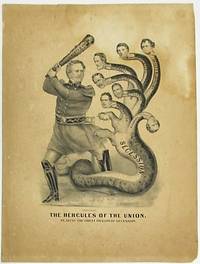
186134445New York: Currier & Ives 1861. Lithograph 13-1/2" x 18". Paper browned but images clear. Short closed tear at top blank margin minor chipping to two corners. Very Good.<br/><br/> "A tribute to commander of the Union forces Gen. Winfield Scott shown as the mythical Hercules slaying the many-headed dragon or hydra here symbolizing the secession of the Confederate states. At left stands Scott wielding a great club 'Liberty and Union' about to strike the beast. The hydra has seven heads each representing a prominent Southern leader. The neck of each Southerner depicted is labeled with a vice or crime associated with him" Reilly. The Southerners are Toombs Stephens Davis Beauregard Twiggs Pickens and Floyd labeled variously as Hatred and Blasphemy Lying Piracy Perjury Treason Extortion Robbery. According to Weitenkampf a variant omits the name of Scott in the title.<br/>Reilly 1861-35. Weitenkampf 131 7 locations. OCLC 191119921 3- AAS Peabody Essex Boston Athenaeum as of December 2017. Currier & Ives? unknown books
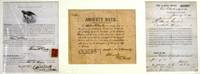
25188Partly printed documents completed in manuscript varying sizes measuring in the range of 7-7.5" x 9-9.75". Matted and mounted behind glass in a 17" x 34" gilt decorative frame. Very Good.<br/><br/> Former Confederates were required to sign oaths of loyalty before regaining citizenship and voting rights. The language of these three oaths differs slightly but each requires the signer to "defend the Constitution of the United States" particularly in reference to the emancipation of slaves.<br/> Davis's oath taken in the District of Columbia is printed at page 105 of Stanley Turkel's book "Heroes of the American Reconstruction" 2005. Davis's background and State of residence are not disclosed. Arthur McMurtry was a corporal in the 26th Texas Cavalry. He is listed in the 1870 Federal Census and two later Galveston directories 1888-1891 as a bookkeeper. Cousinard was mayor of East Baton Rouge from 1857-1859. He enlisted with Company B of the 9th Battalion Louisiana Infantry in 1862. After signing his amnesty oath he became sheriff of East Baton Rouge on May 11 1864.<br/> Arthur McMurtry is distantly related to Pulitzer Prize winner Larry McMurtry: his great-grandfather John McMurtry 1748-1790 was the brother of Larry McMurtry's great-great-great-great-grandfather Samuel McMurtry 1744-1796. Lineage determined using several family trees on Ancestry web site and cross-referencing with Federal Censuses death records and information found on the Texas State Cemetery website. unknown books
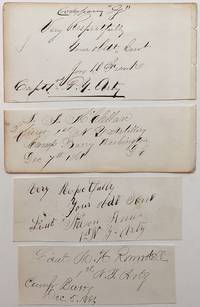
1861267089New York 1861. unbound. Excellent group of signatures with rank and command on various sized paper the largest measuring 2.5 x 5 inches comprising the earliest known autographs of the founding three officers of Battery G First New York Light Artillery along with the last Captain to take command through attrition. Includes: J.D. Frank "Very respectfully - Your Obdt. Servt. - Captain 1st N.Y. Artillery"; M.H. Rundell "Lieutenant - 1st N.Y. Artillery - Camp Barry - Dec. 5th 1861"; Nelson Ames "Lieutenant - Very Respectfully - Your Obdt. Servt. - 1st N.Y. Artillery" and S.A. McClellan "2nd Lieutenant - 1st N.Y. Artillery %u2013 Camp Barry - Washington D.C. - December 7th 1861." Battery G was engaged with the enemy in every battle the Second Army Corps participated in during the war and never was driven by the enemy's fire from a position it was ordered to hold. They also hold the distinction of never falling back until ordered and never losing a gun or carriage of any kind during its term of service. This is an almost impossible-to-assemble group of signatures that are all boldly signed and in very good condition.<br/><br/> Battery G First New York Light Artillery: Originating from New York they distinguished themselves at Gettysburg whereby a monument was erected and dedicated in their honor on July 3 1893. First recruited at Mexico Oswego County New York in September 1861. It joined the regiment at the general rendezvous at Elmira and was there mustered into United States service for three years September 24 1861 with the following officers: Captain J.D. Black First Lieutenant Nelson Ames Second Lieutenant Marshall H. Rundell. The battery remained at Elmira engaged in drilling with the rest of the regiment for a short time and then went by rail to Washington D.C. arriving on October 31. On January 13 1863 Captain J.D. Frank left the battery on sick leave and was shortly afterwards discharged on surgeons certificate. First Lieutenant Nelson Ames was promoted to Captain and took command. On October 15 1864 Captain Nelson Ames was discharged as his terms of service three years had expired. In his place First Lieutenant S.A. McClellan was promoted to Captain and took command of the battery and remained in command until the battery was mustered out.<br/><br/> unknown books
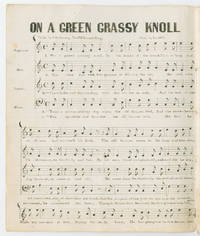
1864248261864. No binding. Condition: Fine. Manuscript Pen and Ink Folk Art Song Book ca. 1864. 24 pp. 6 5/8 x 8 in. This hand-sewn booklet contains eight songs popular during the Civil War era with music and lyrics in calligraphy. Songs include "On a Green Grassy Noll" by J. D. Canning with music by Ira Odell; "The Old Mountain Tree" by James G. Clark; "Harmonian Waltz"; "Year of Jubilee or Kingdom has Come!"; "Squire Jones's Daughter"; "The Sweet Birds Are Singing"; "Lament of the Irish Emigrant"; and "Soon and For Ever" by J. B. Monsell. The last page of the booklet is dated February 21 1864. Partial Transcript: Year of Jubilee or Kingdom has Come! I come up Norf on a little bender Left Missus at home wid no one to tend her Ole Massa's gone I dun-no what to; Sambo pretty sure he don't much care to. Chorus: Den sound de horn beat de drum Sound de horn and beat de drum De year ob jubilee am come Sound de horn and beat de drum De year ob jubilee am come. Met genral Bloaregard on my way here He told me dat I had better stay dere He said up Norf dey would skin and eat me Dat was a yarn dat a little heat me. He said he had just whipp'd Gen-ral Bu-el Grant and Wallace All three in a duel. I axed him den why he was running away Sam-bo says he dat question aint fair play. Oh times down Soth am getting quite rotten He's so berry scarce they have to burn cotton I left dat land ob oppression and gas And roam de free Norf without nary pass. Molasses Junction was a big scarecrow Nigh its wooden guns nobody didn't dare go; But when McClellan got a good ready De Southern Gentry seemed quite unsteady. Abraham Lincoln and Emancipation De two tallest tings in dis tall nation; Hurrah den boys let us still be merry Kingdom has come boys we've good times berry. Historical Background: Music played a prominent role in the American Civil War. On the battlefield and in the camps it boosted morale and released tensions. On the homefront it helped individuals and families express political sentiments grief and longing. Music entertained and often carried political religious and social messages. "The Year of Jubilee or Kingdom has Come!" was written by "Sambo" and first published in 1862 by H. M. Higgins in Chicago. "Squire Jones's Daughter" tells of the virtues of "The prettiest girl in the State of Maine" and was copyrighted by New York publisher Henry De Marsan in 1860. "The Sweet Birds Are Singing" is a cheerful pastoral duet about springtime that dates to at least 1836. "On a Green Grassy Noll" by J. D. Canning was first published in Boston in 1852 and is an elegy for a nameless old farmer who has "ploughed his last furrow." "The Old Mountain Tree" is a ballad in the form of a quartet by James G. Clark first published in 1854. It expresses longing for an old homestead. Clark 1829-1897 enlisted in the 35th New York as a 1st lieutenant and was detailed to remain in the recruiting service. He used music in his efforts to enlist soldiers in the cause and was dubbed "The People's Poet." "Lament of the Irish Emigrant" is a ballad by Helen Blackwood 1807-1867 with music by William R. Dempster 1808-1871 first published in Boston around 1840. It tells the story of an Irish emigrant who has buried his wife Mary and their child. Blackwood Baronness Dufferin and Claneboye was a British songwriter composer poet and author. Dempster a Scottish singer was very popular in the United States. "Soon and For Ever" is a sentimental hymn by J. B. Monsell about the Christian's union with Christ in Heaven. Rev. James Samuel Bewley Monsell 1811-1875 was an Irish Anglican clergyman and poet. He wrote the poem in 1853 or earlier.Condition: Very minor soiling else near fine.<br /> books
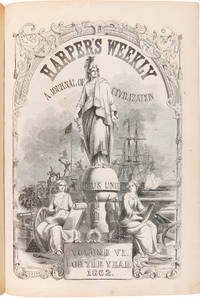
1865WRCAM56383New York 1865. Ten volumes. Volume V No. 210 through Volume IX No. 470. 416; 417-502507-534539- 706711-832; iv230235-416; 417-422427- 438443-832; iv416; 417-502507-832; iv390395-416; 417-848; iv400; iv401- 832pp. Profusely illustrated. Lacks eighteen leaves. Folio. Contemporary three-quarter black morocco and cloth spines gilt. Noticeable wear to spines. Long horizontal closed tear and minor chipping to a few leaves occasional foxing and minor soiling a handful of misbound gatherings and detached leaves. Lacking eighteen leaves and priced accordingly. Overall a fair to good set. The famous Civil War volumes of HARPER'S WEEKLY covering the period from January 5 1861 to December 30 1865 profusely illustrated with engravings after many famous artists of the day most notably Winslow Homer who worked for the magazine in the first years of the war and with a number after photographs by Matthew Brady depicting Civil War scenes important political figures and satirical cartoons. These volumes of HARPER'S WEEKLY. constitute a remarkable illustrated record of the Civil War for the duration of the conflict full of first-hand accounts of battles political news and wonderful engravings and maps some folding nearly all relating to the war. Included is ample reporting of Sherman's march Lincoln's assassination and funeral and all the major battles. "The most popular periodical of its day and valuable for a study of any aspect of the war; the illustrations are unsurpassed" - Nevins. With much on the campaigns in Florida early in the war and so very much more. Though this set is a bit wounded it still holds a wealth of pictorial and textual history on one of the defining events in American history. Also includes a single issue of FRANK LESLIE'S ILLUSTRATED NEWSPAPER November 28 1863 bound into the second volume of HARPER'S WEEKLY for 1863. NEVINS p.15. SERVIES 4601-4615 4696. hardcover books
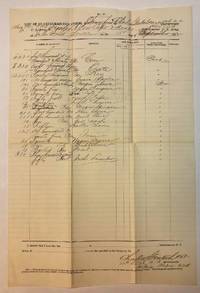
186319805Columbus Ohio 1863. Broadsheet 8" x 10" ordering a Descriptive List of Pay and Clothing for Wm. Harris 44th Ohio Volunteer Infantry who is awaiting discharge papers. Completed in manuscript it is dated May 15 1863 and signed by order of Brig. Genl. Mason. The verso is a printed letter from Assistant Adjutant General Samuel Breck to Capt. Albert Dod 15th U.S. Infantry Columbus Ohio regarding eligibility for final statements and descriptive lists. unknown books
1861100126<p>Group of three daily diaries for 1861 1863 1865 and two others for 1866 and 1867. Together five diaries. Various places: 1861-1867. Each 12mo morocco wallet style bindings four black one red. Diaries for 1861 and 1863 in pencil others combination of pencil and ink. All bindings are worn 1863 is more so and a couple have some tears along edges and hinges. The 1866 diary has more significant wearm and some cracks along the edges. Group of 10 pages are loose in 1863. Condition of writing varies but generally fairly legible. Overall the group is in very good condition.Herrick was from Syracuse New York and served in Company D of the 110th Regiment of the New York Volunteers. However information from the National Park Service archive suggest he served with the 12 Regiment out of New York. He appears to have served during the siege at Port Hudson and did garrison duty at the infamous Union prison Fort Jefferson in Florida. The first diary covers his enlistment in April 1861 to the end of that year. The diary describes training and the trip to Washington where the regiment was reviewed by President Lincoln. It appears that in July 1861 he was discharged for medical reasons but for some reason he re-inlisted in August 1862. The diary for 1863 covers the entire year and includes descriptions of the siege and assault on Port Hudson. Herrick seems to have been ill during this period and stayed in camp a lot. In February 1864 Herrick and the 110th began garrison duty at Fort Jefferson the much reviled Union prison located on Garden Key Island in the Gulf of Mexico. While Herrick’s descriptions often seem somewhat monotonous the weather his health which ships came in his impressions of various drills this diary is one of very few first hand accounts inside the prison. There are some interesting entries including a prison detail discovering coffins while digging a foundation for a new building an officer arrested for selling whiskey to prisoners and a prisoner being "strung up" for stealing. Perhaps the most significant content of this diary is related to Lincoln’s assassination. In an entry on April 22nd a ship brings news to the prison "they had three prisoners slung up for rejoicing over it" Then in an entry dated July 24th the naval transport Florida brought three of the Lincoln assassination conspirators Samuel Arnold Michael O’Laughlin and Dr. Samuel Mudd to the prison. This prison wasn’t known for kindly treatment of prisoners the weather usually very hot and humid and the place was infested with bugs and misquotes. The food was what you would expect and Samuel Arnold was reported to have said the meat was so rotten "dogs ran from it." nps.gov/civilwar/soldiers</p> books
1868294671868. CIVIL WAR. A HISTORY OF MASSACHUSETTS IN THE CIVIL WAR. By William Schouler. Boston: Vol. I E.P. Dutton 1868; Vol. II published by the author 1871. First editions. 2 vols. 8vo terracotta and green cloth; Vol. I with frontis. Vol. II with folding map. Ex-library some shelfwear minor tear to each title page Vol. I inner hinge starting; text and map are fine. Overall very good. unknown books
1916229837Albany J.B. Lyon Company Printers 1916. 1916. First edition. 4to. Frontispiece and 16 plates. Original red cloth stamped in gilt. Very good. 121 pages. No dust jacket. Cover title reads: "Major General James S. Wadsworth at Gettysburg and Other Fields." Presentation inscription on the front free endpaper: "With compliments & best wishes of Frederick B. Maerkle To my friend Col. William C. Griffith dated September 21 1916." Provenance: from the estate of director Delbert Mann. 1st Edition. Hardcover. Very Good/No Jacket. Albany, J.B. Lyon Company, Printers, 1916. hardcover books
18661785839th Cong. 1st Sess.: SMD77. 1866. 1 1 blank pp disbound. Very Good. An argument for Congressional reconstruction to overturn President Johnson's reconstruction policies. SMD77. unknown books
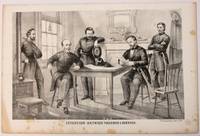
186537368Philadelphia: P.S. Duval & Son LIth. 1865. Broadside lithograph oblong 10-1/8" x 6-3/4." Some foxing at the margins else Very Good.<br/><br/> This is an extremely rare lithograph by Duval depicting General Joe Johnston's surrender of his army to General Sherman on April 18. "Peter Stephen Duval the most prominent Philadelphia lithographer of the 19th-century was born ca. 1804/5 in France. He emigrated from France to Philadelphia in the fall of 1831 to accept a job as a lithographer with the printing firm of Childs & Inman. By 1837 he had established his own lithographic printing shop and remained in business until his retirement in 1869" online Library Company article on Duval. <br/> "Sherman studies the surrender terms as his vanquished opponent Confederate General Joseph E. Johnston waits with evident unease in this rare depiction of the meeting at the Bennett House in Durham North Carolina. The print erred in showing the principals with their staffs; Sherman remembered that 'we were alone together.' Unlike Appomattox the Bennett House surrender quickly had a shadow cast over it when the War Department disallowed Sherman's terms and this scene never rivalled the meeting of Lee and Grant in iconographic memory." Neely and Holzer THE UNION IMAGE: POPULAR PRINTS OF THE CIVIL WAR NORTH. UNC Press: 2000. Page 194 Figure 98. In our copy the face of the man standing behind Sherman differs slightly from the Neely-Holzer illustration.<br/>Neely & Holzer 194. Not located in Reilly Weitenkampf Bartlett Sabin Eberstadt LCP or on OCLC or the AAS online site as of January 2021. P.S. Duval & Son, LIth. unknown books
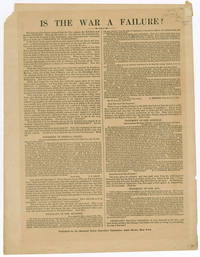
1864WRCAM53826New York 1864. Broadside approximately 11 1/4 x 8 3/4 inches. Small portion of upper left corner torn away short closed at tear at upper right. Tanning light mat burn. Good plus. This scarce broadside rebuts Copperhead claims that the War is a disastrous mistake requiring that "immediate efforts be made for a cessation of hostilities." Issued during the critical 1864 presidential campaign it quotes generals Grant Sherman Seymour and Dix who make clear that the Rebels are on their last legs. In fact "The rebel cause is fast failing from exhaustion." Grant reports: "The rebels now have in their ranks their last man. The little boys and old men" are filling the ranks. "AMERICANS! Read these declarations of your Generals in the field and then decide whether the Chicago Convention was right or wrong in pronouncing the war a failure" unknown books
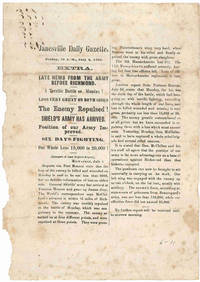
1862WRCAM45999Janesville Wi. 1862. Broadside 8 1/2 x 6 inches. Light wear and foxing. Very good. An unrecorded Civil War broadside publicizing a dispatch from Union Gen. George B. McClellan following The Seven Days' Battles which occurred between June 26 and July 2 1862. In the course of that week Union and Confederate forces fought a series of battles in five different locales. At the end of these engagements the Confederates withdrew to Richmond. This EXTRA provides information about losses and casualties and states: "Gen. McClellan and his big staff all agree that the position of our army is far more advantageous as a base of operations against Richmond than that hitherto occupied." Although most of the battles in the Seven Days can be considered Union victories the overall outcome of the campaign was still not particularly successful for the Union due to McClellan's weaknesses as a commander in the field. Afterwards the Union's Peninsular Campaign was abandoned and the majority of McClellan's men were transferred to John Pope's army in Northern Virginia. unknown books
1890213468Baltimore: R.H. Woodward & Company 1890. Frontispiece of "Mr. Davis Prepared for Burial" 8 full-page sample illustrations from photos pp. 1 - 30 127 - 132 211 - 212 315 - 316 345 - 352 2pp of ads. 1 vols. Purple cloth lettered in gilt decorated endpapers with binding sample of deluxe pebbled morocco spine on front endpaper and that of "library" binding of sheep and black leather labels on rear endpaper. Nice copy albeit the salesman has removed the pages for orders. Frontispiece of "Mr. Davis Prepared for Burial" 8 full-page sample illustrations from photos pp. 1 - 30 127 - 132 211 - 212 315 - 316 345 - 352 2pp of ads. 1 vols. Salesman's Dummy. Publication followed quickly of the heels of the death the former President of the Confederate States of America Dec. 5 1889 and sales must have been high -- especailly in the South. R.H. Woodward & Company unknown books
186537141Texas 1865. Folio 11" x 16". Printed broadside completed in ink manuscript. Signed by Charles Gentsch as quartermaster. Docketed on verso. Contains columns listing number quantity name of articles and condition when delivered. Old folds very clean. Near Fine. <br/><br/> The 51st Ohio Infantry Regiment was organized at Camp Meigs in Ohio beginning September 17 1861 and mustered into service on October 26 1861. The regiment was attached to several different units of the Army of Ohio the Army of the Cumberland and the Department of Texas. The Regiment participated in an expedition down the Ohio River in February 1862 to reinforce General Grant and then took part in the Occupation of Nashville. They marched to Louisville and pursued Bragg from late August to late October 1862 participating in the Battle of Perryville. They later fought at Stone's River Middle Tennessee or Tullahoma Campaign Chickamauga Chattanooga Atlanta Nashville and others. <br/> Charles Gentsch 1842-1914 of New Philadelphia Ohio was mustered in as 1st Sergeant of Company K 51st Ohio Infantry in October 1861. He was promoted to 2nd Lieutenant in January 1863; 1st Lieutenant in April 1863; and to Quartermaster in February 1865 at which time he was also transferred to Company S of the same regiment. After the war he attended Georgetown University. By 1872 he was practicing as a physician in Cleveland as well as a director in the Guardian Savings and Trust Company the United Banking & Savings Company the Lorain Street Savings Bank Company and in several manufacturing companies. He lived out his life in Cleveland and was a member of the Cleveland Academy of Medicine the Chamber of Commerce Chamber of Industry Army and Navy Post of the G.A.R. and other local clubs. His two brothers Daniel C. and Frank H. Gentsch were also physicians. In 1907 he wrote and read a paper before the Ohio Commandery of the Loyal Legion called "Instantaneous Rigor-Mortis Occasionally occurring and observed upon the Battlefield" based on his war experiences.<br/> Leander Alonso Poor 1833-1910 of Vienna Maine graduated from Bowdoin College and was a principal at a high school in Massachusetts when the war began. He joined Company C U.S. Engineers Battalion at Worcester Massachusetts but was discharged for medical reasons. In 1864 he was commissioned Captain in the United States Volunteers and assigned to the Union Army's First Division Fourth Army Corps. His unit was ordered to Texas to reestablish federal authority spending from September 1865 to June 1866 at Indianola and later Port Lavaca to oversee the rebuilding of the San Antonio and Mexican Gulf Railway. He returned to Maine in 1866 and was given the rank of Brevet Major. After the war he was a school teacher and administrator. "Capt. Leander A. Poor U.S.V. in Port Lavaca 1865-1866" by Charles D. Spurlin 2003 THE JOURNAL OF SOUTH TEXAS 16 169-194; military records at website Fold3. unknown books
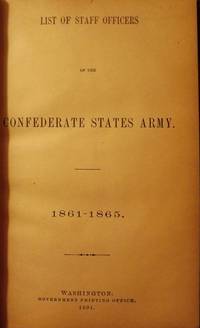
18912671891. CIVIL WAR. LIST OF STAFF OFFICERS OF THE CONFEDERATE STATES ARMY: 1861-1865. Washington: Government Printing Office 1891. Small quarto: brown quarter-morocco leather & marbled boards marbled endpapers & edges. A scarce listing of Confederate officers printed on fragile paper. Very Good front hinge tender small stain page 25 some damage top inner-edge of front endpaper. $750.00. <br/><br/> hardcover books
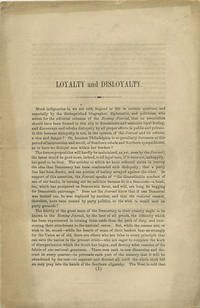
186336453Philadelphia: Ringwalt & Brown Printers 1863. First edition. Self wrappers. A very good copy with sunned wrappers. 8 pp. 8vo. Anonymous piece calling for national unity especially in Pennsylvania. OCLC locates ten copies. Not at AAS. Sabin 42566. Samuel J. May Anti-slavery Collection: 34907118. Ringwalt & Brown, Printers unknown books
1862102018One folded sheet two pages of text illustrated red and blue lettersheet depicting George B. McClellan with slogan "WE HAVE BEAT OUR LAST RETREAT" includes matching postally canceled envelope. Minor folds one small hole at center fold not affecting text normal aging and toning. Overall in very good condition. James Rikert who enlisted in 1861 was discharged in 1862 for disability. He joined as a 21 year old private at Fort Wayne Michigan and mustered into Company G of the MI 5th Infantry. He sent this letter to Celia Gibson as a follow-up to a letter he sent a week earlier concerning their march on Manassas. He reports heavy rains that postponed the march but expects to march the next day. While he mentions his sadness at the loss of his grandmother he makes a point of telling Celia this could be his last letter. "This may be the last letter perhaps that you will ever get from me but if I live through the battle you will son hear from me again and if not you will know that I have gone to my lovely home and that I died as a Christian." Historical Data Systems Civil War Research and Genealogy Database. books
1818100123Letter sheet 9 ¼ x 7 ½ 3pp. on 4 pp. lettersheet. Folded with nicks on folds minor soiling else very good. White was stationed near Washington D.C. and he provides a fair sketch of camp life and soldierly concerns during the first year of the conflict. His wants are few and he goes to some lengths to let his wife know he is taking good care of himself. I wash all my clothes regularly once a week keep my hair cut very close and wash myself clean every morning. I have no fear of getting dirty or lousy. Camp life is described as quite restrictive with lots of work. Duty is very hard we have to drill nearly eight hours every day except when we are on the move. He gives his wife advice on finances and other matters and admonishes her that above all I do not want you to believe any stories about men being shot for disciplinary reasons. hardcover books
5174465. and RETURNED PRISONERS Report no. 67. Original cloth a very good copy. 8vo Pp. 12834 illustrations. This is the official report of the April 12 1864 Confederate "massacre" of the 557 mixed white and black Federal troops at Fort Pillow Tenn. 63% of the garrison were killed or wounded by the troops under the command of General Nathan Bedford Forrest. unknown books
1864105586Washington: Government Printinng Office 1864. hardcover. very good. 2 illustrations one folding. 1259pp. very thick 8vo full contemporary calf leather labels. Washington: GPO 1864. First Edition. Very good.<br/><br/> Naval documents for the year 1864 including the Union blockade. 38th Congress 2d Session House of Rep. Ex. Doc. No. 1.<br/><br/> Government Printinng Office unknown books
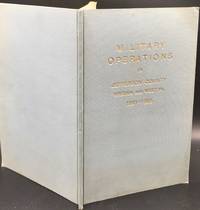
191164367NP: Published by Authority of Jefferson County Camp U.C.V.; copyrighted by Sam M. Hendricks Shepherdstown W.Va 1911. First edition. 23 cm. 42pp. index and a map. original grey cloth with gilt stamping on front cover. <br/><br/> Published by Authority of Jefferson County Camp U.C.V.; copyrighted by Sam M. Hendricks, Shepherdstown, W.Va hardcover books
1900WRCAM26249London: Harrison and Sons 1900. 69pp. Stitched. Titlepage loose. Else very good clean. A lawsuit over blockade running carries on for 35 years. The SPRINGBOK was originially seized by the United States because it was carrying "contraband of war." The subsequent legal struggles for compensation and discussions of the legality of such a move are discussed in these documents. The PETERHOFF also was transporting contraband and had false papers and the British government refused to "find ground to interefere." The 5 documents relating to this ship deal with the subsequent conflict between the United States and Britain. Harrison and Sons unknown books