[Civil War Memoir] Sheridan, Philip HBiblio.com
11 490 résultats
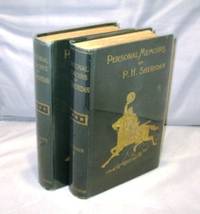
188826054New York:: Charles L. Webster & Company 1888. First Printing of the First US Edition. A Fine bright and tight set in fresh mylar protective jackets. The gilt lettering and cover decorations are bright. Philip Sheridan was a Union general in the Civil War and his career was noted for his rapid rise to major general and his close association with Lt. Gen. Ulysses S. Grant. Grant transferred Sheridan from command of an infantry division in the Western Theater to lead the Cavalry Corps of the Army of the Potomac in the East. In 1864 he defeated Confederate forces in the Shenandoah Valley and his destruction of the economic infrastructure of the Valley called "The Burning" by residents was one of the first uses of scorched earth tactics in the war. In 1865 his cavalry pursued Gen. Robert E. Lee and was instrumental in forcing his surrender at Appomattox. Sheridan prosecuted the later years of the Indian Wars of the Great Plains. Both as a soldier and private citizen he was instrumental in the development and protection of Yellowstone National Park. The general suffered a series of massive heart attacks two months after sending these memoirs to the publisher. Charles L. Webster & Company, unknown
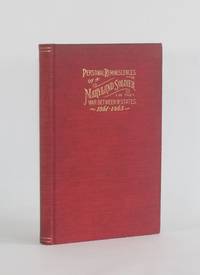
189810826Baltimore: Press of Fleet McGinley & Co 1898. Hard Cover. Very Good binding. Octavo. 177 pp. First edition. Limited to 125 copies. Signed and inscribed by Booth on the first blank. As issued in publisher's red cloth with title in gold on the front cover. A bright copy with very light soiling to the cover; early and short bookseller's description pasted to the bottom of the front pastedown; trivial closed tears to the fore-edge of the first page else clean and sharp. <br /> <br /> Coulter notes that this is more reliable that many of the longer narratives written well after the war because Booth is scrupulous about not including information he couldn't possibly have remembered after so many years Coulter 46. Nevins notes "Written by a young solider who participated in many battled before his capture this work contains so much on affairs both on and behind the lines that it is deserving of republication" CWB I 61. It was eventually reprinted by Butternut Press in the 1980s. This copy signed and warmly inscribed by Booth to Wm. H. Fitzgerald who was in the 12th Virginia until he was wounded in action at the Battle of Malvern Hill in 1862. Fitzgerald was born in Maryland and lived in Baltimore for several decades after the war. This book is remarkably uncommon in commerce particularly in this condition. Howes B-613; Dornbusch II 529. Press of Fleet, McGinley & Co unknown
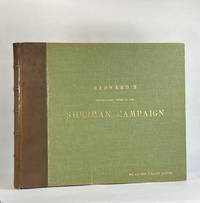
195310075Herman Manasse 1953. Quarter Leather. Very Good binding. Oblong folio. 3 61 ll. Photographic reproduction. All pages are photographic paper likely sliver gelatin prints stubbed and bound in cloth boards backed in morocco. Binding is 16" x 19." Cover titled in gilt with presentation name in gilt below: "Mr. and Mrs. T. Harry Gatton." The first leaf is a photographic reproduction of the endpaper of the original copy capturing an ownership note in French dated 1952. This note along with a printed inclusion also part of the photograph identifies the copy used for reproduction as belonging to G. M. ver Hulst having come to him from his uncle the Comte Francois de Montholon who died 23 December 1951. The printed inclusion notes that this reproduction was done "by Herman Manasse especially for Mr. & Mrs. T. Harry Gatton of Raleigh North Carolina." We use the endpaper inscription as the earliest possible date of reproduction. Based on the physical aspects of the book it was probably done not long after that time. <br /> <br /> Only light wear to the binding. The "contents" leaf has a small closed tear to the top margin; rippling to the photographs throughout. It appears that during the rephotographing process the border of each photograph was masked off except for each photograph's title. Count Montholon's copy was exceptionally clean making this a remarkably good reproduction a couple of the images capture some abrading to the original but generally these are very clean bright images of one of the great American photographic works. As official photographer of the Military Division of Mississippi Barnard photographed Sherman's march to the sea capturing the devastation left in the wake of the general's controversial scorched earth campaign. The images are indeed striking. A contemporary review calls this "a splendid volume containing 61 imperial photographs embracing scenes of the Occupation of Nashville the Great Battles around Chattanooga and Lookout Mountain the Campaign of Atlanta March to the Sea and the Great Raid through the Carolinas. These photographs are views of important places of noted battle-field of military works; and for the care and judgment in selecting the points of view for the delicacy of execution for scope of treatment and for fidelity of representation they surpass any other photographic views which have been produced in this country—whether relating to the war or otherwise." Harper's Weekly Dec. 8 1866. p. 771. And indeed it has held up as a monument of American photography. While the first edition does come to market periodically it realizes some extraordinary prices. <br /> <br /> We've been unable to determine how many copies of this full-sized reproduction were created. Though the inclusion on the first leaf specifically states that this copy was for Gatton a series of cards could have been substituted as the leaf was repeatedly photographed individualizing each copy. So while it is certainly possible that this is a one-off it is more likely that a very small number were reproduced and presented to friends family and notables. To that end Thomas Harry Gatton 1918-2001 was a notable North Carolinian. Beyond his professional endeavors he was a World War II veteran chairman of the North Carolina Historical Commission and was appointed to the American Battle Monuments Commission by presidents Kennedy Johnson and Carter. In short one to whom this presentation would have been warranted and meaningful. Howes B-150; Sabin 3462; De Renne p.1317 all for the first edition Taft Photography and the American Scene p. 232 486. Herman Manasse unknown
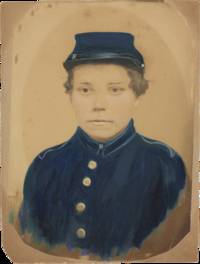
List3122United States N.d. Overpainted albumen photograph measuring approximately 6 ¾ x 8 ½ inches mounted on heavy cardstock. Slight marginal wear; excellent to Near Fine. An overpainted albumen photograph portrait of an unknown Union Army soldier who appears to be quite young dressed in Union fatigues. Though boys under 18 were not supposed to be able to enlist many did so anyway with some estimating that around 200000 underage boys joined the Union Army all told.1 Despite General Order 73 which ordered that “no discharges will be granted to volunteers . on the grounds of minority†so many families tried to get their underaged sons back from the Army that the New York Times called it an “epidemicâ€2. Nonetheless the brave child drummer boy or soldier became an iconic image of the Union cause.1<br /> <br /> 1 Frances M. Clarke and Rebecca Jo Plante “Why the Union Army Had So Many Boy Soldiers†Smithsonian Magazine January 17 2023 https://www.smithsonianmag.com/history/why-the-union-army-had-so-many-boy-soldiers-180981458/.<br /> 2 “The Plea of Infancy an Epidemic†The New York Times August 27 1861 3. unknown
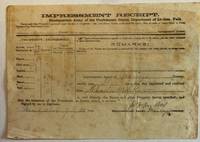
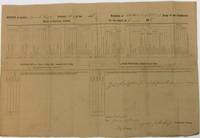
37080Oblong printed folio completed in manuscript. Old folds else Fine.<br /> <br /> Willard Lincoln from the Town of China in Maine enlisted as a First Lieutenant in Co. H of the 19th Maine Volunteer Infantry in 1862. He was wounded on the second day of Gettysburg recovered and was promoted to Captain. When he signed this document Lincoln was "on detached service at Draft Rendezvous Portland Me." <br /> As a condition of payment Lincoln certifies that he "employed the private servants for which I charge for the whole of the time charged and that I did not during the term so charged or any part thereof keep or employ a soldier as a waiter or servant. unknown
501001holograph copies of text for 4 telegrams Boston February 15-18 1864. Small 4to sheet 2pp. recto and verso. F. Soft cover. paperback
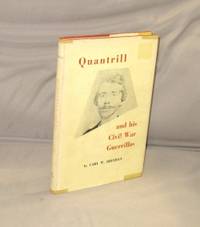
195929022Denver:: Sage Books 1959. First Printing of the First US Edition. A Fine tight copy in a Near Fine unclipped dust jacket with tape reinforced corners. This is a concise well-researched biography of one of the famous Civil War figures William Clarke Quantrill 1837-1865. The action takes place mostly around the Kansas-Missouri border dating from before the Civil War to just afterward. William Clarke Quantrill was a Confederate guerrilla leader during the American Civil War. As a young man Quantrill joined a group of bandits who roamed the Missouri and Kansas countryside apprehending escaped slaves. Later on this group became Confederate soldiers who were referred to as “Quantrill’s Raiders”. This group was a pro-Confederate partisan ranger outfit best known for their often brutal guerrilla tactics which made use of effective Native American field skills. Quantrill’s group included the young Jesse James 1847-1882 and his older brother Frank James 1843-1915 and portraits of both infamous outlaws are included in this engaging biography. Sage Books, unknown
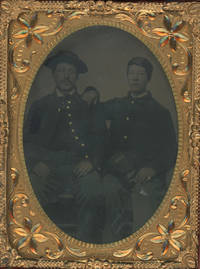
1860List1421American 1860. Tintype measuring 3 ½ x 2 ½ inches in oval case lacking front panel. A fine example. Fine. A particularly striking portrait of two Union soldiers seated together. Their resemblance suggests that they might be brothers. unknown
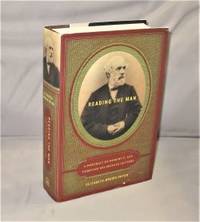
200727715<p>New York:: Viking Press 2007. First Printing of the First US Edition. A Fine tight copy in a Fine dust jacket. To most Robert E. Lee is a beloved tragic figure of a bygone war remembered by history as stoic and brave but without a true emotional life. Recently however historian Elizabeth Brown Pryor uncovered important documents that provide a stunning personal account of Lee's military ability his beliefs and his time. Using dozens of previously unpublished letters as departure points Pryor sheds new light on every aspect of this complex and contradictory general and questions our own understanding of loyalty and patriotism. This tantalizing glimpse of a legendary hero's guarded soul will appeal not only to Civil War buffs but anyone interested in this nation's history.</p> Viking Press, hardcover
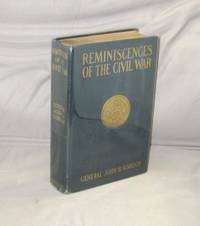
190429020New York:: Charles Scribner 1904. First Printing of the First US Edition. A Near Fine copy in green cloth hardcover binding with bright gilt stamping to the front cover and spine. General Gordon's career was perhaps as brilliant as that of any officer in the Confederate army. In rapid succession he filled every grade--that of Major Lieutenant-Colonel Colonel Brigadier-General Major-General and near the end was assigned to duty as Lieutenant-General and commanded at the surrender at Appomattox one half of the Army of Northern Virginia under Robert E. Lee. He distinguished himself on many bloody fields most prominent the battles of Seven Pines Sharpsburg or Antietam the Wilderness Spottsylvania Court House Cedar Creek Petersburg and Appomattox. At Sharpsburg he was wounded five times but would not leave his troops till the last shot laid him helpless and insensible on the field. One scholar of the war stated that in his study of the great war on both sides he had found but one prominent general who when he was in command or when he led a charge had never been defeated or repulsed and that general was John B. Gordon. Charles Scribner, hardcover
1915197672New York Abingdon Press 1915 1915. First edition. Thick 8vo. Author's preface. Frontispiece portrait photograph. Index. Original gilt stamped maroon cloth. Dust jacket unclipped; few nicks. Very good. Autobiographical reminiscences of the distinguished Ohio-born educator 1830-1921; notable for Chapter 16 which deals with King's Civil War experiences with Sherman's army in the Carolinas: visit to Alaska Chapter 33. No signatures or bookplates. F. Hardcover. New York, Abingdon Press, 1915 hardcover
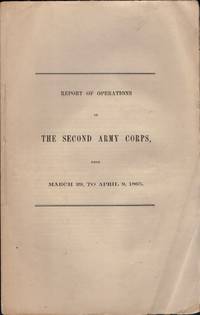
186531532Washington D.C.: Army of the Potomac 1865. First Edition. Wraps. Good. Stitched wraps. 13 pages 1 page blank 1. Light creases to the paper. <br /> <br /> This report summarizes the final battles of the Appomattox Campaign. On April 9th under flags of truce the armies halted to receive communications. "At about 4 p. m. it was announced the Army of Northern Virginia had capitulated." The unit was near Farmville Virginia when Lee's Army surrendered. <br /> <br /> Four brief marginalia corrections in pencil made to the report. Page 8 of the report 6th paragraph down is the printed statement - "Towards sunset I received a communication from Major General Webb Chief of Staff informing me that under instructions from the Lieutenant General Major General Meade resumed command of the Second corps and directing me to report my position and condition of supplies. In reporting my place of halt for the night to Major General Sheridan I informed him of the receipt of this communication." This paragraph has portions marked out in pencil with a note written in the left margin - "I would report thereafter to Maj Genl Meade". On the right side of the paragraph is the note - "I informed Major S of - - notified." Another correction regards the number of casualties of the Second Army Corps in battle near Farmville April 7th. The report prints "671 officers and men killed wounded and missing." The number was corrected in pencil to "571." <br /> <br /> Scarce. OCLC locates 5 copies in institutions. Army of the Potomac unknown
186237699Fort Ellis NC near New Bern 1862. Oblong folio broadsheet uniformly tanned. 12-3/4" x 18-1/2." Printed with manuscript additions. Signed in ink by J.M. Mayo Commanding Company. Contemporary "Duplicate." A few pinholes at fold intersections not affecting text Very Good.<br /> <br /> Most spaces available for the requested detailed information are left blank. Numbers of enlisted and commissioned officers present and absent are listed with notations of "alterations since last monthly return." 122 men were present for duty at the post. George L. Medlin was "furloughed for sickness." Captain Mayo is the only commissioned officer listed as "present." The return was completed about six weeks before the Battle of New Bern<br /> James Micajah Mayo "studied law at the University of Virginia in 1859 and 1860. In October of 1861 following the outbreak of the Civil War he was appointed to the rank of Captain in the Confederate States Army and organized the North Carolina 2nd Artillery Regiment Company F AKA North Carolina 36th regiment Company F nicknamed 'The Pamlico Artillery'. On March 14 1862 at the Battle of New Bern NC his company defended Fort Ellis on the Neuse River about four miles south of New Bern. The fort contained eight guns. When the union troops broke through the confederate defenses south of Fort Ellis Mayo was ordered to destroy his guns and the ammunition magazine which contained over 3000 pounds of powder and 500 loaded shells so that they would not fall into the hands of the enemy. He sent his men out of danger placed the powder 'trail' to the explosives and lit it himself. It was reported the explosion was the largest and loudest of the entire battle.<br /> Unfortunately Captain Mayo was not far enough away from the magazine when it ignited and he was severally sic injured. It was estimated that he was thrown as far as one hundred feet by the blast. Both of his legs were broken his flesh and eyes badly burned and he was reported as 'killed' by some observers. That night he was found by Major W. B. Lowell of the Connecticut 11th who had him moved through Union lines to a hospital where he was treated by Dr. Whitcomb. As a captured Southerner under the doctors care he slowly recovered and eventually regained his eyesight. Major Lowell visited him frequently wrote letters to his mother read and played the violin for him. After five months he was well enough to travel. General Burnside arranged for a special escort to return Captain James M. Mayo back to his home in Edgecombe County. He re-enlisted in September of 1862 in the North Carolina 4th Calvary North Carolina 59th Regiment as a Field Officer appointed to the rank of Major October 7 1862. His unit first saw service in North Carolina and Southern Virginia. In May of 1863 his unit was placed under the command of Brigadier General Beverly Robertson. At the Battle of Upperville Virginia on June 21 1863 leading a charge against Union Forces which ended in hand-to-hand combat he was captured a second time. He was sent to Old Capital Prison in Washington DC and on August 8 1863 transferred to Johnson Island Military Prison Lake Erie Sandusky Ohio where he remained until February 24 1865 and was then transferred to City Point Virginia for exchange. While a Prisoner of War at Johnson Island he kept a detailed diary of the day-to-day event of prison life. The first of two volumes covering the period from August 7 1863 through March 10 1864 is in the Library of Congress Manuscript Division and is stated to be one of the best accounts of prison life written by either Yankee or Rebel. A second volume covering the period from March 1864 to his release in February 1865 has been lost" "James Micajah Mayo" Memories of Dixie NamSouth Forum accessed July 2021. unknown
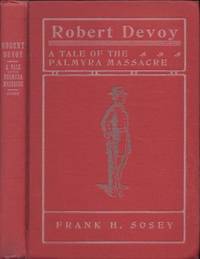
190336496Palmyra Missouri: Press of Sosey Bros 1903. First Edition. Hardcover. Very good. Octavo. 9 173 pages. Frontispiece and 4 Illustrations. Red cloth hardcover with silver stamped title and illustration on the front cover and spine. Interior contents clean. <br /> <br /> From the preface "October 18 1862 ten Confederate prisoners were taken to the Fair Grounds in Palmyra Missouri seated on ten coffins and shot to death by a detachment of Federal soldiers under the order of General John McNeil. McNeil was a Brigadier General in the State Militia in charge of Northeast Missouri under command of General Lewis Merrill whose headquarters were at Macon City. The wholesale slaughter was in retaliation for the abduction and supposed execution by Confederate soldiers under command of Colonel Joseph C. Porte of Andrew Allsman a Union citizen of Palmyra". This book is a fictionalized account of the events in 1862. Press of Sosey Bros hardcover
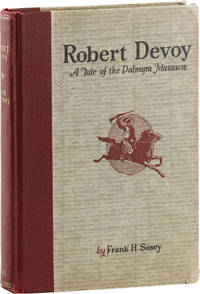
192055055Palmyra MO: Press of Sosey Brothers N.d. ca 1920. New edition enlarged. Octavo. Cloth-backed pictorial paper-covered boards hardcover; 157pp; pictorial endpapers; four inserted leaves of plates. Inscribed on front endpaper by Donald Sosey son of the author to Hon. James A. Farley. Corners bumped and board edges lightly rubbed else a tight straight copy Very Good. <br /> <br /> A narrative blend of fact and fiction based around the true events of the Palmyra Missouri massacre of 1862 in which ten Confederate prisoners were murdered by Union troops without judicial process. Undated reissue on large paper of a work that was originally published in 1903; the author's preface dates this "Souvenir Edition" to ca. 1919-1920 and notes that "some valuable additions have been made to the historical part of the book. Press of Sosey Brothers unknown
188353564Madison WI: Democrat Printing Co. State Printers 1883-1886. Two vols. Thick 8vo. vii 1 829 1; 979 1 pp. Uniformly bound in publisher’s brown half-calf over pebbled black cloth decorated endpapers gilt decorated spines minor rubbing edgewear minor scuffing to corners vol. II rebacked w/ original spine laid down still VG- set w/ typed Honor Roll Lists for the Spanish-American War Veterans from Vernon County WI World War I Veterans as well as Deceased Civil War Veterans from the Grand Army of the Republic Alex Lowrie Post No. 36 Viroqua WI from library of Ramona Angus Bennett 1924-2017. First edition of these invaluable reference works for Wisconsin soldiers in the Civil War with lists by Regiment Company Home Residence Date entered Service Discharge Dates and more. Democrat Printing Co., State Printers, hardcover
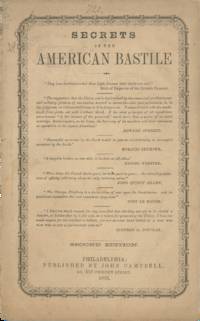
1863List3325Philadelphia Pennsylvania: John Campbell 1863. Second edition. 8vo paper wraps 64pp. Wraps with wear to edges library stamps and some manuscript notes; contents excellent to Near Fine. Overall excellent to Near Fine. A short booklet by William H. Winder 1808–1879 son of the Brigadier General and Baltimore lawyer of the same name concerning his 1861 arrest and imprisonment for treason for his opposition to the Civil War. Winder attributes his arrest to his correspondences with Secretary of State William H. Seward and Secretary of War Simon Cameron. In his letters Winder laid out his case that not only would a war spell the end of any union between North and South but that an agreement between the two would be easy to reach. Winder was imprisoned in Fort Lafayette where the "abominable treatment of prisoners . is too well known to require any notice in this statement†23 and then at Fort Warren. He was released in 1862 after fifteen months.<br /> <br /> Secrets reproduces Winder’s correspondence alongside his editorializing: that he was falsely arrested under the Secretary of State’s name without the Secretary’s knowledge that he was denied his Constitutional rights and especially that the Republican government’s “corruption and imbecility†in its suppression of opposition to the war amounted to “terrorism†vii.<br /> <br /> OCLC locates twenty copies of the second edition. John Campbell unknown
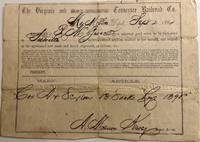
186435643Virginia Tennessee: Virginia and Tennessee Railroad Company 1864. n/a. Broadside. Fair. Broadside. Paper measures approx. 8.25" x 6". Paper is folded creased with a couple of pin holes at the folds. Contents printed and hand written. Departing Depot name difficult to translate but the freight was forwarded to Saltville Virginia known for its salt supplies. The Virginia and Tennessee Railroad Company was vital for transporting supplies for the Confederate Army. This railroad was later incorporated by Norfolk Southern. During the War Robert L. Owen Sr. who had been one of the engineers surveying for the railroad and who had risen through the ranks succeeded McDaniel as president. The railroad became a key supply food and troop movement route for the Confederate States Army particularly from the capital of Richmond to the interior at Chattanooga Tennessee. The V&T moved also key raw materials: copper from mines near Cleveland Tennessee lead from mines near Bristol salt from Saltville Virginia and saltpeter from caves throughout the region. Union forces finally captured much of the railroad and destroyed tracks and rolling stock in late 1864 although service was periodically interrupted by a series of cavalry raids earlier in the war. Virginia and Tennessee Railroad Company unknown
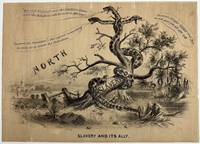
186412816N.p. 1864. Lithograph 14.5 x 20.5 inches. Noticeable toning small areas of light discoloration along top margin short closed tear to left edge minor dust-soiling numerous creases and wrinkles. About very good. A dramatic political cartoon issued during the Civil War and satirizing the dangerous influence of those who argue a compromise on slavery or an easy solution to the war. The work was likely issued in the midst of the 1860 but more likely the 1864 presidential election campaign. The central image of the lithograph involves a three-headed snake -- labeled "The People's Party" and emerging from the American "South" personified by a moss-covered swamp -- which is wrapped around the length of a large tree labeled "Slavery." Each snake vocalizes a different misleading message about the issue of slavery and compromise seemingly aligned with political entities such as the Peace Party and the Copperheads. The messages from each snake head read respectively "Extend Slavery over the Northern States and the Rebellion will be over in 60 days;" "Persevere till after election and then we will give you all you ask;" and "'Support the President' - but oppose everything he may do to crush the Rebellion." This latter message indicates the author of the work supported President Lincoln. The North is personified in the background at left by a depiction of the U.S. Capitol Building. The central image of the lithograph carries echoes of the story of the Book of Genesis with the involvement of a deceptive serpent amid the tree of life.<br /> <br /> The lithograph is signed in the stone at bottom right reading simply "Brooks." Though the work came to us proposing the identify of the artist as Reuben Brooks 1794-1870 we were ultimately unable to confirm this authorship. The lack of an imprint in the lithograph also precludes easy research and identification. In fact the rarity of the lithograph makes it difficult to expound much more about it at all. OCLC reports just a single copy at the Peabody Essex Museum and it is not listed in Weitenkampf or Reilly. Given its rarity and content the present lithograph offers an outstanding opportunity for further research and contextualization. unknown
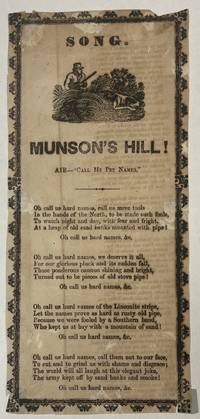
39726np 186-. Broadside 4-5/8" x 10-1/4." Woodcut of hunter with dog at head of title. Text and illustration within an ornamental border. Light extremity wear mild discoloration printed on thin paper with prior mounting remnants. Good.<br /> <br /> "Oh call us hard names call us mere tools / In the hands of the North to be made such fools / To watch night and day with fear and fright / At a heap of old sand banks mounted with pipe!" <br /> The song mocks McClellan and his Union troops for succumbing to Confederate trickery: "Those ponderous cannon shining and bright / Turned out to be pieces of old stove pipe!" Wikipedia says northerners exasperated with McClellan's performance wrote several bitterly satiric tunes about the incident.<br /> Wolf C115 and 1491. Rudolph 181. OCLC 32248473 4- NYHS Brown Wake Forest U VA as of December 2023. unknown
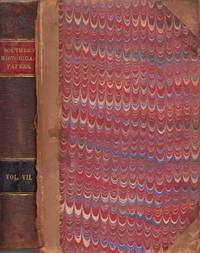
187735347Richmond: George W. Gary 1877. First Edition. Hardcover. Good. Octavo. 1 iv 304 pages 1. Reddish marbled paper covered boards with leather corners and spine. Title labels on the spine. Leather on the spine and corners is dried rotted flaking and chipped. Interior contents in very good condition. Bookseller ticket from Richmond located in the bottom right corner of the front paste down. <br /> <br /> Contents contain several Civil War articles from southern soldiers and officers. George W. Gary hardcover
187635348Richmond: Geo. W. Gary 1876. First Edition. Hardcover. Fair. Octavo. 1 iv 466 pages 31 pages titled "A Roster of General Officers Heads of Departments Senators Representatives Military Organizations &c. &c. In Confederate Service During the War Between the States" 1. Reddish marbled paper covered boards with leather corners and spine. Title labels on the spine. Leather on the spine and corners is dried rotted flaking and chipped. Front cover near detached. Front hinge cracked. Interior contents in good condition.<br /> <br /> Contents contain several Civil War articles from southern soldiers and officers. Geo. W. Gary hardcover
187835345Richmond: Printed by James E. Goode 1878. First Edition. Hardcover. Fair. Octavo. 1 iv 304 pages 1. Reddish marbled paper covered boards with leather corners and spine. Title labels on the spine. Leather on the spine and corners is dried rubbed and rotted. Interior contents in very good condition. Bookseller ticket from Richmond located in the upper left corner of the front paste down. <br /> <br /> Contents contain several Civil War articles from southern soldiers and officers. Printed by James E. Goode hardcover
187735346Richmond: Printed by James E. Goode 1877. First Edition. Hardcover. Fair. Octavo. 1 iv 320 pages 1. Reddish marbled paper covered boards with leather corners and spine. Title labels on the spine. Leather on the spine and corners is dried rotted flaking and chipped. Interior contents in very good condition. Bookseller ticket from Richmond located in the bottom right corner of the front paste down. <br /> <br /> Contents contain several Civil War articles from southern soldiers and officers. Printed by James E. Goode hardcover
187935343Richmond: Geo. W. Gary Printer 1879. First Edition. Hardcover. Fair. Octavo. 1 iv 592 pages. Reddish marbled paper covered boards with leather corners and spine. Title labels on the spine. Front cover mostly detached. Rear joints rubbed. Leather on the spine and corners is dried rotted and flaking. Interior contents in very good condition. Old ink stamp from Richmond bookstore W. E. Simms and Bro. located on the right front flyleaf. Vintage ink stamp from "Lowery 47 Neron Place New Orleans LA" located on the front blank end sheet. Fair only. <br /> <br /> Contents contain several Civil War articles from southern soldiers and officers. Geo. W. Gary, Printer hardcover