11 490 résultats
37090Elephant folio printed broadsheet completed in neat ink manuscript and signed by Captain Charles N. Hunt and Captain George Nelson. Old folds several fold splits repaired minor loss. Else Very Good.<br /> <br /> The 39th Regiment Massachusetts Infantry was organized at Camp Stanton in Lynnfield Massachusetts August 13 through September 2 1862 and mustered for a three-year enlistment under the command of Colonel Phineas Stearns Davis. Originally assigned to the defense of Washington the Regiment later saw action with the Army of the Potomac at the major battles in Virginia. This carefully detailed muster roll was written soon after the Battle at Weldon Railroad in late August 1864. It reflects the consequences of that battle noting soldiers wounded ill and taken as prisoners of war. unknown
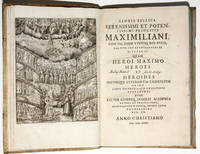
16235340Ingolstadii: Ex officina typographica G. Haenlini 1623. Hardcover. Near Fine. 4to 27 x 17.5 cm. 17 ff. 388 pp. recte 386 7 ff. with misnumbered pages at pp. 203-06 243-46 and 260-71 1 full-page engraving 20 x 15.5 the platemark. Bound in contemporary blind-stamped pigskin raised bands boards beveled somewhat scuffed clasps missing. Blue edges small hole repaired on half title and engraving ownership inscription of Andechs Abbey on title page minor browning in some quires. An excellent and unsophisticated copy. First edition of a rare volume of prose and verse glorifying the military exploits of the Prince-Elector Kurfürst of Bavaria Maximilian I 1572-1651 by members of the University of Ingolstadt as compiled by the Jesuit philosopher-theologian Georg Stengel 1584-1651. The Gloria Bellica is an important witness to the intertwining of princely power university politics and religious sectarianism at the onset of the Thirty Years War 1618-48. Published in the year of Maximilian's elevation to Prince-Elector 1623 the book seems to have been an attempt by faculty at Ingolstadt to secure his favor. The increasingly Jesuitical university would be frequently imperiled during the flux of the war and quickly identified Maximilian himself educated by Jesuits as an important military protector. Maximilian's central role in the German Catholic League had been essential in checking the power of the Protestant Union. The volume is especially notable for its full-page prefatory engraving executed by the Augsburg artist Daniel Manasser a highly detailed and elaborate allegory charting Maximilian's martial rise and the praise conferred on him from various secular and sacred sources. Merchants clerics Liberal Arts herself and a throng of lesser citizens crowd together to salute Maximilian as he rides upward on the back of Pegasus toward the Olympian gods reclining in the empyrean; the demigod Hercules mediates between heaven and earth while battling Nessus and the Lernaean Hydra. Flanking Maximilian's ascent are 8 groups from whom he receives "Gloria": his enemies his commanders and soldiers muses and scientists hometown Bavaria the Catholic League the Holy Roman Emperor Ferdinand I the pope and church and indeed Mary Christ and the saints. The text of the Gloria Bellica is arranged as a fuller version of this scheme with 20 chapters each detailing a source Maximilian's glory. OCLC identifies U.S. copies at Harvard Trinity CT Georgetown and Chicago. VD 17 23:231047E; De Backer/S. and VII 1550 32; Lentner 3774; Pfister I 4297; Mario Praz Studies in Seventeenth-Century Imagery Rome: Edizioni di Storia e Letteratura 1975 pp. 503-04. <br/> <br/> Ex officina typographica G. Haenlini hardcover
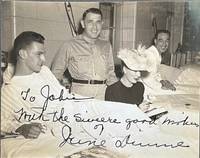
194356274Bethesda MD: National Naval Medical Center 1943-1946. Thick 4to. 8.75 x 11.5 x 4.75 in. Approx. 456 pp issues all separately paginated. w/ 100s of photo and text illustrations self-printed illustrated softcovers all complete; 4; 4 pp unpaginated colour lithograph covers; 164 pp unpaginated. on thick black paper stock w/ 188 silver gelatin photographs sized from 1.5 in. by 3.25 in. up to 8 x 10 in. w/ the majority 3.5 x 4.5 in. and all mounted neatly on pages w/ 92 filled. Original black cloth Multiple Binder w/ all pieces carefully inserted and held by metal rods attached at head & foot of spine rounded corners gilt lettering stamped on front cover minor wear soiling front cover still excellent copy from the libraries of Rear Admiral Commanding William Chambers US Navy commanding officer of Naval Medical Center beginning 1945 after commanding medical facilities in the Pacific theatre during World War II and personally organizing evacuations of wounded from Bougainville & Charles Waite Orville Bunker 1882-1958 commanding officer of the Naval Medical School 1941-1942 and then National Naval Medical Center at Bethesda Feb. 1942-Oct. 1944 signatures of Rear Admiral Chambers Captain Bozarth and photographer John Byers as well as signed photo of Irene Dunn visiting the troops. This extraordinary souvenir album incorporates not only the entire first 15 months of the weekly paper issued by the Naval hospital chronicling 1945 and 1946 events overseen by Rear Admiral Chambers but also incorporates 188 photographs providing essential visual documentation. The National Naval Medical Center at the urging of President Franklin D. Roosevelt former Secretary of the Navy pressed for the construction of the facility which was dedicated and operating by the time the U.S. entered World War II with Rear Admiral Bunker in command. Originally desinged to hold 1200 Beds the Naval Medical School the Naval Dental School and the Naval Medical Research Institute the facility quickly outgrew its’ space and additional temporary buildings were added to accommodate over 2400 American sailors and Marines by the end of World War II. The photos document the celebrity visits by Alan Ladd Veronica Lake Irene Dunne who had appeared in My Favorite Wife the Awful Truth and Anna and the King of Siam Bing Crosby Danny Kaye and others. In addition there are photos of Harold Russell double-amputee that won the best supporting actor Academy Award for “The Best Years of Our Loves.†Also included are photos of the WAVES Hospital Corps School participants nurses surgical facilities hospital wards patients and much more. The facility pioneered comprehensive occupational therapy techniques to rehabilitate injured Naval personnel and US Marines. Byers b. 1901 was a lifelong Carroll County Maryland resident who served in the U.S. Navy from 1942-1946 and afterwards was elected to the Westminster City Council in 1951 and also owned and operated the F.A. Sharrer Funeral Home. Although never operating a professional studio 1000s of his images preserved in the Historical Society of Carroll County chronicle Maryland life. No similar runs of the National Naval Medical Center News in Worldcat Locates 3 libraries holding Medical News Letter issued from 1947-1969; See: Information Bulletin Bureau of Naval Personnel NAVPERS-0 No. 334 January 1945; John Byers Collection Historical Society of Carroll County 2020. National Naval Medical Center, paperback
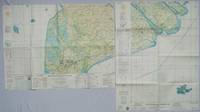
1967203840Washington D.C.: Army Map Service. 1967. Two printed colour adjoining maps 73 x 55.6 cms and 55.6 x 73 cms original folds inked operational annotations to the Quan Long sheet multiple marginal legends noting aerodromes and radio facilities roads railroads and boundaries glossary of terms much of the text is in both English and Vietnamese in very good condition. Detailed U. S. Army maps of the Mekong Delta and Southern Vietnam extending from Rach Gia in the north to the area just south of Quan Long Ca Mau in the south and east including BacLieu and CanTho. The island of Con son is at lower right of the Khanh Hu'ng sheet. Operational notes are inked around Quan Long are marked and the U Minh Forest the impenetrable "forest of darkness" is noted in ink. <br> <br>. . Army Map Service. unknown
1865List2438Camp Low 1865. Original partially printed document 26cm x 77cm. Printed on both sides of the sheet completed in manuscript. Darkening at folds from old tape repairs; partial splits to folds and extremities; complete and quite Good. Docketed verso signed in ink by Lieutenant Morgan Owen. Lists twelve enlisted soldiers most with Spanish surnames two with French surnames. Fine. The formation of the California Native Cavalry in 1863 marked a significant chapter in the state's history. Comprising primarily Mexican-American individuals colloquially referred to as "native" Californians the California Native Cavalry unit was formed 1863. Initially commanded by Maj. Andreas Pico a distinguished hero from the Mexican-American War and later under Salvador Vallejo the regiment drew its ranks from diverse backgrounds. Recruitment efforts began with vaqueros from southern California expanding to include individuals from San José and San Francisco. The unit boasted a varied composition encompassing not only Mexican-Americans but also Chilenos California and Yaqui Indians and even French legionnaires.<br /> Company "B" a contingent largely recruited from the northern part of the state is reflected in the existing muster roll. The company assembled at Camp Low near San Juan Bautista in 1865 making a striking entrance into the town. Described as "gay and gallant Spanish lancaroes" the cavalrymen presented a formidable sight with lances in hand and flags flying leaving a lasting impression on the townspeople who had never before encountered soldiers."The gay and gallant Spanish lancaroes sic came dashing through the town with the lances in their hand a flag flying from each of them. I assure you that they presented a war like appearance the people here had never seen a soldier in their lives – Yes Sir!." letter Maj. Michael O'Brien to Gov. Frederick Low January 1865; quoted in Prezelski "Lives of the Californio Lancers: the First Battalion of Native California Cavalry" in Journal of Arizona History v.40 no.1 Spring 1999. <br /> Under the command of Capt. Porfirio Jimeno Company B swiftly engaged in a critical mission: dismantling the notorious Mason-Henry Gang that had terrorized the San Juan region in the preceding months. Despite successfully wounding John Mason in early April 1865 the gang persisted for another month until Mason met his demise at the hands of a miner he sought to kidnap.<br /> However Company B faced challenges including low morale and a high rate of desertions with over 40 men leaving the company in 1865 alone. Transferred to Tubac Arizona Territory to confront the Apaches the company encountered further desertions along the way. The muster roll listing only twelve soldiers alongside Capt. Porfirio Jimeno reflects this tumultuous period. Overall the muster roll provides scarce documentation of the role of Mexican-Americans in the Civil War with few other examples in the trade or institutionally. unknown
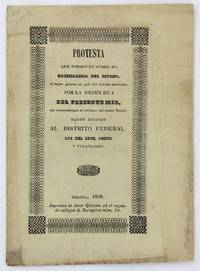
18483999Toluca: Juan Quijano 1848. Very good. 8pp. Quarto. Original printed wrappers. Minor soiling and rumpling. A scarce Mexican protest pamphlet railing against actions taken by United States occupation forces in redistricting Mexican state entities. The author here writes that even though war is barbarous the victor should respect the rights of the occupied and "pay homage to justice." They discuss the impact of occupation on treaty negotiations the historical use of authority in Mexico the impact of American influence in the country on traditional views of the Mexican federation and other matters. Half a dozen copies found in OCLC at the Sutro Library Bancroft the Lilly Library UT-Arlington Wisconsin-Madison and the Instituto Tecnologico in Monterrey Mexico. Juan Quijano unknown
191084196San Antonio: Dahrooge & Co n.d. ca. 1910. A small tan card folding chemise containing a concertina style pull out of 20 monochrome images titled to the front panel with space for an address for postal use with an advertisment for the Dahrooge Co. to the rear panel. A little wear and toning to the edges of the chemise otherwise a very good clean example. <br /> <br /> A souvenir collection of images depicting US soldiers performing drills queuing at chow hall dragging artillery etc. interspersed with images of local Mexican people a horrifying jury-rigged armored vehicle Mexican artillery preparing to engage and a variety of scenery shots. Dahrooge & Co unknown
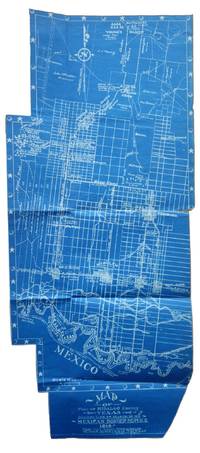
1917List2530VP 1917. Scrapbook measuring 15 ½ x 10 ½ inches. With forty leaves most with newspaper clippings and varied ephemera attached. Boards detached contents generally fine. Laid in is a blueprint map entitled Map of Part of Hidalgo County Texas Showing Line of March in my Mexican Border Service 1916. Made from Survey Notes taken on the march by Corp. C.A. Rice 74 Inf. N.G.U.S. Buffalo N.Y. Armory. Map measuring 33 ½ x 14 ¾ inches irregularly shaped and apparently complete. Very Good. A scrapbook documenting the military service of 1st Sergeant Samuel Gaffney of the 74th National Guard New York in the Mexican Border Service. Gaffney documents the campaign in great detail through printed matter - with each of the forty leaves containing material affixed including panoramic photographs advertisements from local businesses along the routes programs from entertainment offered to the troops military orders and official correspondence and many affixed newspaper articles and photographs. <br /> <br /> The scrapbook is most notable for the inclusion of an unrecorded map by Charles A. Rice the Buffalo native who would eventually map the campaign in larger fashion in a map entitled Map Showing Lines and March and Border Patrols in my Mexican Border Service 1916-1917. The map here just showing the route through Hidalgo County is unrecorded. The larger map - which was produced as souvenirs for the other members of the 74th - is quite scarce as well with five copies known to exist per OCLC with two different numbers. This blueprint map which appears to be complete cartographically and missing only the ornamental border on one portion shows the route taken early in the campaign in 1916. The Buffalo native Rice 1885-1931 who would eventually settle in Texas after the conflict also wrote a history of the 74th during the campaign. Rice published the maps and memoir himself. The map shows the route in great detail showing the location of wells farms roads and identifying landowners. Water quality and abundance is understandably a common theme in Rice’s notes. Some notes show the location of bandits smugglers and the like. We find no other examples of blueprint maps by Rice. <br /> <br /> Other highlights from the scrapbook include seven panoramic photographs of the 74th encamped at Pharr; a broadside advertisement for the shop of Agustin Acevedo in Pharr listing prices of goods; a handbill advertising the 74th’s Minstrels and Great Entertainment show on September 16 1916; an advertisement for a production entitled Glorious Liberty at the National Theatre in Pharr; two circulars instructing troop movement issued by Headquarters Brownsville District; several postcards with songs about the campaign; several snapshots; a mounted albumen photograph of troops at rest with the notation “Corp Frederick Paid†verso; a typed poem entitled “Home Again†and a notebook page describing his activities from January 1917 onward; and a thanksgiving menu for 1916 for the holiday spent at Pharr. The remainder of the scrapbook is composed of affixed newspaper clippings which provide extensive information on the 74th collected in a single volume. <br /> <br /> Overall a significant scrapbook with much information to glean for students of the 74th’s activities with the map providing a unique cartographic reference of the early days of the campaign. unknown
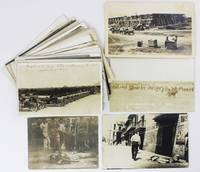
47618Various publishers & dates. Extensive photographic archive documenting events on both sides of the U.S.-Mexico Border during the Mexican Revolution focused primarily on the Border Wars in Texas and the Veracruz Incident of 1914 comprised entirely of contemporary images all but a few of which are original vintage prints. The collection includes: <br /> <br /> • Sixty-one commercially-produced real-photo postcards ca. 14cm x 9cm or the reverse; <br /> • Six commercially-printed postcards using non-photographic processes same dimensions;<br /> • Three carte-de-visite portraits ca 9cm x 6cm mounted to cards;<br /> • Eight small-format photographs ranging from 14cm x 8cm to 11cm x 16cm of which three appear to be commercial images; <br /> • Three 8x10 20cm x 25cm photographic prints printed at some later date from original plates but apparently not contemporary; <br /> • One vintage 4x6 10cm x 16cm photograph mounted on board. <br /> <br /> All but a dozen or so images are captioned in the negative and most are additionally captioned in pencil in a later hand on verso. Approximately half the images include no photo credit; of those that do we have identified the following photographers: W.H. Horne D.W. Hoffman Walter P. Hadsell Van Zile & Chalk and L.O. She. <br /> <br /> Condition is generally Very Good. Two of the photo postcards are damaged with abrasions to significant portions of image area; the remainder show various degrees of edge wear aging and creasing but by and large image quality remains excellent. None of the postcards are postally used though a few include brief contemporary notes on verso. The refusal of Mexican President Porfirio Dîaz to cede power to his rival Francisco Madero in the elections of 1910 resulted in a violent large-scale revolt by campesinos and leftists setting off the thirty-year long Mexican Revolution. American involvement in the conflict began in 1911 when President William H. Taft under the guise of heightening border security moved to back Díaz against the rebels. The resulting mobilization - Taft sent more than 20000 American troops nearly a quarter of all American forces to the Mexican border with especially heavy concentrations in Texas and New Mexico - was to that date the largest mobilization of American military forces in peacetime. At the same time many Americans whose sympathies were not aligned with the Díaz dictatorship including anarchists wobblies Native Americans and more than a few soldiers of fortune went south to fight on the side of the rebels. The resulting border conflict which took place over nearly a decade occasionally pitting American insurrectos against American Federal troops resulted in thousands of Mexican and hundreds of American deaths. <br /> <br /> The Border Wars reached their climax around the period 1912-1914 which happened to coincide with a near-hysterical vogue for postcards among the American public. The result is that the Mexican Revolution is perhaps the first major armed conflict to have been extensively photo-documented in real time and certainly the first to have had a significant mass audience for that documentation. At least three hundred commercial photographers have been identified in association with the Mexican Revolution and they produced tens of thousands of images ranging from the relatively innocuous e.g. peaceful street and harbor scenes in Veracruz to the horrific lynchings and sidewalk cremations. <br /> <br /> This entire range of content is represented in the current collection along with portraits of most of the key players on the Mexican side including El Presidente Porfirio Díaz; his primary rival and successor Francisco Madero; Madero's successor by coup Victoriano Huerta; and various military figures including General Juan Navarro Felipe Angeles Ramírez and numerous others. Many of these semi-professional images though produced with commercial intent "professional" remains a guarded term in the context of what was essentially battlefield exploitation photography are valuable for their almost off-hand depictions of violent day-to-day life on the contested border including the casual destruction and acceptance of death from both sides that seemed to define this conflict. Of particular note are numerous of photographs of African-American troops the so-called "Buffalo Soldiers" as well as at least one image depicting Native American soldiers in uniform. Locales represented include Camp Grossmont in California; El Paso and Laredo in Texas and their cross-border sister cities Juarez and Nuevo Laredo; Veracruz site of the American incursion of 1914 known as the "Veracruz Incident"; and various unidentified encampments and battle sites in both Texas and Mexico. <br /> <br /> A wide-ranging and compelling photographic collection documenting not only a key period in U.S. military diplomacy - one which for better or worse set the tone for American-Mexican relations for the succeeding century - but also a tangible manifestation of the first widespread public incarnation in America of the picture-postcard as a vehicle for both propaganda and photojournalism. unknown
19216158Various places in Mexico Texas and Arizona 1921. Overall about very good. 106 real photo postcards including six duplicates. Varying sizes but most approximately 3.5 x 5.5 inches. Scattered contemporary and later manuscript annotations. Light wear at edges occasionally a bit heavier. Some scattered damp and dust soiling. A substantial collection of over 100 real photo postcards that depict scenes from the Mexican Revolution and the related border war interventions of the United States Army. The images included here some quite violent in nature are dated from 1913 to 1922; most are captioned in the negative. They show ruined buildings military encampments injured soldiers and corpses on both sides of the U.S.-Mexican border and in Veracruz. Also included are identified portraits of individuals such as Francisco Madero Pancho Villa on his deathbed and American General John Pershing. Many of the images are by El Paso photographer W.H. Horne who was one of the most prominent photographers of Border War incidents captured the Columbus Raid in New Mexico and photographed skirmishes near his home in El Paso. Also present are a short series of images by Cal Osborn who documented border incidents near Douglass Arizona and a group by William Hadsell William Hadsell an American resident of Veracruz who ran a Kodak store and was a prolific recorder of events there. Several Mexican photographers are represented as well. Many of the photos are quite gruesome in nature and show corpses in various states of decomposition as well as the aftermath of battles and executions but in all provide an arresting visual document of the interventions by the United States in Mexico during the 1910s. Powerful images of the Mexican Revolution and the resulting upheaval there and along the border with the United States. unknown
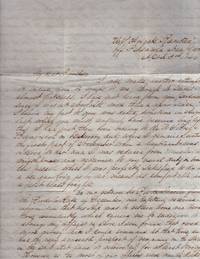
184635409Pensacola 1846. Letter. Very good. Letter. 4 pages. Lined paper folded. 4 pages of content. Postal mark and address written center of the 4th page. Two small wax seals on the edges of page 4. <br /> <br /> Letter is addressed to William Roney Jr. Corner of Third & Branch Sts Philadelphia Pa. Letter written aboard the U.S. Frigate "Raritan" off Pensacola Navy Yard April 3rd 1846 and has a Pensacola post mark and date of April 6 . Written on the eve of the Mexican War April 24 1846 to February 2 1848. Content summarized:<br /> <br /> Thomas Roney Midshipman writes a lengthy letter to his brother about his situation in Pensacola and requests his brother's help with family debts. He writes:“There is very little news from Mexico the latest is that Mr. Slidell has been informed that the government could not receive a Minister from the United States but that there were ready to receive a Commissioner for the settlement of the Texas question. We had consequently demanded his passports and is expected here very shortly in the Ship Manzo. The Mexicans have been making every preparation for a war…were preparing to place Santa Anna at the head of the government again….†Roney had been transferred from the U.S. Brig Bainbridge back to the Raritan. He was relieved as “master†and appointed "midshipman". Roney has no problem with this because the Raritan is more comfortable. Roney recently returned from Rio de Janerio and had to take large advance to pay off debts. The only regret of his demotion to midshipman is that he can’t send money home to Mother any more hopes brothers can make it up. He complains of the cost of his “mess bill†and outfitting upon leaving the coast of Brazil. He writes "Any place is better than the coast of Brazil unknown
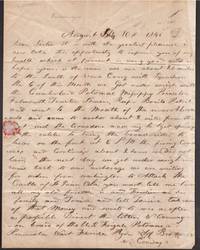
184635410Pensacola 1846. Letter. Very good. Letter. Folded to make 4 pages. 1 page of content 2 blank pages 1 page with address and postal mark from Pensacola Florida dated August 20 1846. Letter addressed to "Dear Sister" and signed "W Conway". Multiple folds and some creasing and toning to the paper. Red wax seal left edge page 1. Small paper tear from opening the letter. Good condition. Letter content summarized:<br /> <br /> US Frigate Potomac. W. Conway Pensacola Florida writes to sister Camden Goose River Maine while involved in the Blockade of Vera Cruz. USS Potomac sailed w/ships Cumberland Missippy sic Princeton Falmouth Truxton Somers Reefer Bonito and Petrel to mouth of river Alvarado off of Veracruz. Describes bombardment: “…the Commodore made rig to get spring word the cable to bring the broadsides to bear on the fort at 6 PM the firing Commenced and Continued about 2 hours we didi not land the next day we got under weigh and came back to our anchorage. we are waiting for orders from Washington to Attack the Castle of St. Juan Ola Fort San Juan de Ulúa offshore opposite Veracruz. unknown
184736655New Orleans: N/A 1847. N/A. Letter. Good. Letter. Approximately 8" x 10". Multiple folds. 4 pages with 3 pages of contents. Addresses and a pencil note written on the back page. 4 small circle corner stains on the first two pages. Overall condition is good or better.<br /> <br /> U.S. Army Paymaster John B. Butler is writing his daughter Harriet on January 17th 1847. From New Orleans he writes ".the wants of the Army imperatively demand that I shall return immediately. I leave tomorrow in the Steam Ship Alabama for the Army in Mexico. I shall go by Brazos Santiago the Rio Grande Camargo Monterey Mier Seraluo &c." He ads "There are many troops arriving from Penna among them I have met Several from Pittsburgh. They are now all embarking on board of ships provided with three months provisions. Their destination is not known but is supposed to be and Vera Cruz.I think Vera Cruz & the castle at that place will be assailed conjunctively by forces on land & by sea. May the God of battles protect our friends."<br /> <br /> Butler urges his daughter to give his kind regards to friends at her school. After initially closing the letter Butler writes a lengthy post script. New intelligence has been provided ".Genl Scott has returned from Carmgo and the Rio Grande and is now at the Brazos awaiting arrival of the troops that have been and that now being shipped at this place. This confirms the belief that Vera Cruz is his destination and the General's first demonstration will be against the fort and fortifications at that place."<br /> <br /> Butler urges his daughter to look at the map to find Vera Cruz and about the strong fort and castle. writing of strife and battle he writes his daughter "War always produces a wanton waste of blood & treasury - Every victory must have its victims; & contending armies are indiscriminate so there is no knowing who may fall."<br /> <br /> The last page has addresses and the letter is addressed to "Miss H. E. Butler Care Rev. C. C. Beatty Steubenville Ohio. N/A unknown
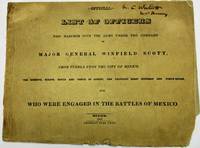
184835450Mexico: American Star Print. 1848. Oblong 4to. 24pp. Errata slip pasted to verso of title page listing "Names Accidentally Omitted" including that of 2d Lt. G.B. McClellan. Map entitled 'Battles of Mexico. Made by Major Turnbull Captain McClellan." Slip laid in concerning "1st Lieut. Andrew I. Williamson 3d Infantry." Original printed wrappers stitched as issued. Persistent chip at blank lower corner of all leaves but text unaffected. Very Good. Contemporary ownership inscription "Geo. C. Westcott U.S. Army" on front wrapper.<br /> <br /> "Printed on the occupying army's own press" Howes. The text lists in tabular format officers' "names and corps" dates "when and where employed" and a column of "Remarks" with information on the officer's fate: sick "mortally wounded" "seriously wounded" during August and September 1847. <br /> Many noted officers later served in the Civil War such as Robt. E. Lee "wounded at Chapultepec" Grant Beauregard Gordon Ewell Pemberton Buckner Longstreet Winder Magruder Pillow future President Franklin Pierce. The inside back cover has an "extract" of Scott's report summarizing his losses and the extent of his victory over the opposing Mexican army.<br /> This copy belonged to Brevet Captain George Clinton Westcott who "joined his regiment at Vera Cruz under the command of General Scott. He remained with that division of the army and participated in the subsequent battles occurring on the march to Mexico; and at Chepultepec although then belonging to the staff he volunteered as one of the forlorn hope in the attack on that citadel and was brevetted a captain for his gallant and distinguished conduct." CHARLOTTE S. WESTCOTT 33d Cong. 1st Sess. HR Rep. 162. 1854. His entry in this book is with his comrades of the 2d Infantry: "With stormers on the 13th Sept. Wounded at Contreras."<br /> Howes S243'aa'. 106 Eberstadt 212. Sabin 56771. American Star Print. unknown
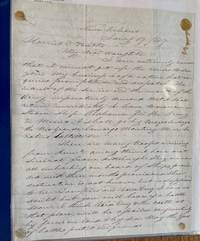
184635407Mansfield Mass: n.p. 1846. Letter. Good. Letter. Approx. 10" x 7.5". 4 pages. 2 pages of content. Some brown stains and light edge wear to the paper. Good condition.<br /> <br /> Letter is dated August 22 1846 and addressed to Hon. D. Webster Marshfield Mass. Signed by Bancroft on page 2. Good content. Letter written during the Mexican War. After Bancroft grants a sailor's detachment he writes to Webster about "News from Mexico" and discusses political and military topics: "Bram is unwilling to act as President"; "Provence of Jalisco defeated and is general slain"; "Vera Cruz is in revolt."; "Federalists refuse to receive Santa Ana"; and "Most sensible people in Mexico discussing peace." etc. From wikipedia:<br /> <br /> George Bancroft October 3 1800 – January 17 1891 was an American historian statesman and Democratic politician who was prominent in promoting secondary education both in his home state and at the national and international levels. During his tenure as U.S. Secretary of the Navy he established the United States Naval Academy at Annapolis. He was a senior American diplomat in Europe leading diplomatic missions to Britain and Germany. Among his best-known writings is the magisterial series History of the United States from the Discovery of the American Continent. n.p. unknown
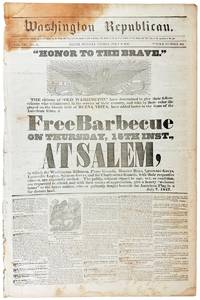
184745585Salem Indiana: Washington Republican / Calvin Frary 1847. Very Good -. Salem IN: Washington Republican 1847. Folio 55cm; removed; 4pp. Stain to upper corner; general wear staining and smudging; Good to Very Good. <br /> <br /> Uncommon Indiana newspaper here celebrating the return of veterans of the Mexican War including the Washington Rifles Posey Guards Hoosier Boys Lawrence Greys Lanesville Legion Spencer Grays and the Charlestown Guards. The public "without regard to age sex or condition" are invited to a "Free Barbecue" to celebrate their return. Includes regular ads and news with particular attention paid to the War. Advertisement for "Mrs. D. Curry's Tavern" to final page. OCLC shows five holdings of various issues and mentions the newspaper began in 1845 and shuttered in late 1847. . Washington Republican / Calvin Frary unknown
1847244341847. Folded sheet. 10 x 7 3/4 inches. 4pp. Old fold lines. Central fold running the horizontal length of the sheet reinforced. An affectionate 1847 Mexican-American War naval letter from a sailor aboard the U.S. store ship Fredonia off Anton Lizardo describing the fall of Tabasco and the secure occupation of the Veracruz coast and discussing a hoped-for transfer to Maury’s Naval Observatory: an intimate on-the-spot glimpse of how large strategic events were experienced and understood by an individual sailor in the Gulf Squadron.<br/> <br/> A very affectionate letter from a sailor to his wife back home full of pining declarations of love and devotion. The sailor Gregory notes that he is safe and likely to stay that way as they are at a good anchorage and the coast has been entirely secured. He indicates that she should direct her letters both to Vera Cruz and Pensacola and that either way they will surely find him with the Gulf Squadron. He also mentions a possible posting to the Naval Observatory which would bring him home to his dearest Jenny. "The frigates 'Potomac' & 'Raritan' have both sailed for home some days ago but we had no opportunity of writing by them as the former sailed from Sacrificios & the latter from Tobasco. You will doubtless have heard long ere you receive this all about the taking of Tobasco. The whole coast is now in our possession and there remains not the slightest chance of any more fighting for the squadron. I must not omit to mention my sweet little wife the Gibbon Edwards Kennard & myself have received an answer from Mr. Maury respecting our application for the Observatory. He says he is very anxious to have us all back again and that he would that day 22d of April go to see the Honl. Secretary and try to get us ordered; but he said he had but faint hopes of success for it was known at the same time at the Dept. that we were very short of officers in this squadron. unknown
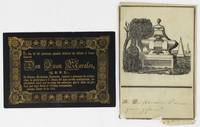
18485842Jalapa: January 10 1848. Near fine. Mourning card printed in gilt on black cardstock with an elaborate ornamental border 3.25 x 5 inches. Minor wear. An elaborate death notice honoring a decorated Mexican military commander in 1848. As a colonel under Santa Anna Don Juan Morales 1802-1847 served as field commander for Mexican forces at the Alamo and Coleto in 1836 and as a Major General in the Mexican-American War. He served as commandant of Veracruz abandoning the city when surrender seemed inevitable; he died shortly thereafter. The text of the card reads: "El dia 23 del procsimo pasado fallecio en Atlisco el Senor General Don Juan Morales Q. E. P. D. Su Esposa Hermanos Parientes Amigos y personas de estimacion lo participan a V. llenos del mas acerbo sentimiento suplicandole haga por su alma los sufragios que le dicte su piedad; por euyo favor le viviran reconocidos." This translates roughly as follows: "On the 23rd of last month General Don Juan Morales Rest in Peace passed away in Atlisco. His wife brothers relatives friends and loved ones share their deepest sympathy with you begging you to do the prayers for his soul that your piety dictates; for which favor they will live on in his honor. Jalapa January 10 1848. January 10 unknown
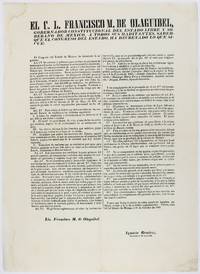
18472633Toluca: February 11 1847. Very good. Broadside 16.75 x 12 inches. Previously folded. Faint dampstaining at left corners. Two small wormholes affecting one letter of text. Otherwise minor edge wear and light dust soiling. Unrecorded printings of two decrees by the legislature of the State of Mexico at Toluca that sought to raise emergency funds to defend the country against American invasion during the Mexican-American War. Passed on February 8 & February 11 1847 these acts authorized the state legislature to borrow 300000 pesos with one third of this money allocated to the army and the remainder to equip the national guard. This expenditure would be covered by a salary tax on government employees and additional taxes on alcohol including pulque and aguardiente sugar and lumber. The second decree provides guidance and stipulations for the collection of these taxes. At this point in time Santa Anna's army was rushing north to meet Zachary Taylor's forces at Buena Vista. Not in OCLC. February 11 unknown
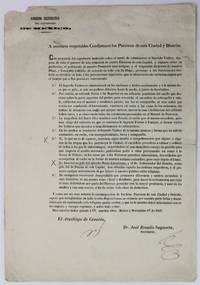
18472345Mexico City: November 17 1847. About very good. Broadside approximately 12 x 8.5 inches. Previously folded two small tape repairs on blank verso. Small chip at upper left corner. Contemporary manuscript rubrics. Light toning and dust soiling. This scarce order was issued by the Archbishop of Mexico two months after the capture of Mexico City by the United States Army. It contains six articles that detail instructions for administering the last rites and orders for several other difficult matters in the occupied city. The extreme unction is to be performed secretly only in the mornings and at night unless the physician believes it is not possible to wait and further instructions are given on how to proceed secretly but properly with the ritual. The fifth article states that that if the American troops insult the residents the clergy should try to restore calm to obtain assistance from the local guards and to inform the American garrison commanders. The final article states that parish priests should "Proceder con la mayor prudencia y usar de los medios y vias mas suaves á fin de evitar toda clase de disturbios." An interesting reflection of the official fear of American distaste for Catholicism; we locate only one example at Yale. November 17 unknown
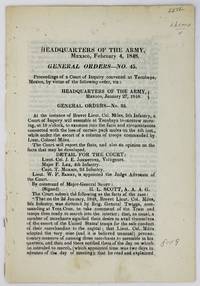
18482272Mexico City 1848. Very good. 3pp. Printed on a single folded sheet. Dbd. Old vertical fold minor foxing. A rare United States Army field printing pertaining to a notable incident that occurred during the Mexican-American War. In early January 1848 Lt. Col. Miles was ordered by Brig. Gen. Twiggs to take command of a wagon train and a small cadre of troops and then conduct them from northern Mexico to Mexico City. Mexican merchants availed themselves of the escort for safe conduct of their merchandise to the capital city and other destinations in the interior of the country. The wagon train consisted of 316 government wagons which stretched to three miles in length with 1700 pack mules adding another nine miles to the procession. Col. Miles had 1300 troops under his command but only 150 of them were cavalry. Mexican guerillas under the command of Zenobia attacked the train between Santa Fe and Rio San Juan resulting in the loss of 300 pack mules along with the goods belonging to the Mexican merchants. Col. Miles was then brought up on charges in a military Court of Inquiry at Tacubaya Mexico the details and results of which are recorded in the present work. In short Col. Miles was exonerated of any misconduct especially considering that he only had "a small number of troops" at his command. The heart of the judgement states that "Lieut. Col. Miles exercised unusual prudence and foresight in his precautionary measures and that his entire arrangements upon the march were most judicious and officer-like and that instead of meriting censure or even animadversion the conduct of Lieut. Col. Miles entitles him to high commendation."<br /> <br /> The incident was described in a contemporary account recorded by American soldier Orlando B. Wilcox: "July 19. New acquaintance named Clark a sutler who was at Buena Vista.saw Zenobia's attack on Col. Miles' train. The Mexican merchants &c. whose pack mules the escort was protecting stood on a hill & saw Walker whipt & gave no assistance though they were numerous together & well armed. Zenobia made a dash at the pack mules. Clark was driven along with the crowd. Saw a volunteer try to cut the girth to save his pack; a lancer cut his head off at a clip. Zenobia left Clark as a prisoner charge of two men to 'whip the yankees.' Charge in deep files cavalry toward Walker's whose forty men dismounted. Walker was at their head; they gave way. Mex's dashed forward & on coming up wheeled to right & left" - Willcox.<br /> <br /> Dixon Stansbury Miles 1804-1862 served a wide-ranging career in the American Army. He fought in the Indian Wars the Seminole Wars and with particular distinction during the Mexican-American War before losing his life early in the Civil War. While commander of the Union garrison at Harper's Ferry in 1862 a time in his career when he had been censured by the Army for drunkenness he was mortally wounded while surrendering to Stonewall Jackson's forces during the Confederate invasion of Maryland.<br /> Willcox Orlando B. Forgotten Valor: The Memoirs Journals & Civil War Letters of Orlando B. Willcox Kent Ohio & London: Kent State University 1999 p.117. unknown
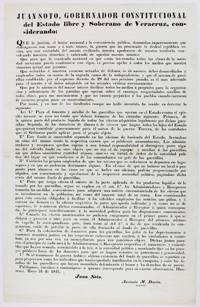
18472634Huatusco: May 31 1847. Very good. Broadside decree 17.5 x 11 inches. Printed on lined paper. Previously folded with a couple of very small losses at central fold. Minor wear at edges. Light dust soiling and toning. A rare broadside decree that establishes guidelines for the collection of funds and donations for guerillas and their families continuing the fight against the American invasion around Veracruz in 1847. The important port city had fallen two months prior and Santa Anna was routed at Cerro Gerro by Winfield Scott a month earlier. All that was left for Mexican forces in the region was sustained guerilla harassment of the American army. In this decree a separate account from regular government monies is established for funds raised and various government departments of the state of Veracruz are ordered to encourage donations and to publicize contributions and children are even encouraged to contribute food to the soldiers. A desperate plea for a desperate situation; dated May 31 1847 and signed in type by Veracruz state president Juan Soto in Huatusco the temporary location of the displaced government. OCLC locates no other copies. May 31 unknown
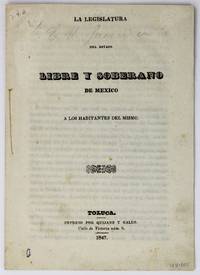
18472376Toluca: Impreso por Quijano y Gallo 1847. Very good plus. 11pp. Gathered signatures stitched. Small ink notation to title page minor scattered foxing. A rare monograph from the Mexican Congress to its people in the midst of the Mexican-American War. Here the Mexican government implores the populace for an end internal bickering and instead to concentrate on defeating the American forces who intend to subjugate not only Mexico but all of the Americas. The Mexican legislature also argues clearly for guerrilla warfare. The work was issued just after the Battle of Cerro Gordo and also printed as a broadside with priority of the two editions unknown.<br /> <br /> "Dated April 26 1847 this rare and virtually unknown pamphlet criticizes the way the central government is handling the war. The writers are especially upset over taxation and the fiscal policy. Not in Haferkorn" - Garrett & Goodwin. OCLC lists just a single copy of this title at the British Library.<br /> Eberstadt 160:339. Garrett & Goodwin p.86. Dorothy Sloan 24b:291. Impreso por Quijano y Gallo unknown
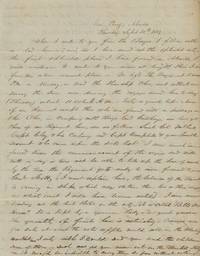
1847List2439Vera Cruz 1847. Folded letter to Wheeling Virginia with learly struck two-line datestamp with "Paid 10" manuscript rate and blue "Steam" handstamp of New Orleans on 1847 with an unusual “Steam†marking applied in New Orleans. Fine condition. Fine. A descriptive and interesting letter from Captain George W. Clutter of Wheeling Virginia describing the scenes and food in Vera Cruz in detail. Clutter had enlisted a detachment of thirty-two men in early 1847 in Monongalia County for service in the war who would eventually become known as the “Mountain Boys of Monongalia.†Clutter was promoted to the captaincy upon the resignation of John Tyler. The company sailed in June of 1847 on the Brig “Tuckahoe†from Old Point Comfort to Point Isabel where they marched to join General Taylor’s forces. <br /> <br /> This interesting letter written by Clutter from Vera Cruz describes the city and cuisine of Vera Cruz in detail. He writes “I am now boarding at the best Hotel in the city - it is called "Bells Stage House'. It is kept by a German lady in great grandeur. The quantity of fruit here is astonishing. Oranges are for sale at about the rate apples would sell in the Wheeling market. I only wish I could send you and the children some of them - such ones as you never eat in the United States as it would be impossible to carry them so far without rotting. <br /> <br /> As we get dinner here at 3 o'clock and no such thing as supper is known I stepped out this evening and obtained a 'cup of chocolate' and 'toast'. If an American or rather United States cook could taste such chocolate as the Mexicans make they never would attempt making the article again - and it is not so much in the simple making of the chocolate but it's in preparing it at the start - for every family even the provost understands making the article from the Cocoa.†Clutter offers additional details on troop movements and logistics of the campaign. Other letters by Clutter during the period are held at the West Virginia Regional History Center at WVU. <br /> <br /> Full contents follow:<br /> <br /> Vera Cruz Mexico<br /> Thursday Sept. 30th 1847<br /> <br /> When I wrote to you from the Brazos I felt in rather a bad humor and as I have arrived at this splendid city the first splendid place I have found in Mexico I will endeavor to write to you more at length than I did from the above named place. We left the Brazos at 5 o'clock P.M. on Monday on board the Steamship Ohio and without ever seeing the sun once during the voyage arrived here today Thursday about 11 o'clock A.M. - truly a quick trip. None of our Regiment except those who were favored with a passage on the Ohio in Company with Brig. Genl. Cushing are here yet. Those of our Regiment here are as follows: Lieut. Col. Withers Capt. Clay & his Company and Capt. Campbell & your humble servant who came upon the sick list. I am much improved since the commencement of the voyage and will with a day or two's rest be able to take up the line of march by the time the Regiment gets ready to move forward to join Genl. Scott. I must explain here the balance of the Regiment is coming in ships which may detain them two or three days in which event I will have become rested. I am now boarding at the best Hotel in the city - it is called "Bells Stage House'. It is kept by a German lady in great grandeur. The quantity of fruit here is astonishing. Oranges are for sale at about the rate apples would sell in the Wheeling market. I only wish I could send you and the children some of them - such ones as you never eat in the United States as it would be impossible to carry them so far without rotting. <br /> <br /> As we get dinner here at 3 o'clock and no such thing as supper is known I stepped out this evening and obtained a 'cup of chocolate' and 'toast'. If an American or rather United States cook could taste such chocolate as the Mexicans make they never would attempt making the article again - and it is not so much in the simple making of the chocolate but it's in preparing it at the start - for every family even the provost understands making the article from the Cocoa.<br /> <br /> In this City may be seen all the fashionable fine buildings and streets to be found in any city of the United States. Also all the various fancy and other goods now in the cities of the North & East can be found here. <br /> <br /> I have not yet found another horse since my arrival but must try and get one tomorrow. I hope my friend Pollock will receive the Mexican roan 'J.B.' which I sent him from Brazos. From hard usage he is not in very good order at present but with little care will be a very useful horse. Don't you ever ask the privilege of riding him however. Mind I know him well. <br /> <br /> As you have heard before this Genl. Scott is in the City of Mexico having sustained a very heavy loss in getting there. We expect to have considerable fighting between here and the City of Mexico ourselves. Time however will reveal all things. <br /> <br /> The soreness in my legs which I complained of is better but I fear exercise will cause it to return. What it will terminate in I am unable to say at present. <br /> <br /> I received a letter from you at this place today which was read with the usual interest notwithstanding it was written on the 13th August 17 days previous to the last one received at Sabinito which was dated 30th August.<br /> <br /> I have just bought five Vera Cruz papers which I will send you. They are half Mexican which half you can dispose of as you see proper. By the bye Mr. Fleeson promised to send you the Matamoros Flag regular. Tell me if you get it. <br /> <br /> Oct. 1st 1847<br /> <br /> This morning I have been all over the city. It would take me a month to describe all the curiosities I have beheld. I will save that for a private chat some long evening after my return. <br /> <br /> I would like to have you Dear little Ada to examine and see the curiosities to be seen. When papa comes home he will bring you some of them. <br /> <br /> My love to Sarah Ann. I would write longer to her had I time. My love to all my friends & acquaintances. <br /> <br /> I am Dearest Sarah<br /> your loving husband<br /> Geo. W. Clutter<br /> <br /> to<br /> Sarah M. Clutter. unknown
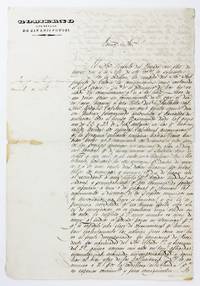
18475172San Luis Potosi: May 8 1847. About very good. 2pp. Previously folded. Short closed tear and minor loss at edges of old horizontal fold. Small area of light staining. Accomplished in a neat secretarial script. A fascinating letter from the governor of San Luis Potosí Ramon Adame that relates reports on the northern front of the Mexican-American War written two months after the Battle of Saltillo and just days after the American invaders had captured Puebla to the south. The letter is addressed to Ignacio de Mora y Villamil the General-in-Chief of Mexico's northern army presumably with the goal of spurring action from his forces with this new information. Adame discusses troop movements and defenses in Real de Catorce and Matehuala to the north and relates reports from Mexican officers that 10000 American reinforcements were approaching Saltillo and Monterrey:<br /> <br /> "Los referidos Capitanes aseguraron que la proxima entrante semana hacian sino habian hecho ya movimiento en direccion a estos puntos las fuerzas enemigas en numero de ocho a die mil hombres: que de Agua Nueva al Saltillo hay de cinco a seis mil y el resto en Monterey. En Matehuala hoy corre la voz unisona que dentro de quince o a los mas veinte dias deben llegarse por estas villas los enemigos."<br /> <br /> He then writes at length concerning the need to improve observation of the nefarious American enemies in order that news might be received quickly and directly and inquires as to how to pay for such agents:<br /> <br /> "Al vecindario a una finita para acordar medidas salvadores y principalmente que por carensia de fondos se espensare a una o dos personas que observase los moviminetos y direccion de los perfidos enemigos norte americanos no logre reuniera y ya la esperienca acreditada que no tienen efecto esta clase de emerciones. Lo que traslado a V.S. para conocimineto del E.S. Gobernador y con el fin de que se sirva decirme de que fondos puede hacerse el gasto para los agentes vigilan los operaciones del enemigo." <br /> <br /> A very interesting snapshot of the lack of resources and organization that led to rapid defeat in the Mexican-American War. May 8 unknown