1 575 résultats
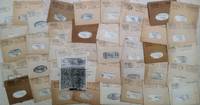
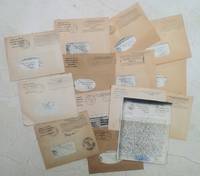
9009During WW II V-mail system was adopted by the US Post Office in 1942 to save space. The weight of 150000 letters was reduced from 2575 pounds to a mere 45. V-mail consisted of miniaturized messages reproduced by microphotography. Individual facsimiles were reproduced in the States and then delivered to the addressee. Lot of 12 War & Navy V-Mail from WW II from one officer to his family. All dated between 1943 and 1945 each about 4 x 5" These 12 letters are from Capt. W.H. Minnich in original transmittal envelope with post marked date. Mostly personal correspondence to family but some interesting comments: December 18 1944 ".This war is a terrible thing and I for one shall be glad when its all over." ".It won't be long until it gets cold again and I hope by then the Germans will have enough. unknown books
9008During WW II V-mail system was adopted by the US Post Office in 1942 to save space. The weight of 150000 letters was reduced from 2575 pounds to a mere 45. V-mail consisted of miniaturized messages reproduced by microphotography. Individual facsimiles were reproduced in the States and then delivered to the addressee. Lot of 42 War & Navy V-Mail from WW II from one officer to his family. All dated between 1943 and 1945 each about 4 x 5" These 42 letters are from Capt. W.H. Minnich in original transmittal envelope with post marked date. Mostly personal correspondence to family but some interesting comments: dated May 21 1945 ".All I want now is for the war to end and then an early return home. I hope to do that in another year after all these Germans and Japs can't fight forever. unknown books
199128192Chiang Mai: Trasvin Publications 1991. Paperback. Very good. 175pp. internally fine with clean text that has no underlining highlighting or notes. <br/><br/> Trasvin Publications paperback books
1959173fdiBangkok: Chalermnit Bookshop 1959. Octavo white cloth hardcover gilt letters 300 pp. Very Good with light foxing age darkened spotting in a Very Good mylar protected dust jacket with light edgewear. Chalermnit Bookshop, (1959). hardcover books
1946630New York; Bethesda; Washington D.C.; Philadelphia 1946. About very good. Scrapbook; 28 leaves filled with a variety of printed and photographic materials. Original embossed cloth boards string tied. Items affixed to album leaves with tape; many items loose and laid in. Leaves tanned; light wear to contents. A scrapbook of diverse materials compiled by a woman named Annelle Hutton while she served in the Naval Hospital Corps on the Eastern seaboard during World War II. Hutton was a member of the WAVES Women Accepted for Volunteer Emergency Service and specialized in aural rehabilitation. The materials in her scrapbook comprise original and commercial photographs news clippings of stories about Hutton and her colleagues printed ephemera from her training and service as well as from social events she attended and other leisure activities. unknown books
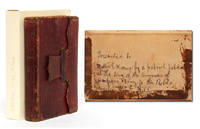
3256Harper's Ferry. Pocket New Testament bound in red sheep over card measuring 3 x 4.25". Extremities somewhat rubbed but in overall solid condition. Offsetting to pastedowns. Various selections dog-eared but no markings to internal text. Multiple ownership signatures from the prominent Koonce family most notably the inscription to the front endpaper: "Presented to Mollie E. Koonce by a patriot soldier at the line of surrender in Harper's Ferry to the Rebels under Gen. Hill." Other signatures include Howard Koonce Alice R. Koonce and Peachie Koonce. A unique artifact that speaks to women's presence influence and the risks they faced in wartime.<br/><br/>The Mollie E. Koonce of the ownership is possibly Mary E. Koonce daughter of George Koonce an entrepreneur and statesman; several other family members' names also appear in the Bible Howard who went on to become a physician and Estelle May "Peach" Koonce. History has remembered and recorded George Koonce. The proprietor of a Harper's Ferry general store Koonce & Son he was a prominent Unionist and delegate to the 1861 Wheeling Convention protesting the secession and arguing for the creation of a separate state West Virginia a Northern and Unionist region carved out of Virginia to which he ultimately served as senator. What remains lesser known are the experiences of the women in this family who were clearly present for the traumatic events of the Harper's Ferry battle and surrender and who were identifiable as part of an activist family. They faced tremendous risk yet it is likely as with women on both sides that they continued maintaining homes and businesses and may have even been volunteers. The fall of Harper's Ferry was an especially harsh loss for the Union 44 killed 47 wounded 12419 captured. In her 1862 account The Battle of Harper's Ferry as a Woman Saw It nurse Mary Clemmer Ames reported that "traitors gathered around us even while we watched. Besotted blear-eyed Virginia cravens squatted on stones and stood with hands in their pockets estimating the probabilities of a fight.Beside these cowards stood women watching trembling for the safety of their homes.young girls whom the fortunes of war had given a temporary home here wondered if with the enemy in they would ever get out." What was Mollie's role in the midst of this and what brought her to the line of surrender where she could receive this gift To what extent was the "patriot soldier" passing along his Bible in request for her prayers versus giving it to her a sign he prayed for her safety<br/><br/>A unique piece of women's Civil War social history raising questions deserving of further research.<br/><br/>U.S. Census Records 1860-1900. George W. Koonce Family Papers at West Virginia University AM.0407. unknown books
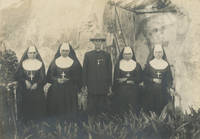
1900List518Most Cuba or Jacksonville 1900. Silver gelatin or albumen photographs various sizes ranging from 3 x 3 to 6 x 8 most captioned to verso. With handwritten manuscript four leaves discussing various diseases. The Spanish-American War was the first war in which nurses formed their own dedicated units as well as the first war in which they were accepted within military hospitals. While no nurses died in battle 153 died during the war from disease. Nurses were responsible for both treating soldiers as well as maintaining sanitary conditions within the camps. Conditions were often poor leading some to work until they were too sick to continue. <br /><br /> The current collection of photographs documents the experiences of a Mrs. Waters who was originally from Groton Massachusetts. The collection begins with a couple early photographs including a portrait as a young woman and a cyanotype of one of Waters' leprosy patients at Johns Hopkins Hospital in Baltimore. The next section shows Waters' training in Jacksonville Florida with either the Fourth or Seventh Army Corps at what was called Camp Cuba Libre both Corps trained there in 1898. The photographs of Jacksonville show life around the military camp and environs with some notable photographs of African-American inhabitants of the region. Three photographs quite notably show the Congregation of American Sisters a small group of American Indian nuns led by Reverend Francis Craft. The photographs taken in Cuba are notable for their portrayal of local life. Several photographs of military installations are taken around the "trocha" or line established by General Valeriana Weyler from Mariel to Majana. Another notable photograph is a cabinet card of a large group of nurses taken by the Havana photographer R. Testar. <br /><br /> The group overall shows very early photographic records of military nurses in training as well as a scarce photographic record from a woman in a combat situation. The photographs are generally well preserved in very good to excellent condition with some light fading. Accompanying the photographs is a four page manuscript essay presumably by Waters discussing leprosy as well as the booklet Spanish Phrase Book for American Soldiers and Sailors published by the National Relief Commission of Philadelphia. <br /><br /> Offered in partnership with Daniel / Oliver Gallery. books
16010CIVIL WAR. Western Sanitary Commission. YEATMAN JAMES E. letter to Miss Mary E. Howe in Cambridge Massachusetts. Bureau of Western Sanitary<br/>Commissions. St. Louis Missouri. April 2 1862. 8.25 x 8.5 inches folded in half. 4 pp. Postal cover 3c Washington postage stamp cancelled Saint Louis .<br/><br/>Detailed and interesting letter from James Yeatman of the Western Sanitary Commission who thanks Miss Howe for sending her box of clothes and reports that "we are progressing fairly with our work and each day something new is developed that requires renewed efforts--we really fear that the public and our good friends will tire of our repeated appeals . so far they have responded in a most liberal manner . " He discusses the case of the one hospital steamer they have; he notes it has three surgeons twelve male and five female nurses. Yeatman speaks of the generous contributions of the "ladies of New England especially Massachusetts" and the hopes he has for a second floating hospital. He notes that a major battle is imminent in the Tennessee area and speaks of sending supplies. He thanks her for directing the attendance of Mr. Bernard to his commission and finally asks for more clothes including vests and pants.<br/><br/>"Miss Howe" the recipient of the letter was Mary Eleanor Howe who was born June 27 1817 in Worthington Massachusetts. Her father was Judge Samuel Estes Howe 1785-1828 a noted abolitiionist. Her mother was Sarah Lydia Robbins. Mary Eleanor never married but lived witH her mother and school teacher sister and servants in Cambridge until her death on August 13 1897. She is buried in Forest Hills Cemetery in Boston. http://www.cambridgehistory.org/content/dr-estes-howe-citizencambridge The Sanitary Commission was a private relief agency created by federal legislation on June 18 1861 to support sick and wounded soldiers of the United States Army during the Civil War. It enlisted thousands of volunteers many of whom were women.<br/>The Western Sanitary Commission of which Yeatman was president was a private agency based in St. Louis and operated in the west to help the Army deal with sick and wounded soldiers. Led by abolitionists it focused more. on the needs of Freedmen. It was founded in St. Louis August 1861 under the protection of General John C. Fremont and under the leadership of Reverend William Greenleaf Eliot 1811-1887 as well as James E. Yeatman 1818--1901 . Born in Tennessee Yeatman moved to St. Louis in 1842 and established a branch of a Nashville iron manufacturing facility. In 1850 he opened a commission house and became one of the founders of the Merchants' Bank. Though once a slave holder Yeatman was a strong supporter of the Union cause. A major activity of the Western Sanitary Commission was acquiring adequate stocks of medicines and medical supplies for the hospitals run by the U.S. Army. Working with Dorothea Dix he also took charge of finding women to be civilian nurses and nurses' aides in Army facilities. unknown books
17000Original WW II Poster from 1942 reads "Women in the War We Can't Win Without Them" Extra large size poster 29" x 41" in. Shows a woman factory worker wearing overalls or apron riveting with both hands a weapon that looks like a torpedo. This highly visual poster was promoting women in the wartime workforce it was produced in 1942 by the War Manpower Commission. At the time "Women in the War" was one of the most widely distributed images of a woman laboring in war production. The poster is in red blue and black poster. Publisher was the United States. Government Printing Office. Place of Publication: "Washington D.C." By 1943 when the labor shortage was most acute the two agencies worked together in concerted campaigns targeting employers to hire women and women to become 'production soldiers'" Yellin Our Mothers' War p. 44. Women laboring in factories even in the service of the war effort was controversial. "Despite the tide of public opinion against working wives War Manpower Commission director Paul McNutt concentrated on on patriotism. The campaigns glamorized war work always showing that women could maintain their femininity and still be useful" Yellin pp. 45-46. Examples of this important poster are held at numerous institutions including the Library of Congress and MOMA. At lower left corner of sheet: "War Manpower Commission Washington D.C." Copies in very good condition like this one are uncommon. unknown books
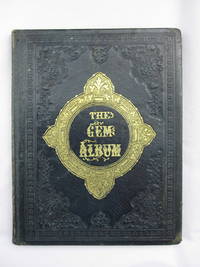
16539Friendship album of a young woman in Toledo Iowa kept from 1863-1869. "The Gem Album." New York: Leavitt & Allen n.d. Original black leather boards. 7 x 5 ½ in. Embossed front and back covers gilt-edged pages gilt detail on front cover and spine. 48 pages. Includes 3 full-page engravings of family scenes such as children blowing bubbles "The Happy Family" and a girl with a small dog. 16 handwritten notes and inscriptions to the owner dated from 1863 to 1869. Spine is lightly worn. Very good condition.<br/><br/>Friendship album of Lizzie Armstrong a young woman living in Iowa during the Civil War period. Many messages include good wishes of happiness and friendship such as "Whoever should inscribe sentiments on these pages let them be a true copy of the heart and mind the holy feelings of true Friendship." Others address her as "Cousin Lizzie" and exclaim "Forget thee No I never shall" Some notes also express darker elements of grief and sadness most likely from friends serving and dying in the Civil War. One friend express deep sentiments of thanks for Lizzie's friendship during a period of "sadness and grief": "You have my heartfelt thanks for you many kindness sic which have to some extent lightning my sorrows." An entry from Lizzie's brother in November 1865 also expresses grief over lost friends who left inscriptions in the album: "Even now I read the beautiful lines of one whose angel spirit has returned to God who gave it; other will follow but on memory's table will they be treasured with a hearts fondest affection." Over 76000 men from Iowa served in the Union Army during the Civil War and at least 13000 perished in battle and from disease. This devastating number of casualties impacted people from all walks of life; and affected many young women who were left without their sweethearts and husbands. unknown books
1912501201912. Wilson George Grafton 1863-1951. Naval War College. International Law Situations with Solutions and Notes 1912. Washington: n.p. 1912. 206 pp. Ex-library with stamps location label to front cover. Gilt lettered cloth some shelfwear. Internally clean. USD 30. Contents: I. Merchant vessels and insurgents. II. Air craft in war. III. Cuba neutral. IV. Strategic areas. V. Taking coal in neutral port. VI. Conversion of merchant ships into ships of war. unknown books
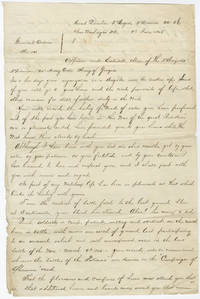
186523320<p>Brigadier General William Cogswell offers a dramatic farewell message to the troops under his command in the Army of Georgia. A Salem Massachusetts lawyer Cogswell turned his law office into a recruiting station after learning the 6th Massachusetts had been attacked in Baltimore. He was first in last out in his Civil War service: In 24 hours he raised the first full company of the war Company C 2nd Massachusetts Volunteers and his brigade fought in the final battle of the war in Bentonville North Carolina. Despite his relative obscurity Cogswell's eloquence rivals the great farewell messages in military history.</p> <b>WILLIAM COGSWELL. CIVIL WAR.</b>Manuscript Document Signed. General Orders No. 14. Farewell to the Army of Georgia Near Washington D.C. June 9 1865. 1 p. 7¾ x 12 in.<p><b>Complete Transcript</b></p><p><i> Head Quarters 3rd Brigade 3d Div. 20th Army Corps </i></p><p><i> Near Washington D.C. 9th June 1865</i></p><p><i>General Orders</i></p><p><i>No. 14</i></p><p><i>Officers and Enlisted Men of the 3rd Brigade 3rd Division 20th Army Corps Army of Georgia.</i></p><p><i>In a few days your organization will be broken up. Some of you will go to your homes and the civil pursuit of life while others remain for still further duty in the West. </i></p><p><i>Your noble record the history of the deeds of valor you have performed and of the part you have taken in this "War of the great Rebellion" now so gloriously ended have preceded you to your homes while the West knows them already by heart. </i></p><p><i>Although I have been with you but six short months yet by your valor by your patience by your fortitude and by your courtesies I have learned to love and respect you and I shall part with you with sorrow and regret. </i></p><p><i>No part of my military life has been so pleasant as that which links its history with yours. </i></p><p><i>From the earliest of battle fields to the last grand blow at Bentonville N.C. your blood has stained Alas! too many a sod. </i></p><p><i>Quick soldierly in camp patient willing and obedient on the march brave in battle with never an inch of ground lost participating to an unusual extent and with unsurpassed valor in the last battle of the War – March 19 1865 – your record will be remembered wherever the "battles of the Potomac" are known or the "Campaign of Sherman" read. </i></p><p><i>That the pleasures and comforts of home may attend you that go that additional honor and laurels may await you that remain that an Almighty and good God may forever lead you in ways of pleasantness and paths of peace that industry and virtue may crown you with their rewards that all that good brave men deserve may be yours that those who remain may shortly be sent to home and friends and that the blessings of a kind heaven may always be with you wherever you go is the last best wish of your Brigade Commander.</i></p><p><i> Wm Cogswell</i></p><p><i> Bvt. Brig Gen Commanding</i></p><p><b>Historical Background</b></p><p><b>William Cogswell</b> 1838-1895 was the son of the founder of the Massachusetts Republican party. He left Dartmouth College and spent two years on a square-rigger sailing around the world. When he returned he attended Harvard Law School and became a lawyer in Salem Massachusetts. When word reached Salem that the 6th Massachusetts had been attacked in Baltimore on April 19 1861 Cogswell turned his law office into a recruiting station and raised Company C of the 2nd Massachusetts Volunteer Infantry in 24 hours. He went on to become its commander.</p><p>Though the regiment suffered heavy losses Cogswell's company distinguished themselves well at the Battle of Antietam. Cogswell was promoted from company to regimental commander. During the Battle of Chancellorsville Cogswell was seriously wounded which resulted in his missing the Battle of Gettysburg where the 2nd Massachusetts lost another commander resulting in Cogswell's promotion to colonel. Cogswell was brevetted brigadier general on December 15 1864 and took command of the 3rd brigade 3rd division of the 20th Corps a part of the Army of Georgia that participated in Sherman's Savannah Campaign better known as the March to the Sea.</p><p><b>Condition</b></p><p>Very good. Lower half of left margin somewhat tattered affecting only one word go edge wear at upper right half some toning. Superb for display.</p> books
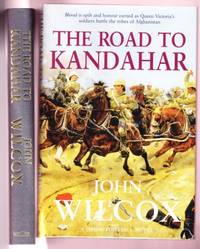
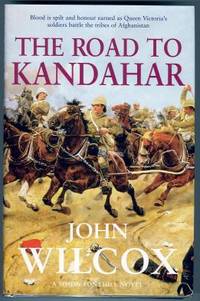
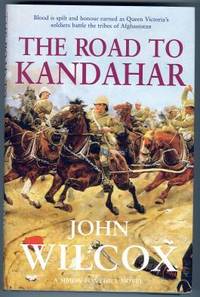
200460527London: Headline 2004. First edition first prnt. Signed by Wilcox on the title page. Additionally Wilcox has written "Here's Simon Fonthill!" above his signature. One of an undetermined number as such. Unread copy in Fine condition in a Fine dustjacket with an archival cover. Wilcox's first novel after two books of non-fiction introducing the Simon Fonthill series. Signed By Author with Quotation. First Edition. Hardcovers. Fine/Fine. 8vo - over 7¾" - 9¾" tall. Headline Hardcover books
200551938London: Headline 2005. First edition first prnt. Limited issue of 250 numbered copies signed and dated "17/02/05" with the holograph quotation "Fonthill again!" by Wilcox on the title/limitation page as issued. Copy #34. Limitation slip laid in as issued. Unread copy in Fine condition in a Fine dustjacket with an archival cover. The limited issue was prepared three weeks in advance of the book's trade publication date of March 7 2005. The second novel in Wilcox's Simon Fonthill series. Signed & Dated by Author. First Edition. Hardcovers. Fine/Fine. 8vo - over 7¾" - 9¾" tall. Limited Edition. Headline Hardcover books
20054052London: Headline 2005. First edition first prnt. Limited issue of 250 numbered copies signed & dated "17/2/05" by Wilcox on the title page and with his holograph inscription "Fonthill again!" Copy #223. This copy lacks the limitation slip. Unread copy in Fine condition in a Fine dustjacket with an archival cover. The limited issue was prepared three weeks in advance of the book's trade publication date of March 7 2005. The second novel in Wilcox's Simon Fonthill series. Signed & Dated by Author with Quotation. First Edition. Hardcovers. Fine/Fine. 8vo - over 7¾" - 9¾" tall. Limited Edition. Headline Hardcover books
2005305103London: Headline 2005. First edition first prnt. Limited issue of 250 numbered copies signed and dated "17/02/05" with the holograph quotation "Fonthill again!" by Wilcox on the title/limitation page as issued. Copy #164. Limitation slip laid in as issued. Unread copy in Fine condition in a Fine dustjacket with an archival cover. The limited issue was prepared three weeks in advance of the book's trade publication date of March 7 2005. One in Wilcox's Simon Fonthill series of novels. Signed By Author with Quotation. First Edition. Hardcovers. Fine/Fine. 8vo - over 7¾" - 9¾" tall. Limited Edition. Headline Hardcover books
1997SKU1025562The Texas Provincial Kitchen Ltd 1997-09-01. First Edition. PAPERBACK. Good. 0965765806 First Edition. Clean has a good binding no marks or notations. The Texas Provincial Kitchen, Ltd paperback books
200234070Cambridge:: Harvard University Press. Fine in Near Fine dust jacket. 2002. Hardcover. 0674008936 . First edition. Fine in an about fine dust jacket. . Harvard University Press, hardcover books
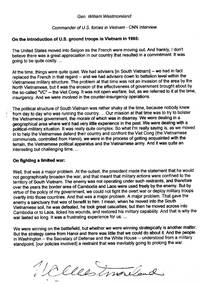
5233U.S. General. Head of all US Forces during the Vietnam War. Great content. Headed: "Gen. William Westmoreland - Commander of U.S. forces in Vietnam - CNN Interview." In part: "We had in fact replaced the French in that regard -- and we had advisers down to battalion level within the Vietnamese military structure. The problem at that time was not an invasion of the area by the North Vietnamese but it was the erosion of the effectiveness of government brought about by the so-called "VC" -- the Viet Cong. It was not open warfare . At the outset the President made the statement that he would not geographically broaden the war and that meant that military actions were confined to the territory of South Vietnam. The enemy was not operating under such restraints.That gave the enemy a sanctuary. We were winning on the battlefield but whether we were winning strategically is another matter." Signed in black ink " W. Westmoreland". Great content and in excellent condition. unknown books
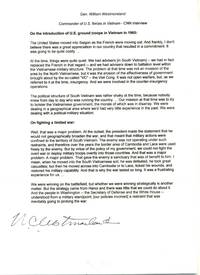
5231U.S. General. Head of all US Forces during the Vietnam War. Great content. Headed: "Gen. William Westmoreland - Commander of U.S. forces in Vietnam - CNN Interview." In part: "We had in fact replaced the French in that regard -- and we had advisers down to battalion level within the Vietnamese military structure. The problem at that time was not an invasion of the area by the North Vietnamese but it was the erosion of the effectiveness of government brought about by the so-called "VC" -- the Viet Cong. It was not open warfare . At the outset the President made the statement that he would not geographically broaden the war and that meant that military actions were confined to the territory of South Vietnam. The enemy was not operating under such restraints.That gave the enemy a sanctuary. We were winning on the battlefield but whether we were winning strategically is another matter." Signed in black ink " W. Westmoreland". Great content and In excellent condition. unknown books
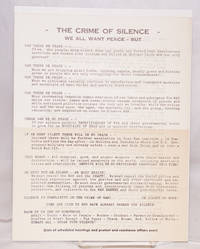
1967179087San Francisco: Western Division Mobilization Against War 1967. 8.5 x 11 inch mimeographed leaflet mildly creased from folding to fit a standard envelope lightly toned below cerase else good condition. Inspirational text one side introduction to the Mobilization and meeting schedule on the other. Western Division, Mobilization Against War unknown books
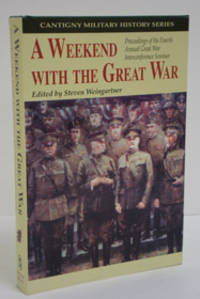
19971773588Cantigny 1997. First Edition. Hard Cover. Near Fine/Near Fine. First edition. 1997 Hard Cover. 296 pp. This volume examines the crisis of 1914-18 in papers and related texts presented at a 1994 seminar jointly sponsored by the Great War Society and the Western Front Association. The contributors from the United States Canada Great Britain France Belgium and Russia explore a range of topics including the mysterious death of German fighter ace Manfred von Richthofen the "Red Baron" and the even more mysterious life of British master spy Sidney Reilly; American heroes and Canadian prisoners; German soldiers; French fortifications at Verdun; the doomed cause of Russian liberals; the Western Front as a bizarre parody of urban life and the war itself as a radical expression of cultural modernism. The book features excerpts from panel discussions and question-and-answer sessions in which the seminar's attendees took part. The result is a work that sheds much light on a dark but fascinating chapter in twentieth-century history. Cantigny hardcover books
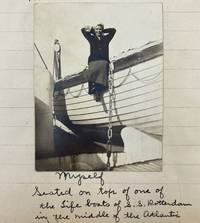
19141820Various places in Germany mostly Darmstadt as well as England Holland the Atlantic Ocean New York and Allentown 1914. Good plus. 144pp. with ten original photographs and printed document mounted at rear. Quarto commercial journal. Black cloth boards edges dyed red. Spine perished boards attached with amateur tape repairs. Text block solid. Minor offsetting from photographs; a bit of soiling to first leaf; light even tanning. Accomplished for the most part in highly legible hand; approximately 17500 words in total. A remarkable manuscript travel journal that documents the European trip of a 22-year-old Pennsylvania woman its interruption by the outbreak of World War I her subsequent stranding in Germany and her trials in securing passage back to the United States. Anna F. Weil b. about 1892 the daughter of an Allentown grocer John Weil departed New York on June 29 1914 aboard the S.S. Rotterdam a 3400 passenger luxury cruise liner operated by the Holland America Line. She arrived in Rotterdam Germany on July 9th and proceeded to connect with family and sightsee in Germany and the Netherlands with plans to proceed to Switzerland and Germany which were cut short by the declaration of war between Germany and England:<br/><br/>"Wed. July 29. To-day war was declared I have many postal cards written to send to American but was told not to send them as they would not reach their destination so all communication with outside countries is cut off. The harbor is closed and no ships can leave or enter German ports. The English cut the German cable a few days ago before war was declared so now we can't even send a telegram from Germany." p.68<br/><br/>At first the war is present in daily life but still seems some distance from it:<br/><br/>"On Sunday Aug. 23. I saw the first wounded French soldiers saw a wagon full but there were well treated by the Germans and the people expressed pity for them as they were a sad looking party. We were at Frankenstein's Castle a ruin on the mountain which can be seen way in the distance from Darmstadt. It was a very nice ramble through the woods and part of the castle is used as a restaurant where we had some thing to eat and drink before resuming our ramble in and about the castle. When at the top of the town it was nice to look over the tops of the trees over the fields and see the villages and the city away off in the distance." <br/><br/>The reality of the situation however quickly becomes more evident and more pressing:<br/><br/>"Aug. 28. Friday. Received a letter from Angeline dated July the 23d. also one from Frank dated August the 4th. Saw hundreds and hundreds of horses which are taken and sent to battle with the men. Saw many companies leaving it was a beautiful sight to see them march as one man. As they passed through the streets the women came and greeted them and gave them flowers. Horses wagons men every thing was covered with the acorn leaves the German emblem of victory and as the women gave the flowers they were placed among the acorn leaves and so they left their homes families and country with flowers and song and their flags waving high above them. It was a beautiful and inspiring sight to see them go but to think of their return made one's heart grow sad. One company that I saw Company 115 had but 30 men left after the battle the rest were dead or wounded."<br/><br/>Throughout the account her German heritage shapes a favorable view of the Germans in the war:<br/><br/>"In Belgium the Germans were very much ill treated they had to flee the country in 1 hours notice and leave every thing back Elizabeth Buehler and her brother as well as other Germans who were living in Belgium in the city of Antwerp had to flee for their lives and all their belongings were taken from them they arrived in Darmstadt with nothing but what they had on their bodies. When the war first broke out the Russians who were in Germany threw bombs and tried various ways of doing mischief. So all were given a chance to leave and got to their own country. Those who refused and did any mischief were taken into custody and placed under guard until the war is over. Those who did any wrong were sentenced to death were shot. This was at least more human that the way some of the Belgians and Russians treated and mutilated the Germans when they had done no wrong and deserved no punishment. War is war and there are rules which we cannot change and are considered honest in warfare but I don't think it right to torture or mutilate a wounded soldier whether friend or foe."<br/><br/>She remained with family at an estate on Dieburger Strasse in Darmstadt Germany until she was able to secure an emergency passport from the American Consul in Frankfurt on September 15th. The return passage was fraught as Holland America misplaced her reservation the ship was delayed and she was forced to find temporary lodgings in Rotterdam when she arrived on October 1st:<br/><br/>"When we got there the proprietor said all was taken this made the porter cross and he said he would find some kind of place for us but we were not going to take any kind of a make shift so we turned and hurried back to the station the porter took hold of my arm and tried to detain us but I broke loose and Mrs. Kramer and I ran as fast as could when we reached the station we were just in time to catch the other four who were driving away in carriages. The eldest one saw us running and stopped the team and waited for us. We got in and such a time till we found lodgings. Every thing was taken which was due to so many Americans and fleeing Belgians. We succeeded in finding a place at 2.30 am where all six of us stayed. Then there was trouble with the driver and one of the Americans went out and called a police-man and settled the trouble and we retired at 3am."<br/><br/>She eventually landed back in The States after a return trip that saw rough seas and an intense scrutiny of passengers upon landing in New York:<br/><br/>"At Staten Island the doctor came to our ship with a yacht flying the yellow flag. Here we stopped for some time the mail ship came and all mail bags were given over to this ship. Then another yacht crowded with American custom officers arrived on the scene and boarded our ship. Then we all had a hurried lunch as there was no time for supper. All had to go on deck until the dining room was in readiness for the officers. It was dark by this time and the ship under way again. When all was ready we had to stand in line with our yellow tickets. Only a few at a time were allowed to enter the dining-room. When once inside we had to look about for the table bearing the number of our ticket. Here we were interviewed by the officer at that table. Some people had a great deal of trouble and were sent from one table to another. Others were refused admission into the United Sates and some had to go to Ellis Island."<br/><br/>The rear pages of the journal are illustrated by 10 mounted original photographs of her initial journey family some sightseeing and her return passage; also tipped in are her emergency passport and a typed letter from the American consul. Overall the journal is a detailed and eventful original woman's travel manuscript as well as a rich primary record of an American civilian caught in Europe during the outbreak of the Great War. A partial transcription with additional excerpts is available upon request. unknown books
178063128Head Quarters Bergen County NJ 1780. Folio one page approximately 125 words in part: "I perceive . that you had collected about two hundred Cattle more and that a further number might be obtained . I cannot of right command the services of the militia . let the commanding officers know how distressed the Army has been and is likely to be for provisions and that it will be rendering splendid service to us and distressing the enemy to remove the Cattle from those parts of the Coast which furnish the New York Markets." Very good. Browned one small piece detached one word of text easily repaired. After Washington's victory at Monmouth June 1778 during which battle Forman had served as an advisor to Charles Lee the war settled into stalemate with Washington's army in New Jersey and the British forces content to remain in New York both sides keeping an eye on each other while trying to provide for their soldiers the American forces suffering deprivation similar to that of Valley Forge. Meanwhile on the day this letter was written word reached Washington of the complete rout of Horatio Gates and his troops at Camden South Carolina opening Virginia to British invasion from the South. Bolstered by American victories at Kings Mountain Oct. 1780 and Cowpens Jan. 1781 and the depletion of Cornwallis's army at its victory over Nathaniel Green at Guilford Court House Washington in conjunction with his French allies moved south to envelop Yorktown earning the British surrender in October 1781 effectively ending the war. General David Forman 1745-1797 born and raised in Monmouth County New Jersey was appointed colonel of a New Jersey regiment that reinforced Washington at New York in June 1776. After suppressing a loyalist uprising later that year during which time he earned the nickname "Devil David" he was chosen to lead a regiment in the Continental army and in 1777 was commissioned brigadier general to lead the New Jersey militia commanding that force in the battle of Germantown Oct. 1777. Disagreements with the New Jersey legislature led to his resignation from that command and he spent the rest of the war running listening posts especially along the coast of New Jersey providing Washington with intelligence on the movements of the British fleet and army a service he was providing at the time of this letter. see DAB Tench Tilghman 1744-1786 born and raised in Talbot County Maryland graduated from the precursor to the University of Pennsylvania in 1761 taking up a mercantile business until the outbreak of the revolution. After serving briefly as a captain in the army he joined Washington as a volunteer and served continuously as an aide-de-camp to the general for the balance of the war. "The amount of secretarial work in addition to military duties that he performed for Washington was prodigious" DAB and he was granted a regular commission of lieutenant-colonel in 1781. After the victory at Yorktown Tilghman was chosen by Washington to carry the announcement of the surrender of Cornwallis to the Continental Congress. Provenance: When recently purchased the letter was in an old frame and removal revealed an autograph note inside the backing included here as follows: "This letter was bought by me about 1860 of Miss Brown residing at 92 Columbus Street Albany New York. She was a sister of an old minister of St. Peters Church. This Miss Brown was a client of Orlando Meads and myself and found this letter in a barrel in the garret of the home occupied by her sister at Manalapan New Jersey formerly owned by General David Forman. signed Dexter Reynolds / Albany Sept. 7 1902. Presented to my son Marcus T. Reynolds." A newly discovered Washington letter shedding light on the general's relationship to state militias and his concerns for providing for his troops while disrupting the supply lines of the British. Not in Fitzgerald or the Founders Online from the National Archives which lists 57 other Washington letters to Forman 1777-1782 showing a gap from 24 July 1780 to 17 May 1781 and two others post-war. 9836. <br/><br/> unknown books
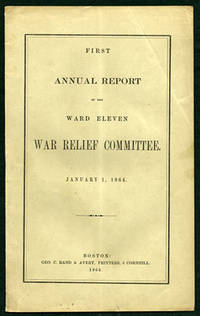
186427535Boston: Geo. C. Rand & Avery Printers 1864. First edition. Stitched paper wrappers. A very good or better copy folded. 14 pp. 8vo. A report on the progress of supporting the families of those serving in the Civil War living in Ward Eleven in Boston Massachusetts now the South End. Scarce. OCLC shows a single copy at the Mass. Hist. Soc. Geo. C. Rand & Avery, Printers unknown books