11 490 résultats
1864370496Washington D.C.: Government Printing Office 1864. 38th Congress 1st Session Senate Rep. Com. Nos. 63 and 68. 128pp. Bound with: Report . with the accompanying testimony. 34pp. 4 wood-engraved plates. 8vo. Publisher's cloth. Minor fading to spine. 38th Congress 1st Session Senate Rep. Com. Nos. 63 and 68. 128pp. Bound with: Report . with the accompanying testimony. 34pp. 4 wood-engraved plates. 8vo. An influential and damning report on the Battle of Fort Pillow in Tennessee which ended with a massacre of Union soldiers many of them African Americans serving in the 6th U.S. Colored Artillery attempting to surrender by soldiers under the command of Confederate Major General Nathan Bedford Forrest. <br/><br/> Government Printing Office hardcover
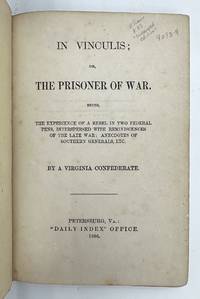
1866370497Petersburg VA: Daily Index" Office 1866. Second enlarged edition. 2 216pp. 12mo. Publisher's brown pebbled cloth a bit cocked some wear and spotting. Minor foxing. Second enlarged edition. 2 216pp. 12mo. Second enlarged edition after the first of the previous year. A famous and highly regarded wartime account. Based on the author's experiences in two federal prisons Point Lookout and Elmira after his capture at the battle near Petersburg. The first edition of this book was the last or next to last book printed in the Confederacy. Keiley a noted journalist and lawyer also wrote THE FALLING FLAG describing the Confederate retreat from Petersburg to Appomattox. A contemporary review of this work quoted by Harwell EVENING COURIER for March 24 1865 states that Keiley's narrative "is invaluable in arriving at accurate conclusions respecting the opinions hopes prospects and designs of the Northern people in their war for subjugation.It has all the thrilling interest of a legend of romance." Howes K27; Nevins I p.195; Sabin 37169; Confederate Hundred 50 1st ed; Crandall 2637 1st ed; In Tall Cotton 149 1st ed Daily Index" Office unknown
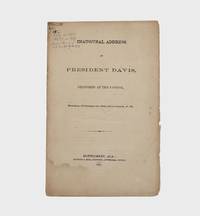
1861377687Montgomery: Shorter & Reid 1861. First edition. 8pp. 8vo. Unbound. Minor staining. Early 20th century price annotations on upper corner of the title in ink and pencil. First edition. 8pp. 8vo. Once secession became a reality in late 1860 the rebellious states had to decide what form of government they would take. As in 1787 when the original thirteen states wove themselves into the United States through a constitution the South wove itself into a Confederacy by creating their own constitution. In early February 1861 representatives of the six seceded states Alabama Georgia Louisiana Mississippi South Carolina and Florida met in Montgomery to draft a provisional constitution and officially establish the Confederate States of America. The document would be unanimously ratified on February 8th and the following day Jefferson Davis would be unanimously elected to the provisional presidency of the Confederacy. Davis was not among the members of the convention however having returned to Mississippi from Washington after resigning his Senate seat. He immediately traveled to Montgomery delivering his inauguration address on February 18 the same day that the delegates signed the provisional constitution.<br /> <br /> Delivered on the steps of the Capitol building Davis invoked the principles of the 1776 Declaration of Independence to justify the secession and independence of the southern states: "It illustrates the American idea that governments rest on the consent of the governed and that it is the right of the people to alter or abolish them at will whenever they become destructive of the ends for which they were established. The declared purpose of the compact of the Union from which we have withdrawn was to "establish justice insure domestic tranquillity provide for the common defense promote the general welfare and secure the blessings of liberty to ourselves and our posterity;" and when in the judgment of the sovereign States composing this Confederacy it has been perverted from the purposes for which it was ordained and ceased to answer the ends for which it was established a peaceful appeal to the ballot box declared that so far as they are concerned the Government created by that compact should cease to exist."<br /> <br /> His address continued by further linking the actions of the seceding states to the Founding Fathers noting that the provisional constitution they have drafted was in the spirit of the original: "We have changed the constituent parts but not the system of government. The Constitution framed by our fathers is that of these Confederate States. In their exposition of it and in the judicial construction it has received we have a light which reveals its true meaning."<br /> <br /> He defended secession by arguing that their sole purpose is the protection of their social and economic system though does not mention the word slavery and "actuated solely by the desire to preserve our own rights and promote our own welfare the separation by the Confederate States has been marked by no aggression upon others and followed by no domestic convulsion."<br /> <br /> Just a few weeks later on the steps of the Capitol in Washington Abraham Lincoln would deliver his own first inaugural address: "In your hands my dissatisfied fellow-countrymen and not in mine is the momentous issue of civil war . We are not enemies but friends. We must not be enemies. Though passion may have strained it must not break our bonds of affection. The mystic chords of memory stretching from every battlefield and patriot grave to every living heart and hearthstone all over this broad land will yet swell the chorus of the Union when again touched as surely they will be by the better angels of our nature." <br /> <br /> While Lincoln's inaugural is quite common published as a government document the first separate printing of Davis's inaugural address although well represented institutionally is quite scarce on the market. Parrish & Willingham 895; Crandall 607; Sabin 15274 Shorter & Reid unknown
a88340Nashville 1864 first edition John T. S Fall. 12mo. 8p. original wraps. Alphabetical listing of Names and of Subjects. Vertical crease throughout. Good splitting at spine worn but intact. . paperback
1864H3378Washington DC: Government Printing Office 1864. Hardcover. Good. Published 1864 8vo original green pebbled cloth xix 282 pp 122 plates. Good copy tightly bound gilt lettering on spine almost completely effaced some glue stains to front pastedown small ink stain to bottom outer corner up to p. 13 other ink stains in the same part of the page through the first half of the book going into margin only a few mm. Some foxing to text but the plates are mainly free of such foxing. Rare book. Government Printing Office hardcover
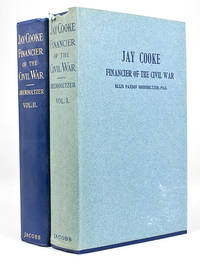
190711958Philadelphia: George W. Jacobs 1907. First Edition. 78 images. Profusely illustrated. 658; 590 pp. 2 vols. 8vo. Original dark blue cloth superb condition in slightly toned original blue-gray dust jackets enclosed in the original publisher's protective board box; box a bit worn. First Edition. 78 images. Profusely illustrated. 658; 590 pp. 2 vols. 8vo. A detailed biography of the colorful financier 1821-1905 whose firm marketed the huge Civil War loans of the Federal Government; whose marketing of its bonds enabled the Northern Pacific Railroad to expand to the Dakotas; and whose firm's eventual closing precipitated the Panic of 1873. A handsome set in choice condition. George W. Jacobs unknown
28047New York: Johnson's 1862. 27" X 18". Very good. Slightest bit of age toning and wear else clean bright and attractive. Handsome hand-colored map "Compiled from the Official Maps of the War Department by A.J. Johnson" and "Showing also the interesting localities along the James Chickahominy and York Rivers." Choice early war-date map simply and tastefully double matted and glazed in a 1¼" walnut-finish frame overall dimensions 33½" X 25". unknown
a26224Paris 1861 Dentu. In French. Dedication reads: A son excellence Jefferson Davis par la volonte nationale President des Etats Confederes d'Amerique. Octavo 31pp. removed from larger binding and rebound in later wraps. Good. . paperback
a66128Boston 1865 American Tract Society. By His Father. Octavo 139pp. fine steel engraved portrait of Bacon in Civil War uniform as frontis original boards with later spine. Good light wear. hardcover
1864105586Washington: Government Printinng Office 1864. hardcover. very good. 2 illustrations one folding. 1259 pages. Very thick 8vo full contemporary calf with leather labels spine reads "Report of the Secretary of the Navy". Washington: GPO 1864. First edition. Leather worn at extremities but still about very good.<br/> <br/> Naval documents for the year 1864 including the Union blockade. 38th Congress 2d Session House of Rep. Ex. Doc. No. 1.<br/> <br/> Government Printinng Office unknown
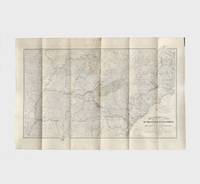
1865377676St. Louis: Printed by Joseph Gedney 1865. Inscribed by Sherman at the lower right "With compliments of W. T. Sherman Lt. Genl. Saint Louis MO September 21 1868. Large map drawn by Capt. William Kossak and John B. Muller under the direction of Maj. W. L. B. Jenney engraved by Evans and Courtenay. 33x51 inches sheet size. Military movements hand colored. Old folds repairs on verso along folds minor staining. Inscribed by Sherman at the lower right "With compliments of W. T. Sherman Lt. Genl. Saint Louis MO September 21 1868" Large map drawn by Capt. William Kossak and John B. Muller under the direction of Maj. W. L. B. Jenney engraved by Evans and Courtenay. 33x51 inches sheet size. Military movements hand colored. An impressively large map covering most of the southern theater of the Civil War extending from Washington D.C. in the northeast to Brunswick GA in the south and westward as far as Natchez Little Rock and St. Louis. The map is filled with remarkable detail including roads towns and villages rivers creeks and railroads. Compiled under the direction of Bvt. Maj. W.L.B. Jenney by order of General Sherman 13 different authorities are credited in its preparation.<br /> <br /> A key to the hand coloring at the bottom reveals the true reason for the map i.e. to chart Sherman's taking of Atlanta and his infamous march to the sea: black lines show the route of the infantry yellow the pursuit of Hood red the 4th Army Corps green the 14th Army Corps and so on; Union fortifications are colored blue and Confederate in red; the routes of Wilson and Stoneman's cavalry corps are also separately delineated.<br /> <br /> There are various versions of this map similarly titled but produced for different publishers and reasons. The most common includes the imprint of Ferd. Mayer Genl. Lith. of New York who printed the map for inclusion in Sherman's Memoirs New York 1875. Another version was produced at a reduced scale for inclusion in the Atlas to Accompany the Official Records of the Union and Confederate Armies with the imprint of Julius Bien plate CXVII. Yet another includes the The American Photo-Lithographic Company of New York imprint at the lower right. The present version however with the St. Louis imprint of Joseph Gedney at the lower left would appear to have been separately published. Given the present version inscribed by Sherman it was perhaps produced on his behalf.<br /> <br /> We have never encountered another of these maps inscribed and signed by Sherman. Stephenson 72; Rumsey 3876 Printed by Joseph Gedney unknown
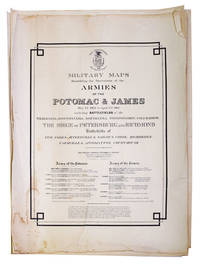
1869267611Washington D.C.: War Department Office of the Chief of Engineers Lithographed by Julius Bien New York 1869. First Edition. Prepared under the direction of Bvt. Brig. Gen. N. Michler Major of Engineers and Bvt. Lieut. Col. P.S. Michie Capt. of Engineers. 16 maps on 17 sheets. All but one double-page. Folio 23-5/8 x 18-1/2 inches. Unbound sheets. Light stains at top edges of several maps title with tape repair. First Edition. Prepared under the direction of Bvt. Brig. Gen. N. Michler Major of Engineers and Bvt. Lieut. Col. P.S. Michie Capt. of Engineers. 16 maps on 17 sheets. All but one double-page. Folio 23-5/8 x 18-1/2 inches. The topographic maps comprise:<br /> 1A. Gettsburg to Appomattox Court House northern<br /> 1B Gettysburg to Appomattox Court House southern <br /> 2. Fredericksburg<br /> 3. Chancellorville <br /> 4. The Wilderness<br /> 5. Spottsylvania<br /> 6. North Anna single page<br /> 7. Totopotomoy <br /> 8. Cold Harbor<br /> 9. Richmond<br /> 10. Bermuda Hundred <br /> 11. Petersburg and Five Forks <br /> 12. Jetersville and Sailor's Creek<br /> 13. High Bridge<br /> 14. Appomattox Court House<br /> 15. Antietam<br /> 16. Harper's Ferry. Phillips Atlases 3688 listing only 15 maps; Civil War Maps 518; Stephenson and McKee "Virginia in Maps" p. 194: "Topographers had already surveyed more than 1300 miles and issued more than 1200 maps prior to the army's passage over the Rapidan River on the night of 3-4 May 1864 the beginning of U.S. Grant's major offensive in Virginia that led from the Battle of the Wilderness on 5 and 6 May to the ten-month siege of Petersburg beginning in mid-June and finally to R.E. Lee's surrender at Appomattox on 9 April 1865. Bvt. Brig.-Gen. Nathaniel Michler's men made more than 1600 photographic sketches between the time of the river crossing and 30 July 1864. The vast number of surveys that Michler directed led to the publication of this atlas. War Department, Office of the Chief of Engineers [Lithographed by Julius Bien, New York] unknown
20046542Knoxville TN: The University of Tennessee Press 2004. First Edition First Printing. Hardcover. Near Fine/Near Fine. 6 1/8 X 9 1/4 Inches. 358 PP. Stated "First Edition" on the copyright page. Signed and dated by author directly on the FFEP. The University of Tennessee Press hardcover
1863354307Washington 1863. 2pp. Single folded leaf. Torn and stained along fore-edge not affecting text. Good. 2pp. In this general order Navy Secretary Gideon Welles sets forth the rules governing flags of truce. The order details the conditions for issuing and the methods of accepting a truce flag. It also discusses the issue of hospital protective flags. <br/><br/> unknown
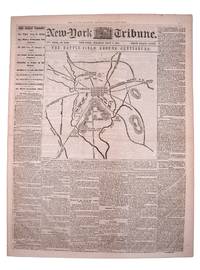
1863351862New York 1863. 8pp. Large illustration on the front page showing the plan of the Battle of Gettysburg. Folio. Disbound. Paper flaw on front page else very good. 8pp. Large illustration on the front page showing the plan of the Battle of Gettysburg. Folio. This issue of the Tribune includes correspondent reports and official dispatches following the battle including Meade's July 4 address to the Army: ".The privations and fatigues the army has endured and the heroic courage and gallantry it displayed will be matters of history to be ever remembered. unknown
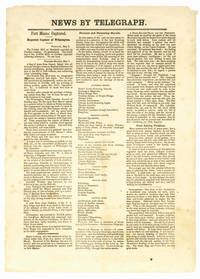
1862262182Rockland Maine: Rockland Gazette 1862. Printed broadside in three columns. 13 x 9-1/4 in. Old folds else fine. Printed broadside in three columns. 13 x 9-1/4 in. Broadside reporting events of the Civil War including the surrender of Fort Macon N.C. General Butler's advance on New Orleans and an unfounded report on the fall of Wilmington it would not be captured until 1865. The remainder of the broadside concerns gardening and farming matters. Attributed to the Rockland Maine Gazette based on the similarity to the type faces and layout of the 1861 Rockland Gazette broadside "Important News by Telegraph." There is also news here from Buckfield and Gorham Maine and news of Major Lothrop of Leeds Maine. Rockland Gazette] unknown
18625979Philadelphia: Lippincott 1862. First American Edition. Hardcover. Very Good. 5 X 7 1/2 Inches. First printing of Trollope's description of American society and his defense of the Union during the American Civil War. Two volumes bound together in the original brown pebbled cloth. Light sunning to spine and foxing to gutters. A few dog-eared pages and some foxing to text. Bump to front cover. A very attractive copy overall. Lippincott hardcover
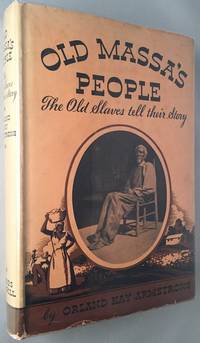
1931103Indianapolis: Bobbs-Merrill 1931. First Edition First Printing. Hardcover. Very Good /Very Good . 6 X 9 Inches. 357 Pages. Stated First Edition on the copyright page! Hardcover in original dust jacket. Original price of $2.50 intact. By far the nicest copy of this book that we have encountered. Chapters include: "Chillun Roun' de Place" "Servin' in de Mansion House" "In de Fiel'" and "Whar de Road Lead" among others. PO inscription on bastard title page. Slight wear at jacket edges and folds. Slight fading to spine. Bobbs-Merrill hardcover
186955186St Louis: Published for the Author at Southwestern Book and Publishing Co 1869. First edition. Illustrated. 100 iv pp. 1 vols. 12mo. Original green cloth. Soiling to boards free endpapers missing. A very good copy. First edition. Illustrated. 100 iv pp. 1 vols. 12mo. Published for the Author at Southwestern Book and Publishing Co unknown
186276762Philadelphia : C. Cohill Artist 1862. Oval Albumen Photograph of Sgt. Thomas R. Orwig. Philadelphia: C. Cohill Artist 1862. The photograph measures 5 1/4 x 7 1/4 inches. On photographer's printed mount measuring 7 1/2 x 9 1/2 inches. Glazed and in the original carved wooden frame. Some nicks to frame and photograph a bit faded but a striking image.Orwig received his bachelor of arts degree from the University of Lewisburg Bucknell University in 1862 and then joined the Union army rising to the rank of sergeant. He died later that year in a naval hospital in Washington D.C. He was a member of the 142nd Pennsylvania Volunteer Infantry. At the Battle of Gettysburg in July 1863 the unit fought first on McPherson's Ridge and then on Seminary Ridge before being driven back to Cemetery Hill. Orwig missed that fight as he had already died.Charles Cohill wass originally a farily well know portrait painter who studied under John Nagle. But after around 1860 Cohill began listing his occupation as “artist†instead of “portrait painter.†Photography had come onto the scene. Cohill opened his studio on the popular Chestnut Street. He advertised himself as selling both “ambrotypes and photographs the best in the world.†C. Cohill, Artist unknown
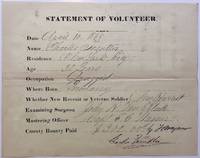
18652739421865. unbound. On the day the war ends a volunteer enlists in the Union Army and collects his $300 bounty! 1 page 6.75 x 8.5 inches -- a Statement of Recruitment whereby Freuter a New York City druggist age 30 is allowed to join the Union Army and receive his $300 bounty on the very day the war has ended April 10 1865. Also signed by the Mustering Officer Captain S. C. Wagner. Note: in the very last days of the war it was not uncommon for deceitful Mustering Officers to allow a bounty to be paid and then splitting the money with the Recruit. Very good condition.<br/> <br/> unknown
1864215608New York: Phelps & Watson Publishers 16 Beekman St 1864. Fold out hand-colored map. 1 vols. 60 x 88 cm 35 x 29 inches folded in cover to 18 x 12 cm. 6-1/2 x 4-1/2 inches; with 35 pp booklet "Brief Description of Battles and Skirmishes of he War. Orange printed pictorial boards cloth spine with 35 booklet tipped to inside front cover. Fragile binding is splitting at cloth spine corners are chipped; map torn along folds one small tear into image. Interestingly the map is stamped on the verso; "Price 50 cts. for the benefit of a one armed soldier"; and signed by an early NYC owner. Fold out hand-colored map. 1 vols. 60 x 88 cm 35 x 29 inches folded in cover to 18 x 12 cm. 6-1/2 x 4-1/2 inches; with 35 pp booklet "Brief Description of Battles and Skirmishes of he War". Fragile and very scarce map from the Civil War this copy being issued after May 1864 as the final entry on the accompanying booklet listing skirmishes concludes with 'spotsylvania Pa." The map itself locates battles and skirmishes by means of red dots or by red underlining of place names and it also gives the population statistics for each state. OCLC locates 4 copies and the map is not in ot in Stephenson Civil War Maps in the Library of Congress. Phelps & Watson, Publishers, 16 Beekman St unknown
1887370494St Louis: Nixon-Jones Printing Company 1887. First edition. Frontispiece portrait. 97pp. 12mo. Publisher's salmon wrappers minor wear. First edition. Frontispiece portrait. 97pp. 12mo. Born and raised in the South but with Union loyalties Henson served as a spy for the North from July 28 1862 until May 20 1864 when he was captured by Confederate soldiers. This narrative describes his many exploits as a false member of the Confederate army and behind enemy lines and includes several discussions of the "secret service." Henson's other claim to notoriety was that he was in possession at the time of the world's longest beard measuring over six feet in length. <br/><br/> Nixon-Jones Printing Company unknown
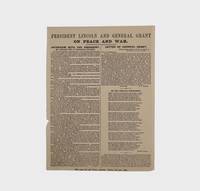
1864377691Np: Printed for Sale by all News Agents 1864. Handbill 11-1/8x8-3/8 inches. Unbound minor toning repaired tear. Handbill 11-1/8x8-3/8 inches. A scarce anti-Demoocrat Election of 1864 camaign handbill which reprints an interview with Lincoln by Joseoph Trotter Mills published in the Grand County Wisconsin Herald in which Lincoln addresses whether he would agree to a peace on Confederate terms which were return African American soldiers to slavery. The interview "shows that Lincoln saw Emancipation as political currency: a vote for him was a vote for the Black fighters helping to save the country" Abraham Lincoln: His Life in Print.<br /> <br /> Also included on the handbill is a August 16 1864 letter by Ulysses S. Grant to E. B Washbourne on what would happen if the North agreed to a peaceand a poem by Bayard Taylor titled On the Chicago Surrender a reference to the peace platform of the Democratic party adopted at their convention. Scarce. Abraham Lincoln: His Life in Print p. 195; BAL 19689. Not in Monaghan Printed for Sale by all News Agents unknown
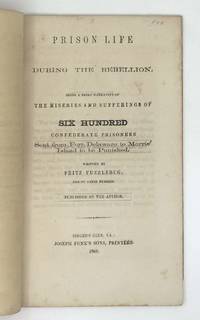
1869370500Singer's Glen VA: Joseph Funk's Sons Printers 1869. First edition. 48pp. 8vo. Publisher's wrappers minor soiling and spotting ads on the rear wrapper. First edition. 48pp. 8vo. Lieutenant John J. Dunkle's sharply-worded account of his time spent in the Union prison on Morris Island South Carolina as part of the "Immortal Six Hundred" a group of Confederate officers held towards the end of the war 1864-65. Written in part to counter accounts of the sufferings of Union POWs in Confederate prisons Nevins describes it as "an early example of Southern-style prison propaganda; basically a diatribe against Union officers and Negro guards." Writing as the improbably-named Fritz Fuzzlebug Dunkle begins with a brief account of the events leading up to their capture and imprisonment at Fort Delaware and the plan to transfer them to the recently Union-occupied Morris Island. Dunkle includes a list of all six hundred Confederate officers by state including their name rank place of capture and their hometown. He then describes the brutal steamship voyage and the extreme privation and abuse they suffered once they reached Morris Island. Dunkle estimates that at least a third of the six hundred died from disease and/or abuse while in custody though the actual number was closer to fifty. Howes D569; Nevins I p.190; Dornbush III 604 Joseph Funk's Sons, Printers unknown