1 575 résultats
1860CAT0150New York 1860. An unusual image of a Zouave soldier in an outdoor setting holding a horse. During the Civil War roughly 95 Zouave regiments formed adopting the names uni-forms and sometimes fighting styles of the North African Zouave brigades. The bulk - about 70 of the regiments - fought for the Union cause. We were unable to determine anything else about this soldier though the image was found in a New York estate. New York was home to two of the most famous Zouave brigades the 5th New York Volunteer Infantry and the 11th New York Volunteer In-fantry. A nearly fine image with a slight crease housed in a full case. unknown books
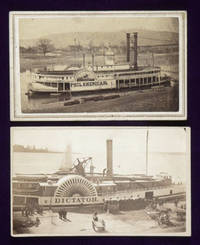
10490CDV. The Dictator was one of the busiest post-war ships on the coastal run from Charleston to Florida from 1865 to 1878; W. Hammant Jacksonville is noted on verso as photographer of the Dictator. In excellent condition. unknown books
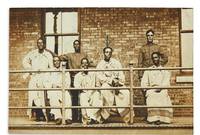
15978BUFFALO SOLDIER Pair of Real Photo postcards of 24th U.S. Infantry musicians in camp. Photographs 3-1/2" x 5-1/2" inches Pine Camp Fort Drum NY c. 1910. Infantryman Joseph Lee identifies himself in these photos. He was part of the 24th during their Houston Mutiny in which many members of the regiment were court martialed after famously coming to the defense of a black woman harassed by local police. <br/><br/>Photos depict members of an original Buffalo Soldier regiment dating from its time at Pine Camp NY later Fort Drum. One captioned in negative "The Famous 24th Inft. Band Pine Camp" shows ~30 uniformed soldiers with instruments. The other uncaptioned showing 7 soldiers; most in white robes with "USA" on the collar perhaps a regimental choir. Both were sent by Joseph Lee 1879- ~1940 Arkansas native enlisted as a musician in the 24th 1903-1919. Both inscribed and addressed one stamped neither postmarked; minimal wear. Lee has apparently self-identified with an arrow in each. This regiment was involved in the dramatic Houston Mutiny of 1917 beginning when a soldier was arrested for aiding a black woman. In the end 19 soldiers were executed and nearly 50 received life sentences but Lee remained with the regiment until his honorable discharge. unknown books
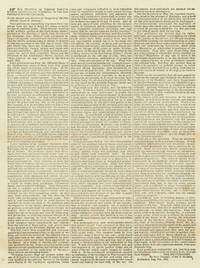
1862217811862. No binding. Fine. Broadside. ""The Petition of Certain Non-Conscripts Respectfully Presented to the Confederate States Congress."" Richmond August 8 1862. Signed in print ""The Petitioners By their Counsel John H. Gilmer."" 1 p. 7 7/8 x 10 3/8 in. Petitioning against General Order No. 46 of the Confederate War Department which rescinded the part of the Confederate Conscription Act of April 16 1862 that mandated the discharge of all voluntary enlistees under age 18 or over age 35 in July 1862. ""These were the terms of the law. They were plain unequivocal and mandatory. Common sense - universal public opinion . understood accepted and adopted the law . Shall an army order revoke a solemn act of Congress . Have we a constitutional Government with specific powers granted . or have we an unlimited Government dependent only on Executive will or ministerial caprice Are the People free or is the Executive supreme"" Historical BackgroundPresident Davis Secretary of War George Randolph and the Confederate Congress instituted the first conscription act in American history in April 1862 after early defeats in Tennessee and North Carolina in anticipation of the expiration of one-year enlistments signed at the war's outset. The Conscription Act would cause all males ages 18 to 35 to be drafted into service unless exempted. Those already enlisted would be held to a three year commitment from their date of entry into the service. Conscription raised difficulties for Southern politicians who had argued for most of their careers against the broad construction of federal powers in the United States Constitution. Some believed it violated the cardinal principle of states' rights others such as Georgia Governor Joseph Brown protested its tendency toward centralization and despotism. Common folks complained about the fact that planters who owned 20 or more slaves were exempt as were many overseers and tradesmen and those who could afford to buy ""substitutes.""According to historian James McPherson conscription was ""the most unpopular act of the Confederate government. Yeoman farmers who could not buy their way out of the army voted with their feet and escaped to the woods or swamps. . Armed bands of draft-dodgers and deserters ruled whole counties.""ReferencesParrish & Willingham 5422 locating 5 copies.McPherson James. Battle Cry of Freedom New York 1988 p. 432. unknown books
186335748Richmond Columbia Augusta and elsewhere 1863. Quarto. Collation as below. Expertly bound to style in half dark purple morocco and purple cloth covered boards flat spine ruled and lettered in gilt yellow endpapers<br/> <br/>An impressive collection of Confederate lithographed sheet music.<br/> <br/>This bound volume includes the majority of the imprints by Richmond publishers and lithographers George Dunn and Company active in Richmond from 1862-64. The collection includes: 1 The Dying Soldier or the Moon rose o'er the battle plain. 4pp. Richmond: J. W. Davies & Sons lithographed by E. Crehen 1864. P&W 6983. 2 Dear Mother I've come home to die. Words by E. Bowers Music by Henry Tucker. 4pp. Richmond: Geo. Dunn & Co.; Columbia SC Julian Selby nd. P&W 6953. 3 God Save the South. Words by Earnest Halphin music by Chas. W. A. Ellerbrock. 6pp. Lithographed by B. Duncan & Co. Columbia SC. Baltimore: Miller & Beacham; Augusta: Blackmar & Co. nd. P&W 7064. 4 The March of the Southern Men. 4pp. Richmond: Geo. Dunn & Co.; Columbia: Julian A. Selby 1863. P&W 7228. 5 On Guard. Words by Wallace Rowe. 4pp. Richmond: Geo. Dunn & Co.; Columbia: Julian A. Selby 1864. P&W 7327. 6 The Southern Soldier Boy. Song sung by Miss Sallie Partington in the Virginia Cavalier at the New Richmond Theatre. 4pp. Richmond: Geo. Dunn & Co.; Columbia: Julian A. Selby 1863. P&W 7494. 7 The South. Poetry by Charlie Wildwood. Music by John H. Hewitt. 4pp. Columbia SC: Julian A. Selby B. Duncan & Co. lith. 1863. P&W 7474. 8 Palmetto Schottisch. Composed and Arranged by A. F. Turner. 4pp. Richmond: Geo. Dunn & Co. 1864. P&W 7348. 9 I Remember the hour when sadly we parted. 4pp. Mobile: H.C. Clarke and others 1864. P&W 7116. 10 Annie of the Vale. Words by G.P. Morris. Music by J.R. Thomas. 6pp. Richmond: Geo. Dunn & Co.; Columbia: Julian A. Selby nd. P&W 6806. 11 Good Bye Sweetheart Good Bye. 4pp. Richmond: Geo. Dunn & Co.; Columbia: Julian A. Selby 1863. P&W 7084. 12 Spring Time Polka. Composed by A.J. Turner. 4pp. Richmond: Geo. Dunn & Co. 1864. P&W 7505. 13 My Wife and Child Song. Poetry by the Late Lamented Hero General Stonewall Jackson. Music by F. W. Rosier. 4pp. Richmond: Geo. Dunn & Co.; Columbia: Julian A. Selby 1863. P&W 7288. 14 Mother Oh! Sing me to rest. Composed by M. Keller. Richmond: Geo. Dunn & Co.; Columbia: Julian A. Selby nd. P&W 7279. 15 The Musical Olio: or Favorite Gems of the Popular Southern Composer John H. Hewitt. 4pp. Macon & Savannah: John C. Schreiner & Son nd. P&W 6966. 16 Up With the Flag. Composed nd Respectfully Dedicated to the Fourth N.C. Troops by Dr. Wm. B. Harrell. 4pp. Richmond: Geo. Dunn & Co.; Columbia: Julian A. Selby 1863. P&W 7572. 17 Pray Maiden Pray! Poetry by A. W. Kercheval. Music by A.J. Turner. 4pp. Richmond: Geo. Dunn & Co. 1864. P&W 7380. 18 The Standard Bearer. Words by Major T.N. P. C.S.A. Music by N.S. Cleman. 4pp. Richmond: Geo. Dunn & Co. 1864. P&W 7506. 19 No Surrender Song. Music by C.C. Mera. 4pp. Richmond: Geo. Dunn & Co.; Columbia: Julian A. Selby 1864. P&W 7301. 20 Keep me awake Mother. Words by Mrs. M.W. Stratton. Music by Jos. Hart Denck. 4pp. Columbia: Julian A. Selby nd. P&W 7175. 21 Gen'l Morgan's Grand March. Composed by C.L. Peticolas. 4pp. Richmond: Geo. Dunn & Co.; Columbia: Julian A. Selby 1864. P&W 7049. 22 Nautical Song.The Alabama. By E. King. 4pp. Richmond: Geo. Dunn & Co.1864. P&W 6793. 23 All quiet along the Potomac To-Night. Words by Lamar Fontaine. Music by J. H. Hewitt. 4pp. Richmond: Geo. Dunn & Co. 1864. P&W 6796. 24 The Exotics. Flowers of Song Transplanted to Southern Soil. 4pp. Augusta: Blackmar & Broth.; Columbia: B. Duncan & Co. lith nd. P&W 7361. 25 Mary of Argyle. Music by S. Nelson. 4pp. Richmond: Geo. Dunn & Co.1864. P&W 7234. 26 Her Bright Smile Haunts Me Still. Words by J.E. Carpenter. Music by W.T. Wrighton. 4pp. Richmond: Geo. Dunn & Co. 1864. P&W 7097. 27 Harp of the South. Awake! A Southern War Song. Words by J.M. Kilgour. Music by C.L. Peticolas. 4pp. Richmond: Geo. Dunn & Co.; Columbia: Julian A. Selby 1863. P&W 7090. 28 Mother is the Battle Over. Arranged by Jos. Hart Denck. 4pp. Richmond: Geo. Dunn & Co.; Columbia: Julian A. Selby nd. P&W 7277 29 The Southern Cross. Words by St. George Tucker. Music by C. L. Peticolas. 4pp. Richmond: Geo. Dunn & Co.; Columbia: Julian A. Selby 1863. P&W 7482. 30 The Star Spangled Cross and the Field of Pure White. Written and Composed by Subaltern. 4pp. Richmond: Geo. Dunn & Co.; Columbia: Julian A. Selby 1864. P&W 7510. 31 Virginian Marseillasise. By F. W. Rosier. 4pp. Richmond: Geo. Dunn & Co.; Columbia: Julian A. Selby nd. P&W 7584. 32 Wait till the War Love Is Over. Words by A.J. Andrews. Music by C.W. Burton. 4pp. Richmond: West & Johnston litho. by Geo. Dunn. & Co. 1864. P&W 7599. 33 When this Cruel War is Over. Words by Charles C Sawyer. Music by Henry Tucker. 4pp. Richmond: Geo. Dunn & Co.; Columbia: Julian A. Selby nd. P&W 7630. 34 You Can Never Win Us Back . Written by a Lady of Kentucky. Arranged by J.E. Smith. 4pp. Richmond: J.W. Davies & Sons. litho. by E. Crehen 1864. P&W 7653. 35 Gems of Southern Song. 4pp. Macon: John W. Burke; Columbia: B. Duncan & Co. lith. nd. P&W 7576. 36 Call me not back from Echoless Shore. Words by Chas. C. Sawyer. Music by Henry Tucker. 4pp. Richmond: Geo. Dunn & Co.; Columbia: Julian A. Selby nd. P&W 6878. 37 The Dearest Spot of Earth to Me Is Home. By W.T. Wrighton. 6pp. Augusta: Blackmar & Bro. nd. P&W 6954. 38 There's Life in the Old Land Yet. Poetry by Jas. R. Randall. Music by Edward Eaton. Augusta: Blackmar & Bro. lith. B. Duncan Columbia. nd. P&W 7548. 39 Who Will Care for Mother Now. Poetry by C.C. Sawyer. Music by C.F. Thompson. 4pp. Richmond: Geo. Dunn & Co. 1864. P&W 7638. 40 Christmas and New Year Musical Souvenir. Music by F.W.R. Richmond: Geo. Dunn & Co.; Columbia: Julian A. Selby 1863. P&W 6903. 41 Our First President's Quickstep. By P. Rivinac. 4pp. Augusta: Blackmar & Bro. B. Duncan lith. Columbia. P&W 7337. 42 Something to Love Me.Words by J.E. Carpenter. Music by E.L. Hime. 4pp. Richmond: Geo. Dunn & Co.; Columbia: Julian A. Selby nd. P&W 7467. 43 Silver Bells Mazurka. Composed by Charles O. Pape. 6pp. Columbia: P.L. Valdry nd. P&W 7446. 44 We Have Parted. Poetry and Music by Miss Ella Wren. 4pp. Richmond: Geo. Dunn & Co.; Columbia: Julian A. Selby 1863. P&W 7613. unknown books
186136810Charleston: Evans & Cogswell 1861. Lithographic broadside 34 x 26 inches. Expert restoration archivally paper-backed. South Carolina calls for secession.<br/> <br/>The very rare lithographic facsimile of the South Carolina Act of Secession which precipitated the beginning of the Civil War and is thus one of the earliest Confederate imprints. One of only 200 copies printed. This large-format contemporary print of the original engrossed and signed manuscript document presents the Act of Secession as it was passed and signed in the South Carolina State House. It so faithfully executed that it also reproduces the ink blots present on the original document. The document features the text of the secession ordinance and the signatures of D.F. Jamison President of the Convention and 169 delegates to the Secession Convention called by Gov. Francis W. Pickens. The historic resolution which revoked South Carolina's ratification of the United States Constitution was largely the work of Robert Barnwell Rhett editor of the Charleston Mercury which printed a well-known secession broadside of its own proclaiming: "The Union Is Dissolved!" The secession resolution was passed unanimously at 1:15 p.m. on Dec. 20 after which Jamison said "The Ordinance of Secession has been signed and ratified and I proclaim the State of South Carolina an Independent Commonwealth." Shortly after passage of the ordinance Evans & Cogswell printers to the convention were asked to prepare a copy for use by the members. The convention reconvened in March 1861 to address issues related to the coming war. According to the report of Paul Quattlebaum Chairman of the Committee on Printing published as an appendix to the March 28 1861 entry in the Journal of the Convention of the People of South Carolina the printing was "in a style creditable to the art; and by a careful comparison with the original the Committee find it to bear a very notable similarity to it." The convention delegates immediately authorized Evans & Cogswell to print 200 lithographic copies of the Ordinance to be distributed at the direction of D.F. Jamison. Evans & Cogswell likely printed the 200 copies including the present copy in the days that followed and probably before the Battle of Fort Sumter on April 12. The copies were then most likely distributed to the convention delegates and other prominent state officials. An exceedingly rare and important Civil War document with only eleven copies known in institutions according to Parrish & Willingham and even fewer in auction records.<br/> <br/>Crandall 1887; Journal of the Convention of the People of South Carolina pp. 204 543. Parrish & Willingham 3794; Sabin 87444. Evans & Cogswell unknown books
186335961Richmond: West and Johnston 1863. 8vo. 546pp. 33 plates. Contemporary leather upper cover tooled in gilt rebacked.<br/> <br/>Provenance: General William Preston binding<br/> <br/>A substantial Confederate military manual covering all aspects of ordnance from artillery and transport to small arms and gunpowder. With distinguished provenance from Confederate General and Ambassador William Preston.<br/> <br/>"Adopted with some necessary changes omissions and alterations from the Ordnance Manual of the United States service of 1861. . It may be added that the labor of Ordnance officers has contributed to this new edition" Preface. Kentucky-born William Preston 1816-1887 studied at Yale and Harvard law school and led a regiment of Kentucky volunteers in the Mexican American war. He was a one-term U.S. Congressman and was named Envoy Extraordinary and Minister Plenipotentiary to Spain by Buchanan in 1858. In 1861 he resigned his post and returned to the U.S. He was from a prominent Kentucky family with close ties to many Confederate officials and officers. He help organize the Confederate state government of Kentucky which fell in December 1861. Preston joined the C.S. Army and rose to the rank of major general. In 1864 he was appointed Envoy Extraordinary and Minister Plenipotentiary from the Confederacy to Maximilian Emperor of Mexico. After the Civil War he served two terms in the Kentucky state legislature.<br/> <br/>Parrish & Willingham 2491. West and Johnston unknown books
12666Four page Civil War date Congressional document regarding the cavalry forces of the United States. Printed on smaller size pages. 8vo In very good condition. unknown books
126654 page Civil War date congressional document titled "Report of The Secretary of War" regarding "the number of three year volunteers in the Service of the United States." Printed on short pages. Lists the number of three year volunteers and their ranks from each state. In very good condition. unknown books
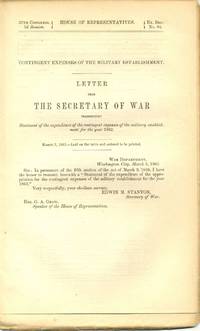
1266415 page Civil War date congressional document titled "Letter from the Secretary of War Transmitting Statement of the expenditure of the contingent expenses of the military establishment for the year 1862." Printed on short pages. The document consists of a 3 column table listing the expenses of war. Very good condition. unknown books
1908011404Hartford: Published by the State Connnecticut 1908. 1st Edition. Hardcover. Very Good . The actual original edition published in 1908 large 8vo blue ribbed cloth gilt-pressed titles and vignette to front and titles to spine. Two frontispieces of sepia photographs of the Union soldier sculpture monument one of his face in close-up separated by tissue guard. 73pp. Laid-in is printed card "Compliments of the State of Connecticut. Library stamp of CT town on pastedown but no other library markings. Published by the State (Connnecticut) hardcover books
6446Historic Newspaper. Harper's Weekly June 24 1865 New York. Cover has large illustration of General Grant meeting with General Scott at West Point. Inside are numerous Civil War illustrations including a whimsical portrayal of Lincoln as a marble bust with female personifications of liberty justice and victory or possibly the union around him. Liberty has her foot on the back of what appears to be a white slaveholder. To Lincoln's left a slave is in the act of rising up while broken shackles lie at his feet. Great content articles on the civil war throughout. Minor stains and very small tears around the edges. In very good condition and still very strong for a paper of this age. unknown books
14072Collection of Civil War Era lead case shot balls and fragments. Fort Huger was an earthwork fortification located on Harden's sometimes called Hardy's Bluff along the James River in Virginia. The bluff is directly across the river from Newport News Virginia. Fort Huger along with nearby Fort Boykin were built in order to prevent Union forces from trying to move up the river towards the Confederate capital of Richmond. The fort was named after Major General Benjamin Huger. unknown books
186559257NY: New York Tribune 1865. Folio folded good copy. Includes an article on a Day of Fasting called by President Johnson after the death of Pres. Lincoln notes that Mrs. Lincoln gave Lincoln's cane to Frederick Douglas Jefferson Davis is still being held at Fortress Monroe and much more. New York Tribune unknown books
1865261000New Orleans 1865. 6 pp. 8 x 5 inches on 2 sheets. Separations at folds crude tape repairs minor chipping. 6 pp. 8 x 5 inches on 2 sheets. Confed. ship attempting to run the Mississippi River blockade at the close of the war. Here a Union sailor describes one of the last naval incidents of the war in which the CSS Webb made a desperate run down the Red River and the Mississippi in a bid for the open ocean before finally being scuttled by its crew past New Orleans. The unidentified author devoted most of his long letter to a description of the pursuit: "There has been a very dareing sic deed committed on this river since I wrote.All the men of war below us fired at her but did not hit her. She was going down the river at the rate of 30 miles an hour. There was a torpedo projecting from her bow. . . . The prevailing opinion here is that Jeff Davis or some other of the leaders of the Confederacy were on board. unknown books
186559258NY: New York Tribune 1865. Folio folded good copy. Includes an article on the Lincoln assassination final scene's in Booth's life Wheeler's command capitulates and much more war news. New York Tribune unknown books
5678Vintage newspaper printed during the Civil War. The New York Times December 13 1864 issue New York NY. The entire front page of this historic war-dated paper has stories of the War including "The War in Tennessee." In part: ".Seventy-four shots were fired at it doing however no damage.Our troops attacked and routed the enemy. The Federal loss was four killed and forty wounded. The enemy's loss is unknown." Slight wear and light foxing. Overall in excellent condition. unknown books
186324584<p>"<i>We the members of the Loyal League do hereby pledge ourselves by words and acts whenever practicable to use our influence in support of the Government in all its measures for the suppression of the present unholy rebellion; and we will use our influence to discountenance and oppose all efforts in opposition to the Government and the Union.</i>"</p> <b>CIVIL WAR--RHODE ISLAND.</b>Pledge and original membership roll of the Loyal League of Providence Manuscript Document Signed with 161 signatures ca. January 1863 Providence RI. 2 pp. 7¾ x 22¼ in.<p><b><br /></b></p><p><b>Historical Background</b></p><p>Loyal Leagues also often known as Union Leagues were men's clubs established during the Civil War. They usually consisted of the professional merchant and artisan classes in northern cities. The first such club formed in Philadelphia in 1862.</p><p>Many of the signers of this membership roll were born between 1844 and 1850 and many were probably students at Providence High School. In 1861 students from the high school organized into a militia company called the "Ellsworth Phalanx" in honor of the New York Zouave commander Elmer Ellsworth killed in May 1861 in Alexandria Virginia. They drilled and paraded in Providence throughout the winter and into the spring of 1862.</p><p>After Confederate General Stonewall Jackson routed Union General Nathaniel Banks' forces at Winchester Virginia and pushed them back across the Potomac River in May 1862 urgent calls went out for troops to defend Washington D.C. In response Governor William Sprague of Rhode Island ordered the organization of the 10th Rhode Island for three months' service. Company B was recruited almost entirely from the ranks of the High School and University companies and commanded by Captain Elisha Dyer former governor of the state. At least one of the signers here William H. Hawkes served in Company B in 1862 and another Harry A. Richardson had served in Company K of the 9th Rhode Island in the summer of 1862.</p><p>The likely author of the pledge and first signer on the right column was Granville Budlong 1844-1909. The first signer in the left column was Lewis G. Janes 1844-1901 son of prominent abolitionist Alphonso Janes. Other signers included Arthur Lincoln son of a professor at Brown University; and William E. Cushing 1844-1880 who became an architect and designed the city's baseball stadium in 1878. At least two signers Frederick Metcalf and Eugene F. Granger were killed later in the war while serving in the military. Metcalf was only seventeen when he died of disease in South Carolina in 1864 after a year in the service. Granger the son of a Baptist minister joined a New Hampshire regiment and died in a Confederate prison in North Carolina. His younger brother Edward V. Granger also signed this roll. Other signers were the sons of merchants railroad agents carpenters tin platers and masons in Providence. Several went on to graduate from Brown University in the late 1860s and early 1870s.</p><p>On March 19 1863 the <i>New York Times</i> reported that in Providence Rhode Island</p><p>"Only two weeks remain before the election. The Republicans and those loyal men of other parties who have united with them are diligently at work in canvassing the State. They are marking those "peace" men who … are expressing sympathy with the rebellion. The Democrats are really very unfortunate. They can't find one of their own party who wants office. They have been trying a month to get a Governor but no Democrat will accept their nomination…. When bad men combine good men must unite. So the loyal men of all parties are coming together in solemn league to support the Government and to give all their energies to the vigorous prosecution of the war. The "League" in this city is composed of some two thousand loyal names. It is fast increasing in numbers and is extending its spirit and influence throughout the loyal portions of the State."</p><p><b>Condition</b></p><p>Originally two joined leaves. The topmost portion of the sheet lost allowing the title "Pledge" to just be made out. Conservation repairs of fold separations. Strong signatures in various color inks continuing and with docketing on verso.</p> books
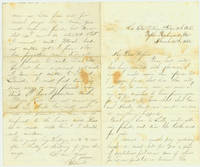
1865223991865. No binding. Fine. Six letters to his wife Libby approx. 15 pp. in all. ""There will be an awful hot time if our Brigade is engaged. I dont think anything can restrain the men if they once get started. I am in hopes to come out alive but no one can tell but the Almighty"" The white officer of the USCT Captain Richard Andrews wrote to his wife about the sieges of Petersburg and Richmond and the impending Appomattox campaign. Union forces including African American soldiers captured Richmond on April 3rd and Lee would be forced to surrender at Appomattox just over two weeks after Andrews wrote. In other letters he details his health concerns his transfers after the war's end and possibilities of land ownership. His final letter details an anticipated transfer to the Freedmen's Bureau in Galveston Texas.RICHARD ANDREWS. Autograph Letter Signed ""Richard"" to his wife Libby before Richmond Va. March 25th 1865 4 7/8 x 8 1/8 in. 4 pp. #22399.01"".I received a month's pay yesterday bought a sword belt for 7.00 a pair of pantaloons for $12.00 pair of gloves for $2.00 paid $25.00 towards the present to Genl. Draper.As soon as I sell my horse I will send you more if I had sold her three days ago I could have got over $100.00 for her but now she is very lame so much so that no one can use her. I fear I shall have to dispose of her at a loss. We shall move in a very short time.Things are coming to a crisis. Lee will have to skedaddle or there will be a terific fight. Our brigade is practicing charging every day. There will be an awful hot time if our Brigade is engaged. I dont think anything can restrain the men if they once get started. I am in hopes to come out alive but no one can tell but the Almighty. My health is pretty fair now and I trust I may not even get wounded for I am anxious to gain strength this summer.""Historical BackgroundFrom Salem Massachusetts Lieutenant Richard F. Andrews fought in the Battle of Chaffin's Farm September 29-30 1864. Just two months earlier he was so sick that he was excused from duty but he volunteered for service and helped lead the 36th Regiment of U.S. Colored Troops to victory. The performance of the USCT at Chaffin's Farm New Market Heights put an end to any doubts of their bravery or fitness for service. There Andrews was shot in the leg and for his bravery he was promoted to Captain.The 36th Regiment of USCT was organized in February 1864 out of the 2nd North Carolina Colored Infantry. In addition to Chaffin's Farm it saw service toward the end of the Siege of Petersburg the single greatest concentration of African American troops during the war at Richmond and its occupation and in the Appomattox Campaign.The United States Colored Troops USCT were regiments of the United States Army during the American Civil War composed of African American soldiers. First recruited in 1863 by the end of the Civil War the men of the 175 regiments of the USCT constituted approximately 10% of the Union Army. The United States War Department issued General Order Number 143 on May 22 1863 establishing a ""Bureau of Colored Troops"" to facilitate the recruitment of African-American soldiers to fight for the Union Army. Regiments including infantry cavalry engineers light artillery and heavy artillery units were recruited from all states of the Union and became known as the United States Colored Troops USCT. USCT regiments were led by white officers and rank advancement was limited for black soldiers. Approximately 175 regiments composed of more than 178000 free blacks and freedmen served during the last two years of the war. Their service bolstered the Union war effort at a critical time. RICHARD ANDREWS. Autograph Letter Signed ""Richard"" to his wife Libby near City Point Va. May 9th 1865 7 ¾ x 9 ¾ in. 4 pp. #22399.02"".I had quite a nap-fell asleep just after dinner and snoozed away for over two hours something unusual for. See website for full description unknown books
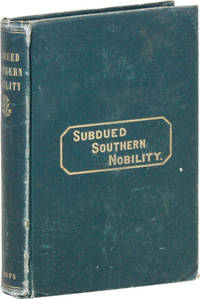
188245520New York: Sharps Publishing Company 1882. First Edition. 12mo 18.5cm.; publisher's green gilt-lettered cloth; 4392pp. Boards a bit rubbed with exposure at corners slight spine lean textblock a bit finger-soiled else Very Good and sound. Novel of the Civil War in which two friends attend a Northern college together before volunteering when hosilities break out each fighting for a different side. WRIGHT III 5314. Sharps Publishing Company unknown books
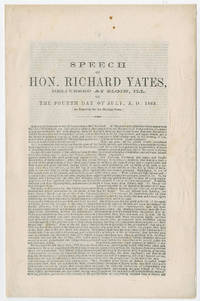
186524904<p>"<i>The American revolution was begun and fought through for an idea—to establish that man is a man—to vindicate the right of every man to equal rights and to equal citizenship…. Every boy imbibes the genius of our free institutions. The poor friendless rail splitter rises to the proudest pinnacle of human power. Cheers The poor tailor boy becomes and is now our President cheers the ferry boy the Chief Justice of our Supreme Court cheers and the humble tanner boys become the great commander who marshals a million of veteran warriors in the great cause of union and liberty and holds up the flaming symbol of emancipation to a whole race of mankind. Applause.</i>" p1/c2 – p2/c1</p><p>"<i>And yet for Jeff Davis who has been a wholesale murderer who has struck at the life of the whole nation and rolled the red wave of bloody civil war over the land they say we must be magnanimous. Sensation. We shoot the poor deserter and the poor soldier who is found sleeping at his post on guard but the nation must be magnanimous and not execute Jeff Davis!</i>" p6/c1</p> <b>CIVIL WAR & RECONSTRUCTION. RICHARD YATES.</b>Printed Pamphlet. <i>Speech of Hon. Richard Yates Delivered at Elgin Ill. on the Fourth Day of July A.D. 1865</i>. Jacksonville IL: Ironmonger and Mendenhall 1865. 8 pp. 6⅛ x 9½ in.<p><b><br /></b></p><p><b>Excerpts:</b></p><p>"<i>We celebrate the 4th day of July 1776 because then commenced the great experiment whether man is capable of self-government. Our fathers boldly announced to the world in the great and immortal charter of freedom the Declaration of Independence the bible of the rights of man which has just been read to you.</i>" p1/c1</p><p>"<i>The American revolution was begun and fought through for an idea—to establish that man is a man—to vindicate the right of every man to equal rights and to equal citizenship not by virtue of his birth or fortune or of his nativity or color but by virtue of his intrinsic God-created manhood.</i>" p1/c2</p><p>"<i>Every boy imbibes the genius of our free institutions. The poor friendless rail splitter rises to the proudest pinnacle of human power. Cheers The poor tailor boy becomes and is now our President cheers the ferry boy the Chief Justice of our Supreme Court cheers and the humble tanner boys become the great commander who marshals a million of veteran warriors in the great cause of union and liberty and holds up the flaming symbol of emancipation to a whole race of mankind. Applause.</i>" p2/c1</p><p>"<i>The system of slavery existing in our Southern States fostered interests tastes opinions manners and prejudices at war with the genius of our institutions and necessarily divided our people.</i>" p2/c2</p><p>"<i>I feel highly honored to-day that I have the opportunity of meeting so many of our returned officers and soldiers here for somehow I cannot divest myself of the feeling that I have been in the war myself and am a returned soldier although I have only on one or two occasions smelt the gunpowder of the enemy. Laughter. Yet under my administration the State of Illinois has sent nearly two hundred thousand brave volunteers to the field.</i>" p3/c1</p><p>"<i>Your brave comrades have died and you have risked your lives that the nation and the Union might live and you have proclaimed at the point of the bayonet the divine right of all men to be free.</i>" p4/c2</p><p>"<i>But thanks to you the accursed blot of human slavery which has divided and distracted us at home and sullied our name abroad is wiped out and every man in America is free.</i>" p5/c1</p><p>"<i>peace prevails in the land yet peace brings with it the most complicated questions. We are not safe until the great questions in dispute for which we have fought have been definitely and forever settled and upon such a basis as to prevent the recurrence of another war to mar our peace and endanger the safety of the Union.</i>" p5/c2-p6/c1</p><p>"<i>And yet for Jeff Davis who has been a wholesale murderer who has struck at the life of the whole nation and rolled the red wave of bloody civil war over the land they say we must be magnanimous. Sensation. We shoot the poor deserter and the poor soldier who is found sleeping at his post on guard but the nation must be magnanimous and not execute Jeff Davis!</i>" p6/c1</p><p>"<i>As a Senator of the United States certainly I could consider no State Government Republican in form which was at variance with the fundamental principles of our republican institutions</i>; <i>which denied the equality of all men before the law; which set aside the principle that governments justly exist by the consent of the governed and that taxation and representation must go together. And I am here to-day to say that I could approve of no State government whose constitution or bill of rights does not deny in express words this right of a State to secede from the Union and which does not provide that slavery shall be finally and forever abolished and prohibited so that not even a root seed or grease spot shall remain of this sum of all villainies the accursed system which has been the fountain of all our troubles and of the fratricidal and bloody war which has desolated the land.</i>" p7/c1</p><p>"<i>I thank God that I have never cast a vote or uttered a sentiment against human freedom; and no loud alarums of popular applause no shining height of human power shall ever seduce me to give up the God-given sentiments of my heart in favor of freedom and humanity.</i>" p7/c2</p><p><b>Historical Background</b></p><p>Fourth of July celebrations in the nineteenth century often began with artillery at dawn a parade and a speech at a courthouse or church for an hour or two. After the speech men often went to a tavern to drink thirteen toasts for the number of the original states while the women and children went home. Bonfires and fire-crackers carried the festivities into the evening. Typically a speech blended a sermon with a political address promoting patriotism. Readings of and orations on the Declaration of Independence or Washington's Farewell Address were also common.</p><p>Early during the Civil War celebrations often included sham battles to portray the real ones occurring on the battlefields. By the middle of the war fundraisers for widows and orphans of soldiers who had died in military service replaced the sham battles. After the war celebrations turned away from the community toward smaller gatherings of families and friends though many smaller communities continued the pre-war tradition.</p><p>The city of Elgin Illinois was established as a village in 1835 on the Fox River thirty-five miles northwest of Chicago. Chartered as a city in 1854 Elgin in 1865 had a population of 4000-5000 people. Four days after Yates delivered this address the city's first major fire swept the entire north side of Chicago Street in the business district.</p><p>Thousands of people from Elgin and the surrounding area celebrated the Fourth of July in 1865 with an artillery salute at dawn a "huge procession" at 10:30 a.m. of "returned soldiers civilians societies and other citizens" who marched from the Waverly House to Colby's Grove. The singing of "America" opened the exercises followed by a prayer by a local minister and a choir concert. Col. Edward S. Joslyn an Elgin attorney who served in the 36th Illinois Volunteer Infantry read the Declaration of Independence. State Adjutant General Allen C. Fuller delivered an address welcoming the returned soldiers then the choir sang "Battle Cry of Freedom." Gen. J. F. Farnsworth responded to Fuller on behalf of the soldiers followed by another choir performance. Former Governor and current Senator Yates followed with his oration and the singing of the "Battle Hymn of the Republic" concluded the formal program. A dinner for the soldiers who were present and a general picnic followed. The city concluded the day's festivities with a ball at the Waverly House.</p><p>The <i>Daily Illinois State Journal</i> proclaimed Yates' speech at Elgin "not only the best effort of his life but one of the most forcible and eloquent among the many able and patriotic addresses which our recent National Anniversary occurring at a juncture in our history of so much interest has called forth."</p><p><b>Richard Yates</b> 1815-1873 was born in Kentucky and graduated from Illinois College in Jacksonville in 1835. He studied law in Jacksonville and at Transylvania University in Lexington Kentucky. Yates began practicing law in Jacksonville in 1837 and served as a Whig in the Illinois House of Representatives from 1842 to 1846 and from 1848 to 1850. He represented Illinois in the U.S. House of Representatives from 1851 to 1855. He joined the Republican Party and supported John C. Fremont for president in 1856 and Abraham Lincoln for U.S. senator in 1858. In 1860 he was elected governor as a Republican and strongly supported the Lincoln administration's conduct of the war. When the Democratic state legislature proved uncooperative Yates dissolved the legislature on June 10 1863 and governed the state on his own. At the end of his term in 1865 Yates won election to the U.S. Senate where he served from 1865 to 1871. He supported radical reconstruction and the conviction of President Andrew Johnson.</p> Ironmonger and Mendenhall books
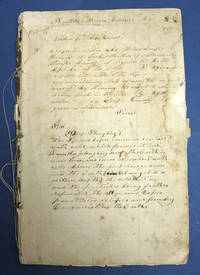
189241503Mecklenburg VA 1892. Sewn gatherings disbound with remanants of perished leather spine. Wear and soiling throughout; some chips occasionally causing minimal textual loss; last leaf quite ragged to inner margin significantly affecting final third of text. Writing in general legible and neat. Good condition withal. 29 leaves of lined wove paper including 4 half-leaves. Lacking first leaf pp 1 - 2 of lecture notes; 4 stubs. Inconsistently hand-numbered throughout.Manuscript notes in ink and/or pencil to recto and verso of leaves with varying amounts of writing per pg. ~1500 words. Some intratextual hand-drawn illustrations and graphs to lecture notes. 11-1/2" x 7-1/2" <br/><br/>A notebook that appears to have been intended for lecture notes kept by Presley Llewellyn Hinton Jr. during a science class at Randolph-Macon College from 1858 - 59 but that was employed for several different purposes by other members of his family during the same period and throughout the Civil War. The Hintons were slaveholders owning at least 13 slaves according to the 1860 slave schedule and longtime prominent members of the community. The lecture notes which comprise hand-numbered pp 3 - 30 and 51 - 55 are from lectures taught by B. Puryear Professor of Chemistry and Natural Philosophy; subjects covered include fairly introductory material regarding dew evaporation electricity elements of chemistry hydrogen and nitrogen gas carbon etc. and the like. Following the first section of lecture notes three pages by one of the Hinton parents we speculate Mrs. Hinton detail Presley’s service in the Confederate Army Company A 3rd Virginia Cavalry as well as that of his brother William from 1861 - 63 largely their leave-taking and visits home: “My Son William Emmet Hinton joind the Confederate Army and left home on the 14th day May 1861 to join his company Mecklinburg Cavalry at Lockets Store near Lombardy Grove. Many relatives and friends met . . . to take leave of their dear sons relations & friends who consented with cheerfulness to leave their quiet and happy homes to battle against our enemy the Yankee who are worse than Indian savages Yea to go through all the hardships privations difficulties and attending a camp life. . . . My Son Presley Lewellyn Hinton joind the Confederate Army and left home on the 26th day May 1861 . . . He would have gone on with his brother William but he was not prepared as he had just returned from the University of Virginia . . .” Approximately 15 remaining pages interrupted by the last section of Presley’s lecture notes are filled with a detailed account record of tuition charged for teaching the daughters and some sons of local families which we speculate was kept by the boys’ sister primarily because of the type of lessons taught. These included piano lessons worsted work and samplers grammar arithmetic geography the history of England and philosophy; fees for ink copy books and other supplies are also included. Another account record follows for bonds of some sort in the same hand as other and a love letter from Presley to a Miss Annie fills both recto and verso of the final leaf. Interspersed with these and sometimes written over top in pencil are the youthful scribblings and pencilled math work of James H. Palmer also of Mecklinberg dated 1892; he appears to have used the manuscript for scrap paper. All in all a uniquely faceted manuscript illustrating many aspects of the life of one Virginia family during the Civil War as well as the paper shortages that likely occasioned such thrift. hardcover books
186611336Washington: Government Printing Office 1866. 4th edition. Original green half leather binding with cloth boards; front board has Bureau of Ordnance device impressed in gilt. Marbled edges. VG pos & prior owner pencil annotations on blank front leaves/sm dampstain in lower gutter from prelims gradually diminishing gone by page 47/smattering of foxing throughout. Illustrated with wonderfully interesting plates & cuts of mortars howitzers etc. 8vo. <br/><br/>Part I: Preparation of Vessels of War for Battle and to the Duties of Officers and Others When at Quarters. Part II: The Equipment and Manœvre of Boats and Exercise of Howitzers. Part III: Ordnance and Ordnance Stores. Government Printing Office hardcover books
40769n.p.: Nashville Chattanooga & St. Louis Railway n.d. Full color chromolithograph with printed caption. 1 vols. Image 14 x 19 inches; matted to 21-1/2 x 26 inches overall. Small portion of blank lower right corner missing well away from image and caption and covered by mat; a few spots of almost imperceptible abrasion to surface else fine and handsome. Full color chromolithograph with printed caption. 1 vols. Image 14 x 19 inches; matted to 21-1/2 x 26 inches overall. Superb Civil War Railroad Chromolithograph. An absolutely brilliant chromolithograph printed on heavy coated stock its clarity of detail putting most examples of this medium to shame. Caption states: "The 'General' was captured at Big Shanty now Kennesaw Ga. April 12 1862 by the 'Andrews' Raiders' and recaptured near Ringgold Ga. by W.A. Fuller Conductor and Anthony Murphy Shop Foreman for the Railroad Company assisted by Confederates and others after an exciting chase of about ninety miles." Illustrated here in repose the elegant engine glows as a work of art. Nashville, Chattanooga & St. Louis Railway unknown books
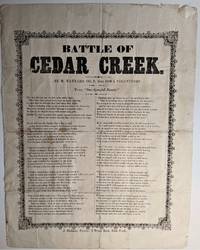
1864691New York: J. Dickson Printer 1864. Broadside in 4to. 310 x 235 mm. 12 x 9 ¼ inches. Caption and ten stanzas of verse in two columns within an ornamental border.  Sheet somewhat dust-soiled with a few minor stains surface wear along folds one corner slightly chipped &c. Still entirely sound and with good margins. The Battle of Cedar Creek was fought in the Shenandoah Valley on October 19 1864. Surprised by the Confederate forces under the command of Jubal Early the Union troops were nearly routed. Riding to the battlefield from Winchester twenty miles away Gen. Philip Sheridan rallied the troops and carried the day. This action occasioned the slightly more famous poem by Thomas Buchanan Read. Private Maynard's poem centers more narrowly on the actions of the 28th Iowa. The regiment was organized in 1862 and mustered out in 1865 having fought campaigns in Mississippi Louisiana and Virginia losing 271 men in the process.  "At dawn October 19 1864 the Confederate Army of the Valley under Lt. Gen. Jubal A. Early surprised the Federal army at Cedar Creek and routed the VIII and XIX Army Corps. Commander Maj. Gen. Philip Sheridan arrived from Winchester to rally his troops and in the afternoon launched a crushing counterattack which recovered the battlefield. Sheridan's victory at Cedar Creek broke the back of the Confederate army in the Shenandoah Valley. Lincoln rode the momentum of Sheridan's victories in the Valley and Sherman's successes in Georgia to re-election." Horace Maynard born ca. 1821 in Ohio is listed in the 1860 Federal census as a school teacher in Penn Iowa residing there with his wife and three small children.  American Battlefield Trust Website. Kansas Historical Society Enrollment of Civil War Veterans 1889.  Note cited in OCLC. National Park Service Website.  . J. Dickson, Printer unknown books