11 490 résultats
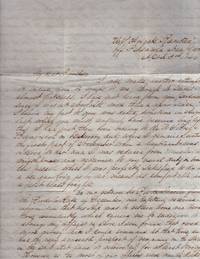
183534738Carroll County Ohio: n/a 1835. Paper. Very good. Paper. Part printed and part manuscript document. Paper measures approximately 8" x 3.5". Signed at the bottom "Daniel McCook Clerk". Light toning to the paper. <br /> <br /> From wikipedia: Daniel McCook June 20 1798 – July 21 1863 was an attorney and an officer in the Union army during the American Civil War. He was one of two Ohio brothers who along with 13 of their sons became widely known as the “Fighting McCooks†for their contributions to the war effort.12.With the outbreak of the Civil War McCook although 63 years old volunteered his services to the Union. He was commissioned as a major and paymaster. When Confederate Brig. Gen. John H. Morgan led his troops through southern Ohio during Morgan's Raid Major McCook joined in the advance of the Union pursuit. Early in the morning of July 19 1863 Federal troops attacked Morgan at Buffington Island where the Confederates were planning to cross the Ohio River back into Western Virginia. McCook was shot and mortally wounded. He died two days later and his body was buried with full military honors in Spring Grove Cemetery in Cincinnati Ohio.5. n/a unknown
184635409Pensacola 1846. Letter. Very good. Letter. 4 pages. Lined paper folded. 4 pages of content. Postal mark and address written center of the 4th page. Two small wax seals on the edges of page 4. <br /> <br /> Letter is addressed to William Roney Jr. Corner of Third & Branch Sts Philadelphia Pa. Letter written aboard the U.S. Frigate "Raritan" off Pensacola Navy Yard April 3rd 1846 and has a Pensacola post mark and date of April 6 . Written on the eve of the Mexican War April 24 1846 to February 2 1848. Content summarized:<br /> <br /> Thomas Roney Midshipman writes a lengthy letter to his brother about his situation in Pensacola and requests his brother's help with family debts. He writes:“There is very little news from Mexico the latest is that Mr. Slidell has been informed that the government could not receive a Minister from the United States but that there were ready to receive a Commissioner for the settlement of the Texas question. We had consequently demanded his passports and is expected here very shortly in the Ship Manzo. The Mexicans have been making every preparation for a war…were preparing to place Santa Anna at the head of the government again….†Roney had been transferred from the U.S. Brig Bainbridge back to the Raritan. He was relieved as “master†and appointed "midshipman". Roney has no problem with this because the Raritan is more comfortable. Roney recently returned from Rio de Janerio and had to take large advance to pay off debts. The only regret of his demotion to midshipman is that he can’t send money home to Mother any more hopes brothers can make it up. He complains of the cost of his “mess bill†and outfitting upon leaving the coast of Brazil. He writes "Any place is better than the coast of Brazil unknown
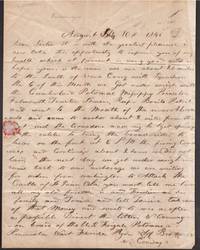
184635410Pensacola 1846. Letter. Very good. Letter. Folded to make 4 pages. 1 page of content 2 blank pages 1 page with address and postal mark from Pensacola Florida dated August 20 1846. Letter addressed to "Dear Sister" and signed "W Conway". Multiple folds and some creasing and toning to the paper. Red wax seal left edge page 1. Small paper tear from opening the letter. Good condition. Letter content summarized:<br /> <br /> US Frigate Potomac. W. Conway Pensacola Florida writes to sister Camden Goose River Maine while involved in the Blockade of Vera Cruz. USS Potomac sailed w/ships Cumberland Missippy sic Princeton Falmouth Truxton Somers Reefer Bonito and Petrel to mouth of river Alvarado off of Veracruz. Describes bombardment: “…the Commodore made rig to get spring word the cable to bring the broadsides to bear on the fort at 6 PM the firing Commenced and Continued about 2 hours we didi not land the next day we got under weigh and came back to our anchorage. we are waiting for orders from Washington to Attack the Castle of St. Juan Ola Fort San Juan de Ulúa offshore opposite Veracruz. unknown
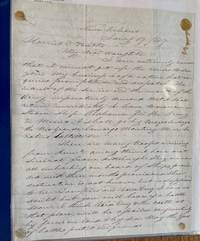
184736655New Orleans: N/A 1847. N/A. Letter. Good. Letter. Approximately 8" x 10". Multiple folds. 4 pages with 3 pages of contents. Addresses and a pencil note written on the back page. 4 small circle corner stains on the first two pages. Overall condition is good or better.<br /> <br /> U.S. Army Paymaster John B. Butler is writing his daughter Harriet on January 17th 1847. From New Orleans he writes ".the wants of the Army imperatively demand that I shall return immediately. I leave tomorrow in the Steam Ship Alabama for the Army in Mexico. I shall go by Brazos Santiago the Rio Grande Camargo Monterey Mier Seraluo &c." He ads "There are many troops arriving from Penna among them I have met Several from Pittsburgh. They are now all embarking on board of ships provided with three months provisions. Their destination is not known but is supposed to be and Vera Cruz.I think Vera Cruz & the castle at that place will be assailed conjunctively by forces on land & by sea. May the God of battles protect our friends."<br /> <br /> Butler urges his daughter to give his kind regards to friends at her school. After initially closing the letter Butler writes a lengthy post script. New intelligence has been provided ".Genl Scott has returned from Carmgo and the Rio Grande and is now at the Brazos awaiting arrival of the troops that have been and that now being shipped at this place. This confirms the belief that Vera Cruz is his destination and the General's first demonstration will be against the fort and fortifications at that place."<br /> <br /> Butler urges his daughter to look at the map to find Vera Cruz and about the strong fort and castle. writing of strife and battle he writes his daughter "War always produces a wanton waste of blood & treasury - Every victory must have its victims; & contending armies are indiscriminate so there is no knowing who may fall."<br /> <br /> The last page has addresses and the letter is addressed to "Miss H. E. Butler Care Rev. C. C. Beatty Steubenville Ohio. N/A unknown
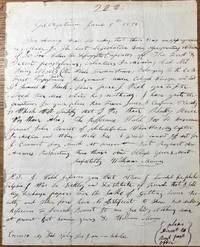
185135415Georgetown: n/a 1851. Letter. Good. Letter. Approx. 8" x 10". 1 page of writing. Paper previously removed from a glass frame. Tissue repairs on the edges. Paper has multiple folds. According to a note found on the back of the glass frame William Mann addressed this letter to Col. William S. Amweg a pension attorney near Lancaster Pennsylvania area in the years 1849-1851. The number 200 is written top of the paper. Unfortunately the note affixed to the back of the frame is now missing. Col. Amweg's name is not found in this document.<br /> <br /> The letter transcribed as best as possible reads: "Georgetown June 8 1851 Sir Having heard not reading that there was an appropriation being made for the last legislative body appropriating a sum of $30000 dollars for defraying the expenses of the First & Second Pennsylvania volunteers in Mexico and not being to the whole circumstance belonging to the Co. of First Pennsylvania Ridgement under Colonel Wincape and Lt. Col. Samuel Black therefore I wish you to intercede for me and lose nothing. I have great acquaintances in your place Rea Frarer Jones B. Canfuier Dr. Casally &c. which will certify that I was there. Reece was there also. The reference would be to Brigadier General John Bennet of Philadelphia who was my captain in Mexico and who would be a friend in need. Just ask for I cannot say much at present but request an answer respecting these things and oblige yours most respectively William Mann. P.S. I would inform you that when I landed in Philadelphia I was sickly and destitute of friends that I sold my discharge papers for the sake of getting home decently and therefore have no certificate to show but making reference to General Bennet Jr. can be had nothing more at present but remain yours &c William Mann. Excuse my bad spelling for I am no scholar. Please direct to post office. n/a unknown
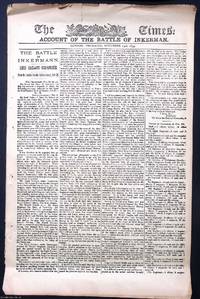
1854373729The Times London 1854. Newspaper. Good Condition. The two Times Special Reports dated 13 November 1854 The Attack on Balaclava and 23 November 1854 The Battle of Inkermann provide detailed contemporary accounts of two of the most significant engagements of the Crimean War. The Balaclava issue contains the earliest extended reports of the battle of 25 October including the now-legendary Charge of the Light Brigade official despatches from Lord Raglan and narrative descriptions that shaped public perception of both the disaster and the heroism involved. The Inkermann issue presents Lord Raglan's despatches and extensive coverage of the desperate fighting on 5 November 1854 when outnumbered British and French forces repelled a much larger Russian army. Together these issues stand as immediate first-hand printed records of events that soon became iconic in British military history. These copies are original 1854 issues of The Times not later reprints or bound compilations. Issued as separate folio supplements printed on rag-based paper and headed with the distinctive Times masthead and royal crest they were sold individually to provide the public with full stand-alone accounts of major battles. Survival of such ephemeral publications is uncommon making these examples both scarce and historically significant. Their value lies not only in their rarity but also in their role as primary sources that convey how the war was reported understood and remembered at the time. Two issues each four pages in length. Some minor marginal tears probably inevitable with newspapers of this sort. Preserved in a modern card cover prepared for practicality - an unassuming but serviceable presentation that favours function over finery. Size: 29 x 44.5 cms. Category: Antiquarian & Rare; Newspapers; Special Interest. This item may require more postage than the rates shown for delivery outside the UK. If extra postage is required we will contact you before processing your order and you will be given the details and option to decline the extra cost. The Times unknown
185835408Barbados: n.p. 1858. Letter. Good. Letter. 8" x 10". 4 pages. 3 pages of contents. Page 4 clipped section at bottom. Paper folded and in very good condition otherwise. <br /> <br /> Letter written aboard the USS Atlanta at Barbados December 27 1858. Eggleston writes: "I am perfectly willing to leave Barbados and its free impertinent darkies. I would like to lasso some 50 or 100 and put them to work in a cotton field. I am convinced that such a field is the only one in which the darky character can be truly developed. Here they do nothing but stroll about the streets & chatter like so many monkeys from sunrise to sunset. We employ them to coal our vessels and how I have wished for Jack Stringer with a bull whip among them whenever I have had anything to do with them". <br /> <br /> Eggleston would later serve as a Lieutenant on the CSS Virginia and was later promoted to Captain in the Confederate Navy. Eggleston was one of the lieutenants of the Virginia Merrimac during its life under the Confederate flag. During his life Eggleston provided details of the legendary battle of the two ironclad ships which can be found under various web sites. n.p. unknown
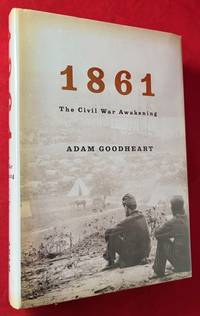
20117279New York: Alfred A. Knopf 2011. First Edition First Printing. Hardcover. Near Fine/Near Fine. 6 1/2 X 9 5/8 Inches. 481 PP. "Adam Goodheart is a Monet with a pen instead of a paintbrush."<br /> -James M. McPherson Pulitzer Prize-winning author of Battle Cry of Freedom<br /> <br /> Stated "First Edition" on the copyright page. Original price of $28.95 intact on the front flap. Signed by Goodheart directly on the title-page. Possibly the only man I actually know who was interviewed by Terry Gross on NPR's "Fresh Air" - which I adore. The book was one of the books of the year in 2011 and was named book of the year by the History Book Club. Only flaw is one small red dot remainder on bottom gutter. Special thanks to my great friend Robert Hicks for introducing me to Adam and his work. Alfred A. Knopf hardcover
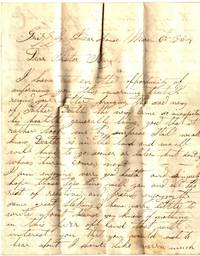
186233742Pocotaligo: n.p. 1862. Letter. Good. Letter. Approx. 8" x 5". 3 pages of manuscript. No envelope or stampless mark on the paper. Paper has three folds. Paper is in very good condition with light edge wear to a couple of spots. The following transcription is a best guess. The legibility of letter is difficult to transcribe and some words are omitted and other words spelled as they appear.<br /> <br /> Pocotaligo Feb 1 1862<br /> Mr E Ward Rock Island Tenn<br /> <br /> Dear Sir<br /> <br /> I find myself seated with yours of January 19th before me. I was very glad to hear from you I had wrote four letters to you and heard from you once in the time I dont think that you ought to quit writeing to us if I do belong to Jeff Davis traveling hog hay stealing 16th regiment I want you to write to me start your letter and I will get them for they will fallaw ten us and we will get them. I have had your letter for several days but I did not have the chance to answer it E We have to stand Pickett Cal Ful and Savages Regiments take it times a we go have and stand twelve days and then they stand twelve days. We have to go about twelve milds miles from the camps to stand. Darien is the Part Rail river and the yankees an on the Island of the same name I stand in sight of plenty of the damn yankees. We was yesterday and came to camps last night. We expect to have a fight hear with the yankees before long for there is plenty of yankees hear. You wanted to know about the fight that was hear on New Years day our regiment was not in it. We it for ten mild mile but it was over before we got thear. Wen we say our men we men mean the Dixaboys the yankees killed our men and we killed some of there and made them take again. We would nat have lost any men at all if our men had nat were two brave and run there up under the canans at the yankees and they Burned them and killed some men. I want you to write to me as soon as you get this gets to hand Tell Nancy that I am as fit as she ever saw me. E I get same good letter from my mama. This leaves me in good health. I remain yours till N.B. Hamrick. The Battle Mr. Hamerick referenced in this letter January 1st 1862 was probably part of the Union Army's Port Royal campaign. A battle took place along the Coosaw River near the Port Royal Ferry in Beaufort County South Carolina. From the Beaufort County Library: <br /> <br /> In late December 1861 the Union forces recognized that the Confederates recently removed to the mainland had been building batteries along the Coosaw River near the Port Royal Ferry. Union Commanding General I.I. Stevens ordered components of the 8th Michigan Infantry 47th and 48th New York Infantries 1st New York Engineers and the 50th Pennsylvania to destroy the Confederate breastworks capture the guns and force the retreat of some companies of the 12th South Carolina Infantry into the interior of Beaufort District. The Union forces accomplished their mission on New Year’s Day January 1 1862 with minimal casualties.<br /> <br /> The first Battle of Pocotaligo took place May 28th 1862. The Union army goal was to tear up the railroad between Charleston and Savannah. The second Battle of Pocotaligo took place October 22 1862. In the first battle the Union moved to destroy a bridge and having reached their objective retreated back to Hilton Head. both armies suffered a few casualties. In the second Battle the Union's goal was again to tear up the Railroad between Savannah and Charleston. After pushing the Confederates back to Pocotaligo the Union initiative stalled and the Union army retreated before nightfall. <br /> <br /> An interesting side note on the future fate of N. B. Hamericksp during the War comes from articles collected in The Spencer Times and the Sparta Exhibitor titled "Recollections of the War From Carroll H. Clark" Transcribed with all the commas dashes and lack of capitalization from Memorial and Biographical Record of the Cumberland Region An Illustrated Compendium of Biography. Geo. A. Ogle & Co. Chicago 1898. pp.253 and 254.<br /> <br /> Carroll Clark was from McMinnville Tennessee. In one of the several articles Clark makes a reference to a "N. B. Hamericksp" possibly the same soldier who wrote this letter. An excerpt from article 25 ".I have left untouched very many interesting events for instance the Battle of Franklin Tennessee in which many brave commanders and soldiers were killed of whom was Genl. Cleburne Genl. Carter and others. My dear friend and schoolmate N. B. Hamrick was killed there. His father and family lived out two miles from here at the place now called the Hill place on the road to Farris Griffiths. N.B. had three brothers in the war and all came through alive. The family came from North Carolina a few years before the war and it has been said brought the first yellow horse to this country. I yet remember the names of the whole family as follows: Uncle Billy Aunt Polly Jeroam Napoleon Bonapart killed at Franklin Jereboam Zorobabel Doctor Cortez and Don Pedro were the boys and two girls named Martha Salena and Mary Boston. All except Jeroam were my schoolmates."<br /> <br /> This letter was addressed to Mr. Ward in Rock Island Tennessee. Carroll Clark's war reminiscences was written in Tennessee. It is possible this is the same N. P. Napoleon Bonaparte Hamericksp who wrote the letter that was later killed at the Battle of Franklin in 1864. Information found regarding casualties at Franklin include variant spelling in the last name. A listing from the Civil War Talk web site states "1st Sgt. Napoleon B. Hambrick Co. I Killed." Another site Home dot Freeuk dot com lists "Sgt Napoleon Bonaparte Hanmbrick n.p. unknown
6252EDWARD ALLEN GOODWIN unknown-1862. Goodwin was the Sergeant in Company K of the 23rd Regular Massachusetts Volunteers. This is the diary of Edward A. Goodwin Co. K 23rd Regt. M. of. M. This diary is THE AMERICAN UNION DIARY FOR 1862 an annual published diary accessible and likely provided to Union soldiers during the Civil War. After a few pages that include a calendar and interest tables the diary provides space for each day of the year 1862. Goodwin wrote entries every day from January 1st to April 7th and none thereafter. At the time Goodwin was serving in the 23rd Massachusetts Infantry Regiment which was a part of the Coast Division under General Ambrose Burnside. Entries are handwritten in either pencil or black ink. Notable entries include: aFriday 7: Naval engagementplace lasting from noon till sunset. Troops were landedin the afternoon and evening. Bivouacked on Roanoke Island in the rain. b Saturday 8: Captured a rebel battery in a swamp. Took 3000 rebel provisions and the whole island wasSergt. Howard hurt his foot. W.S. Clark missing. Both entries describe the Battle of Roanoke Island fought February 7th and 8th 1862. Part of General Ambrose Burnsides expedition to capture key ports in the Outer Banks the battle first saw Union gunboats first firing on Confederate forts under the command of Henry Wise until Burnsides soldiers could land ashore unopposed. and the forts on shore engaged in a gun battle with occasional contributions from the Mosquito Fleet. The next day the Union soldiers successfully flanked the Confederate artillery and infantry defenders on both sides forcing a retreat into the Confederate forts. The forts were then individually taken with the Union suffering only 264 casualties and capturing 2500 Confederate defenders. c Friday 14: Fought the battle of New Bern. Took over 100 pieces of artillery ammunitioncamp equipment &c. I arrived at night in the tents of the enemy. This entry describes the Battle of New Bern fought on March 14th 1862. After first advancing up the Trent River General Burnside had his soldiers exploit the weakened center of the line of the defending Confederates under Lawrence O'B. Branch. This allowed the Union Navy to shell Fort Thompson forcing its abandonment and shortly thereafter the city of New Bern too. 90 Union soldiers were killed and 64 Confederates were killed and 413 were captured. d Monday 31: Sick all day. Took horses.e Monday 7: Saw Amoat the hospital. DeceasedRain in the afternoon. These two entries foreshadow Goodwins ultimate fate including his last entry on April 7th 1862. Goodwin would pass away in New Bern on April 16th. Having survived two major battles unscathed at least according to his diary Goodwin most likely succumbed to disease. It is estimated that 2/3 of Civil War soldiers who died during the war died of disease not in battle. His body was ultimately returned to Massachusetts and is buried in Mansfield. The pages of the journal are in good condition but the exterior of black leather is frayed and partially torn. It should be handled very delicately but its value as a lens into the mindset of a Civil War soldier is immense. hardcover
1863196851863. Negro Soldiers Speech of Hon. James S. Rollins of Missouri Delivered in the House of Representatives Feb. 2 1863. Washington D.C.: L. Towers & Co. 1863. 8 pages. 5.5" x 8.5". Rollins was a nineteenth-century Missouri politician and lawyer notable for his role in establishing the University of Missouri. In this speech Rollins while a committed Unionist comes out against black soldiers entering into combat roles in the Union Army. He addresses Speaker of the House Schuyler Colfax and is concerned that African Americans desire for vengeance against their Southern oppressors would bring the country to ruin. Rollins' support for the war extended only as far as the maintenance of the Union stating that "whenever it becomes a war of subjugation and of conquest or dwindles into a miserable abolition war to free the slaves of the South. then the sooner it is abandoned the better for the entire country." Despite the dissent of Rollins and the sizable element who shared his views Lincoln other leading Republicans like Speaker Colfax and military brass saw the value in forming African American regiments. In fact not long after the 1st Kansas Colored Infantry Regiment becomes were the first black unit to see combat in the Civil War as well as being the first black regiment organized in a northern state. The regiment served primarily in Missouri engaging the Confederates several times including at the Battle of Honey Springs. This speech is a interesting demonstration of the range of opinion within the Civil War era Republican Party and Unionist side more broadly. This speech has been separated from a larger volume; its binding is intact. Foxing along margins some mild toning. Very good condition overall. unknown
186331605Columbus Georgia 1863. Letter. Very good. Letter. Approx. 9.5" x 7.5" lined sheet of paper. Letter is one page long. Folded. Addressed to "Dear Cousin George" <br /> <br /> Hargraves writes "My sister received the following Telegram from Mobile: Have you any information of Martina Lucketts father. If not take her home immediately from the Sisters of Visitation in Mobile." George continues "I suppose from above that Martina is at school and the Superior not hearing from Mr. Luckett wants to get rid of her. What shall be done" Hargraves mentions that he could contact Mr. Jno Forsyth to help Martina and that Aunt Sophia probably would take her in. Written below the Hargraves signature - "I have not been able to hear from any Mississipian about Mr. Luckett. - G H" At the bottom of the letter possibly written in a different hand is a note - "Miss Singleton from Canton saw the Luckett six weeks in two months ago - his children were all with him Miss Martina also. He was not then in the Army." <br /> <br /> The writer of this letter George Hargraves was married to Virginia Forsyth daughter of famous Georgian John Forsyth. "Mr. Jno Forsyth" mentioned in this letter could quite possibly be the son of John Forsyth. John Forsyth Jr. who resided in Columbus before moving to Mobile. unknown
186333624Tullahoma Tennessee 1863. Document. Fair. Manuscript Document. Approx. 12.5" x 8". General Order No. 18 written on the front side and signed by the Assistant Adjutant General H. W. Walter. Also located on the lower left corner of the document is written "Maj Genl Wheeler a' g Wheeler's Cav Corps." On the verso is a handwritten summary of the order. The paper has dried water stains. The ink is light in spots. This handwritten General Order was reprinted in the Official Records of the War of the Rebellion War of the Rebellion Records Series I. Vol. XXIII Part II Correspondence Etc. Chapter XXXV pages 858 859. The signature at the bottom of the document is not legible but it is not in the hand of General Wheeler. The document reads:<br /> <br /> The enemy has seen fit to expel from his lines and send to our midst not only those supposed to be guilty of crimes but non-combatants found in their homes in the peaceful pursuits of life. In the perpetration of these outrages on humanity and these violations of civilized warfare he has prostituted the flag of truce to the base purpose of protecting the guards who drive forth these exiles. Hereafter that flag will not protect those guards but they will be seized and sent forward to be treated as spies or prisoners of war as the circumstances in each case may require. By Command of General Bragg. unknown
186336642Hamilton County Tennessee: n/a 1863. Document. Good. Document. Folded sheet of paper. 9" x 5". Paper has blue lines and multiple folds. 4 pages with 2 pages of content. Some fading to the ink and light toning to the paper. Chattanooga Tennessee is the seat of Hamilton County. Hand written document transcribed here: "State of Tennessee Hamilton County I Sam Elder of said County and State have this day hired Thomas Cavender as a substitute to serve as a Private in Capt J B Kings company or Capt Lyness for which I agree to pay the said Cavender one thousand dollars in hand & the other thousand dollars to be paid in three months from this date and to be loned at interest for twelve months two years is the time of service I have hired the said Thos Cavender now if the said Cavendar serves faithful as a substitute for the time of two years and at the expiration of that time the said Elder to take his place the one thousand dollars that is to be loned if the said Cavender should desert is to come to me the said Elder given under our hands this 30th day of April 1863 attest Wm Caruthers and Bob Caruthers signed seal S. H. Elder signed seal Thos Cavender." A Confederate soldier who paid another person to take his place is often referred to as a "substitute" soldier. During the American Civil War individuals who were drafted or conscripted into military service had the option to hire a substitute to serve in their place if they could afford it. These substitutes were typically individuals who were either unemployed or seeking financial gain. The practice of hiring substitutes was more prevalent among wealthier individuals who could afford to pay for someone else to take their place in the military.<br /> <br /> The Elder family were pioneers in Tennessee. Some of the family settled in Hamilton County. This excerpt is copied from Chattanoogan dot com: "The children of Robert S. Elder included Samuel Houston Sarah Jane Minerva Jane Robert and James B. Sarah married Thomas Monger a Unionist who was on the County Court. Minerva married James Clifford Allen who fought for the Union and was in the Legislature from Bradley County. Samuel H. was on the Confederate side joining 2nd Co. K of the First CSA Cavalry on Sept. 23 1862. He married Sarah J. White. Their daughter Mary A. married Aaron E. Smith. Samuel H. and his brother Robert had a "store boat'' that made calls at the various river landings and they also had a general store at Snow Hill. Samuel H. was postmaster at Long Savannah. He died in 1910 of a heart attack while walking from Avondale to Snow Hill."<br /> <br /> A record for Benjamin Franklin Cavendar from Hamilton County was found. However no mention of Confederates in Hamilton County for Thomas. Although a "Reader's Comment" from the Chattanoogan dot com states this: CAVENDER Benjamin Franklin Co. B 1TN Cav. Carter's Born 1839 in TN son of Henry Cavender. Farmer in Ooltewah. 1860 HC Census Reader Comment; Henry Cavender by his first wife did have a son named Benjamin S. Cavender b. ca. 1806 in NC living in Hamilton in 1850 but d. March 14 1858 in Dade Co. MO. By his 2nd wife Henry Cavender had a son named Franklin b. ca. 1839 in Hamilton Co. TN. However Henry Cavender relocated with several of his married and unmarried children after the 1860 census but prior to the War to Pitman Randolph Co. AR. In service with nephews in Company A of the 12th Missouri Infantry is Henry's son Francis Marion Cavender and an F.N.C. Cavender who I assume may be Henry's son Franklin. I cannot say for certain since there are no enlistment dates on this post but this Benjamin Cavender may be the son of Henry's son Thomas Cavender who remained in Hamilton Co. Thomas' son Benjamin J. Cavender was b. ca. 1844 in Hamilton Co. relocating after the War to Jeffersonville IN. I would be interested in hearing how the authors pegged this solder as Benjamin Franklin Cavender as Civil War soldiers database only lists him as Benjamin. I regret I cannot say anything more definitive than to cast some doubts. Kendall Sparkman.<br /> <br /> According to a record found in familysearch dot org: Captain J. B. King mentioned in the document was an officer for for Company B of the 1st Regiment Tennessee Cavalry Carter's. This regiment was organized in November 1862 using the 3rd Tennessee Cavalry Battalion as its nucleus. This company was active in the Vicksburg Campaign and was captured July 1863. By exchanged it was attached to Waul's Texas Legion then returned to the regiment. It surrendered with the Army of Tennessee.1<br /> <br /> The Caruthers individuals who attested this document were not found in a brief internet search. However there are other possible spellings of the name such as CARRUTHERS CARETHERS CAROTHERS. Some of the individuals named in the site Chattanoogan dot com were near the Chattanooga area during the Civil War. n/a unknown
2005Q-0811701336Stackpole Books 2005-06-21. Hardcover. New. In shrink wrap. Looks like an interesting title! Stackpole Books hardcover
186334799Long Swamp Florida: n.p. 1863. Letter. Good. Manuscript letter written on blue paper. Approx. 10" x 8". 1 page of content. On the back side is written "J L McGahagin Seller Jany 25th 1863". Hand writing is difficult to read at times. Letter has multiple folds. The paper is in good condition with some small splits at the folds. Transcription below:<br /> <br /> Long Swamp Fla Jan 25th 1863<br /> Mr. H. L. Flast<br /> Dear Sir<br /> <br /> I received your letter with draft of $1500 on Maj Teasdale which I will not want to use at percent - 8 I was disappointed in getting the cotton at or near Wacahoota persons in that section have put is up to 45 cts I have about 15 Bales seed Cotton and 12 gined at Home. I will tomorrow to haul down more seed cotton which I think I will enough to make 20 Bales I went to Gainesville and got the draft of 1900 from Dawkins I will have to pay for cotton if I get any more at 'presant' I to pay 'presant' prices - I have not heard from the teacher as yet that you were to and we have an application from Miss Baker for a friends of hers and are waiting to hear from you let us hear soon<br /> <br /> Yours Respectfully signed J L McGahagin<br /> <br /> From find a grave dot com:<br /> <br /> His first wife Sarah Adeline Eubanks McGahagin 1830-1856 is buried on the north side of him. On his other side is his second wife Margaret Jane Leitner McGahagin 1838-1896. His brother William Emmit McGahagin and his brother’s wife Sarah Eliza McCormick McGahagin are buried about fifteen feet south of J.L. McGahagin's tombstone.<br /> Joshua L. McGahagin was a farmer a saw-mill owner and owned real estate. He owned property in Brazil as well as in this country. He owned a sawmill on Lake Weir. He would barge logs across the lake take them by ox cart to the Ocklawaha River where they were barged to Jacksonville. He was a Captain in the Confederate Army.<br /> <br /> "Longswamp was the name applied to a large area which extended from the site of the present Belleview south and southwestward to the Withlacoochee River. A post office under Joshua L. McGahagin was established for this region on August 29 1846. Frequently the office was in the home of the postmaster and mail was carried by rider once each week."<br /> <br /> "In August of 1850 panic followed after finding an Indian camp nearby on the Withlacoochee. As all Indians were supposedly within a reservation in the Everglades wild rumors were circulated. On the McGahagin plantation log barricades were hurriedly erected and settlers from isolated homes rushed here for protection. But the alarm was unjustified. An intensive search disclosed only eleven Indians. These Indians were soon deported back to the Everglades."<br /> <br /> These excerpts were taken from a history of Marion County called "Ocali Country Kingdom of the Sun" by Eloise Robinson Mrs. Roy V. Ott and Louis Hickman Chazal.<br /> <br /> One day several years after the Civil War a man who had served under Joshua Lucas MaGahagin's C.S.A. command entered the home of his eldest son William "Billy" Emmit. He saw his father's framed photograph over the mantel and exclaimed "Why that's the Ole Warhorse!"<br /> <br /> Joshua left for South America in 1868 taking one of his daughters Lula with him. He was back in Marion County in 1870 as he was listed in the Census that year.<br /> <br /> After surviving the Civil War and a trip to Brazil spending hours on horseback Joshua died when he was thrown from a horse. n.p. unknown
186634704Ludlow Vermont 1866. Ledger. Good. Ledger. Octavo. 234 pages total of which 174 pages have writing from a few word numbers etc. to completely filled accounts. Approximately 60 pages are blank. Brownish marbled paper covered boards with tan leather spine. Marbled paper is shelf worn. Spine is chipped at head and base. Arithmetic pencil notes written on the end sheets. A few pages torn out of the ledger in back. Interior content in good condition. About half the pages or less are used for accounts. First page starts with the written heading - "Cash paid out for Company 1863 by S. W. Stinson." Items listed on the first two pages include Horse accessories wagons wagon parts shoes stables oats hay and other horse and wagon related items. Several pages following the 1863 and 1864 records are equations written in pencil. One of these pages has the heading - "Bark Measured for S P Atherton". From the middle sections of the ledger to the end are several products associated with clothing accessories. One page is dated 1865/66. Goods and costs of items include a sewing machine buttons embroidery "infants waist" braid fringe ribbon lace cuffs collars trimmings feather bonnets hats silk etc. Towards the back of the ledger is a short inscription signed by S Stinson Ludlow Vermont. Good. unknown
1864127291864. Civil War dated letter from Grizzly Bear HouseCA from Northern sympathizer who writes to his sister in Michigan in July of 1864. He writes on the civil war but also learns of his father's death. He writes in part : "The news from the war is verry good but some what to slow to suit me but I don't know as I ought to complain for the hart I take in it is not very hard just pay taxes and stay at home well taxes is one necessary part of the war and some one has to fight while others pay but I do hope our folks that is the union folks will give the rebels such a thrashing that they never will need an other and then there will be peace at home and abroad" The Letter is signed: "From your Brother John." The letter has a few splits at folds also minor creases otherwise in very good condition. Original Envelope with stampis included. unknown
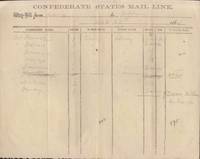
186436185Quincy: Confederate States 1864. Paper. Good. Paper. Approximately 9.5" x 6.5". Folds. Printed and written manuscript form that is dated December 28th 1864. Form lists 7 passenger names taking 8 seats. Likely this route was between Quincy Florida and Albany Georgia. This form was used late in the Confederacy after the fall of Atlanta and Savannah. Paper is in good condition. Confederate imprint. Confederate States unknown
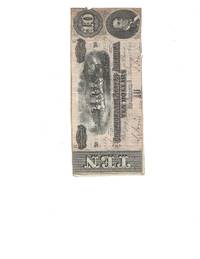
1864167911864. Confederate States of America $10 Note of 1864. When the Civil War broke out the newly-formed Confederate States of America needed to create a monetary system to finance the government and the war effort. The Confederate Treasury printed bank notes The Confederate States dollar was first issued just before the outbreak of the American Civil War by the newly formed Confederacy. It was not backed by hard assets but simply by a promise to pay the bearer after the war on the prospect of Southern victory and independence. As the Civil War progressed and victory of the South seemed less and less likely its value declined. After the Confederacy's defeat its money had no value and most notes were destroyed. In very good condition. unknown
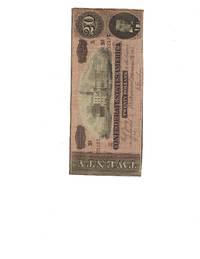
1864167921864. 1864 Confederate States of America $20 Note T67; Feb. 17th 1864 Criswell T67; When the Civil War broke out the newly-formed Confederate States of America needed to create a monetary system to finance the government and the war effort. The Confederate Treasury printed bank notes The Confederate States dollar was first issued just before the outbreak of the American Civil War by the newly formed Confederacy. It was not backed by hard assets but simply by a promise to pay the bearer after the war on the prospect of Southern victory and independence. As the Civil War progressed and victory of the South seemed less and less likely its value declined. After the Confederacy's defeat its money had no value. Very good condition. unknown
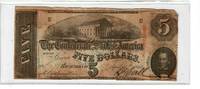
1864167931864. Confederate States 5 dollar note 4/6/63 stamped February 1864. When the Civil War broke out the newly-formed Confederate States of America needed to create a monetary system to finance the government and the war effort. The Confederate Treasury printed bank notes The Confederate States dollar was first issued just before the outbreak of the American Civil War by the newly formed Confederacy. It was not backed by hard assets but simply by a promise to pay the bearer after the war on the prospect of Southern victory and independence. As the Civil War progressed and victory of the South seemed less and less likely its value declined. After the Confederacy's defeat its money had no value and most notes were destroyed. Light staining but in very good condition. unknown
186435361San Francisco: William Alvord & Co 1864. Paper. Good. Paper. Approx. 14" x 9". Single sheet folded with hand written quantity amount description and price on the receipt. Light toning edge wear and a few small edge tears to the paper. William Alvord & Co unknown
186430562Madison Wisconsin: n/a 1864. Document. Good. Document. 8" x 10". Folded. Civil War era date document is for School and University Lands from the Commissioners Office in Wisconsin. Signed by Lucius Fairchild as Secretary of State at the bottom. <br /> <br /> From wikipedia:<br /> <br /> Lucius Fairchild December 27 1831 – May 23 1896 was an American politician soldier and diplomat. He served as the tenth Governor of Wisconsin and represented the United States as Minister to Spain under presidents Rutherford B. Hayes and James A. Garfield. He served as a Union Army colonel during the American Civil War and lost an arm at Gettysburg. n/a unknown
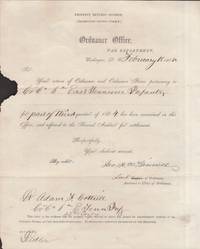
186535417Washington DC: War Department 1865. Paper. Good. Document. Approx. 10" x 8". 1 page. Document is dated February 18 1865. Contents relate to return of ordinance distributed in 1864. It is signed by Jno R. McGuiness. Below his order is the signature of Lt. Adam F. Cottrell Co "C" 6th E. Tenn Infty 23rd Corps. Document has a chip on the center left edge. War Department unknown