1 094 résultats
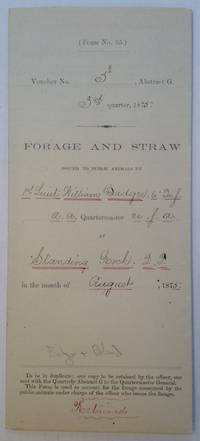
18755905Dakota Territory 1875. unbound. 2 pages Dakota Territory August 1875. This document -- a Statement of Forage and Straw -- is signed by Captain James S. Poland "J.S. Poland" who served under Reno at Little Big Horn and by Lt. William Badger "W. Badger" a close friend of General Custer and survivor of the Black Hills Campaign. The document lists the amount of oats corn barley hay fodder and straw consumed by the animals at the Standing Rock Reservation in The Dakota Territory. The front cover measures 8.5 x 3.75 inches and folds out to the inner page with lists measuring 16.75 x 11 inches. Natural folds and slight creasing in one spot; near fine condition.<br/><br/> unknown books
184735018February 6th 1847. 1847. Very good. - Letter penned in black ink & filling almost 3 sides of a sheet of light gray paper folded once to form 4 sides approximately 7-1/4 inches high by 4-5/8 inches wide. The letter has been mounted on a lightly larger sheet of cream-colored stiff paper. Signed "Anglesey" There are a few small ink smudges to the 2nd & 3rd sides. Very good. <p>The letter is addressed to Scottish geologist Sir Roderick Murchison and concerns a publication which Murchison is proposing and how it would be funded. "Some Estimate of the probable cost of money and of time is called for from General Colby and when it is received you shall again hear from me." The reference is probably to General Thomas Frederic Colby a leading geographer who had been director of the Ordnance Survey.<p>Henry Paget 1st Marquess of Anglesey 1768-1854 was a British army officer and politician. After serving as Member of Parliament for Carnarvon and then for Milborne Port he took part in the Flanders Campaign. During the Peninsula War he commanded the cavalry for Sir John Moore's army in Spain and at the Battle of Sahagun virtually destroyed a regiment of French cavalry. He led the charge of the heavy cavalry against Comte d'Erlon's column at the Battle of Waterloo losing part of one of his legs to a cannonball at the end of the battle. In later life he served as Master-General of Ordnance from 1846 to 1852.<p>The Scottish geologist Sir Roderick sometimes as here spelled "Rhoderick" Impey Murchison 1st Baronet 1792-1871 was the first to describe and investigate the Silurian system. During the last decade of his life he chiefly investigated the Highlands of Scotland. Murchison was one of the founders and a president of the Royal Geographical Society and served on the Royal Commission on the British Museum. In 1855 he was appointed director-general of the British Geological Survey and director of the Royal School of Mines and the Museum of Practical Geology in Jermyn Street London. February 6th, 1847. unknown
186145596n.p. 1861. Very good folded edge worn light soiling and ink staining. 1 sheet. 7.75 x 4.5 inches. Signed by Ernest G. Chormann Brig. Gen. Fitz John Porter Col. William Woods Averell Chief of ordnance Charles P. Kingsbury and Assistant Adjutant-General Andrew J. Alexander for Gen. George Stoneman with the note "approved" by three signatures. Though undated it was likely signed between September 1861 and January 17 1862 based on the service records of those who signed it.<br /> <br /> 1. Ernest G. Chormann in 1861 recruited a volunteer regiment called "Chorman’s Independent Mounted Rifle Rangers" in Philadelphia. See Library Company of Philadelphia for the broadside. The first company of this regiment was mustered into service July 23 1861 and the last was mustered Sept. 15th 1861. The regiment was then under the command of Col. E. G. Chormann. It was numbered the 89th of the line and the 8th Cavalry and left Pennsylvania for Washington on Oct. 4 where it was brigaded with the 3rd Pa. cavalry thus putting Chormann under the command of William Woods Averell who in turn was under the command of Brigadier General Fitz John Porter. On Nov. 9 1861 the New York Times reported "The Eighth Pennsylvania Cavalry Col. Chormann has been brigaded with the Third from the same State. The brigade is commanded by Col. W.W. Averell of the latter regiment. Both are rapidly improving in efficiency and drill." But on Nov. 27 the Philadelphia Inquirer reported that "The statement that charges have been filed against Col. Chormann is said to be erroneous. The Colonel is laboring energetically to ensure the perfection of drill desireable in all well disciplined regiments." By January 17 1862 Chormann had resigned his commission to be replaced by Capt. David Gregg of the 6th U. S. cavalry an experienced officer and a graduate of West Point. Chormann had endorsed Merrill’s Patent Breech-Loading Carbine on September 19th 1861 his letter to General J. W. Ripley Chief of Ordnance Washington D. C. soon appearing in an advertisement for the weapons but so had many other officers. Thus both the reason for his resignation and the purpose of this document remain unknown.<br /> <br /> Little is known about Ernest G. Chormann other than in his autobiography below and for his filing of numerous patents. He was an inventor and also active as an artist between 1853-1880 See Frick Museum Art Reference Library. In 1852 he exhibited saddle patterns at the Twenty-second Exhibition of American Manufactures at the Franklin Institute; in 1861 listed as an engraver and die sinker he bid on a $2500 contract with the U.S. Government for coin designs as part of ongoing experiments into how to prevent “abrasion counterfeiting and deterioration of the coins of the United States; †he was hired as the engraver; he filed for optical and mechanical patents; in 1880 he painted "Letitia Street House 1880" now at the Historical Society of Pennsylvania. The Pennsylvania's Rangers' War song: "Up ! up ! with our flag let its bright stars gleam out" was dedicated to him. <br /> <br /> The Pennsylvania Historical Review 1886 lists his firm Chormann & Mitchell as "inventors and patentees of the specialties manufactured. They manufacture all kinds of art furniture including parlor easels novel and chaste in design labor- saving studio easels sketching easels artists’ kits etc. together with interior decorations. the studio easel being awarded the first premium and diploma at the Centennial Exposition of 1876."<br /> <br /> Chormann adds his somewhat rather fanciful biography:<br /> <br /> "Mr. Chormann the founder of this business was born in France. Early in life he was noted for his energy talent and determination and visited as an explorer and traveller nearly every country in the civilized world. In 1836 he was a colonel in the San Jacinto war where he manifested great courage and prudence and on its termination made an effort to explore almost alone the sources of the Nile. Eventually after exploring various portions of Australia New Mexico Arizona and Lower California and undergoing great hardships and dangers from climate and Indians he was appointed on his arrival in Texas in 1845 captain and superintendent of the Texan Rangers. He was actively engaged in 1847 and 1848 in the Mexican war where his distinguished military ability was of great service to the United States. During his explorations and travels in the West he was associated with those famous old Indian fighters namely De Soto and California Joe. Mr. Chormann was the first white man who explored the Western portion of the Colorado River the whole of the country at that period 1843 watered by this stream being inhabited by tribes of Indians of the most cruel and treacherous nature. Colonel Chormann organized the first regiment that served during the war and which was known as Chormann’s Mounted Rangers. On the 14th April 1861 immediately after the bombardment of Fort Sumpter he began recruiting and put 5000 men in the field. In 1865 he brought East the first specimen of the moss agate. In a few months Mr. Chormann intends to publish a work on Colorado and the West illustrated with splendid engravings which will prove of the greatest interest to all lovers of nature. He was the inventor of stylograph printing and is noted in scientific and artistic circles for his inflexible integrity and sterling ability."<br /> <br /> 2. Fitz John Porter 1822-1901 Civil War Union Major General West Point 1845 served in the Mexican–American War promoted to brigadier general of volunteers in 1861 and divisional commander in the newly formed Army of the Potomac under Maj. Gen. George B. McClellan who was soon is patron. On November 25 1862 Porter was arrested and court-martialed for his actions at Second Bull Run after McClellan was dismissed by Lincoln. He spent the next 16 years trying clear his name and record which he finally did in 1878.<br /> <br /> 3. William Woods Averell 1832-1900 Civil War Union Brigadier General West Point 1855 2nd Lieutenant assigned to the United States Army Mounted Rifles and served in the Indian Wars on the Western frontier severely wounded in a fight with Navajos in 1859 became a 1st Lieutenant with the Mounted Riflemen and was placed on staff duty in Washington D.C. In August 1861 he was appointed as Colonel of the 3rd Pennsylvania Volunteer Cavalry and soon became a Brigadier General.<br /> <br /> 4. Andrew Jonathan Alexander 1833-1887 Civil War Union Brevet Brigadier General served first as a Captain in the 3rd United States Regular Cavalry then as Lieutenant Colonel and Assistant Adjutant General on the staff of Union General George Stoneman.<br /> <br /> 5. Charles Peeble Kingsbury 1816-1879 graduated from West Point in 1840 2nd in a class of 42 served in the Mexican War as General Wolf's ordnance officer and on General Taylor’s staff wrote 'Elementary Treatise on Artillery and Infantry' 1849 and was a contributor to the American Whig Review Western Quarterly Review Putnam’s Monthly and the Southern Literary Messenger from 1840-67 was superintendent of the Armory at Harper's ferry and Chief of Ordnance for the Army of the Potomac August 12 1861 to July 1862 promoted to Colonel and aide-decamp September 28 1861. unknown
1 c. 22x34 cm, ripiegata, con legatura a mezza pelle. Cornice tipografica e capolettera figurato. - Keywords: disfida cavalry cavalleria challenge siena
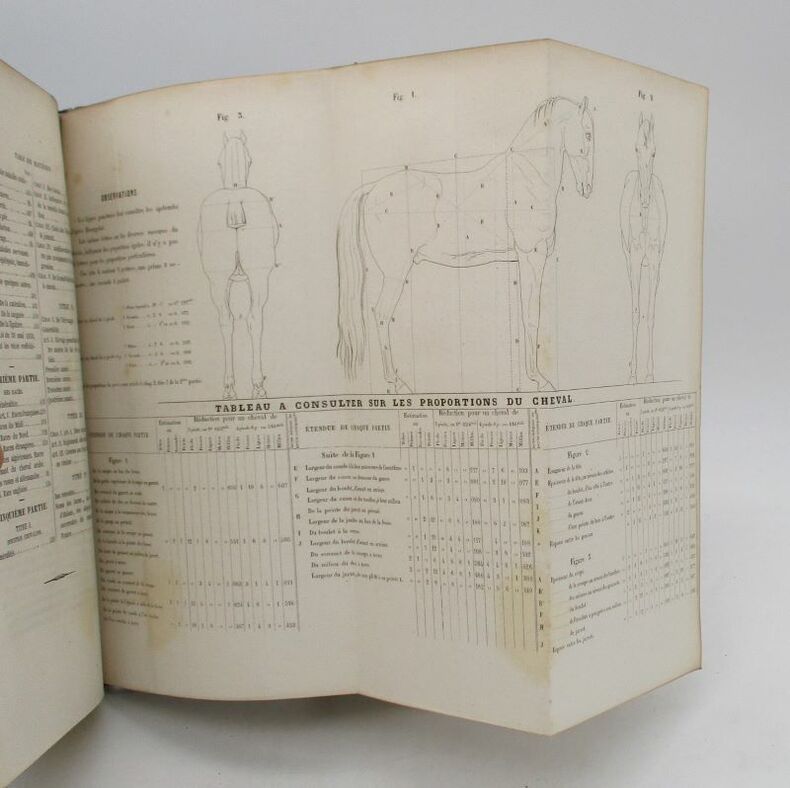
98638À Paris, Chez Guillyn, 1754, 1 volume in-8 de 200x130 mm environ, xiv-(1 f. d'approbation)-439 pages-11 planches dépliantes, 1 feuillet blanc, veau blond marbré, dos à nerfs orné aux petits fers, tranches rouges, gardes marbrées (rel. de l'époque). Quelques feuillets et bordures de certaines planches brunis, coins émoussés et coupes, petite galerie de ver sur le premier plat,
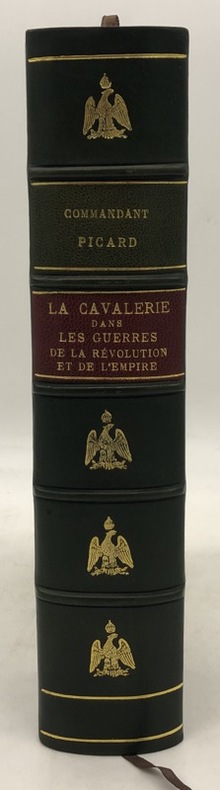
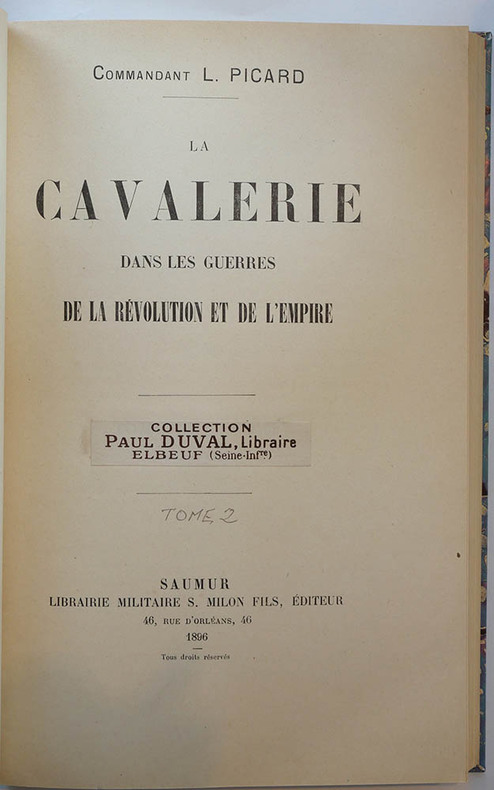
199620Saumur, Milon, 1895-1896 2 tomes en 1 vol. gr. in-8, 419 pp. et 406 pp., demi-veau vert, dos à nerfs orné de filets dorés et à froid et d'aigles dorés, couv. cons. pour le premier tome (reliure moderne).
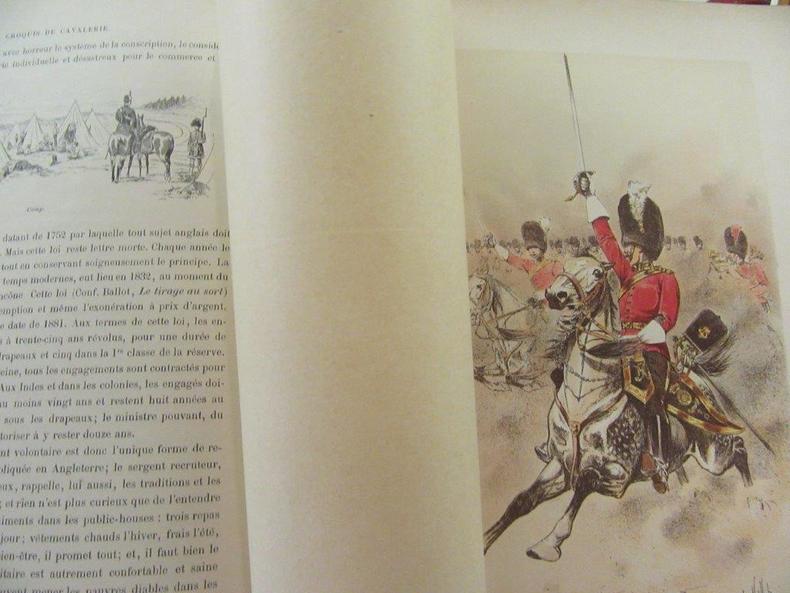
15694librairie militaire S. Milon fils, Editeur Saumur, 1895-1896, 2 vol. in-8 demi-chagrin noir, dos à quatre nerfs ornés de filets dorés, fleurons dorés, plats de couverture conservés. (couvertures Milon fils editeur au premier volume / couverture Paul Duval à Elbeuf pour le second volume). Reliure moderne de bonne facture. T.I 1792-1808 3ff.-419pp.- T.II 1809-1814 2ff.-406pp. Edition originale rare de cet ouvrage de référence sur l'évolution et la tactique de la cavalerie française. Un état des lieux précis est établi pour chaque campagne. Très bel exemplaire.
17226Paris, Librairie de Firmin Didot, frères, 1854. In-8, 578 pp., 7 pl., chagrin vert d'A. Despierres, rel. de l'empereur, double filet à froid et filet doré en encadrement sur les plats, dédicace dorée au premier plat, dos à nerfs orné de caissons à froid et de filets dorés, doublure et garde de soie moirée blanche, tranches dorées (petits manques et frottements, soie tachée, rousseurs).
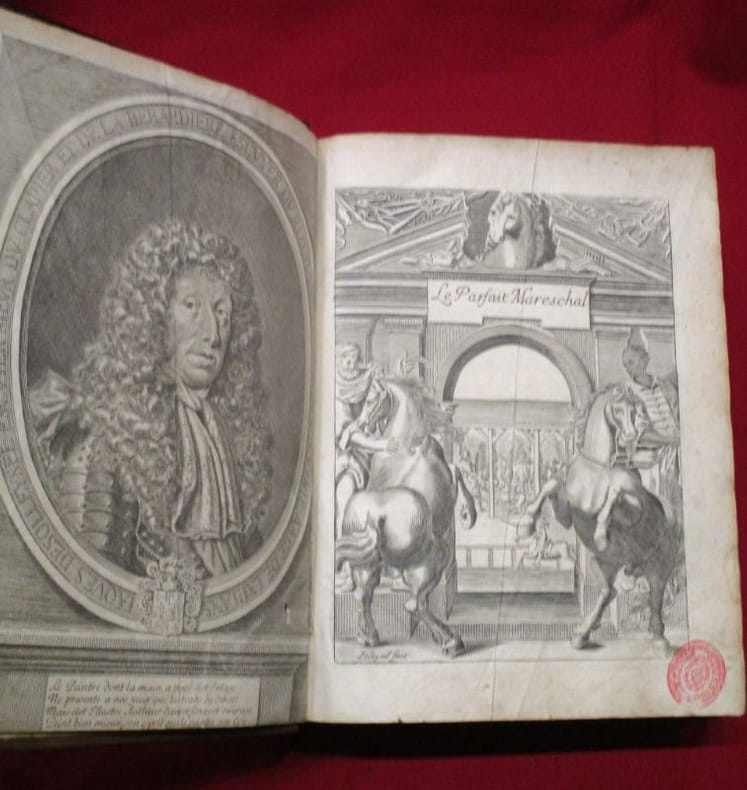
118823A Paris, Chez Jean Mariette, 1713, 2 parties reliées en 1 volume in-4 de 185x245 mm environ, portrait frontispice, titre-frontispice gravé, (3) ff. (titre, avis au lecteur), paginé 513 (au lieu de 512 pages), (5) ff. (table) - page de titre de la seconde partie, 376 pages, 6ff. (table des matières générales). Complet du portrait, du titre frontispice gravé, des deux planches (dont une dépliante) et des nombreuses figures in-texte. Plein cuir brun moucheté d'époque, dos à nerfs portant titres dorés sur pièce de titre en maroquin havane, orné de caissons à motifs dorés, roulette dorée sur les coupes, tranches mouchetées rouges, gardes blanches. Coiffe de tête arasée, quelques taches sombres et épidermures sur le cuir, garde volante en partie découpée, ex libris au tampon rouge (François Viallet) sur deux feuillets, quelques rousseurs et discrètes traces de mouillures sinon bon état général.
2985Paris, Hetzel, 1874. 3 vol. in-12, demi chagrin, 311, 392 & 340p. Table ; Régiments de cavalerie - Régiments de Hussards - Régiment de Dragons - Régiments de Chasseurs. Rousseurs éparses, Bon état.
189345480BBParis, Librairie de Firmin-Didot et Cie, 1893. 4°. 34 cm. XIV, 300 Seiten, 1 Blatt. Halblederband der Zeit mit goldgeprägtem Rückentitel und Kopfgoldschnitt.
Second edition, revised, and corrected, with additions, small 8vo, [8], 128pp., 3 folding engraved plates, the large folding plate showing the horses bit is a little creased with several closed tears to folds but is complete, early ownership signatures to endpapers: Henry Wells; William Lawson (1808); William Lawson Digby (1812), cont. full calf, joint slight cracked, but overall a very good copy. Includes chapters on: The method of preparing horses to be mounted; teaching horses to stand fire, noises, alarms, fights, &c.?preventing their lying down in water?to stand quiet to be shot off from?to disregard dead horses?to swim, &c.; Several remarks and hints on shoeing, feeding, management of horses, &c.
35914Paris, Firmin-Didot en 1893. Le Chic à Cheval ( 2ème série). Petit in-folio en demi-maroquin à coins. Préface de Roger de Beauvoir. 300 gravures in-texte et 50 en couleurs, d'après les dessins de l'Auteur. 294 pages + Table des planches en couleurs , des illustrations I-T et Table des Matières. Bel exemplaire, coins légèrement frottés. Tête dorée.
190881586Pana Illinois: Kerr's Printing House 1908. Presumed First Edition First printing thus. Staplebound wraps. Fair. 2 16 8 pages Three illustrations/plates. Front cover and title page have the names and address of previous owner and a date stamped on it. Cover is worn torn chipped and soiled. The 2nd Illinois Cavalry Regiment was a cavalry regiment that served in the Union Army during the American Civil War. Companies "A" to "L of the 2nd Illinois Cavalry was mustered into service at Camp Butler Illinois on August 12 1861. Company "M"" was mustered in on December 30 1861. The regiment was mustered out on December 30 1865.<br/>The regiment suffered 8 officers and 50 enlisted men who were killed in action or who died of their wounds and 3 officers and 173 enlisted men who died of disease for a total of 234 fatalities. Commanders: Colonel Silas Noble - mustered out February 16 1863; Colonel John J. Mudd - killed in action May 3 1864; Colonel Daniel B. Bush Jr. - discharged July 24 1865; and Colonel Benjamin F. Marsh. Plates I is of Mrs. John J. Mudd Mrs. Ella Mudd Baldwin and Wm M. Baldwin. Plate II is of Lt.-Col. Harvey Hogg who was killed in the Battle of Middleburg Tenn in 1862. Plate III is of George C. Houchens President of the Second Ill. Cavalry Association who died in 1906. These proceedings include the lengthy poem We've All Grown Old by David G. Palmer. This copy was owned by James P. Chase who served in Company H and later lived in Socorro New Mexico. Related marks on page 8. On pages 10-12 is a letter written by M. H. Musser to his wife in 1962 that addresses the battle in which Lt.-Col. Hogg was killed. Other discussion of the battle follow. Kerr's Printing House paperback
28782Paris, Anseime et Pochard, 1820. 2 vol. in-12, basane blonde racinée, dos lisses ornés de fleurons, de palettes et de filets dorés, de deux caissons semés de petites étoiles dorées, pièces de titre en maroquin rouge, roulette dorée sur les coupes, tranches jaspées de bleu. Reliure de l'époque. Bel exemplaire. 129 planches hors-texte gravées sur cuivre, dont plusieurs repliées et 5 planches de musique gravée repliées, (2) ff., xxiij-498 pp.; 12 pp.
18890039151889 Paris, Charavay, 1889. Grand in-8 (195 X 283 mm) demi-maroquin rouge à coins, filet doré sur les plats, dos à nerfs ornés d'une guirlande dorée, compartiments ornés de fers, filets et points dorés et à froid, drapeau français mosaïqué au compartiment central, titre doré, tête dorée, plats de la couverture conservés (Reliure de l'époque) ; (5) ff. dont feuillet blanc, faux-titre, frontispice, titre et préface, 367 pages, (1) f. de table. Taches sombres à la reliure.
45679Paris Librairie de L. Hachette et Cie 1855 in 18 (13x8) 1 volume reliure cartonnée imprimée de l'éditeur, 61 pages [1], des rousseurs sur les premières et sur les dernières pages. Général Eugène Daumas, ex-colonel de Spahis, ex-directeur central des affaires arabes à Alger. Troisième édition. Bon exemplaire
19061107761906 6e et 7e années complètes, reliées avec les suppléments - 1904, 1905 et 1906 - Imprimerie Pairault et Cie, Paris - Revue mensuelle illustrée - In-4, demi basane bleue - Titre, années et filets dorés au dos - 192 p. + 192p. + suppléments de 80 pages (6e année) + 80 pages (7e année) - Très riche iconographie en N&B, ainsi que 46 planches rehaussées à la couleurs (hors texte)
19061107771906 8e, 9e et 10e années complètes, reliées avec un supplément de février 1907 - 1906, 1907 et 1908 - Revue mensuelle illustrée - In-4, demi basane bleue - Titre, années et filets dorés au dos - 192 p. + 192p. + 192p. + 8 pages (supplément N° 2 de février 1907) - Très riche iconographie en N&B, ainsi que 66 planches rehaussées à la couleurs (hors texte)
19001107951900 Première année complète - 1899 et 1900 - Revue mensuelle illustrée - In-4 (environ 25 x 17cm), demi basane verte - Titre, année et filets dorés au dos - 327 pages - Très riche iconographie en N&B, ainsi que 28 planches rehaussées à la couleurs (hors texte)
19011107961901 2e année complète - 1900 et 1901 - Revue mensuelle illustrée - In-4 (environ 25 x 17cm), demi basane verte - Titre, année et filets dorés au dos - 376 pages - Très riche iconographie en N&B, ainsi que 46 + 2 planches rehaussées à la couleurs (hors texte)
19021107971902 3e année complète + 4 numéro de la 4e année - 1901 et 1902 - Revue mensuelle illustrée - In-4 (environ 28 x 20cm), demi basane verte - Titre, année et filets dorés au dos - 192 pages (3e année) + 64 pages (4e année) - Très riche iconographie en N&B, ainsi que 68 + 12 planches rehaussées à la couleurs (hors texte)
227195Paris, Magimel, 1813 2 vol. in-12, XXIV-526 pp. et 12 pp.-8 pp. dépl. de partitions musicales, pl., demi-basane verte, dos à nerfs orné (reliure postérieure). Dos passé. Dernière planche restaurée avec des manques.
202201013A la haye, Chez jean van duren , 1740 ; in-8, cartonnage de l'éditeur. Exemplaire bien conservé "la science militaire" tome 1 reliure demi-velin, tranche frotté, interieur propre.
19621930MARSEILLE. BRUNON. 1962. IN-4 (25 X 32 X 2 CENTIMETRES ENVIRON) DE 72 PAGES, RELIURE D’EPOQUE 1/2 CHAGRIN ROUGE, DOS A QUATRE NERFS, TITRE DORE, COUVERTURE ILLUSTREE D'UNE VIGNETTE EN COULEURS ET DOS CONSERVES. ILLUSTRE DE NOMBREUSES REPRODUCTIONS DE DOCUMENTS ANCIENS, DE COMPOSITIONS ET DESSINS DE P. BENIGNI ET L. FREGIER IN ET HORS TEXTE, DONT 4 PLANCHES HORS TEXTE EN COULEURS. EDITION ORIGINALE. TIRAGE LIMITE A 530 EXEMPLAIRES NUMEROTES, CELUI-CI PORTANT LE NUMERO 203. RARE ET RECHERCHE. VIGNETTES COLORIEES A LA MAIN JUSQU’A LA PAGE 15. ANNOTATIONS MANUSCRITES AU CRAYON EN MARGE DES PAGES 37, 39, 40 ET 41. RELIE AVEC UNE PLANCHE SUPPLEMENTAIRE DE MAURICE TOUSSAINT (LE PASSEPOIL. 30° ANNEE, PLANCHE N°4, 2° REGIMENT D’ECLAIREURS DE LA GARDE IMPERIALE, TROMPETTE ET TROMPETTE-MAJOR, 1813-1814). BON EXEMPLAIRE.