1 098 résultats
18954746Berger-Levrault et Cie 14,5 x 22,5 Paris - Nancy 1895 Plaquette brochée, 52 p., suivies de pages de figures. Ex-libris colonel Lapadu-Hargues. Ouvrage dérelié, mais bon intérieur.(C119) Livre
24290PARIS, Lib. Militaire de J; Dumaine - 1880 - In-12 - broché - 10 figures, certaines PP HT - XI-260 pages + Errata - Exemplaire non coupé
132639Paris, Berger-Levrault, 1934 gr. in-8, 184 pp., frontispice en couleurs, 33 pl. dt 5 en couleurs, toile bleue (reliure moderne).
198793Paris, Berger-Levrault, 1934 gr. in-8, 184 pp., frontispice en coul., 33 pl. dt 5 en coul., broché.
199645Paris, Berger-Levrault, 1933 gr. in-8, 184 pp., front. en coul., 33 pl. dt 5 en coul., broché.
174518462amiens 1745 1 in-8 1 document ORIGINAL manuscrit à l'encre brune, en 8 feuillets sur vélin, grand in-octavo, et son sceau de cire tamponné sous papier (en parfait état d'époque) (24 x 17cm),fait à amiens, le 8 Avril 1745, signatures manuscrites,
181521765Paris 1815 document manuscrit à l'encre brune et préimprimé en noir sur parchemin vélin, format : 36 x 24,5 cm, fait à Paris le 25 Décembre 1815, signature manuscrite de CLARKE Henri-Jacques-Guillaume, Ministre secrétaire Général de la Guerre, Maréchal, Duc de Feltre, cachet royal à l'encre noire "Caisse des Invalides de la Guerre" aux Armes Royales + Cachet sec gauffré du "Ministère de la Guerre" aux Armes Royales,
8vo., First Edition, with 20 plates on 16, and 4 full-page charts and a double-page map in the text, fore-edges lightly browned as often; cloth, gilt back, brown endpapers, a very good, bright, clean copy in price-clipped dustwrapper, the latter lightly browned at edges. Uncommon in anything like this condition
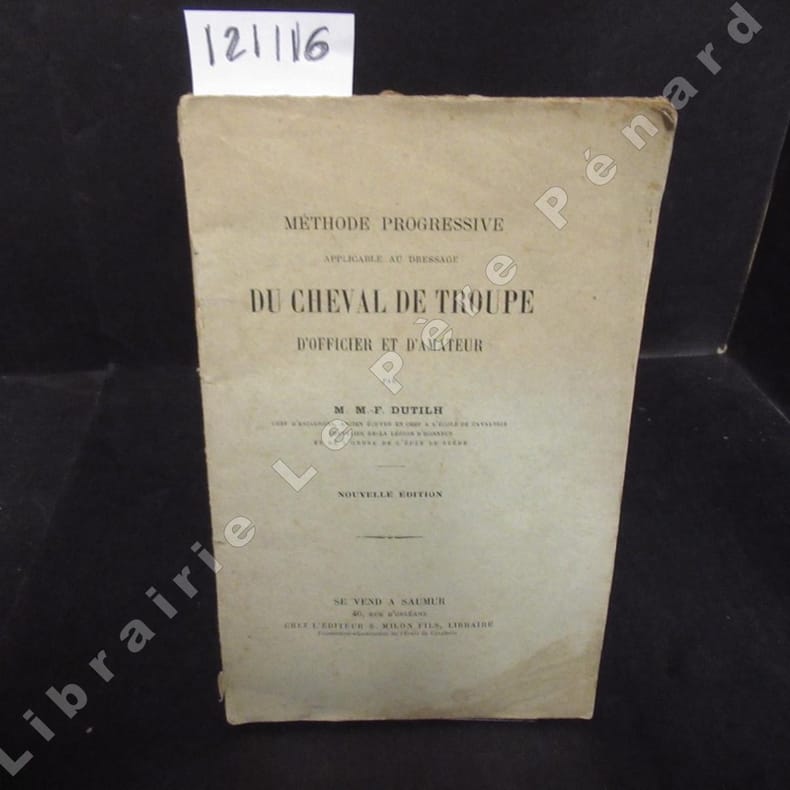
121116sd Se vend à Saumur, chez l'éditeur S. Milon Fils, libraire - Sans date (fin XIXe siècle) - In-8, broché - 78 p.
217785Rennes, Oberthur, 1925 in-8, 132 pp., frontispice, broché, premier plat de couverture illustré.
189195150Paris, E. Plon, Nourrit et Cie 1891 3 volumes. In-8 21,5 x 14 cm. Reliures demi-chagrin grenat, dos à nerfs ornés de roulettes et encadrés de petits fers dorés, XII-390-495-446 pp., 3 frontispices dont 2 portaits du général Marbot, 2 fac-similés d’autographes repliés, table des noms, table des matières. Coupes légèrement frottées, accroc à une coiffe.
199634443Paris éditions S.P.M., Kronos 1996 Préface de Jean Tulard , notes de Nicole Gotteri
186014089Nancy, Vagner, 1860. Un vol. in-12 (193 x 122 mm) de 3 ff. n.fol. et 300 pp. Reliure de l'époque de demi-percaline cerise, dos lisse orné de doubles filets dorés, fleuron central doré, pièce de titre de maroquin anis, titre doré, couvertures conservées.
1865List2438Camp Low 1865. Original partially printed document 26cm x 77cm. Printed on both sides of the sheet completed in manuscript. Darkening at folds from old tape repairs; partial splits to folds and extremities; complete and quite Good. Docketed verso signed in ink by Lieutenant Morgan Owen. Lists twelve enlisted soldiers most with Spanish surnames two with French surnames. Fine. The formation of the California Native Cavalry in 1863 marked a significant chapter in the state's history. Comprising primarily Mexican-American individuals colloquially referred to as "native" Californians the California Native Cavalry unit was formed 1863. Initially commanded by Maj. Andreas Pico a distinguished hero from the Mexican-American War and later under Salvador Vallejo the regiment drew its ranks from diverse backgrounds. Recruitment efforts began with vaqueros from southern California expanding to include individuals from San José and San Francisco. The unit boasted a varied composition encompassing not only Mexican-Americans but also Chilenos California and Yaqui Indians and even French legionnaires.<br /> Company "B" a contingent largely recruited from the northern part of the state is reflected in the existing muster roll. The company assembled at Camp Low near San Juan Bautista in 1865 making a striking entrance into the town. Described as "gay and gallant Spanish lancaroes" the cavalrymen presented a formidable sight with lances in hand and flags flying leaving a lasting impression on the townspeople who had never before encountered soldiers."The gay and gallant Spanish lancaroes sic came dashing through the town with the lances in their hand a flag flying from each of them. I assure you that they presented a war like appearance the people here had never seen a soldier in their lives – Yes Sir!." letter Maj. Michael O'Brien to Gov. Frederick Low January 1865; quoted in Prezelski "Lives of the Californio Lancers: the First Battalion of Native California Cavalry" in Journal of Arizona History v.40 no.1 Spring 1999. <br /> Under the command of Capt. Porfirio Jimeno Company B swiftly engaged in a critical mission: dismantling the notorious Mason-Henry Gang that had terrorized the San Juan region in the preceding months. Despite successfully wounding John Mason in early April 1865 the gang persisted for another month until Mason met his demise at the hands of a miner he sought to kidnap.<br /> However Company B faced challenges including low morale and a high rate of desertions with over 40 men leaving the company in 1865 alone. Transferred to Tubac Arizona Territory to confront the Apaches the company encountered further desertions along the way. The muster roll listing only twelve soldiers alongside Capt. Porfirio Jimeno reflects this tumultuous period. Overall the muster roll provides scarce documentation of the role of Mexican-Americans in the Civil War with few other examples in the trade or institutionally. unknown
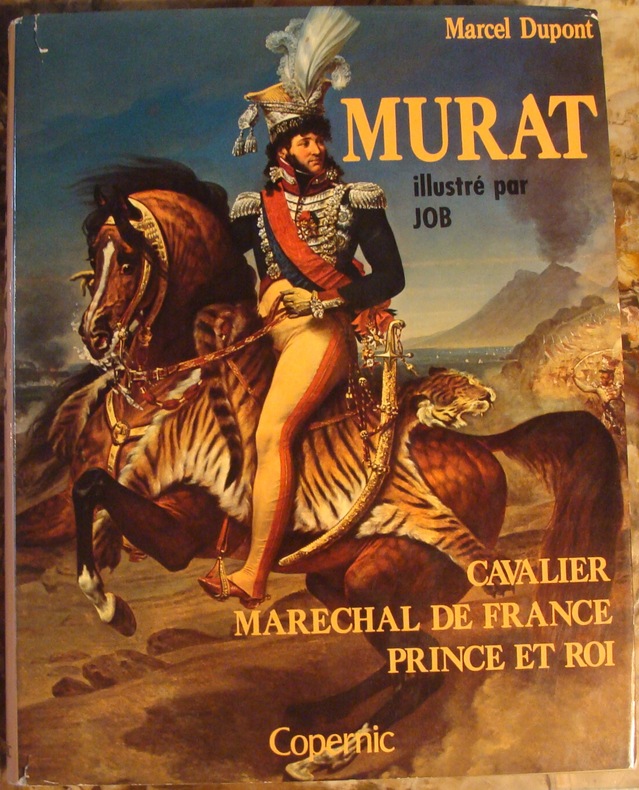
1980614PARIS. COPERNIC. 1980. IN-4 (26,5 X 21 X 3 CENTIMETRES ENVIRON) DE 334 PAGES, RELIURE DE L'EDITEUR A LA BRADEL PLEINE PERCALINE BEIGE, TITRE EN BISTRE, SOUS JAQUETTE ILLUSTREE EN COULEURS. ILLUSTRE DE 12 PLANCHES EN COULEURS HORS TEXTE. BON EXEMPLAIRE.
199833438Pygmalion / Gérard Watelet 1998 in-8°
193413945Hachette 1934 349 pages in8. 1934. broché. 349 pages. Biographie de Joachim Murat (1767-1815) maréchal de France et roi de Naples écrite par l'officier et écrivain militaire Marcel Dupont. L'ouvrage publié en 1934 chez Hachette est enrichi de dessins et d'aquarelles de l'illustrateur Job et dresse un portrait vivant et détaillé de ce cavalier exceptionnel de l'époque napoléonienne
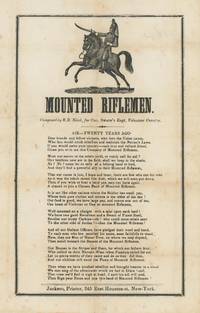
1860LIST026New York: Jackson 1860. First Edition. An unrecorded recruitment broadside for the 11th New York Cavalry. Col. James Swain led the regiment which was first organized on Staten Island in late 1861. Most troops came from New York City the site of robust recruitment in the early years of the conflict largely from Irish and German immigrants. The regiment saw service throughout the South. The verse in small part: "Must our nation to the rebels yield or vainly call for aid / Our brethren now are in the field shall we keep in the shade. that our cause is just I hope and trust there are few who can but own / As if was the rebels raised this dust which we will soon put down. / Then if you wish to bear a hand you might not have again / A chance to join a chosen band of Mounted Riflemen." <br /> <br /> We find no record of the verse's author R.B. Nicol. Curiously though this broadside is unrecorded a broadside with the same song was published in Washington D.C. by G.F. Hardwick in 1864. A very good copy well preserved with some light creasing and hints of foxing. Jackson unknown books
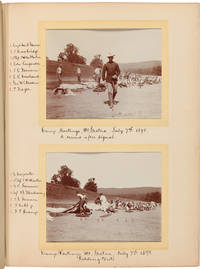
1898WRCAM54683Various places including Pennsylvania Virginia at sea New Jersey and Puerto Rico 1898. 171pp. with 342 photographs. Four large quarto photograph albums. Matching contemporary three-quarter crimson morocco and cloth front covers gilt. Minor shelf wear and some rubbing. Images in overall very good condition. An amazing assemblage of photographs documenting the Spanish-American War experiences of the First Troop Philadelphia City Cavalry which was at that time the oldest volunteer military unit in continuous service to the United States. The photographs are arranged chronologically in four contemporary photo albums with the images occasionally annotated in a contemporary hand and including the identification of numerous members of the Troop. <br> <br> The first volume opens with images of Mt. Gretna Pennsylvania "where troops were sworn into U.S. service May 7th 1898 by Maj. Thompson U.S.A." The photographs record field exercises camp building and tent organization at Camp Hastings cavalry drills an image of "Capt. Groome reading the Articles of War to Troop June 1898" a "first arrival of government horses" several shots of men training and "throwing" their horses shooting practice "Capt. Groome assigning Government horses to Troopers" and various shots of the men at work and even some play. Over the course of the album the names of numerous soldiers are recorded below several of the photographs. <br> <br> The second album opens with several photographs of the Troop striking their tents in preparation for leaving Camp Hastings at Mt. Gretna headed for Camp Alger at Dunn Loring Virginia. Here the Troop was ordered to increase their enlistment numbers. At Camp Alger the Troop was also fitted out with federal supplies and assigned to the Second Army Corps commanded by Maj. Gen. William Graham who is pictured here. Other photographs capture the camp scene at Alger "the First Troop picket line" the Troop receiving their federal-issue khaki uniforms the Troop at roll call and some shots featuring African-American helpers. <br> <br> In late July the Troop was sent to Newport News and several photographs record their brief time there with about a dozen shots of their temporary camp. On July 28 1898 the Troop left Virginia on the transport ship MASSACHUSETTS bound for Puerto Rico. Several images here capture the frenetic loading of the troops and their horses onto the ship with the remaining half dozen or so shots recording the Troop's time on board. <br> <br> The third album picks up where the second left off with the First City Troop embarked on the transport ship MASSACHUSETTS headed for Guanica Puerto Rico. Shipboard activities captured here include a few shots of groups of men being showered with water hoses. Several shots record the arrival of the men in the port of Guanica where they encounter the hospital ship NUECES which reports of the news of the "surrender of Ponce." After the men disembark they pitch their camp around Cathedral Virgin del Carmen on August 5. The next day several photographs record the unloading of horses and stores in the harbor at Ponce. The remaining thirty-eight photographs in this volume record scenes in the interior of Puerto Rico and are the most heavily annotated of the four albums. The images record scenes from the "road from Port of Ponce to Ponce" several scenes capturing a market day in Ponce and recording numerous native islanders the Troop's "temporary camp about 2 miles beyond Ponce" the "Troop wagon leaving camp beyond Ponce to join wagon train for Guayama" on August 8 a shot of the Troop's wagon "on road to Guayama in a Porto Rico mudhole" images of the wagon train to Guayama with the H Troop 6th U.S. Cavalry the "Point of Advance Guard entering Guayama within the lines" the Troop itself "entering Guayama passing General Brooke's Headquarters" a "View of First Troop Phila. City Cavalry U.S.V. Camp at Arroyo August 10th to 6A.M. Aug. 13th 1898" with the last ten images recording the camp or the streets at Arroyo. <br> <br> The fourth album documents the Troop's voyage home to Philadelphia. This time they take passage on the transport ship MISSISSIPPI and about half of the images record their voyage on board. On Sept. 10 1898 they reach Jersey City in New York harbor where they camp for a short time before returning to camp in Pennsylvania where the album ends. A couple of months later all three officers and the ninety- eight enlisted men of the First City Troop were mustered out of federal service for the Spanish-American War. <br> <br> Originally founded in 1774 by twenty-eight Philadelphia patriots as the "Light Horse of the City of Philadelphia" the First Troop of Philadelphia Cavalry is the oldest mounted military unit operating in continuous service to the American republic being the first volunteer cavalry troop organized in defense of the colonies. Among the Troop's original founders was John Dunlap printer to Congress from 1778 to 1789 publisher of the first American daily newspaper and the first printer of the Declaration of Independence. Most of the earliest members were similarly notable professional men of Philadelphia. The Troop served with valor in the American Revolution the War of 1812 the Mexican- American War the Civil War the Spanish- American War and every major American war through the Korean War. <br> <br> The present albums present a unique and important visual record of the First City Troop's activities before during and on the way home from the Spanish-American War. hardcover books
43722aafBagatelle (Paris), Frères Monloisir, au Temple du Délassement, 1760, pt. in-8vo, IV, titre en rouge et noir + 226 p., gardes en papier dominoté, reliure en veau originale, traces de vers aux charnières, coiffe dénudée, debut de fente.
1990LFA-126716859N° 167 - Janvier-Février 1990 : Revue de l'ex Caisse Nationale des Monuments Historiques. 120 pages, format 270 x 210 mm, illustrée, brochée, bon état
1976LFA-126723783Un ouvrage de 96 pages, format 235 x 325 mm, illustré, relié cartonnage couleurs, publié en 1976, Editions Princesse, bon état
19508264Vers 1950. Cours de Vers 1950. Cours de L'E.A.A.B.C. In-4 non paginé. Initiation économique
1888fl1665Imprimerie Nationale Cartonné 1888 Deux volumes in-12 (9 x 14 cm), reliure cartonnée, Tome 1 : Rapports - Titres I et II (290 pages, 1888) // Tome 2 : Titres III et IV (352 pages, 1885) ; reliure abîmées, manques aux dos, plats frottés et salis, gribouillages aux contreplats/gardes, par ailleurs le texte est bien lisible, en l'état. Livraison a domicile (La Poste) ou en Mondial Relay sur simple demande.