Bassompierre (François de ) :Livre Rare Book
66 résultats
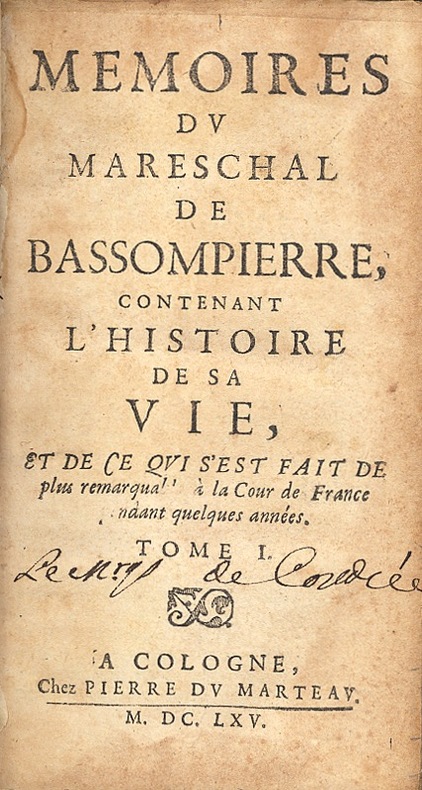
16654528Cologne, Pierre Du Marteau, 1665 ; trois tomes petit in-12 ; demi-veau glacé caramel, dos à nerfs ornés, pièces de titre et de tomaison havane (reliure du XIXe siècle) ; 448 ; 526 ; 430 pp.
16893553A PARIS. PAR FREDERIC LEONARD, PREMIER IMPRIMEUR DU ROY, DE MONSEIGNEUR, & DU CLERGE DE FRANCE. 1689. IN-12 (9,5 X 17 X 3,5 CENTIMETRES ENVIRON) DE (10) + 454 PAGES, RELIURE D'EPOQUE PLEIN VEAU MARBRE, DOS A CINQ NERFS ORNE DE CAISSONS A FLEURONS DORES, TITRE DORE SUR ETIQUETTE MAROQUIN ROUGE, TRANCHES ROUGES. ILLUSTRE D’UNE VIGNETTE DE TITRE GRAVEE SUR BOIS AUX ARMES ROYALES. IMPORTANT RECUEIL REGROUPANT 40 EDITS, ARRETS, ETC., S’ECHELONNANT DU 26 JUIN 1599 AU 14 DECEMBRE 1679. QUELQUES DEFAUTS EXTERIEURS, DONT PETITS MANQUES DE CUIR, SINON BON EXEMPLAIRE.
1692029745Michel Brunet, Paris 1692. Halbleinen Sehr gut
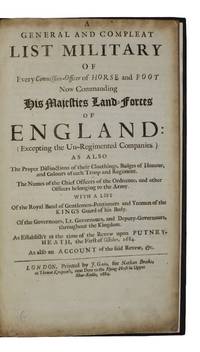
1684AQ22744London: Printed by J. Gain for Nathan Brooks 1684. 4 19pp 1. Modern gilt-tooled calf contrasting red morocco lettering-piece. Minor Shelf-wear. Leaves browned and spotted leaf D1 cropped at foot with some loss of text and sense. The first edition of a Restoration list of officers in the English Army including 'The Proper Distinctions of their Cloathings Badges of Honour and Colours of each Troop and Regiment' and an account of the review upon Putney Heath 1st October 1684. ESTC R14469. Wing G407. First edition. Folio. Printed by J. Gain, for Nathan Brooks unknown
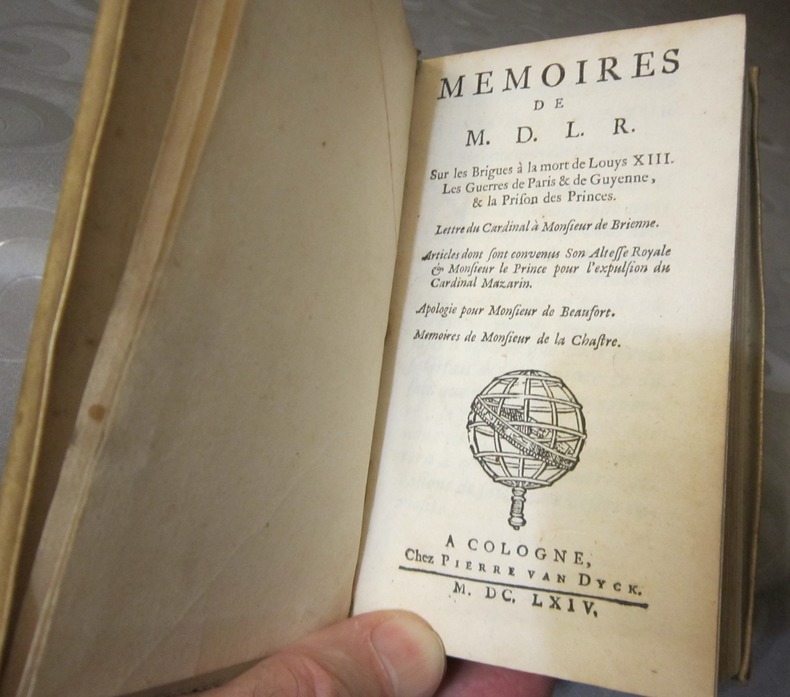
1669003341A Cologne, chez Pierre Van Dyck. in-12 (13,8 x 8,2 cm), 2 ff. (titre et avis au lecteur), 400 pp., reliure d'époque vélin ivoire à recouvrement, dos muet, tranches jaspées, sphère sur le page de titre. (petites taches sur le vélin)
1685AQ22730London: Printed by the Assigns of John Bill deceas'd: And by Henry Hills and Thomas Newcomb 1685. 271pp 1. ESTC R7189 Wing A105. Bound with: Rules and articles For the better Government of His Majesties Land-Forces In Pay during this present rebellion. London. Printed by Printed by the Assigns of John Bill deceas'd: And by Henry Hills and Thomas Newcomb. 1685 36pp. ESTC R28828 Wing R2239. 8vo. Contemporary gilt-tooled speckled calf later rebacked preserving contemporary backstrip. Rubbed head-cap perished. Early manuscript shelf-marks to FEP early inscription of Hugh Scott to title page of first mentioned work dampstaining primarily confined to margins of first work more extensive in second. A scarce late seventeenth-century martial manual on the English army line infantry formations. First printed in 1676 the work is primarily devoted to the correct battlefield positioning of pikes and muskets; detailed instruction is provided for the efficient command of personnel in order to maximise damage inflicted and minimise friendly losses. The information is presented in an efficient and remarkably accessible manner the directions for the 'exercise of the musquet' for example are arranged as a list of succinct stages easily comprehended: 'Handle you Charger / Open it with your Teeth / Charge with Powder.' Successive editions each a revision on the last accommodated advances in military technology such as the introduction of flintlock firing mechanisms and the wide-spread employment of the bayonet. This copy is paired with a reissue of the regulations for the conduct of the infantry occasioned by the onset of the Monmouth Rebellion during which the ranks of the English Army swelled in response to the threat of the deposition of James II. . Printed by the Assigns of John Bill deceas'd: And by Henry Hills, and Thomas Newcomb unknown
1664003335A Cologne, Chez Pierre van Dyck (Bruxelles, Foppens). in-12 (13,5 x 8 cm), 2 ff., 400 pp., reliure d'époque vélin ivoire à recouvrement, auteur, titre et date calligraphiés sur le dos, tranches jaspées et tête rouge. Sphère sur le page de titre.
1650282851650 1 estampe gravée en taille-douce à l'eau-forte en noir sur papier vergé ligné entoilé (avec traces des clous qui ont servi a la fixer tout autour d'un cadre avec traces de plis dans le mode de pliage de cette grande gravure), format : 206 x 179 cm, par Beaulieu, Sebastien de Pontault del. et gravé en noir par Nicolas Cochin, GRAVURE : Extrait des Memoires des généraux. Signé : La Mesnardière et Mesnarderius è Gallis Academicus. A Paris chez le sieur de Beaulieu, Ingénieur ordinaire du Roy, sur le Quay des Grans Augustins près le grand Portal de l'Eglise, au bout du Pont-Neuf. Avec privilège du Roy. 1656
16043325appresso Salvestro Marchetti 16,5 x 22,5 Siena 1ère Edition 1604 Volume in-4, Siena, 1604, appresso Salvestro Marchetti, demi basane fauve début XIXe (?), dos lisse orné de filets entrelacés, pièce de titre au dos, [6 ff.], 197[-1] p. ; [4 ff.], 248 p. ; [2 ff.], 238[-1] p., page de titre en frontispice, portrait, dédicace à "Cosimo de' Medici principe di Toscana" datée "di Siena il di primo di Maggio 1604". L'ouvrage est composé de trois chapitres, marques de l'imprimeur à chaque page de titre et reprises aux colophons. Le titre en frontispice est gravé par le Siennois Dominique Falcini, comportant la marque "DFF". Le titre est dans un ovale entouré de trophées d'armes antiques et modernes qui sont enchainés à une ancre couronnée de deux figures allégoriques. En bas figurent une vue de Sienne et le nom de l'imprimeur. Le portrait gravé d'Imperiale Cinuzzi, vu à mi-corps dans un ovale, qui suit, est signé "Domenico Falcini fecit". Très rare première édition (la seconde, date de 1620) du traité d'art militaire du Siennois Cinuzzi (1556 - 1619), vétéran des armées espagnoles et impériales, ayant servi pendant douze ans en Flandres, en France, sous Alexandre Farnèse et Camillo Capizucchi, puis en Transylvanie et en Hongrie, avec Silvio Piccholomini. (cf. p.2 in Proemio). Le premier chapitre traite de l'importance de la discipline militaire. Le deuxième décrit les qualités nécessaires au capitaine général de l'armée et le troisième, celles du soldat en général et pour chaque poste ("elettione del taburino,del furiere, del Barbier, del Capitan del campagna del Terzo , del dottor di medicina...). Cockle, 596. Bien complet, belles marques de l'imprimeur, agréable typographie avec lettrines. Reliure usagée, avec petites traces de vers aux mors du plat inférieur, frontispice et portrait restaurés en bas de page (au XIXe ?) avec traces de mouillures, mouillures sur les 40 premiers feuillets, puis notamment en bas des pages 80 à 160 du premier chapitre, rousseurs. 2ème chapitre comportant des rousseurs sur la page de titre et suivantes, et mouillures en bas de pages, rousseurs notamment pp. 83-90, note en marge d'époque p.89. 3ème chapitre : rousseurs sur page de titre et table, mouillures en coin, rousseurs notamment pp. 8 à 16, 121-138, 161-238, note en marge pp. 34 et 45.(ALB5). PHOTOS NUMERIQUES DISPONIBLES PAR EMAIL SUR SIMPLE DEMANDE-DIGITAL PHOTOGRAPS MAY BE AVAILABLE ON REQUEST Livre
16043325appresso Salvestro Marchetti 16,5 x 22,5 Siena 1ère Edition 1604 Volume in-4, Siena, 1604, appresso Salvestro Marchetti, demi basane fauve début XIXe (?), dos lisse orné de filets entrelacés, pièce de titre au dos, [6 ff.], 197[-1] p. ; [4 ff.], 248 p. ; [2 ff.], 238[-1] p., page de titre en frontispice, portrait, dédicace à "Cosimo de' Medici principe di Toscana" datée "di Siena il di primo di Maggio 1604". L'ouvrage est composé de trois chapitres, marques de l'imprimeur à chaque page de titre et reprises aux colophons. Le titre en frontispice est gravé par le Siennois Dominique Falcini, comportant la marque "DFF". Le titre est dans un ovale entouré de trophées d'armes antiques et modernes qui sont enchainés à une ancre couronnée de deux figures allégoriques. En bas figurent une vue de Sienne et le nom de l'imprimeur. Le portrait gravé d'Imperiale Cinuzzi, vu à mi-corps dans un ovale, qui suit, est signé "Domenico Falcini fecit". Très rare première édition (la seconde, date de 1620) du traité d'art militaire du Siennois Cinuzzi (1556 - 1619), vétéran des armées espagnoles et impériales, ayant servi pendant douze ans en Flandres, en France, sous Alexandre Farnèse et Camillo Capizucchi, puis en Transylvanie et en Hongrie, avec Silvio Piccholomini. (cf. p.2 in Proemio). Le premier chapitre traite de l'importance de la discipline militaire. Le deuxième décrit les qualités nécessaires au capitaine général de l'armée et le troisième, celles du soldat en général et pour chaque poste ("elettione del taburino,del furiere, del Barbier, del Capitan del campagna del Terzo , del dottor di medicina...). Cockle, 596. Bien complet, belles marques de l'imprimeur, agréable typographie avec lettrines. Reliure usagée, avec petites traces de vers aux mors du plat inférieur, frontispice et portrait restaurés en bas de page (au XIXe ?) avec traces de mouillures, mouillures sur les 40 premiers feuillets, puis notamment en bas des pages 80 à 160 du premier chapitre, rousseurs. 2ème chapitre comportant des rousseurs sur la page de titre et suivantes, et mouillures en bas de pages, rousseurs notamment pp. 83-90, note en marge d'époque p.89. 3ème chapitre : rousseurs sur page de titre et table, mouillures en coin, rousseurs notamment pp. 8 à 16, 121-138, 161-238, note en marge pp. 34 et 45.(ALB5). PHOTOS NUMERIQUES DISPONIBLES PAR EMAIL SUR SIMPLE DEMANDE-DIGITAL PHOTOGRAPS MAY BE AVAILABLE ON REQUEST Livre
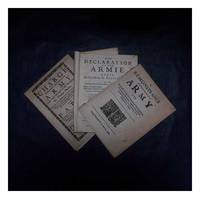
1647413058London : Printed for B.A. ; Printed by the appointments of the Officers ; Printed for Laurence Chapman 1647. First Edition. Softcover. Good set of pamphlet copies; edges slightly nicked and dust-toned as with age. Remain surprisingly well-preserved overall; bright and clean. Physical description; 3 pamphlets dis-bound as issued: paged and unpaged 8; 14 7 pages ; 18 cm. Notes; Full titles: A Remonstrance of the representations of the army for redresse of the grievances of the kingdom : With certain remedies humbly remonstrated to the Parliament for the setling of the kingdome in peace Iune 21. 1647 --- The Declaration of the armie under his Excellency Sir Thomas Fairfax as it was lately presented at Saffron-Walden in Essex unto Major-Generall Skippon.and Colonell Fleetwood members of the House of Commons and Commissioners there for the Parliament. by Colonell Whaley.and Major Disborow with the names of two hundred thirty more Commission-Officers annexed; which declaration is to manifest and set forth to them they being Members of Parliament and of the Army the Armies reall love and diligent care to discharge that duty for which they were raised as will manifestly appeare in time to all that wish well to mercy peace and justice 1647 --- A Charge delivered in the name of the Army under the command of His Excellency Sir Thomas Fairfax unto the commissioners of Parliament with the Army at S. Albans June 14. 1647. : and by them sent up to the Parliament against several members of the Honorable House of Commons. Also a paper delivered to the said commissioners of Parliament June 15. from his Excellency Sir Tho: Fairfax and the Army under his command of some farther humble proposals and desires to the Honorable Houses of Parliament. Printed and published by the appointment of his Excellency Sir Tho: Fairfax and the officers and soldiers of the Army under his command. St. Albans June 17 1647. Signed by me John Rushworth. Subjects; Petitions Resolutions. England and Wales. Army ; Early works to 1800. Great Britain History Civil War 1642-1649 ; Early works to 1800. Great Britain Politics and government 1642-1649 ; Early works to 1800. England and Wales. Parliament Expulsion ; Early works to 1800. Impeachments England ; Early works to 1800. London : Printed for B.A. ; Printed by the appointments of the Officers ; Printed for Laurence Chapman paperback
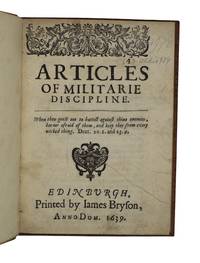
1639AQ22724Edinburgh: Printed by James Bryson 1639. 16pp. Modern blind-ruled tree-calf contrasting black morocco lettering-piece T.E.G. Marbled endpapers trimmed occasionally affecting pagination and signature. Recently dispersed from the Cottlesloe Military Library 'probably the most extensive private collection of early printed books focused on military matters' with the bookplate of Thomas Francis Fremantle 3rd Lord Cottesloe 1862-1965 to FEP. The sole edition of the articles of conduct for the army of 16000 men raised by the Covenanters and commanded by Alexander Leslie first Earl of Leven c. 1580-1661 at the outset of the First Bishops' Wars. The articles besides the expected regulations regarding behaviour towards superior officers and prohibitions concerning desertion reflect the religious reformation championed by the Covenanter authorities. The ecclesiastical social order of the army was structured to mirror the hierarchy of the Church. A 'Kirke Session' applied to each regiment in order to censure 'profainers of the sabbath swearers and drunkards especially such as shall be found drinking in time of prayers of divine service'. Infantrymen were expected to remain celibate whilst in service prostitutes were forbidden in camp and those found to have committed rape were to be executed. ESTC S100228 STC 21904.5. First edition. Quarto. Printed by James Bryson unknown
17003201A AMSTERDAM. CHEZ HENRI SCHELTE. 1700. BEL ENSEMBLE DE 13 AQUARELLES, 12 A PLEINE PAGE ET UNE ILLUSTRANT LE FEUILLET DE TITRE, TOUTES MONTEES SUR ONGLET EN UN VOLUME (32,5 X 41 X 2 CENTIMETRES ENVIRON) RELIURE A LA BRADEL 1/2 CHAGRIN ROUGE A COINS, PLATS RECOUVERTS DE PERCALINE GRISE, TITRE DORE SUR DOS LISSE. COMPREND:- FEUILLET DE TITRE MANUSCRIT, ILLUSTRE PAR UN TROMPETTE DU 9° CUIRASSIERS (1828).- TROMPETTE DU 1° REGIMENT DE CUIRASSIERS DE LA GARDE ROYALE (1824).- TROMPETTE DU 2° REGIMENT DE CUIRASSIERS DE LA GARDE ROYALE. TENUE DE SERVICE. (1825-1830). REMONTE SUR DES CHEVAUX GRIS VERSES AU REGIMENT PAR LA COMPAGNIE DES GRENADIERS A CHEVAL DE LA MAISON DU ROI, LORS DE SON LICENCIEMENT.- MARECHAL-DES-LOGIS TROMPETTE DU 2° REGIMENT DE CUIRASSIERS DE LA GARDE ROYALE. GRANDE TENUE. (1825).- TROMPETTE DU 1° REGIMENT DE CUIRASSIERS DE LA GARDE ROYALE. PETITE TENUE DE SERVICE (1825).- TROMPETTE DU REGIMENT DE CUIRASSIERS DE LA REINE. (1° REGIMENT. 1816).- TROMPETTE DU REGIMENT DE CUIRASSIERS DU DAUPHIN. (2° REGIMENT). GRANDE TENUE. (1816).- JEUNE TROMPETTE DU REGIMENT DE CUIRASSIERS D’ANGOULEME. (3° REGIMENT). GRANDE TENUE. (1816).- TROMPETTE DU REGIMENT DE CUIRASSIERS DE BERRY. (4° REGIMENT). GRANDE TENUE. (1816).- TROMPETTE DU REGIMENT DE CUIRASSIERS D’ORLEANS. (5° REGIMENT). PETITE TENUE DE SERVICE. (1816).- TROMPETTE DU REGIMENT DE CUIRASSIERS D’ORLEANS. (5° REGIMENT). GRANDE TENUE. (1816).- TROMPETTE DU REGIMENT DE CUIRASSIERS DE CONDE. (6° REGIMENT). GRANDE TENUE. (1818).- TROMPETTE DU REGIMENT DE CUIRASSIERS DE CONDE. (6° REGIMENT). GRANDE TENUE. (1816). D’APRES UNE AQUARELLE DU LIEUTENANT-COLONEL JOLY (CABINET DES ESTAMPES).TRES BEL ENSEMBLE, D’UNE TRES BELLE QUALITE D’EXECUTION.
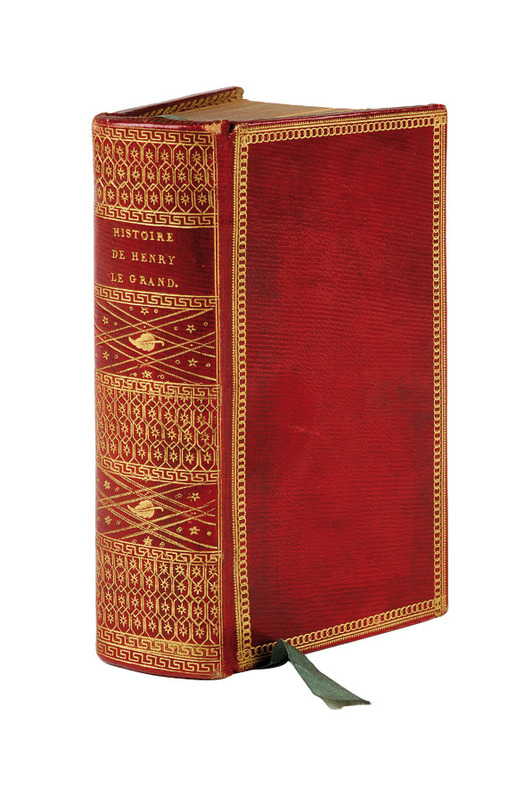
166417474Amsterdam, Daniel Elsevier, 1664; in-12, maroquin rouge, dos lisse à faux nerfs dorés, entièrement décoré et doré «à la Bozérian», roulettes d'encadrement des plats, filet sur les coupes, roulette d'intérieur, tranches dorées (sort très probablement de l'atelier des Bozérian) ; (6) ff. y compris le frontispice gravé et le titre, 566 pp. , (10) ff. , le dernier blanc, Henry le Grand au Roy. Poème par Cassagnes.
162165315Siena, H. Gori, 1621. Qu.-4°. Mit rad. illustr. Titel, einer rad. Portraittafel, einem rad. ganzs. Portrait, 54 blattgr. Radierungen. 2 Bll., 315 (recte 321) (1) S., Ldr. d. Zt. m. goldgepr. Eckfleurons, Rückenverg., goldgepr. Rückenschild, Stehkantenverg. u. Rotschnitt.
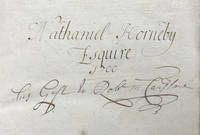
169757867<p>PEACETIME ARMIES ENABLE ABSOLUTISM - AN IMPORTANT DEBATE WITH ENDURING IMPLICATIONS - GIFTED BY A JACOBITE LONDON BANKER TO AN IRISH LANDOWNER</p><p>Collection of 5 items bound together on the issue of a Standing Army being:- <br /><strong>TRENCHARD John</strong> An Argument shewing that a Standing Army is inconsistent with a Free Government and absolutely Destructive to the Constitution of the English Monarchy.<br />London: Printed in the Year: 1697 4to. iv numbered v in error 30 2 advertisement & blankpp. . bound with<br /><strong>MOYLE Walter</strong> The Second Part of an Argument shewing that a Standing Army is inconsistent with a Free Government and absolutely destructive to the Constitution of the English monarchy. With remarks on the late published list of King James's Irish forces in France.<br />London: Printed in the Year: 1697 4to. 27 1 blankpp. . bound with<br /><strong>SOMERS John</strong> A Letter ballancing the Necessity of keeping a Land-Force in times of Peace: with the Dangers that may follow on it.<br />London: Printed in the year: 1697 4to. 2 blank 2 title 16pp. complete with preliminary blank . bound with<br /><strong>TRENCHARD John</strong> A Letter from the Author of the Argument against a Standing Army to the Author of the Balancing Letter.<br />London: Printed in the Year: 1697 4to. 15 1 blankpp. . bound with<br /><strong>FLETCHER Andrew</strong> A Discourse concerning Militia's and Standing Armies with relation to the Past and Present Governments of Europe and of England in particular.<br />London: Printed in the Year: 1697 4to. 2 30pp. <br />The five items bound together in contemporary mottled calf decorative blind tooled panels on sides marbled endpapers very small stain at outer top corner of the last two items small piece of shaved calf repair to the calf skin prior to binding flaked away near upper edge of rear board else a fine fresh copy. Contemporary signature on title of first item "Natt. Horneby" and inscribed on a preliminary blank leaf in a calligraphic hand "Nathaniel Horneby/ Esquire/ 1700" and below that probably at a slightly later date "his gift to Robt. Mc Causland".</p><p><br />1 Trenchard: ESTC r509611 WING T2110. This issue has a press-figure dagger only on leaf B1v and an advertisement on final leaf. Signature C2 is under the "ere is" of "there is". This edition is rare with ESTC locating 5 copies only 2 in B.L. 2 in Oxford & 1 other. See ESTC R16216 for another edition. Wing does not distinguish between the editions. <br />2 Moyle ESTC r177336 WING M3030 ESTC notes "The first part entitled An argument shewing that a standing army is inconsistent with a free government was written by John Trenchard and Walter Moyle. It is often thought Trenchard also assisted in the second part; however attributed solely to Moyle by BM Wing".<br />3 Somers ESTC r11547 WING S4642 <br />4 Trenchard ESTC r16213 There are 2 printings this one line 8 of title page has: 'Balancing'; there is no press-figure on p. 7; p. 15 has additional paragraph beginning: "Now Sir if a Parliament should subject all the Lands .". WING T2113 <br />5 Fletcher ESTC r5238 WING F1294</p><p>Following his invasion of England in 1688 the Glorious Revolution William of Orange became King William III and reigned jointly with his wife Mary. The English parliament's Bill of Rights of 1689 established a constitutional monarchy with extensive restrictions on the royal prerogative. One of those restrictions was that the Sovereign could not raise a standing army during peacetime without parliamentary consent. While William opposed such constraints he accepted them and chose not to engage in a conflict with Parliament. In the following years William was much engaged in European wars that ended with the Treaty of Ryswick in 1697.<br />The wars now over parliament to the king's displeasure decided to reduce the size of the army to 10000 men and later to 7000.<br />The ideological and political significance of the issue was argued out in a series of pamphlets of which these five are probably the most important on both sides of the issue. "The pamphlets . had a powerful effect upon the immediate controversy of 1697-99. The anti-army tracts moreover played a vital role in the formulation of an anti-army attitude which lived on in eighteenth century England and was transmitted along with many other ideas in liberal and republican seventeenth political thought to the American colonies. . Against the peacetime army were principally John Trenchard Walter Moyle Andre Fletcher of Saltoun the Rev. Samuel Johnson and John Toland. Arguing for the king's proposal were chiefly the lord chancellor John Somes and Daniel Defoe . Outstanding among the men who opposed the army was John Trenchard who may be regarded as the leader of the pamphleteers" Schwoerer.<br />Trenchard 1662 - 1723 educated at T.C.D. studied law in London and was a man of considerable wealth through inheritance and marriage. From initial support of the 1689 Revolution he became disenchanted with William and used his wide knowledge of sixteenth and seventeenth century republican political thought to oppose what he judged to be a potentially dangerous power grab by the monarchy. His Argument written in conjunction with Moyle the first pamphlet in this collection launched the debate and determined its parameters. Moyle's <em>Second Part</em> continued their argument. Somers apparently without great conviction argued for retention of a standing army and Trenchard in turn wrote a riposte.<br />Fletcher of Saltoun 1655 - 1716 Scottish writer patriot and politician had returned from European exile with William of Orange in 1688 but terminated his support when he judged that William also King of Scotland was only interested in using the country to help fight foreign wars. He like the other anti-army writers argued that history indicated a direct relationship between absolutism and a peacetime army. He perceived a decay in liberty around 1500 a product of economic and social changes that produced luxury and an abandonment of an old frugal military way of life. Such circumstances allowed defence of the realm to slip into the hands of princes who eliminated ancient rights and freedoms. England the last bastion of liberty faced following 'all the other kingdoms of Europe' along this path unless she avoided a standing army in peacetime.<br />Trenchard and his supporters the group of Whig religious political and economic reformers later sometimes Commonwealth men through their writings promoted republicanism in Britain. However while they were rejected in Britain their ideas were widely influential in British colonial America and on Republicanism in the United States.<br />Nathaniel Hornby or Horneby a London goldsmith and banker served as a Commissioner of Excise 1683 to 88 and in 1691. From the Restoration in 1660 to 1683 the state's excise was farmed out to investors willing to pay the government for the right to collect taxation. In 1683 a new group of Commissioners was chosen to be more efficient in collection than the foregoing. The Revolution of 1688/89 overturned the leadership of the excise branch and only 2 of the 7 Commissioners in office in Feb. 1688 survived a purge in April 1689 with most removed for political reasons. In 1684 when a remodelled department was considered "Sir John Somers whose influence was rising as the Whigs ascended recommended dismissal for virtually all of the commissioners. In particular he singled out Nathaniel Nornby and Thomas Aram who 'were such avowed Jacobites that there was nothing to be said for them'" Krenzke.<br />Nathaniel Hornby perhaps to provide himself with a bolt-hole far from London in the early 18th century rented a house and farm at Muff now Eglinton in Co. Londonderry from Ireland richest commoner and Speaker of the Irish parliament William Conolly himself a head tenant of the London Grocer's Company. Robert McCausland lived at Fruit Hill now Drenagh only a few miles from Muff and near Limavady. That estate was bequeathed to him on his death by William Conolly in 1729 and thereafter alternate eldest sons in the family were named Conolly. Modern McCausland family sources state that Robert was married to a daughter of Conolly but the latter was officially at least childless. Conolly did however support the families of his siblings which may be the connection. Evidently it was as neighbours that a rich London Jacobite banker came to know McCausland and present him with an important collection of pamphlets flagging the perils of creeping central power. From the inscription both men perceived the pamphlets as significant both in themselves and as a gift.<br />Lois G. Schwoerer 'The Literature of the Standing Army Controversy 1697-1699' <em>Huntington Library Quarterly</em> vol. 28 no. 3 1965 p. 187-212 <br />John Krenzke <em>Change in Brewing. Industrialization of the London Beer Brewing Trade 1400-1760</em>.</p> hardcover