9 442 résultats
19773117013Charleston: Self. Fine with no dust jacket. 1977. Letter. LETTER. Typed & SIGNED by General Mark W. Clark on his official 'The Citadel' stationary. Letter in response to request from a collector of World War Two commanding officers' autographs. Clark commanded the American Fifth Army. . Self unknown
199079710Department of the Army 1990. Presumed First Edition First printing thus. Wraps. Good. Three-hole punched and stapled at left side. Sticker residue on front cover. Various paginations approximately 60 pages. Figures. Tables. References. Glossary. Index. This publication supersedes FM 9-84 28 December 1984. It also rescinds DA Form 3549-R 1 October 1970. When issued distribution was only authorized to U.S. Government agencies. This field manual prescribed doctrine and provides techniques procedures and guidance for commanders staffs and soldiers. It applies to all echelons that include nuclear weapons units and their security in support of the AirLandBattle. This field manual also provides training doctrine specifically for nuclear ordnance units and their supporting units during the dispersing modes transition to war and dispersed mode wartime. It explains the nuclear weapons support structure and the associated military police and ordnance units and describes how US host-nation and user-nation support unites are structures and how they divide and deploy with their host-nation units to form NASPs. This field manual also provides general guidance for many of the emergency operations associated with nuclear weapons. As noted in the field manual ordnance soldiers must maintain transport store issue and provide security for nuclear weapons. Military police and other personnel performing security must aggressively screen nuclear weapon storage sites and movements of nuclear weapons. They must also detect delay or divert threat using an overall in-depth security operation that is based on the factors of METT-T. Ordnance MP and host-nation or user-nation soldiers must work together to assure that custodial and nuclear delivery units receive proper types and quantities of nuclear weapons in a reliable condition. They also must be able to defeat forces targeted against US and NATO nuclear capabilities. This manual addresses Nuclear Weapons Units the Threat the Dispersing Mode the Dispersed Mode Ground Convoy Procedures and Emerging Operations. There is also an Appendix on the Military Working Dog and an Appendix on the Ammunition Ordnance Battalion Command Post Diagrams. Department of the Army paperback
196879713Washington DC: Departments of the Army and the Navy 1968. Reprint which includes current pages from Change 1. Wraps. Good. Three-hole punched and stapled at left side. Various paginations approximately 160 pages. Figures. Tables. References. Glossary. Index. Figures D and E and present in an envelop inside the back cover. Figure D is a Circular Map Scale with a scale of 1:50000 and the numbers are in hundreds of meters. Figure E is a Circular Map Scale with a scale of 1:100000 and the numbers are in hundreds of meters. This manual supersedes FM 101-31-1 1 February 1963 including all changes. This manual provides guidance to commanders and staff officers in the operational and logistical aspects of nuclear weapon employment in combat operations. The doctrine presented in this manual is basically concerned with nuclear weapon employment within the field army and the Fleet Marine Force. When the manual discusses special ammunition logistics and vulnerability analyses the scope is extended to include the area of operations. Guidance is presented for the employment of nuclear weapons in the attack of targets on or near the earth's surface. The doctrine in this manual is based on the following basic concepts: a. The U.S. Army and U.S. Marine Corps are organized equipped and trained to fight in nuclear warfare nonnuclear warfare or under the threat of nuclear warfare. In the latter case units are prepared to take the actions indicated in this manual should nuclear warfare begin. b. Nuclear weapons may be employed within the area of operations when the theater commander announces that their use has been authorized. c. Once nuclear warfare has commenced the authority to employ nuclear weapons is decentralized. d. United States nuclear weapons may be employed in support of Allied forces using either United States or Allied delivery means. The nuclear warhead section to include artillery projectiles remains under the control of United States military personnel until time of launching or firing. e. A commander who plans to employ a nuclear weapon coordinates with any adjacent unit commander into whose zone or sector militarily significant weapon effects are expected to extend. Lacking concurrence the commander requests authority to fire from the next higher commander who controls both sectors. f. Nuclear firepower is a form of combat power. Nuclear weapons may on occasion be used alone to accomplish tasks that might otherwise require the maneuver of close combat units; however most tasks require a combination of fire and maneuver. Plans for the employment of nuclear firepower nonnuclear firepower and maneuver forces are integrated to provide decisive results. g. Nuclear weapons are employed to destroy or degrade enemy combat capabilities. Consistent with the requirements imposed by the tactical mission casualties among civilian personnel are held to a minimum. Destruction of manmade structures or natural terrain features tree blowdown or fire areas and creation of high-intensity residual contamination areas may create undesired obstacles to movement. Consistent with military objectives unnecessary destruction and contamination should be held to a minimum. h. Commanders employ the smallest and most readily available weapon with a sufficiently high probability of providing the coverage that insures the desired results. i. Commanders employ surface bursts when surface bursts accomplish the results desired more effectively than do Airbursts. j. Commanders conduct poststrike analysis as required. Departments of the Army and the Navy paperback
1893019244Chicago IL: American Engraving Company 1893. Book. Very good- condition. Paperback. First Edition. 12mo - over 6¾ - 7¾" tall. 16 pages of text illustrated with photographs and one page of text. Paperback binding with both covers illustrated in color. The covers are somewhat soiled and worn remaining in very good condition. The one page of text is titled "A Notable Post" and refers to the George H. Thomas--Post No. 5 Grand Army of the Republic Department of Illinois. The final two pages contain an assemblage of portraits of past commanders of Post No. 5 which was organized August 21 1873 largely through the efforts of Col. Hiram Hilliard. The text is clean and unmarked though the page edges in some cases have minor wear or tiny tears. . American Engraving Company Paperback
18951144409Grand Army of the Republic Dept. of Colorado and Wyoming 1895. A fresh unmarked copy of the rare original edition with little wear other than a closed 1 1/4" tear along bottom fore edge of spine/. Soft cover. VG. 12mo. Book. Grand Army of the Republic Dept. of Colorado and Wyoming Paperback
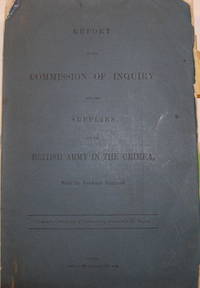
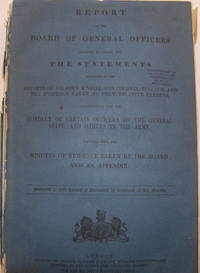
63-9480London UK: Eyre & Spottiswoode 1856. Folio. Blue Wraps 611 pp. Letterpress Charts Good with tears portions of spine missing some splitting along spine else VG. First Edition.PROVENANCE: Collection of Books from the Library of Hugh Small author of Florence Nightingale: Avenging Angel.Hugh Small as a child lived above his surgeon father's consulting rooms in Harley Street almost opposite Florence Nightingale's first hospital. He graduated from Durham University in 1966 with honors in physics and psychology and worked in the US Chile and France before becoming a partner in a multinational management consultancy based in London. He is also the author of The Crimean War Tempus 2007. Hugh is widowed with two daughters and four grandchildren. London, UK: Eyre & Spottiswoode, 1856. paperback
63-9479London UK: Eyre & Spottiswoode 1856. Folio. Blue Wraps 611 pp. Letterpress Charts Good with tears portions of spine missing some splitting along spine else VG. First Edition.PROVENANCE: Collection of Books from the Library of Hugh Small author of Florence Nightingale: Avenging Angel.Hugh Small as a child lived above his surgeon father's consulting rooms in Harley Street almost opposite Florence Nightingale's first hospital. He graduated from Durham University in 1966 with honors in physics and psychology and worked in the US Chile and France before becoming a partner in a multinational management consultancy based in London. He is also the author of The Crimean War Tempus 2007. Hugh is widowed with two daughters and four grandchildren. London, UK: Eyre & Spottiswoode, 1856. paperback
1908288258Washington Barracks D. C.: The Battalion Press Press of the Engineer School Government Printing Office 1908. Hard Cover. Very Good binding. Six pamphlets from the late 19th early 20th century primarily on military engineering bound together in one volume. Brown buckram with a black leather label. Spots of discoloration to the spine. Very Good binding. The Battalion Press | Press of the Engineer School | Government Printing Office unknown
72725E-190. Good. Hardcover. 8vo. Published by Panther Publications Boulder CO. 1965. 173 pgs. Ex-Library item with stamp present to the verso page spine label present to the DJ spine. DJ has light shelf-wear present to the DJ extremities. Bound in cloth boards with titles present to the spine and front board. Boards have light shelf-wear present to the extremities. Bookplate of Colonel Peter Andre of the Special Operations Division present to the front pastedown. Library stamp of Eglin Base Auxiliary Libary present to the verso page. Text is clean and free of marks. Binding tight and solid. This is a legendary work by the famed Swiss expert on guerrilla warfare Major H. Von Dach. Survivalists have rediscovered this important study on resistance and underground operations some making it the keystone of their libraries. Well-written and illustrated with easy-to-understand drawings Total Resistance analyzes and explains the techniques needed to overcome an invading force formation of guerrilla units weapons food and medical considerations ambushes sabotage and much more; 8vo 8" - 9" tall . hardcover
19650711872Washington: Headquarters United States Department of the Army. As New in Shrinkwrap. 1965. Early edition. Loose in Shrinkwrap. 4to - over 9¾" - 12" tall Collectible EXTREMELY RARE. "The M5 radiological fallout area predictor is a transparent device used to provide field units with a means of making an immediate estimate of the location of potential fallout hazard without waiting for a detailed fallout prediction message from the Chemical Biological and Radiological Element BCRE of a major command. 2 huge folding predictors each 23.5 x 40 inches plus pamphlet manual are included there may be other material included but we have not opened the package. The predictors are printed on clear plastic and are extremely complex graphically with azimuth dials nomograms radii and scales for wind distance and helpfully yield of the detonated nuclear device. Still sealed in original plastic field pouch and yet again in US Military vacuum-sealed outer pouch still sealed of type MIL-F 22191 TYPE II. Risks from fallout are broken down into Zone I major casualty risk and Zone II "Zone of Moderate Risk". These are suitable for framing or may be kept for use in case of nuclear attack. Keywords: Nuclear Warfare NCBW Warfare NCB Weapons of Mass Destruction Radiation Radiological Fallout Military History Terrorism. Headquarters, United States Department of the Army unknown
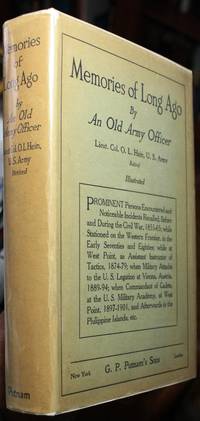
1925020285N.Y.: G. P. Putnam's Sons 1925. Book. Near Fine. Hardcover. First Edition. 310 pages frontis illustrations top edge gilt minor chipping to jacket edges rare in jacket. Hein describes the Grand Review in Washington and the Custer incident. He also recalls meeting Custer in the spring of 1876 while Custer was in route to Washington. Hein also tells of his time in the Apache Wars with Crook. Luther High-Spot 63. G. P. Putnam's Sons hardcover
185930520New York: Redfield 1859. First Edition. Hardcover. Good. 12mo. 144 pages. Blind stamped brown cloth hardcover with title on spine. Cloth covers and spine are worn and faded. Top and bottom of spine patched. Hinges repaired. Light scattered foxing to pages. Previous owner inscription on the front blank end sheet. According to Howes this book is the best account by a participant of the 1858 campaign against the northwestern tribes. Includes two official reports of Colonel Wright in the appendix.<br /> <br /> Howes K 172; Field 837; Sabin 37944; Graff 2341. Redfield hardcover
1926002292Boston & New York: Houghton Mifflin Co. 1926. 1st Edition . Hardcover. Very Good. 8vo - over 7¾ - 9¾" tall. 8vo 305 pgs. plus folding map in the back. One tiny hole in one of the seams not effecting anything pages clean bound in green pebble cloth gilded lettering on front board and spine light staining along top edge of front board otherwise a very nice copy. No writing in pages or signatures found. Rare <br/> <br/> Houghton Mifflin Co. hardcover
1761045558Madrid: D. Gabriel Ramirez 1761. First Edition. Hardcover Vellum. Very Good Condition. Contemporary full vellum mild discoloration small tear to rear cover a few scratches and surface marks. Lacking endpapers otherwise very clean and bright internally.180pp Size: duodecimo 12mo. Quantity Available: 1. Shipped Weight: Under 1 kilo. Category: Military & Warfare; History. Inventory No: 045558. D. Gabriel Ramirez hardcover
187831672Washington D.C.: Government Printing Office 1878. First edition. Cloth. A very good copy with the bookplate of the Military Order of the Loyal Legion of the United States Commandery of the State of Illinois on front pastedown shelf sticker on foot of backstrip a few small tears to the spine ends finger soiling to boards binding solid. xv 527 pp. Illus. with 146 b/w plates many folding. 8vo. Signed twice by Col. F.F. Flint who was commanding officer at Fort Sanders. Includes 32 appendices containing reports on: life-saving apparatus guns projectiles; construction of a 10-inch muzzle-loading rifle and an 8-inch breech-loading rifle; trial of the Taylor battery gun and of many other weapons and fuses; Board to select a magazine gun and more. Government Printing Office hardcover
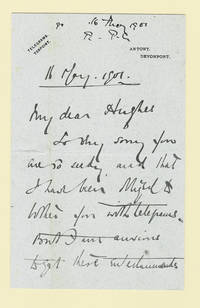
1901101174<p>Antony / Devonport May 16 1901. 1901. Fine. - Over 135 words penned on four sides of 7 inch high by 4-3/8 inch wide "Antony / Devonport" stationery. In his letter addressed to "My dear Hughes" from his Antony House Estate in Cornwall the British Army Officer and Liberal Unionist Member of Parliament Sir Reginald Pole-Carew discusses arrangements for outdoor festivities "".I am anxious to get these entertainment done quickly as promised - and as there is a clever Conjuror whom I know in Plymouth now so seems a pity not to have the out of door's show while he is here and while this lovely weather lasts." He hopes Hughes can come as "Mother will be delighted to see you on Friday." In a postscript he agrees with Hughes that "the Band should be on the evening preceding the outdoors show" and ponders whether there is still time to arrange it. Signed "Reg Pole-Carew". Folded for mailing else fine.</p><p>Celebrated as a military hero the British army officer and landowner Lieutenant-General Sir Reginald Pole-Carew 1849-1924 was commissioned into the Coldstream Guards in 1869. He served with Lord Roberts in the Second Anglo-Afghan War and in the Second Boer War. Promoted to Colonel he was given command of the 9th Brigade with the "local" rank of major-general and led during the Battle of Modder River. Appointed to command the Guards Brigade he later commanded the 11th Division of the South Africa Field Force and in 1903 became the General Officer Commanding the 8th Division in Southern Ireland. He served as a Liberal Unionist Member of Parliament for Bodmin. In February of 1901 the year of this letter Pole-Carew married Lady Beatrice Frances Elizabeth Butler the King and his family receiving them two days prior to their wedding to present Beatrice with wedding presents.</p> Antony / Devonport, May 16, 1901.
1976004585New York: W. W. Norton & Company 1976. 143 pages. General Taylor's forecast of U.S. future security needs. Inscribed to Chief Justice Warren Burger; taped to the front pastedown is a handwritten signed note on Taylor's letterhead to Burger; the note stamped "Received Chambers of the Chief Justice"; typewritten copy of the note on letterhead of the Supreme Court of the United States Chambers of the Chief Justice. The note remarks on perceived interest or non-interest in Taylor's ideas by Presidnts Kennedy and Carter. Clean throughout nearly fine condition; the dutjacket is clipped at one corner. First Edition. Cloth. Very Good/Very Good. 8vo. W. W. Norton & Company Hardcover
1950JC8431Presidio of San Francisco California: Headquarters Sixth Army 1950. Paperback. Near Fine. Staple-bound text block; 4to; pagination varies approx. pp. 100 typed mimeographed text and illustrations and "RESTRICTED" printed on every page. Two courses offering a summary of the discoveries leading to development of atomic energy and the administrative organization for its control in the United states a comparison of atomic bomb and TNT bomb explosions types of atomic bomb explosions effects of known atomic bomb explosions and probable targets for atomic bombs. Also addresses the establishment of the Manhattan engineering district public law 585 atomic energy act of 1946 Atomic Energy Commission AEC and military liason committee. Disturbing stuff with pictures of bomb victims. The whole a little age-toned but near fine. OCLC locates only 3 copies. <br/><br/> Headquarters Sixth Army paperback
197667415Fort Dix NJ: Headquarters US Army Training Center 1976. Wraps. Good. Pencil erasure residue on first page. Includes illustrations. Three-hole punched and staple bound. Various paginationsapproximately 150 pages. References. Thius plan was published for the information guidance and necessary action of commanders directors and office/activity chiefs concerns and supersedes the previous plan dated 1 February 1975. From Wikipedia: "Fort Dix the common name for the Dix unit of Joint Base McGuire-Dix-Lakehurst is a United States Army base located approximately 16.1 miles 25.9 km south-southeast of Trenton New Jersey. Dix is under the jurisdiction of the United States Army Reserve Command USARC. Fort Dix established in 1917 was consolidated with two adjoining U.S. Air Force and Navy facilities to became part of Joint Base McGuire-Dix-Lakehurst JB MDL on 1 October 2009. However it remains commonly known as Fort Dix as of 2012.Fort Dix is named for Major General John Adams Dix a veteran of the War of 1812 and the Civil War. Construction began in June 1917. Camp Dix as it was known at the time was a training and staging ground for units during World War I. The camp became a demobilization center after the war. Between the World Wars Camp Dix was a reception training and discharge center for the Civilian Conservation Corps. Camp Dix became Fort Dix on March 8 1939 and the installation became a permanent Army post. During and after World War II the fort served the same purpose as in the first World War. It served as a training and staging ground during the war and a demobilization center after the war. On July 15 1947 Fort Dix became a Basic Training Center and the home of the 9th Infantry Division. In 1954 the 9th moved out and the 69th Infantry Division made the fort home until it was deactivated on March 16 1956. During the Vietnam War rapid expansion took place. A mock Vietnam village was constructed and soldiers received Vietnam-specific training before being deployed. Since Vietnam Fort Dix has sent soldiers to Operation Desert Shield Desert Storm Bosnia Afghanistan and Iraq. The Atlantic Strike Team AST of the U.S. Coast Guard is based at Fort Dix. As part of the Department of Homeland Security the AST is responsible for responding to oil pollution and hazardous materials release incidents to protect public health and the environment. Fort Dix is also home to Fort Dix Federal Correctional Institution the largest single federal prison in America. It is a low security installation for male inmates located within the military installation. As of November 19 2009 it housed 4 310 inmates and a minimum-security satellite camp housed an additional 426. Inmates use plastic pouches of mackerel as commodity money. Knowing that Fort Dix was on a base closure list the U.S. Air Force attempted to save the U.S. Army post during 1987. The USAF moved the Security Police Air Base Ground Defence school from Camp Bullis Texas to Dix in the fall of 1987. It was eventually realized that it was not cost effective to put 50-100 S.P. trainees on a commercial flight from San Antonio Texas to Philadelphia Pennsylvania every couple of weeks so the school was later moved back to Camp Bullis Texas. Fort Dix was an early casualty of the first Base Realignment and Closure process in the early 1990s losing the basic-training mission that had introduced new recruits to military life since 1917. But Fort Dix advocates attracted Army Reserve interest in keeping the 31 000-acre 13 000 ha post as a training reservation. With the reserves and millions for improvements Fort Dix actually has grown again to employ 3 000. As many as 15 000 troops train there on weekends and the post has been a major mobilization point for reserve and National Guard troops since the September 11 2001 attacks on New York City and Washington D.C. Fort Dix has completed its realignment from an individual training center to a FORSCOM Power Projection Platform for the Northeastern United States under the command and control of the United States Army Reserve Command. Primary missions include being a center of excellence for training mobilizing and deploying. Headquarters, US Army Training Center paperback
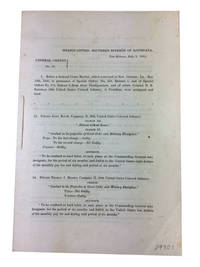
186589901New Orleans 1865. Very Good. 9p. Tied softcover pamphlet. No separate wrapper. 21 cm. Modest spotting and soil. Colonel N. B. Bartram 20th U. S. Colored Infantry was President of this General Court Martial which convened on May 29 1865 and before which 22 soldiers appeared all but 3 of whom served in various the United States Colored Infantry -- one of the exceptions served in the 18th New York Cavalry and the other two served in the 1st New Orleans Volunteers. Charges ranged from Conduct to the Prejudice of Good Order and Military Discipline to Riotous and Mutinous Conduct. The sentence for the latter was that Private John F. Thompson be "confined at hard labor with ball and chain attached to his left leg weighing thirty-two 32 pounds chain two feet long . for the period of two years and forfeit . the whole of his monthly pay for and during the remaining and unexpired term of his enlistment." Two soldiers were found not guilty and two others facing multiple charges were found guilty of only some of the charges. All other soldiers were found guilty. An officer in the 1st New Orleans Volunteers was only given a reprimand after he used his sword to strike an enlisted man because of circumstances which are detailed at some length. Additionally page 7 includes the results of a separate military commision convened with Major M. Maloney as President on March 24 1865 to deal with three civilians -- all three were found not guilty. unknown
191769371New York City France: United States Army 27th Division 1917. Presumed first edition/first printing thus. Wraps. Fair. Signed by previous owner. Two hole cloth bound binder. General Orders 1-33 # 16 absent for 1917. General Orders 1-40 111 120-125 128-129 132 134-140. A remarkable substantial set of WWI Divisional General Orders covering the Division for the time Major General John O'Ryan assumed command on July 25 1917 to General Order 140 of August 25 1918. This may have belonged to Major later Colonel John Tabor Loree who after the war was a senior official at the Delaware and Hudson Railroad. From Wikiepedia: "The 27th Infantry Division was a unit of the Army National Guard in World War I and World War II. The division traces its history from the New York Division formed originally in 1908. The 6th Division designation was changed to the 27th Division in July 1917. When the New York Division was organized in 1908 the New York National Guard became the second state after Pennsylvania to structure its National Guard at such a high tactical level in peacetime. The New York Division was called to active duty during the Mexican border crisis of 1916. While on federal duty it was redesignated as the 6th Division in June 1916. It was released from active duty in December 1916 only to be recalled for World War I service in July 1917. The 6th Division was reorganized and redesignated as the 27th Division on 1 October 1917.Called into federal service on July 15 1917 the Twenty-Seventh Division hastily recruited to increase its numbers and late in August was concentrated at Camp Wadsworth near Spartanburg SC for intensive training. In the spring of 1918 the division began its movement toward embarkation camps. The division s advance detachment left Hoboken on May 2 and arrived at Brest France May 10 1918. Until July 24 the division was in the final stages of training under British mentors in Picardy and Flanders. On July 25 the 27th Division occupied the Dickebusch Lake and Scherpenberg sectors in Flanders. The great Somme "push " lasting from September 24 to October 1 saw the 27th engaged in severe fighting along the Saint Quentin Canal Tunnel. Later the Twenty-Seventh Division was back into action again moving steadily toward Busigny. Major Operations: Meuse-Argonne only the artillery Ypres-Lys Somme offensive. Battle of Dickebusche Lake Summer 1918 Battle of Vierstratt Ridge Summer 1918 Hindenburg Line September 1918. Somme Offensive 25 September 1918 Selle River November 1918" United States Army, 27th Division hardcover
1946MAIN031062IHarrisburg PA: Telegraph Press. VG. 1946. hardcover. hardcover. 4to . 269pp . NO INTERNATIONAL OR PRIORITY. Bit of wear to heel of spine 1/2" ding to bottom rear edge. Full leather. . Telegraph Press hardcover
19190283WWIPrinted by 29th Engineers A.E.F. France: 1917-1919. 1919 Four hundred and seventy three issues in eight volumes bound in two large library buckram bindings. Large 4to. XLib. A rare complete set of this World War One periodical. It contains transcripts of press reports on the war originating from Allied Enemy and Neutral nations. Marked "CONFIDENTIAL" it got limited circulation. A very scarce and very revealing documentary history of events and attitudes during World War One. Scarce and important. PRICE JUST REDUCED! WWI 13 Language: eng. Hardcover. Very Good. Printed by 29th Engineers, A.E.F. (France?): 1917-1919. hardcover
1976054489Fort Levenworth KS: US Army Command & General Staff College 1976. 3-ring Binder. Near Fine/No Jacket. 4to - over 9¾" - 12" tall. chapt.pag.; HB flexible 3-ring binder; green&blk.camo; slight rub w/cleantight pgs. "This manual sets forth the basic concepts of US Army doctrine. . Most important this manual presents principles for accomplishing the Army's primary mission- winning the land battle." illus. <br/> <br/> US Army Command & General Staff College unknown
196487717Livermore CA: U.S. Army Engineer Nuclear Cratering Group 1964. Presumed First Edition First printing. Wraps. Good. The format is approximately 8 inches by 10.5 inches. Various paginations approximately 120 pages. Illustrations figures tables tabular data. Ex-library copy with the usual library markings some blacked out. This is part of Plowshare--civil industrial and scientific used for nuclear explosives. The US Army Corps of Engineers Nuclear Cratering Group NCG program activities include: 1 cratering calibration of various geologic media and development of techniques designed to provide a desired crater geometry with chemical high-explosive detonations; 2 joint planning of and technical participation in AEC nuclear-excavation experiments; 3 development of data on the engineering properties of nuclear craters; 4 development of civil works nuclear construction technology; 5 accomplishment of engineering studies of nuclear construction feasibility; and 6execution of joint CE/AEC civil works nuclear-construction experiments. Four conceptual nuclear-construction applications have been identified as having a significant potential for accomplishment: 1 nuclear quarrying to produce rock fill or aggregate; 2 nuclear ejecta dam construction; 3 nuclear harbor construction; and 4 nuclear canal excavation. This inclosure described the design of the nuclear explosions required to excavate the channel for an Isthmian sea-level canal. The Columbian nuclear cue would use 262 devices with a total yield of 2709 megatons fired in 21 separate detonations. Project Plowshare was the overall United States program for the development of techniques to use nuclear explosives for peaceful construction purposes. The program was organized in June 1957 as part of the worldwide Atoms for Peace efforts. As part of the program 35 nuclear warheads were detonated in 27 separate tests. A similar program was carried out in the Soviet Union under the name Nuclear Explosions for the National Economy. Successful demonstrations of non-combat uses for nuclear explosives include rock blasting stimulation of tight gas chemical element manufacture unlocking some of the mysteries of the R-process of stellar nucleosynthesis and probing the composition of the Earth's deep crust creating reflection seismology vibroseis data which has helped geologists and follow-on mining company prospecting. The project's uncharacteristically large and atmospherically vented Sedan nuclear test also led geologists to determine that Barringer crater was formed as a result of a meteor impact and not from a volcanic eruption as had earlier been assumed. This became the first crater on Earth definitely proven to be from an impact event. Negative impacts from Project Plowshare's tests generated significant public opposition which eventually led to the program's termination in 1977. These consequences included tritiated water projected to increase by CER Geonuclear Corporation to a level of 2% of the then-maximum level for drinking water and the deposition of fallout from radioactive material being injected into the atmosphere before underground testing was mandated by treaty. Peaceful nuclear explosions PNEs are nuclear explosions conducted for non-military purposes. Proposed uses include excavation for the building of canals and harbors electrical generation the use of nuclear explosions to drive spacecraft and as a form of wide-area fracking. PNEs were an area of some research from the late 1950s into the 1980s primarily in the United States and Soviet Union. In the U.S. a series of tests were carried out under Project Plowshare. Some of the ideas considered included blasting a new Panama Canal constructing the proposed Nicaragua Canal the use of underground explosions to create electricity Project PACER and a variety of mining geological and radionuclide studies. The largest of the excavation tests was carried out in the Sedan nuclear test in 1962 which released large amounts of radioactive gas into the air. By the late 1960s public opposition to Plowshare was increasing and a 1970s study of the economics of the concepts suggested they had no practical use. Plowshare saw decreasing interest from the 1960s and was officially canceled in 1977. The Soviet program started a few years after the U.S. efforts and explored many of the same concepts under their Nuclear Explosions for the National Economy program. The program was more extensive eventually conducting 239 nuclear explosions. Some of these tests also released radioactivity including a significant release of plutonium into the groundwater and the polluting of an area near the Volga River. A major part of the program in the 1970s and 80s was the use of very small bombs to produce shock waves as a seismic measuring tool and as part of these experiments two bombs were successfully used to seal blown-out oil wells. The program officially ended in 1988. U.S. Army Engineer Nuclear Cratering Group paperback