30 333 résultats
152759Paris, 1835 in-plano (68,5 x 52 cm), [4] ff. n. ch. (titre et table des planches), et 68 grandes planches à double page, gravées par Perdoux, Desaulx, Cardano, Misbach, Schroeder, Lameau, Fortier, etc., d'après les dessins de Bagetti ; le tout monté sur onglets demi-maroquin vert, dos lisse (reliure à l'imitation). Taches et rousseurs à certaines planches, trace de pliure à la page de titre.
240811Paris, s.n., s.d. (1807) in-folio (48 x 36 cm), titre avec vignette coloriée, 48 planches, gravées à l'aquatinte et coloriées, maroquin bleu à grain long, dos lisse orné, encadrement de dent-de-rat, filet et guirlandes dorés sur les plats, chaînette dorée sur les coupes, dentelle intérieure, tranches dorées (reliure de la première moitié du XXe siècle).
209580S.l., s.d. (vers 1810) petit in-folio oblong (27 x 52 cm), 14 dessins in-folio (33 x 22 cm), contrecollés, séparés chacun par un f. vierge, chagrin cerise, dos lisse orné de filets à froid, encadrements de filets à froid sur les plats, tranches dorées, dentelle intérieure, gardes doublées de papier blanc gaufré (reliure du XIXe). Bel exemplaire.
235034S.l., n.d. in-folio, maroquin rouge, bordure de feuillage et fleurons dorés, armes au centre, dos lisse orné, tranches dorées (reliure de l'époque).
25054401China n.d. ca. 1927-1928. Brown simulated alligator cloth covers 37 x 27.5 cm. black pages spine ribbon-tied ca. 400 b.w. photos corner mounted images very good sharp and clear images NOT fadedsolidnicely done. V E R Y R A R E ! . . SUPERB PHOTO ALBUM OF THE CHINESE CIVIL WAR: . . Beginning of The Communist Party led led by Mao Tse-tung . . V.S. the Kuomintang KMT or Chinese Nationalist Party . Led by Chiang Kai Shek. . The United States Supported the KMT. In this album we see how the KMT soldiers hosted the American Army in China using their trains and military bases throughout China. This unusual album contains 400 original b. w. photographs & and is an historic photographic record of American military deployment showing Dough-boys in China probably from the U.S. Army's 2nd. Battalion 15th. infantry per the flag and insignia found on a group formation photograph. A minority are with written captions by and large taken by the person who made the album also enhanced with a small percent of professional Chinese photos some of which have in-negative captions. There are ca. 3 or so photos missing else completely filling 32 pages or 64 sides one on the inside back cover. The inside of the front cover has five attractive period color luggage type adverts from various hotels: Hotel Lankershim & Coast Line Military & Naval Hotel San Francisco Cal; The Court Hotel Tientsin North China; Grand Hotel des Wagons Litz; Astor House Hotel Ltd. Tientsin. The album begins with photos of a Chinese playing a Pi-pa snake skin banjo then there are three other photos: first two show a Chinese military camouflage train engine from which a Yank soldier in his campaign hat descends and a long train of cars with a large howitzer mounted upon one last shows French troops at parade rest with their rifles and white gloves and crested helmets with anchors naval or marines with others in the background with some officers. The next two pages show Chinese coolies swing a basket from the creek top water a field a mother suckling her baby with her family at the farm a large water tower in the wet slums and a group of Doughboys at attention in formation they wear boots leggings chrome World War I type dress helmets a rifle back pack with bayonet cartridge pouch belts with green wool hip-length jackets. The opposite page shows another view of the Chinese military train a pair of large mounted guns on an armored train car. To the right is a Chinese officer pointing to a large pierced hole in the train with a foreign engineer peering out from the small window. The train sports the Republic of China flag with a Chinese military unit flag painted on the side. Another view shows a group of abandoned Chinese coffins that went to the dogs; a group of soldiers in garrison caps at attention with fixed bayonets as the officers salute someone near the person taking the photo some Chinese officers also present. Next 2 pages show Chinese on a wheel barrow some Japanese women by a pond in Kimono and a group of British troops from their colonial Empire: blacks Indians white trumpeter Chinese and others with musical instruments all wear white cork-type pith helmets. A group of Japanese officers mugging for the camera. Photos of the railhead and large number of Chinese troops with rifles and kit at the railway station some on march carrying their flags others in open box cars with touring cars that are on the move another of camouflaged armored train cars one shows a number of foreign soldiers looking out of a train car window some are with tiny embossed stamp at right corner: "Mei Lee Tien Tsin." The album continues with a mixture of images of civilian Chinese Chinese military their trains moving air planes weapons war refugees in tents military views of barbed wire fortifications trenches machine gunners Russian soldiers Chinese officers Chinese air force funerals rickshaw pullers camel trains captured & wounded prisoners foreign soldiers at their sand-bagged posts. Photos of the great wall magnificent Chinese architectural monuments buildings and pagodas religious icons coffins more coffins mortars & Chinese junks and a plethora of others. The American Consulate General's compound in Tientsin American military band welcoming the newly arrived replacement troops. A large photo group shot of the American officers seated for a memorial photograph with their Battalion flag proudly posted on the wall where they pose source of our citation at the top of the unit name; two buglers are at each outside position the commander is ram-rod straight and taller than all others seated in the front & center; he and only two others on his sides wear full leather knee boots probably indicating the highest ranking officers; others are in boots & leggings. Photos of Doughboys aboard a ship showing the Naval officers with one stunning photo of an American high officer with his Japanese & Chinese counter parts posing for the camera. And a photo of the "Mail Boat Gazun Panama" and a few others of Panama giving credence to the fact that some of these soldiers came from the American East coast via Panama to San Francisco then on to China. Nice photo of semi-nude Panamanian family men women children. Doughboys at target practice photos of Chinese poverty coolies pulling great loads and street vendors. More showing Chinese life style street life horse & bullock carts and yet more caskets left in the open unburied and abandoned train cars full of horses Chinese troops smoke rising from a burning city another with "Tian jin" written in Chinese catholic church more parading of American soldiers within the Tientsin American Consulate parade grounds trooping of the colors. And a nice photo of the "U.S. Army Transport Thomas" Chinese junk &c. A U.S. soldier in a necktie his rifle at fixed bayonet at parade-rest before the Consulate General compound with sand bags inside a photo of a U.S. soldier with his Colt-45 on his hip with canteen looking at some communications connections another photo of two mini U.S. tanks and a very long bridge over the water. Photo of the Tientsin downtown with a Sikh Indian policeman directing traffic. Next page shows a public Chinese street execution: the guilty on his knees with the executioner ready to swing a very large sword and another headless corpse is before him the Tientsin YMCA compound opposite which is likely the inside of the American Consulate offices showing very ancient typewriters and three women staff and one other female Navy person. They all mug for the camera with a good number of U.S. Army or Marine officers behind three desks. Chinese hauling "magnum gold" brand ammunition on hand- trucks a U.S. Army band performing before the Consulate's office. At this point we find a few photos with penned captions: "One of China's Department Stores it shows a bird vendor; Peanut Gambler a mountain of P-nuts; Chinese Shimboo photo of the office and maker of the album and his Chinese officer friend ; "A Chinese Taxi" shows him in a Rickshaw "Me and the boy friend 11/3/28" shows a tiny goat cart carrying a child's coffin with a Chinese man. This penned date gives substantial proof of the date range of the entire album which was placed about the center of the whole work. The next page shows two more penned captions: "Chinese cavalry" and "Note mud house and fence" shows two Chinese officers on horse-back and a very very poor house with very starved animals. The next shows six Chinese undercover men two each holding a Chinese being readied for execution; and a very grizzly photo of a Chinese officer actually executing a Chinese man with his pistol who is seated on a rock: the photo captures the action as the shot blows away the mans brains. Behind the execution scene is a crowd of American soldiers in campaign hats and Chinese military officers who are witness to the event. More views of Chinese street life vendors pullers haulers & horse carts religious icons and a stunning Chinese roofed gate more Chinese troops on the move via train with a very horrible view of a large number of dead Chinese in the muddy filthy waters by a bridge. Homeless Chinese at a "soup kitchen" war refugees hauling their belongings house boat street barbers a group of 7 photos by the ocean. They show American soldiers at leisure looking at Chinese fishermen nets naked fishermen hauling in a net of fish to the beach a burning waterfront village the jetty where several large American transport ships are at anchor and a great assembly of Yankee soldiers on the beach with duffel bags and their gear at the railhead. The last photo shows a great number of various whisky bottles lined up for display. More photos show a coffin maker large coffin basket seller and "chow" sellers on the street. A military formation of 100's of either Scottish or Irish soldiers with fixed bayonets marching down the main street before the "RNC Electricity Dept." below which is a very long line of British soldiers on one side of the street opposite from a good number of American soldiers who are on the side of the street a British Union Jack flies over a castle-like structure this is clearly some kind of grand military parade. More photos of the Great Wall the military parade and army chaplains with an Australia flag flying over another castle tower. Chinese river scene with large numbers of native boats in a canal a beggar's camp with straw -mat tents a canal crossing ferry for people a photo of a U.S. officer stand on top a wooden coffin for a closer look. More poverty-stricken Chinese haulers fortune tellers graves tethered horses log sawyers rice haulers electric trolley with English and Chinese language sign on the roof panorama post card of Shanghai's Bund. The album now shifts to photos of the Peking area. Shows the Ming tombs and the camel-lined road; military train the Americans were transported by that train a large bivouac and tent city where the U. S. military troops camped some Chinese "house boys" proudly holding the American troop's unit flag. More photos of two U.S. soldiers posing near Chinese coffins in a wet ditch. A group of very young Chinese boys posed near the railroad; one is so poor that he has no clothes at all and is in nude. A large group of Nationalist Chinese soldiers marching along a street one classic photo of a single American soldier on guard standing at attention as stands vigil on a barbed-wire barrier his rifle at fixed bayonet. A group of five Chinese young "ladies" who pose for the camera who seemed NOT to be bewildered by the photographer they look like "Sing-song girls" hookers who entertained the U.S. troops. Chinese Buddhist priests in white robes with shaved heads a great gate to Peking Shanghai harbor views shanty huts captured Chinese criminal or traitor guarded by Chinese soldiers train car full of rifles more Chinese soldiers on trains marching in formation on the road. And a good photo of several American officers: one with a whip posing for the camera in garrison hat. Chinese bivouac and American soldiers with bullet and pouches for ammo with rifles at parade rest. More barbed-wire barricades Chinese & British soldiers armored train-mounted gun. More Chinese prisoners traitors being executed heads hoisted on power poles in baskets as a form of public warning and display for other would-be traitors. An American tent bivouac camp at the train yard two more public exec executions by beheading at the moment of loosing one's head an executed dead man lying in the street. Photos of Peking's Forbidden City a Chinese hung to death from a tree a Yank soldier in overalls carries a Chinese bamboo "yoke" with two baskets and smokes a pipe while Chinese look on and laugh. Two photos of lines of Rickshaws waiting for passengers. One comic photo with negative caption: "Find the Chinaman;" it shows two American soldiers sitting among Chinese. Nice shot of the Summer Palace Peking and a U.S. soldier riding in a Rickshaw. The very last photo inside the back cover shows the whole battalion dressed up wearing their chrome helmets standing at attention in formation for a classic and most historic memorial photograph. Their commanding officer is front and center; all have their rifles ammo belts and very polished boots with back packs. They could be standing in the Tientsin American Consulate compound grounds. Followed by a few other photos of Chinese a Chinese soldier et al. This work shows the typical things seen in China during this period of political and military chaos. The feuding war lords and political parties at war; the landing of American military to protect American diplomatic interests. Support & assistance given to the Americans and other foreign military groups by the Nationalist Chinese army. The desperate situation of the tragic Chinese people caught in the grips of upheaval and the summary punishment of traitors in a public display of the swift and ruthless law of China. A riveting and most compelling true record of a U.S. military officer's sojourn to and deployment in China. THE PHOTOGRAPHER AND THE SIZE OF PHOTOGRAPHS: This is not a professional group of photographs but there a very small amount which were obviously purchased by the maker of the album and inserted. The vast majority are his personal photographs these again are obvious to anyone who looks at the album. This is an excellent example of private work of an unknown American Army officer stationed in China during a very chaotic period. He was interested in recording for posterity his experiences and the sights that he saw while on duty. We thank him for giving us privy to this slice of American and Chinese military history. SIZE OF THE PHOTOGRAPHS: The size varies considerably sizes in cm.: the smallest are 8 x 5 most are 14 x 9 3 larger photos 24.5 x 18 and the last 30 x 10. CONDITION OF THE PHOTOGRAPHS: These are original period photos they are all very clear sharp images no fading and in excellent condition. They have been corner mounted. RARITY: Photographic albums of this period in China are NOT commonly found; one made by an American Army officer stationed in China at this time is exceptionally unusual and RARE ! This is a charming primary source with a large number of clean & sharp images taken by an actual participant in this historic period of China. The officer and photographer of these photographs shared for posterity his keen insight and view of these events. We thank him for giving us privy to this slice of American & Chinese military history. . unknown
25054401China n.d. ca. 1927-1928. Brown simulated alligator cloth covers 37 x 27.5 cm. black pages spine ribbon-tied ca. 400 b.w. photos corner mounted images very good sharp and clear images NOT fadedsolidnicely done. V E R Y R A R E ! . . SUPERB PHOTO ALBUM OF THE CHINESE CIVIL WAR: . . Beginning of The Communist Party led led by Mao Tse-tung . . V.S. the Kuomintang KMT or Chinese Nationalist Party . Led by Chiang Kai Shek. . The United States Supported the KMT. In this album we see how the KMT soldiers hosted the American Army in China using their trains and military bases throughout China. This unusual album contains 400 original b. w. photographs & and is an historic photographic record of American military deployment showing Dough-boys in China probably from the U.S. Army's 2nd. Battalion 15th. infantry per the flag and insignia found on a group formation photograph. A minority are with written captions by and large taken by the person who made the album also enhanced with a small percent of professional Chinese photos some of which have in-negative captions. There are ca. 3 or so photos missing else completely filling 32 pages or 64 sides one on the inside back cover. The inside of the front cover has five attractive period color luggage type adverts from various hotels: Hotel Lankershim & Coast Line Military & Naval Hotel San Francisco Cal; The Court Hotel Tientsin North China; Grand Hotel des Wagons Litz; Astor House Hotel Ltd. Tientsin. The album begins with photos of a Chinese playing a Pi-pa snake skin banjo then there are three other photos: first two show a Chinese military camouflage train engine from which a Yank soldier in his campaign hat descends and a long train of cars with a large howitzer mounted upon one last shows French troops at parade rest with their rifles and white gloves and crested helmets with anchors naval or marines with others in the background with some officers. The next two pages show Chinese coolies swing a basket from the creek top water a field a mother suckling her baby with her family at the farm a large water tower in the wet slums and a group of Doughboys at attention in formation they wear boots leggings chrome World War I type dress helmets a rifle back pack with bayonet cartridge pouch belts with green wool hip-length jackets. The opposite page shows another view of the Chinese military train a pair of large mounted guns on an armored train car. To the right is a Chinese officer pointing to a large pierced hole in the train with a foreign engineer peering out from the small window. The train sports the Republic of China flag with a Chinese military unit flag painted on the side. Another view shows a group of abandoned Chinese coffins that went to the dogs; a group of soldiers in garrison caps at attention with fixed bayonets as the officers salute someone near the person taking the photo some Chinese officers also present. Next 2 pages show Chinese on a wheel barrow some Japanese women by a pond in Kimono and a group of British troops from their colonial Empire: blacks Indians white trumpeter Chinese and others with musical instruments all wear white cork-type pith helmets. A group of Japanese officers mugging for the camera. Photos of the railhead and large number of Chinese troops with rifles and kit at the railway station some on march carrying their flags others in open box cars with touring cars that are on the move another of camouflaged armored train cars one shows a number of foreign soldiers looking out of a train car window some are with tiny embossed stamp at right corner: "Mei Lee Tien Tsin." The album continues with a mixture of images of civilian Chinese Chinese military their trains moving air planes weapons war refugees in tents military views of barbed wire fortifications trenches machine gunners Russian soldiers Chinese officers Chinese air force funerals rickshaw pullers camel trains captured & wounded prisoners foreign soldiers at their sand-bagged posts. Photos of the great wall magnificent Chinese architectural monuments buildings and pagodas religious icons coffins more coffins mortars & Chinese junks and a plethora of others. The American Consulate General's compound in Tientsin American military band welcoming the newly arrived replacement troops. A large photo group shot of the American officers seated for a memorial photograph with their Battalion flag proudly posted on the wall where they pose source of our citation at the top of the unit name; two buglers are at each outside position the commander is ram-rod straight and taller than all others seated in the front & center; he and only two others on his sides wear full leather knee boots probably indicating the highest ranking officers; others are in boots & leggings. Photos of Doughboys aboard a ship showing the Naval officers with one stunning photo of an American high officer with his Japanese & Chinese counter parts posing for the camera. And a photo of the "Mail Boat Gazun Panama" and a few others of Panama giving credence to the fact that some of these soldiers came from the American East coast via Panama to San Francisco then on to China. Nice photo of semi-nude Panamanian family men women children. Doughboys at target practice photos of Chinese poverty coolies pulling great loads and street vendors. More showing Chinese life style street life horse & bullock carts and yet more caskets left in the open unburied and abandoned train cars full of horses Chinese troops smoke rising from a burning city another with "Tian jin" written in Chinese catholic church more parading of American soldiers within the Tientsin American Consulate parade grounds trooping of the colors. And a nice photo of the "U.S. Army Transport Thomas" Chinese junk &c. A U.S. soldier in a necktie his rifle at fixed bayonet at parade-rest before the Consulate General compound with sand bags inside a photo of a U.S. soldier with his Colt-45 on his hip with canteen looking at some communications connections another photo of two mini U.S. tanks and a very long bridge over the water. Photo of the Tientsin downtown with a Sikh Indian policeman directing traffic. Next page shows a public Chinese street execution: the guilty on his knees with the executioner ready to swing a very large sword and another headless corpse is before him the Tientsin YMCA compound opposite which is likely the inside of the American Consulate offices showing very ancient typewriters and three women staff and one other female Navy person. They all mug for the camera with a good number of U.S. Army or Marine officers behind three desks. Chinese hauling "magnum gold" brand ammunition on hand- trucks a U.S. Army band performing before the Consulate's office. At this point we find a few photos with penned captions: "One of China's Department Stores it shows a bird vendor; Peanut Gambler a mountain of P-nuts; Chinese Shimboo photo of the office and maker of the album and his Chinese officer friend ; "A Chinese Taxi" shows him in a Rickshaw "Me and the boy friend 11/3/28" shows a tiny goat cart carrying a child's coffin with a Chinese man. This penned date gives substantial proof of the date range of the entire album which was placed about the center of the whole work. The next page shows two more penned captions: "Chinese cavalry" and "Note mud house and fence" shows two Chinese officers on horse-back and a very very poor house with very starved animals. The next shows six Chinese undercover men two each holding a Chinese being readied for execution; and a very grizzly photo of a Chinese officer actually executing a Chinese man with his pistol who is seated on a rock: the photo captures the action as the shot blows away the mans brains. Behind the execution scene is a crowd of American soldiers in campaign hats and Chinese military officers who are witness to the event. More views of Chinese street life vendors pullers haulers & horse carts religious icons and a stunning Chinese roofed gate more Chinese troops on the move via train with a very horrible view of a large number of dead Chinese in the muddy filthy waters by a bridge. Homeless Chinese at a "soup kitchen" war refugees hauling their belongings house boat street barbers a group of 7 photos by the ocean. They show American soldiers at leisure looking at Chinese fishermen nets naked fishermen hauling in a net of fish to the beach a burning waterfront village the jetty where several large American transport ships are at anchor and a great assembly of Yankee soldiers on the beach with duffel bags and their gear at the railhead. The last photo shows a great number of various whisky bottles lined up for display. More photos show a coffin maker large coffin basket seller and "chow" sellers on the street. A military formation of 100's of either Scottish or Irish soldiers with fixed bayonets marching down the main street before the "RNC Electricity Dept." below which is a very long line of British soldiers on one side of the street opposite from a good number of American soldiers who are on the side of the street a British Union Jack flies over a castle-like structure this is clearly some kind of grand military parade. More photos of the Great Wall the military parade and army chaplains with an Australia flag flying over another castle tower. Chinese river scene with large numbers of native boats in a canal a beggar's camp with straw -mat tents a canal crossing ferry for people a photo of a U.S. officer stand on top a wooden coffin for a closer look. More poverty-stricken Chinese haulers fortune tellers graves tethered horses log sawyers rice haulers electric trolley with English and Chinese language sign on the roof panorama post card of Shanghai's Bund. The album now shifts to photos of the Peking area. Shows the Ming tombs and the camel-lined road; military train the Americans were transported by that train a large bivouac and tent city where the U. S. military troops camped some Chinese "house boys" proudly holding the American troop's unit flag. More photos of two U.S. soldiers posing near Chinese coffins in a wet ditch. A group of very young Chinese boys posed near the railroad; one is so poor that he has no clothes at all and is in nude. A large group of Nationalist Chinese soldiers marching along a street one classic photo of a single American soldier on guard standing at attention as stands vigil on a barbed-wire barrier his rifle at fixed bayonet. A group of five Chinese young "ladies" who pose for the camera who seemed NOT to be bewildered by the photographer they look like "Sing-song girls" hookers who entertained the U.S. troops. Chinese Buddhist priests in white robes with shaved heads a great gate to Peking Shanghai harbor views shanty huts captured Chinese criminal or traitor guarded by Chinese soldiers train car full of rifles more Chinese soldiers on trains marching in formation on the road. And a good photo of several American officers: one with a whip posing for the camera in garrison hat. Chinese bivouac and American soldiers with bullet and pouches for ammo with rifles at parade rest. More barbed-wire barricades Chinese & British soldiers armored train-mounted gun. More Chinese prisoners traitors being executed heads hoisted on power poles in baskets as a form of public warning and display for other would-be traitors. An American tent bivouac camp at the train yard two more public exec executions by beheading at the moment of loosing one's head an executed dead man lying in the street. Photos of Peking's Forbidden City a Chinese hung to death from a tree a Yank soldier in overalls carries a Chinese bamboo "yoke" with two baskets and smokes a pipe while Chinese look on and laugh. Two photos of lines of Rickshaws waiting for passengers. One comic photo with negative caption: "Find the Chinaman;" it shows two American soldiers sitting among Chinese. Nice shot of the Summer Palace Peking and a U.S. soldier riding in a Rickshaw. The very last photo inside the back cover shows the whole battalion dressed up wearing their chrome helmets standing at attention in formation for a classic and most historic memorial photograph. Their commanding officer is front and center; all have their rifles ammo belts and very polished boots with back packs. They could be standing in the Tientsin American Consulate compound grounds. Followed by a few other photos of Chinese a Chinese soldier et al. This work shows the typical things seen in China during this period of political and military chaos. The feuding war lords and political parties at war; the landing of American military to protect American diplomatic interests. Support & assistance given to the Americans and other foreign military groups by the Nationalist Chinese army. The desperate situation of the tragic Chinese people caught in the grips of upheaval and the summary punishment of traitors in a public display of the swift and ruthless law of China. A riveting and most compelling true record of a U.S. military officer's sojourn to and deployment in China. THE PHOTOGRAPHER AND THE SIZE OF PHOTOGRAPHS: This is not a professional group of photographs but there a very small amount which were obviously purchased by the maker of the album and inserted. The vast majority are his personal photographs these again are obvious to anyone who looks at the album. This is an excellent example of private work of an unknown American Army officer stationed in China during a very chaotic period. He was interested in recording for posterity his experiences and the sights that he saw while on duty. We thank him for giving us privy to this slice of American and Chinese military history. SIZE OF THE PHOTOGRAPHS: The size varies considerably sizes in cm.: the smallest are 8 x 5 most are 14 x 9 3 larger photos 24.5 x 18 and the last 30 x 10. CONDITION OF THE PHOTOGRAPHS: These are original period photos they are all very clear sharp images no fading and in excellent condition. They have been corner mounted. RARITY: Photographic albums of this period in China are NOT commonly found; one made by an American Army officer stationed in China at this time is exceptionally unusual and RARE ! This is a charming primary source with a large number of clean & sharp images taken by an actual participant in this historic period of China. The officer and photographer of these photographs shared for posterity his keen insight and view of these events. We thank him for giving us privy to this slice of American & Chinese military history. . hardcover books
52697Album of 143 silver gelatin photographs largely 33 x 26.5 cm or the reverse printed on a warm and cold tone photographic stock dry mounted on album leaves 40.6 x 38 cm recto only with printed captions. Full blue morocco covers lined in blue silk gathered with screw posts and bearing the silver insignia of the Army Services Forces and imprinted "Franklin D. Roosevelt." Very good. Laid-in is a TLs from Lieutenant General Brehon Somervell on the letterhead of the War Department Army Service Forces Office of the Commanding General dated 21 October 1944: Dear Mr. President: I felt that you would be sure to be interested in this pictorial story of the Army's activities at the New York Port of Embarkation. At no other point are so many of the Army's activities concentrated. The pictures I believe will tell you the story without any further words from me." The photographs depict the full logistical operations of the New York port including machinery munitions troops and transport and range from broad views of the port to portraits of the troops. The photographic style is largely of the modernist mode with strong diagonals aerial views at off-kilter angles and close-ups of machinery and large equipment. <br/><br/>Although the photographers are not identified there is a very strong resemblance to the work of Margaret Bourke-White who did make an official portrait of General Somervell and was enlisted by the General to photograph the logistics of the North African and Italian theater in 1943; "My assignment to Italy was an unusual one. A request for my services came from the Pentagon.the Army Service Forces under General Brehon Somervell. I was pleased to learn that it was my ability to photograph engineering subjects that impelled General Somervell to ask for me. As before with the Air Force my work was for both Life and the Pentagon. This was an assignment of great scope that would give me a look at the war from many aspects." Bourke-White Margaret. PORTRAIT OF MYSELF. NY 1963. p.235. Further when LIFE Magazine published Bourke-White's photo essay January 10 1944 the introduction states: "The pictures on these pages taken by LIFE photographer Margaret Bourke-White in the United States and North Africa show the tremendous size of the job done by the ASF and the variety of items it supplies."<br/><br/>Many of these images have been digitized and are made available online from a disbound copy in the Robert P. Patterson Collection at the Library of Congress. Robert Porter Patterson Sr. 1891 - 1952 was the United States Under Secretary of War under President Franklin Roosevelt and the United State Secretary of War under President Truman from September 27 1945 to July 18 1947. One could presume that other copies of this album were distributed to others in the cabinet of President Roosevelt. <br/><br/> unknown books
216735Paris, Potrelle et Niodot, s.d. (1799-1804) in-4, 14 planches gravées, et finement colorisées, sur onglets, certaines remontées, veau tabac marbré, dos lisse, pièce de titre cerise en long, encadrement de filets et guirlande dorés sur les plats avec abeilles dorées en écoinçon (reliure postérieure).
240634Amsterdam, E. Maaskamp, s.d. (1811) in-folio, titre bilingue, 12 planches accompagnées chacune de deux feuillets de légende, une en français, l'autre en néerlandais, cartonnage d'attente vert d'eau (reliure de l'époque). Coupes un peu usées.
2011251607112CreateSpace Independent Publishing Platform 2011-03-03. Paperback. Very Good. Book is not new but in very good condition. Overall- Minor Wear. Cover is very good with minor - moderate wear. Buy with confidence.customer service is our TOP PRIORITY! Quick Shipping/ Free Delivery Confirmation! CreateSpace Independent Publishing Platform paperback
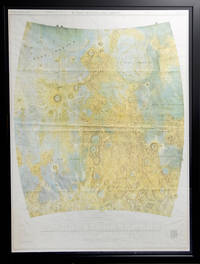
115559Washington D.C. Army Corps of Engineers March 1962. . Colour map 54.5 x 40.5 in glazed and framed; some wear and loss at the edges and to two round spots at the bottom of the lower text portion repaired with paper with slight loss of some text horizontal creases from folding a few light spots; very good condition.<br /> First printing of a monumental and important lunar relief map produced by the US Army Map Service in the run-up to the Apollo program incorporating all six future landing sites. Rare in commerce with no other copies in auction records.<br /><br />Mare Nectaris - Mare Imbrium was compiled during 1961 the same year that Kennedy famously announced to Congress that the US would land a man on the Moon. It was the first Earthside stereographic map of any part of the Moon highlighting the central portion of the visible half of the lunar surface and was based on photographs taken by the Paris Observatory between 1896 and 1907. The map was available in two versions: gradient tint and shaded relief as here Surveying and Mapping United States Superintendent of Documents 1963. The names of the features were derived from the standard source Named Lunar Formations by Mary Blagg and K. Müller and the verso is printed with a complete list of lunar places. A small three-dimensional plastic version at 1:500000 was produced the year before and is somewhat more available.<br /><br />The Apollo sites not yet designated as such at the time of printing are the Sea of Tranquility the Sea of Storms Oceanus Procellarum near Lansberg Crater Fra Mauro near the Bonpland and Perry craters the Appenine Mountains near Haldey Rille the Descartes Crater and the Taurus Mountains-Littrow Crater area.<br /> Washington, D.C., Army Corps of Engineers, March, 1962. unknown
1821PHO-2038Paris, Imprimerie Royale et Imprimerie de L. Toinon et C ,1821-1862, 2 volumes in-folio. 1ère Partie, brochage papier bleu avec étiquette de titre sous coffret moderne, vieille mouillure, papier gondolé, quelques rousseurs. 2nde Partie, sous coffret moderne, rousseurs sur les planches en noir et blanc, mouillure angulaire au début et marginale en fin, petites déchirures en marge sur quelques feuillets, coin manquant faux-titre. XVII-120pp., 24 planches sous serpentes dont 2 cartes et une planche en couleur d’époque et 2ff. (faux-titre, titre)-V (avant-propos) -27pp. (explication , appendice) -20 planches (21) dont 4 en double pages et 9 en couleurs d’époque .
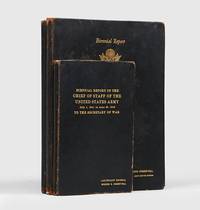
1943190146Washington: United States Government Printing Office 1943-45-46. Presentation copies from General George Marshall to his "miracle worker" General Brehon B. Somervell A complete set of the original official US Army wartime reports handsomely produced the personal copies of General Brehon Burke Somervell 1892-1955 George Marshall's commander of Services of Supply the first two being presentation copies from Marshall the cover of each volume gilt lettered with Somervell's name and rank. Services of Supply was one of the three "superagencies" organized by the US Army after the United States's entry into the war in December 1941 - the other two being Army Ground Forces and Army Air Forces - and gathered under its overarching aegis Quartermaster Corps Chemical Warfare Service Signal Corps Corps of Engineers Ordnance Department Medical Corps and Transportation Corps. "General George C. Marshall the army's chief of staff during World War II held Somervell in high regard for his ability to perform monumental tasks and was willing to overlook his penchant for antagonizing others. "What he did was a miracle" said Marshall in a postwar interview. The U.S. Army in World War II was probably the best-supplied army that had ever gone to war. Much of the credit for that accomplishment goes to Somervell who provided the "sinews of war" for a military effort that literally spanned the globe" American National Biography. Somervell is mentioned directly by Marshall in his concluding remarks to the first volume where he notes "The requirements of logistics are seldom understood. The burdens they impose on the responsible military authorities are rarely appreciated. The conflicting demands of our theater commanders of Allied sovereign powers and of the home front pose difficulties never before approximated in war. The necessity for a high degree of efficiency in management is evident and it has been found in the coordination of all the various supplies and administrative departments of the Army under the command and leadership of Lt. Gen. Brehon B. Somervell. "Published at two-year intervals these reports provide a comprehensive picture of global war as seen from the perspective of the Chief of Staff. The first report describes the race to mobilize an unprepared country and Marshall's appeal on the eve of war for the renewal of Selective Service a reminder of how far the U.S. Army had to come to meet the Axis challenge. The second recounts the initial defeats after Pearl Harbor and the ultimately successful efforts of the United States and its Allies to turn the tide. The final report describes the drive to victory and outlines Marshall's analysis of the reasons for the Allied triumph. Summaries give an overall view of the progress of the war but the scholar and military professional will find most interesting Marshall's comments on such topics as technology the "90-division gamble" the replacement system troop morale and the citizen-soldier and demobilization. These comments and the other material presented in the reports provide not only a fresh perspective on the myriad problems of conducting a global war at the highest levels but also renewed appreciation for the man whom Churchill appropriately called 'the organiser of victory'" Brigadier-General John W. Mountcastle foreword to the 1996 Center of Military History edition. This is a set of the scarce original edition produced by the United States Government Printing Office in Washington; trade editions were also produced by the Infantry Journal Press in the US and HMSO in Britain. The set comprises: Biennial Report of the Chief of Staff of the United States Army July 1 1941 to June 30 1943 to the Secretary of War. Octavo pp. v 56. 6 folding maps and 19 folding charts. Presentation copy from General George Marshall inscribed on a preliminary blank: 'To General Somervell with appreciation and warm regard G. Marshall". Biennial Report of the Chief of Staff of the United States Army to the Secretary of War July 1 1943 to June 30 1945 to the Secretary of War' Quarto pp. iii 123. bound with the supplementary Atlas of World Battle Fronts in Semimonthly Phases to August 15 1945 pp. 101. Presentation copy from General George Marshall inscribed on a preliminary blank: "Dear Somervell - Please accept this copy of my final report as Chief of Staff with appreciation of your tremendous service to the army and support of me with my affectionate regards - G. Marshall October 5 1945". Report by the Supreme Commander to the Combined Chiefs of Staff on the Operations in Europe of the Allied Expeditionary Force 6 June 1944 to 8 May 1945. Quarto pp. x 123. Several colour maps. 3 vols one octavo 232 x 135 mm 2 quarto 305 x 210 mm. Contemporary black pebble-grained skiver gilt lettered on front covers first 2 vols with dark blue vertical-rib cloth endpapers third with white moiré silk-effect endpapers. Bindings a little worn at extremities some mottling to covers scattered foxing otherwise very good. hardcover
660-Eo.J. Feder in Braun, aquarelliert in Blau und Braun, auf Velin. 20,5:27,5 cm. Provenienz: Sammlung Sir William und Bruce S. Ingram, Chesham, vgl. Lugt 1404 a; Kraus-haar Gallery, New York. Ausstellungen: Yale University Art Gallery, New Haven, 1960, Nr. 183. Leihgabe an S.R. Guggenheim-Museum, New York, 1962. Vergleichsliteratur: P. Duflo: Constantin Guys. Fou de dessin grand reporter 1802-1892, Pa-ris 1988, vgl. Tl. II, S. 309: ?Convoi funèbre de Lord Raglan. Juin-Juillet 1855?. - Das vorliegende Blatt zeigt die von Offizieren zu Pferde angeführte Parade anläßlich der Be-gräbniszeremonie von Fitzroy Somerset, 1. Baron Raglan, Oberbefehlshaber der britischen Truppen während des Krimkrieges.
191845147n.p.: Army General Staff College 1918. fair to good. 8.5" x 13.5" approx. 1000 6-vol. set a collection of mimeographed copies and some carbon copies bound together some foxing to text some pages browned. A few pages brittle some pencil notations to text. Volume I contains conferences and lectures for the First Course reissued during the Second Course presented by the Army Staff College--A.E.F. France. Volume II contains map problems of the First Course reissued during the Second Course. Volume III contains conferences 1 to 114 of the Second Course. Volume IV contains conferences 115 to 145 lectures 1 to 26 and miscellaneous matter. Volume V contains map problems 1 to 21 of the Second course. Volume VI contains map problem 22 of the Second Course. Volume VII contains publications. Volume VIII contains maps. This is an extremely rare collection with student notes and comments. We believe this was the personal copy of Lt. Col. Herbert Parsons of the Fifth Division. Among the topics covered are maps and trench maps military geography of the Western Front food supply marches combat artillery infantry transport the intelligence service roads and railways ammunition supply motor transportation liaison billeting and administrative instructions practical exercise in map reading trench relief training of reinforcements evacuation of wounded night operations counter attack exploitation of success examination of prisoners of war burial tactical withdrawal and many others. Army General Staff College unknown
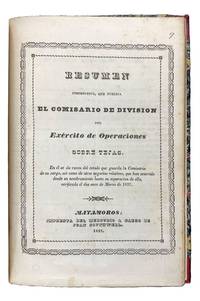
183741693Matamoros Mexico: Imprenta del Mercurio a Cargo de Juan Southwell 1837. 4to. 7 3/4 x 5 1/2 inches. 3 4-36 4. 40 pp. Engraved title-page with decorative border Resumen Instructivo Estado Table 1 by Manuel Mendiola Estado 2 by Luis Jose de la Peza and Vicente Daza. Both estados are accounting tables giving the "ingreso" income and the "egreso" expenditure of the operation. The title carries the date of 3.11.1837 while the text sections are dated 3.14.1837. With woodcut printer's device of an eagle and fleurons. Text in Spanish. Bound to style in 19th-century quarter red straight-grained morocco over 19th-century marble paper boards<br/> <br/> Provenance: Hubert Hudson Texas State Senator for Brownsville 1957-1963<br/> <br/> A rare report detailing the failed Mexican mission to rein in the Republic of Texas following the Texan Revolution.<br/> <br/> "In the fall of 1836 the Mexican government attempted with complete lack of success another expedition into Texas." Streeter "Face-saving explanation for Mexico's failure against the despised Texans in 1836-7." Howes This official pamphlet details the failed Mexican expedition into the Republic of Texas over the period of October 21 1836 to March 14 1837. Barreiro an army commissioner in charge of the operation concludes that the "ridiculo" Texan rebels were far less dangerous than the hostile desert terrain. "No es el numero del exercito de Tejas el temible. Bien despreciable y ridiculo es ese peloton de aventureros que piensan que es como andar en cacerias de fieras haberselas con veteranos valientes y aguerridos: es el clima son los desiertos horrorosos son los rios invadeables son los pantanos." It is not the number of the Texas army that is fearsome. Very despicable and ridiculous is that platoon of adventurers who think that it is like going on wild beast hunts dealing with brave and seasoned veterans: it is the climate it is the horrible deserts it is the uncrossable rivers the swamps. Texas had declared its independence on March 2 1836 a culmination of the Texan Revolution which had begun on October 2 1835. The United States did not diplomatically recognize the Republic of Texas until March of 1837 near the publication date of this pamphlet. Texas would remain an independent nation for a decade until it was annexed by the USA on December 29 1845.<br/> <br/> Howes B 170. Palau 24651. Streeter sale I 357. Streeter Texas 918. Imprenta del Mercurio a Cargo de Juan Southwell unknown
19091819600 leaves typed on recto only bound in original half leather with gilt titling. Six large fold-out maps of the period. Plates composed of postal views with a few photographs laid down. Marbled endpapers hinges reinforced. 'Confidential' stamped in violet as well as 'Office Chief of Staff 2nd section' and 'Withdrawn from Library'. American contractors had just completed the Oruro/Viacha railway in 1908 with 125 miles laid to mineral rich regions to and from La Paz. This study seems to have never been published beyond the present edition.; Folio 20.5 x 41 cm; pages; All shipments through USPS insured Priority Mail. U.S. Army hardcover books
1917K8VDJ4FBG0KGCalcutta: Superintended government printing 1917. Original green cloth with title on spine and front. Small 8vo 17 x 11.5 cm. With 1 folding heliozincographed map of "Lower Mesopotamia" map size 41 x 37 cm with some routes in red and three folding letterpress tables. Second edition considerably expanded of a field guide to Mesopotamia Iraq published on behalf of the General Staff in India for the use of officers serving in the Mesopotamian campaign during the First World War stating on the binding and title-page "for official use only". The guide is divided into eight chapters dealing with Iraq's history geography population resources military strength maritime power administration and communication respectively. The fifth and sixth chapter also contain valuable information on the Turkish military and maritime strength. The present edition adds much new information that was not included in the 1915 edition. For example the "list of routes" in the present guide contains 36 routes between compared to 14 routes in the 1915 guide. The routes are shown on the folding map.With the owner's inscription of H.W. Leatham Lieutenant in the British Royal Army Medical Corps on the first flyleaf. A few small spots or stains. Binding only very slightly rubbed. Overall in very good condition. Superintended government printing, hardcover
181400535755Eastburn Kirk and Co 1814. First Edition. Hardcover. Very Good/No Jacket. 8vo - over 7¾" - 9¾" Brig Gen. Duncan McArthur's Orders to Attend General Hull's Court Martial A remarkable document from the Court Martial Brig. General William Hull following his surrender of Detroit which resulted in a death sentence for cowardice. Although his sentence was later remitted General William Hull is the only U.S. general to be sentenced to death by an American court-martial. This copy of the court martial transcript belonged to Hull's second in command Brig Gen. Duncan McArthur and includes the actual hand-written orders commanding him to attend and testify. McArthur's testimony was an essential and central part of the trial filling the entirety of pages 47 to 73. In it as well as numerous contemporary accounts his outrage against Hull's conduct as Commander of the Army of the Northwest during the War of 1812 including the entire campaign in and around Detroit which ended with Hull's surrender not only of Detrit and the forces directly under his command but for some reason of detached troops under McArthur's command which particularly enraged McArthur. Tipped in is the handwritten order a letter of summons from Inspector General Abimael Youngs Nicoll to Brigadier General Duncan McArthur commanding his appearance at General Hull's court martial letter is dated December 2nd 1813 and includes the folded envelope addressed to McArthur. Duncan McArthur 1772-1839 Brigadier General later Governor of Ohio. 156pp. 177 29pp. appendices. Rebound in black cloth gilt title on spine. Light foxing in places; cloth has light surface wear else a Very Good copy. The President of the Court was Major General Henry Dearborn and the special Judge Advocate was Martin van Buren later President of the United States. There is a signature on the title page somewhat reminiscent of Van Buren's during this period appearing to read 'M.v.B illegible'. Additional provenance: Later the property of Brig. General Thomas McArthur Anderson copy grandson of Brig Gen. Duncan McArthur with his signature to the title page pg. 19 and the last page of text. General Anderson had four decades of decorated service 1861-1900 extending from his rise to brevet rank of Lt. Colonel during the Civil War to command of the Army force sent to Skagway and Dyea Alaska to protect American miners heading to the Klondike Gold Rush to his command of the first 'Philippine Expeditionary Force' during the Spanish-American War. During the Philippine campaign he was promoted to the brevet Major General of U.S. Volunteers two stars and retired as a Brigadier General. Eastburn, Kirk and Co hardcover
216299Paris, E. Bernard, 1890-[1893] 11 parties en 15 vol. grands in-8 de texte ; 5 vol. in-folio d'atlas, demi-chagrin Bradel bordeaux, dos fleuronné, pièces de titre vertes, têtes rouges (reliure de l'époque). Nombreuses pièces de titre manquantes. Épid.
189178S.l., s.d. in-4, 6 planches finement aquarellées, de 21,5 x 28 cm, avec sujets dans une large bordure citron, légendées en allemand (sauf la dernière, en français), en feuilles sous chemise de chagrin azur à recouvrements de toile et lacets, dos lisse muet (reliure moderne). Bon exemplaire.
1843PHO-2292Paris, Chez J. Delahaye Éditeur, 1843. Cinq parties reliées en 3 volumes in-folio demi basane brune à coins, dos lisse cloisonné de filets or, titre doré (Koenig). Quelques planches roussies, comme toujours, petites rousseurs.
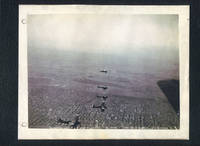
192342800Mitchel Field Long Island NY: U.S. Army Air Service 1923-1925. 1923-1925. Archive of 57 original aerial photographs from the 8th & 14th Photographic Sections Air Service during the Aerial Mapping Survey of New York City and vicinity and the Northeast. 57 original photos mounted on thick card stock 10" x 8". 53 have identifications of place and Air Service Photo section at lower fore-edge of the images and all are printed on glossy photographic stock with some sepia-toned. The images encompass planes in formation over New York views of Manhattan the Statue of Liberty a factory fire in Jersey City Fort Ticonderoga the Zeppelin hanger at Lakehurst New Jersey Albany Philadelphia Hartford Exeter NH numerous Air Fields a scarce series of photos for the Jan. 24th 1925 Eclipse of the Sun and more. The Air Service was created by executive orders of President Wilson in May 1918 during World War I and would eventually expand to nearly 200000 personnel and 2000 aircraft by the end of the war producing planes as well as carrying out operations by aerial reconnaissance photo sections dirigibles balloons and fixed wing aircraft. By 1923 the peacetime cutbacks had slashed the Air Service down to just under 10000 men and 1450 aircraft including 15 photographic sections encompassing the above mentioned 8th and the 14th commanded from 1920 to 1925 by Brig. General Billy Mitchell. Mitchell campaigned tirelessly and bitterly until his court-martial at the end of 1925 to establish the Air Service as a separate military wing independent from the Army and Navy. To aid this mission he authorized a number of publicity stunts to emphasize the modernity and ability of the Air Service including aerial mapping projects speed and altitude records in cross country flying scientific projects and most famously the first flight around the world. The Air Service set up support facilities around the world for the fliers and in April 1924 sent four aircraft named Seattle Chicago Boston and New Orleans west beginning from Seattle Washington and led by Major General Mason Patrick Chief of Air Service. Two of the images in this collection show the two surviving Douglas World Cruisers which on Sept. 8 1924 stopped over in New York One of the photos shows a formation including the New Orleans flown by Lieutenants Eric Nelson and John Harding. They would complete the circumnavigation on Sept. 28 1924 in Seattle nearly 3 weeks later after these photos. The earliest of the dated photos shows 5 DH-4Bs flying in formation on November 20 1923 over Manhattan. The DH-4Bs set records of flying aloft through aerial refueling. The images dated July through November 1924 by the 8th Photo Section during their Aerial Survey mapping projects include Hartford Bridgeport and New Haven CT; Air Port in Boston MA; Fairgrounds at Brockton MA; Exeter NH; Providence and Connecticut Island RI; as well as 2 photos of a Nov. 1924 fire in the industrial section near the docks in Jersey City NJ showing tugboats nearby as well as smoke billowing above the factories damaged by the fire. Images by the 14th Photo Section include the airfield and hangar Lakehurst Naval Air Station NJ which was the home of the ZR-3 Los Angeles dirigible and would later be the site of the Hindenburg disaster; 3 photos of Mitchell Field Long Island NY; landing fields in Van Cortland Park Bronx NY; Governors Island; 2 photos of Roosevelt Field and downtown Albany at Albany NY; aerial views of the Statue of Liberty lower Manhattan including nice images of the Manhattan and Brooklyn Bridges; Fort Ticonderoga; Niagara Falls; Philadelphia; and photographs mapping the area around Mt. Mansfield Vermont. Of particular interest are the series of 11 photographs showing the sequence of the total solar eclipse on Jan. 24th 1925 over Connecticut. The skies were cloudy but 12 planes the ZR-3 Los Angeles dirigible and many scientists and men with special cameras and instruments recorded the event. Ten of the photographs here are marked in stages for the eclipse and an additional separate initial view that is marked Eclipse of the Sun 14th Photo Section Air Service U.S.A. This collection offers an excellent historical record of the early years of U.S. aviation as well as views of the Northeast during the 1920's. All of the images are quite crisp with almost no fading and have two small holes at the left gutter margin where they were apparently stored originally in a two- ring binder. Minor bumping and chipping to some corners of the boards. A few images have lifted at the corners and a couple have very minor loss one with creasing to center of image though not affecting the quality of the image. A remarkable collection of a scarce series of aerial photographs taken by the 8th and 14th Photographic Sections of the U.S. Army Air Service. U.S. Army Air Service, 1923-1925. hardcover
(ca. 31,5 x 23 cm). 2 S. (Fraktur). Original-Zeitung im kleinen Format, beidseitig bedruckt, mit Titel im oberen Bereich. Papier gebräunt und gefaltet, sonst wohlerhalten. Altersentsprechend guter Zustand. Sehr interessante Zeitung aus den letzten Tagen des Zweiten Weltkriegs. Aus dem Inhalt: Sowjets bei Fehrbellin geworfen / Die Schicksalsfrage / Eine Stunde mit kampfbewährten Hitlerjungen / Dem "Stalin"-Panzer überlegen / Das Bollwerk der Sechzehnjährigen / Triumph der Beharrlichkeit. Die Zeitung für die Soldaten der Wehrmacht und weitere versuchte auch in der aussichtslosesten Situation - wenige Tage vor dem Suizid Hitlers und der folgenden Kapitulation - noch zu mobilisieren. Die Rede ist hier überall von Entschlossenheit zum Kampf und von vorgeblich neuen Erfolgen in der Abwehr des Feindes. Über solche tendenziösen Meldungen geht der Text "Die Schicksalsfrage" noch hinaus. Dieser berührt sehr gut den gesteigerten Fatalismus bei Teilen der hitlertreuen deutschen Bevölkerung in den letzten Kriegsmonaten. Es heißt hier: 'Die Sirenenklänge des Agitationsjuden, wie: "es würde schon nicht so schlimm werden", wenn Deutschland die Waffen niederlegte, oder: es handele sich ja nur um einen "Krieg gegen die Nazis", verfangen schon längst nicht mehr bei dem deutschen Volk Adolf Hitlers. Auf der anderen Seite ist man ja im Gegnerlager unvorsichtig genug gewesen, besonders im letzten Jahr, die Katze vorzeitig aus dem Sack zu lassen. Sie haben ja oft und zynisch offen genug in die Welt hinausposaunt, was sie mit uns, dem deutschen Volk, im Falle eines Sieges der Alliierten - lies Weltjuden - vorhaben. Angefangen mit den hysterischen Entmannungs- und Sterilisationsplänen des Juden Kaufmann aus Neuyork, über die bolschewistischen Sibiriendeportationspläne, bis zu den Absichten, aus Deutschland eine ewige Wüste zu machen [...]." Auch ein Zeugnis des propagandistischen Eifers bis zum letzten Moment ist der kleinere Schlusstext "Triumph der Beharrlichkeit". Hier wird eingangs auf ein Zitat Friedrichs den Großen im Siebenjährigen Krieg referiert: '"Deutschland befindet sich zur Stunde in einer furchtbaren Krisis. Mir ward die Aufgabe zuteil, ganz allein für seine Freiheiten, seine Rechte und seine Religion einzustehen [...]"'. Später heißt es dann: "Was für die preußische Geschichte gegolten hat, gilt heute für die des Großdeutschen Reiches. Auch damals stand der Feind tief im Land und verwüstete Städte und Dörfer, auch jener Krieg kostete Blut und Opfer, brachte Tränen und Verzweiflung. Ueber allem aber triumphierte schließlich eine durch nichts zu erschütternde Beharrlichkeit. So und nich' anders ist es auch heute! / Daran wollen wir denken / Danach wollen wir handeln!". Auf die Propaganda-Kompanie "Eichkater" geht die Zeitung "Frontnachrichten" der Kriegsjahre zuvor zurück. Hier handelt es sich um eine Zeitung der Kompanie aus den letzten Kriegstagen. Ob diese Zeitung in weiteren Ausgaben bis Kriegsende erschien scheint fraglich. Es handelt sich nach unseren Recherchen um eine mehr als seltene Publikation der letzten Kriegstage, welche auch in Archiven so gut wie unauffindbar scheint. Äußerst seltene Archivalie und historisches Dokument aus letzten Tagen des NS-Staats!
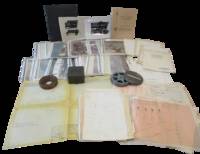
1950229621950. This exceptionally dense technical archive documents U.S. Army rocket and missile development during the height of the Cold War and Vietnam War originating from the estate of a retired aerospace engineer Thomas T. Howell affiliated with the U.S. Army Missile Command with direct work conducted at Redstone Arsenal Alabama and White Sands Missile Range New Mexico. The materials capture the applied test-driven reality of American rocketry at the moment when battlefield rocket systems solid-fuel propulsion and rapid-deployment tactical missiles became central to U.S. military doctrine. Of particular importance is the archive's sustained focus on field testing propulsion diagnostics firing mechanisms and structural integrity analysis with repeated references to multi-stage motors booster threads nozzle pressure profiles thrust measurement strain-gauge instrumentation and dynamic propulsion testing under operational conditions. The presence of Vietnam-era documentation situates this archive squarely within the escalation of U.S. missile and rocket deployment in Southeast Asia when systems such as the Little John rocket and related short-range artillery rockets were actively refined tested and evaluated for combat reliability. <br /> <br /> Collection includes; 2 original testing mechanisms; a 16mm film roll documenting a test launch; over 40 original photographs showcasing different testing sites and rocket units; over 40 hand drafted graphs on red paper; several hand written pages of calculations with formulas and schematics; several signed printed documents signed regarding the procedures for assembly static test flight weight booster motor components all dated in the summer of 1969; and a heavily annotated blueprint.<br /> Redstone Arsenal established in the early Cold War and shaped by the integration of German rocket scientists after World War II became the intellectual and engineering hub of U.S. Army missile work where propulsion systems launch mechanisms instrumentation and tactical doctrines were conceived refined and standardized. White Sands Missile Range by contrast functioned as the proving ground where theory met reality. This Redstone-White Sands pipeline allowed the United States to move rapidly from concept to deployable weapon. The archive comprises a combination of original testing hardware primary testing documentation photographic evidence and engineering drawings and graphs offering a nearly end-to-end view of the rocket development and validation process. Included is an original Electrical Output Firing Mechanism Tester for rocket launchers which is distinctly labeled for testing electrical firing mechanisms with milliwatt-second measurements a piece of surviving test equipment seldom encountered outside institutional collections; a rubber ring with conductive instrumentation in the interior a ring-type electromagnetic integrator or pickup coil used to measure missile velocity by electrically integrating acceleration over time with the central aperture allowed a magnetic core conductor or shaft associated with missile motion to pass through; extensive hand-plotted K&E bar graphs trajectory charts acceleration and velocity curves displacement diagrams and launch-segment data sheets many executed on period engineering graph paper with handwritten annotations calculating thrust pressure acceleration in g's and burnout timing; a substantial group of typed Army test procedures and data-requirement documents several signed and approved by supervising engineers details assembly procedures static and dynamic propulsion tests booster motor configurations which include tapered buttress threads and pin joints strain-gauge placement chamber pressure measurement and photographic documentation protocols; and a blueprint with extensive handwritten calculations in areas surrounding schematic drawings titled "Revisions -- Body Pressure Transducer" dated 1969. The calculations mention error rates "at 0.4% to 0.6% due to boost acceleration." These documents reveal the rigor of U.S. Army missile testing culture where every firing was instrumented recorded and analyzed as part of an iterative engineering feedback loop.<br /> A binder containing over 40 original photographs many stamped on the verso identifying the various locations and rockets such as "LITTLE JOHN" and "WHITE SANDS" on glossy photo paper shows test stands firing sequences hardware setups and missile components in both black-and-white and color. These images provide rare ground-level views of rocket testing infrastructure and procedures at one of the most historically significant U.S. missile ranges. Also present is 16mm film apparently documenting test-stand or firing activity; the film appears physically intact and represents a rare moving-image record of Army missile testing during the era. Completing the archive are large-format blueprints and technical drawings including a detailed pressure-transducer body schematic bearing U.S. Army Materiel Command identifiers Redstone Arsenal attribution and extensive handwritten calculations direct evidence of hands-on analytical work by an engineer engaged in real-time problem solving under Cold War weapons development pressures.<br /> <br /> Materials show expected handling and working-archive wear consistent with active engineering use: edge wear folds staple and paper-clip rust toning and some stains to paper; handwritten calculations and annotations throughout; photographs generally well preserved with strong contrast; hardware tester shows surface wear and oxidation consistent with age and field use; 16mm film appears physically sound but untested. Overall very good condition. This archive represents a rare primary source for the study of U.S. Army rocketry missile engineering and weapons testing during the Vietnam War and late Cold War period. Its combination of original equipment signed technical procedures analytical charts photographs and film makes it especially valuable for institutional collections focused on military technology Cold War science aerospace engineering history and the material culture of U.S. weapons development. unknown