9 442 résultats
196937792London: Muller 1969. Reprint Edition. good fair. 33 cm 208 4 fold-out illus. forms index plain DJ worn and soiled pencil erasure on front endpaper. Facsimile reprint of the First Edition printed by G. Grierson in Dublin 1794. Muller unknown
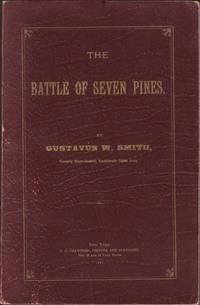
189130696New York: C. G. Crawford Printer and Stationer 1891. First Edition. Wraps. Very good. Wraps. Approx. 9" x 6.25". 202 pages. Brown wrappers with gilt borders and title on front cover. Illustrated with letter facsimiles and maps in back. Light rubs to covers. Very good condition. <br /> <br /> Nevins I page 43 - "A detailed but painfully defensive tract on the Confederate operations at Fair Oaks by the man who temporarily commanded the army. C. G. Crawford, Printer and Stationer unknown
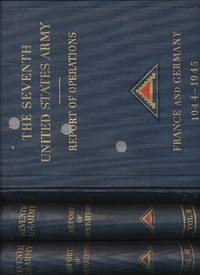
19468162Germany: Aloys Graf. Very Good. 1946. First Edition. Hardcover. Some blotching spots on front cover of volume I. A few bumped corners. ; All three volumes are in excellent condition - exceptions noted. Tight bindings and clean unmarked interiors. All maps are in pristine condition including the three folding maps in rear pocket of volume three. Very heavy set. ; Small 4to 9" - 11" tall . Aloys Graf hardcover
196279714Fort Eustis VA: U. S. Army Transportation School 1962. Presumed First Edition First printing. Wraps. Good. Five-hole punched and stapled on left side. Format is approximately 6.5 inches by 9.5 inches. iii 1 166 pages. Figures. Tables. References. Shipping Data. Cover has some wear and soiling. The text discusses the impact of tactical and logistical operations upon the world-wide distribution of special ammunition and other components of Army missile weapon systems. It describes the distribution sequence defines the control exercised over the distribution system and identifies the responsibilities of logistic agencies. the text also describes the transportation requirement transportation service responsibilities and the capabilities and limitations of the several modes of transportation. The text includes a discussion of the characteristics of special ammunition and transportability data applicable to all components of army missile weapon systems. The Special Text discusses: Distribution with CONUS Distribution within Oversea Commands The Transportation Environment and Transportation System Characteristics. Appendix I is References. Appendix II is the Safe Handling of explosives and other dangerous articles and protection of classified shipments. Appendix III is Characteristics and Properties of Propellants. Appendix IV is Army Missile Systems Component Shipping Data and this includes sections on Hawk Nike-Ajax Nike-Hercules Little John LaCrosse Sergeant Honest John Corporal Pershing Redstone SS-10 SS-11 Redeye Mauler Shillelagh Nike-Zeus Davy Crockett and a Quick reference complete round loading and shipping guide. On 31 July 1942 the Department of War recognized the need for a single manager of Army transportation and created a new branch the Transportation Corps. Since the Revolutionary War Army transportation had evolved through two branches the Quartermaster Corps and the Corps of Engineers. The demands of World War I made the Army first realize its need for a single manager for military transportation. So began an evolution over the next quarter century that culminated in the birth of the Transportation Corps during the opening months of World War II.<br /> <br /> The War Department directed the Quartermaster Corps to transfer the functions and responsibilities of truck and aviation units to the Transportation Corps by General Orders No. 77 on 24 July 1946. The same year the Transportation School consolidated all training except for drivers at Fort Eustis Virginia because of its intermodal rail and sea capability. In 1950 the Army turned over its deep-draft ships to the Military Sealift Command so the Army no longer had the largest navy in the United States military.<br /> <br /> That same year Brigadier General William B. Bunker convinced the Chief of Transportation Major General Frank S. Besson Jr. of the importance of helicopters in logistics. As a result in May the Army approved the organization of five helicopter companies with the first the 6th Transportation Company Helicopter activated in July 1952.<br /> <br /> In 1954 the Engineer Corps turned its landing craft over to the Transportation Corps making the Transportation Corps responsible for all modes of Army transportation. Coincidentally the Navy lifted the size limit on Army watercraft allowing the Army to build landing craft utility LCUs. This led the Transportation Corps to activate the 159th Boat Battalion.<br /> <br /> The Soviet threat against Europe provided the peacetime Army an enemy to plan against. In anticipation of the needs of the Army the Chief of Transportation directed and championed the development of military transportation. Contingency planners assumed the worst-case scenario in which the Soviet Union would use its bombers or worse yet its nuclear arsenal to destroy the fixed ports in France thus severing the vital lines of communication at their European end. This contingency required the Army to rely heavily on over-the-beach operations.<br /> <br /> The Transportation Corps is a Force Sustainment branch of the U.S. Army headquartered is now at Fort Lee Virginia and is responsible for the movement of personnel and matériel by truck rail air and sea. The Transportation Corps provides a full spectrum of transportation capabilities at the tactical operational and strategic levels of war. The Transportation School trains Soldiers to operate and maintain Army tactical trucks material handling equipment and watercraft. The school trains Transportation Operations Traffic Management Convoy Operations Cargo Transfer Cargo Documentation Movement Control Operation of Heavy Material Handling Equipment Sailing and Maintenance of Army Vessels and Unloading Aircraft Ships Railcars and Trucks. U. S. Army Transportation School paperback
198481564Washington DC: United States Department of the Army Headquarters 1984. Presumed First Edition First printing thus. Wraps. Fair. Various paginations approximately 3/4 inch thick. Illustrations Tables Figures. Formulae. Glossary. Bibliography. Upper right corner has damp stains; all pages complete and separate. This manual together with TM 5-858-1 31 October 1983 and TM 5-858-3 through TM 5-858-8 supersedes TM 5-856-1 1 July 1959; TM 5 856-2 15 March 1957; TM 5-856-3 15 March 1957; TM 5-856-4 15 March 1957; TM 5-856-5 15 January 1958; TM 5-856-6 15 January 1960; TM 5-856-7 15 January 1958 TM 5-856-8 15 January 1960; and TM 5-856-9 15 January 1960. The purpose of this manual is to provide guidance to engineers engaged in designing facilities that are required to resist nuclear weapon effects. It has been written for systems structural mechanical electrical and test engineers possessing state-of-the-art expertise in their respective disciplines but having little knowledge of nuclear weapon effects on facilities. While it is applicable as general design guidelines to all Corps of Engineers specialists who participate in designing permanent military facilities it has been written and organized on the assumption a systems-engineering group will coordinate design of the facilities. The effects of a nuclear explosion on its immediate vicinity are typically much more destructive and multifaceted than those caused by conventional explosives. In most cases the energy released from a nuclear weapon detonated within the lower atmosphere can be approximately divided into four basic categories:<br/> <br/> the blast itself: 40-50% of total energy<br/> thermal radiation: 30-50% of total energy<br/> ionizing radiation: 5% of total energy more in a neutron bomb<br/> residual radiation: 5-10% of total energy with the mass of the explosion.<br/> Depending on the design of the weapon and the location in which it is detonated the energy distributed to any one of these categories may be significantly higher or lower. The physical blast effect is created by the coupling of immense amounts of energy spanning the electromagnetic spectrum with the surroundings. The environment of the explosion e.g. submarine ground burst air burst or exo-atmospheric determines how much energy is distributed to the blast and how much to radiation. In general surrounding a bomb with denser media such as water absorbs more energy and creates more powerful shockwaves while at the same time limiting the area of its effect. When a nuclear weapon is surrounded only by air lethal blast and thermal effects proportionally scale much more rapidly than lethal radiation effects as explosive yield increases. This bubble is faster than the speed of sound. The physical damage mechanisms of a nuclear weapon blast and thermal radiation are identical to those of conventional explosives but the energy produced by a nuclear explosion is usually millions of times more powerful per unit mass and temperatures may briefly reach the tens of millions of degrees.<br/> <br/> Energy from a nuclear explosion is initially released in several forms of penetrating radiation. When there is surrounding material such as air rock or water this radiation interacts with and rapidly heats the material to an equilibrium temperature i.e. so that the matter is at the same temperature as the fuel powering the explosion. This causes vaporization of the surrounding material resulting in its rapid expansion. Kinetic energy created by this expansion contributes to the formation of a shockwave which expands spherically from the center. Intense thermal radiation at the hypocenter forms a nuclear fireball which if the explosion is low enough in altitude is often associated with a mushroom cloud. In a high-altitude burst where the density of the atmosphere is low more energy is released as ionizing gamma radiation and X-rays than as an atmosphere-displacing shockwave.<br/> <br/> In 1942 there was some initial speculation among the scientists developing the first nuclear weapons in the Manhattan Project that a large enough nuclear explosion might ignite the Earth's atmosphere. This notion concerned the nuclear reaction of two atmospheric nitrogen atoms forming carbon and an oxygen atom with an associated release of energy. The scientists hypothesized that this energy would heat up the remaining atmospheric nitrogen enough to keep the reaction going until all nitrogen atoms were consumed thereby burning all of the Earth's atmosphere which is composed of nearly 80% diatomic nitrogen in one single massive combustion event. Hans Bethe was assigned the task of studying this hypothesis from the project's earliest days and eventually concluded that combustion of the entire atmosphere was not possible: the cooling of the fireball due to an inverse Compton effect all but guaranteed that such a scenario would not become a reality. Richard Hamming a mathematician was asked to make a similar calculation just before the first nuclear test with the same result. Nevertheless the notion has persisted as a rumor for many years and was the source of apocalyptic gallows humor at the Trinity test. United States, Department of the Army, Headquarters paperback
19451409946Brunswick: Printed by George Westermann 1945. Hardcover. Octavo 407 39 pages 7 leaves folded plates. In Fair condition. Spine is cream without print. Boards in cream cloth black print; fraying to spine caps and corners damp stains smudging/shelf wear toning. Text block has inked out name on front pastedown small portion sliced out of title page cracked hinges shaken binding. Illustrated: color maps on endpapers color folded maps at end of volume b&w plates photographs. <br /> <br /> Oversized books. Additional postage necessary for expedited/international orders. Economy International shipping unavailable due to size/weight restrictions. For international/expedited customers please inquire for rates.<br /> <br /> NOTE: Shelved in Net Desk work area. 1409946. FP New Rockville Stock. Printed by George Westermann hardcover
19457758Germany: United States Army. Near Fine in Very Good dust jacket. 1945. Hardcover. Dustjacket has some edgewear - see image. Protected in a Mylar sleeve if requested. ; Book is in excellent condition. A comprehensive History whose purpose was to present "a story that will serve as a line between what each person experienced and what the complete overall regimental picture really was. The aim is to permit the panorama of the total action to unfold so that each person can be made fully aware and justly proud of all that his regiment accomplished." scarce copy with dustjacket in this condition. Note: the dustjacket is unique unto itself and contains much information and graphics. ; 4to 11" - 13" tall; 349 pages . United States Army hardcover
2008000423Archive 2008 Book. New. Hardcover. 8vo - over 7¾ - 9¾" tall. 125 PP OF ARABIC TEXT WITH 72 PP OF DOCUMENTS PUBLISHED BY THE FOURTH OTTOMAN IMPERIAL ARMY UNDER THE LEADERSHIP OF AHMAD JAMAL PASHA. FINE REPRINT OF THE ORIGINAL TEXT PUBLISHED IN ISTANBUL TANINE PRESS 1916 BY THE FOURTH OTTOMAN ARMY. ON FINE 125 gr. PAPER. IN THREE QUARTER FINE HARD COVER BINDING. private reprint. Archive hardcover
195648001Washington D.C.: Army Map Service 1956.- Gran mapa plegado en color 1745 x 1515 cm; Texto en inglés.- U.S. Strategic Maps 1:500000. En los bordes restos de papel adhesivo y algunas pequeñas faltas. Algo arrugado pero en general buen aspecto. GEOGRAFÃA GUÃAS Y ATLAS DEL EXTRANJERO Book in english Army Map Service paperback
2023BN195858Independently Published 2023. 2023. Softcover. American Military History Volume 1 Second Edition <br/><br/>American Military History Volume 1 Second Edition Center of Military History US Army Independently Published paperback
1983BN253930Taunusstein : Schellenberg 1983. 1983. Die Herzoglich-Nassauische Brigade im Feldzug 1866 : unter Berücksichtigung von Feldtruppen aus Kurhessen Hessen-Darmstadt Baden Württemberg u. Österreich. Das herzoglich-nassauische Militär 1806 - 1866 ; Band. 3 <br/><br/>Die Herzoglich-Nassauische Brigade im Feldzug 1866 : unter Berücksichtigung von Feldtruppen aus Kurhessen Hessen-Darmstadt Baden Württemberg u. Österreich. Das herzoglich-nassauische Militär 1806 - 1866 ; Band. 3 Herzoglich-Nassauische Brigade / Uniformen / Militär - Rosenwald Walter Taunusstein : Schellenberg unknown
2008BN149514Transcript 2008. 2008. Das Militär und seine Subjekte: Zur Soziologie des Krieges <br/><br/>Das Militär und seine Subjekte: Zur Soziologie des Krieges Militär / Soziologie / Warburg Jens - Warburg Jens Transcript unknown
1986001744New York: Exeter Books 1986. illustrated reference to the US Army and allied ground forces in Vietnam 1961-1973 foreward by Gen. Westmoreland 396 pages blue paper with gilt ltrs on spine corners bumped AAON in pencil on lower corner of ffep. DJ is blue with gilt ltrs and pictures of various patches and is bumped/chipped/and torn on edges as well as scuffed front and back. Heavy book requires extra postage that is included in price. 1st Edition. Hard Cover. G/G. Folio - over 12" - 15" tall. Exeter Books Hardcover
19352091502135704160Army War Mountain College General School Assembly Hall 1935. Soft Cover. Fine. The book is in fine condition. Army War Mountain College General School Assembly Hall paperback
19422092902143900391Not Available 1942. Soft Cover. Fine. Volume: 1 Not Available paperback
19422092902143800529Not Available 1942. Soft Cover. Fine. Volume: 1 Not Available paperback
19812092902143900745Not Available 1981. Soft Cover. Fine. Volume: 1 Not Available paperback
19812092902143800745Not Available 1981. Soft Cover. Fine. Volume: 1 Not Available paperback
189928786Washington: Government Printing Office 1899. Cloth bound in very good condition. Green cloth; 9.25" x 6"; 268 pages with many illustrations and fold-out diagrams. Government Printing Office unknown
1966mon0003039553GPO 1967. 1966-01-01. Hardcover. Good. 1.2000 11.8000 9.3000. 2 vol. set complete. Books have shelf wear. Pages are tanning but clean. Pages are intact. GPO, 1967. hardcover
2016x-9813144939World Scientific Publishing Company 2016. Hardcover. New. 372 pages. 9.13x6.14x1.02 inches. World Scientific Publishing Company hardcover
21987Chelsea Royal Hospital Chelsea. 16 January 1863. 2pp 12mo. In fair condition lightly aged with strip of paper from mount adhering at foot of reverse. The recipient's name is not decipherable but he appears to have been a royal equerry. Blakeney hopes that he 'got safe home last night' and thanks him 'for giving me the pleasure of your Company'. He is enclosing a letter from Sir John Wilson 1780-1856 'who is forwarding an application from Mr Ferrier the Quarter Master of this Establishment in favour of an application to obtain admission into the Cambridge '. He asks if he 'might take an opportunity of showing it to His Royal Highness'. He ends by describing Ferrier as 'an excellent man' who 'can be fully depended upon in the opinion he has given'. Chelsea [Royal Hospital, Chelsea]. 16 January 1863. unknown
192510032N.Y.: G. P. Putnam's Sons 1925. Book. Near Fine. Hardcover. First Edition. 310 pages frontis illustrations top edge gilt chipping to jacket edges rare in jacket. Hein describes the Grand Review in Washington and the Custer incident. He also recalls meeting Custer in the spring of 1876 while Custer was in route to Washington. Hein also tells of his time in the Apache Wars with Crook. Luther High-Spot 63. G. P. Putnam's Sons Hardcover
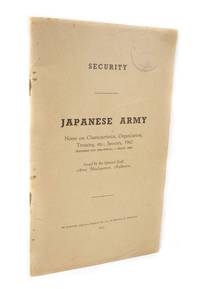
19423296Melbourne: Army Headquarters Melbourne 1942. Quarto stapled printed wrappers 59 pp. 10 appendices. Spots along spine due to rust around staples otherwise a near-fine copy. An analysis of the Japanese fighting machine which encompasses the study of their staff and commanders morale the efficiency and speed of mobilisation arrangements the efficiency of higher commanders and staffs in major tactics and their ability to maintain secrecy. </p> <p>It also provides an examination of the Japanese man power their artillery as well as their standards of armament and technical training. Army Headquarters Melbourne unknown
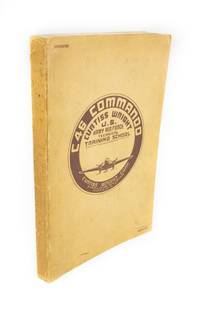
19441698United States of America: US Army Air Force 1944. Large octavo paperbound discontinuous pagination illustrated. Lightly stained front cover spine moderately creased previous owners' inscriptions on inner front cover yet a very good copy. This book is a technical training manual for the United States Army Air Force specifically for mechanics service men and other personnel concerned with the service and maintenance of the Curtiss-Wright Model C-46 transport cargo airplane. [US Army Air Force] unknown