8TH ARMYBiblio.com
9 442 résultats
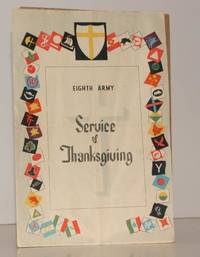
194550749Privately Printed 1945. 8vo. First Edition; original coloured pictorial wrappers single fold covers lightly creased by cross-folding else a very good bright clean copy. Considerably scarcer than its Second Army counterpart this short and simple Order of Service carries on is front cover a host of coloured formation badges representing some of the most famous British and Allied units of WWII. They include Eighth Army 78 Division 2 Polish Corps 10 Corps 5 Corps Canadian Corps 30 Corps 13 Corps Airborne 1 Division 8 Armoured Division 8 Indian Division 1 Armoured Division 10 Indian Division 1 South African Division 10 Armoured Division 4 Indian Division 7 Armoured Division 5 Division 5 Indian Division 2 South African Division 6 Armoured Division Jugoslavs 2 Greek Independent Brigade Frimili Group Cremona Group Folgore Group Jewish Brigade Group Free French Brigade 6 South African Armoured Division 5 Polish Kresowa Division 2 New Zealand Division 56 Division 44 Division 46 Division 5 Canadian Armoured Division 50 Division 1 Canadian Division 1 Australian Division 51 Division 4 Division 3 Carpathian Division. This striking montage serves to emphasise the wide variety of nationalities types and backgrounds of the units under primarily Montgomery's command. Cole reproduces the front wrapper in his standard reference 'Heraldry in War' plate facing p.120. VERY SCARCE IN THIS CONDITION. [Privately Printed], unknown
DA09B-05342Eighth U.S. Army Printing Plant. Collectible - Good. Tokyo: Eighth U.S. Army Printing Plant 1946. 1st edition. 4to hardcover. Special binding by Boonjudo Printing Works. Tan cloth with floral design and gilt titling. 11pp. Illustrations maps. Good book. Some cover wear and soiling. Melton A. Hatch Colonel Acting Deputy Chief of Staff Eight United States Army printed in gilt on the front cover. World War 2 Regimental Histories Inquire if you need further information. Eighth U.S. Army Printing Plant hardcover
17397'MOST SECRET'. Without date or place. British Army North Africa circa 1942. . 15pp. folio. Stapled into pink printed wraps. Title on front cover with 'MOST SECRET'. Copy number 53 in blue pencil. In fair condition on browned high-acidity paper. Front cover coming away from rusted staples. At head of first page: 'NOTE: SECURITY Attention is drawn to the fact that this document is graded "MOST SECRET". It will not be distributed below Lieutenant Colonels' commands.' Contents page divides the document into two parts: 'Equipment' and 'Organisation'. The first part discusses: Light Tanks Cruiser Tanks Infantry Tanks Armoured Cars and Scout Cars Ammunition Gunnery and Fire Control Miscellaneous Equipment. The second part consists of three appendices: 'Command Control and Rear Link A.F.Vs.' 'Report on Valentine Bridgelayer' and 'The Swabey Sight for use with 75-mm guns in Sherman Tanks'. Scarce: no other copy traced not in the Imperial War Museum collection. From the Barrie Pitt papers. 'MOST SECRET'. Without date or place. [ British Army, North Africa, circa 1942. ] paperback
19168Without place or date but the quoted documents dating from 1914 and 1915. . Three documents all in fair condition lightly aged and worn each of the total of six leaves with three later punch holes to the inner margins of the leaves. On the same browned thin wove paper. The source of these items is uncertain but they appear to date from the first decades of the twentieth century. ONE: 'Disposition of Troops in the Canal Defences 15th January 1915.' 4pp. folio. Beginning with: 'G.O.C. Canal Defences. - Major-General A. Wilson. Chief Staff Officer Canal Defences. - Br.-General A. H. Bingley.' Followed by the 'Troops' and 'Posts in Sector' for three sections as well as the 'Advanced Ordnance Depot' and 'Defence of Railway and Sweet Water Canal' 'General Reserve Camp Moascar'. TWO: 'British Force in Egypt in August 1914.' 1p. 8vo. A nine-line list. THREE: Transcription headed 'Letter - General Maxwell to Lord Kitchener. 16th October 1914.' An abridged portion of a letter quoted in full in Sir George Arthur's 'Life of Lord Kitchener'. Text begins 'There is rather more nervousness in Egypt' and ends 'the Canal ought to be safe'. Without place or date, but the quoted documents dating from 1914 and 1915. ] unknown
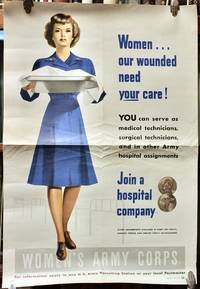
194516951WashingtonD.C. United States Army Recruiting Publicity Bureau 1945 First edition. Full text as follows: "Women…our wounded need your care! You can serve as medical technicians surgical technicians and other Army hospital assignments. Join a hospital company. Other assignments available at Army Air Forces Ground Forces and Service Forces installations. Text printed in blue black and gray. Some creasing. A very good bright and clean copy of this uncommon item encouraging women to serve in Army hospital assignments. Broadside 17" x 25". . With full-color printed illustration of a woman medical technician in uniform carrying a tray of medical instruments. Also with two medals printed in bronze bearing the emblems of the U.S. Army Medical Corps. The Women's Army Corps evolved from the Women's Auxiliary Army Corps a civilian organization of women working with the United States Army when Congress granted military status to its members in 1943. Forty percent of WAC members were assigned to positions as weather observers radio and control tower operators and aerial photograph analysts. Many other women worked as cryptographers medical technicians and mechanics. As the war entered its last two years and as the WAC fought for further inclusion in the ranks of the Army more women were enlisted in roles previously reserved for men Yellin Our Mothers' War pp. 114-116. United States Army Recruiting Publicity Bureau
24124Without date or place but apparently written in Mesopotamia in late 1916. This poem is said to be an earlier work by ‘A Tommy’ the pseudonymous author of the collection ‘If I Goes West’ published in London by Harrap in 1918. WorldCat has no entries to support a second claim: that the present poem was published in 1917 with the subtitle ‘Verses written by a “Tommy†who has fought suffered and triumphed in Mesopotamia and is still on active service there’. While there is no indication that the poem has ever been published in its entirety extracts from it appeared in ‘The Bystander’ 27 November 1916; and ‘The Near East’ 6 July 1917; the latter headed ‘An Alphabet from Mesopotamia’ being preceded by the following: ‘A member of our Fighting Forces in Mesopotamia has composed some verses which he entitles “ The Alphabet of Mesopotamia.†Through the kindness of a correspondent we are allowed to reproduce here some specimens’. There may also be a reference in Catherine W. Reilly’s 1978 bibliography ‘English Poetry of the First World War’. Duplicated typescript titled ‘ALPHABET OF MESOPOTAMIA.’ 2pp foolscap 8vo. Text complete on two leaves of air mail paper glued together. Apparently contemporary and with the look of an item that has been handed around the mess room. Twenty-six four-line stanzas: one for each letter of the alphabet apart from a joint stanza for S and T and ending with an ‘ENVOI’. The first stanza reads: ‘ “A†Was an apple that grew so they say In the Garden of Eden down Qurnah way Till Eve came along and ate it one day And got thrown out of Mesopotamia.’ The poem includes the following stanzas: ‘ “F†Stands for Fritz who flies in the sky To bring down the brute we’ve many a try But the shells that we shoot seem to all pass him by And fall --- on Mesopotamia.’ ‘ “J†Is the jam with the label that lies And states that in Paris it won the first prize But out here we use it for catching the flies That swarm in Mesopotamia.’ ‘ “U†Is the Lake we call Umm-el-Brahm And guards our flanks from all possible karm sic And waters Gorringe’s Barley Farm In the middle of Mesopotamia.’ ‘ “V†Is the Victory we won at Dujailah I heard of it first from a friend who’s a sailor Who read it in Reuter’s on board a mahela On the Tigris in Mesopotamia.’ ‘ “W†Stands for the wonder and pain With which we regard the infirm and insane Old Indian Generals who guide the campaign Which we’re waging in Mesopotamia.’ ‘ “Y†Is the yearning we feel every day For a passage to Basra and thence to Bombay If we get there we’ll see that we stay right away From this wilderness - Mesopotamia.’ Without date or place, but apparently written in Mesopotamia in late 1916. unknown
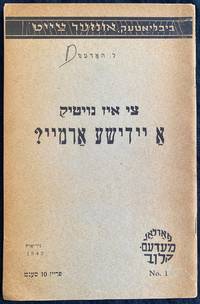
194243432New York: Farlag Medem-Klub 1942. 1st edition. Original Paper Wrappers 8vo 39 pages. 21 cm. In Yiddish. Title translates as “Is it Necessary to have a Jewish Army†A leading Bundist journalist’s call for a Jewish Brigade in WW II to fight the Nazis. “Our answers are based on the firm conviction that Jewish misery and Jewish pain are part of the evil that prevails in the world today; that in a world of slavery and chains this misfortune will follow and follow the path of the Jewish masses where they will not escape from it; That in such a world Palestinian’s i.e. the Jews in Palestine and everyone else's own ‘territory’ can be the bitterest exile; and that on the other hand in a liberated world the earth under their feet will become the most beautiful and safest home where the Jewish masses will enjoy full civil and national rights as people and as Jews.The answers are filled with steel certainty that today the world stands on the threshold of liberation that the terrible sufferings will not be in vain that in pain misery and suffering a new better world is born; A world of exploiters and exploited a world of true equality and freedom.Today the eyes and hearts of the Jewish masses in the ghettos are turned to this world. To this world will turn their eyes all those who are able to take the voice of the ghetto.For this world today in the ghettos and on all the battlefields of the earth proud hosts of Jewish fighters are bleeding as Jewish parts of the great freedom army of humanity which is marching towards the new tomorrow†from the conclusion. <br> <br> Contents include:<br> • The commotion around the Jewish army<br> • Behind the ghetto walls<br> • Death diagnoses instead of help<br> • The crooked mirror<br> • Where did “unity†come from<br> • The Zionist Department Star<br> • About dual citizenship<br> • “The right to fightâ€<br> • Our answer to Hitler<br> • Flag emblem and equal rights<br> • The Jewish account of the world<br> • In the land of bitterest “exileâ€<br> • “Safety on the Volcano"<br> • There is an advice<br> • Sober warnings and reality<br> • “Shame" of the Palestinian Jewish youth<br> • About apparition<br> • Who will protect the Near East<br> • For whom the Jewish army is necessary<br> • The voice of the ghetto<br> <br> Series: Bibliotek "Unzer tsayt" No. 1. SUBJECTS: Jews -- Politics and government. Holocaust Jewish 1939-1945 Great Britain. Army. Jewish Brigade. <br> OCLC: 19313178/970890673. OCLC lists only 2 copies worldwide Harvard YU. Pen mark and toning to front wrapper otherwise Very Good Condition. Rare and important B holo2-163-17C-XX-ECCX-BBIMM@. New York: Farlag Medem-Klub unknown
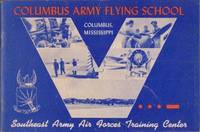
194033862Houston Texas: Published Exclusively by EM. Berry 1940. Soft cover. Very good. Oblong stapled pictorial soft cover. Approximately 6" x 9". 30 pages. Photograph of Colonel L.C. Mallory Commanding Officer on the first page. Contents full of black and white pictures of the headquarters base officers quarters barracks planes mechanics men at work athletics social activities. Inside the back cover is a place for autographs. There is no writing inside. Light wear to the booklet. Published Exclusively by E,M. Berry unknown
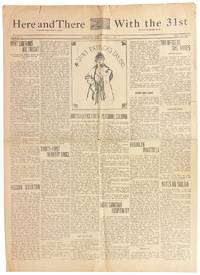
191947912Vladivostok Siberia: 31st Infantry Regiment 1919. Very Good -. Vladivostok Siberia: 31st Infantry Regiment 1919. First Edition. Oversized tabloid 59.5cm; 6pp. Folds chips and a few splits along edges; paper toned and a bit brittle; Good to Very Good. <br /> <br /> Quite scarce publication from the 31st Infantry Regiment published "Every Once In A While" "Wherever We Happen To Be." This issue was published during the Russian Civil War and the United States' failed Siberian Intervention. The paper itself is full of local and international news and leads with an article "What Siberians Are Taught: One Paper Says America Treats the Russians in the Same Way as Negroes."<br /> <br /> We find three holdings in OCLC at the Hoover Institution Montana State and U.S. Army War College. . 31st Infantry Regiment unknown
194359518Washington: AAF Chief Signal Officer 1943. revised edition. Very Good. lge. octavo. card covers xvi 195 12pp. b/w pls. diags. fldg. charts & plans appends. Technical Order No. 08-10-50. This for Airplane Type: P40 N. Hole-punched for filing. A nice copy AAF Chief Signal Officer unknown
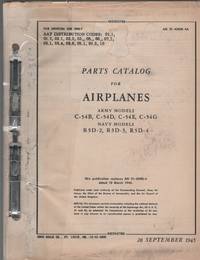
19451799St. Louis: Ross-Gould Co 1945. First Edition . Brackets. Good. Quarto 774pp. In good only condition in metal bracket binding with front wrap repaired with tape and some insect damage. Internally clean and bright with no insect damage. If it was issued with an outer binding or wraps those are not present. A scrace parts catalog for these WWII planes issued just a month after the war ended. Ross-Gould Co unknown
1945134910Winston-Salem NC: Headquarters Aaf Office of Assistant Chief of Air Staff Training 1945. Softcover. good to very good. revised 1 February 1945. 224pp. Quarto. Original printed wrappers. Front wrapper with 3.75" X 0.75" loss of paper to upper left corner only just touching the attractive cover graphics. Some chipping to paper on spine without loss and edges of wrappers. Internally tight clean and unmarked. good to very good A scarce training manual for the Boeing B-29 Superfortress one of the largest and most advanced bombers to see action in World War 2. The manual is heavily illustrated with photographs of the airplane and it's interior and includes detailed instructions on its operation. A fantastic survivor and piece of World War 2 and Korean War history. 1945 Headquarters, Aaf Office of Assistant Chief of Air Staff Training paperback
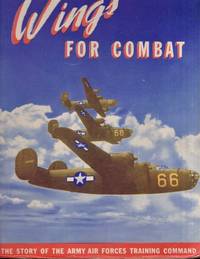
194333863Brooklyn: The Ullman Company Inc 1943. Second Edition. Soft cover. Good. Tall stapled color illustrated paper covers. 80 pages. Illustrated with numerous black and white photographs. Edge wear to the covers. Light shelf wear to the covers. <br /> <br /> Contents include training history; photographs of Barton K. Yount and Walter F. Kraus in charge of the Training Command; photographs of the technicians; radio operators; clerks; College Training; Classification Center; Pre-Flight School; Primary Airplane School; Basic Flying; Advanced Training; Formation; Transition; Bombardiers; Navigation; Aerial Gunners; Glider Pilot; "The Wasps-Women Pilots Play Their Post"; West Point; "Tuskegee-Negro Pilots Are Among the World's Finest"; Mechanics; and Recreation. The Ullman Company, Inc unknown
1859911691859. Her Majesty's Stationery Office London. 1859. Tall sl. narrow hardback bound in plain dark moss green cloth. 314 pages; numerous pages Hancock. Sl. mottling to margin of cloth on upper board; 1-inch horizontal tear to margin of approx. 40 pages of Hancock. hardcover
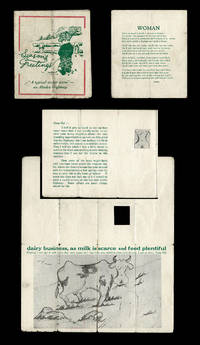
19424346Alaska: n.p. Army Corps of Engineers 1942. Ephemera. Acceptable. Shortly after the bombing of Pearl Harbor the Army Corps of Engineers started and finished building 1600 miles of highway to Alaska. The 10000 strong Corps did it in just over eight months with much help from Canadians. This humerous Christmas greeting was likely sent shortly after it's completion. A 9.25 x 8 inch printed sheet folded 2 times to make a humerous Christmas greeting gag card. A cutout provides the gag of a cow's face being transformed into a naked woman with a dairy business as the punchline. Card is complete w. soil folds and tears. It was obviously carried around in a workman's pocket to provide comic relief. An uncommon piece of Alaska Highway ephemera. n.p. [Army Corps of Engineers?] unknown
23371Spring Garden 26 June 1708. Part-document 19 x 13cm. tipped on to sl. larger paper stained but legible. Probably the lower half of a document text commencing secretarial: "We the Genl Officers for putting in Execution the said Instructions do desire that you will have a special Regard to the said Clause or Article in Her Majesties said Instructions. That whenever any such Clothing is to be provided it may be Referred to our direction. We are"followed by seven signatures of "General Oficers" one illegible William Steuart later c-in-c Ireland Tyrawly Tyrawley Essex 2nd Earl Arran Charles Butler Ist Earl of Arran John Tidcombe DNB Northumberland. The document is incorrectly docketed "Lords of the Treasury - Queen Anne 1708". See image. Spring Garden, 26 June 1708. hardcover
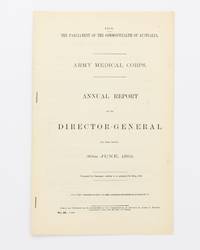
191427330Melbourne: Albert J. Mullett Government Printer for the State of Victoria for the Government of the Commonwealth of Australia 1914. First Edition. Paperback. Very Good. Melbourne Albert J. Mullett Government Printer for the State of Victoria for the Government of the Commonwealth of Australia 1914. Foolscap folio 18 pages. Title-wrappers stapled as issued; an excellent copy. Commonwealth Parliamentary Paper Number 26 of 1914; only 950 copies. Training results of examinations sanitation tables of admissions and diseases and the like; one statistic soon to change was the number of deaths recorded in the Permanent Forces seven including one suicide. Albert J. Mullett, Government Printer for the State of Victoria (for the Government of the Commonwealth of Australia) paperback
19412082702114904991Mono fumei 1941. Soft Cover. Fine. Number of pages: 1 8 128p Size: 15cm Mono fumei paperback
187833304Washington 1878. Each 7-1/2" x 9-3/4" 1-3pp. Wide margins Very Good.<br /> <br /> The orders deal with promotions discharges assignments prison sentences at Leavenworth western outposts and other matters. unknown
184335322Washington DC: U.S. Army 1843. Document. Good. Approx. 10' x 8" document. Folded sheet. 2 pages of contents with address on back. Letter written July 27 1843 and received 2'nd of August 1843. Transcribed below. Some of the content is difficult to decipher<br /> <br /> Ordnance Office Washington 27 July 1843<br /> <br /> Lieut. G. H. Talcott Comnd'g Augusta Arsenal <br /> <br /> Sir: <br /> <br /> It becomes necessary to enclose your property returns for correction neither of them having the certificate required by the 148th article ordinance regulations and now rendered necessary by the change of termination of the fiscal year from 30 September to that of June.<br /> <br /> You drop from the quarterly return a quantity of stores as "sold": no account sales have been rec'd see 103 article: there is also a number of articles dropped under the caption of quotation marks broken up worn out lost and dropped quotation marks but no voucher. These stores should be embraced on an abstract giving each item a separate line and attaching such explanations aside show the particular manner in which it was disposed of in fact all articles disappearing from the return should be covered by a proper voucher so that the May pass at the treasury. The same remarks are applicable to the tool return having omitted to send any vouchers with it: the stores "turned over to Lt. Hagner" do not appear to do not appear on the quarterly return as having been turned in as it is supposed was the case. The tools of iron steel etc. should be taken up on the quarterly return either as unserviceable or there wage in scrap iron steel a letter has been received two day from W Baker requesting certain connections certain corrections to be made to the return but as it has to be sent back for those others he will be best able to make them himself and for which purpose please submit it to him respectfully I am your obedience servant sp.<br /> <br /> Signed in different hand than than the content<br /> <br /> G Talcott Lt. Col. Ordn. U.S. Army unknown
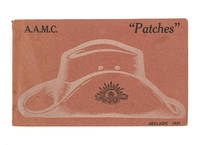
1938108443Adelaide: AAMC Reunion Committee 1938. First Edition. Paperback. Very Good. Adelaide AAMC Reunion Committee 1938. Oblong octavo ii title page verso blank 201 pages plus 19a and its printed verso numbered 21a with some illustrations all produced in brown ink from processed typescript plus 47 pages of plates and 8 unnumbered sectional title leaves all versos blank; all but 6 of the first 30 and 2 later pages are printed rectos only. Flush-cut pictorial wrappers with light wear to the extremities and a few trifling surface blemishes; occasional light foxing and mild signs of handling; a very good copy of a rare and unusual item. 'Ever since the cessation of hostilities of the Great War 1914-1918 it has been the wish of Australian Army Medical Corps AIF ex-servicemen in South Australia that we should have some permanent record of our Fallen Comrades and to those who have "Passed On" since returning to Australia. The following pages are the expression of that wish' foreword. The Honor Rolls run to 18 pages. Other contents include the reunion programme with a list of guests Digger songs 'War and Other Verses' and a lengthy section of war statistics and related items of interest. We have previously handled a copy in which was loosely inserted a 'Critique of the book by the Editor "Rising Sun"' dated Adelaide 31 March 1938. The information contained in our catalogue note at the time is worth repeating: 'Presumably the reference is to "The Rising Sun. A Journal of the AIF in France. With which is incorporated 'The Honk'"; nineteen numbers were issued between 25 December 1916 and 24 March 1917 see Fielding and O'Neill page 264. The anonymous critic is not only onside; his intimate remarks about the compilation and production of the book suggest he was very much inside as well. He writes the following about the AAMC Orderly Room in Adelaide where the work was done: "the well remembered atmosphere of a dug-out was warmly recaptured. On the walls were Leyshon White pictures crisp of technique and so faithfully capturing the spirit that existed 'over there'. War-time quips were bandied freely; each chic female helper may well have been the ghost of Mam'selle herself; each flurry of sound from passing traffic may well have been the whine of more sinister objects"'. <p>Dornbusch addenda 535; Fielding and O'Neill page 233 supplying the name of the editor; Trigellis-Smith 316. [AAMC Reunion Committee] paperback
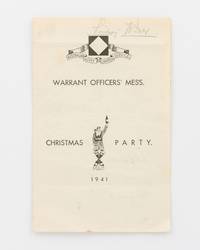
121122Very Good. Large octavo a bifolium with the centrespread comprising a page for autographs and the bill of fare. Creased folded and a little marked; in very good condition. The 18 signatures include at least five by women Jill Trudy Jocelyn Helen and Lucy suggesting the event took place in Australia most probably around Melbourne. unknown
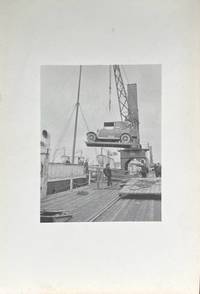
191259779Horsham West Sussex & Haymarket London UK: H.W.C. James A. Sinclair & Co. Ltd. 1912. Two vols. Oblong 8vo. 8.5 x 5 in. 64; 69 leaves unnumbered. including 2 calligraphic titles 63 & 68 platinum print matte finish photographs w/ images sized from 2 x 3 in. up to 3.25 x 3.75 in. on 4.75 x 7 in. prints all expertly hinged at gutter margin a few w/ pencil annotations on versos occasional light toning from the platinum salt emulsions coating the papers. Uniformly bound in striking full green morocco bindings by Zaehnsdorf gilt ruling on covers gilt inner dentelles 5 raised bands on spines title lettering ownership & dating in gilt a.e.g. marbled endpapers very slight shelfwear incremental rubbing at corners still a NF set. An exceptional pair of automobile travel albums composed of platinum print photographs by Dr. E. Stevens apparently presented to fellow Royal Photographic Society member and platinum photograph enthusiast H.W. Child. The motor car was a grey 1912 35 CWT Delaunay-Belleville depicted in 15 of the images bore the GB License Plate of BP1945 registered in 1912 to Charles Stevens c/o Dr. Stevens of Sarcelles Horsham West Sussex July 4 1912. The Delaunay-Belleville in the Brass Era was one of the most expensive and prestigious touring cars for travelers and enthusiasts whose owners at the time included Evalyn Walsh McLean original owner of the Hope Diamond as well as Mann who traveled “Round the World†in 1912 in a similar model. The intrepid travelers clearly intended to photograph and put their new motor through its paces traveling about 3000 miles. The album opens with photos of the auto loaded at Portsmouth and by ferry to Le Havre and then driving down through Normandy Alencon Le Mans Tours Bordeaux and onto Biarritz. The tour extended across the Pyrenees into Spain visiting San Sebastian followed by drives to Pau Lourdes Toulouse Narbonne and then along the South of France into Italy. The drive was not without pitfalls as they suffered punctured tires with two different images showing repairs one with a crowd as well as the photo waiting for a massive rock slide of giant boulders fallen onto the roadway and being removed by wooden wheelbarrows. They continued their tour across the Alps into Switzerland with views of the travelers at a Swiss border station and then capturing scenic vistas and driving onto Salzburg & Linz. One of the images captures advertising and awning of a “Buchdruckerei†specializing in photographic books supplies and photo albums. At that point the motorists had reached the most Eastern point and drove along the Danube route crossing overland to the river Necker Heidelberg and finally into the Netherlands with visits of Amsterdam Haarlem often with picturesque images capturing the Dutch in their iconic wooden shoes windmills canals and even electric railways. One particular image documents the “Art Store†selling Volendam silver & brass and antiques. The final image shows the car being loaded back on the steamship to England from Rotterdam. The platinum photographs were processed by James A. Sinclair & Co. Ltd. at 34 Haymarket in London specializing in photographic prints & equipment and at the time the Platinum prints were Alfred Stieglitz’s process of choice celebrating the images for their aesthetic qualities and permanence. As the Platinum prints were printed direction on coated paper with platinum salts the image was absorbed directly into the paper creating a softer and less-detailed image which was quite durable. Dr. Stevens fl. 1910-1918 who during World War I served as surgeon with the Royal Army Medical Corps joined the Royal Photographic Society in 1915 and exhibited three of his photographs presumably from this excursion including “In the Paese†“Making Port Concarneu†and “Santa Maria della Pace Lago di Como.†Child b. 1859 was a very successful merchant who by 1897 was also an active member of the Royal Photographic Society Platinum print enthusiast and automobile traveler as well. He exhibited several times with the RPS often appearing in their exhibitions from 1898-1915 the last being “Citadel and Church Dinant†shot in 1914 and displayed as an Autochrome. See: Ordinary Members The Photographic Journal Vol. 41 January 1917 pp. 32 41; Exhibition Catalogue of 1898 43rd Annual Exhibition of the Royal Photographic Society 1898; 44th 1899; 45th 1900; 47th 1902; 60th 1915. H.W.C., James A. Sinclair & Co., Ltd., hardcover
190661361London: Salvation Army Book Department 1906. 12mo. 85 pp. plus 3 pp. publisher’s ads on thick paper stock. With 6 photo plates. Blue pictorial publisher’s cloth w/ image on front cover of General Booth’s 1906 Thomas Flyer touring car white lettering lsight scuffing minor shelfwear still VG bright copy. First edition of this informative work tracing the route and adventure in August 1904 as Salvation Army co-founder William Booth embraced the brand new motorized contraption traveling from Land’s End England to Aberdeen Scotland. The 1904 Thomas Flyer touring car was accompanied by a 1904 Thomas Tonneau touring car but Boot’s was painted white in order to attract more attention. Booth stopped off in cities towns and villages to preach to assembled crowds eager to hear the Methodist preacher’s message and the novelty of the automobiles was key. At the time less than 23000 motor cars were owned in all of Great Britain and as noted by the London Transport Museum over 98% of the vehicles in the London streets were drawn by the more than 300000 horses maintained in the urban area at the time. See: An Innovative Army Salvation Army Life and Times History 2023. Salvation Army Book Department, hardcover
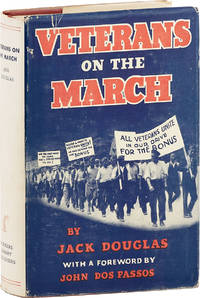
193481894New York: Workers Library Publishers 1934. First edition. Octavo. Cloth boards; dustjacket; 376pp; illus. Tight fine copy in the original pictorial dustwrapper price-clipped slightly rubbed on front cover but still quite attractive Very Good or better. <br /> <br /> A first-hand account of the 1932 Bonus March on Washington from the point of view of a member of the CPUSA-led Workers Ex-Servicemen's League. Includes a 16-pp section of photographic plates halftones and a two-page foreword by John Dos Passos. SEIDMAN D236. Workers Library Publishers unknown