9 442 résultats
194539429Philadelphia: Masterprint Campus Publishing. Good with No dust jacket as issued. 1945. First Edition. Hardcover. Some slight wear along edges of the spine and at top and bottom. ; Illus. padded covers yearbook-style binding and format. Pictorial review - history of the Lexington Kentucky Signal Depot ; 110 pages . Masterprint, Campus Publishing hardcover
186331425New York: D. Appleton and Company 1863. First American Edition. Hardcover. Fair. Octavo. viii 352 pages. Green pebble cloth hardcover with new paper title label on spine. Front and rear hinges repaired. Front joint repaired. A label on the front paste down was removed. Blind embossed stamp of "Robert X. McNeely" located on the copyright page. Old ink inscription from 1913 on the front blank end sheet. This book was first published in London in the same year and included a map and 10 plates. <br /> <br /> Howes E 203 - "This Hungarian imposter claiming to having been a Confederate cavalry colonel was a non-combatant hospital orderly." Nevins I page 86 - "A purported history of the first campaign in the East by a Hungarian soldier of fortune who alledgely joined the Southern forces. D. Appleton and Company hardcover
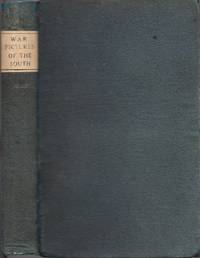
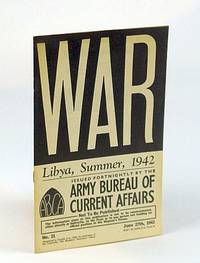
1942665H0378Canada: British Army Bureau of Current Affairs 1942. Book. Very Good. Paperback. Reprint. 8vo - over 7¾" - 9¾" tall. 12 pages. Reprinted in Canada July 1942. "Not to be Published: The information given in this publication is not to be communicated either directly or indirectly to the Press or to any person not holding an official position in His Majesty's Forces." - from front cover. Primary content related to Libya Summer 1942 including one-page map of Tobruk and vicinity. Article on the work of the Pioneer Corps. Smaller articles complement the composure and first-aid training of Japanese troops Hungarians in Russia the task of the blockade of Germany and Japan and a warning about radio traps. Moderate wear. Unmarked. A sound copy. (British) Army Bureau of Current Affairs Paperback
1879008227London : Crown Buildings 188 Fleet Street.: Sampson Low Marston Searle & Rivington 1879. 1st Edition . Hardcover. Very Good. 8vo - over 7¾ - 9¾" tall. In dark blue half morocco over cream paper boards c1988 a few small marks. Spine raised bands gilt tooling & title. Internally lacking title - supplied in facsimile 3 iv-xxxii 1 2-360 pp 3 maps large folding & coloured marbled endpapers & text block edges some faint edge browning. A clever binding by the previous owner. A rare item with only 2 copies at auction since 1895! none online! 217136 mm. <br/> <br/> Sampson Low, Marston, Searle, & Rivington, hardcover
19430089161943. Hardcover. Good. Publisher: The Adjutant General of the Army 1943 Good HB 427 pp. spine crease text off white. A subjective decimal classification with a complete alphabetical index for use of the war department and the United States Army. hardcover
A9781286864470Paperback / softback. New. paperback
B9781286864470Paperback / softback. New. paperback
1998Q-1563114518Turner 1998-01-01. Hardcover. New. In shrink wrap. Looks like an interesting title! Turner hardcover
1982G0531090590I4N10Franklin Watts 1982. Unknown. Very Good. Former library book; May have limited writing in cover pages. Pages are unmarked. ~ ThriftBooks: Read More Spend Less.Dust jacket quality is not guaranteed. Franklin Watts unknown
0562000402.Ghardcover. Good. Access codes and supplements are not guaranteed with used items. May be an ex-library book. hardcover
P25277Koninklijke Militaire Academie: 1929 Breda softcover 34 blz. Ontwerp gebruik en onderhoud met het bijbehorende losse uitvouwblad van het ontwerp van de karabijnen. In zeer goede staat No. 90h Korps Motordienst paperback
1945030790Naples: British Army 1945. Poster. Very Good. No Binding. 40.5 x 26.5. Very scarce and fascinating original item dating to the end of the WWII. A Wanted poster for three soldiers who had taken to a life of violent crime: - Pte Cooper 26; Gdsm Booker 27; and Gnr Tomlinson 27. 'Specialize in Armed Hold-ups of WD Vehicles all types. Will not hesitate to shoot. If seen or thought to have been seen report facts immediately to nearest Provost or Unit Commander.' Details of the three fugitives are given with photographs of Copper and Tomlinson. A few neat fold lines and a few very small nicks to edges otherwise very good. An extremely scarce item. British Army unknown
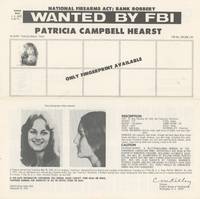
1974List3214Washington D.C.: Federal Bureau of Investigation 1974. Mailer measuring 8 x 15 ¾ inches folded in fours. Yellow tape to seal; else Fine. An FBI mailer soliciting information about Emily Harris and Patricia Hearst of the Symbionese Liberation Army SLA a left-wing militant group based in California and responsible for several killings and bank robberies between 1973 and 1975. Hearst the granddaughter of publishing tycoon William Randolph Hearst had been kidnapped by the SLA in February of 1974; in April she turned up on surveillance video robbing a San Francisco bank with other members of the SLA. Harris was involved in Hearst’s kidnapping and was at the time this mailer was distributed on the run with her husband William Harris and Hearst and wanted for firearms violations. The mailer describes the three as “armed and very dangerous.†<br /> <br /> The trio was arrested in San Francisco in 1975. The Harrises served eight years in prison but were re-arrested in 2002 for the murder of Myrna Opsahl during a 1975 bank robbery. Hearst served two years of a seven-year sentence; her sentence was commuted by Jimmy Carter and in 2001 she was pardoned by Bill Clinton. Federal Bureau of Investigation unknown
191042960N.P.: 1910. 1910. TEXAS. 12" x 8 1/2" broadside offering a reward of $50 for Joe Divincenzo private Battery c 3d Field Artillery Deserter From the Army Fort Sam Houston Texas March 11 1910. Two photographs side and front views and a detailed description. "The act of Congress approved June 18 188 provides 'That it shall be lawful for any civil officer having authority under the laws of the United States or of any State Territory or District to arrest offenders to summarily arrest a deserter from the military service of the United States and deliver him into the custody of the military authority of the General Government.'" Horizontal folds and with chipping to top edge not affecting text. Very good. 1910. unknown
2009Q-0981822835Dept. of the Army 2009-05-13. Hardcover. New. In shrink wrap. Looks like an interesting title! Dept. of the Army hardcover
1547817 Queen's Terrace Bayswater. 24 May 1854. 2pp. 12mo. In good condition on lightly-aged paper with remains of stub adhering to margin on reverse of leaf. The letter begins: 'Dear Sir I got as far as Charing Cross last night on my way to you - when horrified by the lateness of the Hour I did not venture to put in an Appearance & turned Homeward. -' He concludes by inviting him to a dinner at the East India Club 14 St James's Square. 17 Queen's Terrace, Bayswater. 24 May 1854. unknown
19392110502150408660Kaikosha 1939. Soft Cover. Fine. Volume: 1 Kaikosha paperback
1990231017PN. New. 1990. Soft Cover. Date is original print. This is a reprint edition . PN paperback
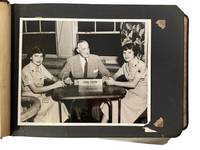
1950231531950. WACKorean War Women's Army Corps photo album compiled by Sgt. Elizabeth Adamek of Cairnbrook PA ca. early to mid 1950s extensively recording enlisted women in post-1948 U.S. Army administrative operations at Camp Zama Japan during the Korean War period. Elizabeth Adamek later Elizabeth Adamek Pierce 1932-2016 served approximately twenty years in the United States Army as an administrative assistant and instructor including service in Japan and the Korean Theater during the Korean War. Adamek is shown several times in uniform with her twin sister Cpl. Cristania Adamek indicating the sisters served in the WAC around the same time period. This album documents postwar U.S. Army overseas base administration showing how clerical labor recordkeeping and office management were carried out by WAC personnel during the Korean War. Images of Hill and fellow servicewomen engaged in office work reveal women's roles in the Army's daily bureaucratic and logistical functions while stationed abroad. A comprehensive primary-source documentation of the operational role of women within permanent peacetime Army structures following the formal establishment of the Women's Army Corps in 1948.<br /> <br /> Photo archive of approximately 240 silver gelatin photographs from Camp Zama Japan and the United States circa early to mid 1950s. The album is housed in a Japanese lacquer-style postbound binding with black paper leaves containing a mixture of small snapshot prints deckle-edge photographs and larger mounted images. The visual content centers on Hill frequently shown in WAC uniform posed in front of barracks administrative buildings and landscaped areas as well as inside office environments seated at desks surrounded by stacked files paperwork and card index systems. Several images explicitly depict clerical workspaces including a servicewoman operating a typewriter beside filing drawers reinforcing the administrative function of WAC personnel. A clearly legible building sign reads "Camp Zama 8030th Army Unit APO 50" situating the album within a specific military unit structure. Additional photographs include formal military reviews with officers and dignitaries group portraits of uniformed women before display walls and social scenes in dining facilities and clubs. Off-duty life is extensively documented through images of Japanese urban streets market stalls rail platforms commercial signage shrine gateways temple architecture zoo enclosures and landscaped gardens alongside recreational scenes such as swimming roadside travel and barracks exteriors collectively illustrating both the operational and social dimensions of overseas Army life. Adamek is posed throughout the album with a romantic partner one Sgt. Kidder whose service at Camp Zama is also documented extensively.<br /> <br /> The album captures the workings of U.S. Army overseas base administration demonstrating the process by which women in the Women's Army Corps sustained military infrastructure through administrative labor. Camp Zama functioned as a major logistical and support installation during the Korean War era and the photographs provide insight into the women that maintained its operations while also recording the social networks and cultural encounters experienced by American service personnel in postwar Japan.<br /> <br /> Elizabeth Adamek Pierce's obituary in The Oklahoman indicates she was honorably discharged from the US Army in 1971 after which she relocated to Oklahoma City and worked in an administrative role with the OKC Police Department. Adamek was a member of the Civil Air Patrol the VFW Post 1335 and a volunteer at Tinker Air Force Base in Oklahoma City. Light edge wear and chipping to album leaves occasional corner wear scattered fading and softness to prints and general handling wear to the binding; overall good condition. A cohesive and well-identified visual record of women's military service in the U.S. Army in East Asia. unknown
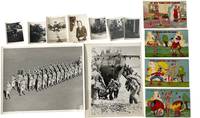
1940231951940. Women's wartime military mobilization photo archive documenting female military service across Allied wartime culture in the United States and southern France during the 1940s. Official press photographers commercial postcard publishers and private snapshot makers record women in uniform within military structures wartime publicity systems and informal social settings while the comic material makes clear that women's enlistment was also processed through satire about masculinization labor reversal and altered domestic authority. The August 22 1944 Army Radiotelephoto press photograph captioned "FRENCH WACS COME HOME" includes helmeted French women carrying rifles and duffel bags as they debark from landing craft "US 38" on the Riviera to join the liberation of their homeland placing women's military service directly within Allied invasion reporting and wartime news transmission.<br /> <br /> Photo archive of 13 silver gelatin and colored real photo postcards ranging from 10 x 8 inch press photos to smaller 3 x 2.5 inches vernacular photos United States and southern France circa 1940s. The grouping joins official press photography commercially printed comic postcards and private snapshots: women serving in uniform within military structures news agencies translating that service into public wartime narrative and vernacular photographs framing servicewomen through friendship memory and off-duty self-presentation. One large press photograph includes a WAC marching unit in tight alignment behind a guidon for a unit attached to a Naval Operating Air Station the elevated viewpoint emphasizing drill uniformity and command structure rather than individual identity. The Radiotelephoto print retains its typed verso caption identifying French WACs coming ashore in southern France. Four color comic postcards published by Beals in Des Moines turn women's enlistment into wartime humor through slogans including "WE'RE GIVING 'EM A BIG WAAC . . . " "I'M BRINGING HOME THE BACON!" "I'M GETTING A BIG BANG OUT OF THIS ARMY LIFE" and "MY HOW TIMES HAVE CHANGED." The most pointed of these "I'M BRINGING HOME THE BACON!" has a uniformed woman dragging a defeated male figure on a rope recasting military service as a comic transfer of masculine power and economic authority to women. "MY HOW TIMES HAVE CHANGED" extends that logic by imagining a man in an apron cooking and sweeping at home making domestic reversal itself the joke. The remaining cards similarly convert women's service into exaggerated spectacle through a rolling-pin attack on a caricatured Axis figure and a smiling servicewoman posed between oversized cannons. Seven small vernacular snapshots shift to individualized presence: one is signed "Love Sherry" two versos identify "Hazel" one verso reads "Golden Gate Park" and the images include women in uniform seated on an urban balustrade standing along city streets posed in landscaped parks visiting a pagoda-like garden site and appearing together outdoors in a paired portrait.<br /> <br /> Women's military service during World War II expanded through the WAAC WAC and related Allied formations while press agencies commercial print culture and snapshot photography assigned that service different public meanings; this archive preserves those overlapping channels in a single grouping. The postcards register wartime unease and fascination around women entering socially masculine roles turning military participation into jokes about strength breadwinning authority and domestic displacement. Minor corner and edge wear to the larger photographs one crease and caption wear to the Radiotelephoto print light rubbing and handling wear to the postcards and general wear curling and minor soiling to the vernacular snapshots; overall very good condition. The grouping preserves women's wartime military presence as it moved between official documentation commercial gender satire and private snapshot culture. unknown
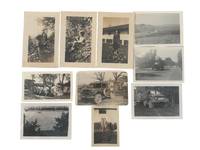
1945225281945. Women History World War II WWII Women's Army Corps photo archive documenting women's military service during World War II and the expansion of women's logistical and technical roles within the United States Army. The photographs record daily activity surrounding Women's Army Corps personnel including ambulance operation vehicle maintenance military training environments and informal moments of rest and recreation. Established in 1943 Women's Army Corps enabled women to enter the Army in noncombat roles that were essential to wartime mobilization including clerical work communications mechanics and medical transport. The images document this institutional transformation through scenes of uniformed women working with military vehicles operating ambulances and participating in the broader infrastructure of wartime military camps. One photograph shows a WAC standing in full service uniform before a low administrative building while others depict women outdoors in wooded settings during moments of leisure illustrating both the disciplined and personal dimensions of wartime service.<br /> <br /> Archive of 20 gelatin photographs created during the 1940s depicting Women's Army Corps personnel military vehicles and associated Army training activities. Photographs measure approximately 3.5 x 5 inches. The photographs show WAC members in both uniform and off duty settings including outdoor portraits and camp scenes. Several images focus on military ambulances and transport vehicles bearing visible Army markings such as "U.S. ARMY 432621" and "AMB-34." Verso inscriptions provide firsthand commentary on military duties and equipment including one caption reading "This is my new AMBULANCE hope you like it sis. safe & OK" and another written beside an ambulance photograph noting "good old Baker 5 kept me from walking." Operational scenes include soldiers crouched behind sandbags with a handwritten note identifying personnel as "Eselinger Conrad Palmer Carvey Boss." Other photographs document the broader military environment surrounding WAC activity including a drill or parade ground and a large motor pool with rows of Army trucks one marked "U.S. Army 008909" positioned in front of a multi story barracks. Additional annotated images identify fellow servicemen and technical details of equipment including "Hines Gallop and myself. Gallop is a jeep driver from North Carolina" and another describing "my radio on right fender" while one photograph is labeled simply "motor pool."<br /> <br /> Women's Army Corps personnel served throughout the United States and overseas during World War II performing essential logistical and administrative work that supported Allied military operations. Ambulance drivers such as the woman referenced in the captions transported wounded soldiers during training exercises and operational deployments and were often responsible for maintaining their own vehicles in field conditions. WAC members later served across European theaters including England France and Italy after the Allied landings in 1944 contributing to the wartime medical evacuation system that moved casualties from combat zones to field hospitals and rear medical facilities. Light edge wear mild surface handling and faint silvering to some prints; overall very good condition. These photographs document both the operational infrastructure of wartime motor transport and the presence of women within that system illustrating how the mobilization of female personnel expanded the technical and logistical capacities of the U.S. Army during the global conflict. unknown
194424341Buffalo NY: Camp Specialty Co 1944. Very good condition. Silk color illustrated souvenir pillow cover from Army Sgt Charles B. Russell who was serving "somewhere in Australia" to be presented to his sister Miss Maxine Russell of Hopkins MO. With the original envelope in which it was posted on April 28 1944. The pink silk cover has a poem printed on the front: "US Army Sister of all the girls I ever knew; there never was one like you. You're the nearest -You're the dearest - pal I ever knew". <br /> <br /> The edges are decorated with vignettes of an antiaircraft gun machine gun paratrooper field gun tank and bomber printed in blue & green with an American flag and American crest. Navy blue & yellow fringe sewn around the edges <br /> <br /> The pillow cover 17 x 17". The envelope 11 3/4 x 6 1/2" Camp Specialty Co unknown
22987Headed Salisbury Rhodesia no date. Part of headed notepaper 11 x 8.5cm good condition tipped on to slightly larger piece of paper as is corner a small clipping from a newspaper about his activity against yellow fever. Text in his hand: "W.C. Gorgas. Colonel Medical Corps U.S. Army Panama". [Headed] Salisbury, Rhodesia, no date unknown
1977755300PN. New. 1977. Soft Cover. Date is original print. This is a reprint edition. . PN paperback
1970740278PN. New. 1970. Soft Cover. Date is original print. This is a reprint edition. . PN paperback