ANON.MareMagnum

30 332 résultats
8vo., Seventh Impression; red cloth, upper board and backstrip ruled and lettered in black, a very good, bright, clean copy. With 6pp publishers' catalogue bound in at end. First published in 1930. Apparently not recorded by Enser.
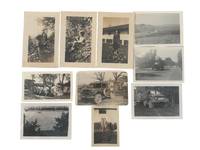
1945225281945. Women History World War II WWII Women's Army Corps photo archive documenting women's military service during World War II and the expansion of women's logistical and technical roles within the United States Army. The photographs record daily activity surrounding Women's Army Corps personnel including ambulance operation vehicle maintenance military training environments and informal moments of rest and recreation. Established in 1943 Women's Army Corps enabled women to enter the Army in noncombat roles that were essential to wartime mobilization including clerical work communications mechanics and medical transport. The images document this institutional transformation through scenes of uniformed women working with military vehicles operating ambulances and participating in the broader infrastructure of wartime military camps. One photograph shows a WAC standing in full service uniform before a low administrative building while others depict women outdoors in wooded settings during moments of leisure illustrating both the disciplined and personal dimensions of wartime service.<br /> <br /> Archive of 20 gelatin photographs created during the 1940s depicting Women's Army Corps personnel military vehicles and associated Army training activities. Photographs measure approximately 3.5 x 5 inches. The photographs show WAC members in both uniform and off duty settings including outdoor portraits and camp scenes. Several images focus on military ambulances and transport vehicles bearing visible Army markings such as "U.S. ARMY 432621" and "AMB-34." Verso inscriptions provide firsthand commentary on military duties and equipment including one caption reading "This is my new AMBULANCE hope you like it sis. safe & OK" and another written beside an ambulance photograph noting "good old Baker 5 kept me from walking." Operational scenes include soldiers crouched behind sandbags with a handwritten note identifying personnel as "Eselinger Conrad Palmer Carvey Boss." Other photographs document the broader military environment surrounding WAC activity including a drill or parade ground and a large motor pool with rows of Army trucks one marked "U.S. Army 008909" positioned in front of a multi story barracks. Additional annotated images identify fellow servicemen and technical details of equipment including "Hines Gallop and myself. Gallop is a jeep driver from North Carolina" and another describing "my radio on right fender" while one photograph is labeled simply "motor pool."<br /> <br /> Women's Army Corps personnel served throughout the United States and overseas during World War II performing essential logistical and administrative work that supported Allied military operations. Ambulance drivers such as the woman referenced in the captions transported wounded soldiers during training exercises and operational deployments and were often responsible for maintaining their own vehicles in field conditions. WAC members later served across European theaters including England France and Italy after the Allied landings in 1944 contributing to the wartime medical evacuation system that moved casualties from combat zones to field hospitals and rear medical facilities. Light edge wear mild surface handling and faint silvering to some prints; overall very good condition. These photographs document both the operational infrastructure of wartime motor transport and the presence of women within that system illustrating how the mobilization of female personnel expanded the technical and logistical capacities of the U.S. Army during the global conflict. unknown
194424341Buffalo NY: Camp Specialty Co 1944. Very good condition. Silk color illustrated souvenir pillow cover from Army Sgt Charles B. Russell who was serving "somewhere in Australia" to be presented to his sister Miss Maxine Russell of Hopkins MO. With the original envelope in which it was posted on April 28 1944. The pink silk cover has a poem printed on the front: "US Army Sister of all the girls I ever knew; there never was one like you. You're the nearest -You're the dearest - pal I ever knew". <br /> <br /> The edges are decorated with vignettes of an antiaircraft gun machine gun paratrooper field gun tank and bomber printed in blue & green with an American flag and American crest. Navy blue & yellow fringe sewn around the edges <br /> <br /> The pillow cover 17 x 17". The envelope 11 3/4 x 6 1/2" Camp Specialty Co unknown
22987Headed Salisbury Rhodesia no date. Part of headed notepaper 11 x 8.5cm good condition tipped on to slightly larger piece of paper as is corner a small clipping from a newspaper about his activity against yellow fever. Text in his hand: "W.C. Gorgas. Colonel Medical Corps U.S. Army Panama". [Headed] Salisbury, Rhodesia, no date unknown
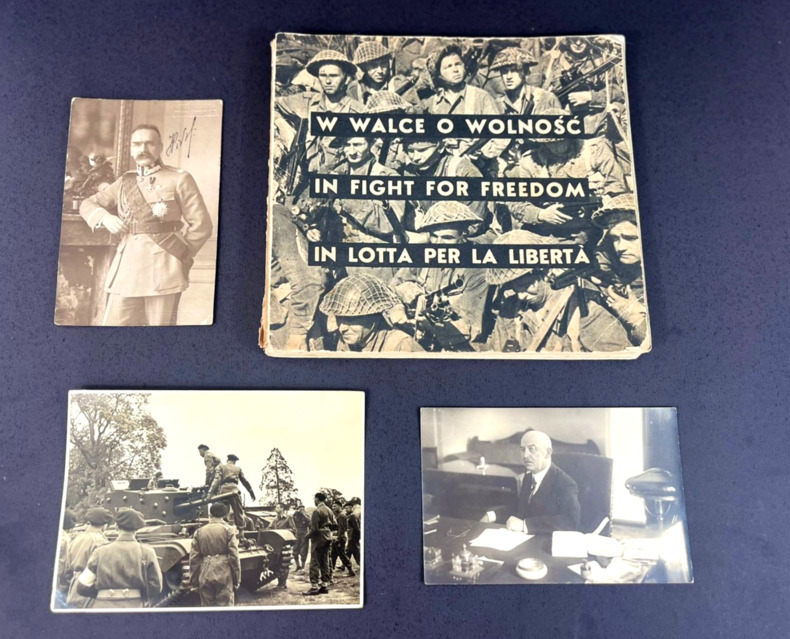
1945517This is a set which belonged to Janusz Gluchowski, a high-ranking Polish military officer at the time of the WW2. The set contains three original B&W pictures. First one: undated postcard showing Marshal Jozef Pilsudski, signed by himself in black ink, 8.5 x 13.5 cm, with two embossed mentions above and below. Second picture: undated postcard showing Poland President Gabriel Narutowicz, with a written mention on the back. Third picture: 11 x 15.5 cm photograph. General Tadeusz Bór-Komorowski inspecting a British Cromwell tank, accompanied by Polish officers of the 3rd Armored Regiment (3 puk pancerny). The image was captured during an official ceremony in the city of Kelso, Scotland, in the immediate post-war period, on June 15, 1945. The scene shows the General in an observation position, climbing onto the tank while surrounded by Polish soldiers. The tank corresponds to a British model widely used by Polish forces in exile during the Western European campaign. On the reverse, the following handwritten inscriptions appear: VI 1945, Kelso. N. Wódz gen. Bór-Komorowski dokonuje inspekcji 3 p. panc. N. Wódz w towarzystwie bryg. puku na czogu." / June 15, 1945, Kelso The book is an illustrated three-languages (Polish, English and Italian) set commemorating the struggles of the Polish II Corps. Edited by Wyda Rererat [Referat] Kultury i Prasy Kresowej Dywizji Piechoty in Rome, 1945. Oblong book of 21 x 19 cm, unpaginated (144 pp.). Cover detached. Endpapers and first page show Janusz Gluchowski's stamp. In publisher's photographically illustrated wrappers. Each page contains a photographic image or a photomontage accompanied with a short text in three languages. Front cover shows some wear and tear, the binding is a bit loose - we would advise having this book bound. The Polish II Corps was a major tactical and operational unit recruited from Polish deportees in the Soviet Gulags in 1943. First they fought in the Middle East, and in 1944 February they were transferred to Italy and as independent part of the British Army to fight in the Italian campaign, in the battles of Monte Cassino and Ancona and also the Battle of Bologna during the final offensive in Italy in 1945. The book goes through the story of Poland and the later established Polish II Corps, starting with the German and Soviet occupation in 1939. It shows the deportation of Poles to forced labour to the Gulag and, after the Polish-Russian Military Agreement in 1941, the establishment of the Polish Army on Soviet soil, also their military training and their fights in various battles. Janusz Julian Gluchowski was a Major General in the Polish Army during the Second Polish Republic. He was born on August 6, 1888, in Bukowa. He fought in the Polish Legions in World War I, the Polish-Ukrainian War, the Polish-Soviet War, and the invasion of Poland by Nazi Germany, Slovakia, and the Soviet Union in 1939, which culminated in the start of World War II. In his adolescence, he attended high school in Czstochowa. In 1905, he became a member of the Combat Organization of the Polish Socialist Party and was wounded in the hand during an attack near Czstochowa. To avoid arrest by the Russian authorities, he left for Belgium, where he studied at the University of Liège. He returned to divided Poland around 1910 and settled in Austrian Galicia. In 1912 he graduated from the Officers' School of the Riflemen's Association in Stroza, near Krakow. In the early hours of August 1914, he commanded a platoon in Oleandria and was Wadysaw Belina-Pramowski's representative during the legendary attack of the so-called Seven Lancers of Belina (Uaska siódemka). On August 6th, together with the First Cadre Company, he left Krakow and marched to Miechów. In October 1914 he was promoted to Lieutenant (Poruchik) and, in November 1916, to Rittmeister (Cavalry Master). Until 1917 he served in the First Uhlan Regiment of the Polish Legions. After the Oath Crisis (Kryzys przysigowy) he was interned first in Fort Beniaminów and later in Werl. Released in October 1918, he went to Lublin, where, in early November, he formed the Third Ulan Regiment (later renamed the Seventh Ulan Regiment of Lublin). Along with his unit, he fought in the Polish-Soviet War. On May 29, 1920, he was promoted to Polkovnik. He was transferred in July 1920 to Eastern Galicia, taking command of the First Cavalry Brigade, fighting against the Soviets in Galicia and Volhynia. After the war, he remained in this position until 1925, when he was transferred to the Fourth Cavalry Brigade. Promoted to Brigadier General on March 16, 1927. Appointed commander of the Center for Higher Military Studies on June 4, 1930, and three years later, after the death of General Stanislaw Tessaro, he was appointed commander of Military District X in Przemyl. In October 1935, he became Deputy Minister of Military Affairs. In the early days of the 1939 invasion of Poland, Gluchowski ordered General Walerian Czuma to prepare the defense of Warsaw. In mid-September 1939, he fled to Romania. After his escape, he managed to travel to the Middle East and, in January 1941, received orders to go to London. In October 1941, he was appointed Commander of the Training Brigade stationed in Scotland. On September 23, 1943, he was appointed commander of all Polish Army units stationed in Great Britain, except the First Independent Parachute Brigade, which remained under the authority of the Commander-in-Chief. He was promoted to Major General on June 1, 1945. He decided not to return to Soviet-occupied Poland and remained in Great Britain. He frequently criticized the Soviet regime and the Soviet occupation authorities in postwar Poland. Furthermore, he was one of the founders and president of the Jozef Pilsudski Institute in London. He was, therefore, an active member of the Polish community in Great Britain. He was president and honorary member of several Polish veterans' organizations. He died on June 11, 1964, in London, England.
200735302Marburg; BdWi-Verlag, 2007. Keine fortlaufende Seitenzählung. Lex. 8° (=25-30cm), Leinen.
198223082Stuttgart : Deutsche Verlags-Anstalt, 1982. 402 S. ; 25 cm. Gr.-8°, geb. Oln. OU
19823573Stuttgart : Deutsche Verlags-Anstalt 1982. 402 S. ; 25 cm Gewebe, gebundene Ausgabe, in loser Buchfolie eingeschlagen, Exemplar in guten Erhaltungszustand
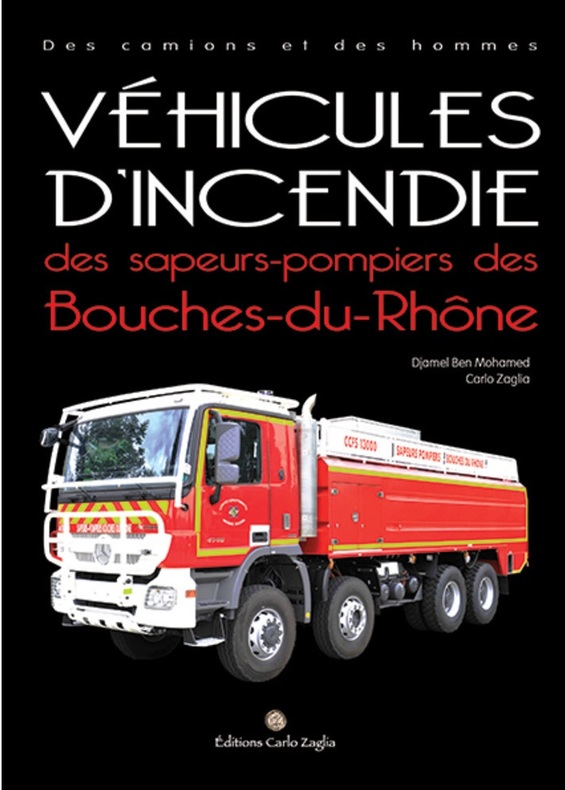
2015120799La Seyne-sur-mer, Editions Carlo Zaglia, 2015, in-4°, 287 pp, 405 photos en couleurs, 3 cartes sur double page, reliure cartonnée illustrée de l'éditeur, bon état (Coll. Des camions et des hommes)
199841002Wöfersheim-Berstadt, Podzun Verlag. 1998. OBroschur, 4°, 48 S., mit Abbildungen, überarbeiteter reprint von WA 58. Zustand sehr gut.
1977755300PN. New. 1977. Soft Cover. Date is original print. This is a reprint edition. . PN paperback
1970740278PN. New. 1970. Soft Cover. Date is original print. This is a reprint edition. . PN paperback
1946182135D'histoire et d'Art 1946 in12. 1946. Broché.
152759Paris, 1835 in-plano (68,5 x 52 cm), [4] ff. n. ch. (titre et table des planches), et 68 grandes planches à double page, gravées par Perdoux, Desaulx, Cardano, Misbach, Schroeder, Lameau, Fortier, etc., d'après les dessins de Bagetti ; le tout monté sur onglets demi-maroquin vert, dos lisse (reliure à l'imitation). Taches et rousseurs à certaines planches, trace de pliure à la page de titre.
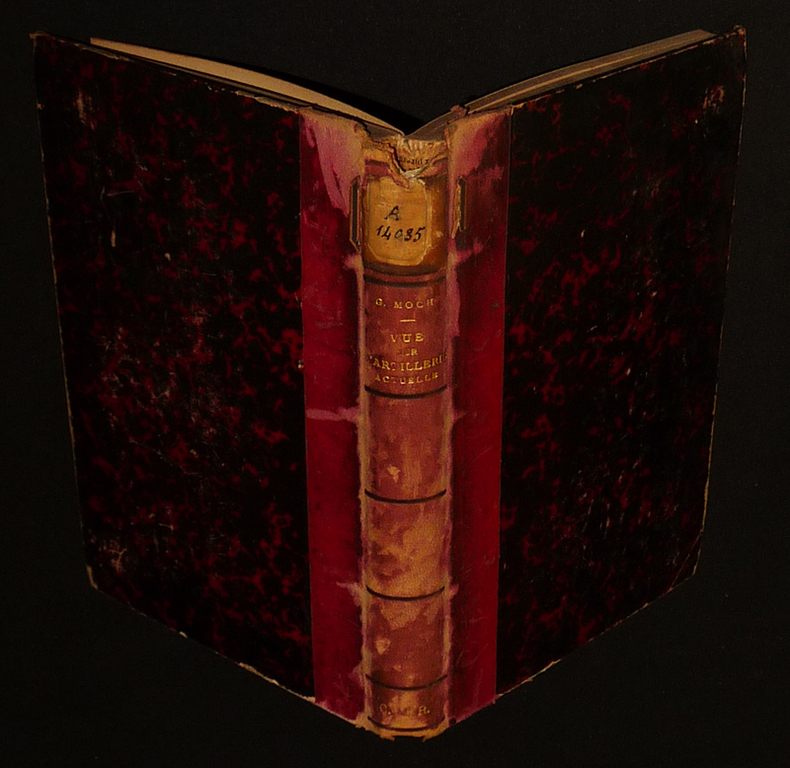
1895va1325Berger-Levrault et Cie Relié 1895 In-8 (14,5 x 22 cm), reliure demi-peau, dos lisse, VIII-221 pages ; épidermures sur le cuir, coupes frottées, usures aux plats, ancien exemplaire de bibliothèque (étiquette au dos, tampons à l'intérieur), en l'état. Livraison a domicile (La Poste) ou en Mondial Relay sur simple demande.
1897SKU1040213Government Printing Office 1897-12-31. hardcover. Very Good. 0x0x0. Government Printing Office; Washington 1898. Hardcover. A Very Good brown leather boards and brown cloth spine gilt lettering on front board binding intact all text block edges stained blue with some blemishes handling/scuffing to boards rubbing along board edges slightly starting hinges some age toning to pages previous owner handwritten ink name top title page without Dust wrapper. A nice and overall clean copy. 16mosextodecimo or approx. 4 x 6.75 inches 296pp. fold-outs indexed. We pack securely and ship daily with delivery confirmation on every book. The picture on the listing page is of the actual book for sale. Additional Scans are available for any item please inquire. Government Printing Office hardcover
194614256Verlag Tschudi & Co, Glarus, 1946. 112 Seiten, OLeinen m. OU, signiert und gewidmet. ("Jenny und Robert Faesi mit vyle Maiegrüess 1946 Maria und Georg Thürer"). Gutes Exemplar. Selten. Very rare. Good copy, signed by the author. Das Buch stammt aus der Bibliothek eines Autographensammlers. Georg Thürer (1908 Tamins - 2000 in Teufen) war ein Schweizer Schriftsteller, Hochschullehrer, Literaturwissenschaftler und Historiker.
2013651879Kortrijk: Groeninghe. 2013. 214 Seiten. 25cm. Zustand: Sehr Gut (Innen); Einband Außen hat geringe bis leichte Gebrauchsspuren; Ist gering bis leicht schief gelesen; Broschiert
9473Melun, Imprimerie Administrative, 1939. Placard 32 x 50 cm.
1826PHO-2360Sl, imprimerie royale, 1826-27 - 4 vol. in 8° (21,5x13cm), 4ff - 429 pp. -2ff./442 pp.-2ff.- 431 pp./ 2ff.- 416pp., demi-basane tabac, dos à nerfs avec auteur, titre et tomaison, épidermures, petites rousseurs, mouillure angulaire au tome 2 Texte seul, illustré de 12 planches de costumes en couleurs, dont 4 planches de costumes en noir (T1), et de 3 planches inscription archéologiques.
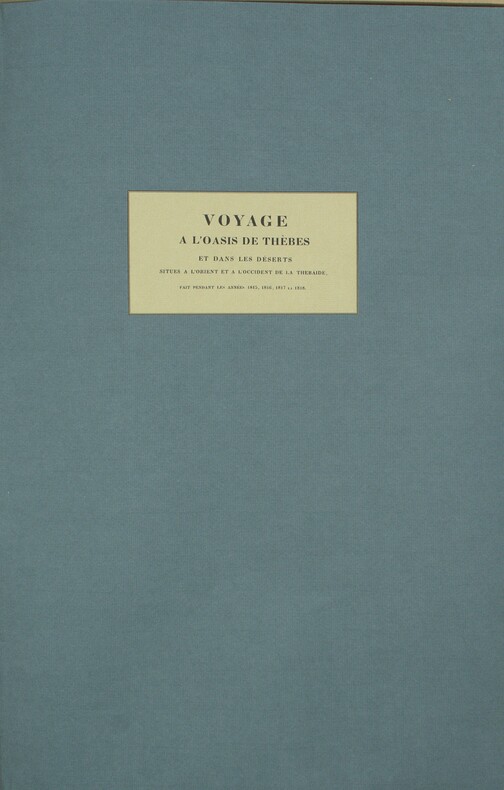
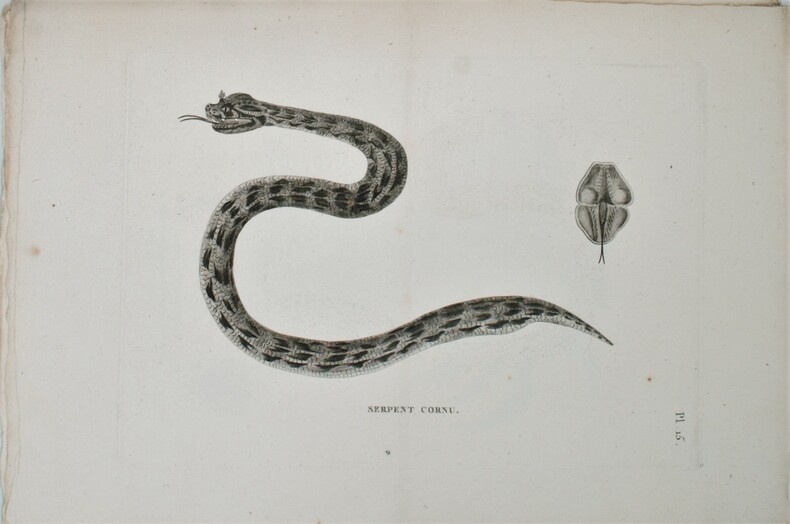
1821PHO-2038Paris, Imprimerie Royale et Imprimerie de L. Toinon et C ,1821-1862, 2 volumes in-folio. 1ère Partie, brochage papier bleu avec étiquette de titre sous coffret moderne, vieille mouillure, papier gondolé, quelques rousseurs. 2nde Partie, sous coffret moderne, rousseurs sur les planches en noir et blanc, mouillure angulaire au début et marginale en fin, petites déchirures en marge sur quelques feuillets, coin manquant faux-titre. XVII-120pp., 24 planches sous serpentes dont 2 cartes et une planche en couleur d’époque et 2ff. (faux-titre, titre)-V (avant-propos) -27pp. (explication , appendice) -20 planches (21) dont 4 en double pages et 9 en couleurs d’époque .
1792PHO-1270Paris, Chez Plassant, 1792. ATLAS seul in-4, en feuilles , titre , liste des planches , 4 cartes dépliantes et 88 planches dont 19 à double page , non rogné , pages de titre et liste des planches légèrement effrangés et salies
1792PHO-1271Paris, Chez Plassant, 1792. ATLAS seul in-4, relié cartonnage d’attente , titre , liste des planches , 4 cartes dépliantes et 87 (88) planches dont 18 (19) à double page , non rogné , quelques brunissures , défauts à la reliure.
2011GITd543bParis Perrin 2011. Fort in-8 broché couverture illustrée 675pp Avec une carte et des illustrations hors texte en noir et en couleurs.
1833PHO-1493Paris, Arthus Bertrand, 1833. — 3 volumes in-8, 210x130, et un Atlas in-4, 305x235 : XV, 286 pp., 1 carte ; (2 ff.), 326 pp.; (2 ff.), 439 pp.; (2 ff.), 30 pl. pour l’Atlas. Texte : Demi basane bleue, dos lisse orné avec auteur et titre, tranches mouchetées, plats légèrement frottés, petites rousseurs, accompagné de son Atlas, Titre, explication des planches et 30 planches, relié plein papier bleu, dos lisse avec auteur, titre et tomaison, frottements, trace de réparation, mouillure angulaire, quelques rousseurs.