Baumann, AlexanderAntiquariat.de

56 résultats
1890P30236Künast:Wien.1890. ca 140 Seiten.23x16 cm. Original-Halbleinen
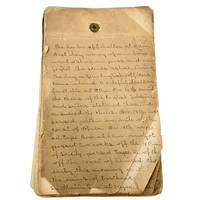
18990012049Donsol Pilar Manila Philippines New York Malta. Poor with no dust jacket. 1899-1901. Other. On offer is an unbelievable handwritten account of 19 months of action on the frontlines of the Philippine Insurrection the Philippine-American War between November 1899 and June 1901. An unknown American soldier writes of his experiences in a level of detail that cannot be overstated. This diary places the reader in the Philippines with shocking realism making this diary exceedingly rare. The 139 pages of this journalled account of events have been removed from a larger document and someone has pinned these loose pages together. This writing begins at the end of a sentence penned on presumably November 17 1899 and concludes half way through a sentence written on June 23 1901. There seem to be very few missing pages from within the journal and it reads very smoothly. The content is outstanding. The diary opens with our soldier diarist sailing from New York to the Philippines via the British Naval base at Gibraltar and the Suez Canal. He describes his experiences sailing sharing about a stop ashore in Malta a Thanksgiving spent at sea a concert enjoyed aboard the gunboat Nashville on the way to Manila and more. He arrives with his regiment in Manila on Dec 22 1899. The troops explore Manila and meet Filipino locals. In early January of 1900 they receive orders to head to southern Luzuon on the Kobbe Expedition which refers to General William Kobbes Expedition to Bicolandia. This expedition was in response to an urgent order from Washington to open up hemp ports of Southern Luzon due to an American hemp shortage. The problem was the port towns were largely controlled by Filipino Insurgents. Our diarist provides absolutely remarkable detail about Americas role in defeating the Insurgents and the tragedy of the Filipino peoples experience. Context indicates that our diarist was possibly a member of the 43rd Volunteer Infantry Regiments USV Company A. An excerpt that provides a sense of how our soldier explains the circumstances in the Philippines follows: Jan 16th we got the order to pack up and get ready to leave Mikata and to proceed to the Southern part of Luzon we were put aboard the transport Hancock which was at anchor in the Bay of Manila All combined we were named the Kobbe Expedition to the Southern Luzon to open up the Hemp ports and protect the natives from the Insurgents down there On the 21st of Jan 1900 our boats dropped anchor in a bay named the bay of Sorsogon in the Province of Albay All over this province there are large gangs of Insurgents holding the towns so at many towns our boys had a hard fight with the Insurgents before they could take the towns and the gun boat had to shell many of the towns. Our Regt. Occupied nine towns. Our detachment of A and D. Co. Were taken to a town named Donsol the gunboat Helena took us ashore from the Hancock On their arrival ashore they were met by a crowd of Philippinos. They had an order from the officers of the Insurgents it read saying that they would not haul down their colors nor surrender for three days. So our Major returned to the gunboat and a short conversation was held with the officers of the gun-boat and it was decided to prepare the gun boat for action and land all of us. If the Insurgents fired one shot at us the gun-boat would shell the town The hills were full of fleeing people. A detail of men were sent out on the hills at once then the Insurgents fired their first shot at us. Our boys had a warm fight for 15 minutes. They found the hills well entrenched and also found one big cannon. Lots of spears Bolas and wooden guns. They returned to town bringing in a few prisoners. A scouting party was seent and they saw a lot of Philippinos fleeing to the mountains. This town had a population of 10000 and three hundred were Insurrectors. The next thing we done was to find ourselves some good houses to live in. Outposts were put out all around the town. A few natives came across our post for a few nights and on the 22th Jan the Insurgents paid our town a visit setting fire to one of the big houses where our men were sleeping. Our men got out of the house without anyone being hurt. We surrounded the town fired a few volleys . Later in January our soldiers regiment goes on the first of many missions all of which he describes in glaring detail. On this mission the troops attempt to leave Donsol for Pilar when they run into trouble as the connecting bridge was destroyed by Insurgents. They make it to Pilar and find the town has been deserted. As they march back to Donsol they find someone has lit the bridge ablaze: Jan 28th We had a very hard time crossing the bridge burning our shoes and legs but we got safely on the Donsol side before the bridge fell with a crash into the river. We marched on we heard several shots from the Mauser and Remington rifles. Next we discovered a big fire and a call to arms and fire call was sounded The fire of the Insurgents got heavier. Our Major gave an order not to fire. He was going out in the front of our lines. He went out with a detail of men and discovered that our town was surrounded and the hills were full of Insurgents. He fired a few volleys then he came into town. The Insurgents answered him by firing a cannon. Then the Insurgents gave a yell and started to advance and we kept quiet and let them get close to our lines. Then we got the order to commence firing and the boys opened up all around the town and we soon put the Insurgents to flight firing a few shots as they ran. Next morning we discovered a few dead Insurgents close to our lines. The Insurgents almost always carry their dead and wounded along with them in their flight Our soldier does an absolutely phenomenal job of describing not only the day-to-day in Donsol where he spends majority of his time but also the various missions in which he participates. His words paint a fulsome picture of the war: 21st Feb at noon our Major asked for a detachment of men to volunteer to go up the river on a scouting expedition. I along with 12 more men went out of our company and 12 out of D. Co. Along with Capt. Hart of D. Co. And our Major left Donsol in a hard paddle boat and one white boat in tow On our way up the river we could see high hills on each side and the river was very narrow. There were many Insurgents outposts in the high trees all the way up and we fired at every one we saw. We went up a distance of 8 miles before we thought of coming home as it was getting late We had traveled one mile on our homeward way when the Insurgents fired on us from the left hand ashore. Our men in the rear boat fired a volley into the two Insurgents and were taking good aim for a second volley when the hills fairly echoed with the yells from the Insurgents. They then opened up on the right hand side which was aimed at the white boat hitting one of our men our company in the head and he was killed instantly. Then we answered their shots from each of our boats and from that time until we got back to Donsol we were under the hot fire of the Insurgents we could see the hills full of Insurgents and we had plenty to shoot at. We made every shot count. The insurgents even fired rocks at us from the high hills . More texture is added when our soldier discusses aspects of the war that dont involve active fire. Some examples follow: March 5th Gen Kobbe of the 8th Army Cor was here on a visit and he said these two companies were a very industrious lot of men and that the building of the stocade and trenches was a very sensible work he also brought us 17 of the Battery G 3rd Artillery men and one Hotch Kiss gun for reinforcements. April 10th the mail boat was here bringing the report of Gen. Pawa likely Jose Ignacio Paua an Insurgent Gen in Command of the Insurgent troops through this province. He surrender to our Colonel in Legaspi Legazpi and was sent to the Military Prison in Manila. April 21st We took a long march across the hills in a round about manner to a town named Sevilla merely an Insurgent camp. The town was deserted on our arrival. Fires were still burning in the houses. Everything was just as they had dropped it in their flight. We passed through the town and discovered many traps laid in the roads for us. One trap was an arrow trap on each side of the path in the bushes and by pulling a strong the arrows would stick into anyone going down the path. None of their traps caught us. Our soldier writes frequently about expeditions for which he volunteers. He describes a mission to Banningaran sic. En route the men captured Captain Hernandiz sic; possibly Adriano Hernández y Dayot and his family before being caught unprepared by the Insurgents who severely injured one of the American sargeants. On their hike back to Donsol they are again attacked by the Insurgents this time caught off guard as they attacked from the rear. And so it goes for many more months. Our author describes the movements of the men with whom he is stationed his commanding officers and the various wins and setbacks of both the Americans and the Insurgents. In May of 1901 our soldier and his regiment begin the process of boarding a ship to return to America. There is of course never a straightforward path and there are many bumps in the road. However our soldier does eventually board a ship and begins again to describe his journey in detail. The diary cuts off abruptly mid-sentence on June 23 1901 as our soldier is describing being at sea with nothing but a sailboat in sight for miles. While we do not know our soldiers identity we do know he was safely heading home at the conclusion of his diary. We know he was a highly motivated volunteer soldier who displayed total buy-in to the mission of the Americans in the Philippines and we know he was a gifted writer penning his experiences with such texture and realism that the reader feels as though they too have been on the front lines of a bloody wet miserable war in the Philippines - fighting for America and for the displaced Philippino people forced to flee from the Insurgents to the mountains. This journal measures 8x5 inches and contains 139 single-sided sheets. The pages were all loose so the author has pinned them together with a single round-headed fastener post. There are no covers to this journal. As a result the first and last few pages show obvious and significant wear and tear including a large corner of the first page being completely ripped off obstructing the text. The handwriting is quite legible. Overall Fair to Poor. ; Manuscripts; 8vo 8" - 9" tall; 139 pages . unknown
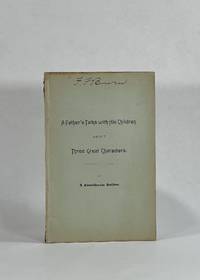
189210676Lynchburg VA: J. P. Bell Company Book and Job Printer 1892. Original Wrappers. Very Good binding. Octavo. 36 pp. First edition. As issued in printed wrappers. Wrappers a trifled toned some light abrasion to the top edge of the rear wrappers; contemporary previous owner name at the top of the front wrapper; similarly early editorial correction in the margin of one page. <br /> <br /> The three parts each are presented as a dialog between young children and the author and discuss Robert E. Lee Stonewall Jackson and J.E.B. Stuart in turn. Uncommon. Dornbusch III 50. J. P. Bell Company, Book and Job Printer unknown
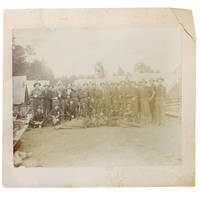
1890187391890. African American soldier photographed among members of a United States Army camp unit in the American West during the late nineteenth century providing visual documentation of Black participation within the military environment during the era of segregated service. African American soldiers served in the United States Army throughout the nineteenth century most prominently in units known as the Buffalo Soldiers which were formally organized after the Civil War. While Black soldiers were typically assigned to segregated regiments images occasionally record their presence in mixed military environments such as camps labor details or logistical units. The photograph captures a group of soldiers gathered in a temporary camp setting and includes a seated Black soldier identified by a contemporary handwritten note on the verso reading "Notice 'Black Soldier.'"<br /> <br /> Albumen sepia tone photograph mounted on photographer's board showing a group of American soldiers posed within a military encampment. Photograph measuring approximately 8.5 x 10 inches mounted on a photographer's board measuring approximately 10.75 x 10 inches. The men are dressed in clothing typical of western military and frontier settings of the late nineteenth century including dark buttoned shirts trousers supported by suspenders and boots. The African American soldier appears seated among the group with a cigarette in his mouth. The soldiers are gathered in a clearing surrounded by trees where rows of tents are arranged on raised wooden platforms suggesting an organized encampment. Cooking equipment stacked blankets plates and tankards are visible indicating a communal meal or informal gathering. One soldier holds what appears to be a long rifle with a visible barrel and wooden stock. Several soldiers sit or recline on the ground in the foreground while others stand behind them creating the appearance of an informal group portrait taken during daily camp life rather than a formal military arrangement. Handwritten note on the verso reads "Notice 'Black Soldier.'" Top right corner of the board cracked with tape repairs on the verso; slight water staining at the top left corner and damp staining at the lower left corner with partial cracking at the lower right corner. Image itself remains clear and largely unaffected. Overall condition good. The photograph preserves a visual record of African American presence within the late nineteenth century U.S. Army camp environment during a period when the armed forces remained formally segregated. unknown
1821003-L1821. Kreidelithographie, 1821, nach Anne-Louis Girodet-Trioson, 1801. 42,5:59,3 cm. Lith. de G. Engelmann. - Im ganzen nicht ganz frisch. Provenienz: Trockenstempel, nicht bei Lugt. Literatur: Meyers Künstlerlexikon 128, 5; Thieme-Becker II, S. 233; McAllister Johnson 72, 5. ? Blatt 5 der Folge ?Têtes tirées du tableau représentant les ombres des héros francais recues dans les palais aériens d?Ossian??. ? 1801 hatte Napoleon Anne Louis Girodet-Trioson (1767-1824) den Auftrag gegeben, für Schloß Malmaison die Apotheose der gefallenen Helden Frankreichs, deren Schatten im Elysium Ossians empfangen wurden, zu malen. Noch zu Lebzeiten Girodet-Triosons lithographierte dessen Schüler Aubry-Lecomte unter seiner Aufsicht eine Folge von Köpfen aus diesem Gemälde.
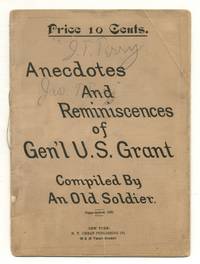
1885558564New York: N. Y. Cheap Publishing Co 1885. Softcover. Good. First edition. 16mo. Stitched printed buff wrappers. Early owner name "Jas. T. Terry" vertical crease with a bit of splitting some old penciling on front wrap a good copy. OCLC locates only six copies. N. Y. Cheap Publishing Co unknown
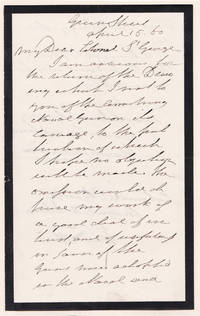
186034086Green Street London: April 15 1860. 1860. Very good. - Letter penned in black ink filling most of both sides of a sheet of cream paper approximately 8 inches high by 6 inches wide bordered in black. The letter is tipped onto a slightly larger piece of card stock. Signed "Howard Douglas". There is a tiny chip to the left edge of the black border. Folded twice for mailing. Very good <p>Howard Douglas writes to Colonel John St. George 1812-1891 Director of Ordnance at the War Office asking for the return of a drawing of a gun which he wants to include in his upcoming book "Treatise on Naval Gunnery" fifth edition revised published in 1860. "I am anxious for the return of the drawing which I sent to you of the Armstrong Naval Gun on its carriage.The omission would deprive my work of a good deal of interest.I have stopped the Press waiting for your reply".<p>General Sir Howard Douglas 3rd Baronet 1776-1861 was a British military officer and Member of Parliament for Liverpool from 1842-1847. After entering the Royal Military Academy Woolwich he was commissioned Second Liutenant in the Royal Artillery in 1794 becoming Lieutenant a few months later. He served as Governor of New Brunswick from 1823-31 and had to deal with the Maine boundary dispute with the United States of 1828. He also founded Fredericton College now known as the University of New Brunswick and was its first Chancellor. From 1835 to 1840 he was Lord High Commissioner of the Ionian Islands where he introduced a new code of laws known as "the Douglas code". The code infuriated the Greek Orthodox patriarchate in that it included innovations affecting family life especially marriage and divorce. Abused or abandoned women could more easily obtain a divorce. Further it legalized marriage between step-siblings and second cousins. Douglas was the author of several important military and naval treatises including the "Treatise on Naval Gunnery" of which the fifth edition is referred to in this letter. It became a standard text book and was the first publication to draw attention to its subject. Green Street [London]: April 15, 1860. unknown
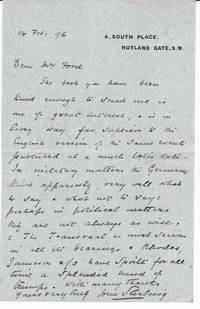
189635639London: 14 February 1896. 1896. Fine. - Letter filling one side of a 7 inch high by 4-3/8 wide sheet of light gray letterhead with the address printed in raised lettering at the top. Signed "John Sterling". Folded twice for mailing. Near fine. <p>Sterling writes to Mrs. Richard Ford thanking her for sending him a military book about the Jameson Raid. "It is of great interest & is in every way far superior to the English version of the same events published at a much later date. In military matters the Germans know apparently very well what to say & what not to say: perhaps in political matters they are not always as wise. The Transvaal is most serious in all its bearings & Rhodes Jameson & Co have spoilt for all time a splendid hand of trumps."<p>Major-General John Barton Sterling 1840-1926 entered the army in 1861 serving in Egypt and the Sudan. He was wounded at Tel-el-Kebir in 1882 and subsequently commanded the Coldstream Guards until his retirement in 1901. He was a member of the Royal Yacht Squadron and the Atheneum Club. At the Atheneum he befriended Kipling who wrote of him that he "dealt faithfully with me when I made technical errors in any tale of mine that interested him." "Something of Myself" page 143. [London]: 14 February, 1896. unknown
1875052767Westminster: Manuscript ALS. ca. 1875 1875. No Binding. Very Good. Original autograph letter signed ALS 'W. Gifford Palgrave' to "Dear Joseph" regretting he is unable to make the journey William Palgrave Gifford. Speaker's Court the Palace Westminster undated. 15x10 cm. In English. 2 pp. in good condition with a separate photographic portrait of Palgrave. William Gifford Palgrave was an English priest soldier traveller and Arabist author of A Personal Narrative of a Year's Journey through Central and Eastern Arabia 1862-1863. Palgrave was born in Westminster. He was the son of Sir Francis Palgrave and Elizabeth Turner daughter of the banker Dawson Turner. His brothers were Francis Turner Palgrave Inglis Palgrave and Reginald Palgrave. He was educated at Charterhouse School then occupying its original site near Smithfield and under the head-mastership of Dr Saunders afterwards Dean of Peterborough. Among other honours he won the school gold medal for classical verse and proceeded to Trinity College Oxford where he obtained a scholarship graduating First Class Lit. Hum. Second Class Math. 1846. He went straight from college to India and served for a time in the 8th The King's Regiment of Foot Bombay Native Infantry H.I.C. Shortly after this he became a Roman Catholic was ordained a priest and joined the order of the Jesuits Society of Jesus and served as a member of the order in India Rome and in Syria where he acquired a colloquial command of Arabic. He convinced his superiors to support a mission to the interior of Arabia which at that time was terra incognita to the rest of the world. He also gained the support of the French emperor Napoleon III representing to him that better knowledge of Arabia would benefit French imperialistic schemes in Africa and the Middle East. Palgrave then returned to Syria where he assumed the identity of a travelling Syrian physician. Stocking his bags with medicines and small trade goods and accompanied by one servant he set off for Najd in north-central Arabia. He travelled as a Christian. The service he would do for the Society of Jesus and the French empire would be as a spy not a missionary. Palgrave became friendly with Faisal bin Turki bin Abdullah Al Saud while in Riyadh Saudi Arabia. Faisal's son Abdul Rahman bin Faisal asked Palgrave to get him strychnine. Palgrave believed that Abdul wanted to poison his father. Palgrave was accused of espionage and was almost executed for his Christian beliefs. <br/> <br/> Manuscript ALS., [ca. 1875] unknown
1870rbr1-wam365Howes B781; Graff 235; Rader 326. Many Western American Scholars believe Belden Fabricated much on a thread of Historical Fact. C. F. Vent hardcover
186545094Leipzig : Wigand, 1865. 3 Bde 1 - 3. 332, 398, 432 S. 8°. 2., verb. u. verm. Aufl. - Wohlfeile Volksausg. OLwd mit Rückengoldpräg. u. Kopfbuntschnitt.
185076713Hildburghausen, Kunstanstalt des Bibliographischen Instituts, [ca. 1850]. Bildgröße 9,5 x 14 cm. Unter Passepartout.
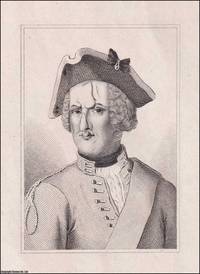
1809373329Robert Graves London Undated c.1809. Unframed Print. Very Good Condition. Robert Graves was renowned for his historical engravings which often depicted military figures and events. This particular illustration portrays Corporal Thomas Brown in 18th-century military attire. He is dressed in a distinguished uniform featuring a buttoned coat a sash across his chest and a striking tricorn hat an iconic piece of both military and civilian fashion of the time. His rank is indicated by the cord on his right shoulder. The tricorn was not just a stylish accessory; it served a practical purpose shedding rain and providing an unobstructed field of vision.Corporal Thomas Brown gained fame for his remarkable bravery during the Battle of Dettingen in 1743 a conflict within the War of the Austrian Succession. As a member of Kings Own Regiment Dragoons Blands Dragoons Brown demonstrated extraordinary courage by reclaiming his regiments standard after it had fallen into enemy hands. In the heat of battle he lost two horses beneath him and sustained grievous injuries including the loss of two fingers and most of his nose. Despite these wounds he fought his way through enemy lines recovered the standard and returned it to his regiment earning enthusiastic cheers from his fellow soldiers.His heroism was later recognized by King George II who awarded him a gold-topped walking stick a silver prosthetic nose and a pension. After retiring from military service Brown settled in Yarm where he ran an inn named after himself. He passed away in 1746 and was laid to rest in St Mary Magdalenes Church where his marked grave remains today. This unmounted image is approx 10 x 15 cms the sheet overall is 20 x 28 cms. Mildly creased in the outer margins which will simply disappear from view when mounted and framed. Category: PRINTS : Antiquarian Interest; PRINTS : Historic Interest; This item may require more postage than the rates shown for delivery outside the UK. If extra postage is required we will contact you before processing your order and you will be given the details and option to decline the extra cost. Robert Graves unknown
1817084-Lum 1817/18. Aus einer Folge von 4 Blatt Kreidelithographien, um 1817/18. 29,4:42,6 cm. Mit der Adresse von C. de Lasteyrie, rue du four St. Germain No. 54. Literatur: Béraldi XII, 394.
1863144848Stuttgart, Nitzschke 1863. VI, 349 Seiten. Beschädigter Kart.-Einband der Zeit. (Einband mit Fehlstellen und sehr stark berieben. Papier teils etwas stockfleckig). 21x14 cm
185419867gsStuttgart, Krabbe, 5. Auflage, 1854. Halbleder / Hldr., mit marmorierten Deckeln und Rückenprägung, kl. DinA 5, kleineres Format, 184 Seiten, Einband mit Gebrauchsspuren, beschabt, fleckig, gebräunt, berieben und bestoßen, Schnitt und Seiten !!! sehr stark gebräunt und sehr stark stockfleckig !!!, STARKE Gebrauchs- und/oder Altersspuren
18942400991894. Signiert, datiert und bezeichnet "Karl Müller / Hb, 94". 43,5 x 60,5 cm.
1896131707Wien, Verlag von Jasef Safar 1896. VIII. 135. (1) Seiten. Halbleinwand-Einband der Zeit mit aufgeklbtem Originalumschlagblatt. (Geringe Gebrauchsspuren). 24x15 cm
189916223AB1899. Leipzig Diederichs 1899. 27 : 19 cm. 157 nn. Seiten mit 184 teils ganzseitigen Abbildungen. Illustrierter Original Leinenband. Erste Ausgabe. - Monographien zur deutschen ulturgeschichte 1. Band. unknown
1880156466Berlin, Ernst Siegfried Mittler und Sohn, 1880.
189579508Hamburg, Rudolph Senf, [ca. 1895]. Druck auf sandfarben getöntem Fond. Bildmaß ca. 16 x 28 cm. Unter Passepartout.
1896218452Berlin, Karl Siegismund Verlag, 1896.
1898218453Berlin, Karl Siegismund Verlag, 1898.
1899218454Berlin, Karl Siegismund Verlag, 1899.
1900218455Berlin, Karl Siegismund Verlag, 1900.