224 résultats
251475 April 1829. 5 Belgrave Square London. See his entry in the Oxford DNB which states that he 'was after Wellington the most respected soldier of his time in Britain whose opinion carried immense weight both at home and abroad and not only on military matters'. 2pp 12mo. In fair condition lightly aged with slight creasing at head. Reads: ‘Sir George Murray has to acknowledge the receipt of Mr. Wrights letter of the 4th. Instant and in compliance with the request expressed in it he encloses a Copy of his speech on the Catholic Relief Bill as published in a reported form by the Proprietors of the Review of Parliament and which he believes to be correct.’ A supporter of Catholic emancipation Murray was Colonial Secretary in Wellington’s administration and left office on its fall in November 1830. 5 April 1829. 5 Belgrave Square [London]. unknown
6252EDWARD ALLEN GOODWIN unknown-1862. Goodwin was the Sergeant in Company K of the 23rd Regular Massachusetts Volunteers. This is the diary of Edward A. Goodwin Co. K 23rd Regt. M. of. M. This diary is THE AMERICAN UNION DIARY FOR 1862 an annual published diary accessible and likely provided to Union soldiers during the Civil War. After a few pages that include a calendar and interest tables the diary provides space for each day of the year 1862. Goodwin wrote entries every day from January 1st to April 7th and none thereafter. At the time Goodwin was serving in the 23rd Massachusetts Infantry Regiment which was a part of the Coast Division under General Ambrose Burnside. Entries are handwritten in either pencil or black ink. Notable entries include: aFriday 7: Naval engagementplace lasting from noon till sunset. Troops were landedin the afternoon and evening. Bivouacked on Roanoke Island in the rain. b Saturday 8: Captured a rebel battery in a swamp. Took 3000 rebel provisions and the whole island wasSergt. Howard hurt his foot. W.S. Clark missing. Both entries describe the Battle of Roanoke Island fought February 7th and 8th 1862. Part of General Ambrose Burnsides expedition to capture key ports in the Outer Banks the battle first saw Union gunboats first firing on Confederate forts under the command of Henry Wise until Burnsides soldiers could land ashore unopposed. and the forts on shore engaged in a gun battle with occasional contributions from the Mosquito Fleet. The next day the Union soldiers successfully flanked the Confederate artillery and infantry defenders on both sides forcing a retreat into the Confederate forts. The forts were then individually taken with the Union suffering only 264 casualties and capturing 2500 Confederate defenders. c Friday 14: Fought the battle of New Bern. Took over 100 pieces of artillery ammunitioncamp equipment &c. I arrived at night in the tents of the enemy. This entry describes the Battle of New Bern fought on March 14th 1862. After first advancing up the Trent River General Burnside had his soldiers exploit the weakened center of the line of the defending Confederates under Lawrence O'B. Branch. This allowed the Union Navy to shell Fort Thompson forcing its abandonment and shortly thereafter the city of New Bern too. 90 Union soldiers were killed and 64 Confederates were killed and 413 were captured. d Monday 31: Sick all day. Took horses.e Monday 7: Saw Amoat the hospital. DeceasedRain in the afternoon. These two entries foreshadow Goodwins ultimate fate including his last entry on April 7th 1862. Goodwin would pass away in New Bern on April 16th. Having survived two major battles unscathed at least according to his diary Goodwin most likely succumbed to disease. It is estimated that 2/3 of Civil War soldiers who died during the war died of disease not in battle. His body was ultimately returned to Massachusetts and is buried in Mansfield. The pages of the journal are in good condition but the exterior of black leather is frayed and partially torn. It should be handled very delicately but its value as a lens into the mindset of a Civil War soldier is immense. hardcover
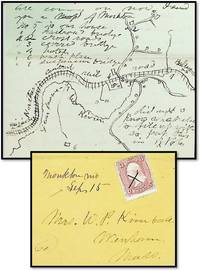
21451Very Good. HAND-DRAWN MAP OF MONKTON MD - UNION SOLDIER DESCRIBES GUARDING THE NORTHERN CENTRAL RAILROAD AND A CHAOTIC 'CHICKEN RAID' DURING THE FINAL YEAR OF THE CIVIL WAR.<br /> <br /> An original Civil War manuscript letter dated September 14 1864 written by a Union soldier stationed in Monkton Maryland. The letter features a remarkable hand-drawn map of the town and military outposts documenting the regiment's duty guarding the vital Northern Central Railroad bridges and a humorous incident involving a 'liberated' flock of chickens.<br /> <br /> Key Features:<br /> Visuals: The final page features a detailed pen-and-ink hand-drawn map of Monkton MD. It identifies the 'Northern Central Rail' 'River' Gunpowder Falls 'Covered Bridge' 'Hotel' and 'Our House' Barracks.<br /> Content: The soldier details life on guard duty at the 'Covered Bridge' building a brick stove for warmth and sleeping on straw. He recounts a a vivid and informal account of an improvised 'chicken raid' following a rail stop illustrating camp life food scarcity and soldierly opportunism late in the war. where a train passed carrying chickens; eight chickens "got off" escaped or were pulled off leading to a chaotic chase by the soldiers and the Captain to secure 'soup for dinner.' Full transcription available<br /> Postal History: Includes the original envelope addressed to Mrs. W.P. Kimball in Wenham Mass featuring a 3-cent George Washington stamp 1861 issue and a Monkton MD postmark.<br /> The envelope features a 3-cent George Washington stamp 1861 Issue tied by a Monkton MD postmark. Please Note: A previous owner noted this as a 'Scott #64' on the protective sleeve; however it has not been expertized and is sold as the more common Scott #65 Rose variety. We leave the final determination of the shade to the buyer.<br /> Transcription: A previous owner has handwritten the letter onto one page in attractive cursive. We also has a typed transcript available.<br /> <br /> Physical Specs:<br /> Date: September 14 1864<br /> Dimensions: Standard bi-fold letter sheet approx. 5x8 inches folded; Envelope included.<br /> Format: Handwritten ink on period writing paper.<br /> <br /> Condition: Very Good - The handwriting is legible and ink remains dark. Paper shows standard age-toning and fold lines consistent with mailing. The map is clean and sharp. This letter offers a specific window into the defense of the Northern Central Railroad NCR a critical supply line for the Union Army connecting Baltimore to Harrisburg. In 1864 regiments like the 8th Massachusetts Infantry were stationed along this line to protect bridges from Confederate raiders Gilmor's Raid had struck this area just months prior in July 1864. <br /> <br /> The mention of the 'Covered Bridge' at Monkton is historically significant as this was a key infrastructure point. The soldier's map provides a rare first-hand topographical view of the encampment layout relative to the rail line.<br /> <br /> Keywords: Civil War Letter Monkton MD Northern Central Railroad Hand Drawn Map Soldier Art 8th Massachusetts Infantry Wenham MA Covered Bridge Military Correspondence 1864. unknown
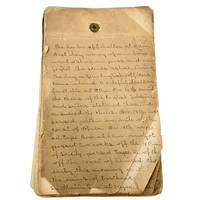
18990012049Donsol Pilar Manila Philippines New York Malta. Poor with no dust jacket. 1899-1901. Other. On offer is an unbelievable handwritten account of 19 months of action on the frontlines of the Philippine Insurrection the Philippine-American War between November 1899 and June 1901. An unknown American soldier writes of his experiences in a level of detail that cannot be overstated. This diary places the reader in the Philippines with shocking realism making this diary exceedingly rare. The 139 pages of this journalled account of events have been removed from a larger document and someone has pinned these loose pages together. This writing begins at the end of a sentence penned on presumably November 17 1899 and concludes half way through a sentence written on June 23 1901. There seem to be very few missing pages from within the journal and it reads very smoothly. The content is outstanding. The diary opens with our soldier diarist sailing from New York to the Philippines via the British Naval base at Gibraltar and the Suez Canal. He describes his experiences sailing sharing about a stop ashore in Malta a Thanksgiving spent at sea a concert enjoyed aboard the gunboat Nashville on the way to Manila and more. He arrives with his regiment in Manila on Dec 22 1899. The troops explore Manila and meet Filipino locals. In early January of 1900 they receive orders to head to southern Luzuon on the Kobbe Expedition which refers to General William Kobbes Expedition to Bicolandia. This expedition was in response to an urgent order from Washington to open up hemp ports of Southern Luzon due to an American hemp shortage. The problem was the port towns were largely controlled by Filipino Insurgents. Our diarist provides absolutely remarkable detail about Americas role in defeating the Insurgents and the tragedy of the Filipino peoples experience. Context indicates that our diarist was possibly a member of the 43rd Volunteer Infantry Regiments USV Company A. An excerpt that provides a sense of how our soldier explains the circumstances in the Philippines follows: Jan 16th we got the order to pack up and get ready to leave Mikata and to proceed to the Southern part of Luzon we were put aboard the transport Hancock which was at anchor in the Bay of Manila All combined we were named the Kobbe Expedition to the Southern Luzon to open up the Hemp ports and protect the natives from the Insurgents down there On the 21st of Jan 1900 our boats dropped anchor in a bay named the bay of Sorsogon in the Province of Albay All over this province there are large gangs of Insurgents holding the towns so at many towns our boys had a hard fight with the Insurgents before they could take the towns and the gun boat had to shell many of the towns. Our Regt. Occupied nine towns. Our detachment of A and D. Co. Were taken to a town named Donsol the gunboat Helena took us ashore from the Hancock On their arrival ashore they were met by a crowd of Philippinos. They had an order from the officers of the Insurgents it read saying that they would not haul down their colors nor surrender for three days. So our Major returned to the gunboat and a short conversation was held with the officers of the gun-boat and it was decided to prepare the gun boat for action and land all of us. If the Insurgents fired one shot at us the gun-boat would shell the town The hills were full of fleeing people. A detail of men were sent out on the hills at once then the Insurgents fired their first shot at us. Our boys had a warm fight for 15 minutes. They found the hills well entrenched and also found one big cannon. Lots of spears Bolas and wooden guns. They returned to town bringing in a few prisoners. A scouting party was seent and they saw a lot of Philippinos fleeing to the mountains. This town had a population of 10000 and three hundred were Insurrectors. The next thing we done was to find ourselves some good houses to live in. Outposts were put out all around the town. A few natives came across our post for a few nights and on the 22th Jan the Insurgents paid our town a visit setting fire to one of the big houses where our men were sleeping. Our men got out of the house without anyone being hurt. We surrounded the town fired a few volleys . Later in January our soldiers regiment goes on the first of many missions all of which he describes in glaring detail. On this mission the troops attempt to leave Donsol for Pilar when they run into trouble as the connecting bridge was destroyed by Insurgents. They make it to Pilar and find the town has been deserted. As they march back to Donsol they find someone has lit the bridge ablaze: Jan 28th We had a very hard time crossing the bridge burning our shoes and legs but we got safely on the Donsol side before the bridge fell with a crash into the river. We marched on we heard several shots from the Mauser and Remington rifles. Next we discovered a big fire and a call to arms and fire call was sounded The fire of the Insurgents got heavier. Our Major gave an order not to fire. He was going out in the front of our lines. He went out with a detail of men and discovered that our town was surrounded and the hills were full of Insurgents. He fired a few volleys then he came into town. The Insurgents answered him by firing a cannon. Then the Insurgents gave a yell and started to advance and we kept quiet and let them get close to our lines. Then we got the order to commence firing and the boys opened up all around the town and we soon put the Insurgents to flight firing a few shots as they ran. Next morning we discovered a few dead Insurgents close to our lines. The Insurgents almost always carry their dead and wounded along with them in their flight Our soldier does an absolutely phenomenal job of describing not only the day-to-day in Donsol where he spends majority of his time but also the various missions in which he participates. His words paint a fulsome picture of the war: 21st Feb at noon our Major asked for a detachment of men to volunteer to go up the river on a scouting expedition. I along with 12 more men went out of our company and 12 out of D. Co. Along with Capt. Hart of D. Co. And our Major left Donsol in a hard paddle boat and one white boat in tow On our way up the river we could see high hills on each side and the river was very narrow. There were many Insurgents outposts in the high trees all the way up and we fired at every one we saw. We went up a distance of 8 miles before we thought of coming home as it was getting late We had traveled one mile on our homeward way when the Insurgents fired on us from the left hand ashore. Our men in the rear boat fired a volley into the two Insurgents and were taking good aim for a second volley when the hills fairly echoed with the yells from the Insurgents. They then opened up on the right hand side which was aimed at the white boat hitting one of our men our company in the head and he was killed instantly. Then we answered their shots from each of our boats and from that time until we got back to Donsol we were under the hot fire of the Insurgents we could see the hills full of Insurgents and we had plenty to shoot at. We made every shot count. The insurgents even fired rocks at us from the high hills . More texture is added when our soldier discusses aspects of the war that dont involve active fire. Some examples follow: March 5th Gen Kobbe of the 8th Army Cor was here on a visit and he said these two companies were a very industrious lot of men and that the building of the stocade and trenches was a very sensible work he also brought us 17 of the Battery G 3rd Artillery men and one Hotch Kiss gun for reinforcements. April 10th the mail boat was here bringing the report of Gen. Pawa likely Jose Ignacio Paua an Insurgent Gen in Command of the Insurgent troops through this province. He surrender to our Colonel in Legaspi Legazpi and was sent to the Military Prison in Manila. April 21st We took a long march across the hills in a round about manner to a town named Sevilla merely an Insurgent camp. The town was deserted on our arrival. Fires were still burning in the houses. Everything was just as they had dropped it in their flight. We passed through the town and discovered many traps laid in the roads for us. One trap was an arrow trap on each side of the path in the bushes and by pulling a strong the arrows would stick into anyone going down the path. None of their traps caught us. Our soldier writes frequently about expeditions for which he volunteers. He describes a mission to Banningaran sic. En route the men captured Captain Hernandiz sic; possibly Adriano Hernández y Dayot and his family before being caught unprepared by the Insurgents who severely injured one of the American sargeants. On their hike back to Donsol they are again attacked by the Insurgents this time caught off guard as they attacked from the rear. And so it goes for many more months. Our author describes the movements of the men with whom he is stationed his commanding officers and the various wins and setbacks of both the Americans and the Insurgents. In May of 1901 our soldier and his regiment begin the process of boarding a ship to return to America. There is of course never a straightforward path and there are many bumps in the road. However our soldier does eventually board a ship and begins again to describe his journey in detail. The diary cuts off abruptly mid-sentence on June 23 1901 as our soldier is describing being at sea with nothing but a sailboat in sight for miles. While we do not know our soldiers identity we do know he was safely heading home at the conclusion of his diary. We know he was a highly motivated volunteer soldier who displayed total buy-in to the mission of the Americans in the Philippines and we know he was a gifted writer penning his experiences with such texture and realism that the reader feels as though they too have been on the front lines of a bloody wet miserable war in the Philippines - fighting for America and for the displaced Philippino people forced to flee from the Insurgents to the mountains. This journal measures 8x5 inches and contains 139 single-sided sheets. The pages were all loose so the author has pinned them together with a single round-headed fastener post. There are no covers to this journal. As a result the first and last few pages show obvious and significant wear and tear including a large corner of the first page being completely ripped off obstructing the text. The handwriting is quite legible. Overall Fair to Poor. ; Manuscripts; 8vo 8" - 9" tall; 139 pages . unknown
1911000418Schenectady New York. Fine with no dust jacket. 1911. PETER J. ARNOLD - Union solider in the 134th NY Vols. Partly cropped slip on which he writes "I saw General Grant many times this word cropped away in front of Petersburg during 1864 and 1865." Signed with his X mark and full name Schenectady 1911. ; Manuscript Handwritten Autograph Civil War Era Union Americana Confederate; Signed by Autograph . unknown
19620001450KOREA. Very Good. 1962. Manuscript. On offer is a super manuscript relic of Canada's Korean War participation being a handwritten day book diary pages of a soldier with the famed French Canadian regiment the 'Van Doos'. The 2-ring 6 x 4 inch pages record terse fact filled sometimes intimate personal notations of this soldier's duties and life in the Korean Theatre. Some pages are missing but from April 2nd 1952 through November 3rd 1952 he notes 216 days in Korea at this point this serviceman provides an intimate picture of a support soldier laying cables building rafts laying out minefields and many times under attack. June July August and September are the most filled months and in roughly 137 pages one reads the day to day mundane and of course the definitely not mundane entries - how he was driving a jeep with a Sergeant and a military officer and the jeep was under mortar fire and it rolled over down an embankment. Other entries include: May 17th 1952 29 years old; check Vandoos reg. 2000 mine A/P minefield. Got shelled in the valley. 18 - 75 mm came in on us in ½ hour. No casualties; received letters from patootie. Wrote letter to patootie; started booby trap MF mine field; Sgt. Jackson went to battle school in Japan; attended class pontoon raft demonstration at Widgeon bridge; June 25th 7th Wedding Anniversary; mention of Operations Buster and Buckingham Noahs Ark; went over to Sgt's mess a HQ. Tied one on; constructed & operated close 50/60 raft all day; buffet lunch @ Vandoos HQs; took 5 L/Cpls up to Black Watch; almost got clobbered by a heavy mortar which landed 25' behind jeep and much more. One online source provides: BACKGROUND NOTES: The Royal 22e Régiment is an infantry regiment and the most famous francophone organization of the Canadian Forces. The regiment comprises three Regular Force battalions two Primary Reserve battalions and a band making it the largest regiment in the Canadian Army. The ceremonial home of the regiment is La Citadelle in Quebec City where the regimental museum is housed. The regiment is nicknamed the Van Doos an anglicized mispronunciation of vingt-deux "twenty-two" in French. The regiment's regimental headquarters is located in Quebec City with all three of its regular battalions stationed at various bases in the province of Quebec. The regiment serves as the "local" infantry regiment for Quebec. During the Korean War 1951-1953 the regiment expanded to three battalions each serving in turn as part of the Canadian brigade in the 1st Commonwealth Division. Thus the "Van Doos" represented one-third of Canada's infantry contingent throughout the war. Overall in very good condition save for one page chewed as noted by 'Kibbles'.; 12mo - over 6¾" - 7¾" tall; KEYWORDS: CANADIANA FRENCH CANADIAN REGIMENTS VAN DOOS VANDOOS 22ND REGIMENT KOREAN WAR SEOUL PYONG YANG OPERATION NOAHS ARK OPERATION BUCKINGHAM MINE FIELDS BLACK WATCH CANADA Personal Memoir Handwritten hand written autograph autographs signed letters document documents manuscript manuscripts writers writer author holograph personal ANTIQUITÉ CONTRAT VÉLIN MANUSCRIT PAPIER ANTIKE BRIEF PERGAMENT DOKUMENT . unknown
100968The full-length albumen paper studio portrait 92 × 55 mm is mounted as issued on the printed card of W.H. Schroeder 649 George Street Haymarket 'and at Princes Street Grafton'. The firm was definitely active at that address from 1867 to 1879 but the image appears to be earlier rather than later in this period. The uniform is that of the NSW Volunteer Artillery from the 1860s. Very similar caps are also to be found in a Tasmanian photograph in the collection of the Australian War Memorial A04784 'ten men of the Hobart Town Volunteers Artillery and ten men from the First Rifles' dated October 1863. unknown
1024389367.Ghardcover. Good. Access codes and supplements are not guaranteed with used items. May be an ex-library book. hardcover
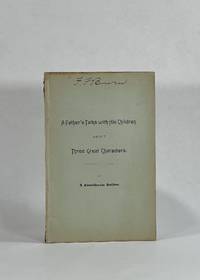
189210676Lynchburg VA: J. P. Bell Company Book and Job Printer 1892. Original Wrappers. Very Good binding. Octavo. 36 pp. First edition. As issued in printed wrappers. Wrappers a trifled toned some light abrasion to the top edge of the rear wrappers; contemporary previous owner name at the top of the front wrapper; similarly early editorial correction in the margin of one page. <br /> <br /> The three parts each are presented as a dialog between young children and the author and discuss Robert E. Lee Stonewall Jackson and J.E.B. Stuart in turn. Uncommon. Dornbusch III 50. J. P. Bell Company, Book and Job Printer unknown
1851244220.Ghardcover. Good. Access codes and supplements are not guaranteed with used items. May be an ex-library book. hardcover
1982226781.Ghardcover. Good. Access codes and supplements are not guaranteed with used items. May be an ex-library book. hardcover
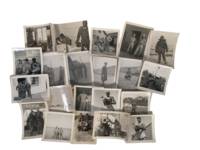
1957193551957. Vernacular photograph archive of African American soldiers in integrated U.S. Army units circa 1950s documents the early implementation of military desegregation following Executive Order 9981 and provides visual evidence of Black and white soldiers serving together during and after World War II including the Korean War. The photographs place African American servicemen within the first generation of formally integrated military units preceding broader civil rights gains in civilian society. Scenes of joint training transport and daily life show Black soldiers operating alongside white counterparts in contexts ranging from shipboard movement to antiaircraft defense positions indicating the practical realities of integration in active and post-conflict environments. The archive captures both structured military activity and informal moments offering a record of service that contrasts with the segregated conditions that had defined earlier periods of U.S. military history.<br /> <br /> United States and Korea circa 1950s. Archive of 21 silver gelatin vernacular photographs with several images bearing manuscript captions on the verso identifying individuals and locations including one noting Korea 1957-1958. Photographs depict a range of settings including military bases in Korea stateside camps shipboard scenes and antiaircraft gun emplacements in snowy terrain. Multiple images show interracial groups of soldiers posing with rifles and submachine guns while others capture informal activities including one sequence featuring a soldier holding an inflated puffer fish aboard a ship. One photograph includes a note written in Italian on the verso indicating cross-cultural contact or circulation. Composition and subject matter vary from posed group portraits to candid operational and leisure scenes.<br /> <br /> Created during the first decade of enforced military integration these photographs align with the transitional period in which desegregation policies were implemented unevenly across the armed forces with fuller integration not realized until the mid-1950s. The Korean War served as a critical testing ground for integrated units accelerating changes in military structure and social dynamics within the ranks. This archive provides a ground-level view of those developments documenting both the normalization of interracial military service and the persistence of shared routines duties and environments across racial lines. Light wear from handling with minor surface marks and occasional verso annotations; overall very good condition. unknown
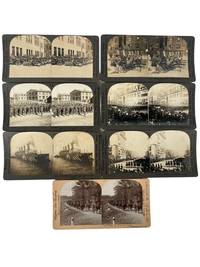
1918205021918. Buffalo Soldier regiments depicted in stereoview photographs from the World War I era document African American cavalrymen and infantry units serving in segregated formations of the United States Army during the early twentieth century. These images record soldiers from several historically significant Black military units including the 9th U.S. Cavalry the 10th Cavalry and the 369th Infantry Regiment. African American soldiers served in large numbers during World War I despite segregation in the armed forces and the war marked a turning point in public recognition of Black military service. The photographs capture cavalry movement machine gun training and celebratory returns from the European front preserving visual evidence of the military presence and public visibility of Buffalo Soldiers during the conflict.<br /> <br /> Archive consists of seven stereoview photographs published by the Keystone View Company during the World War I period. The views depict soldiers from the 9th U.S. Cavalry the 8th Regiment of Colored Troops the 10th Cavalry the Chicago Regiment of Colored Troops and the 15th Regiment of the 369th Infantry. Two stereoviews show Black machine gun companies operating Lewis guns one of the principal light machine guns used on the Western Front during the war. Another view shows Troop K of the 10th Cavalry moving on horseback at Camp Chickamauga in Georgia. Additional stereoviews depict African American soldiers returning from European service and marching in public celebrations including scenes of troops parading along major boulevards such as Fifth Avenue in New York.<br /> <br /> The Buffalo Soldier regiments had already established a long military record before the First World War. Units such as the 10th Cavalry formed part of the segregated Regular Army created after the Civil War and served in campaigns across the western United States during the Indian Wars later participating in the Spanish American War the Philippine American War and operations during the Mexican Revolution. World War I marked one of the final periods in which cavalry units remained visible in American military organization as mechanized armor and motorized vehicles soon replaced mounted troops. At the same time Black soldiers who returned from service were celebrated in wartime parades yet continued to face segregation and racial discrimination within American society. Stereoview cards remain well preserved with light age wear typical of early twentieth century photographic prints. Very good condition overall and a visually compelling record of Buffalo Soldiers during the World War I era. unknown
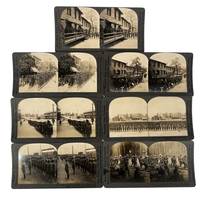
1918205031918. Keystone View Company. Buffalo Soldiers stereoview photographs World War I era document African American military service in the American Expeditionary Forces and place segregated Black troops within the broader Allied war effort in Europe. The images identify units of "Colored Troops" including engineers of the Signal Corps and depict formations logistical organization and moments of assembly such as soldiers "lined up for democracy." These photographs situate African American soldiers-many of whom descended from the Buffalo Soldier regiments established after the Civil War-within a transnational military environment that included French British and colonial forces. Scenes showing interaction with Moroccan and Indian troops on French roads reflect the multinational composition of Allied armies during the final phases of the war while the presence of Black American troops underscores their continued participation in major military operations despite segregation within the U.S. Army.<br /> <br /> France and possibly other European locations circa 1917-1919. Archive of seven stereoview photographs published by the Keystone View Company. Images depict African American soldiers in formation including lines for mess and organized ranks as well as mixed Allied groupings on roadways and near encampments. Stereographic format intended for three-dimensional viewing with printed captions identifying subjects and units. Photographs emphasize both structured military order and the varied roles occupied by Black troops particularly in engineering and support divisions.<br /> <br /> Produced during the final years of World War I these stereographs align with the expanded deployment of African American soldiers overseas and the broader visibility of Black troops within global conflict. While their service contributed to Allied operations these soldiers returned to a United States that maintained racial segregation and limited civil rights situating the archive within the larger history of African American military participation and postwar inequality. As visual records the images support research into race military organization and the international dimensions of the war. Light handling wear; overall very good condition. unknown
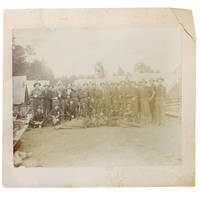
1890187391890. African American soldier photographed among members of a United States Army camp unit in the American West during the late nineteenth century providing visual documentation of Black participation within the military environment during the era of segregated service. African American soldiers served in the United States Army throughout the nineteenth century most prominently in units known as the Buffalo Soldiers which were formally organized after the Civil War. While Black soldiers were typically assigned to segregated regiments images occasionally record their presence in mixed military environments such as camps labor details or logistical units. The photograph captures a group of soldiers gathered in a temporary camp setting and includes a seated Black soldier identified by a contemporary handwritten note on the verso reading "Notice 'Black Soldier.'"<br /> <br /> Albumen sepia tone photograph mounted on photographer's board showing a group of American soldiers posed within a military encampment. Photograph measuring approximately 8.5 x 10 inches mounted on a photographer's board measuring approximately 10.75 x 10 inches. The men are dressed in clothing typical of western military and frontier settings of the late nineteenth century including dark buttoned shirts trousers supported by suspenders and boots. The African American soldier appears seated among the group with a cigarette in his mouth. The soldiers are gathered in a clearing surrounded by trees where rows of tents are arranged on raised wooden platforms suggesting an organized encampment. Cooking equipment stacked blankets plates and tankards are visible indicating a communal meal or informal gathering. One soldier holds what appears to be a long rifle with a visible barrel and wooden stock. Several soldiers sit or recline on the ground in the foreground while others stand behind them creating the appearance of an informal group portrait taken during daily camp life rather than a formal military arrangement. Handwritten note on the verso reads "Notice 'Black Soldier.'" Top right corner of the board cracked with tape repairs on the verso; slight water staining at the top left corner and damp staining at the lower left corner with partial cracking at the lower right corner. Image itself remains clear and largely unaffected. Overall condition good. The photograph preserves a visual record of African American presence within the late nineteenth century U.S. Army camp environment during a period when the armed forces remained formally segregated. unknown
2090202120405485Taiyo-do shoten N.A. Soft Cover. Fine. Number of books: 1 Taiyo-do shoten paperback
19942091502135413109Hebei Science and Technology Publishing House 1994. Soft Cover. Fine. Number of books: 4 Hebei Science and Technology Publishing House paperback
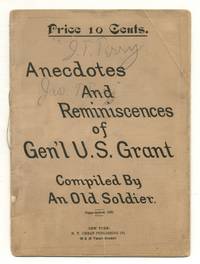
1885558564New York: N. Y. Cheap Publishing Co 1885. Softcover. Good. First edition. 16mo. Stitched printed buff wrappers. Early owner name "Jas. T. Terry" vertical crease with a bit of splitting some old penciling on front wrap a good copy. OCLC locates only six copies. N. Y. Cheap Publishing Co unknown
1426959818.Gpaperback. Good. Access codes and supplements are not guaranteed with used items. May be an ex-library book. paperback
22285'A Anteuil ce 25 floreal an 11'. i.e. 15 May 1803. An interesting letter casting light on bibliographic and book trade practices in Consulate Paris. 2pp 12mo. Forty-two lines of closely-written text on the first leaf of a bifolium the recto of the second leaf being addressed 'Au Citoyen Firmin Didot Rue du Regard A Paris'. In good condition lightly aged with white paper stub of mount adhering to second leaf. 'L'Aristote' is written in the left-hand margin of the first page and he begins by giving the results of the collation of the various editions of du Val's Aristotle finding that 'l'edition de 1619 et celle de 1629 sont la meme et la plus belle; et que celle de 1639 inferieure pour l'execution est la Seule qui contienne les dernieres additions de du Val – dont je suis curieux'. He notes the printers of the three editions. In the light of his discoveries he discusses the purchases of the 1639 edition from 'la personne que vous charges de ces commission' asking him 'de vouloir bien recompenser pour moi cet agent car voila bien des peines que je luie donne et bien des emplettes difficiles et qu'il fait pour moi et si bon marche qu'il est impossible qu'il y ait le moindre benefice ce qu n'est pas juste'. A long postscript concerns 'notre bon ami Cabani' and his 'pauvre camarade Heimebart' In a second postscript he states that he has had to abandon his intention of calling on Didot for 'l'exemplaire en question' as he is 'un peu souffrant'. 'A Anteuil ce 25 floreal an 11'. [i.e. 15 May 1803] unknown
1915207331915. Australian Imperial Force soldiers postcard correspondence Archive 1915 to 1916 documents ANZAC service during the Gallipoli campaign and subsequent deployments across the Mediterranean theater through sustained communication with a civilian recipient in Sydney. The archive centers on letters addressed to a woman identified as Olga written by multiple soldiers including her brother Eric and another correspondent George. The material records trench conditions troop movement and the transmission of news from the front including the report of Eric's death. The correspondence situates individual experience within the Gallipoli campaign where Allied forces sustained heavy casualties in operations against Ottoman defenses and traces the continuation of service across France Egypt and Greece following the withdrawal.<br /> <br /> Archive of 54 handwritten postcard letters. Europe North Africa and the Mediterranean 1915 to 1916. Each message is written on the verso of a period postcard most measuring approximately 5.5 x 3.5 inches with photographic views of cities and towns including London French villages Cairo and locations in Greece. Several images depict damaged urban environments. One postcard bears a censorship marking with portions of text obscured. The correspondence includes multiple authors primarily Eric and George. In one letter from France George writes "Thank you for the pose.We are having beautiful weather at present. Just like an Australian spring. Love from George." Eric writing from Egypt on April 16 notes "We are once again in the trenches where we have had a very lovely time for a few days." A later letter reports Eric's death stating "You need have no fear that he was decently buried" while subsequent correspondence reflects diminished communication and shifting personal relationships including George's inquiry "Do you ever write to me Olga. I wish a few letters from you would turn up."<br /> <br /> The Gallipoli campaign fought from April 1915 to January 1916 resulted in extensive casualties and became central to the development of ANZAC identity commemorated annually as Anzac Day. Following the evacuation of Gallipoli Australian forces were redeployed across multiple theaters including the Western Front and Middle Eastern campaigns reflected in the geographic range of these postcards. The archive documents the function of wartime correspondence under censorship and the role of letters in conveying both military experience and personal loss to the home front. Light wear consistent with handling; overall very good condition. unknown
1912052625Autograph Letter Signed ALS Letterhead 'Çatalca Ordusu Menzil Müfettisligi'. AH 1328 1912. Soft cover. Very Good. Original autograph letter signed by Ali Hikmet Ayerdem. 38x23 cm. In Ottoman script. 1 p. Three long lines. Dated 22 Kanunisani 81328 AD 1912. Written to Ayastefanos High Commands for the assignment of cavalry major 'Mustafa Resid Bey'. Ali Hikmet Ayerdem 1877; Larissa - March 21 1939; Istanbul was an officer of the Ottoman Army and a general of the Turkish Army. Rare. <br/> <br/> Autograph Letter Signed (ALS) Letterhead 'Çatalca Ordusu Menzil Müfettisligi'., [AH 1328] paperback
16269Grant Cottage King's Road Sloane Square London. 21 January 1813. 2pp. cr.8vo 30 x 18.5cm. In fair condition aged and worn with slight damage to one corner resulting in loss of one word of text. 62 lines of text with deletions and emendations and the thirteen lines of the conclusion largely rewritten. Headed: 'To the Right Honorable the Earl of sic Bathurst His Majestys Principal Secretary of State for the Colonial & War Department &c &c &c the Memorial of Major General Charles Viscount Grant de Vaux Shewest sic'. The first paragraph reads: 'That your memorialist although a french Emigrant is descended from two ancient and noble British families both by his father and mother and holds at present the rank of major general in the British Service - having resided in England since the year 1790 during which period after his services in the Emigrants Army became unnecessary he devoted his attentions to objects of Science and has published several works on Astronomy Navigation History &c tending to discoveries particularly on Nautical Science and on the history of Mauritius; which having met the approbation of men of talents and the patronage of Government your memorialist humbly hopes that his labours will ultimately prove beneficial to this country and to his unfortunate and numerous family.' The second paragraph concerns 'a large tract of Land in Canada' granted to him in 1794 'with a view to remove to that country a considerable number of french Emigrants who were to be conducted by him'. The third paragraph concerns 'the island of Mauritius where your memorialist was born' where his father 'the late Baron Grant &c commanded the troops' which has been 'conquered by his majesty's arms and is a valuable colony of Great Britain' The fourth paragraph concerns his family he having married 'a native of this country by whom he has eight children not provided for all born in England'. In the fifth paragraph he stresses his 'loyalty and integrity'. In conclusion he prays that 'your Lordship be pleased to issue an order that his Grant of land may be conferred to him in the isle of France 'the Isle of France' was another name for Mauritius his native country in lieu of the grant in Canada which was extensive according to his rank and numerous family'. Biographical/Historical NoteCharles Grant vicomte de Vaux was the descendant of a family of nobles who had emigrated from Scotland to France in the 14th century. Vaux was born in 1749 on the island of Mauritius where his father Louis-Charles Grant the Baron de Vaux served as governor. As a youth Vaux sailed to France to be educated and settled at Vaux-sur-Seulle in Normandy and eventually became an army officer. During the American Revolution he sided with the colonists and earned money selling supplies to the colonies and investing in ships to engage in privateering. The majority of the ships were lost and after the war Vaux petitioned the United States Congress for compensation. Though Vaux considered emigrating to North America he remained in France until forced by the revolution in France to flee to Great Britain in 1790. During his time as a refugee Vaux became interested in the prospect of starting a settlement in Canada and much of his energy during the next decade was focused on gaining permissions and raising money for the expedition. In the mid-1790s Vaux attempted to support himself as an army officer after being granted the position of colonel and permission to recruit a regiment which he formed with other French émigrés; it was stationed temporarily in Holland. This pursuit failed however and the regiment was dispersed after France invaded Holland during the French Revolutionary wars. Vaux then turned to writing to support himself publishing numerous books which included History of Mauritius and Introduction to Four New Maps of the Four Quarters all the while still attempting to plan a Canadian settlement. Despite his constant petitioning planning and pleas for aid Vaux was never able to realize his dream of moving to Canada. Little is known of the last two decades of his life but he is thought to have died in France around 1818." Grant Cottage, King's Road, Sloane Square [London]. 21 January 1813. unknown
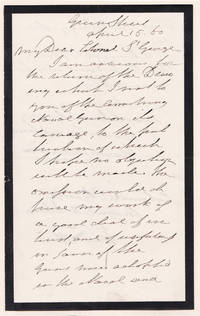
186034086Green Street London: April 15 1860. 1860. Very good. - Letter penned in black ink filling most of both sides of a sheet of cream paper approximately 8 inches high by 6 inches wide bordered in black. The letter is tipped onto a slightly larger piece of card stock. Signed "Howard Douglas". There is a tiny chip to the left edge of the black border. Folded twice for mailing. Very good <p>Howard Douglas writes to Colonel John St. George 1812-1891 Director of Ordnance at the War Office asking for the return of a drawing of a gun which he wants to include in his upcoming book "Treatise on Naval Gunnery" fifth edition revised published in 1860. "I am anxious for the return of the drawing which I sent to you of the Armstrong Naval Gun on its carriage.The omission would deprive my work of a good deal of interest.I have stopped the Press waiting for your reply".<p>General Sir Howard Douglas 3rd Baronet 1776-1861 was a British military officer and Member of Parliament for Liverpool from 1842-1847. After entering the Royal Military Academy Woolwich he was commissioned Second Liutenant in the Royal Artillery in 1794 becoming Lieutenant a few months later. He served as Governor of New Brunswick from 1823-31 and had to deal with the Maine boundary dispute with the United States of 1828. He also founded Fredericton College now known as the University of New Brunswick and was its first Chancellor. From 1835 to 1840 he was Lord High Commissioner of the Ionian Islands where he introduced a new code of laws known as "the Douglas code". The code infuriated the Greek Orthodox patriarchate in that it included innovations affecting family life especially marriage and divorce. Abused or abandoned women could more easily obtain a divorce. Further it legalized marriage between step-siblings and second cousins. Douglas was the author of several important military and naval treatises including the "Treatise on Naval Gunnery" of which the fifth edition is referred to in this letter. It became a standard text book and was the first publication to draw attention to its subject. Green Street [London]: April 15, 1860. unknown
1959053659Istanbul: Manuscript - Autograph letter / Letterhead 'TC Sihhat ve Içtimaî Muavenet Vekâleti' 1959. Soft cover. Very Good. Original typescript document with manuscript autograph writings and signature by Lütfi Kirdar as Minister of Health Lütfi Kirdar. 21x15 cm. Sent to Halide Nusret Zorlutuna. In Turkish modern Turkish with Latin script. 1 p. Lütfi Kirdar was born in 1887 in Kirkuk. He comes from a rooted and well-known family 'Kirdarzâdes' of Kirkuk. After completing his primary and secondary education in Kirkuk and high school education in Baghdad he came to Istanbul in 1908 and entered the Faculty of Medicine. After the Balkan War Kirdar joined the war voluntarily and after the war he graduated from the Faculty of Medicine of the Darülfünûn -i.e. Istanbul Üniversitesi- 1917. With the outbreak of World War I he joined the army. Kirdar who was participating in the National Struggle received the Independence War Medal. After the War of Independence in 1923 he specialized in eye diseases in Vienna and Munich. He returned to Turkey in 1924 and was appointed to the Directorate of Izmir Health. At his own request he was appointed to the eye clinic of Izmir Memleket Hospital in 1933. In 1935 he became a member of parliament from Kütahya. In 1936 Manisa was appointed as mayor and after that in 1938 to Istanbul. He held this last post for 12 years. Istanbul Harbiye Sports and Exhibition Palace Open-Air Theater Inonu Stadium in Dolmabahce Taksim Square Taksim Excursion and Ataturk Boulevard were held during his period. In 1940 the Taksim Barracks was demolished. He was arrested on May 27th. He died of a heart attack on 17 February 1961 in Yassiada where he was tried. He was buried in Zincirlikuyu Cemetery after a funeral on 19 February 1961. <br/> <br/> Manuscript - Autograph letter / Letterhead 'TC Sihhat ve Içtimaî Muavenet Vekâleti' paperback